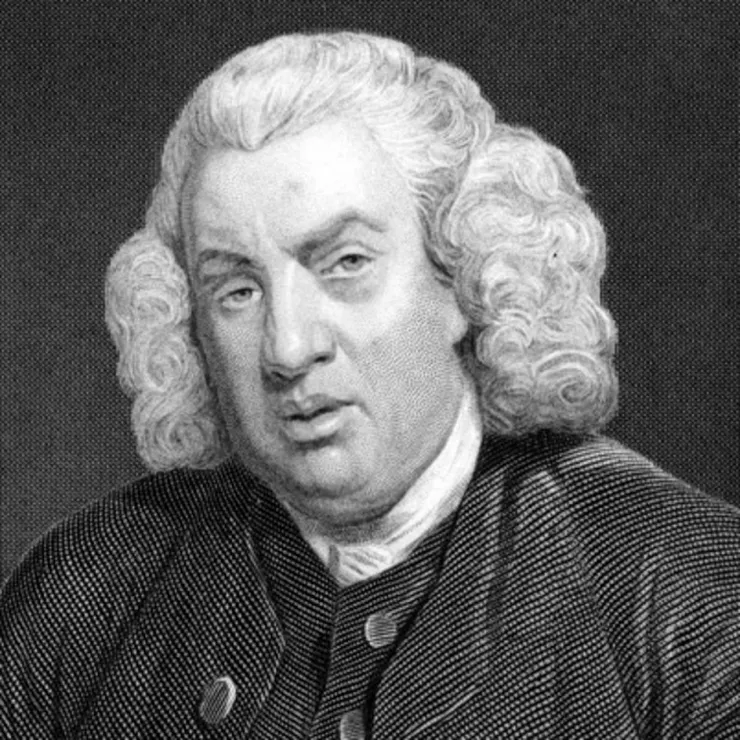
In his college reunion update in 1977, Walter Jackson “Jack” Bate remarked that writing, research and teaching had become his life.
He elaborated: “Like others in that kind of situation where one’s recreation is the same as one’s work and where so much of one's work consists of writing, I find myself unable ever to say what I’m doing without falling into a long rambling summary of everything I’ve been trying to talk or write about, long and rambling because one starts to use the opportunity to qualify or try to improve on what one’s already said. That's the occupational disease.”
Writing, research, teaching: Bate was good at all three.
His “Age of Samuel Johnson” course was so popular at Harvard that he became known on campus as “Bate the Great.” Many years after he first taught the course, he stood before his class in a navy blue pinstripe suit, his yellowed notes on the lectern before him, still delighting in the words and quirks of Johnson, James Boswell and Hester Thrale.
To the larger world he was best known as a master biographer. His John Keats, on the poet he called “the best example of a really great writer of the last two centuries,” won the 1964 Pulitzer Prize. His Samuel Johnson won the Pulitzer in 1978.
In his review of Johnson for The New York Times, Thomas R. Edwards compared it favorably to Boswell's Life of Johnson. “Of this great work,” he wrote, “it may be justly said, as its subject said of ‘Paradise Lost,’ that it is not the greatest Life of Johnson only because it is not the first.”
The Pulitzer Prize Board was well served by its 1978 jury in the Biography or Autobiography category. The report it received included this fascinating Dec. 1, 1977, addendum from Michael Kammen, the jury chair, who himself had won the Pulitzer Prize for History five years earlier.
Samuel Johnson by W. Jackson Bate
By MICHAEL KAMMEN
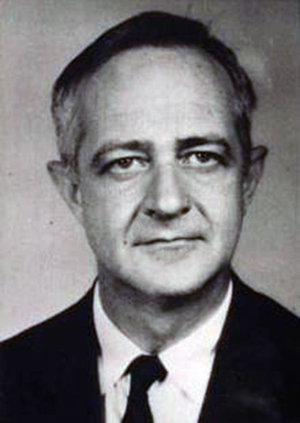
Walter Jackson Bate
It is instructive and interesting, therefore, to set Bate’s Johnson alongside Carl Van Doren’s Benjamin Franklin, which received the Pulitzer Prize for Biography in 1939; parallel texts, in a sense, for parallel lives. Johnson’s arrival in London (1737), with two pence half penny in his pocket, brings to mind Franklin’s account of his first arrival in Philadelphia (1723) with a Dutch dollar and a shilling in copper.One of the most attractive attributes of this book, from the perspective of an Americanist, is the way that it illuminates – by similarity as well as contrast – the life of Benjamin Franklin. They were almost exact contemporaries: Johnson 1709-84, and Franklin 1706-90. Each one was really self-educated. Both were precocious, became extraordinarily learned, and later had honorary doctorates conferred upon them which caused their contemporaries to call them Doctor Johnson and Doctor Franklin. (Oxford voted to award Franklin the doctor of civil law in 1762; it did not so honor its native son until 1775.) Each one is remembered as the quintessential exemplar of the Enlightenment in his own country.
In 1723 Johnson did an important exercise in school on the theme of Festina Lente (“Make Haste Slowly”), the very same classical maxim which became a favorite of Franklin’s Poor Richard. Both men had an instinctive knack for aphoristic sayings, of course, and each remains the most quotable source of epigrams from his respective culture. Johnson’s Rambler essays are every bit as pithy as Poor Richard’s sayings.

Michael Kammen
Both men were fiercely loyal to their friends and retainers – bad character to the contrary notwithstanding. Johnson conceded that a chap named Hervey “was a vicious man but very kind to me. If you call a dog Hervey, I shall love him.” (Bate, 166 and 200 n.) That, in turn, makes one immediately recall Franklin’s famous remark that “if I was sure . . . that my valet de place was a spy, as probably he is, I think I should not discharge him for that, if in other respects I liked him.” (Van Doren, 569)
Johnson loved the diversity and the human density of London. “When a man is tired of London,” he liked to say, “he is tired of life.” Franklin would have echoed that, hated to leave London, and spent most of eighteen years there (1757-75), separated from his wife, whose company meant less to him than London’s bustle and bright company. (Just as Franklin wrote to Deborah, his wife, as “my dear child,” so Johnson wrote to his wife, Tetty, as “my dear Girl.”)
Bate’s Johnson also helps us to bring into better perspective a comparison between English and colonial culture in the eighteenth century which may well have been exaggerated by recent scholars. Bernard Bailyn, for example, has pointed out that in early American cities, such as Philadelphia, “the numerous cultural associations, the clubs, were recruited from the professional middle and tradesmen lower-middle classes. Franklin’s famous Junto was a self-improvement society of autodidacts. Its original membership included a glazier, a surveyor, a shoemaker, a joiner, a merchant, three printers, and a clerk.” (See “England’s Cultural Provinces, Scotland and America,” in Paul Goodman, ed. Essays in American Colonial History [1967], 624.)Bate’s Johnson reminds us, however, that so many members of Johnson’s circle were also of humble origins and even artisanal vocations. Edward Cave, founder of the Gentlemen’s Magazine, in 1731, was the son of a cobbler. David Garrick, the great actor, was the grandson of a Huguenot who had fled Bordeaux in 1685 following the revocation of the Edict of Nantes. Richard Savage was the impoverished bastard of the Countess of Macclesfield. Savage sponged off his friends and eventually died in debtor’s prison. Arthur Murphy was the son of a Dublin merchant. And Samuel Johnson, himself, was the son of a poor bookseller whose fortunes declined sadly and steadily. Historians may have made too much, after all, of the aristocratic roots of English culture as compared with the petit-bourgeois sources of its provincial counterpart.
Johnson self-consciously took all knowledge as his province, and so, of course, did Franklin. What we are likely to forget, however, is the extent of Johnson’s interest in mechanical things and chemical experiments. Although he did not achieve fame as a scientist, as Franklin did, Johnson’s great Dictionary is in many respects an index to mid-eighteenth century scientific information. Johnson’s extraordinary Renaissance mind was interested in engineering, and his home-made brick oven for “chymistry” caused Mr. Thrale to fear that Johnson would blow up his own establishment!
Did Franklin and Johnson ever meet? Although their politics and their social circles were very different, they should have nonetheless; but we do not know anything about their interaction. Bate tells us that Johnson had followed Franklin’s electrical experiments very closely, and that they first met in 1760 through a philanthropic organization to which they both belonged. Van Doren has nothing on contact between the two men: only the fact that Franklin derived pleasure from having Johnson’s Lives of the Poets read to him during his dotage in the 1780s.
There is some irony in the fact that Franklin’s mortal enemy, Alexander Wedderburn, did Johnson a very good turn. Solictor-General Wedderburn, who questioned and humiliated Franklin in the Cockpit during 1774, was the same man who, in 1762, had recommended Johnson to Lord Bute for an annual pension of £300. Thereafter Johnson exchanged his customary life of penury for an existence in modest physical comfort.
That Wedderburn played such different roles in the lives of these two men simply calls attention to the fact that one was a Tory nationalist, the other a rebellious Whig. However different their politics may have been, though, Bate’s Johnson reminds us of those more important qualities which they shared: intellectual achievement, profound insight into human nature, brilliant conversation, and a common understanding of mankind’s need to come to terms with our greatest enemy – ourselves.
Sources: “Walter J. Bate, 81, Professor and Biographer,” New York Times, July 28, 1999; Pulitzer files.