
During the year after the death of my mother, I feared deeply that music had somehow left me. I had been working on the first few pages of a new piece for the Chicago Symphony Orchestra. I had been excited about the project, and a deadline loomed. Strangely, I was not wanting for ideas at this time; indeed, I filled up many, many pages with the scribbles, dots, lines, arrows, arcs and cross-outs that characterize the burgeoning scores of any composer who still puts pencil to paper, rather than staring at a screen. Nothing, however, seemed to work or take on a life. Nothing seemed “like me” or right. And my ideas actually looked overwrought and hyper-manipulated on the page: my pencil marks were angry and dark; the staves were marred by heavy erasures. The nape of my neck didn’t tingle as it always does when I know I’ve found the right kind of gesture.
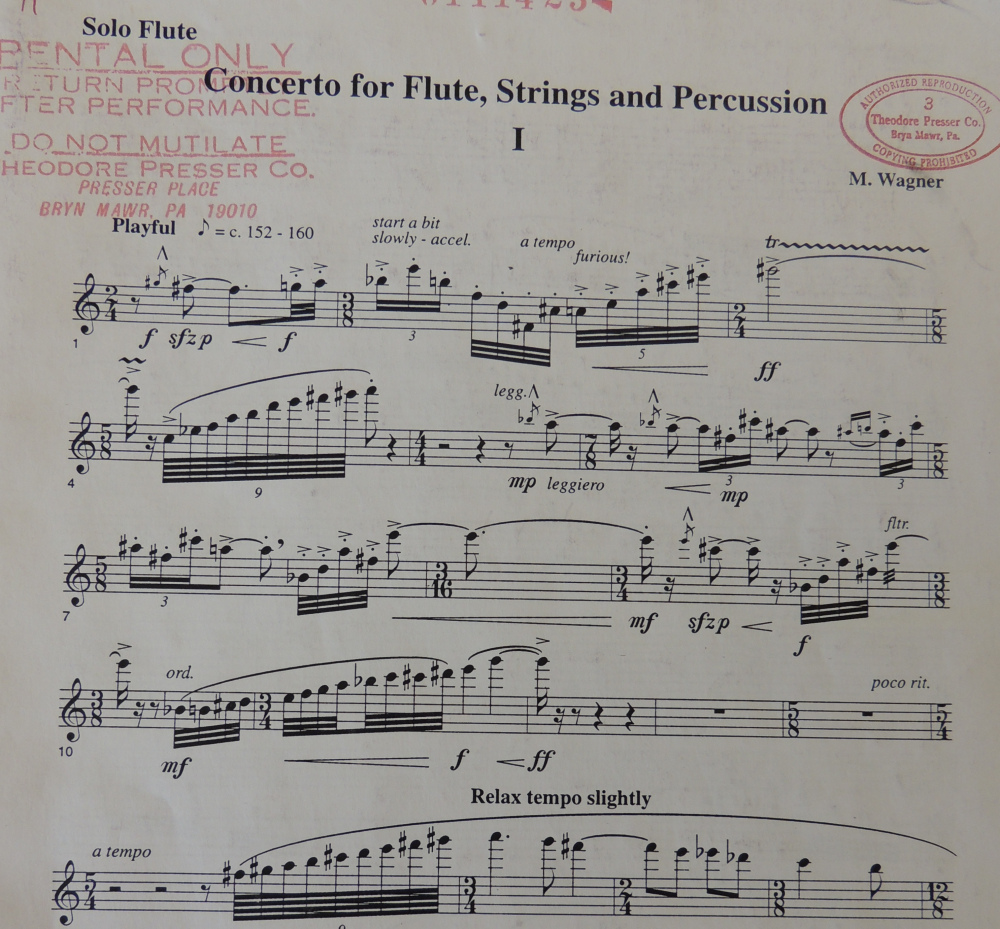
The score for "Concerto for Flute, Strings and Percussion," for which Wagner won the 1999 Pulitzer Prize in Music.
Intellectually, I knew that grief can hinder creativity – this seems to be a no-brainer. Indeed, I had purposely, and wisely, ceased all creative work in the months following September 11th, 2001. Still, the notion that the death of my mother, my best friend and most astute listener, could limit my ability to work, did not “land” or enter my marrow. I would soldier through!
Looking back from my current state of renewed productivity, I see now that my year of “magical thinking,” a year of trying and failing, then trying and failing again, was a journey I needed to make – that even simply ceasing my work, as I did after 9/11, would not have been enough. The process of trying and failing was my grief.
The fear of losing one’s ability to compose is not uncommon. Music is, after all, unseen. It moves through time, is completely abstract, and it is gone, or in the process of disappearing, the moment it is sounded – a puff of smoke. For my entire life, though, music has been a real and integral part of who I am – not an accoutrement or acquired skill, but a bred-in-the-bone “sense.” While my year of perceived estrangement was a special kind of hell, it enabled me to take stock of music from the perspective of a civilian. I have come out of the other side with renewed love and gratitude for this art that, much to my relief, is still as much a part of me as my brown eyes, my dislike of liver and marzipan, and my love of potato chips.
I have never experienced an epiphany with regard to music. It was always clear to me, and to others, that I was and would remain a musician. I was spared the agony of deciding what my major would be in college, or whether to pursue music thereafter. During my young life, however, it was not immediately clear what kind of musician I would or could be.
I have never experienced an epiphany with regard to music. It was always clear to me, and to others, that I was and would remain a musician.
As soon as I was able to reach the keyboard, I began to play the piano. Rather than learning to read notated music or practice scales (the traditional route), I stubbornly insisted upon working things out by ear. Later, I “improved upon” or added my two cents to the works of other composers. I also improvised my own “pieces,” although no one else would ever play them. I crouched by my father’s enormous speakers with an ear pressed. I was enthralled by Leroy Anderson, The Fantasticks, Benjamin Britten’s Ceremony of Carols, Amahl and the Night Visitors, My Fair Lady and Bing Crosby’s Christmas album. (Debussy, Stravinsky, Mahler, Berg and Copland, et al., would come later). I loved to sing.
And I was an insomniac. At night, I sang out my window into the woods across the street. I sang every part from West Side Story (Tony, Maria, Anita!) until the neighbor boys shouted for me to shut up! At twilight, in the summer, I carried a lantern up and down the block, singing, “Oh Paloma, Remember Me!” to the young children being tucked into bed. It never occurred to me that tired parents might find this annoying.
Indeed, I was happy to perform for anyone and everyone. This tendency soon became a problem, as I was also prone to “correcting” my mother’s piano students. When I entered the school system, I was totally unaware that most other children are not drawn to music as I was. It was difficult for me to sit still in class, and I was often sent out to the hall, or to the principal’s office. By the time I was 11 years old, my teachers decided that rather than put up with me for the entire school day, they would simply send me home after lunch. Because my mother was a full-time music teacher at my school, I walked home daily, through my beloved woods, to an empty house.
I was delighted with this scenario – and humiliated. I had never experienced such solitude, but this, in a way, became a haven. The woods near my home became my patient, ever-appreciative audience and I felt completely free to sing at the top of my lungs – to the trees, the stream, the ferns, and to the skunk cabbage and dogtooth violets! There were no children to make fun, or teachers to scold! They were all busily involved with the afternoon lessons I was missing. It was during these walks through the woods that I began composing real songs with lyrics – songs that had beginnings, middles, ends. The first part of my walk involved composing. The second part, memorizing what I had composed. The resulting tunes could be sung accurately to my mother, who later notated them. Thus, they could be sung by other people.
I had become a composer. And, not surprisingly, my songs were about singing with abandon:
Here I am, standing in a puddle,
Singing at the top of my lungs!
Singing all of the songs of my life,
Singing happiness, and strife.
Singing in the rain, singing in the rain,
Singing out the sunshine pouring into my heart!
Or about walking alone through the trees:
One starry night
I walked down the road that went forever.
Through the whispering pines,
I walked down the road that went forever.
I stopped at the orchard,
The sweet smell of apple was there,
The night voices were lingering in the air.
I looked at the moon,
Caught by a thorn in a bramble tree,
And I pondered a lovely thing than she.
There is a somewhat romantic notion that composers are inspired by pain and chaos. To a certain degree this is true, as our life experiences are a part of everything we do and the decisions we make. During my young life there was much chaos in the world: I remember vividly the day President Kennedy was assassinated, and later, the days when Martin Luther King Jr. and Robert Kennedy were murdered. The Vietnam War came, via television, to our living rooms. And, of course, there was acute, concomitant social unrest. While I was aware of all these things, especially growing up in a college town, my range of vision – my ken – was only deep enough to encompass the small world of my family, neighborhood, classmates and teachers. I could not process what was happening in the world, but I did confront the pain and chaos associated with being different. Ironically, my punishment for being different (and difficult) ended up freeing my mind and opening my heart to new, creative possibilities. By singing to the trees and ferns I had discovered a way to connect with people – with performers and listeners.
Ultimately, the music teachers in my school took my six songs, added three of their own, and turned these into a three-act musical play entitled We Love Recess. The story involved children on the cusp of their teenage years, yearning for independence and the kind of carefree lives (!) their parents seemed to enjoy, while missing the enveloping cocoon of early childhood. The following year, I joined my sixth-grade class in presenting the first of many performances of We Love Recess. Other classes, in other years, followed suit.
It was exhilarating (and terrifying!) to hear my music performed by other people, and I wanted more. I soon learned that every song – every piece – is a living, ever-evolving thing that changes with each performance, and with each performer. It is with gratitude that I continue to connect to the world in this most elegant, exhilarating and terrifying way.