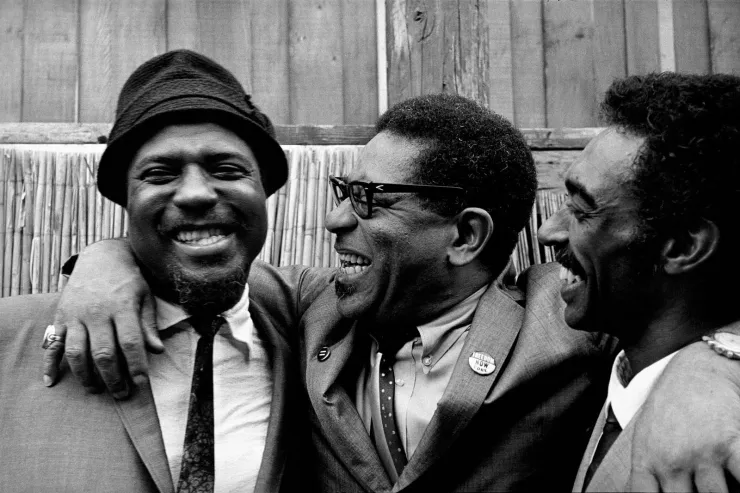
Despite enjoying a venerable performing and recording career until his retreat from public life in the mid-1970s, posthumous 2006 Special Citation recipient Thelonious Monk is perhaps best remembered for an array of 70 compositions that reshaped the jazz repertoire, including "Blue Monk," "Straight, No Chaser" and "Well, You Needn't."
Yet one song remains a particularly powerful symbol of its composer's life and influence: the hymnlike "'Round Midnight."
Initially copyrighted as "I Need You So" in September 1943 amid two milestones in Monk's life — the loss of a job as house pianist at Harlem nightclub Minton's Playhouse and his courtship of Florida Normal and Industrial student Nellie Smith, whom he married four years later — the febrile milieu of wartime jazz catapulted the obscure song into the standard repertoire when musical foil and close friend Bud Powell persuaded bandleader Cootie Williams to record the song with his ensemble. (Monk would refuse to testify against Powell when the pianist was arrested on heroin charges in his presence in 1951, resulting in the revocation of his cabaret card and a career purgatory of years of fly-by-night, unlicensed gigs in Brooklyn and Bronx corner bars, often facilitated by world music pioneer Randy Weston.)
Although Williams claimed compositional credit on the transitional "Grand Finale" by virtue of an eight-bar interlude that was only performed once, he retained shadowy producer Bernie Hanighen (best known for collaborations with Billie Holiday and electronic music pioneer Raymond Scott) to author a new set of lyrics, including an opening verse that eschewed the titular "finale" in favor of a more ineffable plaintiveness:
It begins to tell'Round midnight, midnight.
I do pretty well, till after sundown,
Suppertime I'm feelin' sad;
But it really gets bad,
'Round midnight.
Along with the new title and lyrics, further interpolations by Dizzy Gillespie were sanctioned by Monk, and the composer first recorded what amounted to a precis of the song as a restrained 3:11 single in November 1947.
In February 1964 — more than 20 years after the likes of Monk, saxophonist Don Byas and drummer Kenny Clarke offered a signpost to the bebop revolution at Minton's — the pianist became one of the few musicians to ever appear on the cover of Time magazine amid the success of "Monk's Dream," his breakthrough album for Columbia Records. And while Monk continued to grapple with the structural inequalities that hampered his career for the remainder of his life, "'Round Midnight" was on its way to a singular distinction, becoming the most recorded jazz standard composed by a jazz musician.
As we celebrate Black History Month, these five versions of "'Round Midnight" continue to offer new insights into its composer — and the ongoing evolution of American culture.
1. "'Round Midnight" by the George Russell Sextet (from "Ezz-thetics" [Riverside, 1961])
Remaining slightly off the beaten cultural path throughout his distinguished career, composer, educator and pianist George Russell earned a MacArthur Fellowship in 1989 for his pathbreaking contributions to jazz theory, as exemplified by "Lydian Chromatic Concept of Tonal Organization" (1953), a roadmap to modal jazz rivaled only by Nicolas Slonimsky's "Thesaurus of Scales and Melodic Patterns" (1947) as a sourcebook for postwar jazz and fusion musicians.
Powered by a redoubtable ensemble that included such luminaries as saxophonist/clarinetist Eric Dolphy and fusion pioneer Don Ellis, Russell's "Midnight" begins with a burst of languorous atonality before settling in to a midcentury noir groove.. The track is dominated by a vertiginous solo from Dolphy, offering a taste of the mature style that would manifest on "Out to Lunch!" (1964), recorded several months before he succumbed to a diabetic coma. Dismayed by the vicissitudes of racism, Russell lived and worked in Scandinavia for much of the 1960s before returning as a faculty member at the New England Conservatory of Music at the behest of 1994 Music winner Gunther Schuller.
2. "'Round Midnight" by Kenny Dorham (from "'Round About Midnight at the Cafe Bohemia" [Blue Note, 1957])
Considered by critic Gary Giddins to be "virtually synonymous with underrated," trumpeter Kenny Dorham had not led a recording session for more than eight years when he died from complications of kidney disease aged 48 in December 1972. In the decade that spanned the bulk of his work, Dorham was a frenetically prolific figure, recording more than 15 albums in his own right while serving as a sideman for such disparate figures as future NEA Jazz Master Toshiko Akiyoshi and singer Abbey Lincoln.
Recorded a little more than a year before Monk's valedictory Beat-era engagement at the East Village's Five Spot in mid-to-late 1957, Dorham's date at the nearby Cafe Bohemia in Greenwich Village is an auguring of his friend's later triumph, contextualizing "Midnight" alongside Rodgers & Hart's "My Heart Stood Still" and a rendition of Vernon Duke's "Autumn in New York." The traditional arrangement includes a comparatively perfunctory solo from tenor saxophonist J. R. Monterose before evolving into a showcase for Dorham's stately sonority, serving as a blueprint for such later triumphs as "Quiet Kenny" (1960).
3. "'Round Midnight" by Betty Carter (from "'Round Midnight" [Atco, 1963])
A liminal figure in jazz whose career was bookended by the big band era and a triumphant 1994 performance at the Clinton White House, Betty Carter bridged hyperlocal arts advocacy in her Brooklyn neighborhood with a prescient approach to recording (her label, Bet-Car Records, released nearly all of her post-1970 oeuvre through a distribution deal with Verve Records) and an inimitably experimental style that liberated vocal jazz from the conventions and occasional pretenses of traditional pop, arguably culminating in a 25-minute 1979 performance of her self-penned "Sounds (Movin' On)," later released on "The Audience with Betty Carter."
Although "'Round Midnight" emerged as something of an introspective leitmotif throughout her career (occupying a slot on no less than three of her albums in various decades), Carter seldom deviated from the straightforward approach first heard in this 1963 interpretation, which was produced by Nesuhi Ertegün and orchestrated by arranged by Claus Ogerman and Oliver Nelson. Astute listeners will note the similarities between their arrangement and Nelson's later work on the oft-maligned "Monk's Blues" (1968), an innovative (if errant) attempt to meld the composer's angular songs to conventional big band arrangements.
4 and 5. "'Round Midnight" by Chick Corea (1983 Munich Piano Summer solo performance); "'Round Midnight" by Chick Corea and Bobby McFerrin (from "Play" [Blue Note, 1992])
When he moved to New York to pursue studies at Columbia and Julliard at the cusp of the 1960s, second-generation jazz musician Chick Corea immediately was hailed by his peers as a prodigious exponent of an atrophying art form increasingly subsumed by a new generation of popular music, with instant classics like "Windows" and "Litha" (both popularized by Stan Getz's post-bossa nova quartet, including Corea, on "Sweet Rain" [1967]) potentially marking the last gasps of the post-bop insurgency.
By the time of his death from cancer in February 2021, Corea was one of the resurgent genre's elder statespeople, a nonpareil eclectic with a case of Grammys that attested to his fluency in subgenres ranging from Latin jazz to free improvisation, jazz fusion to conventional Evans-style piano trios. According to longtime friend and collaborator Herbie Hancock, "We didn’t talk a lot about political issues or the news of the day. [...] His primary focus, as far as I could tell, was always music and always about the heart and about the value of the arts, and how important the arts are as nourishment for the human spirit. And I totally agree with that."
With a fluid style that confidently assayed pre-punk fashions but owed little on the surface to Monk's recombinant stride runs, Corea was, at least in theory, an odd interlocutor for his songbook; this was belied in part by an increasingly scarce affinity for and understanding of compositional technique, with songs such as "Spain" and "La Fiesta" gradually earning recognition as some of the few universal post-1960 jazz standards.
It was not until 1981's "Trio Music" — a reunion of his celebrated "Now He Sings, Now He Sobs" (1968) trio — that Corea first engaged "'Round Midnight." Although the version therein proved to be relatively faithful (with Corea and bassist Miroslav Vitouš emulating some of Monk's stylistic quirks), he had made it his own by the time it was performed at a Munich solo concert in 1983, suffusing the piece with contrapuntal flourishes that recalled Liszt's wildering 1865 transcription of Beethoven's Ninth Symphony. Indeed, when he revisited the song once more (and with seeming finitude) alongside Bobby McFerrin on 1992's "Play," the lyrics themselves were shorn in favor of spare, wordless vocalizations undergirding Corea's wildly neoromantic improvisations on the standard.