After graduating from Princeton University in 1929, the Texan Price Day set off on a newspaper and magazine career of great variety. He worked as a cartoonist, a freelancer and a science fiction writer. His stories appeared in Collier’s and the Saturday Evening Post.
Shortly after Pearl Harbor he got a job as a city editor in Fort Lauderdale, Fla., but didn’t keep it long before the Baltimore Sun hired him and sent him to Europe as a war correspondent. He covered Anzio, the liberation of Rome and the breaking of the German line in the Vosges Mountains.
On May 7, 1945, he was the only staff correspondent of an individual newspaper to cover Germany’s surrender. His story for the Sun began:
REIMS, France, May 7 – At 2:45 o'clock on this warm spring morning, Col. Gen. Gustav Jodl signed his name for the fourth time and carefully put down his pen. Europe's long war was over.
Day’s postwar assignments included the Potsdam Conference and the Nuremburg trials. Then the Sun tapped him to participate in its ambitious coverage of the postwar fate of the British Empire. In that role, in early 1948, Day scored an interview with Mahatma Gandhi, a leader of the movement that had brought independence to India in 1947. Gandhi was killed 11 days after the two men spoke.
Day’s story, woven less from what Gandhi said than from what Day saw, was one in a 12-part series, “Experiment in Freedom: India and Its First Year of Independence.” The stories won Day the 1949 Pulitzer Prize in International Reporting.
‘I may not be alive’
By PRICE DAY
“A good thread,” said the Mahatma, “is a thing of beauty and a joy forever.”
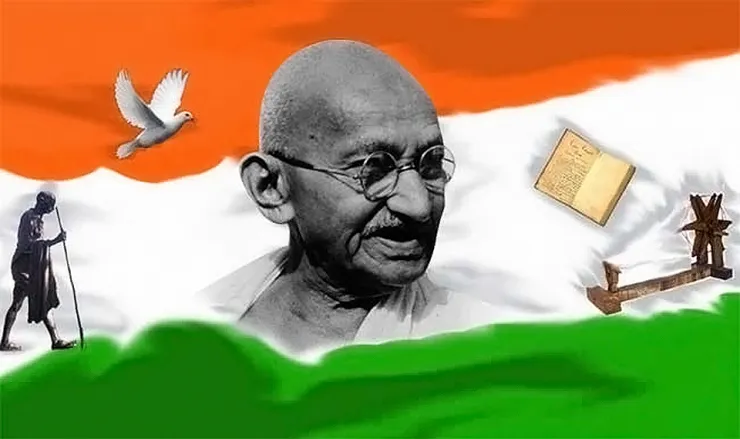
With the fingers of one hand he maintained the proper delicate tension on the cotton thread he was spinning. With the other hand he turned the small, flat charka – spinning wheel – at his side on the white mattress.
Broken threads, he explained, could be repaired but should not be. He held up a little ball of broken threads. They were valuable as lamp wicks, he said, and in many other ways, such as for stuffing pin-cushions like the one on the low table in front of his mattress.
Also on the table sat a porcelain group of three monkeys: hear, see, speak no evil.
A few papers, a bottle of ink, a penpoint in a stained holder, a quart bottle two-thirds full of water and his famous dollar watch made up the rest of the homely furnishings of his immediate establishment.
At the moment he was staying in one of the richest houses in New Delhi, though normally he lives there in the colony of the sweepers, among the lowest of untouchables. In either place, the mattress and the objects on and before it are the same.
Hand-spinning, of course, is a token of Mohandas Karamchad Gandhi’s identification of himself with the depressed millions of India, and of his belief in village industries. It also appears to assist him in his process of thought.
Furthermore, at this particular time, the thin white thread, held out in his fingers, seemed to symbolize India.
The time was that of the Delhi riots, when fear had arisen that the least bit too much strength might snap the new thread of government in the Indian Dominion and prevent the fabrication of the potentially strong khadi, home-woven cloth of full and effective Indian self-rule.
Gandhi, after his 73-hour fast in Calcutta, had arrived in Delhi on the worst day of the riots, and had at once announced his intention of remaining until they ended.
His real task, however, was much wider than the stopping of the Delhi troubles. By the time of his arrival in New Delhi, it had become plain that the mass flight of Hindus and Sikhs from Pakistan and of Moslems from India threatened both dominions with economic disaster unless it was halted.
Less dramatically than by fasting, but with no less concentration, he went to work on a campaign which, if successful, might well be recorded by history as the greatest of all his achievements.
In brief, innumerable conferences, in his evening talks, in writing, he pursued his task hour by hour, changing his approach with each change in the situation.
“I no longer have friends,” he said when interviewed. “I may hold a prayer meeting tonight – but I may not be alive.
“Whenever I make plans, something – call it God, call it Nature – intervenes. I had planned to go to the Punjab at once, but now I must stay in Delhi.“A man going to a fire with a bucket of water must put out any fires he finds along his way. If I do this here, I will still have water to spare for the conflagration ahead.”
Despite his age – by Hindu reckoning he is seventy-nine, by Western seventy-eight – Gandhi recovered quickly from the Calcutta fast.
He is in fact not a frail man, rather, a wiry one. When he walks he supports himself with one hand on the shoulder of one of his followers, often his granddaughter Manu, but in his step there is a definite, if deliberate, spring.
Also, he is tall rather than short, although when seated on his mattress the thin, naked torso, the squarish bald skull and the large ears make him appear smaller than he is.
His voice is no longer strong, but is quiet and definite. His hands are small and steady.
Surrounded by adoration, he is still relaxed, at times drily witty, occasionally almost gay. Behind his glasses – or over their upper rims – his eyes are alert and lively.
His personal needs go little beyond pen, paper, transportation, umbrella, sandals, enough khadi for a peasant loincloth and the rice, vegetables, goat’s cheese and curds on which he exists.
His entourage, however, consisting as it does of secretaries, cooks, physicians and followers, is elaborate enough to have elicited the remark from an admirer that no one would ever know how much it had cost to keep the Mahatma in poverty.
Busy as he is, the atmosphere around Gandhi is one of calm and cleanliness – a rare atmosphere in India in the stormy weeks after independence.