To compress cables and telegrams, a considerable code was developed through the years which included the names of men in the office, rivals in the profession, and others who had to do with business or politics, together with words to express figures.
For himself Joseph Pulitzer selected the cipher word “Andes,” modestly taking the name of the second highest altitude on the earth’s surface. He commonly went by the code name in office conversation.
Mr. William H. Merrill, his chief editorial writer, was “Cantabo”; his treasurer, J. Angus Shaw, was “Solid” — a neat compliment; S.S. Carvalho was designated by a single syllable “Los”; John Norris became “Anfracto”; C.M. Van Hamn “Gyrate,” illustrating perhaps the vicissitudes of a managing editor; Florence D. White was “Volema” on the wire. I was honored with three stage names, “Gulch,” “Mastodon” and “Quixotic”; Dumont Clarke, his vice-president, was “Coin,” a commodity with which he had much to do; Col. George B.M. Harvey was “Sawpit”; James Gordon Bennett came over the cable as “Gaiter,” and William R. Hearst as “Gush.”
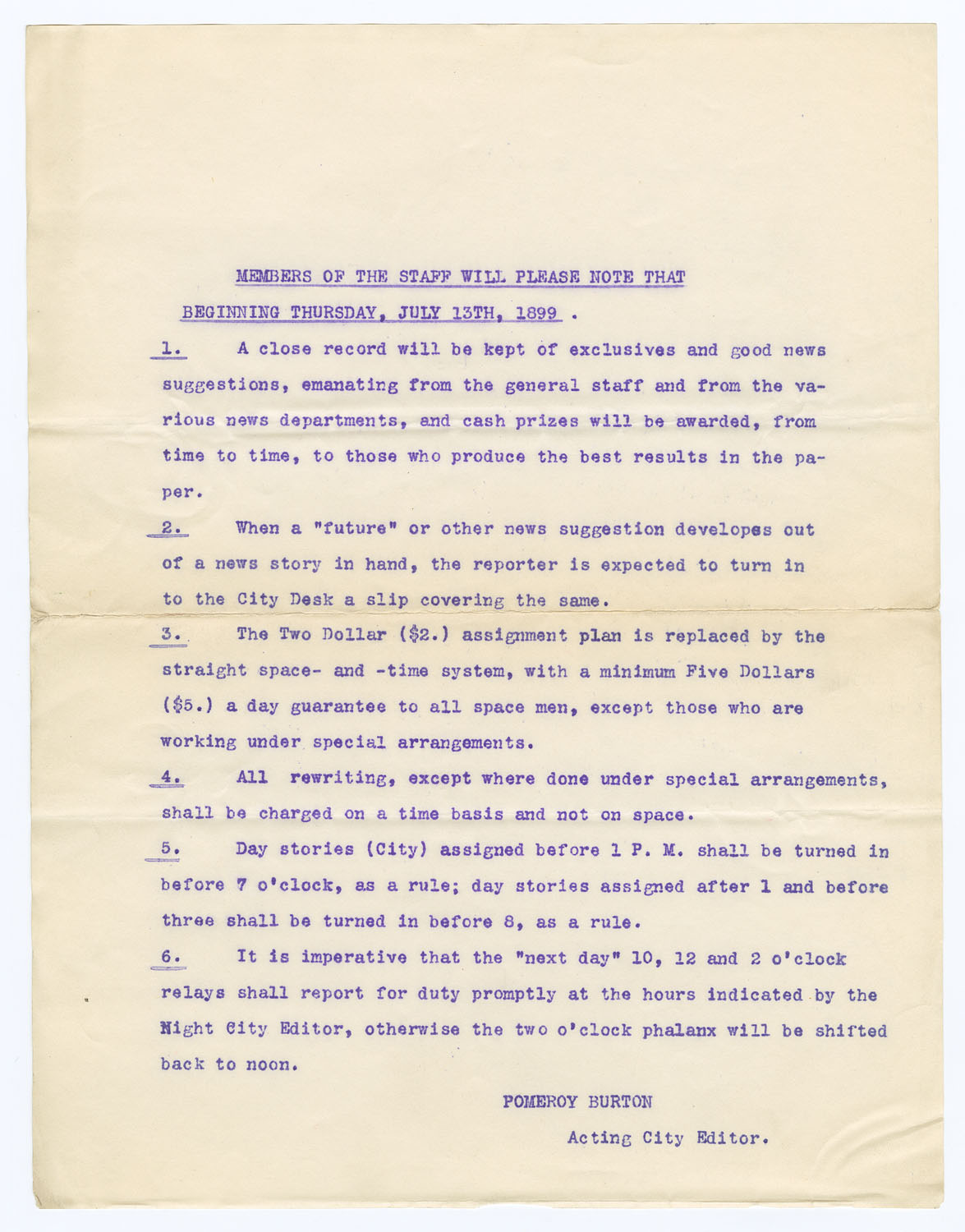
A notice from Pomeroy Burton on the journalism awards that would become the Pulitzer Prizes.
For William J. Bryan two code designations were used, “Guilder” and “Maxilla,” the latter possibly a delicate reference to his jaw. Pomeroy Burton became “Gumbo,” perhaps, as he himself said, because he was “so often in the soup.” The papers were respectively “Senior” (Morning), “Seniority” (Sunday) and “Junior” (Evening).
The code amused Mr. Pulitzer and he was forever tinkering it. During the Panama rumpus a cipher was constructed especially for it.
His telegrams and cables usually came unsigned save for a final word, “Sedentary,” which meant that a prompt reply was required. This commonly went back in a single word, “Semaphore,” meaning “message received and understood.” When in good humor and pleased he would sign personal messages “J.P.” but when his wrath was high they came signed “Joseph Pulitzer.” That meant trouble. In my eighteen years of association I received three bearing the ominous full signature.
His days after his withdrawal from active work were much the same: morning hours spent with papers and mail, a drive before luncheon, then an hour of reading and repose, after which he rode in a carriage or on horseback, saw visitors from five o’clock to six, dressed for a seven-thirty dinner, after a brief rest in bed, and then, leaving the table about nine, listened to a little music, and was read to sleep by one secretary or another.
Extravagant as he was in verbal expression, Mr. Pulitzer valued judgment and conservatism that waited on facts. In one of the changes of a generation in the office when the old heads vanished almost altogether, he caused each of the younger moulders of opinion to be given a beautiful set of gilded scales from Tiffany’s, the implied meaning of the gift being quite plain.Like most successful men, he had his superstitions, and one of these was a reverence for the figure 10. He was born on the 10th of April, reached St. Louis on the 10th of October, consolidated the Post with the Dispatch on the 10th of December, 1878, bought the World on the 10th of May, 1883 — and won. He made the superstition something of a fad and used the numerals always when he could. In buying his first New York house, he selected No. 10 East 55th Street — the two fives adding another 10.
He cut the price of his morning newspaper from two cents to one on Feb. 10, 1896, and began the expensive duel with the millions of the Hearst estate. The result of the latter experiment was not to his liking and he lost interest in the superstition in his later years.
Meal-times were play hours. At the table liberty of speech was the rule, and the guests and secretaries had full freedom to express themselves without regard to the feelings of the host. Sometimes the fire became hot and he would retreat to have his dessert and coffee alone. Violent disputes about music, literature, politics, history and art were the rule, with not infrequent assaults upon his own opinion and the ways of the World tempered by anecdotes and good stories. He loved table talk of this sort. “Tell me a good story” was his most frequent greeting to a guest. His mind was so active and projective that it was hard to set him reminiscing; when he did venture back over the travelled road, the tale was worth hearing.
He loved art and music, a taste reflected in the great benefactions made to the Philharmonic Society and the Metropolitan Museum of Art in his will. When sight grew dim, as with most blind people, melody became a solace. The piano especially appealed to him and he heard great players whenever possible. Now and then Paderewski would pay him a visit and there would be a carnival of piano playing. The strings came next. His winters on the Riviera were made happy by the splendid orchestra maintained at Monte Carlo by the Prince of Monaco.
The group of secretaries always included one excellent pianist whose duties were by no means light and whose slightest error in technique met with instant and fierce rebuke. Like Napoleon, his omnivorousness and great curiosity gave him a tremendous appetite. He was most insistent about his meals; ate often and heavily, frequently awakening in the night to satisfy his hunger with an extra meal.
He was fond of luxury; always craved and secured the best. This was from no vainglory of extravagance, following the acquisition of wealth, but was an inborn instinct, which he nearly always managed to gratify even when poor. He wished to be warm, to sleep well, to be comfortably housed and to have at his command good books and valued publications.
In his later years he spent at least twelve hours of the day in bed. His afternoon nap was the trial of his valet and the terror of fellow travellers. Rooms had to be kept vacant above, below, and on either side of him at hotels; and the White Star Line, upon whose steamers he usually made his European voyages, kept his good will for many years by maintaining a huge drugget made of manila rope which was spread upon the deck so that the footsteps of the idlers on the promenade deck could not jar his slumbers in the stateroom below.
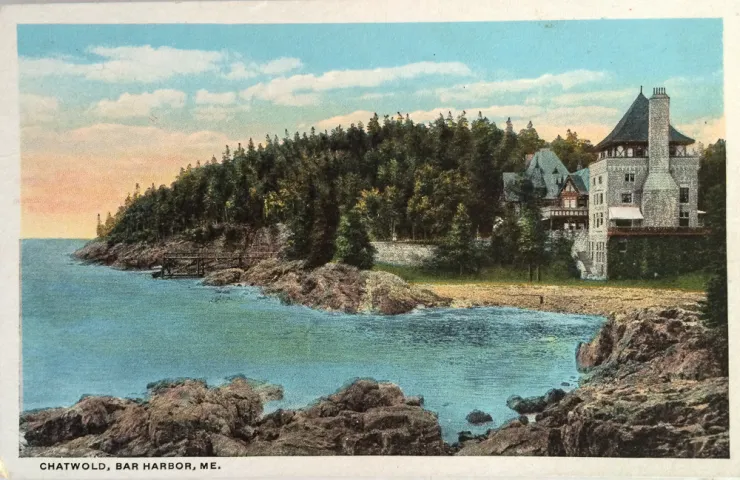
This desire for silence became almost a mania. The great house, Chatwold, at Bar Harbor, Maine, had added to it in 1895 a huge granite pile, called the “Tower of Silence” by some of the humorous inmates, with specially constructed walls and partitions designated to shut out all noise — which they did not do.
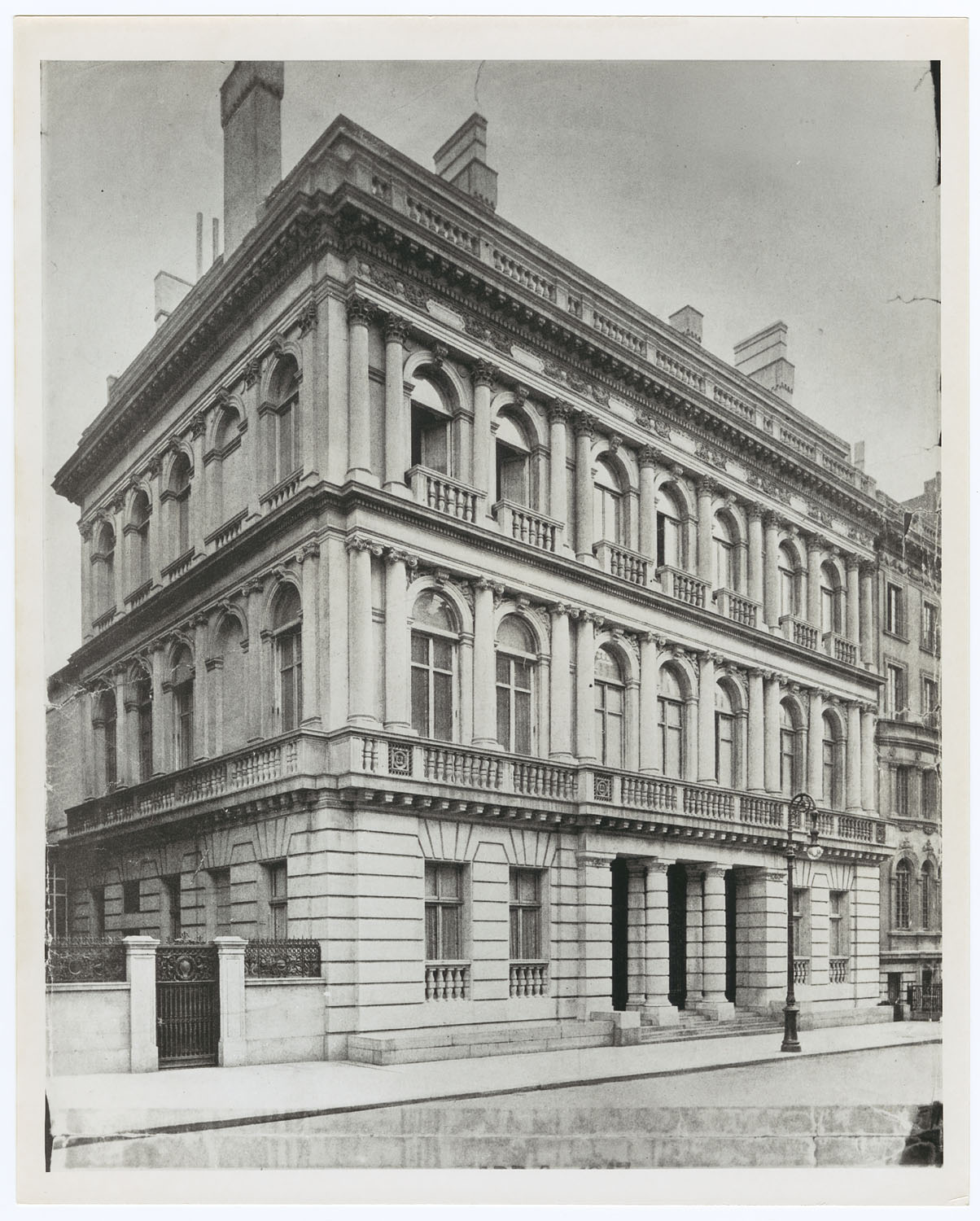
Pulitzer's McKim, Mead and White designed house on East 73rd Street.
The new city mansion, Nos. 7 and 15 East 73rd Street, New York, built in 1902, failed to provide soundproof quarters in spite of much planning by the architects, McKim, Mead and White. Indeed, his rooms seemed to be haunted by noise, among the varieties of which was a strange knocking that nearly drove him frantic. In building the house, a living spring that could not be suppressed was found in the cellar. It was fed into a sump-pit; this in turn was emptied by an automatic pump operated by electricity, which started when the water reached a certain level and stopped when lowered. By rare fatality the pump had been placed so that the drum of the re-direct heating system acted as a sounding board and spread the incidental vibrations through the house, centering most loudly in Mr. Pulitzer’s bedroom.
The pump was shifted under the sidewalk, but he abandoned the room and built a single-story annex in the yard, with double walls packed with mineral wool. The windows were guarded by triple glass; ventilation was by the fireplace chimney. He was sure that the jar of early morning whistles found its way to his ears by this opening. Silk threads were stretched across it to break the sound. Three doors were hung in the short passage from the main mansion, the floor of which was on ball bearings to prevent vibration. Here at last he found zero. The room was so still as to be uncanny.
Behind the Tower of Silence at Chatwold was a little balcony overhanging a rock-lined canyon through which a noisy brook went babbling to the awaiting sea. This was his favorite resting-place. Here he would sit in the cool of the morning, or in the graceful shade of the afternoon, listening to the threnody of the surf breaking almost under his feet, and gaining a tranquility denied him elsewhere in the clatter of life.
Just as his auricular nerves were abnormally sensitive to noises, so those of his olfactory cells shared this quality as to odors. Perfumes he especially disliked.
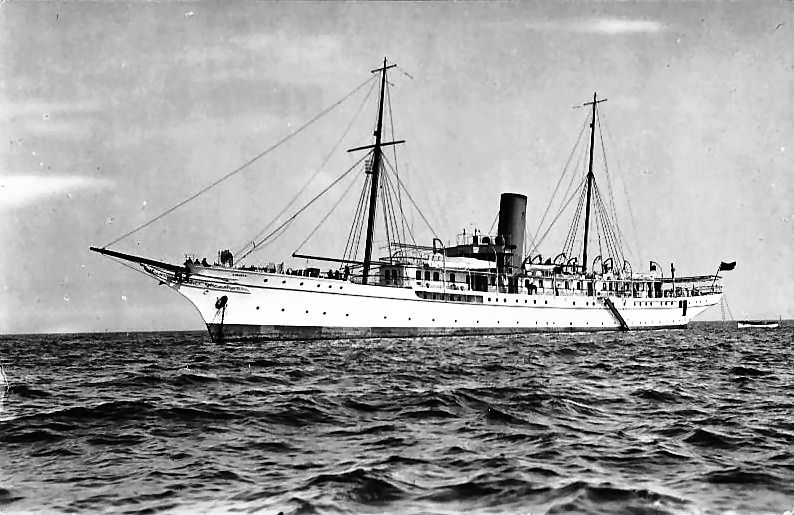
Pulitzer's yacht, the Liberty.
On one occasion, while at Cap Martin, a luckless British medico who came highly recommended all the way from London to be surgeon of the Liberty, for the first time in his life loaded his pocket-handkerchief with patchouli. By some mischance a whiff of this reached J.P. before the candidate was presented, and roused him to fury. The doctor was taken below by a valet and deodorized before he could be examined. The incident unsettled him so that he declined the berth.
A jeweler from Nice, well scented after the French fashion, boarded the yacht one day with a selection of his wares to be purchased as holiday gifts. He smelled like all the flowers of nearby Grasse, whence come the essences of the world. A thoughtful secretary placed the merchant where a strong wind blew his savor out to sea and so saved the situation and the sale.