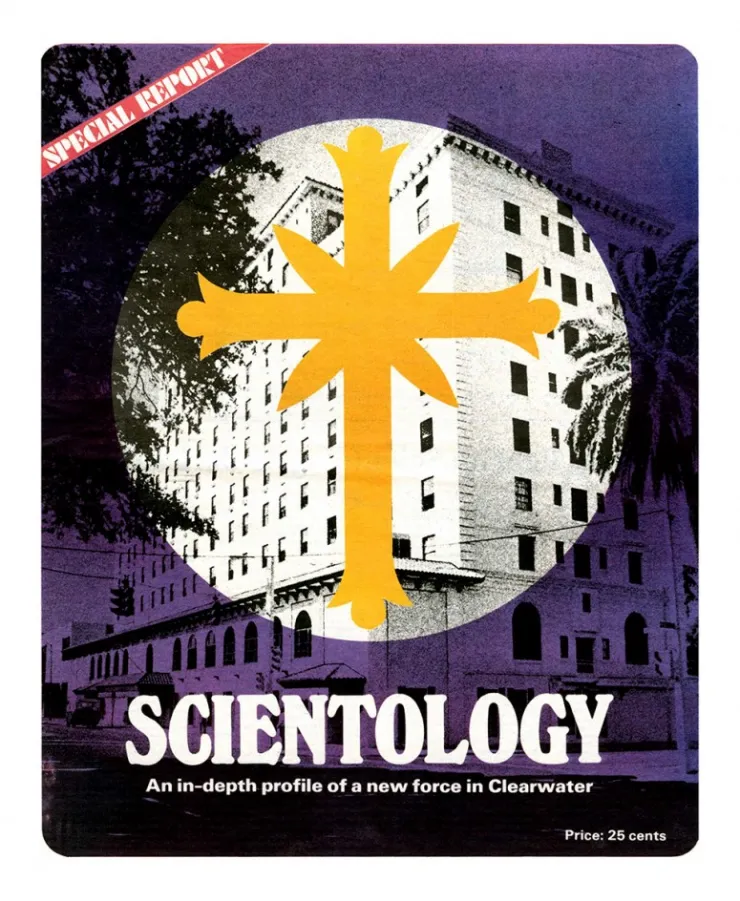
In 1975 the Church of Scientology slipped into Clearwater, Fla., and began acquiring downtown property. Soon it had created a major headquarters and changed the face of the city, causing friction and discord in many quarters.
Reporters for the local Clearwater Sun (defunct) and the regional St. Petersburg Times (now The Tampa Bay Times) filled their columns with news of this strange new neighbor.
In late 1979, using court documents in a criminal case against Scientology leaders, Bette Swenson Orsini and Charles Stafford of the Times took a look back at how the Scientology invasion had occurred. Their work won the 1980 Pulitzer Prize for National Reporting.
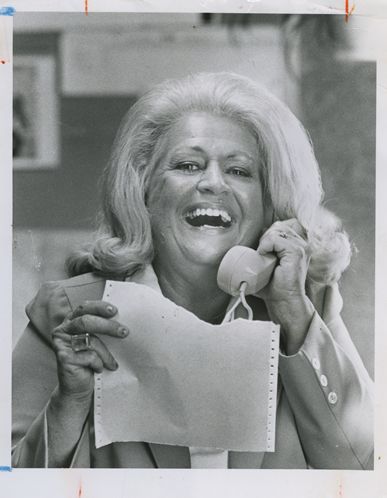
Bette Orsini
Orsini, who worked for the Times for more than four decades, covered the Scientologists for three years. After her death in 2011, Bob Haiman, the former Times executive editor who worked with her and Stafford on the series, described her as “one of the most tenacious – almost ferocious – reporters I have ever worked with. . . . Every cliché, including the one about the bulldog that gets a hold of an ankle and won't let go, was true of her.”
Stafford was a veteran news reporter when he came to the Times in 1968 from the Tampa Tribune. While working on the prize-winning series, he wrote a story about researching the Church of Scientology files the paper had acquired through the courts. Among them was a detailed summary written by a Scientology operative about the Times’ own confidential files. “Suddenly,” Stafford wrote, “you feel that you are peering over the shoulder of a fellow reporter, tiptoeing into the big boss’ office while he is at dinner and rummaging through his desk.”
Here is the introductory story Stafford wrote for the 14-part Pulitzer Prize-winning series. It was published on Dec. 16, 1979.
Old-time religion? Forget it
By CHARLES STAFFORD
It was this time four years ago – this time of year when the old-time religion celebrates the birth of a child – that the new religion came to Clearwater.
It came sneaking into town: A religion with beliefs and practices so alien to the teachings of Jesus that are preached in Clearwater’s Christian churches, so different from the law of the prophets that is taught in the city’s synagogues.
This is the law of the God of Israel:
Thou shall not steal.
On Nov. 9, 1975 – the Sabbath – agent of the new religion with the code name “Silver” entered Internal Revenue Service headquarters on Constitution Avenue in Washington, and made his way to the office of Charles Zuravain, an attorney in the disclosure division of the chief counsel’s office. “Silver” found the file he wanted and began copying documents. When he left late that Sunday, he took with him a stack of copies of confidential IRS documents one foot thick. That was theft.
This is the commandment of Jesus:
Thou shalt love thy neighbor as thyself.
On Dec. 5, the hierarchy of the new religion issued this directive:
“Power Project 3: Normandy.”
“Major Target: To fully investigate the Clearwater city and county area so we can distinguish our friends from our enemies and handle as needed.”
Neighborly?
This is the law of the God of Israel:
Thou shalt not bear false witness against thy neighbor.
On Jan. 26, 1976, a day when Scientology was still masquerading in Clearwater as the United Churches of Florida, a church official named Joe Lisa informed another church leader that he had devised a scheme to get reporter Mark Sableman fired by the Clearwater Sun. This was his plan:
“Have a woman (elderly) go into the office and in grief and misemotion (sic) start screaming she wants to see Sableman’s boss. She goes in and sees this man and screams and cries about Sableman sexually assaulting her son, or grandson. The woman takes a magazine which is lurid and perverted and throws it into the face of the man/woman and screams ‘Look what he gave my son, not to mention what the pervert did . . . sob, sob, to my Johnny.’ I’m going to the police. If you can’t do something about that pervert Sableman I will see they do something to you.”
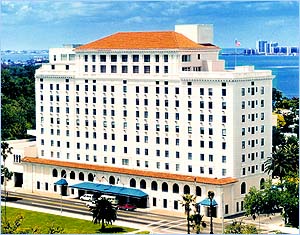
The Fort Harrison Hotel in Clearwater, purchased as a headquarters by the Church of Scientology in 1975.
Two days later citizens of Pinellas County learned that their new neighbors in the Fort Harrison Hotel in Clearwater were practitioners of a new religion, Scientology, founded just 29 years ago by a science fiction writer named L. Ron Hubbard.
It was 19 months before the government of the United States discovered that agents of the Church of Scientology had been systematically rifling files of government agents for more than two years.
Discovery of the true nature of Scientology began on July 8, 1977 – to Scientologists a day that will live in infamy – when FBI agents pounded down the doors of church offices in Los Angeles and Washington and carted away 48,149 documents. Many of these were copies of government documents that agents like “Silver” stole after infiltrating government agencies. Others were files of private organizations, like the American Medical Association and The St. Petersburg Times.
Still others were internal documents of the Church of Scientology, and these would reveal myriad dark secrets.
But knowledge of what the documents contained came slowly to the public.
On Aug. 15, 1978, a federal grand jury in Washington indicted 11 Scientologists, nine of whom held high positions in the church’s Guardian Office. That office had this mandate: “To sweep aside opposition sufficiently to create a vacuum into which Scientology can expand.” The 28-count indictment charged them with conspiring to steal government documents, theft of government documents and conspiring to obstruct justice.
The 11 included Mary Sue Hubbard, world traveler, wife of the founder of Scientology and second-ranking officer of the Church; Jane Kember of England, the head of the worldwide church’s Guardian office, and these other Scientologists: Morris “Mo” Budlong of England; Henning Heldt, Los Angeles; Duke Snider (no relation to the baseball player), Hollywood, Calif.; Richard Weigand, Van Nuys, Calif.; Gregory Willardson, Beverly Hills, Calif.; Mitchell Hermann, also known as Mike Cooper, Hollywood, Calif.; Cindy Raymond, Hollywood, Calif.; Gerald Bennett Wolfe, Arletta, Calif.; and Sharon Thomas, Los Angeles.
All were officials of the Guardian Office except Wolfe and Miss Thomas. Wolfe was “Silver,” the agent who infiltrated the IRS, while Miss Thomas was the church’s secret agent in the Justice Department.
On Aug. 29, 1978, nine of the indicted Scientologists stood before the bench of U.S. District Judge George L. Hart, Jr. in the federal courthouse at the foot of Capitol Hill and pleaded innocent. Two were missing. Jane Kember and Mo Budlong were in England.
For the next 14 months, a platoon of attorneys fought to prevent a trial and to keep the seized documents from the public eye. They claimed that the FBI raids on church offices were illegal, that the search warrant was too general. One U.S. District Court judge upheld their claim. But two other District Court judges – one in Washington and one in California – rejected their claim. The Scientologists’ appeals to higher courts also failed.
Trial was scheduled for Sept. 24 in Washington before U.S. District Court Judge Charles R. Richey. It did not begin. For two weeks attorneys for the government and the Scientologists argued and bargained, and on Oct. 8 Judge Richey ruled that an agreement had been reached.
As a result of that agreement, Mary Sue Hubbard and her eight colleagues appeared before Judge Richey on Oct. 26. The team of prosecutors headed by Assistant U.S. Attorney Raymond Banoun presented a written statement of the government’s case backed up by three folders of documents. The defense attorneys stipulated that this was the evidence the government would have presented had the case gone to trial. Judge Richey then found the nine Scientologists guilty of one count each of the indictment.
This scenario left the defendants free to appeal. They will claim that the convictions should be overturned because the evidence used against them was seized illegally. But they will not claim that they are innocent of plotting to infiltrate government agencies and steal government documents. They never have.
Having found the Scientologists guilty, Judge Richey lifted the seal from the documents seized in the FBI raids. Six boxes were made public before attorneys for the defendants and the church could appeal to the U.S. Court of Appeals for the District of Columbia. The appellate court upheld Judge Richey and on Nov. 23, the day after Thanksgiving, the court began releasing the remaining documents.
The number had been trimmed down. Certain documents seized in the raids were returned to the church, apparently because they had no bearing on the government’s case. Others were removed to prevent injury to innocent people mentioned in them.
But 20 boxes – roughly half of the documents seized in raids – were made public.
Examining them is like seeing the dark side of the moon, or stepping through a looking glass.
They were taken from church offices in Los Angeles and Washington. But there is so much in them about Scientology’s plans and programs for a quiet city in Florida.
The documents reveal that the Church of Scientology came to Clearwater with a written plea to establish its program headquarters – its school of theology, so to speak – in the old Fort Harrison Hotel and to take control of the city. They show that United Churches of Florida was created as a front to protect church assets from seizure by the government.
They show that church officials conceived and carried out plots to discredit their “enemies” – the mayor who questioned their secrecy, reporters who investigated and wrote about Scientology, the editor and owner of the area’s largest newspaper, even local police departments.
They show that covert agents of the church took jobs with local newspapers, community agencies and law firms in order to spy.
They underscore what a spokesman for the Church of Scientology told a group of Clearwater High School students recently:
We step on a lot of toes. We don’t turn the other cheek.
Government prosecutors, in a memorandum to Judge Richey urging maximum sentences, delivered this judgment:
“That these defendants were willing to frame their critics to the point of giving false testimony under oath against them and having them arrested and indicted speaks legion for their disdain for the rule of law. Indeed, they arrogantly placed themselves above the law, meting out their personal brand of punishment to those ‘guilty’ of opposing their selfish aims.
“The crime committed by those defendants is of a breadth and scope previously unheard of. No building, office, desk or file was safe from their snooping or prying. No individual or organization was free from their despicable conspiratorial minds. The tools of their trade were miniature transmitters, lock picks, secret codes, forged credentials and any other device they found necessary to carry out their conspiratorial schemes. It is interesting to note that the founder of Scientology, L. Ron Hubbard, wrote in his dictionary entitled Modern Management Technology Defined . . . that ‘truth is what is true for you.’ Thus, with the founder’s blessings they could wantonly commit perjury as long as it was in the interest of Scientology. The defendants rewarded criminal activities that ended in success and sternly rebuked those that failed. The standards of human conduct embodied in such practices represent no less than the absolute perversion of any known ethical value system.“In view of this, it defies the imagination that these defendants have the unmitigated audacity to seek to defend their actions in the name of ‘religion.’ That these defendants now attempt to hide behind the sacred principles of freedom of religion, freedom of speech and the right to privacy – which principles they repeatedly demonstrated a willingness to violate with impunity – adds insult to the injuries which they have inflicted on every element of society.”
As he prepared to sentence Mary Sue Hubbard, Judge Richey told her that “we have a precious system of government in the United States. . . . For anyone to use the benefits of those laws or to seek under the guidance of those laws to destroy the very foundation of the government is totally wrong and cannot be condoned by any responsible citizen.”
The judge imposed maximum sentences on Mrs. Hubbard and two other defendants: five years in prison and $10,000 fines – though he said he would reconsider Mrs. Hubbard’s sentence after she had spent three months in prison. He sentenced five other defendants to four years in prison and $10,000 fines, and the remaining defendant to one year of prison – six months of it suspended – and a $1,000 fine.
There, in capsule form, you have the story of Scientology since it came to Clearwater four years ago. The details are intriguing, and they will come. But first it is necessary to understand the creation of Scientology and its creator.
Sources: Bette Orsini obituary by Andrew Meacham, St. Petersburg Times, March 28, 2011; Charles Stafford story on Scientology files, St. Petersburg Times, Nov. 10, 1979; Fischer, Heinz-Dietrich, Complete Biographical Encyclopedia of Pulitzer Prize Winners, 1917-2000, K.H. Saur, Munich, 2002, pp.230-31.