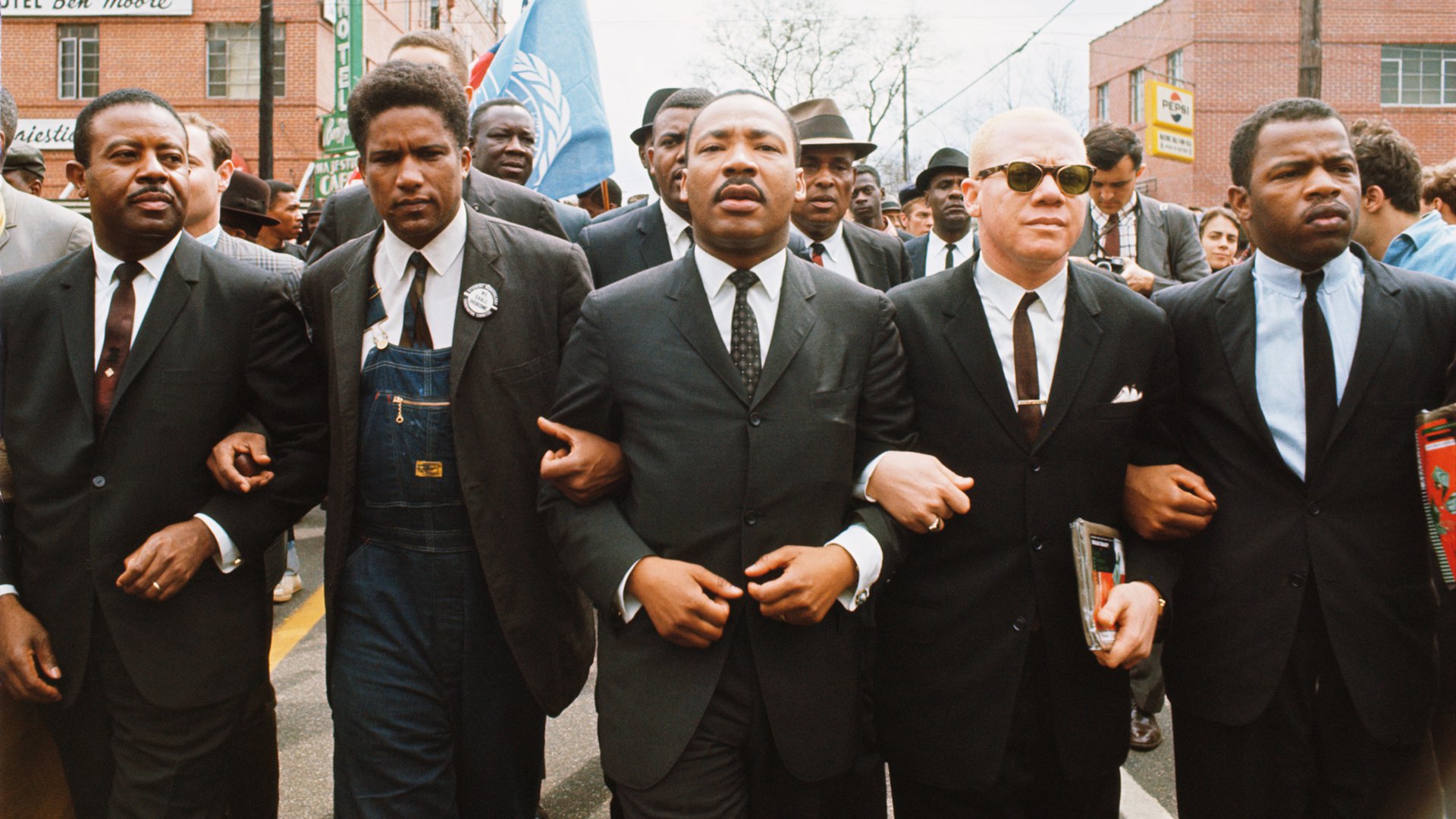
(From left): Ralph Abernathy, James Forman, Martin Luther King Jr., Jesse Douglas, and John Lewis in Selma. (The Atlantic)
"I came here to say to you that in spite of yesterday, in spite of man's terrible inhumanity to man ... in spite of all the brutality we have no alternative but to keep moving forward. ... We have gone too far to turn back. ... We must let them know that nothing will stop us, not even the threat of death itself."
— Martin Luther King, as reported by Haynes Johnson
In honor of Martin Luther King Day, we are proud to present Haynes Johnson's Pulitzer-winning coverage of the Selma marches and demonstrations on pulitzer.org.
These events were a signpost that the United States stood on the precipice of a new age.
In a failed African-American voter registration campaign organized by the Dallas County Voters League, the Rev. Martin Luther King's Southern Christian Leadership Conference — with furtive support from President Lyndon Johnson and White House domestic affairs advisor Joseph Califano — found an essential test case for the reforms that would ultimately be implemented in the Voting Rights Act of 1965.
But the road beyond what King characterized as "the sagging wall of segregation" was perilous, marked by the racially motivated death of activists Jimmie Lee Jackson and the fatal beating of Rev. James Reeb (a white Unitarian Universalist ally from Boston) by a local white posse.
Shortly thereafter, a photo of activist Amelia Boynton being carried by her colleagues following a police-posse beating on "Bloody Sunday" resulted in a national outcry that galvanized the world. A nationally televised address by President Johnson to a joint session of Congress on March 15 calling for the Voting Rights Act precipitated a final, peaceful march to the state capital under the aegis of Johnson-directed National Guard personnel.
Myriad reporters were embedded in Selma by that juncture, but few carried the imprimatur of Washington Star National Correspondent Haynes Johnson.
The son of New York Sun stalwart and 1949 Local Reporting winner Malcolm "Mike" Johnson (best known for his shoe-leather coverage of corruption on the New York waterfront and the Ku Klux Klan's reign of terror in 1920s Georgia), the younger Johnson was just as concerned with what he would later call "increasing racial and ethnic tensions, economic inequities and the rapidly widening gap between the haves and have-nots [that] will inevitably result in new and greater explosions."
After taking an undergraduate degree from the University of Missouri's journalism school, Johnson completed a master's degree in history at the University of Wisconsin. Looking to escape his father's shadow, he left New York and worked at several newspapers before settling at the Star, where he enjoyed a varied career as a reporter, columnist, city editor and editor of an ill-fated weekly supplement oriented toward teenagers.
As assistant city editor, he assigned the first story ever published by 1973 Public Service contributor Carl Bernstein. "He knew, perhaps better than any other, that you had to get out of Washington to really report on America," Bernstein recalled in 2013. "Haynes loved journalism— he was married to it, as Bob [Woodward] remarked to me.”
Indeed, Johnson's work in Selma prefigures many of the developments that would manifest in the New Journalism of the late 1960s and 1970s. Drifting away from the pool, Johnson showcased the viewpoints of the indigent and underprivileged (exemplified by sharecroppers initially fearful of participating in the protests) in addition to such future luminaries as John Lewis and Andrew Young. In his recurring evocation of the area's "Spanish moss and magnolia trees," he brought a Southern Gothic panache seldom found in the era's daily reporting.
Although Johnson offered comprehensive overviews of the seminal events, his July special report on the aftermath of Selma was singled out by the then-Advisory Board. In this piece, he juxtaposed newfound optimism and native pride ("Why, I'd rather live here than anywhere in the whole world") against the stark realities of political activism, including the alleged embezzlement of Voters' League funds and the failure of a boycott against white businesses.
After the younger Johnson earned the National Reporting Prize in 1966, the Johnsons became the second parent-child duo to receive named Pulitzers. (They were preceded by cartoonists Clifford and James Berryman, who received the 1944 and 1950 Editorial Cartooning Prizes, respectively.)
Going on to a career as an editor and columnist at The Washington Post that culminated in placing as a finalist in 1983 for a series on the epoch's recession, Johnson rarely commented on his experiences that spring. His work in Selma stands as a testament to King's dream of a "great camp waiting in the promised land" that remains unfulfilled — and largely deferred.
Read the full entry here.
Please note that this entry includes quotes with racial epithets and outmoded editorial descriptors.
Related
View Moneta Sleet's Pulitzer-winning photo of Coretta Scott King at her husband's funeral here.