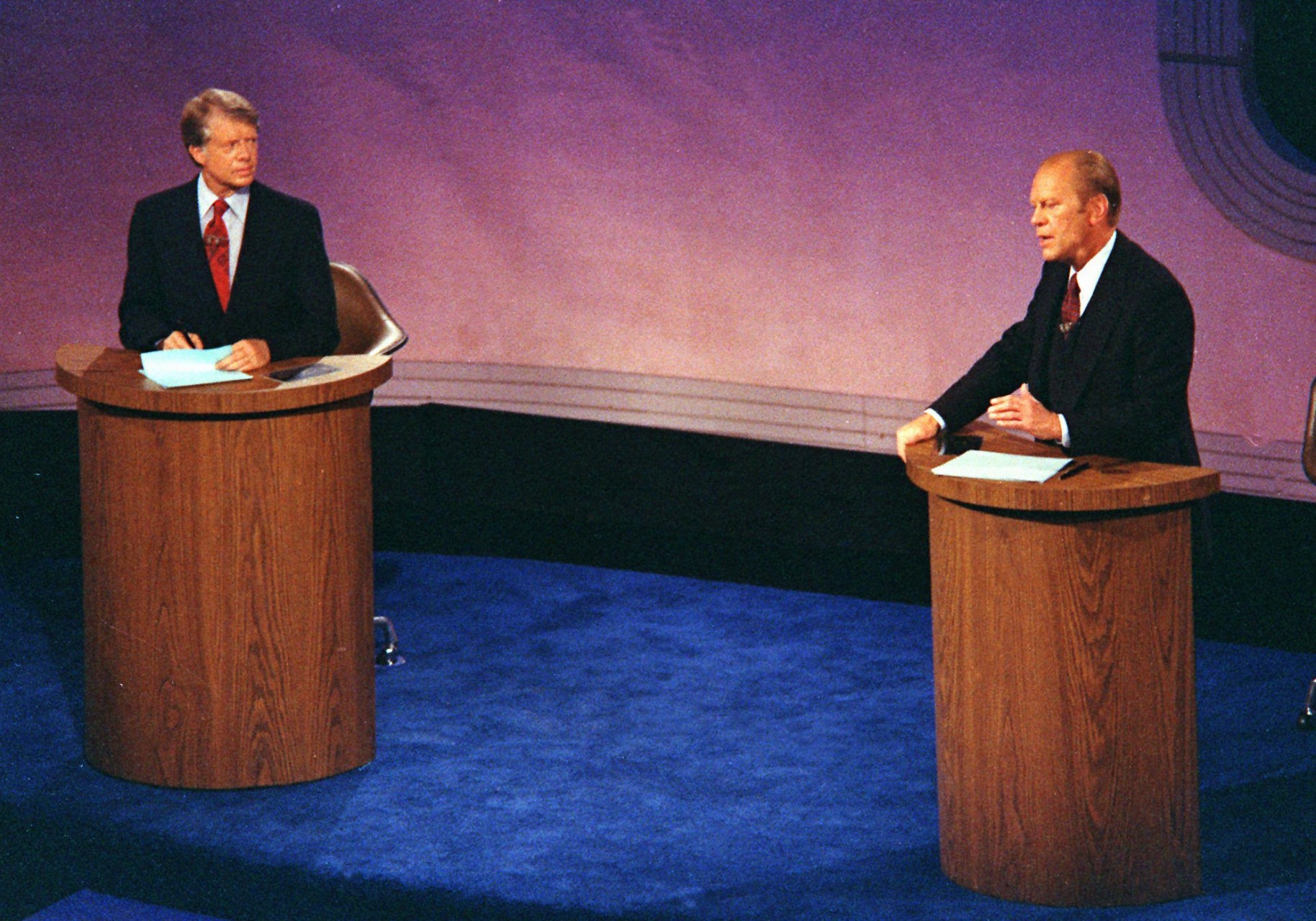
Presidents Ford and Carter at the third debate on October 22, 1976. (Courtesy of Lynn University)
"The early pollsters' odds led Ford to a move that has become customary for the underdog. He challenged Carter to debate. It hadn't been done in a presidential campaign in 16 years, and no incumbent had never agreed to a debate."
We are proud to present Walter Mears' Prize-winning coverage of the 1976 presidential campaign for the first time on Pulitzer.org.
One of "the boys on the bus" profiled by Timothy Crouse in his classic account of the 1972 campaign press corps, Mears was a mainstay of the Associated Press. After graduating from Middlebury College in 1956, he initially worked as Vermont state house correspondent in Montpelier, ultimately moving to a storied career as the wire service's chief political writer, special correspondent and executive editor.
The heart of Mears' portfolio rested in its probing analysis of one of the most unique presidential campaign cycles of the 20th century. Neglected by regular campaign trail chroniclers such as 1962 General Nonfiction winner Theodore H. White, the 1976 campaign pitted Jimmy Carter, a virtually unknown former Georgia governor, against 25th Amendment-derived President Gerald Ford.
Whereas the oft-studied 1972 campaign amounted to an airtight coronation for incumbent Richard Nixon (and defeat for Democratic nominee George McGovern), the 1976 campaign leveled the field, emphasizing many of the innovations taken for granted today.
Polling — both by publicity-oriented firms and private consultants, most notably the Carter-retained Pat Caddell — became a key analytic metric in the process. And, for the first time since 1958 Biography winner John F. Kennedy's round against Nixon in the 1960 race, the candidates agreed to debate one other on three occasions.
As Mears wrote on the eve of the election: "The campaign moved from the crowded, noisy area that belongs to candidates toward the silent solemnity of the polling booth."
Although he was invited to join David Rockefeller's Trilateral Commission in 1973, Carter enjoyed little name recognition into the beginning of 1976. As the primary season commenced, he leveraged the Democratic field, which ranged from Henry "Scoop" Jackson (a lodestar of the neoconservative movement who supported increased defense spending and opposed desegregation busing) to Kennedy wing "progressive centrist" Mo Udall to civil libertarian Frank Church.
He also benefited from the desultory regional campaigns of first-term California Governor Jerry Brown and segregationist Alabama Governor George Wallace, who took significant shares of the primary popular vote despite winning only a handful of contests. Although Carter distanced himself from Wallace's demagoguery, he was the only candidate who could appeal to the party's emerging constituency and the remnants of the New Deal coalition.
Ford, whose popularity never recovered following his pardon of Richard Nixon a month after his predecessor's resignation, faced a crisis of legitimacy underscored by a faltering economy. In addition to surviving two assassination attempts during his abbreviated tenure, his Cabinet and senior staff were marred by frequent infighting, culminating in the "Halloween Massacre" of 1975.
The personnel shuffle attenuated the influence of Henry Kissinger (ending his unprecedented joint appointment as national security advisor and secretary of state) and Vice President Nelson Rockefeller, who was perceived as too liberal for the forthcoming ticket. (Following much prevarication, he would be replaced on the ticket by longtime Kansas Senator and 1996 Republican presidential nominee Bob Dole.)
Although Ford had been regarded as a reliably conservative member of Congress by the business-oriented standards of the Eisenhower era, he would face a primary challenge from the grassroots-oriented New Right in former California Governor Ronald Reagan.
Reagan and his surrogates utilized the emergent conservative policy infrastructure (including the American Conservative Union and the Conservative Political Action Conference) to criticize the Kissinger-driven détente with the Soviet Union alongside First Lady Betty Ford's support of abortion and the proposed Equal Rights Amendment.
Ultimately winning 11 primaries and nearly as many delegates as Ford, the incumbent's nomination was saved by two figures whose legacies would loom large in American history: future Cabinet jack-of-all-trades James A. Baker III, who served as campaign manager, and delegate coordinator Paul Manafort.
As captured by Mears, the 1976 general election campaign was characterized by inertia after the febrile primary season. In particular, two events — Carter's unexpected confession to veteran journalist Robert Scheer that he "looked on a lot of women with lust" and Ford's contention in the second debate that "there is no Soviet domination of Eastern Europe and there never will be under a Ford administration," leading Carter to allege that Ford has been "brainwashed" — dominated the media landscape for weeks, undercutting the chance of either candidate developing a commanding lead.
While Carter was victorious on November 2, his success was predicated on the last gasp of the New Deal coalition, an increasingly unwieldy coalition of the deep South, Texas and the industrial Midwest and Northeast. Unable to surmount ongoing economic instability, the Iranian hostage crisis and his tight-knit staff's inability to acclimate to Washington norms, he would ultimately lose the presidency to Reagan after one term in 1980. Among the many highlights of his post-presidency was attaining the rare Pulitzer Prize finalist distinction in 2002 for the memoir "An Hour Before Daylight: Memories of a Rural Boyhood."
But the precedent set by both candidates in agreeing to debate has endured for nearly 50 years, through periods of peace and prosperity, war and strife, and increasingly crowded primary cycles. Although remembered at the time for Ford's Eastern Europe gaffe and technical difficulties that afflicted the first debate in Philadelphia, the events augured what would eventually evolve into one of the most remarkable post-presidential friendships since Adams and Jefferson.
"May the glowing casts remind us of a politics that elevates rather than divides, and a nation that is as honorable as it is powerful," Carter reflected at Ford's funeral on January 3, 2007. "Sleep well, old friend."