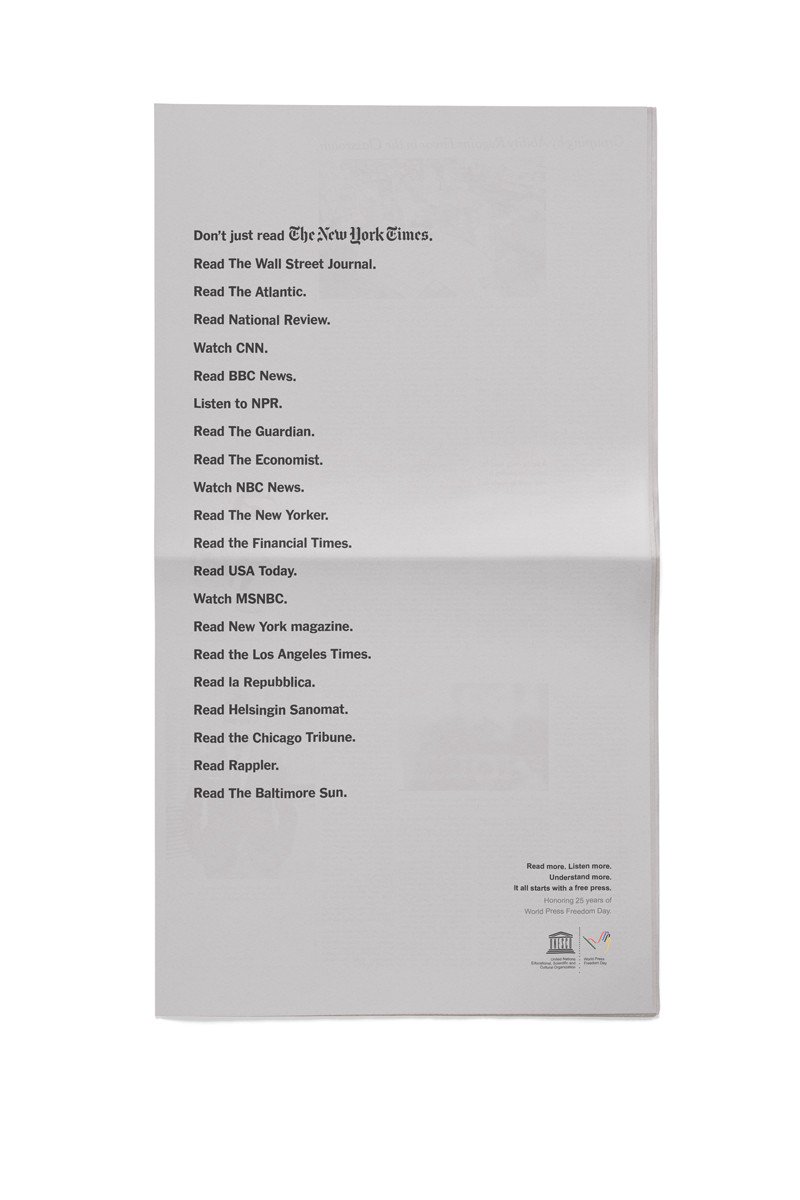
'Read more. Listen more. Understand more.' (Medium)
May 3 marked the 25th anniversary of World Press Freedom Day. Initially declared by the United Nations General Assembly in 1993, the day commemorates the anniversary of the Windhoek Declaration, a statement of press freedom principles drafted by African journalists at a UNESCO seminar in Windhoek, Namibia in 1991.
As press freedom is increasingly imperiled around the world, we present a selection of content and events celebrating this important day.
- Since 1998, UNESCO has marked the day by holding an annual conference of media professionals, press freedom advocates and representatives from U.N. agencies. The 2018 event ("Keeping Power in Check: Media, Justice and the Rule of Law") is being held in Accra, Ghana. Imprisoned Egyptian photojournalist Mahmoud Abu Zeid (also known as Shawkan) will receive the annual UNESCO/Guillermo Cano Press Freedom Prize in absentia. The prize carries a $25,000 stipend.
- 36 international news organizations are participating in a coordinated ad campaign ("Read more. Listen more. Understand more.") lauding the cross-platform work of their peers. (The New York Times' ad is shown above.) In a May 2 Medium post, New York Times Chief Operating Officer Meredith Levien reflected on the effort. "Today," she said, "we’re asking our audience not just to continue reading The Times; we’re asking them to pick up The Wall Street Journal. Or The Guardian. Or Le Monde. Or watch CNN. Or the BBC. Or listen to NPR. The list goes on."
- CNN Chief International Correspondent Christiane Amanpour considered World Press Freedom Day in the context of two recent bombings in Afghanistan that resulted in the death of nine journalists. "There is a lot to be concerned about over the current climate of press freedom, but I do have hope," she said. "As a journalist for nearly 35 years at CNN, I've worked with hundreds of other reporters. And one thing I know is that everyone in this profession possesses a tenacity and a fearlessness that can't be taught."
- A variety of Brookings Institute fellows with media backgrounds also weighed in on the importance of the day. In particular, Nonresident Senior Fellow Marvin Kalb addressed concerns about declining press freedom in the United States. "I view the President’s repeated criticisms of the press, his humiliating of journalists, his emphasis on 'fake news,' his attacks on the press as the 'enemy of the people,' his undervaluing of the press’s importance in a democracy, as signs of danger to our freedom," he said. "It could be that his bark is louder and more threatening than his bite, but I do not want to run the risk of losing everything because I misjudged his intent."
- While the spotlight shines on China, Turkey, and the United States, declining press freedom also remains an exigent threat in less developed nations. According to Muthoki Mumo and Jonathan Rozen of the Committee to Protect Journalists, online journalists in countries such as Tanzania, Uganda and Nigeria are being forced to pay steep registration fees and are often subject to punitive cybercrime laws.
- In a piece for the South China Morning Post, Cherian George of Hong Kong Baptist University visited several burgeoning Asian news organizations that have embraced strict ethical standards. For example, Business Weekly (a Chinese language magazine) "will not accept advertising from companies it writes about."