The New York Times, by Clifford J. Levy and Ellen Barry
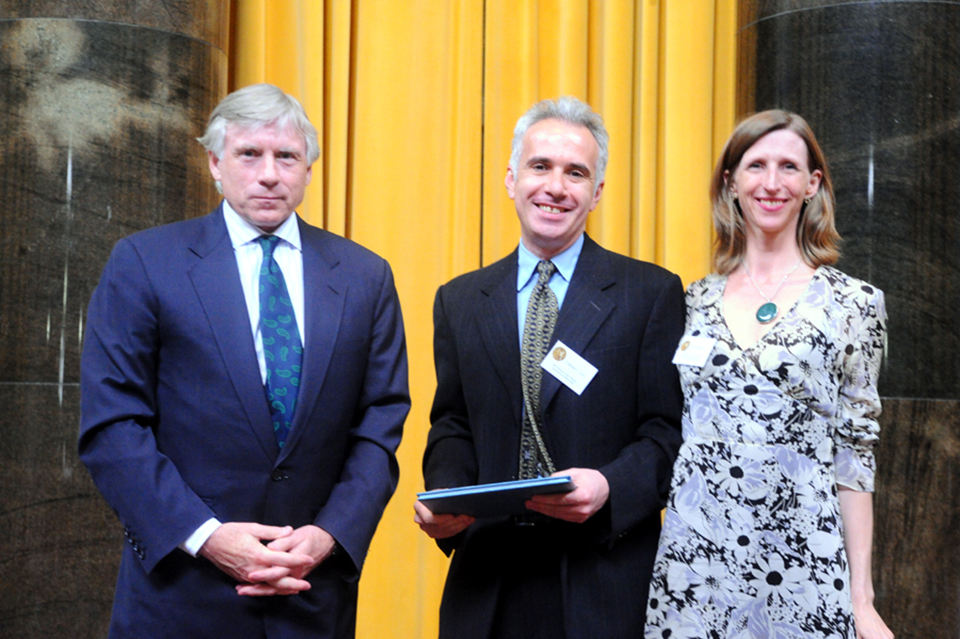
Lee C. Bollinger, President of Columbia University (left), presents the 2011 International Reporting prize to Clifford J. Levy and Ellen Barry of The New York Times.
Winning Work
By Clifford J. Levy
“We used to have so many journalists here, but they have all suffered and have all given up,” Mr. Belousov said. “Only I remained, and now I am giving up.”
KHIMKI, Russia — Mikhail Beketov had been warned, but would not stop writing. About dubious land deals. Crooked loans. Under-the-table hush money. All evidence, he argued in his newspaper, of rampant corruption in this Moscow suburb.
“Last spring, I called for the resignation of the city’s leadership,” Mr. Beketov said in one of his final editorials. “A few days later, my automobile was blown up. What is next for me?”
Not long after, he was savagely beaten outside his home and left to bleed in the snow. His fingers were bashed, and three later had to be amputated, as if his assailants had sought to make sure that he would never write another word. He lost a leg. Now 52, he is in a wheelchair, his brain so damaged that he cannot utter a simple sentence.
The police promised a thorough investigation, but barely looked up from their desks. Surveillance videos were ignored. Neighbors were not interviewed. Information about politicians’ displeasure with Mr. Beketov was deemed “unconfirmed,” according to interviews with officials and residents.
Prosecutors, who had repeatedly rejected Mr. Beketov’s pleas for protection, took over the case, but did not seem to accomplish much more. Mr. Beketov’s close colleagues said they were eager to offer insights about who in the government had been stung by his exposés. But no one asked.
Eighteen months later, there have been no arrests.
In retrospect, the violence was an omen, beginning a wave of unsolved attacks and official harassment against journalists, human rights activists and opposition politicians around the region, which includes the Moscow suburbs, but not the city itself. Rarely, if ever, is anyone held responsible.
One editor was beaten in front of his home, and the assailants seized only copies of his articles and other material for the next day’s issue, not his wallet or cellphone. Local officials insisted that he sustained his injuries while drunk.
Another journalist was pummeled by plainclothes police officers after a demonstration. It was all captured on video. Even so, the police released a statement saying that he had hurt himself when he was accidentally pushed by the crowd.
These types of attacks or other means of intimidation, including aggressive efforts by prosecutors to shut down news media outlets or nonprofit groups, serve as an unnerving deterrent. And in a few cases in recent years, the violence in the country has escalated into contract killings. Corruption is widespread in Russia, and government often functions poorly. But most journalists and nonprofit groups shy away from delving deeply into these problems.
The culture of impunity in Russia represents the most glaring example of the country’s inability to establish real laws in the two decades since the collapse of the Soviet Union. And this failure radiates throughout society, touching upon ordinary men and women who are trying to carve out lives in the new Russia, but are wary of questioning authority.
Russia’s president, Dmitri A. Medvedev, has bemoaned the country’s “legal nihilism.” Yet under Mr. Medvedev and Prime Minister Vladimir V. Putin, it has persisted. And among the major beneficiaries have been the governing party’s politicians.
Threats, Then a Beating
Boris Gromov, the governor of the Moscow region, commanded the 40th Army during the Soviet war in Afghanistan, and his opponents believe that he governs with a general’s sense of order. Mr. Gromov, appointed by Mr. Putin, has in turn seeded local government with fellow Afghanistan veterans, including the Khimki mayor, Vladimir Strelchenko.
Mikhail Beketov often referred to Mr. Gromov and Mr. Strelchenko as “army boots,” and did not think much of their honesty.
Mr. Beketov was brawny like a boxer, fast-talking, perpetually late and prone to latching onto causes. He himself had been an officer in the army paratroops, but then switched to journalism, working as a war correspondent in Afghanistan and Chechnya. His experiences left him with a distaste for overbearing military officials.
He established his newspaper, Khimkinskaya Pravda (Khimki Truth), in 2006. He wrote regularly about what he considered corruption among local officials, who were often members of Mr. Putin’s governing party, United Russia.
He financed the newspaper himself. It had a circulation of only about 10,000 copies, but it garnered a large following in Khimki, which has a population of 185,000, and the surrounding cities, especially after Mr. Beketov grabbed hold of two topics.
His articles resonated nationally when he questioned why the city had demolished a monument that contained the remains of Soviet fighter pilots. The work was done to widen a road.
And he relentlessly focused on the fate of the Khimki forest, a pristine expanse of old-growth oaks and wild animals, including elk and boars, improbably close to Moscow. With little public notice, the government had planned to build a major highway to St. Petersburg through the forest. Mr. Beketov suspected that officials were secretly profiting from the project.
Local officials, unaccustomed to such criticism, lashed out publicly. Privately, Mr. Beketov received phone threats. He asked the authorities for help, but was rebuffed, his colleagues said. He returned home one day to discover his dog dead on his doorstep. Then his car was blown up.
Instead of investigating the explosion, prosecutors opened a criminal inquiry into his newspaper. His friends said that Mr. Beketov told them that one city official had warned him about his articles.
But he did not relent. “You can imagine what kind of money the authorities plan to fleece from this so-called infrastructure,” he wrote about the highway plan.
“For four years, I have observed our authorities,” he said. “I have closely interacted with many senior officials, including Strelchenko himself. Given how the authorities have collected scandals with frightening regularity, I have come to a regrettable conclusion: They are shameless.”
On a November evening in 2008, Mr. Beketov was assaulted, most likely by several people, outside his home. He was discovered by a neighbor the next day.
Even as Mr. Beketov later lay in a coma at the hospital, he was not safe. A threat was phoned in: We will finish him off.
Journalists have been attacked in a region along the M-10 highway.
His friends and colleagues grew so alarmed that they moved him out of the Khimki hospital to a better, more secure one in neighboring Moscow.
Both the police and prosecutors found the case tough to crack.
Yuliya Zhukova, a spokeswoman in the Moscow region for the investigative committee of the prosecutor general’s office, said the office had conducted a thorough inquiry, but ultimately had to suspend it for lack of evidence. She said that investigators needed to interview Mr. Beketov to make progress, but that his doctors would not allow that. (Mr. Beketov has been unable to communicate since the attack.)
Yevgenia Chirikova, a leader of a local environmental group who worked closely with Mr. Beketov on his articles about the highway, said that she was eager to help, but that investigators did not contact her.
“I waited and waited and waited,” Ms. Chirikova said. “I knew that according to the rules, they are supposed to question those closest to the victim.”
She said she decided to approach the investigators herself. They questioned her for several hours, asking her about her motivations for getting involved in the case, she said.
Ms. Zhukova criticized allies of Mr. Beketov and some journalists for assuming that the attack was related to Mr. Beketov’s work.
“Very often, unfortunately, they have presented erroneous information, and misled people regarding the course of the investigation,” she said.
Governor Gromov and Mayor Strelchenko declined to be interviewed for this article. After the attack, Mr. Strelchenko said he had played no role in it, but also complained that it was getting too much attention.
“I don’t want to say that it was good what happened to Mikhail,” he said. “But I want you to separate truth from untruth.”
Attacks on Two Editors
To the north on the M-10 highway from Khimki is a city called Solnechnogorsk, where a newspaper, Solnechnogorsk Forum, was publishing exposés about how local politicians were seeking to do away with elections to maintain power.
Yuri Grachev, Editor of Solnechnogorsk Forum.
The newspaper’s editor, Yuri Grachev, is 73. In February 2009, several men assaulted him as he left his home, putting him in intensive care for a month with a severe concussion, a broken nose and other wounds.
Police officials first said he was drunk and fell down. Then they said he had been the victim of a random robbery, though all that was taken was a folder with material for the newspaper’s next issue. The muggers have not been found, and politicians from the governing party, United Russia, said the attack had nothing to do with Mr. Grachev’s work.
“Maybe it was hooligans or maybe it was by chance,” said Nikolai Bozhko, the local party leader, who is also an Afghanistan war veteran. “The idea that it was ordered — I don’t believe that.”
Prosecutors had better luck finding evidence that Solnechnogorsk Forum had committed libel. They have brought charges against the paper, aiming to shut it down.
“The system will stop at nothing to break you,” Mr. Grachev said.
Farther up the M-10 Highway is Klin, where an opposition rally was held in March 2009 to protest corruption and increases in utility rates.
As Pyotr Lipatov, editor of an opposition newspaper called Consensus and Truth, was leaving the rally, three men pushed him to the ground and punched him repeatedly on the head. “Even when I was unconscious, they didn’t let me go,” Mr. Lipatov said.
This beating was recorded on video by protesters. Mr. Lipatov’s colleagues used the video to track down the men who beat him. They were police officers.
While Mr. Lipatov, 28, was recovering in the hospital, he said two other police officers visited and urged him to sign a statement saying that he had provoked the attack. He refused. The police then issued a statement.
“According to Lipatov, filming the meeting with his camera, he found himself in the middle of a reactionary crowd, was pushed and fell to the ground,” the statement said. Two videos of the demonstration show a different sequence of events.
Officials later acknowledged that police officers had been involved in the attack, but they still brought no charges. Instead, they raided Mr. Lipatov’s offices, seized computers and brought a criminal extremism suit against him. They asserted that he had sought to foment “negative stereotypes and negative images of members of the security forces.”
Fearing for his safety and more criminal charges, he quit.
“Everyone was against me — the judges, the police, the prosecutors, everyone,” he said. “I took over Consensus and Truth because I supported Prime Minister Putin’s call to fight corruption. But look what happened. The machine here did everything possible to defeat us.”
Promises, but No Arrests
After the attacks in Khimki, Solnechnogorsk, Klin and elsewhere, the authorities, apparently concerned that the region had developed a reputation as a danger zone for journalists, vowed to protect them.
“Attacks on journalists, naturally, create a special resonance,” Governor Gromov’s office said. “The regional government believes that every case of an attack on journalists must be thoroughly investigated.” Even so, no arrests have been made in any of the cases.
And the harassment has not let up.
On March 31, The New York Times interviewed Ms. Zhukova, the spokeswoman for the investigators, about Mr. Lipatov. The next day, investigators approached him in the central market of Klin and said they urgently wanted to question him about the beating, he said.
The session lasted more than six hours. Mr. Lipatov said they tried to pressure him to sign a statement saying that he had wanted to lead a mob to storm city buildings, thereby justifying the police beating. He said he declined to do so.
Back in Khimki, a new opposition newspaper, Khimki Our Home, was established to help continue Mr. Beketov’s work.
The editor, Igor Belousov, 50, is a deeply religious man. He publishes the Russian Orthodox calendar in his newspaper. Before turning to journalism, he was a senior city official, but he resigned because of what he described as pervasive corruption.
Not long after the publication got started, Mr. Belousov was accused of criminal libel by prosecutors and civil libel by Mayor Strelchenko. In February, the police, without any notice, arrested him on charges of selling cocaine. Court documents show that the case is based exclusively on the testimony of a drug dealer from another city who could not recall basic details of the alleged crime.
“We used to have so many journalists here, but they have all suffered and have all given up,” Mr. Belousov said. “Only I remained, and now I am giving up.”
© The New York Times
By Ellen Barry
MAGAS, Russia — Only one spectator showed up for the final hearing in the killing of Magomed Yevloyev. He was a broad-beamed, ruddy-faced man in a carefully pressed black suit, and once in the courtroom he removed his tall fur hat, set it on the bench beside him and waited for a chance to speak.
Sunlight streamed in the window, bouncing off the white walls, but the old man had brought a heaviness with him into the room. When the time came, Yakhya Yevloyev stood and recited a litany of evidence not gathered — witnesses not interviewed, threads left dangling — that might have led to a murder conviction in his son’s death.
The room went silent out of respect for the man’s loss, and for a moment it seemed as if the process could rewind 18 months to the beginning, when his son, an opposition leader in the southern republic of Ingushetia, was hustled into a police car and shot through the head at point-blank range.
Back then, in August 2008, it was a crime so outrageous that it seemed to demand action. Magomed Yevloyev was openly feuding with the region’s leader, Murat M. Zyazikov, when the two men happened to board the same flight from Moscow. Barely half an hour after the police escorted Mr. Yevloyev, 36, off the plane, he was dropped off at a hospital with an execution-style wound.
Death is often murky in the violent borderland of the Russian north Caucasus, but this one seemed different. Protests broke out in Ingushetia, and Western leaders pressed Moscow to punish those responsible. Even the Kremlin appeared to feel the political pressure: within two months, President Dmitri A. Medvedev removed both Mr. Zyazikov and his interior minister.
Almost two years later, the case serves as a lesson in how the legal process can be strangled. In Russia, the prosecutor has long served as the guard dog of the powerful. Peter the Great envisioned the office as “the czar’s eye,” and Stalin forged it into a brutal instrument of control.
Though post-Soviet reforms pared away that power, prosecutors still come under direct political pressure and rarely turn their scrutiny upward. In this case, federal investigators reporting to Moscow took over and blocked any inquiry that could have pointed to senior officials.
Yakhya urged investigators to pursue the case as a murder, but an examination of the legal records shows that possibility was not explored. Instead, the state opened a case of negligent homicide, a mild charge used in medical malpractice cases, and prosecutors requested a sentence of two years. By comparison, defendants can receive five-year sentences for distributing pirated software.
The official explanation of what happened took shape an hour and five minutes after Magomed Yevloyev died on a hospital bed. His death, investigators wrote, resulted from a bizarre accident.
‘Point Blank’
When Magomed Yevloyev arrived at the hospital that day, he was in a so-called deep coma — unresponsive to touch, sound or light — and a doctor measured his blood pressure at zero. A coroner pronounced him dead at 2:55 p.m., describing the gunshot wound to his head, canting slightly upward through his right parietal lobe, as “point blank.”
At 4 p.m., an investigator in the regional prosecutor’s office opened a negligent homicide case, stating that Mr. Yevloyev was being transported for questioning in a bombing case when he tried to wrestle a Kalashnikov rifle from the officer to his right. The investigator had not spoken to the three officers who were in the car — he had just read statements provided by the Ingush Interior Ministry — and his explanation raised more questions than it answered.
“Measures were taken to suppress that attempt,” he wrote, “during the course of which Mr. Yevloyev received a gunshot wound from an accidental shot from a police weapon.”
This story was fleshed out over the next two weeks, but there were problems with it. The suspect, Ibragim D. Yevloyev (he shared a common surname with the victim, but they were not relatives), was not an officer who would normally transport a witness, but a guard for Ingushetia’s interior minister, who was at the airport to greet the president. And beginning with his first interview, at 4:25 p.m. that day, he was at a loss to explain how the accident had happened.
At a crime-scene re-enactment 13 days later, the suspect told forensic experts from the prosecutor’s office that he had not pulled the trigger. He said he had been aiming a 9-millimeter Stechkin pistol out of a window to his left, anticipating an attack by armed supporters of Magomed Yevloyev. When he wheeled around toward the two men grappling over the Kalashnikov, he said, Mr. Yevloyev reared back and hit the Stechkin, causing it to fire.
If investigators checked for Mr. Yevloyev’s fingerprints on the Kalashnikov, they never presented any evidence of it. And if Mr. Yevloyev reared his head back and hit the gun, it is not clear how the bullet hit him on the flat side of the head, an inch above his left ear. But a transcript of the crime-scene re-enactment shows the forensic experts did not press the matter:
Specialist Osenchugova: “Could your gun have possibly touched the head of the victim when you made that sudden turn?”
Ibragim Yevloyev: “The gun shot when I turned because of the fight. I can’t show exactly how it happened, it happened very quickly.”
Specialist Osenchugova: “Do you remember if the victim’s head, perhaps, leaned toward a headrest, or, maybe, bowed down?”
Ibragim Yevloyev: “I can’t explain the details.”
“Later,” the transcript reads, “the suspect was asked to show with a laser pointer the trajectory of the gunshot. The suspect refused to do it, saying that for him the difference between a laser pointer and a real gun was fundamental.”
At that point, the prosecution experts took the laser and re-enacted the gunshot themselves. The investigator asked if anyone had questions, but no one did. Asked whether the officer’s account was plausible, Specialist Osenchugova said she considered it “possible not to rule out this mechanism of injury.”
And with that, the re-enactment was over.
A Political Enemy
Yakhya Yevloyev, 67, did not expect prosecutors to represent his interests. Under Russian law, victims hire their own counsel to cross-examine witnesses and testify in court. This gives them a formal voice, but not an equal one. In this case, Yakhya and his lawyers were alone in arguing that his son had been murdered.
There was no shortage of evidence that Magomed Yevloyev was viewed as a political enemy. After several years as a bare-knuckled assistant prosecutor — he left the job after he was accused of participating in a prisoner’s murder — Mr. Yevloyev founded the Web site Ingushetiya.ru, which criticized Mr. Zyazikov and rallied its readers to protest. After filing criminal cases against the site on extremism charges, prosecutors in June 2008 won a decision to close it. The site’s top editor applied for political asylum in France.
During the flight to Ingushetia from Moscow, Mr. Yevloyev and Mr. Zyazikov had found themselves in close quarters for the first time in years. A few weeks later, Mr. Zyazikov told a reporter from Ren TV, a Russian television channel, that he did not even know that Mr. Yevloyev was on the plane with him that day and had no idea who killed him. But Yakhya’s lawyers said their history raised the question of whether the men had a confrontation, and whether the president made the call that set the detention in motion.
Yakhya’s team also had a stroke of luck: a police investigator came forward to say he had been ordered to falsify testimony. Jambulat K. Shankhoyev had authorized police officers to bring Magomed in for questioning that day — but, Mr. Shankhoyev acknowledged, he later discovered that he had been asked to do so after Mr. Yevloyev was already in the police car. “I understood I had been set up,” the investigator wrote in a statement to Ingushetia’s president and prosecutor. When the investigator confronted his superiors about this, he wrote, he was told to keep quiet.
Nevertheless, investigators rejected motions filed by Yakhya’s lawyers one after another. They offered circular logic: If the preliminary investigation pointed to an accident, what legal basis was there for gathering evidence for a murder case?
So there would be no deposition of Mr. Zyazikov, or of passengers on the airplane who might have seen the two men interact, or of Mr. Shankhoyev, the investigator charging a cover-up. Police phone records would not be subpoenaed to trace the officers’ conversations with officials before and after the killing. Yakhya’s lawyers would not be allowed to be present during a crime scene re-enactment, leaving them powerless to point out its weaknesses.
Yuri N. Turygin, the regional prosecutor in Ingushetia, said he prayed Magomed Yevloyev would survive the gunshot wound, aware of the turmoil that would result if he died. Yet he suggested that Mr. Yevloyev, with his history of defiance, probably provoked his captors as he was being driven to police headquarters, knowing that some of his supporters were in pursuit.
“In my view, what caused his behavior was his character,” Mr. Turygin said in an interview. “He is a former prosecutor, he enjoyed some authority, and that dictated his behavior. It was probably within the framework of the law, but it was on the edge of an insult. He could humiliate a police officer — he could say, ‘They are running after you, and when they catch up with you, they will show you.’ ”
It was Mr. Turygin’s office that initially opened an investigation into negligent homicide. The case was taken out of his hands a day later, when it was transferred to the federal investigative committee, based in Moscow. In any case, Mr. Turygin said that if Yakhya Yevloyev had a compelling argument that a murder charge should have been pursued, the judges had leeway to send the case back to the prosecutor.
“The court did not consider it convincing and didn’t return the case,” Mr. Turygin said. “It’s the court’s assessment. I cannot criticize the judges’ actions.”
In response to detailed questions from The New York Times, a spokesman for the federal investigative committee wrote that legal analysis of the evidence was “not within the authority of investigative organs,” and suggested that questions be directed to judges.
Magomed S. Daurbekov, the chairman of Ingushetia’s Council of Judges, said the blame should fall on investigators, because judges were constrained by the evidence they compiled. He said the case should have been opened as a murder case and downgraded later if the evidence supported only a lesser charge, a procedure that might have reassured the victims that a full investigation had taken place. (In the United States, prosecutors usually bring the highest charges they believe the evidence will support, and judges, as in Russia, cannot revise them upward.)
In any case, Mr. Daurbekov said, it was out of the judges’ hands.
“It is not possible to say, ‘Why did the investigator do it this way?’ ” he said. “We cannot give our opinions on those matters. All we can say in this conversation is that it is on the conscience of those who investigated the case.”
A Final Hearing
In December 2009, Ibragim Yevloyev was convicted of negligent homicide and sentenced to two years in a prison colony. Yakhya appealed, and by March, when the case reached the Ingush Supreme Court in Magas, the capital, he was the last person hanging on the result. He stepped out into the hallway, nerves strung tight, when the three justices began deliberating.
He believed in the law. Conservative by nature, he had ordered his firebrand son to give up opposition activities. After his death, unnamed “friends of the deceased” publicly declared a blood feud against 13 officials, but Yakhya said he argued strenuously against it, rejecting a tradition that courses powerfully through the Caucasus. He repeated his answer like a prayer: Let the state punish them.
This was the last chance. In the brilliant light of the Supreme Court, he begged the judges to send the case back to the prosecutors on the basis of its flaws. Indeed the judges had identified a flaw, but it was not one that he expected. As he sat in stunned silence, the judges announced that prosecutors had overcharged Ibragim Yevloyev, and reduced his sentence from two years in a prison camp to two years’ house arrest.
So that was that. When one judge — an acquaintance from his hometown — crossed the room to touch Yakhya on the shoulder, he stalked wordlessly out onto the street and into a waiting car. His dignity seemed trampled.
“What happened here, I couldn’t have foreseen it,” he said later, when the words came. “It was a mockery, not only of me, but of all those who believed in the fulfillment of the law. It was a demonstration that the law can be bent.
“You can do whatever you want,” he said. “Steal, murder, kidnap. Whatever you want.”
The more radical voices in his son’s circle said Yakhya had been foolish to look to the courts for vindication in the first place. Magomed Khazbiyev, 30, one of the opposition leaders waiting at the airport on the day Magomed Yevloyev was killed, glinted with anger on the day of the decision.
“The judicial system in Ingushetia doesn’t exist now, and it never did,” Mr. Khazbiyev said. “Officially, yes, there is some judicial process. But the blood feud — whether or not there is Russian law, whether Russia exists, even if Russia disappears, or the whole outside world disappears — the blood feud in Ingushetia will exist until the last Ingush dies.”
There is no indication that Moscow wanted the case handled differently. Mr. Zyazikov — a retired lieutenant general in the Federal Security Service — works in Moscow now. When he was removed as Ingushetia’s president, he became an adviser to President Medvedev. (He refused, through a spokesman, to answer questions from The New York Times for this article.) His former interior minister has also had a soft landing, and is now working as a senior investigator for the Russian Interior Ministry. Through an intermediary, he also declined to comment.
The policeman, Ibragim Yevloyev, remains under house arrest, though his lawyer says he is still a target in a blood feud, and reluctant to step outside for fear of being shot.
But in the end, none of these men will make the final decision on how to define justice in this incendiary part of Russia. That choice arches into the future — someday falling to Magomed Yevloyev’s impish, dark-haired children, who will eventually have to decide whether to put their faith in the state.
They are still in elementary school, and do not see much of their father’s old allies from the opposition. Their mother hopes to protect them from the politics and violence that swallowed up her husband. As far as they know, their father died in a car accident.
© The New York Times
By Clifford J. Levy
LISTVYANKA, Russia — On the edge of this Siberian village is a resort with a veiled guest list and armed guards at the front gate. When local officials have expressed unease about what goes on inside, the reply has always been the same: do not interfere.
Two and half years ago, the village’s mayor, Tatyana Kazakova, had enough. A major construction project at the resort had exposed a hot water main, threatening the heating supply for the entire village as temperatures plunged to 30 degrees below zero.
Ms. Kazakova was not a typical bureaucrat. She was one of the most successful businesswomen in this vast region, a real-estate magnate with a blond ponytail who represented a new breed of Russian entrepreneur.
She filed a lawsuit against the resort, and asked the regional prosecutor to open a criminal inquiry.
A criminal inquiry was indeed opened — against Ms. Kazakova.
The resort belongs to the F.S.B., the main successor to the Soviet-era K.G.B., and the F.S.B. arrested her and had her prosecuted.
She is now on trial in a case that has already become a disquieting example of the power of the security agency in today’s Russia.
More than 25 agents have delved into every aspect of Ms. Kazakova’s life, carrying out what they have termed a “counterintelligence operation.” Masked special service officers with automatic weapons have raided her associates’ homes. More than 250 witnesses have been interrogated, and 67 volumes of evidence have been amassed, according to the trial records.
Even a prominent Kremlin official has declared that Ms. Kazakova is being persecuted, and so has the human rights ombudsman here in Siberia, who is a government official. Yet the F.S.B. remains largely untouchable.
“Why are they doing this, who fears me?” Ms. Kazakova, 47, asked in a letter that she passed to her lawyers last year. “Why are they keeping me in jail, when I pose no threat?”
The F.S.B., which protects national security and investigates major felonies, has never publicly explained why it decided to devote such resources to pursuing the mayor of a village of 1,700 people. She was charged with abuse of office and election irregularities, crimes that the F.S.B. rarely scrutinizes at the local level.
After her arrest in March 2008, she was held in a cell at Pre-Trial Detention Center No. 1, a jail in the Siberian regional capital of Irkutsk that was once used by Stalin’s secret police. For nearly two and a half years, she was denied all contact with her fiancé, mother and three children, including a 15-year-old daughter who has a neurological disease.
Late on Wednesday night, after The New York Times made repeated inquiries to the F.S.B. about the charges against Ms. Kazakova, the judge in the case reversed previous decisions and agreed to release Ms. Kazakova on bail. The next day, Ms. Kazakova embraced her family for the first time since 2008.
The judge is expected to issue a verdict in Ms. Kazakova’s trial within the next few weeks. Her lawyers say, based on how the trial was conducted, that the judge does not seem open to the possibility that Ms. Kazakova is not guilty. She could face several years in prison.
Russia is a freer society than its Soviet predecessor, and the F.S.B. is smaller and less intrusive than the K.G.B. But the agency still functions mostly in secret, with an intimidating reputation and almost no oversight from other branches of government.
Prime Minister Vladimir V. Putin, the country’s paramount leader, is a former director of the F.S.B. and a former K.G.B. officer, and since his rise to power a decade ago, the agency has wielded tremendous influence in government and industry. Mr. Putin has appointed many former agency officers to senior positions. They are known as the siloviki, from the Russian word for “force.”
The agency has regularly faced criticism for undertaking politically motivated inquiries, especially those involving opposition politicians. It has also prosecuted scientists and academics for what it has contended were illegal transfers of classified information abroad.
And now, the Kremlin seems bent on making the F.S.B. even stronger. Parliament, controlled by Mr. Putin’s party, is in the process of approving legislation that would allow F.S.B. agents to warn people that their activities were “unacceptable” and leading toward a crime. The K.G.B. once employed a similar practice against Soviet dissidents.
The F.S.B. would not comment on Ms. Kazakova. Regional prosecutors said her arrest had nothing to do with the security agency’s resort. But they could not explain why in many other municipal corruption cases in the region, the F.S.B. was not involved, and defendants were treated far more leniently.
“There are laws in Russia, but the security services are beyond any laws,” said one of Ms. Kazakova’s lawyers, Dmitri Dmitriyev. “They act with total impunity. They can undertake special inquiries, collect information on people, violate fundamental human rights, put people in prison, keep them there as long as they want, manipulate judges and manipulate prosecutors. This case is just a demonstration of all this.”
Ms. Kazakova’s longtime companion, Dmitri Matveyev, 40, who had lived with her for years, wanted to marry her after her arrest, but the judge in the case would not allow it. After Mr. Matveyev gave an interview to The Times, he said he was visited by two F.S.B. agents, who instructed him not to speak to The Times again.
“I told them that I am not going to listen to them,” Mr. Matveyev said. “It has been two and a half years, and that has been a long enough period of silence. That is why I am going to talk.”
Getting Things Done
Ms. Kazakova made her fortune operating hotels and markets in Irkutsk, earning praise for her savvy all the way to the Kremlin. She then turned her attention to Listvyanka, a downtrodden fishing village on Lake Baikal, an environmental masterpiece that by some estimates has 20 percent of the world’s fresh water.
She built a hotel here, and after her election as mayor in 2006, promised to spur an economic revival. She planned a major vacation complex, called Baikal City, and even proposed building a residence for the Russian president.
She prided herself on getting things done, but her political opponents called her headstrong and domineering. Her family said she spent more than a million dollars of her own money building a municipal government headquarters for Listvyanka and modernizing utilities and other services. Those figures could not be confirmed independently. Still, the revival of the village was widely praised around Siberia by leaders of Mr. Putin’s governing party, and residents said the changes were notable.
“I am sorry to say that before, we didn’t even have toilets,” said Igor Skripkin, 72, a retired basketball coach. “Now, we have hotels and workplaces. It is all because of her.”
When the F.S.B. resort, which is also a rehabilitation center, began renovations and expansion, it would not divulge its plans to local officials. It said the work was being done under an “antiterrorism program” and thus had to be kept secret, according to court records.
After construction exposed the hot water main, Ms. Kazakova contacted the resort’s director, an F.S.B. colonel named Valery Trifonov, but he dismissed her concerns and told her that she had no right to involve herself in the resort’s activities.
Though the resort appeared to eventually take efforts not to damage the water main, Ms. Kazakova complained that two major fires there had also threatened her village. And she took her most provocative step, appealing to the regional prosecutor in February 2008 to investigate. In her complaint, she said the resort never received permits from the village for its projects, and frequently violated safety rules.
She accused Colonel Trifonov of “threatening the lives of not only those who vacation at the resort and its workers, but also the lives of those people who reside in Listvyanka.” She even sent a complaint about Colonel Trifonov to F.S.B. headquarters in Moscow.
The next month, Ms. Kazakova was arrested by a squad of F.S.B. agents at the regional airport after returning from a business trip to China.
The F.S.B., in conjunction with the regional prosecutor, accused Ms. Kazakova of fraudulently awarding a $120,000 contract for utilities maintenance to a company that Ms. Kazakova secretly controlled, and said the work was never done.
“The fact that she really did something for Listvyanka, thank God for that,” said Vladimir Salovarov, a regional spokesman for the investigative committee of the Russian prosecutor general’s office. “Let her keep doing this. But there is another side to this. You shouldn’t break the law.”
Asked whether the case was related to the F.S.B. resort, he said, “That is absolute garbage.”
Two of Ms. Kazakova’s trial lawyers, Aleksandr Gliskov and Ilya Shcherbakov, said the allegations were fabricated. They said the utilities contract was delayed because of typical weather-related and bureaucratic problems. They pointed out that the company, Kommunalshik, had returned the $120,000 to the village budget even before the charges were brought.
Kommunalshik’s founder, Irina Mikhailova, denied that Ms. Kazakova had rigged the bidding or had anything to do with the company. Ms. Mikhailova said she was arrested by the F.S.B. and transferred in an unheated railway car to a jail 400 miles away. She was held for nine months while the authorities pressured her to corroborate the charges against Ms. Kazakova, she said.
She said investigators threatened to send her to Kolyma, which is 2,000 miles away and was once notorious for its gulags, if she did not cooperate. “They said I would rot in jail,” she said, but she refused to cooperate.
Without Ms. Mikhailova’s help, prosecutors relied mainly on two former Kommunalshik employees, who testified that Ms. Kazakova had a financial interest in the company. Ms. Kazakova’s lawyers described the former employees as disgruntled.
The F.S.B. also scrutinized the village election two years before, which Ms. Kazakova won, 618 votes to 541. She was accused of illegally registering 136 people who did not live in the village.
There are no records left from the election, so prosecutors acknowledged in court that they did not know whether any of the 136 people actually voted. Nor have they presented testimony that these people had been asked to register personally by Ms. Kazakova.
While election fraud is rampant in Russia, the F.S.B. has not typically devoted its resources to investigating electoral malfeasance even in more prominent districts or races.
The agency’s investigation of Ms. Kazakova seemed so unusual that when its regional head, Maj. Gen. Sergei Staritsyn, held a rare news conference, journalists peppered him with questions about it. Two asked why the F.S.B. was involved in such a “trivial” case.
“Your question demonstrates a deformed attitude toward such types of crimes,” General Staritsyn said. “Such facts must not be perceived as trivial.”
Kept From Her Family
In Russia, the authorities wield strict control over the conditions of suspects in pretrial detention, including when to approve medical care and visits by family members. Often, this power is used as a weapon to obtain confessions or to weaken suspects so that they cannot mount a defense in court.
For nearly two and a half years — from her arrest in 2008 to her release on bail on Thursday — Ms. Kazakova had been barred from seeing her three children, mother and fiancé in jail. The judge in the case, Yekaterina Maslova, and prosecutors would not allow it.
Ms. Kazakova’s youngest child, Darya, 15, was apart from her for so long that in recent months, she could barely remember her mother’s voice. “When I come home, it’s so empty without her,” Darya said in an interview in May. “I miss her so much. I want to sit next to her, to hug her and to kiss her.”
The law enforcement authorities had also barred Darya from leaving the country to receive crucial medical care. She has neurofibromatosis, an inherited neurological disorder that is not curable and causes noncancerous tumors to appear throughout the body. Local doctors had recommended that she go abroad.
Ms. Kazakova’s mother, Olga Falomeyeva, 74, burst into tears when she recounted the many times her requests for jail visits had been rejected. She salved her grief by harvesting vegetables in her backyard garden and preparing Ms. Kazakova’s favorite dishes, which she sent to her behind bars. In her rulings, the judge had said that because Ms. Kazakova’s oldest daughter, Olga Kazakova, could be called as a witness, permitting any relatives to see Tatyana Kazakova “could influence the course of the judicial process in the criminal case and could affect the determination of truth in this case.”
The issue of pretrial punishment has drawn widespread attention in Russia in recent months after scandals surrounding two defendants who died in custody in Moscow. One of them, Sergei Magnitsky, was ensnared in a tax fraud case, and investigators sought unsuccessfully to get him to testify against his client, a London-based fund, Hermitage Capital Management, that was once a major investor in Russia.
After those two deaths, Russia’s president, Dmitri A. Medvedev, called for better treatment of defendants accused of nonviolent economic crimes. But the authorities in Irkutsk did not relent until Wednesday, only after receiving questions from The Times.
Last month, before the judge’s decision to grant Ms. Kazakova’s bail, Mr. Salovarov, the spokesman for the investigators, was asked about the family’s assertion that visiting rights had been denied for nearly two and a half years. He said the family was lying.
“The accusation that we have not granted permission for visits for relatives, it is absolute nonsense,” he said.
But Mr. Salovarov was directly contradicted by documents from the jail itself. A Kremlin official, Pavel Astakhov, the federal children’s ombudsman, has also supported the family. Mr. Astakhov has called the treatment of Ms. Kazakova a “major injustice.”
“I just don’t understand how this can be reasonable in this particular case,” Mr. Astakhov said in a letter to the chairman of the regional court system.
The regional human rights ombudsman, Ivan Zelent, has said that Ms. Kazakova has grounds for filing an appeal to the European Court of Human Rights.
Once, in the spring, prosecutors did agree to allow Ms. Kazakova’s mother and Darya to attend her trial. But when they arrived at court, the judge was taken aback. “Who is that?” the judge asked of the prosecutors. When told that it was Ms. Kazakova’s mother and daughter, the judge demanded that they be removed.
Ms. Kazakova, who was being held in a large cell in the courtroom, as is customary for criminal defendants at trials in Russia, cried, “Momma! Momma! Take off your coat and sit down!” The judge ordered Ms. Kazakova to be silent. And her mother and daughter were escorted out.
© The New York Times
Officer Stirs Debate on Rituals of Corruption
By Clifford J. Levy
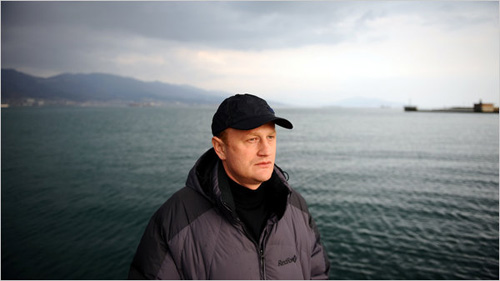
Aleksei Dymovsky, a former policeman, on the Black Sea shore in his hometown, Novorosiysk, in Southern Russia. (James Hill for The New York Times)
NOVOROSSIYSK, Russia — One day last fall, a police officer here put on his uniform and sat on a drab tan couch before a video camera. In a halting monotone, he recorded two video appeals to Vladimir V. Putin, 13 minutes in all.
He was a nobody cop from a nowhere city, but his words would startle this country.
“How can a police officer accept bribes?” the officer asked. “Do you understand where our society is heading?
“You talk about reducing corruption,” he said. “You say that it should not be just a crime, that it should be immoral. But it is not like that. I told my boss that the police are corrupt. And he told me that it cannot be done away with.
“I am not afraid of quitting. I will tell you my name. I am Dymovsky, Aleksei Aleksandrovich.”
The videos were uploaded to YouTube in November, and a nation that has grown increasingly infuriated by police wrongdoing could not take its eyes off them.
Here, finally, was an insider acknowledging the enveloping culture of corruption in Russia’s police forces — the payoffs large and small, the illegal arrests to extort money, the police chiefs who buy fancy cars and mansions on modest state salaries.
The videos have been watched more than two million times, giving Mr. Dymovsky a kind of fame in Russia similar to that of the police whistleblower Frank Serpico, who in the 1970s spoke out against police corruption in New York City.
But despite the attention, Mr. Putin, the prime minister, has spurned him. So has Mr. Putin’s protégé, President Dmitri A. Medvedev, though Mr. Medvedev has conceded that police corruption has reached shameful levels. And local authorities quickly retaliated against the officer.
Mr. Dymovsky, 32, was immediately fired from his job here in Novorossiysk, a port on the Black Sea, 750 miles south of Moscow. The police interrogated him, his relatives and his close friends, and raided their homes.
During one search of Mr. Dymovsky’s apartment, investigators tried to plant drugs, according to his wife, who was nearly nine months pregnant at the time.
In January, they arrested him and charged him with abuse of office and fraud under a law governing state secrets. The crime they alleged: embezzling $800 in petty cash from the department over several years.
In jail, Mr. Dymovsky was isolated, and prosecutors sought to subject him to a lengthy psychiatric examination. But with the affair proving an embarrassment, he was released after six weeks, and the charges were eventually dropped.
Still, the chief of the Novorossiysk police and a high-ranking officer sued Mr. Dymovsky for slander, and a judge ordered him to pay the equivalent of $3,500 in damages.
International research organizations rank Russia as having the world’s most corrupt large economy, in part because of bribery linked to law enforcement personnel. But senior Russian officials have long seemed to view the loyalty of police officers as more important than their integrity.
And the authorities appeared to do nothing to correct the abuses that Mr. Dymovsky publicized.
The Interior Ministry, which oversees the police nationwide, denied Mr. Dymovsky’s charges. All was in order, the ministry said, with the Novorossiysk police force.
Mr. Dymovsky’s Internet appeals have been imitated by other Russians who are despondent about official malfeasance and believe that they have no other outlet for their views because the state-controlled media whitewashes these problems.
But the Kremlin is seeking to curtail this trend, at least among the police. Parliament, controlled by Mr. Putin’s party, this month toughened penalties for officers who criticize their superiors. It is being called the “Dymovsky law.”
Making Ends Meet
Mr. Dymovsky admits that his own hands are not clean. According to his personnel records, he had a promising career as a police officer, with commendations and promotions. Even so, he said in an interview, he took bribes.
As a major, he was paid only about $450 a month. He said that the authorities know that on such low salaries, officers must find other ways to make ends meet.
He insisted that he accepted only small bribes, never more than $20 at a time. But this was his point: Corruption is endemic.
“The system, from your first day at work, requires you to go out and obtain bribes,” he said. “How else are you going to survive?”
Mr. Dymovsky also described a practice that is considered common in Russia: When officers end their shifts, they have to turn over a portion of their bribes to the so-called cashier, a senior member of the department. Typically, $25 to $100 a day.
If officers do not pay up, they are disciplined.
Mr. Dymovsky said that by 2007, he had become so demoralized that he pledged to himself that he would never again accept a bribe.
Around the same time, he tried to speak with Mr. Putin on his annual call-in television show, during which he responds to complaints and questions from Russians. Mr. Putin was president then.
Mr. Dymovsky said he had called and informed the operator that he hoped to ask Mr. Putin what he was doing about the “lawlessness and corruption” among the police.
He was kept off the air, and later found out that his call had been traced. The Interior Ministry in Moscow alerted his department, and he was reprimanded at several meetings. He was told that a letter had been drafted under his name, in which he would deny having called.
“I realized how this system of covering each other’s backs worked, and that it was not just restricted to Novorossiysk, but reached as far as the Kremlin,” Mr. Dymovsky said.
He decided to record the videos after months of tension.
Mr. Dymovsky said he was upset that his superiors did not care that he had suffered a work-related injury to his arm. (Mr. Dymovsky devoted part of his appeals to denouncing workplace conditions for the police.)
In person these days, Mr. Dymovsky is far more relaxed than the stiff officer in the videos. Tall, with light red hair and a slightly mischievous laugh, he has become a confident public speaker, and seems to enjoy — if not crave — the spotlight.
Luxury on $25,000 a Year
In Novorossiysk, Mr. Dymovsky offered a tour of what he maintained were among the most dispiriting symbols of corruption: the luxury homes of the police brass.
The main stop was the spacious beachfront home where the head of the department, Chief Vladimir Chernositov, lives.
The building, with a conspicuous light blue roof, is on the Black Sea, some of the most expensive real estate in Russia, valued at roughly $800,000 an acre, according to advertisements.
Chief Chernositov has not denied that the home is his, but has never publicly explained how he can afford it. A police chief’s salary for a city like Novorossiysk, which has 225,000 people, is typically about $25,000 annually, experts said.
One of Chief Chernositov’s deputies, Vladimir Grebenyuk, said in an interview that the department was offended by Mr. Dymovsky’s video appeals.
He said Mr. Dymovsky had been an average, though not disgruntled, employee.
Deputy Chief Grebenyuk said that after the videos were publicized, a special committee examined Mr. Dymovsky’s accusations.
“Not a single fact presented by Dymovsky was confirmed,” Deputy Chief Grebenyuk said. “Everything he said was false and invented.”
“You know, our system, the system of the Interior Ministry, is very transparent,” he said.
Asked how many members of the department had been punished for corruption recently, he said the number was tiny. But he would not provide any details.
A Backlash Felt in Moscow
Those who have helped Mr. Dymovsky or demanded a wholesale revamping of the police have also come under pressure.
In Novorossiysk, a human rights activist named Vadim Karastelyov was jailed for a week for distributing leaflets asking residents to attend a rally for Mr. Dymovsky. After Mr. Karastelyov was released, he was savagely beaten by two strangers who did not try to rob him.
Mr. Karastelyov had been receiving anonymous threats by phone and text message, but the police would not provide him with protection. He recently fled Novorossiysk with his family.
“The police leaders want everyone to forget about Dymovsky, so they can continue to doing what they have been doing — committing corrupt acts and fabricating cases against innocent people,” Mr. Karastelyov said.
The backlash extended to Moscow.
A few weeks after Mr. Dymovsky’s video appeals, a senior member of Parliament from Mr. Putin’s own party, Andrei Makarov, declared that the police were so corrupt nationwide that the entire Interior Ministry should be abolished.
Mr. Makarov was disavowed by his party.
“When I made that statement, believe me, for several days, no one knew what would happen to me,” Mr. Makarov said in an interview. “It was as if, ‘How dare he!’ What happened was that I was talking about the people who have the real power in this country.”
Mr. Makarov said he was not a fan of Mr. Dymovsky, expressing doubts about Mr. Dymovsky’s honesty. But Mr. Makarov said reform was desperately needed.
Reform Plan Stalls
He said the government should dismiss half of the country’s 1.2 million police officers and establish a system to fairly adjudicate complaints about the police.
President Medvedev has proposed reducing the number of officers by 20 percent, but there are already indications that his reform proposal has stalled.
“Police officers know for sure that nobody will hold them accountable if a crime is not solved, but they will be held accountable if they allow a demonstration to occur,” Mr. Makarov said. “They will not be held accountable for putting an innocent person in jail or beating one on the street, but they will be if somebody takes a stand against the authorities.”
Mr. Dymovsky said the only real answer is for Russians to create a grass-roots anticorruption movement. Since his release from jail, he has been traveling around the country, trying to rally support for new policies.
But he is still apparently considered a danger.
Recently, he went to Novosibirsk, Russia’s third-largest city, to attend a protest. He said he was accosted by four plainclothes police officers, who told him that if he ever wanted to see his family again, he should leave and never return.
© The New York Times
By Clifford J. Levy
IRKUTSK, Russia — It was late one afternoon in January when a squad of plainclothes police officers arrived at the headquarters of a prominent environmental group here. They brushed past the staff with barely a word and instead set upon the computers before carting them away. Taken were files that chronicled a generation’s worth of efforts to protect the Siberian wilderness.
The group, Baikal Environmental Wave, was organizing protests against Prime Minister Vladimir V. Putin’s decision to reopen a paper factory that had polluted nearby Lake Baikal, a natural wonder that by some estimates holds 20 percent of the world’s fresh water.
Instead, the group fell victim to one of the authorities’ newest tactics for quelling dissent: confiscating computers under the pretext of searching for pirated Microsoft software.
Across Russia, the security services have carried out dozens of similar raids against outspoken advocacy groups or opposition newspapers in recent years. Security officials say the inquiries reflect their concern about software piracy, which is rampant in Russia. Yet they rarely if ever carry out raids against advocacy groups or news organizations that back the government.
As the ploy grows common, the authorities are receiving key assistance from an unexpected partner: Microsoft itself. In politically tinged inquiries across Russia, lawyers retained by Microsoft have staunchly backed the police.
Interviews and a review of law enforcement documents show that in recent cases, Microsoft lawyers made statements describing the company as a victim and arguing that criminal charges should be pursued.
The lawyers rebuffed pleas by accused journalists and advocacy groups, including Baikal Wave, to refrain from working with the authorities. Baikal Wave, in fact, said it had purchased and installed legal Microsoft software specifically to deny the authorities an excuse to raid them. The group later asked Microsoft for help in fending off the police. “Microsoft did not want to help us, which would have been the right thing to do,” said Marina Rikhvanova, a Baikal Environmental Wave co-chairwoman and one of Russia’s best-known environmentalists. “They said these issues had to be handled by the security services.”
Microsoft executives in Moscow and at the company’s headquarters in Redmond, Wash., asserted that they did not initiate the inquiries and that they took part in them only because they were required to do so under Russian law.
After The New York Times presented its reporting to senior Microsoft officials, the company responded that it planned to tighten its oversight of its legal affairs in Russia. Human rights organizations in Russia have been pressing Microsoft to do so for months. The Moscow Helsinki Group sent a letter to Microsoft this year saying that the company was complicit in “the persecution of civil society activists.”
Tough Ethical Choices
Microsoft, like many American technology giants doing business in authoritarian countries, is often faced with ethical choices over government directives to help suppress dissent. In China, Microsoft has complied with censorship rules in operating its Web search service, preventing Chinese users from easily accessing banned information. Its archrival Google stopped following censorship regulations there, and scaled back its operations inside China’s Internet firewall.
In Russia, leaders of advocacy groups and newspapers subjected to antipiracy raids said Microsoft was cooperating with the authorities because the company feared jeopardizing its business in the country. They said Microsoft needed to issue a categorical public statement disavowing these tactics and pledging to never cooperate in such cases.
Microsoft has not done that, but has promised to review its policies in Russia.
“We take the concerns that have been raised very seriously,” Kevin Kutz, director of public affairs for Microsoft, said in a statement. Mr. Kutz said the company would ensure that its lawyers had “more clearly defined responsibilities and accountabilities.”
“We have to protect our products from piracy, but we also have a commitment to respect fundamental human rights,” he said. “Microsoft antipiracy efforts are designed to honor both objectives, but we are open to feedback on what we can do to improve in that regard.”
Microsoft emphasized that it encouraged law enforcement agencies worldwide to investigate producers and suppliers of illegal software rather than consumers. Even so, it has not publicly criticized raids against small Russian advocacy groups.
With pirated software prevalent in this country, it is not surprising that some of these groups might have some on their computers. Yet the issue, then, is why the police choose to focus on these particular targets — and whether they falsify evidence to make the charges more serious.
Microsoft also says it has a program in Russia to provide free and low-cost software to newspapers and advocacy groups so that they are in compliance with the law.
But the review of these cases indicates that the security services often seize computers whether or not they contain illegal software. The police immediately filed reports saying they had discovered such programs, before even examining the computers in detail. The police claims have in numerous instances been successfully discredited by defendants when the cases go before judges.
Given the suspicions that these investigations are politically motivated, the police and prosecutors have turned to Microsoft to lend weight to their cases. In southwestern Russia, the Interior Ministry declared in an official document that its investigation of a human rights advocate for software piracy was begun “based on an application” from a lawyer for Microsoft.
In another city, Samara, the police seized computers from two opposition newspapers, with the support of a different Microsoft lawyer. “Without the participation of Microsoft, these criminal cases against human rights defenders and journalists would simply not be able to occur,” said the editor of the newspapers, Sergey Kurt-Adzhiyev.
The plainclothes officers who descended upon the Baikal Wave headquarters said they were from the division that investigated commercial crime. But the environmentalists said they noticed at least one officer from the antiextremism department, which tracks opposition activists and had often conducted surveillance on the group.
The officers said they had received a complaint from a man named Dmitri Latyshev, who claimed that he had been in the headquarters and spotted unlicensed Microsoft software on the computers. The police produced a handwritten complaint from Mr. Latyshev, dated Jan. 27. The raid occurred the next day.
People at Baikal Wave said they had never seen or heard of Mr. Latyshev. Located in Irkutsk recently, Mr. Latyshev said by phone that he had filed the complaint but would not say why.
Baikal Wave’s leaders said they had known that the authorities used such raids to pressure advocacy groups, so they had made certain that all their software was legal.
But they quickly realized how difficult it would be to defend themselves.
They said they told the officers that they were mistaken, pulling out receipts and original Microsoft packaging to prove that the software was not pirated. The police did not appear to take that into consideration. A supervising officer issued a report on the spot saying that illegal software had been uncovered.
Before the raid, the environmentalists said their computers were affixed with Microsoft’s “Certificate of Authenticity” stickers that attested to the software’s legality. But as the computers were being hauled away, they noticed something odd: the stickers were gone.
In all, 12 computers were confiscated. The group’s Web site was disabled, its finances left in disarray, its plans disclosed to the authorities.
The police also obtained personnel information from the computers. In the following weeks, officers tracked down some of the group’s supporters and interrogated them.
“The police had one goal, which was to prevent us from working,” said Galina Kulebyakina, a co-chairwoman of Baikal Wave. “They removed our computers because we actively took a position against the paper factory and forcefully voiced it.”
“They can do pretty much what they want, with impunity,” she said.
A Company’s Pollution
The paper factory is located on Lake Baikal, the world’s oldest and deepest lake, which is home to hundreds of species that exist nowhere else, including a freshwater seal. Over the years, the factory has spewed mercury, chlorine, heavy metals and other pollutants into the water.
Baikal Wave rejoiced when the factory closed in 2008, having succumbed to sizable losses, as well as pressure from environmentalists. But after the financial crisis hit, the Kremlin worried about unrest from unemployment. In January, Mr. Putin reopened the factory, which has employed as many as 2,000 people, saying that it no longer polluted the lake.
Baikal Wave, which was founded in Irkutsk, one of Russia’s largest cities, as the Soviet Union was collapsing, began planning a protest. That was when the officers showed up.
In a statement, the Irkutsk police said the raid was proper. “The inspection of Baikal Environmental Wave was intended to protect intellectual property and had no connection whatsoever with the activities of the advocacy organization,” the statement said.
It said a forensic examination of the computers in February showed that several contained illegal software that would have cost more than $3,300. Baikal Wave said the examination was fraudulent.
Prosecutors say they are now weighing whether to press charges against Baikal Wave or its leaders. It is possible, though unlikely, that they could face jail time if convicted.
Neither Microsoft’s Moscow office nor its local lawyer contacted Baikal Wave to hear its side. The lawyer did provide testimony to the police about the value of the software that Baikal Wave was accused of illegally obtaining.
Baikal Wave sent copies of its software receipts and other documentation to Microsoft’s Moscow office to show that it had purchased the software legally. The group said it believed that the authorities would be under pressure to drop the case if Microsoft would confirm the documents’ authenticity.
Microsoft declined to do so. In a letter to Baikal Wave, the company said it would forward the materials only to the authorities in Irkutsk, which already had copies of them.
“A determination of the actual circumstances of this case and the question of whether a violation of the law took place is the duty of the court,” Microsoft said.
The company also told Baikal Wave that it was willing to have its specialists assist the police in Irkutsk in evaluating the computers.
In response to written questions, Alexander Strakh, Microsoft’s chief antipiracy lawyer in Moscow, said that in all these cases, Microsoft assisted the authorities only as called for under Russian law.
Mr. Strakh was asked whether Microsoft believed that these raids were a tool to suppress the opposition. “We have no direct knowledge of decisions by authorities to use investigations in that manner,” he said.
Microsoft has hired numerous private lawyers across Russia who represent the company in piracy cases. Several of the lawyers have cropped up in these politically sensitive inquiries.
This year, prosecutors in the southwestern city of Krasnodar brought a piracy case against an immigrant rights activist named Anastasia Denisova. She said in an interview that she was surprised at the aggressive posture of Microsoft’s local lawyer.
In an official document, the Interior Ministry said the case against Ms. Denisova was begun “based on an application” from the lawyer. (Microsoft’s Moscow office said that statement was not correct.)
Ms. Denisova said the lawyer overestimated the value of the allegedly pirated software. As a result, the accusations were more serious.
“The Microsoft lawyer was very active, coming to the court all the time, even though he was not summoned,” she said. “He also claimed that he was going to sue me, despite the fact that Microsoft had publicly stated that it would not do so against an advocacy group.”
In May, after Ms. Denisova had spent several months under the threat of a prison sentence, the charges were dropped. Prosecutors acknowledged that the investigation had been mishandled.
Samara, in Russia’s industrial heartland, has been a focal point for these raids. In May 2007, when Mr. Putin was holding a summit meeting there with European leaders, the police sought to prevent protests by seizing computers from several organizations, including Golos, an election monitoring and human rights group, and the local edition of Novaya Gazeta, the country’s most influential opposition newspaper.
Last year, they took computers from another newspaper, Samarskaya Gazeta. According to case records, the police conducted that search based upon a complaint from a man who admitted that he had never been in the newspaper’s offices or seen its computers.
Mr. Kurt-Adzhiyev, the editor of both newspapers, said Microsoft’s lawyer in the case regularly appeared at court hearings to back prosecutors and the police. He said the lawyer testified that seized computers contained pirated software even though it was later shown that the computers had never been examined.
“Microsoft says publicly that they have no claims in these cases, but then their lawyers come into the court and say whatever the police want them to say,” Mr. Kurt-Adzhiyev said.
The Damage Is Done
Prosecutors eventually dropped or suspended the charges against Mr. Kurt-Adzhiyev after he was able to discredit them. But he said the damage was done. He said the newspapers lost computers and data, and he spent an enormous amount of time ensnared in legal proceedings. The local edition of Novaya Gazeta had to close.
Mr. Kurt-Adzhiyev said he now realized that the authorities were not so much interested in convictions as in harassing opponents. Even if the inquiries are abandoned, they are debilitating when they require months to defend.
Microsoft’s Moscow office said its lawyers had conducted themselves properly in the cases in Krasnodar and Samara.
In Irkutsk, Baikal Environmental Wave has also struggled to recover from the raid. It located some old computers and was still able to hold protests against the paper factory.
The seized computers were not returned by the police until July, five months after they were removed. Their hard drives had been inspected by police experts in February. The environmentalists do not know whether all their data remain, and they are sure that files were copied.
Ms. Rikhvanova, one of the group’s co-founders, who has been fighting to defend Lake Baikal since the 1960s, was unable to use her computer. When she got it back, she discovered that it had been disabled by a virus.
© The New York Times
By Ellen Barry
MOSCOW — Iosif L. Nagle was watching a final curtain at his small theater company when he saw two young men waiting for him in the audience. They didn’t look like patrons of the arts — something about their faces marked them as law enforcement — and Mr. Nagle bundled up and followed them out into the cold.
A few minutes later the three of them were talking over glasses of vodka. The subject was the jury that Mr. Nagle sat on, which, after four months of testimony, was leaning toward acquittal on some charges brought by the government.
The visitors, showing him cards that identified them as security officers, said it would be awful if such a bunch of criminals went unpunished. Would he consider, one of them said, withdrawing from the jury on the grounds of illness? Mr. Nagle said he had refused without a thought.
“I told them, ‘Why should I say I’m sick? You did your job badly, guys,’ ” said Mr. Nagle, 56. “ ‘Why did you bring an unsubstantiated case to court?’ ”
He watched them drive away that night, more annoyed than frightened. But already jurors and alternates were dropping off the panel one by one, and as winter turned into spring, only 12 of them, the number needed for a jury trial, were left. Even as they edged close to a verdict, the question became whether they could stay together long enough to deliver it.
Juries were supposed to change Russia. Introduced amid a raft of liberal reforms in 1993, they shifted power away from the state structure and thrust it into the hands of citizens. Juries introduced real competition into Russia’s courts, granting acquittals in 15 to 20 percent of cases, compared with less than 1 percent in cases decided by judges.
But the state has never been happy about leaving the fate of high-profile prosecutions in the hands of ordinary people.
Some juries skeptical of a prosecution have been dismissed on the verge of important verdicts. When they vote to acquit, their verdicts are routinely overturned by higher courts, allowing prosecutors to try for a conviction before another jury. Lawmakers are continuously chipping away at what types of criminal offenses merit a jury trial.
Meanwhile, the number of jury trials remains so small — around 600 a year out of a total of more than one million — that they vanish into a justice system that in some important ways has changed little since Soviet days.
The people on Mr. Nagle’s jury last summer were ordinary Muscovites: highbrow intellectuals, a gray-suited businessman, a couple of morning drinkers who got tossed out early. One juror, a dainty woman who operates a crane, arrived in the metropolis at age 20 with a single suitcase. The foreman had acted at Moscow’s most revered theater company.
All of them grew up in a country with no jury system. Mr. Nagle, artistic director at Moscow’s French Language Theater, gorged on Perry Mason novels and “Twelve Angry Men” before showing up, his professional interest piqued by “this human comedy which goes on” in the jury room. Rakhilya Z. Salnikova, the crane operator, also came eagerly.
“I felt that it would be an honor for me, that they would have that much trust in me,” she said. They settled in to listen to testimony, she said, “as if we were watching a film.”
No Ordinary Case
Igor V. Izmestiev, who sat in the metal defendant’s cage in the courtroom, had the sleek, well-fed look of the new rich. Though there were 12 other defendants, accused of carrying out contract hits for him, this was the man who mattered, the one at the vortex of power and money.
A multimillionaire and former senator, Mr. Izmestiev, 44, had risen to prominence in his native Bashkortostan, a southwestern republic that sits on enormous reserves of crude oil. He owed much of his success to Murtaza G. Rakhimov, who for two decades ran the region like a personal fief.
Mr. Izmestiev was partners with Mr. Rakhimov’s son Ural, whose fortune Forbes estimated at $1.2 billion, and was so close to the family, his lawyer said, that Mr. Rakhimov called him “his second son.”
Mr. Izmestiev’s political cover caved in spectacularly, and he was arrested on suspicion of murder in 2007. Commentators offered various explanations for the extraordinary prosecution, most often that it served as a warning shot to the Rakhimovs, who were finally forced from power this summer.
Whatever the reason, charges against Mr. Izmestiev accumulated until they included attempting to bribe a Federal Security Service agent, organizing and leading a criminal gang, ordering five murders and six attacks, burning down a printing business, and attempting to kill Ural Rakhimov. A new charge, terrorism, was tacked on in 2008. The jury trial was closed to the public, another move that caught the attention of legal activists.
“I don’t know if he is guilty or not,” said Lev A. Ponomarev, founder of the group For Human Rights, “but I can say for sure that it is a political question.”
In the jury room, a few on the panel were beginning to say the same thing. They were split, occasionally arguing so passionately that the bailiff had to come in, said Lidia S. Vasilyeva, one of the jurors. She felt that Mr. Izmestiev was probably guilty of some wrongdoing, but not the list of charges he was facing.
“You don’t get that kind of money without getting your hands dirty,” she said, “but everything they tried to hang on him, it was absurd.”
She was one of four jurors who told The New York Times that they were not convinced.
“I think that guilt, not just of one person, but of several people, was not proven,” said Teimuraz Bagylly, a businessman who also serves as deputy director of a legal research group, who withdrew after five months to attend a professional conference. Ms. Salnikova, who dropped out to return to work, agreed.
“I looked at them and thought, ‘This isn’t believable,’ ” she said.
By the time the trial was half over, Mr. Nagle said, he had been persuaded that the charges were driven by politics and money. He said at least half the jury had agreed with him.
“All this seemed unconvincing and unproven, practically the whole prosecution, with very few small exceptions,” he said. “We expected that there would be some main evidence which proved everything. But it never appeared.”
‘Like Spiders in a Jar’
Mr. Nagle did not feel frightened by the investigators who came to visit him that winter. They were his son’s age, he recalled, and he used a sterner tone with them than they did with him. They seemed to accept his answer, he said.
“They understood that threats would only get resistance out of me,” he said.
When he returned to jury duty, he submitted a note informing the judge that law enforcement officials had urged him to withdraw, a blatant violation of Russian law, which grants jurors the same protection from influence as judges. But there was no response, he said.
Two months later, Ms. Vasilyeva said, she too was approached by young men who suggested, during a friendly conversation, that she drop off the jury.
“They said, ‘We know you are leaning toward a verdict of acquittal,’ ” she said. “I said ‘I am not the only one.’ I said I could only speak for myself — I don’t know what another person has in their head.
“I must say that made me feel angry,” she said. “I got really mad. It was anger and nothing but anger.”
By late February, seven months into the trial, 10 jurors had dropped out. The withdrawal of one more would result in a dismissal. But two or three weeks were all they needed to reach deliberations.
Or that’s what they thought on Feb. 25, when the judge announced that a victim in the case was sick and the trial would have to wait until he could make a statement.
February turned into March and then April — three feet of crusty snow melted into a slushy deluge — and the 12 of them would remain in the jury room, playing cards or working crossword puzzles, on the days when they were called to appear. First they felt like uninvited guests and then, said Ms. Vasilyeva, like “spiders in a jar.” The delays made them angry, and in some cases, suspicious.
By May it was a test of endurance. Juror No. 4 kept complaining that she was needed in her hometown in Siberia, where her mother was sick. The juror was so reluctant to break the quorum that she twice bought airplane tickets and returned them, Ms. Vasilyeva said. Though they were still split on the question of guilt, all 12 felt a stubborn desire to finish, she said.
“I said to everybody, ‘Let’s go through to the verdict. I’m happy to sit here all night,’” she said.
She was not the only person in suspense. Sergei Antonov, the defense attorney, had felt confident since the fall, when he watched jurors smirking at prosecution witnesses. Then, one of the investigators assigned to the case had approached him in the smoking room and congratulated him on winning, he said.
“He said, ‘We listen to the jury and we know they are tending toward acquittal,’ ” he said.
But as the recess dragged on, Mr. Antonov realized that one of 12 jurors was bound to drop out.
“When nothing is happening, sooner or later the question arises, ‘Does it make sense to show up tomorrow?’ ” he said. “These people, for three months, they came every day. I realized that they wanted to give a verdict.”
But the filaments that held them together were fraying. The fourth juror submitted a note saying she was leaving for Siberia, and offering to return to Moscow if testimony resumed, said her fellow jurors. On May 12, the panel was dismissed.
‘There Is No Justice’
Ms. Vasilyeva, a retired telephone operator, professes herself entirely uninterested in politics — she rarely reads a newspaper, she said proudly. But as the jury’s designated mother hen, she was angry enough to speak publicly about the dismissal, about how unprotected jurors are from outside influence, how hard they worked to reach a verdict, how frustrating it was not to deliver it.
“Where money and politics are mixed up,” she said, “there is no justice.”
Mr. Nagle was similarly outspoken. He complained that “in old age, I have become disappointed in the justice system,” and told a television news crew about being approached by law enforcement and asked to drop out.
The experience left such a sour taste in his mouth, he said, that he tries not to dwell on it.
“The law doesn’t work. People in power can do whatever they want with the law,” he said. “It is always unpleasant when some of your illusions are destroyed.”
The only answer he has gotten is an indirect one.
A few days after Mr. Nagle described his complaints on the air, Pervy Kanal, the state-controlled television station, aired a segment devoted to the crimes of Mr. Izmestiev, concluding that “it is impossible to extract details from this porridge of politics, oil and blood, but it’s clear it has been brewed by one thing: big money.”
The camera cut to the host of the show, Aleksei V. Pimanov, a powerful television executive who has recently been nominated by the governing party, United Russia, to become a senator. Mr. Pimanov delivered a barbed message to the jurors who had spoken out, implying that they had been bribed by the defense.
“We would not have made this program while the case was going on if it had not been for the very strange behavior of these former jurors,” said Mr. Pimanov. “Something tells me that their statements — made in violation of all rules and laws — were made for a good reason. What that reason was, you can guess for yourselves.”
Since then, the jurors have kept quiet.
As for the case against Mr. Izmestiev, it will most likely end with a verdict in a matter of weeks.
This time the state is taking no chances. A spokesman for Russia’s general prosecutor, Yury Y. Chaika, would not respond to an inquiry from The Times on the matter, saying the case is still pending. But at a ceremony honoring investigators this fall, Mr. Chaika singled out the Izmestiev prosecution as a singular success.
He has every reason to be confident.
This spring, while the jurors were playing cards in the jury room, Russia’s Constitutional Court ruled that terrorism cases were too important to be trusted to ordinary citizens — they are, the court reasoned, too vulnerable to intimidation.
So this time, the verdict will be decided by a panel of three judges.
© The New York Times
By Clifford J. Levy
NOVOSIBIRSK, Russia — On the eve of regional elections, an opposition candidate named Olga V. Safronova arrived at a school for a campaign finale. She planned a rousing speech with a refrain that Russia had been seized by a dictatorial ruling party.
But operatives from that very party showed up to stop her.
What displeased them was this: Ms. Safronova’s political party was supposed to be a fake opposition, created by the Kremlin to give the illusion that Russia was a thriving democracy. Now, though, this puppet party was rebelling here in Siberia — battling for votes, defying the governing party and even assailing Prime Minister Vladimir V. Putin himself.
The governing party — in coordination with the authorities themselves — soon responded. And their efforts to suppress Ms. Safronova’s party, A Just Russia, seemed to underscore how laws intended to guarantee free and fair elections carry little weight in Russia.
The governing party operatives tried to bar Ms. Safronova from the school. They called the police to interrogate her. They warned teachers and others that they would be fired if they attended, and most left. Ms. Safronova ignored the threats and began speaking in an auditorium that was nearly deserted. Even so, the operatives sought to shout her down.
“You do not have permission to speak here!” said Gennadi V. Bykovsky, a former prosecutor and aide to the governing party candidate. “We don’t want to hear your blabbering.”
Ms. Safronova lashed back. “You are corrupt!” she said. “Do you see this? They can violate the law as much as they want. And me? How dare I! I should be lined up against the wall and shot for just trying to express my point of view.”
All around Novosibirsk, A Just Russia came under pressure, and had little chance of defending itself. The police raided the party’s offices, and the state television channel accused it of conducting a dirty campaign. Local officials even emblazoned logos of the governing party, United Russia, on city bulldozers to give the party, not the government, credit for fixing roads.
On Election Day, hundreds of soldiers from a military garrison were marched to a polling place and ordered to vote for United Russia, according to nonpartisan voting monitors.
It was as if the governing party and the government had merged, just as in the Communist era. And in many ways, they have. United Russia effectively controls regional governments, prosecutor’s offices, courts, police departments and election commissions.
Up against this colossus went Ms. Safronova, 53, a former Kremlin supporter who grew increasingly frustrated with the country’s political stagnation and decided to do something about it this year. She mounted her campaign for regional assembly, and worked to transform A Just Russia in Novosibirsk, Russia’s third largest city.
From the start, Ms. Safronova realized that the odds were against her.
She dressed like a corporate lawyer on the campaign trail, slogging through the mud of a dairy farm in the city suburbs in high heels. But the truth was that she was a widow with little money who lived with her mother, son and granddaughter in a threadbare housing project that looked as if it had not been renovated since Brezhnev’s time. She had long blond hair that she sometimes styled in a classic Slavic peasant braid, as if to hark back to her rural roots.
An economist by training, she had made many enemies as regional leader of a group called the Public Anticorruption Committee and, before that, as an advocate for small business in Novosibirsk. She expected that the governing party would be infuriated with the regional branch of A Just Russia. And so she was not surprised when she received menacing phone calls from people who would not identify themselves.
“They say, if I don’t end my campaign, they will kill me,” she said.
Still, she thought that even if she did not win, she could secure a high enough percentage of the vote to help prove that Russia had a viable new opposition at the regional level.
If United Russia went unchallenged, she insisted, then Russia would end up like the Soviet Union: foundering under the corrupt and incompetent reign of a single party.
“We are hoping that a massive number of people will come out on Election Day and declare that they will not take this anymore,” she said shortly before the voting. “We are striving to create a true multiparty system, a real democracy in Russia.”
To United Russia, those were fighting words.
A Puppet Rival Party
When the Kremlin birthed A Just Russia in October 2006, Mr. Putin, then Russia’s president, said the new party would “promote democratic values.” But it would also allow the Russian leadership to declare that the country had a multiparty system — even though A Just Russia was loyal to Mr. Putin.
His political aides also believed that A Just Russia (sometimes translated as Fair Russia) would siphon votes from the Communist Party, which still has support from the elderly, as well as people disgruntled with the country’s lurch toward capitalism. A Just Russia was to be left-leaning and modeled on Social Democratic movements in Europe.
But some Russians hunger for an alternative to the governing party and the Communists. From the day that the party was set up, some of its regional leaders agitated to split from the Kremlin. This year, in places like Novosibirsk, that movement started taking off.
Novosibirsk, with a population of 1.4 million people, was fertile ground because it is one of the country’s most progressive regions, site of a hub of prestigious universities.
What’s more, across the country, the governing party’s popularity before the Oct. 10 election was suffering. Public discontent was rising because of the weak economy and the authorities’ mishandling of crises over the summer, including a heat wave and forest fires. In Novosibirsk, United Russia was plunged into crisis when one of its own representatives got up in the regional assembly and unexpectedly repudiated the party. His microphone was cut off.
Regional chapters of A Just Russia had tried to wage authentic campaigns before, but the one here in October was among the fiercest. The headquarters of A Just Russia in Moscow referred to these newly assertive tactics as the “Novosibirsk experiment.” It viewed the election as a warm-up for national parliamentary balloting next year.
The party’s national leader, Sergei M. Mironov, who is head of the upper house of Parliament, visited the city and channeled funds to the campaign. (Because of Mr. Mironov’s prominence, the local authorities did not hamper him when he held campaign events here, his aides said.)
Mr. Mironov is a Putin ally, but he began drawing a distinction, vigorously opposing Mr. Putin’s party while usually — though not always — backing Mr. Putin himself. It was not clear why Mr. Putin tolerated this. There was speculation that he thought that competition would keep United Russia’s regional cadres from becoming complacent.
Whatever the case, people like Ms. Safronova flocked to A Just Russia. She became a regional aide to Mr. Mironov. For her assembly campaign, she put together a team of volunteers who had assisted her on anticorruption activities. But they, too, were subjected to pressure, especially younger men.
Rustam Mamedov, 34, who owns a construction business, said he joined A Just Russia because he was angered by constant demands to pay bribes to city officials. He said that in the weeks before the election, he was regularly threatened by United Russia officials, as well as the police. He recalled one phone call from an official whom he would not name.
“He told me that if we did not terminate our campaign, we would have very serious problems,” Mr. Mamedov said. “He made clear that he would get us in trouble with the narcotics police by planting drugs on us and then having us arrested. That’s what they usually do.”
Like others in the Safronova campaign, Mr. Mamedov did not relent, but he said he restricted his movements as the election neared. While his accusations could not be independently confirmed, such accounts were echoed by other volunteers for A Just Russia who were interviewed separately.
United Russia was especially angered that its rival printed hundreds of thousands of party newspapers that took aim at United Russia over basic issues like pensions, utility costs, corruption and food prices. “United Russia is a business,” one newspaper said. “It is a shameless, cynical and greedy business that is picking the pockets of the taxpayers.”
The police detained workers for A Just Russia who distributed the newspapers, and United Russia’s youth wing held a rally in the central square of Novosibirsk, where it dumped copies of the papers into a large waste bin marked “Garbage, Lies, Filth.”
In late September, the police went further, raiding the headquarters of A Just Russia and confiscating bundles of newspapers. The pretext was a bureaucratic error — the party had allegedly failed to fill out paperwork related to the printing of the newspapers.
United Russia leaders voiced exasperation at A Just Russia, saying that the party was so desperate for votes that it routinely violated the election law. They said A Just Russia sought to use legitimate law-enforcement activities to portray itself as a victim.
“They deliberately provoke these operations,” said Viktor A. Ignatov, a senior United Russia official in Novosibirsk. “If the police had not removed the literature, A Just Russia would have invented some way to provoke the police into doing it. They simply do outrageous things. If we had used such methods, our people would have long ago been arrested.”
It was just before the election, and Mr. Ignatov expressed confidence in his party’s prospects.
“I think that the Just Russia ‘project’ has been a failure,” he said.
A Candidate Fights On
But Ms. Safronova soldiered on. She was an animated speaker, able to connect with audiences by drawing upon her years in the trenches going up against crooked local officials. Even so, she often did not get a chance to get to the podium.
She booked a municipal cultural center for an event, and at the last moment, was told that the building had been closed for repairs. When she drove by soon after, it was open and decorated with balloons to attract visitors. She wanted to meet workers at a sprawling hospital, but her request was rejected on the grounds that it was a “sanitary zone.”
“My United Russia opponent was later welcomed there,” she said. “Apparently, he had no germs.”
Regional election officials denied that opposition candidates faced obstacles to campaigning, but such tactics were widely documented in Novosibirsk by Golos, the country’s leading nonpartisan voting rights monitor.
Nadezhda A. Lantsova, a senior coordinator in the city for Golos, said the government sought to hinder the opposition more this year than in any campaign in recent memory. She said the governing party seemed to view A Just Russia as a potent contender, to be taken more seriously than the Communists, who are seen as having limited support.
“Officials who do not obey the ruling party in relation to its campaign needs are simply fired from their jobs,” Ms. Lantsova said. “And the party can do this with impunity.”
By Election Day, Ms. Safronova was feeling beaten down but knew that she had to persevere because the next 24 hours would be crucial. Ballot-stuffing and other electoral misconduct is rampant in Russia, and it almost always benefits the governing party.
She visited as many polling places as possible so that United Russia operatives would know that she was watching. But when she monitored the returns, she sensed that something was wrong. Some polling places were delaying reporting totals.
When the results from those polling places finally arrived in the middle of the night, several showed spikes in turnout, as well as implausibly high totals for the governing party candidate — nearly 80 percent of the vote in some cases. It was a classic sign of vote-rigging, according to election experts who examined the totals.
Ms. Safronova ended up losing badly, coming in third with only 16 percent of the vote. The governing party candidate, Anatoly V. Zhukov, triumphed with 49 percent.
Overall, United Russia did not fare as well in Novosibirsk as it did in other regions, but it still dominated, garnering 50 out of 76 seats in the regional assembly.
Local election officials pronounced themselves pleased with the conduct of the election. “A Just Russia is putting out incorrect information, to my great regret,” said Tamara I. Aleksenko, chairwoman of the Novosibirsk regional election commission. “This was as democratic as you can get. Everything was done according to the law.”
Ms. Safronova did not agree. The day after the election, she was poring over the returns at the headquarters of A Just Russia when she started receiving phone calls from friends, expressing condolences. She had kept her composure until then, but something seemed to snap. She walked out to the corridor, her eyes filled with tears.
“This was so dirty, so dishonest,” she said. “I would understand if it had been an honest fight, but it was not. I have no desire to do this again. Maybe there will come a time when I will think differently. But for now, no.”
She decided to put it behind her and resume her anticorruption work, but others apparently had not forgotten. Last week, several men abruptly descended upon her office, threw down some documents and threatened to beat her if she did not leave immediately. The building was owned by the government, and she was being evicted.
© The New York Times
By Ellen Barry
MOSCOW — It was more than a year ago when six members of an obscure oversight panel filed into Butyrskaya Prison to look into the death of a prisoner.
They were hardly an intimidating bunch: retired women in hats, mostly, scribbling their observations in notebooks, regarded by the prison staff as a minor irritant, like fleas.
In a country whose law enforcement structures wield enormous power, it is easy enough to ignore civilian watchdog groups. But this day was different. When the doctors were led in and told to take a seat, the panel’s leader, a veteran human rights activist named Valery V. Borshchev, felt something unfamiliar in the air.
“They lied to us, of course,” Mr. Borshchev later recalled. “But they were frightened. And the fact that they were frightened gave us hope that something would really change.”
The man who had died was Sergei L. Magnitsky. His death in pretrial detention at the age of 37, officially recorded as resulting from sudden heart failure, sent shudders through Moscow’s elite. They saw him — a post-Soviet young urban professional — as someone uncomfortably like themselves. He had been arrested after accusing police investigators of a huge tax fraud, and he died awaiting trial.
A full account of Mr. Magnitsky’s death, the group knew, could restore some confidence in Russia’s legal system. A whitewash, on the other hand, could erode what faith remained.
Investigating the death meant confronting Russia’s security structures — the police, prosecutors, courts, prisons and prison doctors, all links in a self-protective chain. The findings, however decisive, would have to compete with an official inquiry, which would ultimately determine if anyone would be prosecuted.
Even so, they felt oddly hopeful. President Dmitri A. Medvedev, by all accounts genuinely angry over Mr. Magnitsky’s death, insisted that state prosecutors stop dragging their feet and open a case. Two days later, a top prison administrator admitted “obvious violations on our part” to a Kremlin advisory group.
In a country ruled more by commands than by laws, a command had gone out: This time someone would have to be punished.
So the inspectors walked into Butyrskaya with uncommon confidence.
“We could cover ourselves with this comment and say, ‘The president demanded an investigation,’ ” said Lyubov V. Volkova, deputy head of the panel, known as the Public Oversight Commission. “It was like an umbrella. We could go in and say, show us this, show us that. We are under this umbrella.”
Unlikely Detectives
Ms. Volkova and her colleagues were hardly detectives. Their group was brand new, approved by Mr. Medvedev after more than a decade of lobbying the government. They were empowered to inspect cells and investigate complaints, but their recommendations were not binding. In their berets and reading glasses, they seemed to pose little threat. But once inside Butyrskaya, the commission members were neck deep in a criminal investigation.
They moved from cell to cell, standing in the last spaces Mr. Magnitsky had occupied, seeing the last people he saw. They paged through sheaves of complaints he made: there were more than 400, as many as three a day, sometimes written by hand. The picture of a man began to take shape before them.
“Every day, in prisons, we see beaten, constrained, terrified people, who don’t complain about anything,” said Ms. Volkova, 62, a brash blonde partial to satin pants and animal prints. “Magnitsky complained. And the more he complained, the worse they made it for him. And then he complained again.”
“He is the only one we’ve seen like this,” she said.
There were signs that something had gone badly wrong. A doctor on the prison’s medical staff who had been treating Mr. Magnitsky for abdominal pain appeared more distraught than others interviewed by the group. Three days before his death, she told them, Mr. Magnitsky complained about vomiting and severe pain on his right side.
That was a Friday, and she went home for the weekend. No doctor saw him again until Monday, and then, she said, he had “acute, belting pain, vomiting every three hours.” It looked to her as if he had acute pancreatitis, which left untreated can lead to organ failure. As the commission members hastily took notes, the doctor described her alarm, saying: “It was necessary to push for an examination. I thought he had a chronic disease.”
At this, the commission members’ ears pricked up. Whom did she have to lobby to get Mr. Magnitsky treated?
But the conversation was cut short. At that moment, Mr. Borshchev recalled, a prison official walked up behind the doctor, grasped her by the shoulders, and took her out of the room.
Tracing a Prisoner's Journey
Mr. Borshchev learned about prisons in the 1970s, when, as a close friend of the Soviet dissident Andrei D. Sakharov, he ferried books and sausages to the outskirts of penal colonies to be passed to political prisoners. From his own interrogations for dissident activities, he knew that a prisoner needed a plan to withstand official pressure. He had his own plan: As soon as the investigator raised his voice, he would stop talking and gaze out the window.
Now 68, Mr. Borshchev has fat streaks of white in his beard, and peers over his glasses as if he is presiding over his own personal Supreme Court.
At Butyrskaya, he walked from one cell to another, tracing eight transfers Mr. Magnitsky underwent in the last three months of his life. The cells were increasingly cramped, dark and dirty.
Though a prison doctor had diagnosed gallstones and pancreatitis and ordered a follow-up ultrasound, Mr. Magnitsky was suddenly transferred to Butyrskaya, which had minimal medical facilities. There he had an attack, writing of pain “so acute that I was not even able to lie down.” In September, Oleg F. Silchenko, lead investigator in the case, refused Mr. Magnitsky’s appeal to advocate for the ultrasound, saying investigators were under no obligation to intervene. The ultrasound never happened.
Mr. Magnitsky was allowed only one visit with his wife and mother for the full 11 months he was in custody; they attended court hearings so they could stare at him from across the room. He passed the time by reading Shakespeare’s tragedies. When overcome with anxiety or despair, a cellmate later said, he would turn his face to the wall, as if he wanted it to swallow him up.
To Mr. Borshchev, there was only one way to interpret this: the prisoner was refusing to cooperate. Indeed, Mr. Magnitsky’s job at a Russian-American law firm drew him into a battle between William F. Browder — once the largest foreign investor in the Russian stock market — and the Interior Ministry, which oversees law enforcement. In 2007, Mr. Browder’s company, Hermitage Capital, based on Mr. Magnitsky’s research, accused police investigators of an immense act of corruption, charging that they had seized three of Mr. Browder’s subsidiary companies and used them to receive a $230 million tax refund.
The next year, the Interior Ministry charged Mr. Browder’s companies with evading $17.5 million in taxes. As soon as Mr. Magnitsky was arrested, investigators were pushing him to testify against someone, presumably Mr. Browder, said his defense lawyer, Dmitri V. Kharitonov. But he refused.
The commission’s narrative flowed with some logic until it reached Nov. 16, 2009, the day he died. The nervous doctor sent Mr. Magnitsky to another prison, which had a hospital. There, the oversight panel met a surgeon named Dr. Aleksandra V. Gaus, who said she noted upon his arrival that he had symptoms of acute pancreatitis and prepared to send him for treatment.
At 7 p.m., Dr. Gaus said, he started to act erratically, and she changed her mind, determining that he was suffering from “acute psychosis and persecutory delusions.” She called a team of eight guards to forcibly subdue him, and they handcuffed him to the bed in an isolation cell to wait for a psychiatric emergency team. An hour and a half later, officials said, he collapsed when the psychiatrist was examining him, and was rushed to intensive care for resuscitation. He was declared dead at 9:50 p.m.
Mr. Borshchev was mulling over this account when he got a startling phone call. A few days earlier, he had left his card for the psychiatrist who was present at Mr. Magnitsky’s death. On the phone was the psychiatrist, Dr. Vitaly V. Kornilov, who told a different story: He and his team had been forced to wait at the clinic’s outer gates for a full hour — roughly from 8 until 9 p.m. — before they were allowed inside.
By the time he entered the cell, as Dr. Kornilov would later tell the official investigators, “we were presented with the fact that we could not carry out a psychiatric examination because of the lack of a patient.”
“The head of the corpse was tilted toward his left shoulder, his eyes were open and wide,” he said, according to official documents. “No heartbeat could be felt, no breath or arterial pressure was felt, his skin was pale and cool. Biological death had occurred 15 minutes before.”
The Panel Reports
Six weeks after Mr. Magnitsky’s death, Mr. Borshchev published the commission’s report. He was pleased; though there were still gaps and contradictions, he was sure the commission had uncovered enough to show that someone could be charged, if only for negligence. “When undesirable information gets into the case file, it starts working by itself,” he said. “It must be disproved or else unraveled.”
But another inquiry — the official one — was taking place out of public view. Around 12 hours after Mr. Magnitsky died, his body was examined by a coroner who reported that Mr. Magnitsky’s death was as sudden and unpredictable as a lightning strike. In her report, a copy of which was reviewed by The New York Times, she listed the cause of death as heart failure as a result of dilated cardiomyopathy, a disease that sometimes makes headlines when young athletes collapse in the middle of a game. She found no evidence that he was suffering from pancreatitis.
The autopsy would undergo a series of expert analyses — one of which involved dozens of specialists and was headed by the country’s most famous cardiologist. That panel was confident enough to provide what appeared to be an endpoint to the investigation.
“The drawbacks in medical aid given to Magnitsky,” they wrote, “have no connection to his death.”
Still, the experts did not hide their dissatisfaction. After reviewing accounts from medical staff members, they said the testimony was so contradictory that they could not even determine the time or place of Mr. Magnitsky’s death, official documents show. They were given such paltry documentation that they “couldn’t give an objective assessment of medical care” or determine whether a crime occurred.
They noted that none of Mr. Magnitsky’s doctors had showed concern over his heart, and that diagnostic work done three weeks before his death showed no signs of heart disease.
Moreover, no blood samples were taken when Mr. Magnitsky arrived at the hospital — “the lab only works during the day, and it was night,” Dr. Gaus told a forensic expert — and little toxicology screening was done after his death. So it is difficult to know whether his symptoms were caused by septic shock, an overdose of some agent, or some other form of poisoning. And there was little explanation for the fact that he had been left in a cell for more than an hour in a state of acute distress.
By fall, police officials were so confident that they began to go on the attack. At a ceremony to observe Militia Day, the Interior Ministry bestowed public honors on the investigators who helped put Mr. Magnitsky in prison. On the anniversary of his death, the ministry held a news conference to announce an astounding new accusation: He himself was guilty, said a spokeswoman, of applying for a fraudulent $230 million tax refund. That is the crime Hermitage had reported to prosecutors in 2007.
The inquiry Mr. Medvedev had ordered was extended a second time, but now a new signal had gone out: No arrest was imminent.
“There is no basis to believe that his death was connected to the officials carrying out his prosecution,” Aleksandr Bastrykin, director of the Investigative Committee, the Russian agency that was charged with inquiring into his death, said in September.
No Longer Waiting
Mr. Borshchev had long since stopped waiting for a response to his report. He was at home listening to the radio one day when he heard Aleksei V. Anichin, the head of the Interior Ministry unit that handled Mr. Magnitsky’s case, say that his investigators were “the people who suffered the most from Mr. Magnitsky’s death” — because they lost the opportunity to convict him.
“After this statement,” he said, “it became clear that the investigation is not interested in finding the truth.”
Something had changed during the year, and the members of the Public Oversight Commission felt it as keenly as anyone. When the time came to nominate the new members of the panel — whose single high-profile act had been its damning report on Mr. Magnitsky’s death — the candidates were not well known in human rights circles.
Two were from the Association of Professional Security Guards; two were from the Veterans of the Secret Services; another two were from the Association of Retired Police Operatives; two were from the Association of Police Veterans. The balance on the panel is now so tenuous that Mr. Borshchev fears he will be replaced as the body’s president. One of his critics on the panel, Anton V. Tsvetkov of the Officers of Russia Foundation, complained about “nihilists who disavow everything, who criticize everything,” but said his position had nothing to do with the report on Mr. Magnitsky’s death. “I don’t think anyone read that report,” he said.
Two weeks ago, the state’s lead investigator for the first time asked to interview Mr. Borshchev and Ms. Volkova about their research in the case. They sat together for three hours, meticulously reviewing the findings, which are to be attached to the official file. As they left, Mr. Borshchev said, he clung to the hope that Mr. Medvedev might still press to uncover what really happened.
Ms. Volkova said she was exhausted from the effort of hoping. “I have begun to feel sorry for our president, for Medvedev,” she said. “I look at him and say: ‘Poor, poor boy. Are you really going to clean up all this dirt that they are producing? These hundreds of thousands of corrupt people?’ I am sure that he is the most pitiable person.”
“Nothing was stopping him from giving an order, at least, not to give awards to the investigators,” she said. “Nothing stopped him.”
© The New York Times
By Clifford J. Levy
MOSCOW — In a small courtroom in Moscow, friends of Natalya K. Estemirova crowded onto wooden benches, clasping photographs of her. It was 16 months after the murder of Ms. Estemirova, a renowned human rights advocate in the tumultuous region of Chechnya, and now the legal system was taking action.
A defendant was on trial, and his interrogators were demanding answers about special operations and assassination plots.
But the defendant was not Ms. Estemirova’s suspected killer. It was her colleague Oleg P. Orlov, chairman of Memorial, one of Russia’s foremost human rights organizations.
The authorities had charged Mr. Orlov with defamation because he had publicly pointed the finger at the man he believed was responsible for the murder: the Kremlin-installed leader of Chechnya. If convicted, Mr. Orlov could face as many as three years in prison.
The shooting of Ms. Estemirova, 51, in July 2009 has so far produced only an incomplete investigation, and no charges have been filed against anyone involved. Her case has instead turned into an example of what often happens in Russia when high-ranking officials fall under scrutiny. Retaliation follows, and the accuser becomes the accused.
Mr. Orlov, who first raised his voice against official wrongdoing as an anti-Soviet pamphleteer in the 1980s, has found himself under an unrelenting legal siege from the Chechen leader, Ramzan A. Kadyrov.
Mr. Kadyrov’s attempt to silence Mr. Orlov reflects an increasingly common tactic in Russia. The authorities do not summarily imprison their critics as dissidents, as in Communist times. They instead often invoke an array of civil and criminal charges, including defamation, to exact financial penalties or prison sentences. They haul their opponents before judges who are wary of handing down decisions against those in power.
Mr. Kadyrov, who denies any connection to Ms. Estemirova’s killing, rules unchallenged in Chechnya. Still, he has portrayed Memorial as a treacherous and violent organization. In seeking charges against Mr. Orlov in Moscow, 1,000 miles from Chechnya, he effectively quashed the idea that the Russian capital offers sanctuary for those pursuing human rights issues in remote regions. No one from the Kremlin has come to Mr. Orlov’s defense.
Mr. Kadyrov’s lawyer, who under the law can work with the prosecution during the proceedings, has even used the trial to promote his own black-is-white theory of Ms. Estemirova’s death. “Maybe Memorial itself ordered the killing” to discredit Mr. Kadyrov, said the lawyer, Andrei A. Krasnenkov.
Mr. Orlov has been allowed to remain free while the trial continues, and has not recanted his criticism of Mr. Kadyrov, who has been assailed by human rights groups for his brutal methods in quelling the Islamic insurgency in Chechnya.
Mr. Orlov said that Mr. Kadyrov, if not directly responsible for ordering Ms. Estemirova’s murder, was at a minimum responsible for demonizing her and for indicating to his associates that he would not mind if she were no longer around. Mr. Orlov said Mr. Kadyrov had to be held accountable for the climate of bloodshed and fear in Chechnya.
With his shaggy mop of gray hair and sport coats — no tie, even in court — Mr. Orlov, 57, resembles an unassuming history professor. But during his tenure, Memorial has expanded well beyond its historical mission of remembering victims of Communist persecution. It has delved into some of the most provocative issues in Russia, from Chechnya to the rights of the political opposition.
“Of course, I don’t want to go to prison and lose my freedom,” Mr. Orlov said the other day at his office, which has a large bulletin board that is a shrine of sorts to Ms. Estemirova, who was also known as Natasha.
“But those words that I said were only a minimal debt owed to the murdered Natasha Estemirova,” he said. “This was the least that I could do for the memory of my deceased comrade and friend. I had to do it. I told the truth.”
Getting at the Truth
Natalya Estemirova was a former history teacher with a knack for putting victims at ease and a willingness to venture into conflict zones to get at the truth. As a senior researcher for Memorial in Chechnya, she had repeatedly documented atrocities committed by the security forces. Her findings had led to successful rulings against the government at the European Court of Human Rights — the only place many Russians feel they can obtain justice.
She did not support Islamic extremists in Chechnya, and did not shy from detailing their misdeeds. But she wanted the authorities to suppress the insurgency lawfully.
Mr. Kadyrov is a former militant who switched sides and became a Kremlin ally. He rose to power after his father, the Chechen president, was assassinated in 2004. Three years later, Vladimir V. Putin, then Russia’s president, named Mr. Kadyrov to lead Chechnya. He was only 30 years old. A bearded and muscular amateur boxer, he likes to brandish weapons before the cameras and show off a personal zoo, stocked with a tiger, ostriches and other exotica. The Kremlin has credited him with stabilizing and rebuilding Chechnya.
Mr. Kadyrov has often said that Ms. Estemirova and Memorial manufactured their conclusions in order to curry favor with Western donors and weaken Russia.
In 2008, witnesses at the current Orlov trial testified, Mr. Kadyrov tried to sideline Ms. Estemirova by appointing her to a government human rights panel. He apparently reasoned that if she had an official role, she would not go public with her criticism.
Soon after, Ms. Estemirova gave an interview with a national television network in which she disparaged rules in Chechnya requiring women to wear Islamic head scarves.
“I generally don’t like it when someone imposes something on me, dictates something to me or orders me around — how to live, how to dress,” Ms. Estemirova said.
Mr. Kadyrov, a major proponent of the rules, was infuriated, and at a meeting, fired her from the rights board.
“Natasha said he spoke to her very aggressively, in a hostile tone, and periodically broke into screaming,” a colleague, Yekaterina Sokiryanskaya, told the court this month.
“He threatened Natasha, and expressed his extreme displeasure with Natasha’s work in particular,” Ms. Sokiryanskaya said. “He said his arms were covered in blood up to his elbows. He said he had killed people, and he was not ashamed of it because he fought against the enemies of Chechnya.”
Ms. Sokiryanskaya then recounted the most chilling part. Mr. Kadyrov asked Ms. Estemirova whether she had a daughter, though he knew that she did. He posed another question: Did she ever fear for her daughter’s safety?
Ms. Estemirova left the meeting and fled Russia with her teenage daughter. It was the second time that she had gone into exile after being berated by Mr. Kadyrov, her friends said. But after a few months, she returned, still criticizing Mr. Kadyrov and his security forces.
In July 2009, Ms. Estemirova was compiling information about how the security services were setting fire to the homes of relatives of suspected militants. A senior Chechen official complained to a colleague of hers that she was smearing Chechnya’s reputation.
The official made reference to Anna Politkovskaya, the crusading opposition journalist who was killed in 2006 and was Ms. Estemirova’s friend. He said that if Ms. Politkovskaya had trod more cautiously, she would still be alive.
Ms. Estemirova’s superiors in Moscow grew alarmed and began planning to evacuate her again. But it was too late.
As she left her apartment in Grozny, the Chechen capital, on July 15, she was shoved into a car by unidentified men, who drove her to the neighboring region of Ingushetia.
She was found shot to death on the side of a road. None of her valuables or documents were stolen. The authorities were not able to explain how her assailants transported her through several police checkpoints without being detected.
First Grief, Then Anger
When the news of Ms. Estemirova’s murder reached Moscow, Mr. Orlov was consumed with grief and regret: Why hadn’t Memorial gotten her out sooner? Then he became angry.
“People ask me, who is guilty of this murder?” Mr. Orlov thundered at a news conference. “I know the name of this person. I know his title. His name is Ramzan Kadyrov. His title is president of the Chechen Republic.”
In Chechnya, Mr. Kadyrov denied that he had anything to do with the killing, and promised to personally lead the search for the killers. Even so, he publicly belittled Ms. Estemirova and Memorial.
“Why would Kadyrov kill a woman whom no one cared about?” Mr. Kadyrov said in an interview with Radio Free Europe/Radio Liberty in August 2009. “She never had any honor, dignity or a conscience. Never.”
On Chechen television, he later referred to Memorial with the kind of language that the Soviet Union used when persecuting dissidents. “They are not my opponents — they are enemies of the people, enemies of the law, enemies of the state,” Mr. Kadyrov said.
Mr. Kadyrov would not be interviewed for this article. His aides said he had made his views clear in court papers.
Mr. Kadyrov first brought a civil lawsuit against Mr. Orlov, and less than three months after the murder, a judge ruled in Mr. Kadyrov’s favor. Memorial and Mr. Orlov were ordered to publish an official retraction of the charges against Mr. Kadyrov on Memorial’s Web site, and pay roughly $2,300 in damages.
At Mr. Kadyrov’s behest, prosecutors then indicted Mr. Orlov on criminal defamation charges.
At the trial this fall, Mr. Kadyrov’s lawyer, Mr. Krasnenkov, has suggested that Memorial menaced Mr. Kadyrov, not the other way around. Mr. Krasnenkov forcefully questioned a colleague of Ms. Estemirova, Aleksandr V. Cherkasov.
Mr. Krasnenkov: “Are you aware of physical threats toward Ramzan Kadyrov — or threats to kill him — heard from the very lips of one of the staff members of Memorial?”
Mr. Cherkasov: “I know nothing about that.”
Mr. Krasnenkov: “Can you guarantee that Memorial does not have a special group that exerts psychological and physical pressure on people whom Memorial is displeased with? Yes or no!”
Mr. Cherkasov: “Of course, I can. It’s strange for me to hear such a thing.”
Outside court, Mr. Krasnenkov said in an interview that a guilty verdict should compel the F.S.B., the main successor to the K.G.B., to close down Memorial. He said he hoped that Mr. Kadyrov’s stance against Memorial would encourage other Russian politicians to not only file civil lawsuits over unjust criticism, but also seek criminal charges.
“They should do this for the sake of preserving the reputation of the state,” Mr. Krasnenkov said.
Mr. Kadyrov has not yet testified in the case, but he may do so in January. The judge is expected to hand down a verdict soon after.
In the meantime, the inquiry into Ms. Estemirova’s murder continues, including into who ordered it.
Law enforcement authorities now maintain that the actual killer was an Islamic extremist who was shot to death by the police in autumn 2009. They say they located the weapon used to kill Ms. Estemirova next to an identification document with the extremist’s picture on it.
Mr. Orlov described that determination as a farcical attempt to pin her murder on a dead man — an insurgent, no less.
Mr. Orlov made a formal request to the authorities: If they have ruled out involvement by government officials in Ms. Estemirova’s death, then they should release the case file showing that they examined that theory. The request was denied.
© The New York Times
Biography
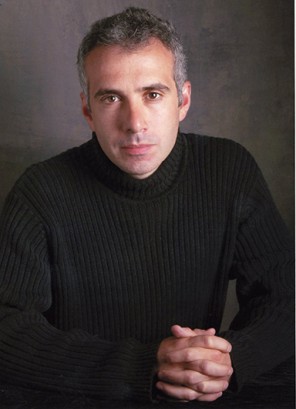
Clifford J. Levy was named Moscow bureau chief ofThe New York Times in July 2007, a year after becoming a Moscow correspondent for The Times. Before that, he was a projects reporter for the Metropolitan desk of The Times from 2000 to 2005. He was also Albany bureau chief, metro political reporter, City Hall correspondent and Newark correspondent. He joined The Times in 1990 as a news assistant, and was promoted to reporter in 1992.
Mr. Levy won the 2003 Pulitzer Prize for Investigative Reporting, The Times's first award in that category since it was created in 1985, for a three-part series that exposed the sometimes-fatal neglect of mentally ill people in privately run adult homes regulated by New York State. Mr. Levy also received a George Polk Award for that series. In 1999 he won a Polk Award for articles on the campaign finance practices of prominent state officials in New York.
In 2009, Mr. Levy was the International Print Winner for the RFK Journalism Awards for "Kremlin Rules,' a series about the erosion of democracy in Russia. The Society of Professional Journalists awarded Mr. Levy the 2008 Sigma Delta Chi Award for Foreign Correspondence for the series, and he won a 2009 EPpy Award in the category of Best Web Special Feature Enterprise for this series.
Born in New Rochelle, N.Y., on June 15, 1967, Mr. Levy graduated from Princeton University in 1989 with a bachelor's degree in public policy and international affairs.
Mr. Levy is married with three children.
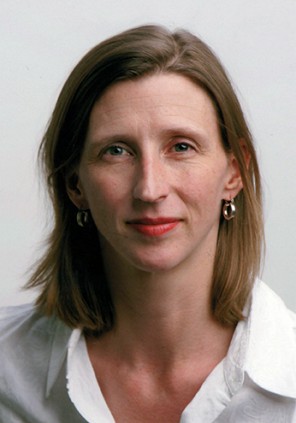
Ellen Barry became the Moscow correspondent for The New York Times in June 2008. She joined The Times as a Metro reporter in January 2007. Before joining The Times, Ms. Barry was a national correspondent for the Los Angeles Times, where she covered Ned Lamont's campaign, the Amish school shooting and exurban sentiments on immigration. From 2004 to 2006, she was the Atlanta bureau chief for the Los Angeles Times. From 1999 to 2003, Ms. Barry worked for The Boston Globe, first as a New England rover, then briefly in central Asia, and subsequently as a mental health beat reporter. In November 2003, she worked on the paper's Iraq foreign desk.
From 1996 to 1999, she was a feature writer at the Boston Phoenix, and from 1993 to 1995, she was a staff reporter for The Moscow Times. Ms. Barry began her career in journalism as a managing board member of The Yale Daily News in 1993.
Ms. Barry was part of The New York Times team that was a 2008 Pulitzer Prize finalist in Breaking News Reporting for reporting on a fire in the Bronx that killed nine people. She was also a Pulitzer Prize finalist in 2004 for her beat reporting on mental health, and a 2002 Pulitzer Prize finalist in Feature Writing for a series, "Lost Boys of Sudan." This series also earned her the American Society of Newspaper Editors 2002 Distinguished Writing Award for Non-Deadline Writing. She is the recipient of the American Society of Newspaper Editors 2004 Jesse Laventhol Prize for Deadline News Reporting by a Team for coverage of the Rhode Island nightclub fire.
Born April 11, 1971, in Tarrytown, N.Y., Ms. Barry graduated from Yale University in 1993 with a B.A. in English literature and additional coursework in nonfiction writing and Russian language. She was awarded the 1993 Wallace Non-Fiction Prize and the 1993 Wright Prize for best essay by a senior.