For distinguished musical composition by an American in any of the larger forms including chamber, orchestral, choral, opera, song, dance, or other forms of musical theatre, which has had its first performance in the United States during the year, Three thousand dollars ($3,000).

Stringmusic, by Morton Gould

Premiered on March 10, 1994, by the National Symphony Orchestra at The John F. Kennedy Center, Washington, D.C..

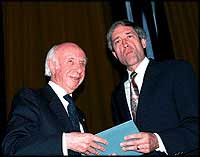
Morton Gould receiving his 1995 Pulitzer Prize from George Rupp, Columbia University President.

Winning Work

Stringmusic

In 1994, the American musical community celebrated Mr. Gould's eightieth birthday and this new work was commissioned by the National Symphony Orchestra under a grant from the Hechinger Fund for New Orchestral Works, the Hechinger Foundation, in honor of Mstislav Rostropovich's farewell season as the National Symphony Orchestra's music director.

Mr. Gould provided the following note for the premiere performances of his work, affectionately referring to his friend Mstislav as "Slava."

String Music is a large-scale suite, or serenade, for string orchestra, comprising five movements. In this music I use the strings in ways that exploit this medium's particular capabilities and potentialities. I have been especially concerned with contrasts in terms of color and texture; there is a great deal of antiphonal writing--sometimes to the extent of suggesting two separate string orchestras. Frequently I have one section playing entirely pizzicato (plucked strings) while the other plays arco (bowed). I make use of such devices as col legno (tapping the string with the wood part of the bow) and playing without vibrato. Basically, String Music is a lyrical work, built entirely on original themes and reflecting, in a way, the many moods and many facets of a man and musician we have all come to know for the intensity and emotion of his commitment to music and life.

Prelude: 
 
The Prelude opens the work with a declamatory, rhapsodic statement in the cellos echoed by muted violas; the effect is something like a responsory service. Following this dramatic opening is a very brisk, almost jazz-like episode built around a playful figure, basically a rhythmic pattern with a quiet sort of propulsion. It becomes louder, with fast- moving passages building in intensity and rhythmic pulse, and then fades away rather mysteriously.
 
Tango: 
 
The second movement is a Tango; it had to be. When Slava conducted my Latin American Symphonette here in 1990, he told me he especially liked the second movement, a Tango, because he is "a tango expert." (I want to stress that Slava pronounces this word in the proper Latin way, "TAHN-go," not "tang-go," as many of us are wont to do.) It begins with a grand sweep up, and a formal tango rhythm is quickly established. The strings alternate between arco and pizzicato, sometimes with one group providing pizzicato accompaniment for the other's arco motif, sometimes vice versa. There is a sequence of varied and contrasting tango evocations: early on, after a somewhat strident Argentine-style tango episode, with its pronounced rhythm, there is a striking change to a languorous, voluptuous episode for four violins, in the old Mitteleuropa cafe style--a sort of parody, but not quite. This in turn is interrupted by a virulent tango-attack-rhythm. From that point to the end of the movement there is a continuous back-and-forth--a few bars of the languorous rhythm and a few bars of the "attack" rhythm; but that constant alternation itself provides a sort of continuity, and the Tango ends with a sweeping, songlike rubato episode.
 
Dirge: 
 
As centerpiece I've written a Dirge, in which I meant to reflect not only the intensity but in particular the sense of sorrow, loss, and even anger that must be associated with so much that Slava has experienced in consequence of his ideals and his loyalties. The cortege-like quality of this elegiac music, I feel, is in keeping with a prominent part of his personality. The piece opens with a short episode in which the string harmonics are evocative of bells. This leads to a solo for double bass, rather like a transformed spiritual. The bell-evocation recurs, and then all the basses take up the theme introduced by the solo bass. A measured "air," a slow cortege with a long lyrical line, proceeds (with no vibrato) against a "walkingbass." This material then grows in intensity until it reaches a point of "crying out," and then dies away, to be followed by a contrapuntal passage, still elegiac but resolutely moving on, with a striding bass line gradually taken up by the other strings. This procession is interrupted by little chorales, as if from afar, from another time and place. The final passage presents a highly transformed version of the traditional Dies irae,with echoes of the lyrical theme and others from earlier in the Dirge, resolving finally in a col legno passage. (This, by the way, is the movement I completed at 4:30 a.m. last September.)

Ballad: 

The Ballad that follows is designed to relax the tension. It is very lyrical and romantic and songlike--a Lied for string orchestra, a sort of love note.
 
Finale: 
 
Strum is the clearly descriptive title of the still more light-hearted final movement. Here the pizzicati are played not with each note cleanly plucked, but in a strumming way, rapidly across the strings. It starts very fast, with tremolo effects and double notes and lots of contrast, and takes off as a real virtuoso piece, unreservedly jubilant. Following a passage like a wild country music festival and a legato played pianissimo but at high speed, the piece simply roars to the end, which comes with a big thrumming sound played arco and answered with a massive pizzicato snap.

—Morton Gould

Text excerpts from notes by Richard Freed, Stagebill, Copyright R.F. 
Musical score excerpts Copyright © 1994 by G. Schirmer, Inc. 
Musical excerpts graciously provided by G. Schirmer, Inc.

Copyright: 1994, Morton Gould

Biography

Morton Gould's first composition was published when he was six years old. He attended the Institute of Musical Art (now the Juilliard School) and found work in the vaudeville and movie theaters in New York City during the Depression. He was the staff pianist at Radio City Music Hall when it first opened, but he finally gained national prominence through his work on the radio.

Gould composed Broadway scores (Billion Dollar Baby, Arms and The Girls), film music (Delightfully Dangerous, Cinerama Holiday, Windjammer) music for television (Holocaust and the CBS war documentary World War I); and ballet scores (Interplay, Fall River Legend, I'm Old Fashioned). As a conductor, he has led all the major American orchestras. He won a Grammy Award in 1966 and the American Symphony Orchestra League's 1983 Gold Baton Award.

Finalists

Nominated as finalists in Music in 1995:

Andrew Imbrie

A cantata for mixed chorus with soprano solo and small orchestra, premiered on November 4, 1994, at the New England Conservatory in Boston. Commissioned and performed by the Cantata Singers.

Donald Erb

Premiered on May 5, 1994 by The Cleveland Orchestra in Youngstown, Ohio

The Jury

Gunther Schuller(chair )*

composer-conductor

David N. Baker

composer, distinguished professor of music

David Hamilton

music critic

Christopher Rouse*

composer, professor of composition

Chou Wen-Chung

composer, Fritz Reiner Professor Emeritus of Composition

Winners in Music

Gunther Schuller

Premiered on December 2, 1993, in Louisville, Ky. Performed and commissioned by The Louisville Orchestra.

Shulamit Ran

Commissioned by The Philadelphia Orchestra and premiered by that orchestra on October 19, 1990.

1995 Prize Winners