The New York Times
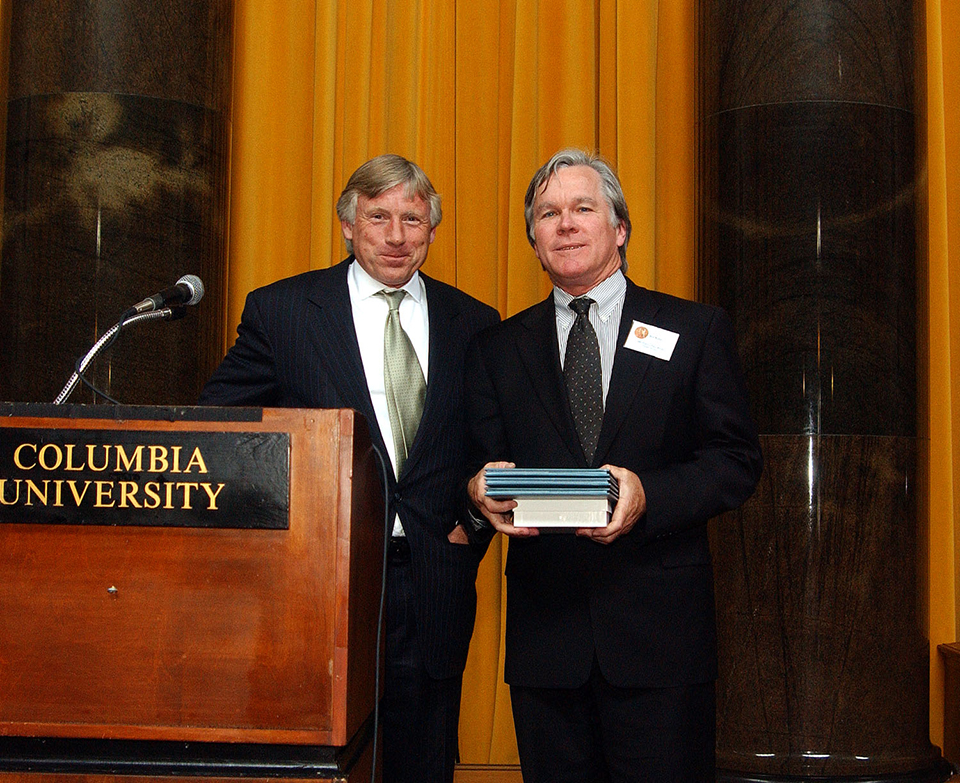
Columbia University President Lee C. Bollinger (left) presents Bill Keller of The New York Times, with the 2004 Pulitzer Prize for Public Service.
Winning Work
By David Barstow and Lowell Bergman
TYLER, Tex. -- It is said that only the desperate seek work at Tyler Pipe, a sprawling, rusting pipe foundry out on Route 69, just past the flea market. Behind a high metal fence lies a workplace that is part Dickens and part Darwin, a dim, dirty, hellishly hot place where men are regularly disfigured by amputations and burns, where turnover is so high that convicts are recruited from local prisons, where some workers urinate in their pants because their bosses refuse to let them step away from the manufacturing line for even a few moments.
Rolan Hoskin was from the ranks of the desperate. His life was a tailspin of unemployment, debt and divorce. A master electrician, 48 years old, he had retreated to a low-rent apartment on the outskirts of town and taken an entry-level maintenance job on the graveyard shift at Tyler Pipe.
He would come home covered in fine black soot, utterly drained and dreading the next shift. "I don't know if I'm going to last another week," his twin brother recalls him saying. The job scared him; he didn't know what he was doing. But the pay was decent, almost $10 an hour, and his electricity was close to being cut off. "He was just trying to make it," his daughter said.
On June 29, 2000, in his second month on the job, Mr. Hoskin descended into a deep pit under a huge molding machine and set to work on an aging, balky conveyor belt that carried sand. Federal rules require safety guards on conveyor belts to prevent workers from getting caught and crushed. They also require belts to be shut down when maintenance is done on them.
But this belt was not shut down, federal records show. Nor was it protected by metal safety guards. That very night, Mr. Hoskin had been trained to adjust the belt while it was still running. Less downtime that way, the men said. Now it was about 4 a.m., and Mr. Hoskin was alone in the cramped, dark pit. The din was deafening, the footing treacherous under heavy drifts of black sand.
He was found on his knees. His left arm had been crushed first, the skin torn off. His head had been pulled between belt and rollers. His skull had split. "If he fought that machine I know his last thought was me," said his daughter, April Hoskin-Silva, her dark eyes rimmed with tears.
It was not just a conveyor belt that claimed Mr. Hoskin's life that warm summer night. He also fell victim to a way of doing business that has produced vast profits and, as the plant's owners have admitted in federal court, deliberate indifference to the safety of workers at Tyler Pipe.
Mr. Hoskin worked for McWane Inc., a privately held company based in Birmingham, Ala., that owns Tyler Pipe and is one of the world's largest manufacturers of cast-iron sewer and water pipe. It is also one of the most dangerous employers in America, according to a nine-month examination by The New York Times, the PBS television program "Frontline" and the Canadian Broadcasting Corporation.
Since 1995, at least 4,600 injuries have been recorded in McWane foundries, many hundreds of them serious ones, company documents show. Nine workers, including Mr. Hoskin, have been killed. McWane plants, which employ about 5,000 workers, have been cited for more than 400 federal health and safety violations, far more than their six major competitors combined.
No McWane executive would be interviewed on the record. But in a series of written responses, the company's president, G. Ruffner Page, acknowledged "serious mistakes" and expressed deep regret for Mr. Hoskin's death. "Our intensified focus on safety speaks to lessons learned," he wrote. At the same time, he sought to explain and strongly defend the company's business methods.
"Over the years, McWane has grown by the acquisition of troubled companies that had become uncompetitive," he wrote. "Through substantial investment in new plant and equipment and more disciplined management practices, McWane transformed these underperforming companies into efficient and viable operations." Disciplined management, he said, has allowed McWane to stave off foreign competitors who have no regard for safety.
In the last decade, many American corporations have embraced such a vision of capitalism -- cutting costs, laying off workers and pressing those who remain to labor harder, longer and more efficiently. But top federal and state regulators say McWane has taken this idea to the extreme. Describing the company's business, they use the words "lawless" and "rogue."
The company's managers call it "the McWane way."
The story of Tyler Pipe, drawn from company and government documents and interviews with dozens of current and former workers and managers, is a case study in the application of the McWane way. It is the anatomy of a workplace where, federal officials and employees say, nearly everything -- safety programs, environmental controls, even the smallest federally mandated precautions that might have kept Rolan Hoskin alive -- has been subordinated to production, to the commandment to keep the pipe rolling off the line.
Federal safety inspectors tried to make a difference. They cited and fined and cajoled. But for years, records show, little changed.
"You put people at risk," a former senior plant manager at Tyler Pipe said. "We did every day."
Which is why even now the toughest of Tyler Pipe veterans remember the day McWane came to town as the day they were, as one of them put it, "kicked into hell."
Introducing 'the McWane Way'
Tyler, a city of 85,000 an hour and a half's drive east of Dallas, began as a stagecoach town, but it came of age around two precious commodities, East Texas crude and some of the finest roses on earth. Oil and roses still help define Tyler, or at least a certain conjured Tyler. The municipal rose garden alone has 38,000 bushes, and the old oil families still carry clout.
But by the early 90's, the shuttered storefronts down by the county courthouse explained why local leaders were so endlessly worried about the care and nurturing of Tyler's contemporary crown jewels -- the Kelly-Springfield tire plant, two air-conditioner factories and Tyler Pipe.
These big manufacturers, they knew, represented something extremely valuable and increasingly rare: places where someone with a high school diploma and a strong back could make $15 an hour, where a Mexican immigrant with little English could firmly grasp the next rung.
The pipe foundry occupies several hundred acres northwest of downtown. Its smokestacks rise high above a north and south plant, each with its own cupola, a multistory furnace that melts tons of scrap metal to produce smoky white rivers of molten iron. The molten iron is poured into spinning cylinders to form pipes, into molds of packed black sand to make fittings.
The company would not let a reporter tour the plant. But employees describe simply stepping inside as an overwhelming experience. First is the heat, wave upon wave of it, sometimes in excess of 130 degrees. Then there is the noise -- of pipe slamming into pipe, of pneumatic tools that grind and cut, of massive machines that shudder and shake, of honking forklifts and roaring exhaust systems. Dust and fumes choke the lungs and coat the lights, leaving the plant floor a spectral labyrinth of glowing pipes and blackened machinery.
In the early 90's, Tyler Pipe employed about 2,800 people and did about $200 million in business a year. It was modestly profitable, and the owners, the Tyler Corporation, were conventionally paternalistic. They distributed turkeys at Christmas and door prizes at the annual employee barbecue. Regulators said the plant, while far from perfect, made an effort to comply with safety and environmental rules.
In late 1995, the Tyler Corporation sold the foundry to McWane. In one stroke, McWane had bought one of its main rivals and acquired its largest plant.
Within weeks, senior executives flew in from Birmingham and set about executing a plan of stunning audacity: Over the next two years, they cut nearly two-thirds of the employees, yet insisted that production continue apace. They eliminated quality control inspectors and safety inspectors, pollution control personnel and relief workers, cleaning crews and maintenance workers.
"It got pretty bad," recalled Kevin Fowler, the human resources manager from 1996 to 1999. "If I walked into a department people would wonder if I was coming with their termination."
Alarmed by the layoffs, city leaders sought meetings with McWane executives. Their requests were rebuffed. "They just disassociated themselves from the city," Thomas G. Mullins, the chamber of commerce president, recalled.
To keep up production, McWane eliminated one of three shifts; instead of three shifts of eight hours, there were two 12-hour shifts. At the end of a shift, supervisors often marched through yelling, "Four more hours!" So employees worked 16-hour days, sometimes seven days a week.
Men who operated one machine were ordered to operate three. Breaks were allowed only if a relief worker was available, but McWane had reduced the number of relief workers and forbade supervisors to fill in for hourly workers. The policy hit hardest near iron-pouring stations, where workers had to drink plenty of fluids to withstand the heat. The humiliating result, six workers said in separate interviews, was that men were sometimes forced to urinate in their pants or risk heat exhaustion.
Even the most basic amenities did not survive. The barbecues and 401(k) plan were easy enough targets. But items like soap, medicated skin cream and hand towels were eliminated from the plant stockroom as unnecessary "luxuries," company records show. If they were available at all, they had to be specially ordered with approval from top managers.
Several workers said they were told by their bosses to bring their own toilet tissue. Near the cupola, managers rationed crushed ice for the workers' drinks, company records show. Out by the loading docks, they eliminated portable heaters used by forklift drivers to warm up in winter. "We do not provide comfort heat for individual employees," Dick Stoker, the works manager, explained in a memorandum.
Restrictions were placed on safety equipment. Protective aprons, safety boots and face shields were no longer stocked and readily available. Heavy, heat-resistant $17 gloves were replaced by $2 cloth ones. As a result, workers wrapped their hands in duct tape to protect from burns.
The union was helpless to resist, past and current leaders agree. Organized labor had never been a potent force at Tyler Pipe, and the layoffs devastated the union's membership. The contract barred strikes, permitted 16-hour days and let breaks be canceled.
"My hands was tied," said Bobby Hopson, former president of Local 1157 of the United Steelworkers of America.
Morale plummeted, but profits soared. Senior managers say they were told that Tyler Pipe earned more than $50 million in 1996 -- double the reported profits for the five-year period before McWane arrived.
Four years after the takeover, inspectors from the federal Occupational Safety and Health Administration spent several days taking the measure of the new regime. They found more than 150 safety hazards. They found poorly maintained equipment. They found a work force that was poorly trained, ill equipped, overworked.
"Throughout the plant, molten metal is seen spilling from the cupolas, bulls and ladles," their report said. "The forklift trucks transport the metal, and the ground behind the trucks often smokes with puddles of molten metal. Workers are covered with black residue from the foundry sand. Many work areas are dark, due to poor lighting and clouds of sand. Despite all the ignition and fuel sources, exit paths are not obvious. Many workers have scars or disfigurations which are noticeable from several feet away. Burns and amputations are frequent.
"This facility is located in a relatively small town where jobs are not plentiful. Throughout the plant, in supervisors' offices and on bulletin boards, next to production charts and union memos, is posted in big orange letters: REDUCE MAN HOURS PER TON."
Talking Safety, Walking Danger
Any foundry is filled with dangers seen and unseen. For three of the last four years, the cast-iron foundry industry has recorded the nation's highest injury rates. But the inspectors said they were drawn to Tyler Pipe because its rate was so much higher than the industry average, records show. Even with far fewer workers at Tyler in 1996 than in 1995, more workdays were lost because of injuries, records show.
On paper, the company emphasized safety. "You are expected to work efficiently and as quickly as possible without compromising safety rules or safe practices in any way," the employee handbook states.
But inspectors and workers alike called the safety program a charade. "In essence, they are doing it in `form' but not with substance," the inspectors wrote.
The company prepared extensive written safety rules. But even the most senior supervisors let employees work in clear violation of those rules, the inspectors found. And while the company promised twice-a-week safety inspections, the same hazards showed up week after week.
Ultimately, the inspectors wrote, it came down to incentives: "They have never developed a mechanism to hold supervisors accountable for safety while, on the other hand, they have mastered a system for holding supervisors accountable for production downtime."
Shutting down machines, taking special precautions before entering dangerous pits, putting safety guards on, taking them off -- all these safety measures "lengthened the `downtime' taking away from production activities," OSHA inspectors wrote.
It was Elena Glasscock's job to make sure supervisors gave their workers proper safety training. But many supervisors were simply overwhelmed by production demands, she said. What little training they did offer was lost on Tyler Pipe's many Hispanic workers who spoke little English.
"I would ask the supervisor, if this person could not speak English, how did he know what the work instruction said?" she recalled. Last summer, after 28 years at Tyler Pipe, she resigned in disgust.
Experienced workers left in droves. Many were fired under a new "no fault" attendance policy that assessed points for each sick day and half points for arriving late or leaving early. Ten points resulted in dismissal. Others quit because of sudden demotions and pay cuts. Mr. Fowler, the personnel director, said he quit because he tired of being seen as a "monster."
New employees are called "pumpkin heads" because of the orange hard hats they must wear, and each week waves of pumpkin heads arrived. But it was not until pumpkin heads started showing up with electronic monitoring bracelets that people realized the company was recruiting at Texas prisons. Many of the newly released prisoners did not last. They worked up to 16 hours a day, sometimes for 14 days straight, then were fired or quit before they qualified for benefits or union protection.
According to interviews and company documents, turnover at times approached 100 percent. Many rookie employees got hurt and left. It was a vicious cycle: injuries fueled turnover; turnover fueled injuries.
The plant was filled with workers who barely knew their way around, let alone grasped the dangers they faced. In April 1996, a crew of outside contract workers was sent up onto the roof to clean gutters. One worker, Juan Jimenez, stepped through a skylight and plunged 55 feet to his death. Mr. Page said that Tyler Pipe's safety director had pointed out the skylight to Mr. Jimenez, but OSHA inspectors said the death "could have been avoided" if the skylight had safety rails as required under OSHA rules.
In interviews, dozens of workers said the unrelenting pressure to make production quotas resulted in dangerous shortcuts. Bobby Hopson's younger brother, Jerry, a 54-year-old father of two, took a shortcut in May 1996. His maintenance crew had finished work on a production line and, hurrying to get out of the way, cut through a molding machine. The line started up, and Jerry Hopson was crushed by a hydraulic piston. A year later, after more than 20 operations, he died.
"He was just a swell feller," his brother, the former union president, said, brushing back tears. In the local paper, a plant executive had called Jerry Hopson "a good man who made a very big mistake." But Bobby Hopson insisted that senior supervisors were well aware of the shortcut and its hazards, yet made no effort to stop its use.
"If you lose a minute, you've already lost, you know, maybe a fitting or two," he said.
Losing Limbs but Not Pipes
On Jan. 22, 1997, another maintenance worker, Ira Cofer, descended alone into a machine pit. "Downsizing had ended the earlier practice of entering the pits with a buddy," OSHA investigators later wrote. When Mr. Cofer's sleeve snagged in an unguarded conveyor belt, he struggled desperately to free himself. It was nearly three hours before his screams were heard.
"Eyewitnesses said that the friction of the belt had sanded his arm away, so that even his elbow joint was worn smooth and flat," investigators wrote.
Mr. Cofer's arm had to be amputated.
"I was mad for a while, then I was praying," he said of the ordeal. "There was nothing there but the Lord."
In their accident report, plant managers put the blame squarely on Mr. Cofer: "Keep hand away from belt and do not work alone," they wrote.
Within months, four more maintenance workers suffered amputation injuries at Tyler Pipe. In 1999, OSHA cited the plant for 31 instances of inadequate guarding on machines. By 2000, according to OSHA, 60 percent of the north plant's 70 maintenance workers had been hurt.
Senior managers knew all this, OSHA records show. They knew that guards were frequently left off for weeks at a time. They knew that maintenance mechanics were working on running conveyor belts, entering treacherous machine pits alone.
And so in June 2000, Rolan Hoskin, afraid of the job but too desperate for work to quit, took his turn in the pit.
His death prompted Mr. Stoker, the works manager, to issue a memorandum. "WE WILL NOT PUT PRODUCTION AHEAD OF SAFETY," he wrote. "If that means that we lose a couple of pieces of pipe or fittings to do the job in a safe manner, so be it. Then we need to figure out how to recover the lost production safely."
But in a memorandum dated Aug. 2, an engineering manager raised serious concerns about safety. He called for a potentially costly program to build new safety guards. "We are not in compliance on most if not all our belt conveyors," he warned.
In response, he received a dismissive letter from the human resources manager.
Burn the Tires, Scrub the Toilet
McWane's senior executives, including C. Phillip McWane, the chairman and chief executive, received regular reports from all their plants. The reports measured seemingly everything -- injuries, lost work hours, dismissals, operating margins. By 2000, it was clear that Tyler Pipe had become an exceedingly profitable enterprise.
It was also clear that something was very wrong. Red flags were everywhere.
There had been three deaths since the takeover. The injury rate was climbing, the company's own reports showed. "Safety is without a doubt one of our worst areas," Mr. Stoker wrote in a confidential memorandum to top supervisors. "I have failed in this area, but I can promise you that we will not fail to improve in this area come 2001."
Meanwhile, the plant had been deemed an "E.P.A. High Priority Violator," and company lawyers were recommending steps to forestall a criminal inquiry of its environmental record, company records show.
After the takeover, Tyler Pipe's environmental department was virtually wiped out, several current and former employees said. One former senior manager said that when he arrived in 2000, he found an environmental program "in the Dark Ages."
"It was not humanly possible for one person to handle all of the environmental issues at a plant of that size," he recalled.
In March of that year, state environmental investigators spent several days at Tyler Pipe. They found that the plant had failed to keep inspections records, to get required permits and to maintain pollution controls and wastewater treatment lagoons. The list ran on and on.
Now, with federal regulators lurking, Mr. Stoker told his staff, "We are so far out of compliance at Tyler Pipe that I cannot begin to cover our needs in this letter."
Even so, in a January 2001 memorandum, senior McWane executives outlined an environmental upgrade at Tyler Pipe and several other plants that was relatively low cost -- outside audits, better training, improved manuals, an annual company environmental conference.
Before long, the company's stated desire for "environmental excellence" was tested in a small way. The question was what to do with a pile of 200 old tires. It would have cost about $750 to have them hauled away to a hazardous waste dump. But company documents show that Mr. Stoker had another solution, even though he had been told that it violated state air-quality laws.
"He wanted the tires burned and he wanted them burned now," an internal company document stated. And so they were, in the cupola. Buckets of contaminated grease disappeared the same way, workers said.
The biggest worries, though, had to do with safety. Texas workers' compensation laws give McWane broad immunity from negligence lawsuits. But they also required it to pay medical bills and lost wages for injured workers. Company executives complained that they were "hemorrhaging" money on workers' compensation -- many millions of dollars a year and rising.
Once again, the company chose a minimalist approach, according to company and OSHA records and former safety and health employees. It devised a system of "workers' compensation cost control techniques" that shifted responsibility for safety problems onto the workers themselves.
It was a system that assumed widespread fraud and often subjected workers reporting injuries to disciplinary action, and sometimes firing, for violating safety rules.
"Whether the employee is 100 percent or 5 percent at fault is irrelevant," wrote Stephen A. Smith, then president of the McWane subsidiary that owns Tyler Pipe.
In 2000 and 2001, company records show, more than 350 workers were subjected to disciplinary actions -- known as D.A.'s -- after reporting injuries. "All disciplines short of termination is administered with the intent and purpose to teach," the plant's employee handbook explained.
But OSHA inspectors concluded that the system was used not to teach but to punish. Disciplinary action was meted out if it was the fault of the employee or not, they said.
"The true significance of a D.A. is that they move an employee along a track for termination," the inspectors wrote. Even longtime employees with exemplary work records could be fired for a single D.A. Employees say they learned to keep injuries a secret whenever possible.
In his response, the McWane president, Mr. Page, said no Tyler Pipe worker had been fired in retaliation for reporting an injury. He said managers were encouraged to enforce safety rules "so that there would be no doubt about management's commitment to the safety program." He added, "No judge or jury has ever concluded that Tyler Pipe acted improperly."
As many companies do, McWane insists that injured workers return to work as soon as possible on "modified duty." Mr. Page described modified duty as a beneficial program that speeded recovery. At Tyler Pipe, though, records and interviews show that modified duty often meant humiliating and punitive jobs like cleaning toilets.
John T. Combs was the senior manager who oversaw modified duty. In an internal company e-mail message, he extolled the benefits of assigning injured workers to toilet duty and described how he assigned "an aggressive, physically imposing supervisor" to oversee them. "This accomplished one of two things," he wrote. "1) the employees would return to work because cleaning toilets is not fun and it paid less than their regular job or 2) they would quit."
Mr. Combs did not respond to telephone messages.
Around town, Tyler Pipe was approaching pariah status. "You know what the saying in the community is?" a county commissioner asked at a commission meeting in 2001. "That if you can't work anywhere else, go to work at Tyler Pipe." With a work force that had crept up to about 1,200, company records showed there were more than 900 new hires in 2001.
That December, a group of employees composed an unsigned letter to Mr. Page. It began: "On behalf of the employees of Tyler Pipe Company . . . Please Help!"
`We Do Not Send Flowers'
Michelle Sankowsky, a nurse, was hired in January 2002 as Tyler Pipe's occupational health and compensation manager. It was a new position, overseeing all workers' compensation cases. She met daily with Boyd T. Collier III, the human resources manager, and other senior executives. She quit after four months, she said, because she concluded that the company routinely targeted injured workers for dismissal.
"You've got to understand," she said. "The mentality is that if it weren't for people looking for a free ride, looking for the paid vacations, if it wasn't for the malingerers, if it wasn't for the fakers, if it wasn't for people being careless and reckless, then they wouldn't have the numbers."
Ms. Sankowsky said she suggested a variety of low-cost ideas to reduce rampant ergonomic complaints. She proposed conducting warm-up exercises and wrapping brush handles in foam. "Not cost effective," she says she was told.
In Texas, injured workers have the right to choose their own doctors. At Tyler Pipe, this right came with an important qualification. "We require every employee injured at work to see the company-approved physician if a doctor is necessary," the employee handbook says. "NO EXCEPTIONS!" The labor contract said the same. In a memorandum to all workers, Mr. Collier said he wanted injured workers to see the company doctor first to "ensure the very best care in Smith County for our employees."
Ms. Sankowsky sees it differently. "It all boiled down to that they wanted to be in control," she said. Controlling the care, she said, was viewed as the key to saving money and reducing injury numbers reported to OSHA. And the key to controlling the care, she said, was Occu-Safe, a tiny medical company hired in 1999 to run the plant dispensary and care for injured workers at its downtown clinic.
Occu-Safe was an unlikely choice for the job. Established only months before, it had no track record and few other clients. It was owned by Mike Adams, whose prior business experience, court records show, included a bankrupt air-conditioning venture. In an interview, Mr. Adams said he won the contract by promising deep reductions in workers' compensation claims.
Mr. Adams also shared Tyler Pipe's skepticism about injury claims; he says he believes that up to 50 percent are fraudulent, and that "overutilization" of doctors is a "huge problem." At his clinic, he said, doctors are under strict orders to avoid "hope so, think so, want so medicine."
Tyler Pipe was by far Mr. Adams's largest client, paying him $615,000 in 2001, records show, and Mr. Adams began most days discussing injury cases with Mr. Collier, the human resources manager. Occu-Safe, Ms. Sankowsky said, was simply too small to assert unbiased medical judgment.
"One of the benefits of having Occu-Safe as your medical provider is that people were not taken off work," she said.
Mr. Adams denies that Mr. Collier has tried to influence medical decisions. "The day he does, I'll walk away," he said.
Still, records suggest that Occu-Safe was responsive to Mr. Collier. When a supervisor punctured his arm late one Friday night, emergency room doctors put him on Vicodin, a strong painkiller, and told him to stay off work a week. But according to internal e-mail, Mr. Collier wanted him back right away; Occu-Safe representatives ordered him to switch to a less potent drug and report to work on Tuesday.
Workers who insisted on seeing their own doctors were assumed to be malingerers. It was called "jumping ship," and employees who did it, Ms. Sankowsky said, were targeted for disciplinary action and termination.
Mr. Collier's hostility toward outside doctors was apparent in an e-mail message on Feb. 19, 2002, to Ms. Sankowsky, who had asked about sending flowers to an employee who had had surgery for a workplace injury.
"Michelle: Typically we do not send flowers to hourly ee's," he wrote. "And the only time we send flowers to salaried ee's is death in the immediate family; I'd entertain a proposal to fund flowers for cases like Brian but we need to scope it very narrow so it didn't apply for cases that were referred by CARPENTER and his band of outlaws."
Mr. Collier was referring to Dr. Robert Carpenter, a chiropractor with union ties who has treated approximately 60 injured Tyler Pipe workers over the last two years. About 40 of them have since been fired, said Dr. Carpenter, who has filed a defamation suit against Mr. Collier. He said he no longer gets new patients who work at Tyler Pipe.
"If I was an injured worker, then I would think that perhaps I might get fired if I went to see Dr. Carpenter," he said.
A Broken Back and a Bass Boat
Marcos Lopez crossed the Mexican border and found work at Tyler Pipe at the age of 17. He was used to tough work, and he saw plenty of men get hurt. But nothing on earth, he said, prepared him for McWane.
"You reach this point that you just don't care about you," said Mr. Lopez, who is now 45. "And you set your mind on work. And that's what they want. And that's how people get hurt."
On March 2, 2002, it happened to him. He was working on some machinery, stretching awkwardly in a tight space, when he slipped and fell. His back slammed into metal. He heard a snap, he said, and felt dizzying waves of pain and nausea. In the dispensary, records show, he was pale and weeping and showing signs of shock. He said his pain -- a "burning in the bone" -- was so intense that it was a challenge just to breathe.
Had he been sent to a hospital, had an X-ray been done, it would have been clear that Mr. Lopez had suffered a terrible injury, a severe compression fracture in his spine.
But he was not sent to a hospital. "They just tell me to sit down and wait for the safety man," he recalled. Ms. Sankowsky, in the dispensary that day, recalls that senior safety managers were deeply suspicious of Mr. Lopez. He had a prior back injury, in 2000. Worse still, he had "jumped ship" and been kept off work for months.
Then, in questioning Mr. Lopez, the managers discovered that he had recently bought a bass boat. They found this highly significant, Ms. Sankowsky recalls. Might he be faking injury to get his boat paid off with disability insurance? When she argued that shock was difficult to fake, Ms. Sankowsky said, the safety manager brushed her aside: "Michelle, don't you think that you could sweat and cry a little bit if you thought you were going to get a free boat and paid vacation?"
Mr. Lopez was sent by van to the Occu-Safe clinic where, after a brief examination, he was given pain medicine and sent home, records show. The clinic doctor diagnosed a back strain and told the plant to expect Mr. Lopez back in three days. In fact, he was getting worse. He felt a creeping numbness in his legs and hands.
At Tyler Pipe, Ms. Sankowsky said, Mr. Collier and the safety managers were "really circling their wagons around Mr. Lopez, that he's a fraud, he's a fake, and, you know, we're going to get him before he gets us." At a meeting on March 13, the managers approved a plan to place Mr. Lopez under surveillance, corporate records show.
The next day, on his third visit to Occu-Safe, Mr. Lopez asked for an X-ray. It showed a "bad compression fracture," medical records state. Still, he was sent home. Nobody informed him of the new findings, he said, and according to Ms. Sankowsky, this was deliberate.
"Why do you not tell this gentleman that he's got a compression fracture of the spine?" she said she asked an Occu-Safe manager. "And he said to me, `Well, then he'd know how hurt he was.' "
The clinic, she said, quietly began to explore the possibility that Mr. Lopez had cancer that had weakened his spine. Mr. Collier, she said, welcomed the news. "So we can deny the claim because it's cancer?" she recalls him asking.
Mr. Collier declined to comment.
Finally, more than three weeks after his fall, Mr. Lopez was sent to a surgeon. "He said, `You're one hair to be paralyzed for the rest of your life,' " Mr. Lopez recalled. The doctor told him something else: his fracture had gotten worse since the accident.
It is when he says this that Mr. Lopez, a proud and reserved man, begins to weep. For months after the surgery, he said, he could not dress himself, or pick up the soap in the shower. "I feel destroyed," he said.
Mr. Adams would not discuss the case in detail; Mr. Lopez has sued Occu-Safe for malpractice. But Mr. Adams insisted that "Marcos got the care that he needed."
McWane kept Mr. Lopez under surveillance this year, determined to prove him a malingerer. In his response, Mr. Page said Mr. Lopez had been filmed "lifting heavy loads into his car" -- proof, he said, that Mr. Lopez has not suffered any serious disability. A doctor for the Texas Workers Compensation Commission, however, recently determined that despite surgery and months of rehabilitation, Mr. Lopez has a permanent partial disability.
Additional reporting by James Sandler and Robin Stein.
© 2003 The New York Times Company
By David Barstow and Lowell Bergman
The company's growth has been guided by some of the most prominent figures in Alabama's business establishment.
BIRMINGHAM, Ala. -- In their hometown, the McWanes are known for quiet generosity. The family pledged $10 million to the science museum, the McWane Center. They have given millions more to Alabama's major cultural institutions, including the Birmingham Civil Rights Institute. College students compete for McWane scholarships.
The family's latest philanthropic project is this city's icon, a 56-foot statue of Vulcan, the god of fire and forge. Thanks to a $2 million leadership grant from the McWanes, the statue will soon be restored and returned to its pedestal atop Red Mountain, overlooking downtown as a symbol of the city's working men and women.
Yet if the good works are appreciated by Birmingham's civic leaders, the business empire that supports this philanthropy is barely known. The family is so private that not a single sign advertises the McWane corporate headquarters. In a 1997 profile of James Ransom McWane, then chairman of McWane Inc., The Birmingham News wrote that "even well-connected" business leaders had never met the man it described as "a riddle in his hometown."
"Son," said N. Lee Cooper, past president of the American Bar Association and founding partner of the Birmingham law firm that has long represented the family's corporate interests, "the McWanes haven't talked in a hundred years, and they aren't about to start now."
The untold story of how a reclusive family ascended into the ranks of the nation's wealthiest industrial dynasties is an often-painful one, written in the blood and tears of the very blue-collar workers celebrated by the Vulcan statue.
As reported yesterday in The New York Times, McWane Inc., one of the world's largest makers of cast-iron water and sewer pipes, is also one of the most dangerous businesses in America. The company has by far the worst safety record in an industry that, for three of the last four years, has had the highest injury rate in the nation. McWane has been cited for more than 400 safety violations since 1995, four times more than its six major competitors combined.
A nine-month examination by The Times, the PBS program "Frontline" and the Canadian Broadcasting Corporation program "The Fifth Estate" also found that McWane has an extensive record of environmental violations. McWane plants have been found in violation of pollution rules and emission limits at least 450 times since 1995, records show. Environmental regulators have said McWane plants are among the worst polluters in New Jersey, Alabama and Texas.
The examination is based on thousands of company and government records and hundreds of interviews with current and former McWane employees, including plant managers, safety directors and environmental engineers. These employees -- some speaking on the record, others on condition of anonymity -- opened a window into a closely held and expanding corporation that dominates an unglamorous yet essential industry.
At McWane plants, they said, workers who protest dangerous work conditions are often "bull's-eyed" -- marked for termination. Supervisors routinely run roughshod over safety and environmental laws that interfere with production in the slightest. They dump polluted water under cover of night. They bully injured workers. They intimidate union leaders.
And everyone, they said, operates under a system of financial and disciplinary incentives that results in lives being put at risk every day.
"The people, they're nothing," said Robert S. Rester, a former McWane plant manager who spoke at length about his 24 years with the company. "They're just numbers. You move them in and out. I mean, if they don't do the job, you fire them. If they get hurt, complain about safety, you put a bull's-eye on them."
C. Phillip McWane, the current chairman and chief executive, declined repeated requests for interviews over the last five months. But the company president, G. Ruffner Page, said in written exchanges that McWane was committed to protecting the environment and the welfare of its workers. While acknowledging that "our standards have not always been met," he emphasized that the company has taken action to improve its record.
Many McWane employees said there had indeed been improvements, particularly in recent months as the company came under new federal scrutiny. Some plants, they added, are better than others. But they strongly disagree that the changes show a fundamental turnabout by a chagrined corporation. To many of them, McWane remains frozen in a long-ago time, a time when industrial barons made great fortunes off molten iron but left behind broken lives and a damaged environment.
The Deep Roots of Iron
Birmingham was built around its foundries, and for all its racial and social upheavals, for all its ambitious embrace of the new economy, this is still a place with an abiding attachment to iron and steel.
Three major pipe foundries, including McWane, are still based in the city. On the edge of town, the rusting remains of the old Sloss Furnaces have been converted into a national landmark and museum. For more than 80 years, the McWanes have been woven into this legacy. The original family patriarch, J. R. McWane, helped finance and direct the casting of the Vulcan statue.
"McWane was an old-fashioned Andrew Carnegie-like figure," said Henry McKiven, a historian at the University of Southern Alabama, referring to another reclusive Scotsman who combined generous philanthropy with ruthless foundry management.
Like Carnegie, J. R. McWane believed in strict conformance with a rigid manufacturing process. If that process called for 80 pipes an hour, he expected 80 pipes an hour, and not one pipe less.
Through four generations, that demand has been the guiding principle of the family business. And it has proven enormously profitable, fueling the company's growth beyond its original foundry, the McWane Cast Iron Pipe Company, just northeast of downtown Birmingham. Today, it has plants in 10 states and Canada.
As it expanded, McWane typically sought distressed foundries, often in fading manufacturing towns, then imposed cost cuts, layoffs and what Mr. Page referred to as "disciplined management practices." Not one of those new plants was given the McWane name, a tradition that has helped keep the family and its business practices out of the public eye.
Yet McWane products are threaded deep into the infrastructure of American life. McWane pipes can be found in Las Vegas casinos, Indiana hospitals and at Ford Field, the new stadium of the Detroit Lions.
The company's growth has been guided by some of the most prominent figures in Alabama's business establishment.
John J. McMahon Jr., now chairman of the executive committee and company president from 1980 to 1998, is president pro tempore of the trustees of the University of Alabama. Another member of the McWane board, Fournier Gale III, was special counsel to Alabama's former governor, Donald Siegelman, and general counsel to the Business Council of Alabama, the state's most powerful business lobby.
Today, McWane Inc. regularly makes Fortune magazine's list of the 500 largest private companies. According to one knowledgeable person, the company's annual revenues approach $2 billion, an estimate that does not include the family's banking and real estate interests.
In defending McWane, Mr. Page said the company had worked to preserve manufacturing jobs in an industry threatened by what he characterized as unfair competition. Foreign manufacturers in China and Latin America, he said, "have little or no regard for the safety of their workers or concern about polluting the environment."
McWane itself, however, has been the subject of repeated investigations into bid rigging and other forms of anticompetitive behavior, government records show. In 1995 a McWane subsidiary pleaded guilty to conspiring to corner a major part of the Canadian pipe market and paid a then-record fine of $2.5 million (Canadian).
Canadian court documents, recently unsealed at the request of the The Times and the Canadian Broadcasting Corporation, allege that Mr. McMahon, then president of McWane, orchestrated the conspiracy in a series of clandestine meetings in Birmingham. In the meetings, held at a barbecue joint and in a supermarket parking lot, Mr. McMahon pressed executives from another Birmingham foundry, U.S. Pipe, to pull out of the Canadian market or face a price war, documents show.
Mr. McMahon declined to discuss the case, but said the court records "only tell one side of the story."
The company has pleaded guilty to two other crimes, a state environmental felony in 1997 in New York and a federal misdemeanor in 2002 for violating safety laws in Texas.
But in Birmingham, few people know of this record. If the McWanes are known at all, it is chiefly for their philanthropy and their intense privacy. "They don't like the limelight, and they don't particularly want credit for what they've done," Tony Zodrow, president and chief executive of the McWane Center, said.
Not long ago, Birmingham's civic elite turned out for a reception celebrating the restoration of the Vulcan statue. Some guests could not identify a photograph of C. Phillip McWane, but that did not dampen their praise of the McWanes.
"They have done wonderful things for the city," one guest, Mrs. C. H. H. Emory, said. "They are a family which has returned a thousand fold everything they've ever gained."
The Discipline of Production
Everything about Robert Rester -- his neck, his chest, his forearms -- is linebacker thick. He is 6 foot 1 and 246 pounds. His face is red and beefy, with a goatee the color of rust. His eyes are blue and direct. On his left shoulder is a tattoo of a bald eagle against an American flag and the words, "Don't [expletive] with this."
Mr. Rester was part of the small fraternity of hard-nosed men who run McWane foundries. He was plant manager at two of them, most recently the flagship foundry in Birmingham.
Mr. Rester, who is 44, grew up expecting life to be one long slog, and he took quiet satisfaction from being able to do a hard job in a hard place. `'I was raised in McWane pipe shops," he said. When his first mentor died in an explosion, he didn't flinch. Over 24 years, he kept climbing through the ranks, McWane style, starting as a welder, working 16-hour days, skipping vacations, shrugging off injury and illness, making up to $125,000 a year by being the toughest, meanest McWane manager he could be.
Gradually, he said, he became numb to the constant body count -- crushed hands and feet, disfiguring lacerations, burns from molten iron, amputations. His sole focus, he said, was finding a fresh body to keep production rolling. Who got hurt? Why did the injury happen? Could it have been prevented? Those questions hardly crossed his mind. "I was like a robot," he said. What mattered -- all that mattered -- was getting the machines moving again, he said.
Mr. Rester and other managers linked this mindset to an updated version of the patriarch's dictum: time equals pipe, and pipe equals money.
For a McWane manager, they said, taking time for a safety or environmental problem holds few attractions. It means slowing production to fix equipment. It means more safety training, less time to make pipe. Indeed, police records show that at one McWane plant in Alabama, supervisors refused to wait a few hours for federal safety inspectors to arrive before restarting a conveyor belt that had crushed a man to death.
The formula is reinforced at every level of production. Line workers who fail to make daily quotas get "D.A.'s" -- disciplinary actions. Those with several D.A.'s are said to be on "death row." For plant managers like Mr. Rester -- essentially the chief operating officer -- annual bonuses depend on how their production compares with production at other McWane plants. And for general managers, the pursuit of more tons per hour can mean hundreds of thousands of dollars in profit sharing.
Mr. Rester was one of dozens of McWane supervisors who described a system of unstinting discipline used not just to squeeze out productivity gains, but to suppress union unrest and discourage injury claims.
Supervisors were urged to discipline injured workers, company documents and interviews show. The company says the purpose is to teach safety. But Mr. Rester said the true intent was to punish workers for reporting injuries while shifting blame from the company.
"If he steps in a hole, you know, it's because he wasn't watching where he was going, not because there was a hole there that should've had a cover on it," Mr. Rester said.
Internal McWane records show that top executives tracked the number of injured workers who received disciplinary actions at each plant. Workers who resisted, who cited government regulations or sought independent medical advice, became targets for termination, Mr. Rester said. "We'd say or do whatever we had to," he said. This included putting up safety signs after the fact to make it appear as if the worker had ignored posted policies, he said. It included altering safety records and doctoring machinery to cover up a hazard.
"After a while," he said, "you realize what you have to do to save your job." It became automatic, he said, like a reflex.
The Custodians of Safety
Union Foundry, one of two McWane plants in Anniston, Ala., was a dangerous place to work. In 1995, it had about 350 employees and recorded more than 250 injuries, internal company records show.
That year, McWane sent in a new safety director, Clyde E. Dorn. He was hardly an ideal candidate for the job. He had never worked in a foundry, let alone as a safety director. He had just obtained a bachelor of science degree in occupational safety and health. By his own admission, he was a 44-year-old alcoholic with an arrest record and substantial debts from unpaid child support. He held the job until 2001, when he was fired after being caught trying to buy Oxycontin in a police sting operation; he recently began a prison sentence.
Even apart from his lack of experience, Mr. Dorn said, it was virtually impossible to be effective. He had no budget, no assistants and little authority. He lacked even the authority to shut down a production line if he spotted a safety hazard, he said.
There was one exception, he said: "If someone was caught in the machine."
Mr. Dorn said he managed to make simple and inexpensive safety fixes, as long as they did not affect production. But requests for more safety equipment and an assistant were ignored, he said. Larger safety issues -- like too few workers working too many hours -- were off limits, he said.
Federal safety rules, for example, limit the weight workers may lift. At Union Foundry, workers were routinely ordered to lift fittings that exceeded these limits, Mr. Dorn said, and many suffered strains and back injuries as a result.
"There was nothing that I could do. I mean management knew about it. You'd go to them and you'd talk to them and they would say, `We'll look at it.' " Asked why he didn't demand action, he replied, "They made it perfectly clear that I wasn't guaranteed a job if I ticked them off."
Indeed, when the federal Occupational Safety and Health Administration investigated a worker's death at Union Foundry in 2000, inspectors were told that company policy "was not to correct anything until OSHA found it," agency records state.
In interviews, other current and former safety directors complained of having little authority or help. And internal company documents show that McWane executives recognized that safety directors were overburdened. But in recent months, some safety directors said executives had given them more influence.
Mr. Dorn was one of 38 full-time "safety and environmental professionals" whom McWane says it employs in its plants. Some of them came with significant credentials. But several, like Mr. Dorn, possessed few qualifications and seemed to have only a vague understanding of their duties.
At the plant in Elmira, N.Y., an accountant whose job was being cut was made safety director. The McWane plant in Birmingham hired a safety director from a temporary employment service that specialized in environmental testing. A few years before, he had been placed on probation for drunken driving. Asked in a sworn deposition to describe his duties, he replied, "There is nothing written as to what my duties are."
In another deposition, a safety manager at the Tyler plant was asked: "So, you're the safety director, but you don't know if the superintendents are supposed to report safety violations to you. Is that correct?"
"Yes," he replied.
Most McWane safety directors spend only part of their time dealing with safety. The rest is devoted to activities designed to reduce workers compensation costs. Managers have told OSHA investigators that McWane expects them "to do whatever it takes to bring and keep these costs down."
This included conducting time-consuming investigations to catch fraudulent injury claims -- which is what Mr. Dorn asserts he was doing when he was arrested for trying to buy Oxycontin from an employee out on workers compensation. It also included placing injured workers under surveillance and challenging doctors on expensive treatment plans. Mr. Dorn, a man with no medical background, said he was under constant pressure to manipulate treatment decisions.
Although McWane's internal safety rankings gave Union Foundry high marks under Mr. Dorn, two Union Foundry workers were killed and hundreds were injured during his tenure, and OSHA repeatedly found perilously unsafe working conditions.
A year after he was hired, for example, OSHA inspectors spent six days at the plant and chronicled a list of serious safety violations: exposed wiring, leaking gas lines, inadequate respirators, nonexistent safety training, missing records, explosion hazards, burn hazards, unguarded conveyor belts, and employees exposed to lead, cadmium, arsenic and beryllium without any protective equipment.
During the inspection, records show, Mr. Dorn was asked if employees ever worked underneath or near a certain industrial elevator. He assured the inspector that no one did, OSHA records state. Seven months later, a worker, Johnny Flint Brewster, Jr. was crushed to death under the same elevator. He had been cleaning sand from the shaft and did not see it descend. OSHA inspectors said the shaft was inadequately guarded, records show.
In his written response, Mr. Page did not address Mr. Dorn's work at Union Foundry. But he noted that Mr. Dorn has been replaced by a man with foundry experience and a master's degree in health and safety who oversees a staff of three.
The Environmental Issues
At many McWane plants, government records and interviews with employees describe persistent defiance of laws protecting workers and surrounding communities from toxic pollution. In a corporate culture where production is paramount, McWane plants have been sanctioned repeatedly for failing to stop production to repair broken or ineffective pollution controls. Several environmental managers described production equipment being tampered with so it wouldn't shut down automatically when pollution controls failed. They told of senior company executives ordering them to ignore requirements for pollution permits.
"I was asked to do things I didn't want to do," said one manager responsible for environmental safeguards at a plant in Canada. Some former managers said they quit because they feared they were being forced to break the law. "It wasn't a normal work environment," one said.
McWane has 10 major United States foundries. A few have relatively minor records of environmental problems, officials said. The Ohio plant, for example, has earned praise from state regulators.
But five plants -- in Alabama, Utah, Texas and New Jersey -- have been designated "high priority" violators by the Environmental Protection Agency. A sixth, in New York, has been convicted of a felony, illegal possessing hazardous waste.
Mr. Page said that McWane plants "have overwhelmingly abided" by pollution laws. He also cited some $31 million in recent pollution control projects as evidence of the company's commitment to a clean environment. "On occasion, all companies of any size receive citations," he wrote.
Union Foundry, which has received some of the highest environmental fines ever levied by Alabama, has been cited for more than 50 violations, records show.
"They have discharged air pollution -- lead and arsenic and copper and thallium off into the air," said Byron Bart Slawson, a lawyer for the Alabama Environmental Council, who filed suit against the plant. "They've been spreading it across this community for years."
At Union Foundry, OSHA testers found that at least seven workers had been exposed to exceptionally high levels of silica in 1996. Exposure to silica can cause silicosis, a lung disease that can lead to a slow death. OSHA inspectors said plant managers, including Mr. Dorn, failed to ensure that respirators were used, even though conditions "were obviously bad."
Inside McWane plants, workers have repeatedly complained of blurred vision, severe headaches, respiratory problems and other ailments after being exposed, often without training or protection, to chemicals and agents used to make pipes, government records and other documents show.
In 1998, Shane Shaw, a 19-year-old employee at a McWane plant in Provo, Utah, was admitted to an emergency room. His urine was black as coffee. His kidneys were failing. Other organs were beginning to shut down. He was close to death, medical records show.
In time, his doctors diagnosed severe arsenic poisoning -- the result, they concluded, of chipping arsenic-laced residue from casting machinery without a respirator. In an interview, Mr. Shaw said that he was not required to wear a respirator, nor was he warned of the dangers of arsenic. He has recovered and left McWane, but his doctors say he faces an increased risk of cancer.
Six months before Mr. Shaw became ill, a state OSHA inspector had visited the plant. "The respirator program was totally ineffective," the official wrote.
At Atlantic States Cast Iron Pipe, the McWane plant in Phillipsburg, N.J., residents have complained about pollution for decades. Local newspapers reported that crossing guards near the plant once had to wear gas masks. Since 1995, the plant has been found in violation of state and local environmental rules and emission limits more than 150 times. It has paid or faces more than $3 million in fines. Even so, regulators still consider it one of the state's worst polluters.
"One looks in vain for any evidence of corporate stewardship with respect to environmental issues," Bradley M. Campbell, the state's environmental commissioner, said. McWane's conduct, he said, amounts to a pattern of "resistance, recalcitrance and denial, if not outright lawlessness."
On a Sunday morning in December 1999, Brian and Kathy Fleming awoke in their home on the banks of the Delaware River and noticed oil on the water. Authorities traced the 8.5-mile-long slick to a storm water pipe near Atlantic States. At the plant a sump pump was draining a pit filled with the same kind of oily substance into storm drains.
State and federal investigators raided the plant but learned little about who had authorized the pumping. The case was dropped after McWane contributed $50,000 to an environmental group. But two former plant employees say the investigators failed to detect a string of illegal discharges that dwarfed the December spill.
The men, Robert Bobinis, a maintenance supervisor, and Brad Schultz, a member of his crew, said in separate interviews that each week, during the midnight shift, they were ordered to pump thousands of gallons of water fouled with industrial contaminants into drains feeding the Delaware.
The water filled huge basement vaults that had to be pumped dry so production could continue, both men said. "They didn't want to shut down," said Mr. Bobinis, who filed a whistleblower lawsuit against Atlantic States; it was settled, he said, for a sum he declined to disclose.
Mr. Page called the men's accusations unsubstantiated.
The same thing, however, happened at McWane Cast Iron Pipe in Birmingham, according to several employees and state environmental records. Workers waited for night or heavy rainstorms before flushing thousands of gallons of polluted water through storm drains and into local rivers and creeks. Mr. Rester, the former plant manager, said the illegal dumping was "standard procedure," done with the full knowledge of senior McWane executives, including an executive vice president.
"All he would ever say is, `Whatever we had to do to run 'em we had to do it,' " Mr. Rester recalled. "You know, `Get rid of the water. We got to run.' "
The Safety Statistics
At Union Foundry, there is a new sign at the front gate: "Safety Starts With Attitude." In the last year, McWane has embarked on a high-profile safety campaign.
In his written responses, Mr. Page, the company president, said spending on safety-related capital projects had "increased significantly over the past five years."
The commitment, he said, has paid off. Injury rates at McWane's United States plants, he said, have steadily declined since 1995 and compare favorably with the rest of the cast-iron foundry industry.
"It would be foolish not to protect our most valuable and essential assets -- our people," Mr. Page wrote.
There is no independent way to confirm the company's assertions about injury rates; OSHA refused to release its own calculations, saying they are not public.
But internal McWane documents obtained by The Times -- reports from plants to corporate headquarters -- show that while some foundries have reported declines in injuries, others have reported sharp increases.
At one major McWane subsidiary, Ransom Industries, which includes eight foundries in the United States and Canada, injuries have surged by virtually every internal McWane measure.
From 1999 to 2001, for example, the number of lost workdays caused by injuries more than tripled. Indeed, in 2000, the last year for which direct comparisons are available, Ransom's rate of injuries that resulted in lost workdays was nearly triple the industry average.
McWane's fatality rate since 1995 -- though lower than for industries like timber and fishing -- is about six times the rate for primary metal manufacturers, the category that includes cast-iron foundries.
At the same time, OSHA records show that at several McWane plants, inspectors have found the company's injury reports to be suspect.
For example, at the plant in New York in 1997, many workers told inspectors about injuries not listed in the plant's reports to OSHA. The inspectors determined that the omissions were deliberate; in 108 instances, they said, the plant had failed to report an injury or underreported the number of workdays an employee missed.
When OSHA factored in the missing injuries, the rate of serious injuries more than doubled, placing the plant well above the industry average.
Mr. Page blamed the problem on "a simple breakdown in communication."
Several current and former managers at other plants, though, said they had techniques to manipulate injury totals.
"Once you have numbers, you have fines, you have attention and you have inspections," a former senior safety manager said.
He described a simple way of disguising the severity of injuries from OSHA: "I'd go to the hospital and get guys out of bed or a wheelchair to avoid a lost-time incident." Even if the worker sat in an office all day, he explained, McWane could still claim that his injury had not required him to miss work.
The Times asked J. Paul Leigh, a health economics expert at the University of California at Davis and an author of "Costs of Occupational Injuries and Illnesses," to examine the internal injury reports as well as Mr. Page's analysis of injury rates.
Professor Leigh said he was "suspicious" that some plants reported so few minor injuries -- a possible indication, he said, that employees are reluctant to report less severe injuries for fear of disciplinary action.
Indeed, in interviews at several plants, workers said that fear of punishment, and sometimes firing, had taught them to keep injuries -- even deeply painful ones -- secret whenever they could.
Mr. Page said that "accident incident rates are not the best way to measure the safety environment in a company."
He also disputed the significance of McWane's 404 OSHA violations since 1995. McWane paid fines to settle many of those citations, but without acknowledging any fault.
"The vast bulk of what you present constitutes claims and assertions that have never been upheld or proven to be true," he wrote.
The Cast of Another Die
"I just knew for a long time that sooner or later, somebody's going to have to stop it, somebody's going to have to say something, and I was always hoping it would be somebody besides me."
Finally, though, Robert Rester decided that he needed to speak out about McWane.
Part of it was bitterness. When first contacted in June, he had just taken sick leave for a heart problem. At first reluctant to speak, he said he had begun to suspect that "what I've watched them do for 25 years to other people" was being done to him. In September, while still on leave, the company fired him, saying he had failed to get treatment for "alcohol abuse." He denies any alcohol problem; since then, records show, McWane tried to hire him back.
But Mr. Rester says he is also motivated by guilt, by a sense that he gave himself to the wrong cause. "I've done so much that's not right for that company," he said.
The misgivings began, he said, when he was sent to manage a new plant in Hamilton, Ontario. "We were going to go up there and show them how to make pipe" McWane-style, he recalled. But the Canadians bluntly told him they would shut the place down if he treated them the way McWane treated its workers in the United States.
"I had to find a way to get people to work without being, well, a big white bwana," Mr. Rester said. He learned that he could get more from his workers if they "don't mind coming through the gate."
Years later, back in Birmingham as plant manager at McWane Cast Iron Pipe, he said he tried to import some Canadian lessons. He set about spending money to clean the plant up and change the tone. The makeover died with the arrival of a new general manager, he said. Mr. Rester protested and was demoted, shipped off to Union Foundry as a maintenance supervisor.
Telling his story recently, Mr. Rester began musing about another foundry in Birmingham. It is the American Cast Iron Pipe Company, known as Acipco, and he knows it is not in his future. "The only time you can get a job at Acipco," he said, "is if somebody retires or dies."
Acipco, as workers and managers there describe it, is a place where safety and a clean environment are not captive to the demands of production. Workers take yoga classes in a modern health club with the latest in weight-training equipment and a spring-loaded floor for aerobics. They get cash bonuses if they keep their cholesterol down. The company has even spent millions of dollars to install special air-conditioned booths in the hottest parts of the plant.
`"We had people say, `You're crazy, that won't work. Why are you doing that?'" the company's president and chief executive, Van L. Richey, said. But they did it, he said, and productivity increased.
Just this week, Acipco was ranked sixth in Fortune magazine's list of the 100 best employers in America. Acipco, in short, sounds almost like a caricature of blue-collar paradise. But it also strongly suggests that the McWane way is not the only way to survive, and succeed, in the dangerous and increasingly competitive business of making cast-iron pipe.
Mr. Richey takes pains to point out that the company is not a utopia. Acipco has paid millions of dollars to settle racial discrimination complaints and, with the rest of the industry oligopoly, has faced periodic bid-rigging investigations, although it has never been charged with any crime.
Still, several statistical measures show how different Acipco is from McWane.
At some McWane plants, turnover rates approach 100 percent a year. Acipco -- with a work force of about 3,000, three-fifths the size of McWane -- has annual turnover of less than half a percent; 10,000 people recently applied for 100 openings. McWane has also been cited for 40 times more federal safety violations since 1995, OSHA records show.
Acipco was founded in 1905 by John J. Eagan, a devoutly Christian industrialist from Atlanta who had resolved to demonstrate that a factory could be run on the basis of the Golden Rule: Do unto others as you would have them do unto you.
Mr. Eagan believed that if workers felt they had a genuine stake they would work harder and smarter and produce more. To carry out his plan, he decided to institute profit sharing for all employees. Upon his death, he declared, Acipco's workers would inherit the company.
Many of his fellow industrialists ridiculed the plans as do-gooder nonsense, doomed to failure. Historians say the doubters included Acipco's own president, J.R. McWane.
Mr. McWane had spent much of his early career at Acipco. But days before the profit-sharing plan was made public, he severed all financial ties with Acipco and set up his own pipe shop across town, the McWane Cast Iron Pipe Company. The two companies -- and their dueling visions of capitalism -- have been in competition ever since.
Additional reporting by James Sandler and Robin Stein.
© 2003 The New York Times Company
By David Barstow and Lowell Bergman
ELMIRA, N.Y. -- After all the search warrants, witness interviews and forensic tests, a team of veteran prosecutors and investigators came to an overwhelming conclusion about the death of Frank Wagner. The industrial explosion that killed him, they agreed, was the result of reckless criminal conduct by his employer, McWane Inc., the Alabama conglomerate that owns a cast-iron foundry here in upstate New York.
"The evidence compels us to act," the prosecution team wrote in a confidential memorandum to the state attorney general, Dennis C. Vacco, in 1996. The team urged him to ask a grand jury to indict McWane and its managers on manslaughter and other charges. A grand jury inquiry, senior investigators believed, could have taken them up the corporate ladder.
But Mr. Vacco never sought an indictment against McWane for any crime. Only after an unusual intervention by the United States attorney in Buffalo, who threatened federal charges, did McWane agree to plead guilty to a state felony and pay $500,000. But as the company and Mr. Wagner's widow are quick to note, that charge, a hazardous-waste violation, specifically did not hold McWane accountable for Mr. Wagner's death.
Looking back in bitterness, many of the investigators view the devolution of the Wagner case as the result of a hardball campaign of political interference orchestrated by McWane, one of the world's largest makers of cast-iron sewer and water pipes.
"It was a reckless act on the part of certain individuals in that company that caused the death of that person. I'll believe that till the day I die," said Donald Snell, who supervised the state environmental agency's investigation. "The ends of justice were not met."
Still, what is most remarkable about the two-and-a-half-year investigation of Mr. Wagner's death is that it happened at all.
McWane is one of the most enduring violators of worker-safety and environmental laws, according to government records and regulators. In interviews, exasperated regulators who have tangled with the company use words like "lawless" and "renegade" to describe McWane.
The responsibility for that record, though, is hardly McWane's alone. McWane has persisted largely unchecked by taking full advantage of a regulatory system that has often proven itself incapable of thwarting flagrant and continual safety and environmental violations by major corporations, according to a nine-month examination by The New York Times, the PBS television program "Frontline" and the Canadian Broadcasting Corporation program "The Fifth Estate."
In plant after plant, year after year, McWane workers have been maimed, burned, sickened and killed by the same safety and health failures. Flammable materials are mishandled; respirators are not provided; machines are missing safety guards; employees are not trained. The evidence spills forth from hundreds of regulatory files scattered in government offices around the country -- more than 400 safety violations and 450 environmental violations since 1995 alone.
Yet regulators and law enforcement officials have never joined forces to piece this record together, never taken a coordinated approach to end patterns of transgression. Their responses, piecemeal and disjointed, bring into sharp relief weaknesses in government's ability to take on corporations with operations spread far and wide.
"The current law is inadequate to deal with serious violators, repetitive violators, situations where people are put at risk day after day," said Charles N. Jeffress, who headed the Occupational Safety and Health Administration in the late 1990's.
Nine workers have been killed in McWane plants since 1995. OSHA investigators concluded that three of those deaths resulted directly from McWane's deliberate violations of federal safety standards, records show. Safety lapses at least contributed to five other deaths, investigators found.
Yet those deaths rarely received more than cursory attention from state and local law enforcement authorities. The police often did little more than photograph the body and call the coroner. Local district attorneys, if they were informed, generally deferred to OSHA.
For its part, OSHA referred only one of the deaths to the Justice Department for possible federal prosecution. That case ended with a single misdemeanor plea; no executive was charged.
Referrals are "considered a waste of time," said Patrick Tyson, an OSHA director in the Reagan administration.
Indeed, under federal law, causing the death of a worker by willfully violating safety rules -- a misdemeanor with a six-month maximum prison term -- is a less serious crime than harassing a wild burro on federal lands, which is punishable by a year in prison.
A close look at McWane's recent history, and especially at the Wagner case and deaths in McWane plants in New Jersey, Texas and Alabama, illustrates how the company has been able to evade, beat back and often outlast government scrutiny. The examination was based on thousands of government and company documents and hundreds of interviews with current and former McWane employees, including senior managers, safety and environmental supervisors, personnel directors and production superintendents.
McWane, current and former managers said, viewed the burden of regulatory fines as far less onerous than the cost of fully complying with safety and environmental rules. At the time of Mr. Wagner's death, company budget documents show, McWane calculated down to the penny per ton the cost of OSHA and environmental fines, along with raw materials. Since Mr. Wagner's death at the Kennedy Valve plant here, 85 miles southeast of Rochester, the company has paid less than $10 million in fines and penalties for its safety and environmental violations and three criminal convictions -- less than 1 percent of its annual revenues.
In a written statement, the company's president, G. Ruffner Page, said it was company policy to obey the law.
"In organizations made up of human beings we must deal with human errors that sometimes have tragic consequences," Mr. Page wrote. "In those situations where we have not been successful in preventing violations of our policies, we have taken concrete steps to prevent future occurrences, including management changes, increased focus on safety and the institution of more rigorous compliance programs."
Mr. Page asserted that McWane "recently reached an agreement" with OSHA "to begin a cooperative effort to further improve safety." No such agreement exists. On Jan. 3, OSHA notified McWane that it did not qualify as an "OSHA partner" because the company had not yet shown sufficient commitment to workplace safety.
"Clearly they have a serious record with us, and we need to do something different," said the current OSHA administrator, John L. Henshaw.
After Frank Wagner's death, the desperation of fellow workers found expression in a bumper sticker that began showing up on pickups in the parking lot of the plant on the edge of town: "Pray for me. I work at Kennedy Valve."
Foiling OSHA: The Forklift Case
Resistance starts the moment an inspector shows up at the gate, say managers and workers at McWane plants across the country and in Canada. Several senior managers said their plants followed a set procedure.
Step 1, they said, was to stall the inspectors outside as alarms went out to supervisors to fix or cover up violations. Machines operating without required pollution controls would be shut down. Machines with obvious and irreparable safety defects would be hidden behind stacks of pallets. Chemical spills would be mopped up. Safety guards, often left off for weeks at a time, would be reattached.
Clyde E. Dorn, former safety director at a plant in Anniston, Ala., said he simply lied. Once, he recalled, he withheld test results that showed workers were severely overexposed to silica, which can cause the lung disease silicosis. Robert S. Rester, a former plant manager in Birmingham, said his workers fooled environmental regulators by submitting samples from the city water supply. It was just that simple, he said.
Mr. Page wrote, "To my knowledge, the company has never deliberately submitted false test results to any agency."
In violation of OSHA rules, McWane managers have also altered workplace death scenes before investigators arrived, police and OSHA records show.
One such case occurred at the Atlantic States foundry in Phillipsburg, N.J. Not only was a possible criminal investigation undermined, but the case also yielded a picture of persistent safety problems disregarded there and at other McWane plants.
At 6 a.m. on March 24, 2000, an Atlantic States worker named Alfred E. Coxe was run over by a forklift. Patrol officers arrived within minutes, and as Mr. Coxe was being airlifted to a hospital, they set about preserving the scene. Using chalk, they marked the position of the forklift and tire marks, their reports show. Meanwhile, detectives from the county prosecutor's office and the Police Department were summoned, along with officials from the medical examiner's office and OSHA. The detectives arrived first, within two hours.
The forklift was gone.
In their reports, the detectives said plant officials were evasive about its whereabouts. What is more, they wrote, plant workers had repeatedly run a street sweeper over the area, wiping away chalk marks and tire marks. Workers told a local newspaper reporter that supervisors had rushed to "clean up" before OSHA arrived.
The detectives interviewed the driver, Juan F. De Los Santos Sr., who told them that the forklift brakes had failed when he tried to keep from hitting Mr. Coxe, according to police reports.
There was one more thing: the driver told detectives that "supervisors were aware of this problem and continued to allow him and other employees to use this forklift," records show. Only after finishing his statement was Mr. De Los Santos told that Mr. Coxe, a 47-year-old Vietnam veteran with a wife and son, had died of grievous internal wounds. Mr. De Los Santos put his head in his hands and began to cry.
OSHA inspectors arrived four and a half hours after Mr. Coxe was struck. They asked plant managers to produce the forklift. It was brought from the maintenance area. Plant officials were asked if it had been tampered with. They said no, and a manager conducted a series of skid tests. "At full speed the front wheels, which are the only wheels with brakes, leave 12 1/2 feet of skid marks," the medical examiner, who witnessed the tests, noted in his report.
The tests seemed to put to rest any questions about the brakes. Later that day, an OSHA official told the local newspaper that the forklift appeared to be fine.
The county prosecutor, John Laky, decided not to pursue charges. "It troubled me that that forklift was removed before it could be inspected," he recalled in an interview. Still, he said, it was not clear that Mr. De Los Santos could have avoided Mr. Coxe even if the brakes had worked perfectly.
But Mr. Laky acknowledges making his decision without knowing several things about the forklift, its driver and McWane.
Contrary to the skid tests witnessed by OSHA, photographs and notes taken by the first officers at the scene neither showed nor described any skid marks from the front tires, the only ones with brakes. According to those records, the only tire marks at all were behind the rear tires, a discrepancy that remains unexplained.
Mr. Laky said he had assumed that the marks were skids caused by applying brakes on the rear tires. He was shocked when told that the forklift's only brakes were on the front.
Mr. Laky was also unaware of persistent forklift problems at Atlantic States, a pattern that OSHA inspectors began to discover in the weeks after Mr. Coxe's death.
The first clue came from another driver assigned to the forklift that struck Mr. Coxe. That driver told OSHA inspectors that it had been having brake problems for more than a month, that he had reported those problems and that nothing had been done.
With a little more digging, OSHA inspectors found that defects reported by drivers were routinely ignored, in part because there was only one mechanic for 14 forklifts in 24-hour use. They also discovered that neither the mechanic nor the drivers were authorized to take forklifts out of service for safety defects. Only senior supervisors could do that, they found.
There were problems with the drivers, too. Mr. De Los Santos was not certified to operate a forklift; the year before, he had struck his supervisor with a forklift, breaking the man's foot. What is more, managers had assigned at least six other uncertified workers to drive forklifts.
McWane's corporate safety policies required that forklift drivers be trained and certified, and that forklifts with safety problems be pulled from service and repaired. But the same forklift problems that OSHA found at Atlantic States have also been discovered at other McWane plants.
One forklift very nearly ran over an OSHA inspector at Union Foundry in Alabama, records show. During another visit there, inspectors found that brakes and horns "on most forklifts" were not working.
Union Foundry "cut back on their servicemen for the vehicles, and consequently there is not enough help to get all the repairs completed as needed," OSHA wrote. Employees had to keep running them "even when vehicles are reported with defects."
This particular inspection, which resulted in a $2,000 fine for the defective forklifts, was conducted one year before Mr. Coxe was killed at Atlantic States.
Several weeks after Mr. Coxe's death, OSHA officials returned to inspect the foundry's forklifts. They examined forklift inspection sheets filled out each day by the drivers. The sheets indicated safety defects on all 14 machines -- including No. 24, the one that had killed Mr. Coxe.
Its brakes were not working properly.
Mr. Page blamed "driver inattention" for Mr. Coxe's death and denied any effort to alter the scene "for the purpose of deceiving OSHA." He said the police had given plant workers permission to move the forklift. Several police officers involved in the case rejected this assertion, saying that even rookie officers know to preserve fatality scenes until detectives arrive.
Without admitting any fault, McWane paid $10,500 to settle OSHA violations for operating unsafe forklifts at Atlantic States and failing to train drivers.
In a prepared statement, Mr. Henshaw, the OSHA administrator, said his investigators "acted to the fullest extent possible" based on the available evidence. Because of a six-month statute of limitations on OSHA violations, he said, the agency cannot act now, he said.
But, he added, "if other law enforcement officials have reason to pursue questions about the case at this time, we would defer to their authority and cooperate fully."
Politics and an Exploding Oven
Jane Wagner saw the priest waiting at the hospital and understood at that precise moment that her husband was dead. "All our plans that we had, you know, hopes and dreams that we had, were just all gone," she said. "Just blew up. Literally blew up."
Frank J. Wagner, 40, was operating an industrial oven at Kennedy Valve when it exploded just before 2 p.m. on Jan. 13, 1995. The oven's heavy steel door was blasted open, crushing Mr. Wagner against a pillar.
Local authorities, the first on the scene, performed the barest of investigations. The police conducted no witness interviews, reports show. James T. Hayden, then the Chemung County district attorney, says he quickly determined there was no basis for homicide charges. "There was no way to know he would be at the wrong place at the wrong time," Mr. Hayden said.
The case might have ended there, but OSHA investigators called criminal investigators at the New York Department of Environmental Conservation, who also brought in the state attorney general's office. They soon turned up a wealth of evidence never considered by Mr. Hayden.
The oven exploded, they concluded, because it was being used to incinerate hundreds of gallons of old industrial paint. The paint was exceptionally volatile. The paint label said: "Warning! Flammable. Keep away from heat, sparks and flame." The oven's instruction manual warned that the oven should not be used for "anything that is easily ignitable." A plant engineer told investigators he had warned bosses "that burning flammable liquids in the oven was an absolute no-no."
Yet senior plant managers had ordered workers, including Mr. Wagner, to do just that, instead of paying for proper disposal. "Burn in the incinerator," the plant manager wrote in a memorandum seized by investigators. As for being in the wrong place at the wrong time, Mr. Wagner was under specific instructions to monitor a control panel by the oven door.
Nor was this an isolated error. OSHA's civil inquiry found 85 safety violations, mostly serious or repeat offenses, including exposing workers to fire hazards.
By late 1995, prosecutors had prepared draft indictments that proposed charging McWane and several executives with a string of felonies, including second-degree manslaughter, endangering public health and unlawful possession of hazardous waste, records show. "Even a child knows that you shouldn't put a bucket of gasoline in a fire," prosecutors wrote in one memorandum, summarizing the theory of their case.
All they needed was for Mr. Vacco, New York's new Republican attorney general, to let them present the case to a grand jury. But as a newly obtained McWane legal document shows, McWane made it clear that Mr. Vacco would pay a steep political price for pursuing any indictment.
In a memorandum to Mr. Vacco, the company's lawyers asserted that an indictment would send a message that contradicted his "business-friendly policy." They also warned that an indictment would bring Mr. Vacco "adverse press" and would mean the "possible closure" of Kennedy Valve, which provided 320 jobs in an "economically depressed area" that was part of Mr. Vacco's upstate political base.
To help deliver the message, McWane enlisted John O'Mara, one of the state's most powerful Republicans and a man extraordinarily well positioned for the job.
Mr. O'Mara, a former Chemung County district attorney, was an adviser not just to the Republican governor, George E. Pataki, but also to Mr. Vacco's political patron, Alfonse M. D'Amato, then a United States senator. Mr. O'Mara was chairman of Mr. D'Amato's judicial-screening panel and had been on the selection committee that recommended Mr. Vacco for his previous job, as the federal prosecutor in Buffalo.
Records also show that, as attorney general, Mr. Vacco had hired Mr. O'Mara's daughter-in-law as a supervising assistant attorney general in Binghamton.
While the career prosecutors dealt with one set of McWane lawyers, Mr. O'Mara opened secret discussions with Mr. Vacco's chief political aide, William M. Flynn, the first deputy attorney general, several officials involved in the case said.
"You were walking into a buzz saw," said Ed Saslow, who supervised all criminal prosecutions in Mr. Vacco's office. "You had the D.A. and O'Mara saying, `No case.' It was the wrong foot from the get-go."
Months went by without a decision from Mr. Vacco. "The more time that elapsed, the more we realized it was drying up and dying on the vine," said Mr. Snell, now retired.
Mr. Flynn and Mr. O'Mara did not return telephone messages seeking comment.
In a recent interview, Mr. Vacco acknowledged contacts between Mr. O'Mara and his office but denied having been improperly influenced. He said he had taken a personal interest in the case "to make sure that we did everything by the book." Any lack of action, he added, was not because of political interference but because of "foot dragging" by indecisive career prosecutors. "What happened here is that my assistants couldn't make a decision," he said.
Prosecution records suggest otherwise. In a 1996 confidential memorandum summarizing their legal case and analyzing potential defenses, the prosecution team, supported by senior supervisors, strongly urged Mr. Vacco to seek an immediate indictment.
An indictment for manslaughter or criminally negligent homicide, they said, was "legally and practically justified." The company's economic threats, they said, were a "naked attempt at extortion."
Still, Mr. Vacco demurred.
Today, he acknowledges that he could have obtained an indictment for criminally negligent homicide. But he says he was not persuaded by what he called a "tenuous" prosecution theory.
"Would there have been a conviction? I don't know," he said. "It would have been a titanic battle."
As for McWane's economic threats, he said, "I don't think that a prosecutor should put his or her head in the sand when making these judgments."
But investigators, prosecutors and Mrs. Wagner's lawyer were so upset that they quietly approached the United States attorney in Buffalo, Patrick Nemoyer, a Clinton appointee. Peter J. Ahearn, the Federal Bureau of Investigation chief in Buffalo, said his agents were struck by the strength of the evidence. "I mean it was right there on a silver platter to be done," he said.
In January 1997, two years after Mr. Wagner's death, federal prosecutors convened the Kennedy Valve Task Force and issued their first grand-jury subpoenas. At the same time, OSHA inspectors were discovering evidence that Kennedy Valve was still dangerous. They found that the plant was running machinery against manufacturers' instructions, resulting in two explosions that burned several employees.
Mr. Vacco was livid at the federal intrusion. In a contentious discussion, his aide, Mr. Flynn, persuaded the federal prosecutors to halt their investigation. McWane and the attorney general's office quickly began negotiating a plea bargain.
"The corporation and their advocates didn't want to face federal charges," Mr. Snell said. "They had absolutely no control of the federal government. They apparently had a lot of confidence in facing the state and the attorney general's office."
McWane admitted no responsibility for Mr. Wagner's death. Instead, the company pleaded guilty to illegally possessing hazardous waste -- the obsolete paint -- and agreed to a $25,000 fine and $475,000 in contributions to various environmental programs and local organizations. The plant manager pleaded guilty to a misdemeanor and was ordered to pay $90 in court costs.
"The death was not the result of any criminal misconduct on the part of anyone at Kennedy, but rather a terrible industrial accident," Mr. Page, McWane's president, said in a written response.
Mr. Vacco announced the plea deal on the courthouse steps. "Not only does this plea agreement hold Kennedy Valve accountable for the wrongful death of its employee, but it also honors Frank Wagner's memory in a lasting and positive way," he said.
Two weeks later, OSHA reported 35 more safety violations at Kennedy Valve. Mr. Vacco's chief environmental prosecutor, Andrew D. Goldsmith, resigned to join the Justice Department -- in part, colleagues said, because he was demoralized over his boss's handling of the Wagner case.
After her long battle to have McWane held accountable for her husband's death, Jane Wagner says she felt worn down and defeated. "After a while," she said, "everybody gets tired of hearing about it, you know. It's like, `Oh, isn't this over yet?' you know, and, `Jane, you need to move on.' "
Looking to Punish
On June 29, 2000, a maintenance mechanic named Rolan Hoskin was crushed in a conveyor belt at Tyler Pipe in Tyler, Tex. His death was the result of several serious and preventable safety failures.
There was no safety guard on the conveyor, though McWane had been cited many times for similar violations. Mr. Hoskin had also been trained to adjust the belt while it was moving, another violation for which McWane had been repeatedly fined.
The history of the Tyler plant was a case study of a persistent violator, of fines assessed and paid without any discernible impact. Only nine months before Mr. Hoskin's death, OSHA had announced $169,500 in fines against Tyler Pipe for, among other things, putting employees' lives at risk by allowing them to work on and around unguarded and moving conveyor belts. OSHA officials had been particularly appalled by the case of Ira Cofer, a maintenance mechanic whose arm was torn apart in an unguarded conveyor belt.
Now, with Rolan Hoskin's death, federal officials resolved to punish McWane.
As with Mr. Wagner in Elmira, local authorities in Tyler had no such interest. The police did not even notify the district attorney's office about Mr. Hoskin's death.
One official in Texas was intensely interested, though -- Kathryn Delaney, the OSHA area director responsible for Tyler. She had long experience with Tyler Pipe. Union leaders admired her doggedness. Once, they recalled, she had threatened to open a field office across the street. Tyler Pipe's executives viewed her with utter contempt, several supervisors said.
Although OSHA had already proposed civil fines of $1,015,000 in response to Mr. Hoskin's death, Ms. Delaney and other top agency officials took the rare step of referring the case to the Justice Department.
Of some 200,000 workplace deaths since OSHA's creation in 1972, OSHA has referred just 151 cases to the Justice Department, records show. Federal prosecutors declined to act on more than half of those referrals; 11 people have been sentenced to prison.
The Hoskin case made its way to William P. Sellers IV, virtually the only department lawyer dedicated to prosecuting workplace deaths. More than any prosecutor in the country, he has seen the formidable obstacles to winning even a misdemeanor conviction for causing an employee's death.
To convict a company, prosecutors must prove that a death was caused by willful disregard of safety rules. As for prosecuting individual officials, appellate decisions have made it especially difficult. It is not enough to show that supervisors or middle managers knowingly put lives at risk. Prosecutors must prove that senior executives knew of a specific safety problem, understood the risk of death and ignored it.
The essence of McWane's defense -- set forth in response to a civil suit brought by Mr. Hoskin's family -- was that senior executives were blameless, that Mr. Hoskin and perhaps low-level supervisors had failed to abide by corporate safety procedures.
Nonetheless, Mr. Sellers pressed on, with help from Ms. Delaney and federal prosecutors from Dallas. Their hope was to use other federal criminal laws with felony penalties, like lying to a federal officer, to prosecute McWane executives, a person involved in the investigation said. By last spring, the investigation appeared to be gathering momentum. Several years of medical records had been subpoenaed. Federal investigators began requesting interviews with supervisors.
At a meeting last spring with the human resources manager and company lawyers, several supervisors were advised not to cooperate with investigators, one supervisor said in an interview. "He explained a lot to us about the Fifth Amendment," the supervisor said of the manager. By summer, a grand jury was hearing evidence against Tyler Pipe, according to Layne C. Lathram, a spokeswoman for OSHA.
Then the case came to an abrupt end.
It happened in an unusual court hearing last July 19. In a brief session, a charge was filed, a plea was entered and a McWane subsidiary was sentenced for a single misdemeanor -- causing Mr. Hoskin's death by willfully violating federal safety rules. The company paid $250,000, half the maximum, and was placed on probation for a year. It will be subject to four random OSHA inspections. No executive was charged, nor was the name McWane uttered in open court.
The sudden plea left a lot of people disappointed and confused. Some Tyler Pipe workers had seen in the federal investigation a ray of hope. Senior OSHA officials said they had been given no heads-up about the deal, even though Ms. Delaney and other OSHA compliance officers were deeply involved in the investigation. Nor was Mr. Hoskin's family consulted.
The Justice Department refused to let Mr. Sellers speak to a reporter about the plea.
But if the outcome suggests the system's limitations, it pays to consider what happened at another McWane plant less than two months after Mr. Hoskin's death.
On Aug. 22, 2000, at Union Foundry in Alabama, Reginald Elston, 27, an ex-Navy man with an infant daughter, was crushed to death while clearing debris from a conveyor belt. As in the Hoskin case, the safety guard had been removed. It was being used as a table for Cokes. The police closed the case in six days.
When OSHA investigators arrived, they did not know about Mr. Hoskin's death, and Mr. Dorn, the safety director, was careful not to volunteer the information. "You don't tell OSHA, you know, more than they need to know," he said in an interview.
OSHA's failure to quickly connect the two deaths -- it took at least several weeks, records show -- was understandable. There is no centralized rap sheet for corporations as complex as McWane, with its web of subsidiaries under different names.
But even if they had a central file, OSHA inspectors have no authority to undertake a comprehensive investigation of a corporation with similar violations in several states, agency officials said. As a result, they said, patterns of misconduct often go undetected. Cooperation between OSHA and other regulatory agencies is all but nonexistent, because of incompatible computer systems and age-old bureaucratic resentments.
As at Tyler Pipe, at Union Foundry a critical question was whether senior managers were aware that the safety guard had been removed. The company did not make it easy to answer that question.
Shortly before Mr. Elston's death, Mr. Dorn said in the interview, a maintenance worker had identified the missing guard as a potential hazard in a handwritten note to his supervisors. Mr. Dorn said he discovered the note just as OSHA was concluding its investigation of Mr. Elston's death. Recognizing that the note could trigger a criminal prosecution, he said, he briefly considered handing it over to OSHA. Then he thought better of it. "I couldn't afford to be fired," Mr. Dorn explained.
Mr. Page denied any company cover-up. "If Mr. Dorn concealed anything from investigators, he likewise concealed it from the company," he wrote.
OSHA did not refer Mr. Elston's case to the Justice Department, though the agency investigators concluded that his death, like Mr. Hoskin's, was the result of deliberate indifference to safety rules. OSHA officials would not discuss their handling of the case.
OSHA did, however, propose $181,200 in civil fines, later reduced to $147,700.
A Toothless Watchdog
Since OSHA's establishment by President Richard M. Nixon, workplace deaths have been cut in half, the agency says. How large a role OSHA has played in achieving this reduction, though, is the subject of considerable debate.
The agency's charter is prevention, not punishment. But its critics -- and many inspectors -- have long complained that OSHA lacks the tools to change the conduct of major employers with egregious records.
The agency does not do regular inspections of all workplaces; indeed, the rules sharply limit its access. Moreover, critics say the agency's fines are far too low, particularly given the lengthy appeals process. In its 32-year history, the fines have been increased just once, in 1990, when the maximum sanction for a single safety violation was increased to $70,000 from $10,000.
OSHA can seek higher fines by citing multiple violations. But over three decades it has proposed civil fines exceeding $1 million against just 15 employers, OSHA officials said.
"The real solution is they need to change the law," said Mr. Tyson, who ran the agency in the Reagan administration. "They need to make `killing a worker' a felony."
Senior Justice Department officials have testified before Congress about the urgent need for increased criminal penalties for repeat violators.
But the current OSHA chief, Mr. Henshaw, says he sees no such need. Existing laws, he said in an interview, are "fairly strong," and the rules governing fines give him flexibility to punish the worst violations. He declined to say if causing a worker's death by willfully ignoring safety rules should be upgraded to a felony.
"My role is on the civil side," he said.
The Bush administration has proposed a 1.7 percent cut in OSHA's budget for 2003. But Mr. Henshaw said he had adequate resources "to carry our strong, fair and effective enforcement." OSHA, he said, has increased inspections by cutting paperwork. Fines are up slightly, too, the agency said.
Still, Mr. Henshaw acknowledged that despite more than 100 inspections, his agency had failed to protect McWane's employees. His plan, he said, is five more unannounced inspections in the next year.
"They've got to change, and they indicate the willingness to work," he said. "But the proof's in the pudding. We will not put any more people in jeopardy."
Adding to a Grim Toll
Several weeks after that interview, on Oct. 29, a machine operator at Tyler Pipe was crushed between a truck and a metal bin. The worker, Guadalupe Garcia, 43, was nearly cut in half, his family said, and doctors had to squeeze bags of blood into him, more than 200 units. Both legs were amputated, and he is recovering.
On the day he was crushed, OSHA was in the midst of an inspection at Tyler Pipe. Ms. Delaney, the OSHA area director, declined to comment on the results but said, "Mr. Garcia's incident caused us to shift and expand the focus of what we are looking at."
Mr. Garcia's injuries, though, touched off a new wave of despair among Tyler Pipe's employees. Employees once afraid to speak with reporters eagerly sought them out. "What more will it take?" one manager asked as Mr. Garcia lay in critical condition.
Indeed, several Tyler Pipe employees, who asked not to be identified for fear of being fired, said safety shortcomings had played a role in the accident. They said Mr. Garcia had been struck by an inexperienced driver backing up in a poorly lighted area.
Mr. Page said that the lighting was adequate. "We do not know why Mr. Garcia was behind that truck," he wrote. "He had no work responsibilities in the area."
But Mr. Garcia's relatives say senior plant managers told them he was crushed as he hurried to hook the metal bin -- known as an on-off bed -- to the truck. "They thought what had happened was that he was trying to rush, trying to hook up the bed back to the truck and he was trying to rush back to his work station and didn't make it," his daughter said.
Mr. Garcia, the relatives said, had repeatedly complained of production pressures; he was being asked to handle more tasks, take more risks, they said.
"What does a life mean to them?" asked Eloise Soriano, a family friend. "How can the management or the owners go to sleep at night knowing that a family's dad is in a hospital fighting for his life? That's all the family has. How can they sleep at night?"
Additional reporting by James Sandler and Robin Stein.
© 2003 The New York Times Company
By David Barstow
CINCINNATI -- As the autopsy confirmed, death did not come right away for Patrick M. Walters. On June 14, 2002, while working on a sewer pipe in a trench 10 feet deep, he was buried alive under a rush of collapsing muck and mud. A husky plumber's apprentice, barely 22 years old, Mr. Walters clawed for the surface. Sludge filled his throat. Thousands of pounds of dirt pressed on his chest, squeezing and squeezing until he could not draw another breath.
His mother, Michelle Marts, was the first in his family to hear.
"You just stand there like you're suspended in blank space," she said of that moment. She remembers being enveloped by a paralyzing numbness. He was her only child. She could not hear or breathe or move. Was this, she found herself wondering, what Patrick felt?
She called Patrick's father, her ex-husband, Jeff. "It literally knocked me off my feet," he said. "I lay there, right there on the floor, screaming and crying."
Mrs. Marts next called Patrick's wife, Crystal. "I remember running upstairs and just hugging my kid and thinking, `How am I going to tell her,' " Ms. Walters said.
Soon after, an investigator from the coroner's office called Mrs. Marts. He could not have been nicer. Such a tragedy, he said. But by then, the first insistent questions had begun to form. Her son had often spoken about his fear of being buried alive. He had described being sent into deep trenches without safety equipment, like the large metal boxes placed in excavations to create a sheltered workspace.
"Was there a trench box?" she asked the investigator. He paused, she recalled. "He says, `Ma'am, no safety procedures were followed. None.'
"He was just so disgusted."
Other officials shared his disgust, starting with the federal safety investigator who stood over the trench that night as Patrick Walters's body was pulled from the mud. Only two weeks before, the same investigator had caught men from the same company -- Moeves Plumbing -- working unprotected in a 15-foot-deep trench, a blatant violation of federal safety laws.
One of the men was Patrick Walters, who, when questioned by the investigator, had described a host of unsafe work practices.
"They don't like me on these jobs a lot," Mr. Walters had volunteered, according to a tape recording of the interview.
"Why is that?"
"Because, I don't like getting in the holes -- even with a box."
The inspector's boss, the federal Occupational Safety and Health Administration's top official in Cincinnati, was angry too. He knew Moeves Plumbing well. In 1989, he had confronted the company over another death. The circumstances were nearly identical: a deep trench, no box, a man buried alive.
But their professional disgust could not touch the pure rage of Patrick Walters's parents. A veteran plumber himself, Jeff Walters knew the treachery of trench walls. Moeves Plumbing would deny any wrongdoing and tell OSHA it was trying to do the right thing on safety. But to Jeff Walters, sending an untrained, unskilled apprentice into an unprotected, unstable, rain-saturated, 10-foot-deep trench was flat-out criminal.
"You done killed my boy!" he recalls screaming that night on the phone to Moeves Plumbing.
His first instinct was revenge by shotgun. His wife and members of his church intervened. They prayed and wept, and then they resolved to seek their justice from the authorities instead.
The entire family mobilized around this goal. Over the next six months, they gathered records, interviewed witnesses and learned all they could about OSHA. Blue collar and self-reliant, they did not expect much from government. Indeed, their research turned up plenty of unflattering descriptions of OSHA. Inept. Timid. Overmatched. Jeff Walters knew OSHA as the guys who would sweat the small stuff -- show up at a job site and write up a $5,000 fine for a frayed power cord.
Even so, year after year, grieving families across America depend on OSHA to stand for them, and for their dead. Surely, the Walters family reasoned, if OSHA had any purpose at all it was to keep employers from repeatedly killing workers by flouting safety rules.
It is a federal crime for an employer to cause a worker's death by willfully violating safety laws. To initiate a prosecution, OSHA must first refer the case to the Department of Justice. Yet, even in the very worst cases, that is something the agency does only a small fraction of the time.
To the Walters family, though, it seemed like such a small thing to ask for -- a simple request from one bureaucracy to another to take a look, consider the evidence and decide whether to prosecute. That was it.
"It looked like an open-and-shut case," Mrs. Marts said. "No box. Put down in a hole. Buried alive."
An Apprentice Looking to Please
There was still mud in his ears.
Patrick Walters was laid out in his coffin for the visitation, his face puffy and bruised, his ears still flecked with dried bits of clay. They all noticed.
"Mom, can I put this in with Dad?" Crystal Walters's 4-year-old daughter, Christen, asked, holding up one of her drawings.
Patrick Walters was not Christen's father, but he had raised her as his own. Young, financially pressed and prone to quarrel, Patrick and Crystal Walters had married in 2000; they were separated at the time of his death, but still trying. "I loved him," Ms. Walters, 22, said. "Still do."
Looking at him there that day, Ms. Walters found the whole thing incomprehensible, she said. With his linebacker build and nonstop motor, her husband had seemed so indestructible.
But it was dangerous work, and he had known it. He told his mother of being buried to his waist in one trench. He told his father of being lowered into trenches on the bucket of a backhoe, leaving him no ladder to escape a collapse. "I just ask God never to let me die that way," he said to his wife.
His family urged him to put up a fuss. But he pointed out that he was only an apprentice, easily replaced. If he was seen as a troublemaker, he worried, his bosses would find an excuse to get rid of him. Their attitude, he told his father, was "either do it or go home."
And in truth, he did not have many better alternatives. His troubles in school had begun when he was 10, the same year his parents' marriage broke up. By 16, he was running afoul of the law. An episode involving stolen guns and then a police chase resulted in a stretch in juvenile detention.
"The best thing that ever happened to him," his father said.
Still, an arrest record and a G.E.D. earned him only dead-end temporary jobs in factories. He cleaned animal cages. Whatever the dangers, he saw Moeves Plumbing as his big break.
Small and family owned, about 50 employees, Moeves (pronounced MAY-vis) had agreed to pay for his four-year apprentice program. That would mean a plumber's license and $25 an hour and a decent middle-class life for him and Crystal and Christen.
"He was looking at Moeves like this is my road, my way forward," his father said. There was even talk of them one day forming Walters & Son Plumbing.
It was a hard road for $8.50 an hour. But he stuck with it. He put in hard days on the job, then went to school three nights a week. School records show that he missed only three classes. His grades were good.
"A miracle," his mother said.
His father saw a boy becoming a man.
The Physics of the Trench
On May 31, 2002, a local fire chief called the Cincinnati OSHA office to complain that men were installing a storm drain in an unsafe trench. Charles Shelton, a veteran OSHA compliance officer, was at the scene in less than an hour.
Every trench is a potential death trap. Trench walls give way at any time, often without warning. The deeper the trench the greater the risk, which is magnified further if the soil is loose or wet. Hundreds are killed or injured in trenches each year.
That is why federal safety laws require employers to take special precautions for trenches deeper than five feet. The walls must be sloped back at a safe angle or shored up with bracing. If a trench box is used instead, it must be big and sturdy enough to withstand the tremendous forces of a collapse. A "competent person" -- someone trained in excavation safety -- must inspect the trench before work begins and then daily thereafter.
From a parking lot, Mr. Shelton watched the workers from Moeves Plumbing. One was Patrick Walters. Mr. Shelton approached with a video camera. The trench, about 15 feet deep, was neither sloped nor shored. There was a box, but it was far too small -- only eight feet tall -- to be effective. And Mr. Shelton had seen men working outside even that undersize shelter.
He shut the job down on a Friday afternoon. On Monday, at 9:22 a.m., he turned on his tape recorder to interview Patrick Walters. "Employees were working in an excavation that was unprotected," Mr. Shelton began, "and I've got this young man, he was exposed to the trench."
His voice was noticeably nervous, but Patrick Walters described a company that did not follow the basic requirements of trench safety. He told of supervisors who tolerated dangerous shortcuts and made little effort to enforce safety rules.
Mr. Shelton asked about safety meetings.
"We've had a couple," Mr. Walters said. "They don't do it regularly anymore." He then volunteered that the company no longer had a safety manager.
"How long has he been gone?"
"I can't remember. It's been a while since we had one."
It had been more than three months.
The safety manager, Robert W. Schum, who left Moeves Plumbing with his son and formed his own company, said in a recent interview that his duties had actually involved "very little safety." His main job, he explained, was managing the warehouse. Sometimes he would check toolboxes for frayed power cords. That was about it. In some two years as safety manager, he said, he could not recall giving any training on trench safety.
The month after he left, Moeves Plumbing sent three supervisors to a training course on trench safety. Two of them -- including the field supervisor for all Moeves trench crews -- subsequently supervised the digging of the very trench that now so troubled Charles Shelton.
In his inspection report, Mr. Shelton wrote that he had recommended several immediate changes. Moeves Plumbing needed "someone competent in trenching" to train workers or "at least to identify good and bad trenches and to provide trench protection and enforce compliance," he told a senior company official.
His advice went unheeded. But the company's owner, Linda Moeves, did take one step. She called the OSHA director in Cincinnati, William M. Murphy, to complain.
"She was agitated," Mr. Murphy recalled. Mr. Shelton had asked for records to show that she was training employees in trench safety and seeking to enforce safety rules. "Why does he need to be asking to see these records?" Mr. Murphy recalled her asking.
He remembers telling her she would do well to show that she had trained her employees properly. "And she said, `You know that since that last case we've been trying to do the right thing.' "
Same Company, Another Death
Bill Murphy had not forgotten that last case, 13 years before.
Over more than two decades as the agency's chief in Cincinnati, Mr. Murphy had become a legendary figure within OSHA. He and his office had repeatedly received OSHA's highest awards for aggressive enforcement. His personal history gave him an appreciation for the lives of men like Patrick Walters. He was raised in Scott County, Tenn., one of the poorest counties in the country. The son of a coal miner and farmer who fathered 22 children, he was the first in his family to graduate from high school.
"None of us are smart," Mr. Murphy, 61, said in an interview. "We just work harder."
He knew about death on the job firsthand. One of his half brothers had been electrocuted on a power line; another had fallen to his death erecting steel decking. In one of his first jobs, in an aircraft plant, an explosion killed two men in his work area. Soon after, he went to work for OSHA.
When Mr. Shelton told him about the problems at Moeves Plumbing, Mr. Murphy's mind reeled back to 1989, to that last case and to how afterward Linda Moeves had pledged to do the right thing.
Clint Daley, an inexperienced laborer just like Patrick Walters, had been digging a sewer line with a backhoe operator named Dan Callahan. The trench, 12 feet deep, was neither sloped nor shored. There was no trench box. Mr. Daley was in the trench when the walls cracked. Mr. Callahan shouted a warning.
"By the time he got turned around, it caved in," he said later in a deposition.
What made Clint Daley's death particularly outrageous to Mr. Murphy was that his inspectors had three times before warned Moeves Plumbing's crews about trench safety -- in 1984, 1985 and 1986. They had issued safety pamphlets, and a $700 fine.
Yet Moeves Plumbing had not bought any trench safety equipment. Nor had it provided any safety training, on trenches or anything else.
Mr. Murphy might have referred the Daley case to the Justice Department for prosecution. He had, after all, concluded that Clint Daley died because Moeves Plumbing willfully violated safety rules. But Mr. Murphy's response was tempered by his assessment of Linda Moeves.
Her husband, the company's founder, had died in 1987, and though she had helped out in the office, it was not clear she had the skills to run a plumbing business. Her prior job was social director of a racket club.
Mr. Murphy admired the way she had hung tough in the cutthroat contracting world. And when she was interviewed by OSHA about Mr. Daley's death, she pleaded ignorance -- about the prior OSHA warnings, about the $700 fine, even about there being federal safety rules for trenches.
"She was too willing to trust her employees to do the right thing," Mr. Murphy said.
Mrs. Moeves promised deep changes. She quickly enrolled in a trenching safety seminar. She bought hydraulic shoring equipment. She saw that her supervisors and backhoe crews learned trench safety. There would be regular safety meetings, a new safety director and a safety committee to correct hazards.
She also established a written safety policy. Trenches deeper than four feet would be sloped or shored "as required by OSHA standards," the policy said. What's more, trenches would be inspected daily by either Mrs. Moeves or a field supervisor. Employees who broke the rules would be disciplined, and even fired after a fourth offense.
Ultimately, Mr. Murphy fined Moeves Plumbing $13,700 for the violations that killed Mr. Daley.
Over the next three years, Moeves Plumbing was inspected five times and cited for seven relatively minor violations. Mr. Murphy concluded that Mrs. Moeves had learned a painful lesson.
Now, Mr. Shelton's inspection raised some pointed questions about the permanence of that lesson. Court records show that Moeves Plumbing's safety committee had not existed for years. Nor were there records of any trench inspections or of employees being disciplined for safety violations. Several Moeves workers said they could not recall Mrs. Moeves or her supervisors ever directing them to take precautions against trench collapses.
"I was unpleasantly surprised," Mr. Murphy said. "I had thought she had gotten her act together."
Wet, Deep and Deadly
About a week after Charles Shelton's inspection, Moeves Plumbing received a work order for a routine job running sewer and water lines into new homes about 40 miles north of Cincinnati.
The job was assigned to John F. Kehrer, 49, an experienced backhoe operator. Patrick Walters typically worked as Mr. Kehrer's helper, doing the dirty work of laying, cutting and connecting pipes after Mr. Kehrer dug the trench. In a recent deposition given to lawyers for the Walters family, Mr. Kehrer described Patrick Walters as a hard worker who had never refused an instruction.
On the first day of this job, though, Patrick Walters was unavailable. He had gone for treatment after being hit in the back by a backhoe bucket. A doctor prescribed painkillers and cleared him for work.
With another helper, Mr. Kehrer started to dig. In his deposition, he said seeping water had made him worried.
"It's never safe when there is water in there," he explained.
"Why?"
"Because everything is so unstable."
The trench was at least eight feet deep. Still, he said, they took no precautions.
Mr. Kehrer insisted in his deposition that he was not competent to assess the hazards. Yes, he had taken a 10-hour trench safety class with a prior employer. But he also said that he had forgotten most of what he learned, and had received no safety training in six years at Moeves Plumbing.
The next day, Mr. Kehrer returned to finish the job with Patrick Walters. There had been more rain overnight, a downpour that filled the trench. It took hours to pump the water out. Then he started to dig.
Moeves Plumbing's safety policy -- the one instituted after Clint Daley's death -- called for a field supervisor to inspect trenches daily. According to Mr. Kehrer, though, no supervisor inspected this trench.
By early afternoon the trench was 10 feet deep. Its walls -- saturated with rainwater -- were neither shored nor sloped. There was no trench box, no ladder. It was time to cut a sewer pipe, the helper's job.
Mr. Kehrer said he did not actually order Patrick Walters into the trench. "He knew what to do," he said. But he acknowledged doing nothing to stop him, though he knew enough to recognize that the trench violated federal safety laws.
"I just did not think anything was going to happen, plain and simple," he said.
Mr. Kehrer told an investigator that he felt his backhoe start to shift. It slid toward the trench as the walls began to collapse. He barely had time to yell a warning.
In one great whoosh of mud, Patrick Walters was gone.
The Ingredients for a Prosecution
It took more than seven hours to dig out the body. He was found pitched forward at the waist, knees buckled, hands reaching upward. Charles Shelton was there.
"I can't believe it," Mr. Shelton would tell Mr. Murphy. "I just talked to him."
Again, Mrs. Moeves pleaded ignorance. She told Mr. Shelton that no one had informed her that his inspection uncovered any safety flaws. "I feel that we have a very good safety program," she added.
The men from OSHA were unimpressed.
"Employees take their cues from the leaders of the company," Mr. Murphy said. And despite all Mrs. Moeves's promises, he added, "here the leader of the company was not providing training, was not insisting that things be done the proper way."
What made these failures particularly egregious, Mr. Murphy believed, was that Moeves Plumbing should have known better, given how routinely it dug trenches. Mr. Shelton was not permitted to be interviewed for this article, but records show that he told a police officer that he was considering pushing for criminal charges.
His boss was, too.
Mr. Murphy had long felt that OSHA needed to do more to encourage criminal prosecution. If a company "cheats on paying their taxes," he said, "we will charge them with a felony. Why would we be afraid to do that if they take one of their employees' lives?"
Over the years, he said, he had seen too many companies pay insignificant fines and keep on committing the same violations with the same results.
"You've got to put people in jail," he said.
Yet there was a problem: "Nobody in OSHA has ever really been interested in prosecuting these kinds of cases."
The reasons were complex -- scarce resources, fear of bad publicity, a collective belief that the Justice Department does not like these cases -- but the result, he said, was layer upon layer, year after year, of endless review.
And then there were the lawyers.
OSHA is not allowed to refer a case to Justice without approval from its own lawyers, who are Labor Department solicitors. Mr. Murphy was not alone in viewing the solicitors' office as a "black hole" -- where cases simply disappeared because the lawyers were too busy, too eager to settle or too intimidated, particularly if the employer was a powerful corporation.
"The No. 1 problem in OSHA is you have to fight with your own people to prosecute these cases," he said, adding: "Very few were taken up. Sometimes I'd know why. Sometimes I wouldn't."
But after 23 years, Mr. Murphy was adept at working the system to get his way. And in this case, the strategy was first to persuade the regional office in Chicago and the national office in Washington that Patrick Walters's death should be treated as a "significant penalty" case. In OSHA-speak, that meant the fines would be at least $100,000.
If the case was deemed "significant," he reasoned, there would be a better chance of referral to the Justice Department. Even this would take a real fight. But, he added, "It was a rare thing that I went forward with what I believed to be a significant case and someone in regional or Washington decided not to concur."
One Family's Call to Action
"One huge hurt as one big circle" is how Patrick Walters's stepsister, Jeanie Menz, had put it.
The family rallied around the goal of finding out who was responsible for what went wrong. Aunts, uncles, cousins, stepparents -- everyone pitched in.
On OSHA's Web site, Ms. Menz found the agency's fatality inspection procedures. One document caught their attention: "Referral for Criminal Prosecution."
No one was quite sure how to proceed, though. They made lists of media contacts and legislators. They brainstormed lists of questions for possible witnesses. A contingent drove to the collapse site and spoke to construction workers, including some who had tried to save Patrick.
"Where did he die?" his mother asked.
"Right where you're standing, ma'am," came the reply.
Crystal Walters wanted answers, too. Yet she also found herself quietly raging at her husband for setting aside all his fears and complaints and climbing into that trench.
"But he was young," she said, "and he thought he was made of steel."
The family shared the sense that friends and neighbors did not understand the depth of their disgust and anger. Even in gestures of sympathy, people caused unintended hurt simply in the way they described his death: Act of God. Accident. Fate.
"My boy got killed is the way I put it," Jeff Walters said.
No, he would say, Mrs. Moeves did not mean for his son to die. But neither does the guy who knocks back a bottle of booze, then goes for a spin and kills his neighbor's child. Either way, he insisted, death was a foreseeable result of reckless behavior. "Any other way," he said, "if somebody kills somebody they go to prison."
But who would hold Mrs. Moeves to account?
Sorting through Patrick Walters's belongings, they found Charles Shelton's business card. Jeff Walters called and left a message.
On the Web, they discovered a support group called Fight, or Families in Grief Hold Together, founded by Ron Hayes, an Alabama man whose son was killed 10 years ago working in a corn silo.
Mr. Hayes is often brutal in his assessments of OSHA. ("Organized crime from top to bottom, son.") But he also considers John L. Henshaw, the agency's administrator, a friend. Mr. Henshaw named him to the National Advisory Committee on Occupational Safety and Health.
Mr. Hayes takes several calls a week from families reeling from a death on the job, wondering what to do next. On Aug. 1, 2002, the call came from Jeff Walters's second wife, Marian. By coincidence, Mr. Hayes was going to be in Cincinnati that week. He agreed to meet for dinner.
Jeff Walters and Ron Hayes have equally vivid memories of that night. They met at a Chinese buffet and felt an instant bond. They were both plumbers. Both of their boys were named Pat, and both had died young. And both had been buried alive.
"You need a willful violation in this, Jeff," Mr. Hayes said that night. "If you don't get the willful, then you don't get the Justice Department investigating."
Even so, he warned, the odds were long. OSHA classified only a tiny percentage of violations as willful, and far fewer were prosecuted. The family would have to be knowledgeable and absolutely determined.
Jeff Walters finally got through to Mr. Shelton. "We need a willful violation against Linda Moeves," he recalled telling him. "She's already killed one person. Now she's killed Patrick."
Mr. Shelton, he said, seemed to share some of his anger.
"I felt like there was a guy out there who was really trying to do his job."
A Shrinking Pool of Allies
That same month, though, the Walters family lost an important ally. Bill Murphy retired from OSHA on Aug. 2, 2002.
And there was a further complication: Linda Moeves's friendship with Richard T. Gilgrist, then one of three assistant area directors rotating through Mr. Murphy's job while a decision was made on a successor.
Mr. Gilgrist's boss, the regional administrator in Chicago, Michael G. Connors, said in an interview that Mr. Gilgrist had called him after the inquiry was "fairly well completed" to discuss an "unusual situation."
According to Mr. Connors, Mr. Gilgrist described what had happened and explained that while his office was planning to push for a "significant penalty" designation, it was recommending a willful violation only for the first incident, involving the 15-foot trench, not for Patrick Walters's death.
But he also said that Mrs. Moeves was a neighbor, and so he was recusing himself from the case. "I believe he absolutely pulled out of the case and did nothing on it after I talked with him," Mr. Connors said.
Mr. Gilgrist's conflict alone, Mr. Connors said, raised something of a red flag. But he also found it "unusual" that the Cincinnati office "would go willful on the nonfatality and then not see willful on the second case."
"I said send the cases up," he recalled.
Mrs. Moeves, meanwhile, had hired Robert A. Dimling, the premier OSHA defense lawyer in town, a man well practiced at extricating clients from OSHA's crosshairs.
One example of his savvy came not long after Mr. Murphy retired. The lawyer, who would not comment on the case, helped arrange for Mr. Murphy and Mrs. Moeves to meet over lunch, where Mr. Murphy offered "to entertain the idea" of helping Moeves Plumbing, Mr. Murphy recalled.
For a $5,000 annual retainer, he could become Mrs. Moeves's OSHA consultant, training her employees and advising her on future matters, including inspections. Mr. Murphy said he made it clear that he could not help on the Walters case. But his reputation, he told her, could ensure that her company was "well respected" at OSHA.
"In my view," he explained, "this was a way to help fix the problems in a comprehensive way."
Mrs. Moeves agreed to consider the offer, he said, but she ultimately did not accept.
The Walters family began to detect a shift in tone from Mr. Shelton. He sounded defensive, Jeff Walters recalled, and suggested that OSHA might not recommend criminal charges. Mrs. Moeves, the inspector noted, was promising safety improvements.
The family pinned its hopes on Ron Hayes, who took the case directly to the top. In late August, he had lunch with John Henshaw, the OSHA chief, at the Alabama Governor's Safety and Health Conference.
Mr. Hayes recalled handing Mr. Henshaw a folder with a photograph of Patrick Walters and documents about Moeves Plumbing. Mr. Hayes said he explained about Clint Daley's death, and about the OSHA inspection two weeks before Patrick Walters's death, and about how, from what he could tell, it pretty much looked as if a 22-year-old had been sent into a death trap.
"He said, `Ronnie, this is horrible,' " Mr. Hayes recalled.
"And I said, `Yeah, John, and these are the people you need to prosecute. I'm depending on you to watch this one.' "
Mr. Hayes said he told Mr. Henshaw that the case was not just about the Walters family. The best way to stop other employers from doing the same thing, he argued, was to bring more prosecutions. Why not start with Moeves Plumbing? ("Asked him to make this happen -- this case is bad," Mr. Hayes would write in his daily log.)
"I honestly begged," he said. "I couldn't have done anything more than get down on my knees."
Mr. Henshaw did not commit himself, Mr. Hayes recalled. He suggested the family might have better luck with the local district attorney. Yet he also agreed to look into the matter, Mr. Hayes said.
Mr. Hayes left feeling optimistic. He viewed the OSHA bureaucracy as the main obstacle. So he had made an end run. "How much higher can you get?" he asked. "I had such high hopes with John."
The Walters family did, too, especially after Mr. Henshaw wrote to Jeff Walters on Oct. 9, 2002, offering "my heartfelt condolences" and assuring him that OSHA was still investigating.
"Given our mission of providing safer workplaces," he wrote, "we feel each worker's death as a personal loss and tragedy."
Hanging Hopes on a Single Word
On Nov. 26, 2002, nearly six months after her husband's death, Crystal Walters received a letter from OSHA notifying her of the results of its investigation. She read it slowly, carefully, searching each paragraph, each line for one word: willful.
OSHA actually issued two sets of violations -- one for the trench that killed Patrick Walters, one for the trench inspected two weeks before. In each case, Moeves Plumbing was assessed several serious safety violations for failing to train employees in trench safety and to ensure that trenches were inspected by a "competent person."
Furthermore, OSHA found that Moeves Plumbing committed one willful violation at each trench by failing to provide protection against a collapse. It was exactly the same willful violation that had killed Clint Daley.
"We got the willful," Crystal Walters yelled over the phone to her father-in-law. "Awesome."
In a flurry of calls, word spread through the entire family. The letter, they all believed, was vindication for their months of sleuthing, proof that what happened was not just some act of God. Now it was a matter of pressing OSHA to refer the case to the Justice Department, and then pressing the Justice Department to prosecute.
"We had everything that we needed," Jeff Walters said.
The jubilation lasted all of one day.
It died in a four-page agreement signed on Nov. 27 by Mr. Dimling and the acting area director, Dennis A. Collins. In exchange for Moeves Plumbing's promise not to fight in court, OSHA agreed to one crucial change: The word "willful" was stricken from the violations in Patrick Walters's death.
In its place, OSHA substituted the designation "unclassified" -- a term of art invented more than a decade ago by some of the nation's top corporate defense lawyers.
Their clients resented the stigma -- not to mention the legal risks -- associated with being labeled a "willful" violator of federal safety laws. So the lawyers dangled a carrot: If OSHA would replace the pejorative "willful" with the nonjudgmental "unclassified," their clients would pay higher fines and make substantial safety improvements.
In recent years, though, OSHA has been less and less zealous about collecting those carrots. In the case of Moeves Plumbing, OSHA agreed to cut its fines 40 percent, from $90,000 to $54,000. Moeves Plumbing could pay in four annual installments, with the first not due for another year. It was not required to admit any wrongdoing.
It did, however, agree that employees working in trenches would complete a 30-hour OSHA training course. And it would hire a consultant to perform random trench checks for two years.
On her lawyer's advice, Linda Moeves canceled an interview for this article. But in a brief discussion with a reporter in her offices, she expressed sympathy for the Walters family and defended her company's safety practices. She said she knew that Patrick Walters's relatives had pushed hard for prosecution, and that OSHA had given strong consideration to a criminal referral.
But no employer, she insisted, cares more about the welfare of her workers than she.
Anatomy of a Decision
It was heartbreaking and baffling all at once. No willful violation. No criminal referral. Just like that. Crystal Walters burst into tears. Michelle Marts did, too. They all had the same questions: How could it happen so fast? Why weren't their voices heard? Where was John Henshaw?
"I got swept under the rug," Jeff Walters said. "Like I'm not important."
It was a sickening feeling, they said, this sense that Linda Moeves had gotten away with it and that their government had been complicit. Why else drop the "willful" only on the violation that killed Patrick?
Mrs. Marts remembers Crystal Walters reading her OSHA's brief form letter of explanation. "It should be pointed out that the OSH Act contains no provisions allowing OSHA to impose greater penalties when accident or death is involved," it said.
Yes, it was true that OSHA could not increase its civil fines just because someone died. But didn't the rules explicitly permit OSHA to ask the Justice Department to file criminal charges when death is involved?
"We were both just dumbfounded," Mrs. Marts said. "No explanation. No nothing."
Peeling back the layers is not easy.
Ed Frank, a Labor Department spokesman, said OSHA could not find any records related to its decision not to seek criminal charges against Moeves Plumbing. Among officials involved in the case, only Mr. Connors, the Chicago regional chief, was made available for an interview.
Still, from interviews with him and with the retired Mr. Murphy, as well as an examination of the available record, a much clearer -- and at the same time profoundly befuddling -- picture of what happened inside OSHA begins to emerge.
OSHA's final determination seems almost perverse. To begin with, the Chicago office would determine that the violations that killed Patrick Walters were more flagrant than Cincinnati thought -- yet would reduce the punishment. Stranger yet, Mrs. Moeves escaped a criminal referral not because of anything she did right, but because of something she did wrong.
And in the end, OSHA would say that it had achieved "a good solution" by obtaining promises of additional vigilance and training -- the same promises Bill Murphy extracted after Clint Daley's death in 1989.
When the Cincinnati office's formal recommendation came in, Mr. Connors said, it was much as Mr. Gilgrist had suggested that summer: it called for willful violations for Charles Shelton's first inspection only, on the ground that work had gone on under the noses of the two supervisors just trained in trench safety. Even so, the area office did recommend a "significant penalty" for both cases -- $101,500 -- which would have led to a review by Mr. Henshaw.
Mr. Connors said that he and his assistants in Chicago disagreed with the Cincinnati office on both counts. First, they believed that the violations that killed Patrick Walters were indeed willful.
By law, a willful violation means the employer demonstrated either "intentional disregard" or "plain indifference" toward safety laws. Given the history -- indeed, the very recent history -- of trenching violations by Moeves Plumbing, Mr. Connors said he and his aides saw strong evidence of plain indifference, even if they could not prove that Mrs. Moeves was personally aware of the trench's unsafe conditions.
Yet having decided that Moeves Plumbing had again killed a worker by willfully violating safety laws, the Chicago office decided that the case did not warrant a significant penalty. It reduced the proposed fine from $101,500 to $90,000. It also considered and rejected seeking a Justice Department review for possible prosecution.
Mr. Connors said he and his aides had argued long and hard to persuade the Cincinnati office that Patrick Walters's death warranted a willful violation. Wasn't he troubled, then, when the Cincinnati office, without his blessing, promptly dropped the willful designation in its settlement?
"These are always a negotiation," he said.
Recently, the Labor Department's top lawyer circulated a directive restating what he called a basic principle: "special consideration" should be given to referring cases "where the employer's conduct is particularly egregious, such as where the employer has a history of similar violative conduct or of disregarding safety warnings."
Moeves Plumbing's history was considered, Mr. Connors said. But more important, he argued, was being able to show that Mrs. Moeves had "specific knowledge" that her men were working in an unsafe trench. Put another way, having censured Mrs. Moeves for violating a central principle of trench safety -- making sure the job was inspected and deemed safe -- OSHA then decided that she should be spared prosecution because that same failure meant she was not aware of the trench's perils.
"The tragedy of this was it was clearly preventable," Mr. Connors said. "Had the company followed the rules, this young man didn't have to die. And nobody feels good about that. We'd love to take it as far as we could and to somehow comfort the family. But I don't know there's anything that we had here that we could do that. And no, we don't feel good about that."
As for John Henshaw, he said in an interview that he had no role in deciding the case. He recalled Mr. Hayes showing him Patrick Walters's photograph at lunch, he said, but he did not remember Mr. Hayes laying out what had happened and beseeching him to refer the case to the Justice Department.
His recollection, he said, was that Mr. Hayes, "a friend of mine," asked him only to make sure Jeff Walters received a condolence letter. The Walters family did not realize it, but it was a form letter that had given them so much hope.
"Ron may have been trying to tell me something," Mr. Henshaw said. "But what I told him was that I don't get involved in these cases. These are done at the regional and area level."
Angry, Unsatisfied, Determined
Patrick Walters's family has a new plan.
Step 1 is to use the civil courts to put Linda Moeves out of business. Step 2 is to use any money won from Moeves Plumbing to mount a campaign against OSHA.
"I'm going to take it, and I'm going to move to Washington and lobby against OSHA from now until the day I die," Jeff Walters, 47, said. "I'm coming after them."
Their chances of winning are remote.
Ohio's workers' compensation laws broadly shield Moeves Plumbing from civil liability, even if its negligence caused Patrick Walters's death. To win the suit, filed in state court, the family must prove that Moeves Plumbing committed an "intentional tort" -- that it sent Patrick Walters into that trench knowing death or injury was "substantially certain to occur."
Here again, OSHA's actions benefited Moeves Plumbing. By dropping that one willful designation, OSHA made it more difficult to prove an intentional tort.
But Ron Hayes says there is no dissuading Jeff Walters from his plan.
"This man will be a bitter man for the rest of his life," he said. "No. 1 because his son was killed. And No. 2 because his government betrayed him, and like so many others out there the anger just continues to build and build."
If her former husband is focused on changing the system, Mrs. Marts, 45, confesses that she is still battling fantasies of revenge. One involves Linda Moeves buried to her neck in mud. For months, Mrs. Marts has lived on the brink of breakdown.
What eats at her, she said, is that she cannot stop thinking about how her boy died. When she gets into an elevator, she holds her breath as long as she can. She imagines him under all that mud, holding his breath.
She still has not washed his pillow cases or his old clothes, clinging to his fading scent as long as she can. She listens often to his interview with Charles Shelton, to his smoker's cough and his nervous laugh. She visits the cemetery nearly every day, tidying up, rearranging the flowers.
It was a lot of money, but after Patrick died the family agreed that his final resting place would have to be in a mausoleum, not six feet under.
"There's no way I was going to put him in the ground again," his mother said.
© 2003 The New York Times Company
By David Barstow
Every one of their deaths was a potential crime. Workers decapitated on assembly lines, shredded in machinery, burned beyond recognition, electrocuted, buried alive -- all of them killed, investigators concluded, because their employers willfully violated workplace safety laws.
These deaths represent the very worst in the American workplace, acts of intentional wrongdoing or plain indifference that kill about 100 workers each year. They were not accidents. They happened because a boss removed a safety device to speed up production, or because a company ignored explicit safety warnings, or because a worker was denied proper protective gear.
And for years, in news releases and Congressional testimony, senior officials at the federal Occupational Safety and Health Administration have described these cases as intolerable outrages, "horror stories" that demanded the agency's strongest response. They have repeatedly pledged to press wherever possible for criminal charges against those responsible.
These promises have not been kept.
Over a span of two decades, from 1982 to 2002, OSHA investigated 1,242 of these horror stories -- instances in which the agency itself concluded that workers had died because of their employer's "willful" safety violations. Yet in 93 percent of those cases, OSHA declined to seek prosecution, an eight-month examination of workplace deaths by The New York Times has found.
What is more, having avoided prosecution once, at least 70 employers willfully violated safety laws again, resulting in scores of additional deaths. Even these repeat violators were rarely prosecuted.
OSHA's reluctance to seek prosecution, The Times found, persisted even when employers had been cited before for the very same safety violation. It persisted even when the violations caused multiple deaths, or when the victims were teenagers. And it persisted even where reviews by administrative judges found abundant proof of willful wrongdoing.
Behind that reluctance, current and former OSHA officials say, is a bureaucracy that works at every level to thwart criminal referrals. They described a bureaucracy that fails to reward, and sometimes penalizes, those who push too hard for prosecution, where aggressive enforcement is suffocated by endless layers of review, where victims' families are frozen out but companies adeptly work the rules in their favor.
"A simple lack of guts and political will," said John T. Phillips, a former regional OSHA administrator in Kansas City and Boston. "You try to reason why something is criminal, and it never flies."
In fact, OSHA has increasingly helped employers, particularly large corporations, avoid the threat of prosecution altogether. Since 1990, the agency has quietly downgraded 202 fatality cases from "willful" to "unclassified," a vague term favored by defense lawyers in part because it virtually forecloses the possibility of prosecution.
The Times's examination -- based on a computer analysis of two decades of OSHA inspection data, as well as hundreds of interviews and thousands of government records -- is the first systematic accounting of how this nation confronts employers who kill workers by deliberately violating workplace safety laws. It identified a total of 2,197 deaths, at companies large and small, from international corporations like Shell Oil to family-owned plumbing and painting contractors in quiet corners of America.
On the broadest level, it revealed the degree to which companies whose willful acts kill workers face lighter sanctions than those who deliberately break environmental or financial laws.
For those 2,197 deaths, employers faced $106 million in civil OSHA fines and jail sentences totaling less than 30 years, The Times found. Twenty of those years were from one case, a chicken-plant fire in North Carolina that killed 25 workers in 1991.
By contrast, one company, WorldCom, recently paid $750 million in civil fines for misleading investors. The Environmental Protection Agency, in 2001 alone, obtained prison sentences totaling 256 years.
OSHA has often made itself an easy target for criticism. Labor scolds the agency for taking years to write new safety rules. Business ridicules it for nitpicking inspections. But no one disputes OSHA's duty to deter employers from killing workers by deliberately violating safety laws, and few object to the idea that OSHA should at least ask prosecutors to look at such cases.
Yet OSHA -- whipsawed by criticism, fearful of public embarrassment -- has become almost paralyzed by even this task, current and former officials agreed.
In an interview this month, OSHA's administrator, John L. Henshaw, acknowledged that the agency had referred few cases to prosecutors. But he insisted that OSHA seeks criminal sanctions "to the fullest extent that the law provides." And he emphasized that workplace deaths had fallen over the last five years.
OSHA has not sought more prosecutions, he said, because officials concluded that most cases simply lacked enough evidence for a conviction. "There's a higher degree of evidence that you need," he said.
While true in some cases, this is only part of the explanation. Before OSHA deems a violation willful, it subjects the case to especially intense scrutiny, sometimes spending thousands of hours amassing evidence. It does so because of the stigma attached, and because the maximum fine for a willful violation is 10 times higher than for almost any other kind of violation. Only 404 of OSHA's 83,539 cited safety violations this fiscal year were labeled willful.
"We make sure we have the evidence," said John B. Miles Jr., OSHA's regional administrator for five Southern states.
Yet when it comes to deciding what to do with that evidence, many current and former officials said, the culture of reluctance rules, regardless of which party controls Congress or the White House.
Paul Bakewell, who recently retired after 26 years as an OSHA inspector and supervisor in Colorado, said that inspectors meet so much resistance that the very notion of pursuing criminal charges soon disappears -- especially since killing a worker is only a misdemeanor under federal law.
"I personally didn't think, `Oh, it's a fatal, it's willful, it should go criminal,' " Mr. Bakewell said, adding, "You just don't need that grief. The honest to God truth is that it's just going to slow you down. They want numbers, lots of inspections, and it will hurt you to do one of these cases."
A Tool That Few Will Use
Posters crammed with statistics line the hallway to John Henshaw's office in Washington. "Metrics," he calls them.
Numbers drive OSHA's management culture. When Mr. Henshaw speaks of his accomplishments at OSHA, part of the federal Labor Department, he makes his case with numbers -- 3,000 more inspections this year than in 2000, 9,000 more serious violations.
But one number missing from Mr. Henshaw's posters is how often OSHA uses its ultimate enforcement tool, the ability to refer cases to federal or state prosecutors.
The omission matters greatly, veterans of the agency said, because at OSHA, what gets counted gets rewarded. And if it is not counted, that sends an unmistakable signal.
When it comes to an interest in prosecuting cases, William M. Murphy, the top OSHA official in Cincinnati until his retirement in 2002, said, "We've never communicated that to the staff."
In the early 1990's, OSHA agreed that inspectors should be trained to work on criminal investigations. The program was discontinued after fewer than 100 employees had the training.
In 1994, the agency formed an Enforcement Litigation Strategy Committee to focus resources on cases with "maximum deterrent effect." Deaths involving willful violations were high on the list. The committee disbanded after a few meetings.
Two years later, OSHA established a policy requiring its local offices to advise Washington in writing of "cases appropriate for potential criminal prosecution." The policy has not been enforced; OSHA headquarters said it could not find any such written notifications.
The Environmental Protection Agency has more than 200 criminal investigators and works closely with three dozen environmental prosecutors at the Justice Department. But Richard E. Fairfax, OSHA's director of enforcement programs, said he had never met William P. Sellers IV, the one federal prosecutor in Washington who works almost entirely on workplace safety crimes. "I know the name," Mr. Fairfax said in August, "but I'm not placing it."
Indeed, although Mr. Henshaw and his top assistants in Washington insist on approving any proposed fine over $100,000, they said they played virtually no role in deciding when the agency seeks criminal charges. That decision, they said, has been left almost entirely to local and regional OSHA officials and Labor Department lawyers.
And yet in at least one region of the country, OSHA inspectors have been instructed in writing not to initiate contact with state law enforcement authorities, whose local laws often offer stronger and more flexible criminal sanctions.
Until presented with results of the Times examination, the agency had never done a comprehensive study of how often workers were killed by willful safety violations.
The Times tried to identify every such workplace death in the last 20 years. It also tracked every prosecution, conviction and jail sentence that resulted from these deaths, and it tallied every civil fine.
The deaths were the subject of 1,798 investigations, 1,242 of them by OSHA. The rest were done by the 21 states and one territory with their own versions of OSHA. But with a handful of exceptions these state agencies have been just as hesitant to seek prosecution as the federal OSHA.
In all, The Times found 196 cases that were referred to state or federal prosecutors, resulting in 81 convictions and 16 jail sentences.
Mr. Henshaw declined to comment specifically on The Times's findings but said he considered it a high priority to seek prosecution for willful violations that kill. "We have a law under the Occupational Safety and Health Act that gives us tools, both civil and criminal, to discharge our responsibility and to correct workplaces," he said. "And that's what we're trying to do."
High Hurdles From Within
When people at OSHA explain their reluctance to pursue criminal prosecutions, they sometimes begin by pointing to the example of Ronald J. McCann.
Mr. McCann, acting regional administrator in Chicago during the early 1980's, was an early champion of criminal prosecutions. He had a simple, no-nonsense approach: If a death resulted from a willful violation, it should be referred to the Justice Department without delay.
But in the early days of the Reagan administration, he said in a recent interview, that policy brought a clear rebuke from OSHA's new political appointees. Twelve times he sought prosecutions. "They were all thrown out." Soon after, he said, he was removed from his job and transferred so often that he ended up living in a tent to avoid moving his family again.
"We wanted to stop people from killing," said Mr. McCann, now retired. "We wanted to make an example of those few people who do so much harm to society for their own personal gain."
But that impulse -- which many OSHA inspectors clearly share -- often runs headlong into a deeper instinct to avoid any action that might draw unwelcome scrutiny from Washington. That instinct is reinforced, many OSHA employees say, by an obscure but powerful arm of the Labor Department, the Office of the Solicitor, which oversees the work of the department's 500 or so lawyers.
The solicitor, a political appointee who reports to the labor secretary, makes the final decision on whether to refer a case to the Justice Department. Thomas Williamson Jr., the Labor Department's solicitor under President Bill Clinton, called the solicitor's office a "choke point control" -- a mechanism to, among other things, protect the labor secretary's political flanks.
And in Mr. Williamson's view, referring cases carries risks OSHA can ill afford. "You lose control of it," he explained. "You start accusing people of crimes and they get acquitted, you're going to destroy the credibility of the agency."
For his part, Mr. Phillips, the former regional administrator, said, "I had more fights with our solicitors than I did with any employer's attorneys."
Joseph M. Woodward, the top OSHA solicitor at the Labor Department, described his office's work as necessary and prudent.
"These are cases where somebody has died and you're looking at maybe it was even a deliberate violation of the standard, so they're very high-priority cases," Mr. Woodward said. "It's a very serious charge, and you don't want to make it unless you think that it's warranted, and that you can prevail. So you analyze it under that much higher burden of proof."
But the practical result, current and former OSHA officials say, is that to have even a chance of referral, a case must clear an unwritten threshold that has little to do with actual legal requirements. In interviews, OSHA investigators used words like "smoke screen" and "snow job" to describe the legal objections they encounter.
"It can't just be willful, it has to be obscenely willful," said Jeff Brooks, who spent 16 years as an inspector and supervisor before leaving the agency in 2001. "If they didn't purposely with malice seek to kill this person, then you don't prosecute."
What this means, they say, is that prosecutors often never even get to assess cases with compelling evidence of criminal wrongdoing. In 1998, for example, inspectors concluded that willful safety violations had resulted in a worker being crushed to death by a front-end loader in Beaver Falls, Pa. They found that the employer, Venango Environmental, had long known that the machine had defective brakes and steering. An administrative law judge called the case "replete with evidence" that Venango had committed willful safety violations.
The case was not referred to prosecutors.
In interviews, a number of federal prosecutors said they would be happy to take on more of these cases. But Joseph A. Dear, who served as OSHA administrator under President Clinton, emphasized that such eagerness was not universal. "After you do all the work, get the file perfect," he said, "you take it to a U.S. attorney, and they say, `It's a misdemeanor?' "
Human Life vs. Harassed Burro
When Congress established OSHA in 1970, it made it a misdemeanor to cause the death of a worker by willfully violating safety laws. The maximum sentence, six months in jail, is half the maximum for harassing a wild burro on federal lands.
With more than 5,000 deaths on the job each year, safety experts and some members of Congress have long argued that hundreds of lives could be saved if employers faced a credible threat of prosecution.
"A company official who willfully and recklessly violates federal OSHA laws stands a greater chance of winning a state lottery than being criminally charged," said a 1988 Congressional report.
Actually, it overstated the odds for much of the country. During the two decades examined by The Times, in 17 states, the District of Columbia and three territories, there was not a single prosecution for willful violations that killed 423 workers.
There have been repeated efforts to make it a felony to cause a worker's death. But strong opposition from Republicans and many Democrats doomed every effort. Congress did, however, agree in 1984 as part of a broader sentencing reform package to raise the maximum criminal fine to $500,000 from $10,000. And in 1991, it raised civil fines. But the added deterrent appears modest.
From 1982 until 1991, the median fine for a willful violation that killed a worker was $5,800, according to the Times examination. Since 1991, the median has been $30,240.
A much less publicized change has actually eroded any remaining potential for prosecution. Starting in 1990, with a death at a Nebraska meatpacking plant, OSHA began to accede to employer demands that it replace the word "willful" with "unclassified" in citations involving workplace deaths.
Unclassified was a term invented by lawyers who specialize in defending corporations against OSHA. Indeed, the word appears nowhere in the law or regulations governing OSHA. But the agency's field manual permits the "unclassified" designation when an employer is willing to correct unsafe conditions "but wishes to purge himself or herself of the adverse public perception attached to a willful" violation.
Mr. Woodward, the top OSHA solicitor, acknowledged that employers "might occasionally" push for unclassified violations to minimize criminal liability. But he defended the arrangement as a useful compromise.
Companies, he explained, "might do everything in the world that you wanted them to do as far as fixing the problem and making the workplace safer for the workers." But the big sticking point, he said, was "they didn't want to admit willful."
Major corporations, and their lawyers, have been increasingly successful in persuading the agency to eliminate the word "willful," The Times found. The agency has done this even for employers who have repeatedly shown a deliberate disregard for safety laws, resulting in multiple deaths.
The effects of the new policy have been felt by families in several small towns around the country where, over the last decade, refineries and petrochemical plants either owned or co-owned by Shell Oil have blown up because of safety violations.
Each town in turn was consumed by the disasters, the funerals and the cleanup. And every time, safety investigators would show up and dig in, filling thick files with the details of how management had disregarded known hazards. Often, the safety violations were exactly the same from plant to plant. And yet in each case, defense lawyers persuaded regulators to label the most flagrant violations unclassified.
In Belpre, Ohio, an explosion in 1994 killed three workers. OSHA called it a "runaway chemical reaction" and blamed poor training, inadequate maintenance, bad equipment and shoddy oversight.
Anacortes, Wash., a small town on Puget Sound, shook from the explosions the day before Thanksgiving 1998. Necessary maintenance had been put off, investigators found, and pledges of safety improvements had been neglected. Six men died.
Almost three years later, in Delaware City, a crew was working near a tank filled with spent sulfuric acid at the Motiva Refinery, a plant with a long history of leaks, injuries and deaths. Managers had issued the work order despite employees' warnings that the tank was severely corroded and overdue for maintenance, according to court records and OSHA documents. A welding torch ignited leaking vapors, and the explosion flung Jeffrey Davis, 50, into the tank. The acid consumed all but the steel shanks of his boots.
Then last year, a worker was killed at the Shell plant in Geismar, La. OSHA inspectors spent over 12,000 hours documenting a series of preventable safety violations.
In all, Shell and partners paid $4.3 million in OSHA fines for the 11 deaths, sums too small to make a meaningful dent in Shell's earnings. There was no admission of wrongdoing, no referral to prosecutors.
"When you are talking settlement, essentially the rules go away," said Robert C. Gombar, a lawyer for Shell in the Anacortes and Delaware City explosions. Mr. Gombar's firm, McDermott, Will & Emery in Washington, advertises on its Web site that it "pioneered" the use of unclassified violations to avoid "unnecessary complication presented by harmful labels." In the Shell cases, Mr. Gombar said, the company simply persuaded OSHA that it should not cite any willful violations. "They know we'll litigate and we'll win,'` he said.
In a written statement, Shell said that it was treated no differently from any other company and that its "highest priority" was employee safety.
That was not the accountability many of the 11 families had envisioned.
Dyna Fry had learned from the evening news that her husband, Woody, was among those killed in Anacortes. She became consumed with piecing together what happened. She said she yearned for a criminal trial so managers would be forced to "make eye contact with my family."
Other Shell widows and relatives felt the same way.
"We would have worked in McDonald's for the rest of our lives if it meant anyone would go to jail for this," said Nicole M. Granfors, whose father, Ronald J. Granfors, was killed in Anacortes.
In Delaware, the state's congressman and senators wrote to Mr. Henshaw this year and demanded that he account for "OSHA's inexplicable decision" to reduce the violations in Delaware City. OSHA's handling of the case, they wrote, had compounded "the emotional trauma for the family."
In response, OSHA's deputy administrator, R. Davis Layne, wrote that OSHA had simply "exercised its prosecutorial discretion" to settle a contested case. Families, he explained, are not consulted "regarding confidential litigation matters."
But if OSHA saw no potential for a criminal case, Delaware's attorney general, M. Jane Brady, did. In an interview, she recalled the stunned reaction of one Motiva lawyer when she announced her intention to seek charges: "You got to be kidding me."
This summer, Motiva pleaded no contest to criminally negligent homicide and assault, only the second such prosecution in state history. The company was ordered to pay $46,000 in fines, then the maximum under state law, and $250,000 more to a victims fund. Soon after, Delaware changed its law to allow far higher fines.
A Response by the States
Once the dominant regulator of workplace safety, the federal government is falling behind a growing number of states.
At least four states now require safety inspectors to notify prosecutors of deaths caused by safety violations. Eleven states have increased prison terms beyond the six-month federal maximum. In Michigan, California and Arizona, it is now not only a crime to commit safety violations that kill but also to commit safety violations that cause severe injuries.
Again this year, there is talk of toughening the federal law. Three months ago, in an evaluation of OSHA's handling of deaths among immigrant workers, the Labor Department's inspector general recommended that OSHA study the potential deterrent effect of making it a felony to commit willful violations that kill. In Congress, Senator Jon S. Corzine, a New Jersey Democrat, is proposing legislation to increase the maximum sentence to 10 years from six months.
Like past efforts, this one will meet fierce resistance.
"Obviously we're not going to support the expansion of criminal penalties," said Randel K. Johnson, vice president for labor issues at the United States Chamber of Commerce.
At OSHA, Mr. Henshaw recently ordered up some new metrics. After The Times sought comment about its analysis, he asked his agency to conduct its own. The results, his aides said, closely mirror those found by The Times.
They argued, however, that 151 cases could not have been referred to federal prosecutors because the willful violations were of the employer's "general duty" to provide a safe workplace, not of a specific safety standard. Federal law, they said, does not permit referral in such cases. They conceded, though, that such cases could be referred to state and local prosecutors.
Nevertheless, Mr. Henshaw made it clear that he saw no need to change either the law or OSHA's handling of these worst cases of death on the job.
"You have to remember," he said, "that our job is not to rack up the individual statistics that some people like to see. Our job is to correct the workplace."
Remy Gerstein and Robin Stein contributed additional reporting for this article. The data analysis was done by Tom Torok.
© 2003 The New York Times Company
By David Barstow
A tall, bearded man with a taste for bow ties and pink dress shirts, Mr. Hubert is a prosecutor with a mission. He is part of a small team of circuit-riding prosecutors who are crusading to transform the Wild West mores of rural California, a culture they regard as far too tolerant of death on the job.
GUSTINE, Calif. -- For decades, Portuguese dairy farmers have dominated this wisp of a town on the windswept edge of the San Joaquin Valley. Tough, stubborn and hard-working, their families have prospered in a dusty land where death and injury are as close as a falling hay bale or a thrashing bull.
It is accepted fact here that life is hard and cruel, that risk is everywhere, that death is as random as the summer lightning. When your time comes, words will be spoken over your coffin at Our Lady of Miracles, and then life will push on, as it always has. "We're a 'forgive and forget' community," is the way one town elder put it some years back.
This is the place that Roy J. Hubert Jr. has made his battleground.
A tall, bearded man with a taste for bow ties and pink dress shirts, Mr. Hubert is a prosecutor with a mission. He is part of a small team of circuit-riding prosecutors who are crusading to transform the Wild West mores of rural California, a culture they regard as far too tolerant of death on the job.
Their methods are simple, and controversial. With permission from local district attorneys, they bring high-profile criminal cases against employers who kill workers by violating workplace safety laws.
"We're trying to drive a behavioral change within business," Mr. Hubert said. "We're a negative reinforcer."
And so, from his office in Sacramento, 100 miles north of here, Mr. Hubert spends his days scouring reports of workplace deaths from all over California. Late last year, he found precisely what he was looking for on a Gustine dairy farm, a case he believed was outrageous enough to shock a powerful industry and challenge the unwritten moral code in a town named after a little girl who was thrown from her horse and killed.
It happened at the Aguiar-Faria & Sons dairy, a sprawling farm of some 1,700 cows operated by one of Gustine's leading families. Two dairy workers, illegal immigrants from Mexico, drowned in a deep, dark sump hole filled with manure and wastewater. The coroner's report succinctly cataloged their struggles in life and in death: Between them, they had eight pennies and one dime in their pockets; their lungs, however, were packed with bovine excrement.
The people of Gustine saw one more hard, cruel stroke of fate.
Roy Hubert saw a golden opportunity. In January, in a place where dairy is king, he methodically assembled enough evidence to persuade a grand jury in nearby Merced to indict the farm's general manager and its herdsman for involuntary manslaughter and other felonies.
Just like that, both men were looking at nearly five years in prison.
"Stunned" barely begins to describe Gustine's collective response. If criminal prosecutions for worker deaths are rare in the rest of the country, they are unheard of here. And of all the people to charge.
The general manager and part owner, Patrick J. Faria, was chief of a local volunteer firefighting company. His family had long been a prominent sponsor of the annual Our Lady of Miracles festival. The Faria cows have led the festival parade.
"As respected as they come in this community," said William H. Mattos, publisher of The Gustine Press-Standard.
Many were baffled by what they saw as a ludicrous intrusion by the government. How could there be a crime in something like this, something that nobody ever meant to happen?
Especially when Pat Faria had not even been on the farm that day.
And when the herdsman, Alcino Nunes, a soft-spoken father of two who is known as Ralph, had wept openly as his men were fished from the sump hole.
"If they had a clue," said Tony Xavier, a friend of Mr. Faria, "they wouldn't prosecute this case."
Roy Hubert would have been amazed, and disappointed, by any other response.
"These are not evil people," he said. "They are not people who hurt for the sake of hurting. They are not bad people. This is good ol' Pat, good ol' volunteer fireman Pat. He feels terrible. He's devastated. I get a lot of that. Well, good. So are the widow and the mother and the father and sister and brother. Just imagine the incredible despair and anguish as you're drowning in manure."
California at the Vanguard
California stands alone in the United States in its willingness to prosecute employers who kill or harm their workers by violating safety laws.
Long before Congress created the federal Occupational Safety and Health Administration in 1970, California had its own workplace safety standards, and it is one of 21 states that run their own versions of OSHA. Its powerful labor leaders and big-city district attorneys have long been adept at using headline-grabbing workplace deaths to win ever-stronger enforcement powers for the state agency, known as Cal OSHA.
Under federal law, it is a misdemeanor to commit safety violations that kill workers. The maximum penalty is six months in jail and a $500,000 fine. But after a deadly refinery explosion in 1999, California adopted one of the nation's first laws making that same offense a felony. In California, conviction carries a sentence of up to three years in prison and a $1.5 million fine.
Every workplace death or serious injury in California is investigated with an eye to potential prosecution. That work is done by a special Cal OSHA unit, mostly former police officers, whose members are required by law to refer every death to local prosecutors if there is credible evidence of a deliberate safety violation.
Federal law sets a far more exclusive standard: only the most egregious workplace deaths -- those caused by an employer's "willful" safety violations -- can be referred to the Justice Department. But as The New York Times found in an eight-month examination of workplace death in the United States, in even those worst cases, the federal OSHA only rarely seeks prosecution.
It is largely the same story in the other states that run their own workplace safety programs. California has prosecuted more employers for safety violations than all of those states combined, The Times found. At the same time, its workplace death rate is substantially lower than that of the rest of the nation.
Still, California's record can be misleading. Most of these prosecutions take place in Los Angeles, San Francisco and a handful of other large cities whose district attorneys have the resources and political will. In dozens of small rural counties, district attorneys have been just as reluctant as the rest of the country to pursue what are often technical, time-consuming and politically sensitive prosecutions.
Roy Hubert and his small band of roving prosecutors are trying to rectify this pattern of uneven enforcement. Called the Circuit Prosecutor Project, they work from the offices of the California District Attorneys Association in Sacramento, under the direction of Gale Filter, a man who combines a prosecutor's cold-eyed pragmatism with a reformer's messianic zeal.
Mr. Filter, a former deputy district attorney in Southern California, joined the project in 1999, soon after it was established to help district attorneys in 34 rural counties enforce environmental laws. He has since expanded to worker safety, and in an interview, he spoke of his desire to stand up for migrant workers, illegal immigrants and others who hold neither power nor influence.
"Who vindicates their rights?" he asked.
But he also described a larger ambition -- nudging and shaping the legal values of communities that resist thinking of workplace deaths as potential crimes.
With help from Cal OSHA's criminal investigators, the Circuit Prosecutor Project has brought cases against a farmer whose employee was cut to pieces in a corn harvester, a gold miner in the Sierra Nevada whose employee's head was pinched off by an ore chute, and the general manager of a company responsible for a tank explosion in Northern California that killed one worker and left another with third-degree burns over most of his body.
"I like to think we're challenging the system, and I like to think that by doing that we're challenging the mores of society," Mr. Filter said. "I suppose you could say we're opportunists, but I don't mind."
In Roy Hubert, he found a kindred spirit.
Raised in Wisconsin, Mr. Hubert, 63, spent his early career as a labor organizer, a prosecutor and a criminal defense lawyer. He saw opportunity in the burgeoning world of workplace safety law. There were few lawyers in the field, and it matched his interests in law and science. But he also decided that he could not be effective without "really knowing what is going on."
So he earned a master's degree in safety at the University of Southern California, then took a huge pay cut to become a safety manager for several Georgia Pacific millwork plants in Northern California. He described Georgia Pacific as a company that makes an "incredible effort" to protect workers. But he also recalled the feeling when a Georgia Pacific employee was killed at a nearby plant. "You feel like you've failed," he said. "What do you say to this man's widow?"
He later went to work for Littler Mendelson, a large California law firm with a reputation for the scorched-earth defense of major corporations charged with civil OSHA violations. Indeed, Cal OSHA inspectors have a nickname for Littler Mendelson; they call it Hitler Mussolini.
"They're tough, darn good lawyers," Mr. Hubert said, smiling and acknowledging that this entry looks more than a little jarring on his résumé.
Still, looking back at "this odyssey of mine," as he calls it, Mr. Hubert cannot help but observe how his past has perfectly prepared him for what he calls "the best job I've ever had in my life."
He has seen safety from all sides, he says. He knows the shortcuts, the ways employers cut corners, the tricks company lawyers use to poke holes in charges of safety violations, the excuses supervisors give for ignoring safety rules.
Yes, he knows he could make more money at Littler Mendelson. But it is more satisfying and fun, he said, "to drive change" in the fifth-largest economy in the world.
"Gale says we're doing God's work," he said. "I'm of a religious persuasion where this is something we probably don't say." But, he added, it comes awfully close.
Mr. Hubert started work at the Circuit Prosecutor Project in December 2002. One case immediately grabbed his attention: Gustine.
Drowned in a Rank Stew
It was not the most promising pickup line.
"I don't own a car, I'm not here legally and I don't earn much money," he said, flashing a smile. "It's up to you."
Angelica Acevedo Hernandez followed José Alatorre onto the dance floor.
He was tall, dark and dapper, a 19-year-old welder with a neat goatee and long sideburns who had crossed the border from Mexico in 1998. He sent love letters with uneven purple hearts, and he made her laugh. She was 21, a Gustine High graduate who worked the late shift sorting nuts at an almond factory. They were married at a chapel in Fresno, moved into a quiet apartment in Gustine and hung wedding photographs in their living room. A son followed.
In 2000, José Alatorre took a welding job at the Faria dairy, $8.75 an hour and no benefits. It was his first time on a dairy, but he liked the work, liked repairing fences and corrals, liked mixing with the 30 or so other dairy hands. The one thing he did not like was the smell of manure, the way it hung on him after work. He became fanatical about showering as soon as he got home.
Feb. 22, 2001, was their first wedding anniversary.
Angelica Alatorre woke up early that morning and found her husband standing over their son's crib. "He gave me a really big hug, more than usual," she said. He told her he wanted to be this happy the rest of his life. He gave her an anniversary gift, a ring, and left for the farm.
She spent the morning making enchiladas for lunch. Enchiladas were his favorite meal. She set the table, and then stepped outside to get some air and wait for her husband. The dairy was only a few minutes away. It was cold, she remembered, and gray.
She looked to the sky.
In the distance, she saw a Medi-Flight helicopter.
It swept over Gustine, population 5,000; over Gustine High School, where a fine brown dust coats the bleachers at the football field; past the Pusateri Nut Company and the Manuel M. Lopes American Legion Hall, where men in white straw cowboy hats, pressed shirts and big gleaming belt buckles gather at the front door for wedding parties; past the Gustine Club, a dim bar in the center of town where Billie Jean Rocha serves up Portuguese beans, and the regulars play dice on a battered bar.
On the outskirts of town, the helicopter began its descent, passing over trailer homes and tiny bungalows where farmhands live, and over new developments for the commuters pouring over the coastal range from San Francisco, exurbia encroaching on the Old West.
It landed at the Aguiar-Faria dairy, established a half-century ago by the Farias, one of the earliest Portuguese families in Gustine. The first Portuguese arrived from the Azores, rocky islands off the Iberian Peninsula, and worked as farmhands for Dutch dairy producers. Over time, they pieced together their own herds, and then built their own dairies, 20 acres at a time. Families who once worked for the Dutch now employ mostly migrant workers from Mexico, and their farms cover hundreds of acres, with thousands of cows milling under long metal sheds. Some have automated milking pens and cows tagged with computer chips.
What has not changed is the problem of how to handle the huge quantities of manure and urine produced by large dairy operations. At the Aguiar-Faria dairy, the waste was pumped into a lagoon roughly the size of a football field. The manure would settle, and the remaining wastewater would be used to flush the cattle pens over and over.
That morning, though, the men were having difficulty draining the lagoon. They suspected a problem with a pump in a sump hole next to the lagoon. Perhaps it was clogged. A worker named Juan Caballero suggested climbing down inside to see. Ralph Nunes, the herdsman in charge of dairy operations, agreed but told him to take a rope and two more men in case of trouble.
The sump hole, a concrete shaft about four feet wide, was more than 30 feet deep. There was no ladder, just some bracing here and there. At the bottom was a stinking stew of manure, urine, afterbirth and other farm detritus.
Enrique Araisa, 29, clambered down first.
He came up after a few minutes and said he could not see anything wrong.
José Alatorre went down to take a look too. He complained that he was not getting enough air. Then he pitched head first into the dark green liquid.
Juan Caballero threw the rope down. He told investigators he could hear splashing and thrashing. He felt the rope tighten. Mr. Araisa scrambled back down to help his friend. But then he, too, collapsed and fell.
There was more thrashing, then nothing.
According to the autopsy reports, hydrogen sulfide and other gases from the waste most likely overcame both men, causing them to fall and drown. They were both long dead by the time the helicopter landed.
Fifteen minutes later, the phone rang at Angelica Alatorre's apartment.
Fate vs. Accountability
Gustine mourned in the traditional way.
Patrick Faria visited the families and paid his condolences.
"He told me he was so sorry," Angelica Alatorre recalled.
He offered to pay for the funerals, including the costs of shipping the bodies back to Mexico. A memorial Mass was held for the two men at Our Lady of Miracles, and then life pushed on.
On a recent night, Pat Faria could be found at the Stevinson Bar and Grill, buying dinner and drinks for a dozen or so friends who had spent the day helping him brand and castrate 150 cattle. It was a festive, relaxed, close-knit group.
"You try to find a bad word about Pat Faria," his friend Tony Xavier said. "Try to find a person that he hasn't done something for."
Mr. Faria is a big man with a bushy head of hair. He sat quietly, his dirt-stained shirt unbuttoned, a great hairy belly poking out unceremoniously. On a small stage, a band called the Neon Knights was setting up.
Mr. Faria, 52, apologized that he could not say much because of the charges against him, but he seemed eager to explain himself. He told of a childhood spent waking at 3 a.m. each day to milk cows. ("You work. Then you go to school. And then you work again.") And he spoke of a deep and abiding ethic at once communal and fiercely independent. When someone needs your help, you give it, he said. If you promise to do something, you do it.
"Your blood," he said, "runs in the veins that your parents give you."
Mr. Xavier and his wife, Diana, jumped into the conversation. Mr. Xavier, lean and handsome, "starts colts" -- settles them enough so they can be ridden. Mrs. Xavier, blond and striking, is a "cutter" -- expert at maneuvering cattle with her horse. Both said that they accepted without complaint the possibility that they could be bucked off at any time, or kicked in the head. Death was that close.
"It's just life," Mr. Xavier said.
Dairy farmers are no different. "This is a hazardous job," said Mr. Xavier, who has worked on the Faria dairy. "Nobody told them, `Stick them down a hole. They're going to die.' What those guys did, I've done 10 times. If I had been there that day, I'd have gone down in that hole."
A few years ago, Mr. Xavier's father was killed on another Gustine dairy farm, crushed under a bale of hay. "It was a freak stupid accident," he said. "It's just one of these things. It's like being in the Twin Towers the day those planes hit. Hey, it was his day. That's just how life is."
When Pat Faria spoke of the deaths on his dairy farm, he used similar words.
"This was just one of those bad deals," he said, his voice low and gravelly. "It's a bad deal, any way you look."
The Politics of Prosecution
Roy Hubert and the Circuit Prosecutor Project cannot go forward with a case without the permission of the local district attorney, who is an elected official. The question, then, was whether they could get the go-ahead from Gordon Spencer, a popular and moderate Republican in his fifth term as the district attorney of Merced County, which includes Gustine.
"There's absolutely no way that you keep politics out of these situations," Gale Filter explained.
Mr. Spencer was hardly blind to the political sensitivities of prosecuting a popular dairy farmer from Gustine, especially in a county where dairy farmers as a group exert such influence. During his 27 years as a prosecutor in Merced County, he could recall just one case where an employer had been prosecuted for safety violations that resulted in a worker's death, and that involved a collapsed construction trench, not the county's leading industry.
Still, Mr. Spencer was also past president of the California District Attorneys Association, and he had strongly supported the Circuit Prosecutor Project. As it is, he said in an interview, his 21 prosecutors can barely keep up with 4,300 felony cases each year, and none possess the specialized knowledge needed for complex environmental or workplace safety cases.
"We knew there was kind of a vacuum," he said.
As for the Faria case, he added, choosing his words with care: "I recognize the value of this industry and the importance of it in our community. But it just seemed like there were facts here that made the prosecution warranted."
As if to underscore the urgency of the safety situation, in August 2002 another man died at another Gustine dairy farm under similar circumstances. He was overcome by hydrogen sulfide and drowned while working in a sump pit of a manure lagoon. And there had been other such deaths, in California and in other dairy states, like Michigan, where five dairy workers died in one manure pit in 1989. As Roy Hubert saw it, it was high time that the dairy industry stopped using "fate" as a way of avoiding a problem.
Last January, he presented the Faria case to a Merced County grand jury.
"If you know anything about the agricultural industry, it's that, particularly on dairy operations, cattle manure produces certain lethal gases," he said in his opening statement, according to a transcript. "It produces ammonia. It produces hydrogen sulfide. It produces methane, among other gases. And when you put those gases inside a confined space, it becomes particularly lethal."
California's safety laws, he told the 18 jurors, require employers to take several precautions before allowing workers to enter a confined space like a deep and narrow sump hole with no easy way in or out.
"In order for anyone to even think about going into a confined space," he said, "they need special training and equipment."
What is more, Mr. Hubert said, he had evidence that Pat Faria knew all about those dangers and safety laws. For one thing, he had been taught them as part of his volunteer-firefighter training. Mr. Hubert subpoenaed the man who had trained Mr. Faria in "Confined Space Awareness" in a four-hour class for firefighters in 1999.
The trainer explained how he had taught Mr. Faria the dangers of gases in confined spaces, including how hydrogen sulfide is common in spaces where there is wastewater. The trainer said he also taught Mr. Faria about how no one should enter a confined space without an air test, safety harnesses and respirators.
Mr. Faria had been tested on the class material. In fact, his answer sheet was given to the grand jurors.
He passed, the trainer said.
There was more. Pat Faria's farm had a written safety plan, just as California law required.
"Our safety and health program," the plan stated, "will include all necessary mechanical and physical safeguards, inspections to find and eliminate unsafe working conditions or practices, training for all employees in good safety and health practices, use of personal protective equipment wherever necessary."
The plan named Pat Faria as the farm's "safety coordinator" and made him responsible for training and equipping his employees against safety hazards. It also contained an explicit warning about manure pits: "CAUTION! Beware of dangerous gases and oxygen depletion within these structures," it stated, specifically describing the dangers of hydrogen sulfide.
This, too, went to the grand jury.
In his closing argument, Gale Filter ticked off all the safety procedures that had been ignored. No training. No air testing. No harnesses. Not even a ladder.
"Probably the thing that's most disturbing in all of this," he said, "it's like the MasterCard commercial -- $10 for a sign; $60 for a harness; couple hundred dollars for a monitoring device. Two men's lives: priceless. It could have all been avoided for a minimum expenditure of money in a business that at times was estimated to be bringing in $85,000 a month."
For José Alatorre's widow, the indictment was a balm after months of hurt, a promise of sorts that her husband's death would at least stand as a warning to other dairy farmers.
"What were they thinking?" she asked. "They didn't give anything at all to protect them -- nothing."
She saw it, too, as a way of evening accounts.
"They say that Faria is going to lose everything. But it is money. How about me? I lost my husband. He lost money. I lost my husband. How do you think I feel when Guillermo asks me about his dad, `Where's Daddy at?' When I say he's not here, he asks can we go to him. I just go into my bedroom, and he watches cartoons with my brother and I go into my bedroom and cry, alone."
Enrique Araisa's mother dissolved into heaving sobs when asked about the son who had died helping José Alatorre. But his father, Aberlardo, eyes downcast under the brim of his Oakland Raiders cap, hands worn from picking tomatoes, spoke for them both.
"It still doesn't bring my son back," he said.
Resentment, Then Results
It was not long before Gordon Spencer heard rumblings from powerful dairymen, including some who have been among his political supporters. "They just say, `Well, what's going on with that case?' "
Mr. Spencer said he sought to reassure them that "their D.A. hasn't lost their mind," that this was one of the rare cases that merited prosecution. "We've had phone conversations and we've had meetings to explain the facts," he said. "I don't know that we sold our cases in the end."
Roy Hubert has felt some of the backlash, too. He attends a synagogue in Modesto, 30 miles from Gustine. More than one member, he said, has approached him at services. One asked, "What is wrong with you?" Another, he said, asked why he was "picking on dairy people."
Mr. Spencer had tried to defuse the backlash with some quiet diplomacy. Before the charges were announced, he called Michael L. H. Marsh, chief executive of Western United Dairymen, the largest dairy association in the state.
"I was really shocked," Mr. Marsh said. "I indicated to him that we were of course disappointed because it just sort of compounds the tragedy -- wham, here's another shoe to drop."
The association convened an emergency board meeting, consulted with lawyers and called other dairy trade groups. "We hadn't heard of anything like this ever in the United States," he said. "The precedent that it would set -- it's just so extraordinary."
One evening, with the sun setting over the coastal range, an elderly woman emerged from a ranch house wearing a housecoat and pink slippers. It was Madeline Faria, the mother of Pat Faria and the matriarch of the Faria clan. Her house overlooks the lagoon and the sump hole.
"You can't get it out of your mind," she said, squinting into the sun. "I can't even look out there without thinking about those two men drowning."
Nor can she get her mind around the image of her son in a courtroom, facing a possible prison sentence. Her son, she said, is a good and conscientious man. He worked alongside many of his employees, she pointed out. Some of their families lived on their farm. Yet now the Aguiar-Faria dairy has ceased operations, its employees let go and the land leased to another dairy operator.
"I really don't know why he wants to go after us, of all people," Ms. Faria said, referring to Roy Hubert.
But one of her other sons, clearly furious at the attention the indictments have brought to their family, shared one theory.
"He's trying to make a name for himself," he said contemptuously.
It is a widely held sentiment. At the Gustine Club, it is near impossible to find any printable comments about Roy Hubert and his crusade.
But on closer inspection, there are clear indications that something important and rare has occurred here. For all the resentment stirred by the prosecutor with the bow tie, the old moral lines have begun to shift.
On dairy farms across the valley floor, there has been a broad reassessment of safety. Farmers are hiring safety consultants, putting their workers through safety training, installing first aid kits and posting signs.
"It makes you concerned because you think, `Heck, he's a dairyman and I'm a dairyman, too,' " said Mark Ahlem, a young farmer in the valley.
Before the indictment, Mr. Ahlem said, "We were taking some baby steps toward setting up some regular safety meetings."
Since the indictment, though, he has hired a part-time safety director, insisted on frequent safety meetings and established a disciplinary system for safety violations.
Another dairy farmer, Frank Faria -- no relation to Pat Faria -- said the indictment was an "unfortunate wake-up call." He has since hired a safety consultant for his dairy operation, and feels much better for it.
The changes are not entirely the doing of this one indictment. Cal OSHA levied $166,650 in civil fines against the Faria dairy for the two deaths, a substantial penalty for almost any farmer. The agency also conducted a sweep of the valley's dairy industry, inspecting more than 160 farms, levying nearly $500,000 in fines and offering free consultations. The Western United Dairymen held several crowded training sessions about the dangers of confined space.
But in conversations with farmers here, it is clear that the prosecution made the deepest impression. When the Cal OSHA inspectors swept into the valley, faxes and phone calls raised the alarm from farm to farm. Some of the farmers "were kind of ornery," said William J. Krycia, the regional Cal OSHA manager. An indictment was not so easy to sidestep.
Perhaps most telling of all, even the Farias and their friends acknowledge that dairy farms have become more conscious of safety as a result of this case.
"Nobody will go down there again in this valley without a spacesuit on," Tony Xavier said of the sump holes.
Mr. Hubert said there was no question that the prosecution had a "profound effect" on Gustine and the rest of the dairy industry in the Central Valley.
"The important thing is the message -- that when the rules are broken in an egregious manner, we're gonna come calling, `Hello, call your bondsman,' " he said. "This is the deterrent effect."
A Widow Apart
Angelica Alatorre cannot bring herself to wear the ring her husband gave her that anniversary morning. Every so often, though, she drives out to the Faria dairy. She walks across the flat, hard fields to the sump hole by the manure lagoon. A wooden cross stands there now, etched with his name.
She likes to leave sunflowers.
Ms. Alatorre says she feels increasingly isolated in Gustine. The Farias are a popular and important family here. She worries that she is somehow being blamed for the layoffs that have hit the dairy since her husband's death.
"People who know Pat Faria, I think they're mad at me," she said.
She has followed the criminal proceedings, but only from a distance and with great ambivalence. The trial date is in the spring, and she hopes this prosecution scares other dairy farmers enough that no one else has to die the way her husband died.
Robin Stein contributed additional reporting for this article.
© 2003 The New York Times Company
By David Barstow and Lowell Bergman
Two and a half months ago, a worker was crushed by a truck at Tyler Pipe, a sprawling cast iron pipe foundry in East Texas where three workers have died and hundreds have been injured since 1995. Doctors amputated both of the worker's legs to save his life.
This week, in separate telephone interviews, both the injured worker and the driver of the truck blamed several safety hazards for the accident and asserted that those dangers had been repeatedly ignored or dismissed by plant managers. The hazards, they said, included poor lighting, inadequate safety training and shoddy maintenance on the truck itself.
"If there had been lighting, there's a great possibility I would have seen him back there," the truck driver, Mark A. Hall, said of Guadalupe Garcia Jr., the worker he struck while backing up to a metal bin late one evening.
Mr. Garcia, 44, who is recovering in a hospital in Tyler, said he and other workers had pointed out to managers that existing lights were not working in the area where the accident occurred. "The supervisors know they don't got no lights over there," Mr. Garcia said, emphasizing that he did not blame Mr. Hall for what happened.
The two men spoke out for the first time just one week after the foundry's owner, McWane Inc., one of the world's largest manufacturers of cast iron water and sewer pipes, became the subject of a series of news accounts based on a nine-month examination by The New York Times, the PBS program "Frontline" and the Canadian Broadcasting Corporation program "The Fifth Estate."
The examination found that McWane, owned by a Birmingham, Ala., family, was one of the nation's most dangerous employers. Since 1995, the corporation has recorded more than 4,600 injuries while accumulating more than 400 safety violations, four times the total among its major competitors combined. It has also violated pollution laws and emission limits more than 450 times.
In response to the coverage, McWane has taken out newspaper advertisements in several communities where it operates foundries. In the advertisements, McWane's president, G. Ruffner Page, acknowledged "some terrible accidents in our foundries that have caused suffering and heartache to many families."
But he also said the company had made "great strides" in improving its record of compliance with safety and environmental regulations. He said the company, which operates plants in 10 states and Canada, had spent more than $100 million since 1997 on "state-of-the-art safety, environmental and other compliance systems." He said the company had also made management changes and hired new safety and environmental employees.
"Our inconsistency in addressing important issues in the past is a matter of profound regret," Mr. Page wrote. "But I want to emphasize that I am relentlessly focused on extending our recent progress."
Mr. Garcia was crushed on Oct. 29 in the midst of an inspection at Tyler Pipe by the federal Occupational Safety and Health Administration. But Mr. Garcia said he had not yet been interviewed by OSHA inspectors. He said he was eager to discuss with inspectors his experiences at Tyler Pipe, which he described as a harrowing workplace where supervisors repeatedly ordered him to take dangerous shortcuts to keep production moving.
Mr. Hall also raised questions about the rigor of the OSHA investigation. He said that OSHA did not interview him until about a month after the accident and that the inspectors told him then that the company had not been forthcoming in providing information as to how he could be contacted.
Mr. Page did not respond to telephone messages left at his office yesterday. But in written statements to The Times, he has denied that Mr. Garcia's accident was a result of safety failures.
John L. Henshaw, the OSHA administrator, said in a written statement that his agency was conducting a "comprehensive investigation" of the accident. A senior OSHA official said that the agency had held back from interviewing Mr. Garcia out of concern for his health but that investigators had already interviewed more than 50 Tyler Pipe employees about the accident and about Tyler Pipe's history of safety problems.
In an interview yesterday, Ronnie Jack Whitting, owner of a video production company in Tyler, said he had twice recorded unsafe work conditions inside Tyler Pipe, once in 1999 when he was hired by plaintiffs' lawyers suing on behalf of workers and again in 2000 when he was hired by Tyler Pipe to produce a safety and orientation video for workers.
Mr. Whitting said that for the video in 2000, he was under instructions from plant managers to edit out any evidence of safety hazards. "They did not want anything on the final edited tape that 'could be used as a nail in the coffin,'" he said. The raw tape, he recalled, required extensive editing because it contained so much footage of safety and health violations.
In the 1999 video, the camera operator captured a message written on a wall of the factory: "To the Inspectors. Help."
© 2003 The New York Times Company
By David Barstow and Lowell Bergman
The Bush administration is to announce a series of policy changes today that it says will give the federal Occupational Safety and Health Administration more power to crack down on companies that persistently flout workplace safety rules.
Under the new policies, OSHA officials will be directed to conduct more follow-up inspections of companies that commit safety violations of "the highest severity," according to a memorandum obtained by The New York Times.
Companies that fail to correct violations will in some cases find themselves facing contempt of court orders from federal judges to force action. The legal threat will be buttressed by a better-coordinated enforcement approach on the part of OSHA inspectors, who will be required to link more thoroughly incidents at all work sites owned by the same "overall corporate entity."
Currently, follow-up inspections are relatively rare, contempt orders are all but unheard of and there is little effort to coordinate inspections of large, complex corporations that have work sites spread across several states, often operating under different corporate names.
In an interview yesterday, John L. Henshaw, the OSHA administrator, said that the changes had been prompted by a recent New York Times series examining McWane Inc., a major manufacturer of cast-iron sewer and water pipes that has one of the worst workplace safety records in the United States.
The series reported that McWane, a company in Birmingham, Ala., that employs some 5,000 workers in a dozen American plants, had been cited for more than 400 safety violations since 1995, far more than all of its major competitors combined. During that time, records show, McWane employees suffered at least 4,600 injuries. Nine workers were killed, three of them because of McWane's deliberate violations of federal safety standards, OSHA inspectors concluded.
"There are those who, despite OSHA's enforcement and outreach efforts, continually disregard their very basic obligations under the Occupational Safety and Health Act," Elaine L. Chao, the labor secretary, said in a statement released yesterday. "This enhanced enforcement is meant for them."
Mr. Henshaw said the policy changes were aimed at one of the most glaring regulatory deficiencies highlighted by the McWane example. As OSHA's own investigation files showed, McWane workers have been maimed, burned and killed year after year by the same patterns of safety and health failures. Yet regulators in far-flung offices never joined forces, either to recognize or end these patterns. Their disjointed responses allowed McWane's conduct to go largely unchecked.
The policy changes, which can be carried out directly, without alterations in law or regulation, will put "more teeth" into OSHA's ability to police companies that continually defy workplace safety rules, Mr. Henshaw said, adding that the changes will not require new money or inspectors. "We have been looking at ways to be more serious and more tenacious," he said.
But he stopped short of endorsing even tougher measures that some members of Congress have proposed to prevent more of the kinds of deaths that have been documented in McWane plants and elsewhere.
Senator Jon Corzine, Democrat of New Jersey, circulated a letter to other senators last month seeking support for a proposed Wrongful Death Accountability Act, which would increase to 10 years from 6 months the maximum criminal penalty for employers who cause the death of a worker by willfully violating safety laws.
Asked whether he supported Mr. Corzine's proposal, Mr. Henshaw replied, "We have no position."
OSHA has already begun to apply elements of the new policies in its dealings with McWane; inspections are under way at several McWane plants. But the policy changes could have even more significant consequences for other major American corporations with high injury rates.
The United Parcel Service, for example, has 178 work sites on OSHA's list of some 14,000 workplaces with the nation's highest injury and illness rates, records show. Under the new OSHA policy, an egregious safety violation, such as one that caused an employee's death, would bring on automatic inspections at all 178 work sites.
"It puts the corporate entity on notice that if we have a high severity violation, then they become a focus of the agency," Mr. Henshaw said of the policy change, estimating that hundreds of workplaces could expect to face closer scrutiny. "It creates a certainty that we will be there."
But some workplace safety advocates said that although the policy changes were welcome, they did not begin to address deeper structural weaknesses at OSHA, including the fact that the fines it imposes on transgressors have been raised only once in its 32-year history.
"The idea of trying to focus on employers who are failing to abate and are repeat violators is not a bad idea," said Margaret Seminario, director of safety and health for the A.F.L.-C.I.O. "However, what seems to be missing in this policy is enhanced enforcement."
Citing her analysis of OSHA's fines during the Bush administration, Ms. Seminario said the average fine for a willful safety violation had decreased by 26 percent, to $26,888 in 2002 from $36,487 in 2000. The average fines for companies that fail to fix safety violations have decreased 68 percent, to $2,448 in 2002 from $7,687 in 2000 , she said.
"For repeat and persistent bad behavior, they are not proposing changes in the citation and penalty structure that would treat these employers any differently," Ms. Seminario said.
But others said that in instituting the changes, Mr. Henshaw was walking a fine line in an administration that has made no secret of its overall distaste for tighter business regulations.
"Henshaw cannot say what he thinks because of the administration," said Patrick Tyson, an OSHA administrator under Ronald Reagan. "Business would not understand going to a felony," he added, referring to Mr. Corzine's proposal.
Mr. Tyson, though, is among many experts across the ideological spectrum who say they believe that the worst employers will not take OSHA seriously unless they face a lengthy prison term for killing a worker through indifference to safety rules.
"Six months is nuts," Mr. Tyson exclaimed.
Now an Atlanta lawyer who consults with several Fortune 500 companies on workplace safety issues, Mr. Tyson said his law firm was recently retained by McWane to "turn their safety program around." He said his firm and other outside consultants were interviewing supervisors, managers and executives at every McWane plant.
"They seem to be real," Mr. Tyson said of the changes at McWane.
© 2003 The New York Times Company
By David Barstow and Lowell Bergman
McWane Inc., an Alabama-based pipe manufacturer with one of the worst workplace safety records in America, has been fined $196,000 for new violations at its largest plant, the federal Occupational Safety and Health Administration announced yesterday.
The violations occurred at Tyler Pipe, a sprawling foundry with 1,200 employees in Tyler, Tex., 90 miles east of Dallas. OSHA, which has cited McWane's plants for more than 400 safety violations since 1995, found 13 serious violations, four repeat violations and one minor infraction when it returned to Tyler Pipe for a new inspection in October. Some of the most serious violations were discovered weeks into the inspection, when a worker was crushed by a truck. Both legs had to be amputated.
"OSHA is holding Tyler Pipe accountable for the well-being of their employees," John L. Henshaw, the OSHA administrator, said in a written statement. "We expect them to step up to the plate and make their facility a safer place."
In January, McWane was the subject of a series of articles and television documentaries by The New York Times, working in partnership with the PBS program "Frontline" and the Canadian Broadcasting Corporation program "The Fifth Estate." The articles and documentaries reported that McWane was one of the most dangerous employers in America.
Since 1995, there have been more than 4,600 injuries at McWane plants. The company, which makes cast iron water and sewer pipes, employs about 5,000. Three workers were killed because the company willfully violated federal safety laws, OSHA inspectors found. The company has also amassed hundreds of environmental violations in that time.
G. Ruffner Page, president of the company, said in an interview yesterday that McWane had decided not to contest either the new violations or the fines. He said the company was working hard to improve safety by spending millions on new training and equipment, changing managers and hiring safety consultants. Just last week, he said, he completed a 10-hour safety course.
"Like every business, every company," he said, "you have to change with the times."
In recent months, McWane employees have reported significant changes. Safety hazards once ignored are now dealt with promptly. Workers reporting injuries say they are no longer singled out for retaliation or dismissal.
"They have religion," said Patrick Tyson, an OSHA administrator under the Reagan administration who was recently hired as a consultant by McWane.
But as Mr. Page acknowledged, yesterday's fines are evidence that McWane plants can still be treacherous. "It takes a long time to turn around a 1,200-employee plant," Mr. Page said.
Several of the worst violations at Tyler Pipe were discovered because of what happened to Guadalupe Garcia, a 43-year-old machine operator, who was crushed by a truck on Oct. 29 and lived only after doctors pumped more than 200 pints of blood into his mangled body.
"He's a legless man trying to do the best he can and get on with his life," John J. Eastland, a lawyer for Mr. Garcia, said yesterday. "He seems to be grateful for what he does have."
Union officials, long critical of OSHA's enforcement efforts, said that yesterday's fines were far too light given McWane's history and the gravity of the new violations.
"These are things that kill people," Margaret Seminario, director of safety and health at the A.F.L.-C.I.O., said of the new violations at Tyler Pipe. "Here you have very, very serious hazards, an employer with an atrocious record. And you get basically a slap on the wrist with respect to enforcement."
© 2003 The New York Times Company
By David Barstow and Lowell Bergman
"Now we get gloves for free," said a worker at a McWane plant in Phillipsburg, N.J. Workers used to be charged 97 cents a pair, he said.
McWane Inc., a major manufacturer of cast-iron pipes and one of the nation's most persistent violators of workplace safety and environmental laws, is the target of a federal criminal investigation, according to law enforcement officials and current and former employees who have been questioned in the inquiry. The investigation began in January, the same month the company was the subject of articles by The New York Times and a documentary on the PBS television program "Frontline." They described how McWane, a private conglomerate owned by one of Alabama's wealthiest families and employing 5,000 workers, had recorded more than 4,600 injuries since 1995 while also illegally polluting the air and water in several states where it owns foundries.
Several former McWane employees interviewed for the series said they had since been contacted by Justice Department prosecutors and by criminal investigators from the Environmental Protection Agency. Last week, a senior investigator described the inquiry as "very significant, substantial and nationwide."
The investigation -- encompassing McWane's safety and health record as well as its failure to protect the environment -- is especially significant because it represents an unusual effort by the federal government to build a case against a major corporation that for years has avoided serious criminal sanctions despite a lengthy record of infractions.
The company has been cited for more than 400 safety violations and 450 environmental violations since 1995. While the company has paid roughly $10 million in fines and penalties, no McWane official has ever gone to jail for these violations. Instead, a disjointed and fragmented regulatory apparatus repeatedly failed to detect, much less end, patterns of misconduct.
The investigation, which comes as members of Congress and regulators consider tougher laws for dealing with persistent violators, involves some of the Justice Department's most senior environmental prosecutors in Washington working with assistant United States attorneys in districts around the country.
The inquiry also includes at least a half-dozen full-time investigators from the E.P.A., with assistance from another half-dozen investigators in field offices in states where McWane, which is based in Birmingham, Ala., has plants. The investigation has also relied on assistance from the federal Occupational Safety and Health Administration, which is separately continuing a series of safety inspections at five McWane plants, a senior investigator said.
G. Ruffner Page, president of McWane, said in a statement last night that the company had not been contacted by any state or federal investigators. "If we are contacted, however, we will give them our full cooperation, as is our policy and practice," he said. "Furthermore, we are confident that any such investigation would reveal the significant progress we have made in recent years on safety, health and environmental compliance."
A Justice Department spokesman declined to confirm or deny the existence of any investigation.
In recent months, McWane has invested millions of dollars in new safety and environmental equipment. Senior managers have received more safety training, and the company has hired consultants to help it improve safety programs. Some managers have been reassigned or removed.
Still, current and former McWane workers in New Jersey, Alabama and Texas said investigators had asked them about allegations of illegal dumping, of illegal air emissions and of efforts to mislead regulators, and about workers who were disciplined or fired after reporting on-the-job injuries.
Investigators also appear to be developing new information, seeking interviews with current and former employees who were not interviewed for the original articles in The Times. In recent weeks, for example, E.P.A. investigators have sought to question a former McWane executive who, in a series of recent interviews with The Times, said he was fired after alerting two of McWane's highest executives to what he says were unreported environmental crimes at a foundry in Provo, Utah.
The former executive, Franklin Marold, said that in late 1999 and early 2000 he told McWane's president, Mr. Page, and McWane's general counsel, James M. Proctor II, that the Pacific States Cast Iron Pipe Company, the McWane plant in Utah, was doctoring air emission tests.
Mr. Marold said he told them the falsified tests were meant to fool state environmental regulators into thinking that the plant was not releasing more smog and air pollution than its operating permit allowed. Mr. Marold, who has filed a wrongful-termination suit against McWane, said he also told the executives that the plant at times improperly diverted fouled industrial wastewater into a nearby wetlands area.
"I'm not a tree hugger, but I'll draw a line," he said. "To blatantly do something willfully -- that's wrong. I have a problem with that."
At the time, Mr. Marold, a 16-year McWane employee, had just been promoted to assistant general manager at Pacific States, a job that made him the No. 2 manager at the plant and gave him responsibility for assuring compliance with environmental regulations. Mr. Marold said he appealed to Mr. Proctor and then Mr. Page because his immediate boss, the general manager of Pacific States, had not taken action when he brought the matter to his attention.
Mr. Marold said that even though he supplied documents that supported his claims, Mr. Page and Mr. Proctor made no effort to correct the problems. Instead, he asserted, Mr. Page told him to let the matter drop.
Months later, in October 2000, Mr. Marold said, he was abruptly fired by Mr. Page, who flew out to Provo on a company jet to deliver the news. He said Mr. Page told him, "Son, you're a round peg in a square hole."
Mr. Marold said he had rejected a settlement offer "in the high six figures" because it would have required him not to discuss his years at McWane with anyone, including government officials. "They were trying to buy my silence," he said.
Mr. Page, in his statement, said that Mr. Marold's allegations "were thoroughly investigated and found to be without merit." He said Mr. Marold was fired for "failing to properly perform his employment duties."
Mr. Marold, he said, tried "to extract a substantial monetary settlement from the company in exchange for an agreement to refrain from contacts with the news media."
"We refused to pay him what he demanded, despite the knowledge that he would talk with you about his unwarranted accusations," Mr. Page wrote.
But a former engineer at Pacific States said in a recent interview that Mr. Marold's allegations about the plant were accurate. He recalled a conversation with McWane's lawyers in 2001 when he was questioned about Mr. Marold's claims. "Every day we run, we are breaking the law," the engineer said he told them.
The engineer said the plant had regularly "fudged" smokestack test results to Utah air quality regulators. "We would stack the deck for the test," he recalled.
The engineer, who said he had not been questioned by federal investigators, also said that from 1996 until 2001, Pacific States regularly used its cupola, the furnace in the foundry used to melt iron, to burn hazardous waste -- primarily old paint -- in violation of environmental regulations. He said he and others also knew about contaminated wastewater that was allowed to flow into wetlands. "It had been going on for as long as I was there," he recalled.
Environmental regulators in Utah said they were not aware of any allegations that Pacific States was deceiving them about its air and water emissions. "If a company intentionally wants to falsify records or produce more than they are allowed to produce or burn a lot of hazardous waste, then there is no way we can catch them unless an insider decides to report it," said Robert W. Sirrine, a compliance inspector with the state division of air quality.
The plant, he said, has long been a subject of smoke and odor complaints from neighbors. But, he added, McWane has spent millions of dollars in recent years on upgrading pollution control equipment there.
Indeed, in recent interviews, workers at several McWane plants said that since January, life on the shop floor had changed sharply. Supervisors are starting to put safety and environmental compliance over production quotas, and general conditions are improving, they said.
"Now we get gloves for free," said a worker at a McWane plant in Phillipsburg, N.J. Workers used to be charged 97 cents a pair, he said.
At Kennedy Valve, a McWane plant in Elmira, N.Y., workers agreed that operations were finally starting to reflect written corporate policies. Fear of the strict chain of command and once-ubiquitous threats of disciplinary "tickets" has dissipated, they said.
Now, safety and the environment are grounds for refusing orders, they said. "You wouldn't believe the change," Thomas Dininny, who has worked at the plant for 28 years, said. "Supervisors who tell people to do unsafe things will be disciplined or terminated."
This month, members of a Congressional subcommittee overseeing OSHA asked if fines were enough to deter companies like McWane. At a hearing, John L. Henshaw, the agency's administrator, said it had written new policies to crack down on persistent violators.
© 2003 The New York Times Company
By David Barstow and Lowell Bergman
TRENTON, Dec. 15 -- Senior managers of a New Jersey foundry owned by McWane Inc., the nation's largest manufacturer of cast-iron pipe, conspired for years to violate workplace safety and environmental laws and then obstructed repeated government inquiries by lying, intimidating workers into silence and systematically altering accident scenes, according to a sweeping federal indictment unsealed here on Monday.
The motive, the indictment said, was to enrich the foundry, Atlantic States Cast Iron Pipe in Phillipsburg, N.J., and its managers by maximizing production "without concern to environmental pollution and worker safety risks."
The foundry's managers routinely dumped thousands of gallons of contaminated wastewater into the Delaware River, repeatedly exposed workers to unsafe conditions and regularly deceived environmental and workplace safety regulators, the indictment charges.
When one worker, Alfred E. Coxe, was struck and killed by a forklift with a history of brake problems, the indictment stated, the McWane managers "took steps to conceal facts" and instructed one employee to "provide a misleading account" to hide the plant's faulty forklifts from the federal Occupational Safety and Health Administration.
The managers took other steps to evade regulators, the indictment asserted. They falsified injury logs, submitted false pollution monitoring reports and burned incriminating evidence in the foundry's cupola, a furnace that turns scrap metal into molten iron.
"To Atlantic States' blue-collar work force, composed in large part of immigrants, some non-English speakers, all working in an area with few jobs that could support a family, these defendants routinely presented a harsh choice," Tara Donn, a special agent for the Environmental Protection Agency, wrote in an affidavit that accompanied the indictment. "Perform an unreasonably dangerous work task or lose your job; work injured or lose your job; lie to OSHA or lose your job; lie to environmental regulators or lose your job; forego filing workers compensation claims or lose your job."
In court on Monday, defense lawyers entered pleas of not guilty for Atlantic States and its managers, who were released on bail but ordered not to return to the plant without permission because of reports of witness intimidation.
Later, at a news conference, a lawyer for McWane, the former Whitewater prosecutor Robert Ray, called the company a "responsible corporate citizen" that has demonstrated a willingness to change its culture. While acknowledging "areas where the company has fallen short" in the past, Mr. Ray said that McWane had spent tens of millions of dollars on new safety equipment and pollution controls and remained committed to making all of its plants "model facilities for the 21st century."
"While this is a difficult day and a disappointing day for the company," he added, "the company also knows that it is now in a position to move forward and get through this process."
Prosecutors said on Monday that they had begun their multistate investigation into McWane's safety and environmental record in January, after reading a series of articles in The New York Times and watching a companion documentary by The Times, the PBS program "Frontline" and the Canadian Broadcasting Corporation.
The articles and documentary described McWane as one of the nation's most persistent violators of workplace safety and environmental laws. Based in Birmingham, Ala., and owned by the McWane family, a wealthy industrial dynasty, the company employs thousands of workers in about a dozen plants in the United States and Canada.
"What you will see as alleged in this indictment is a pattern of completely outrageous illegal conduct," said Christopher J. Christie, the United States attorney in Trenton. The indictment, Mr. Christie added, is "something, quite frankly, that is well long overdue."
Criminal inquiries are continuing at several other McWane plants around the country, including its largest plant, Tyler Pipe, in Tyler, Tex.
Mr. Ray said the company was cooperating with the investigations but was also fully prepared to defend itself from any additional charges.
According to the affidavit accompanying the indictment in New Jersey, managers were instructed "to instill fear in the workers" to squeeze the most profit from Atlantic States. They screamed, threw hard hats at workers and used racial and ethnic slurs, Ms. Donn wrote.
Ms. Donn told of one worker who asked for time off after learning that his father had two weeks to live. The plant manager's response, she said, was to tell her to stop complaining and get back to work.
Several workers, she wrote, told investigators that members of minority groups and workers who were labeled "troublemakers" were punished by being assigned to "more dangerous and unbearable work stations." One of the worst was near the door of a 2,200-degree oven, she wrote.
Mr. Ray, the McWane defense lawyer, asserted that many of the acts cited in the indictment were "historical" incidents, years old and not representative of McWane's recent efforts to improve its safety and environmental record.
But several events included in the indictment happened no long ago.
As recently as August, according to the indictment, the plant manager ordered up to 100 drums of paint burned illegally in the foundry's cupola.
In May 2002, prosecutors said, plant managers ordered a safety device removed from a cement mixer so that pipe production would not be slowed. Months later, they said, a worker lost three fingers because the device was missing, and the plant manager then "proceeded to orchestrate a cover up to fool the OSHA inspectors."
But on Monday morning, investigators for the E.P.A. appeared at Atlantic States in Phillipsburg and arrested the plant manager, John Prisque, 54, its maintenance superintendent, Jeffrey Maury, 36, its engineering manager, Daniel Yadzinski, 60, and a production superintendent, Craig Davidson, 39. A fifth man, the plant's former human resource manager, Scott Faubert, 40, turned himself in to the authorities.
The men were brought to United States District Court here, where they were met by their lawyers, who are being paid by McWane.
An assistant United States attorney, Norv McAndrew, said in court on Monday that under federal sentencing guidelines all five face six to eight years in prison if convicted on all charges. Mr. McAndrew said Atlantic States could be fined up to $2 million.
© 2003 The New York Times Company