The Washington Post, by Stephen Hunter
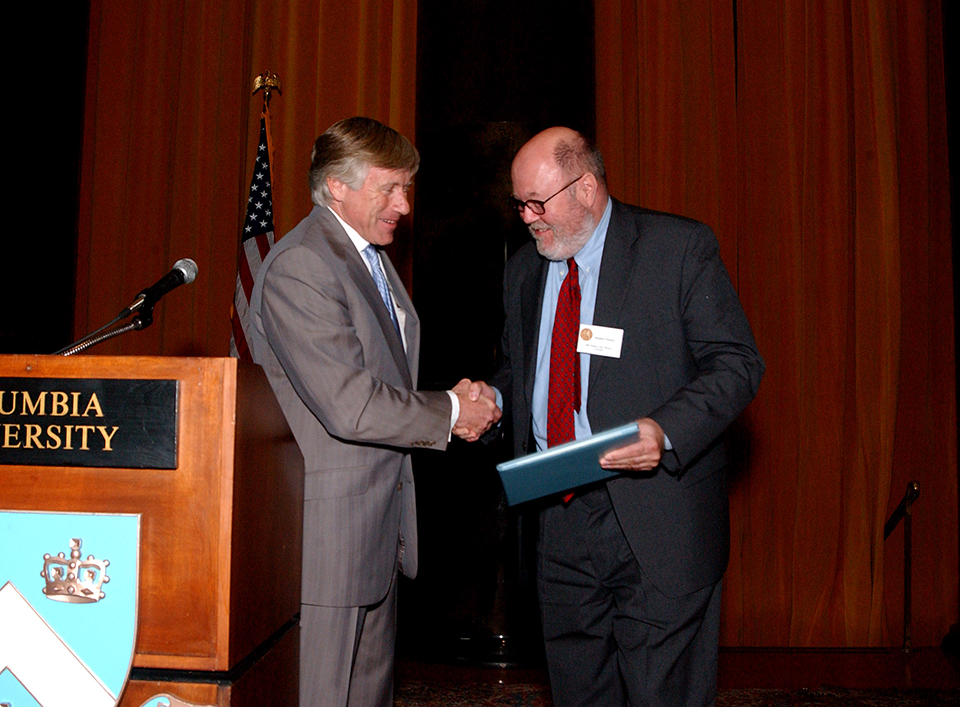
Columbia University President Lee C. Bollinger (left) presents Stephen Hunter with the 2003 Pulitzer Prize in Criticism.
Winning Work
This "Chicago" doesn't toddle, it swings, it Lindy Hops, it Charlestons the night away, and probably all your woes along with it. It's the bee's knees.
By Stephen Hunter
A superior adaptation that bypasses the Ann Reinking version now on Broadway, it is drawn from the 1975 Bob Fosse musical, which itself was drawn from "Roxie Hart," the 1942 William Wellman movie about the 1920s Chicago crime scandal. It's blessed with a mega-wattage star turn by Catherine Zeta-Jones (can't dance, can't sing, but she sure does deliver the goods!), smooth-as-silk high unction by Richard Gere and a rich mahogany Irish lilt by, of all people, John C. Reilly.
Even Renee Zellweger, more actress than music hall gal, is pretty impressive. She can't dance either, but you wouldn't know it from this movie, in which she dances up a storm. Her flaw is in her destiny, not her character: She just doesn't have the It-thing going to the temperature of La Zeta-Jones, and at the end, when director Rob Marshall contrives to put the two of them onstage together belting out the razzle-dazzle number, you'll have to force yourself to look at Zellweger. (I tried but couldn't.)
Marshall (a heretofore undistinguished TV choreographer) has thought rigorously about the artificiality of musical theater and how awkwardly it fits within the framework of the naturalistic film. He didn't want merely to make a recording of a stage production, but at the same time he didn't want to break the thing out into a real world, where its theatricality would seem inappropriate. The compromise he has come up with works extremely well.
Aside from a few spectacular sequences set in an actual theatrical locale, most of the singing and dancing take place in the head of Roxie Hart (Zellweger). She's a fanciful wannabe star, and it's entirely appropriate that her imagination is jivey with musical-comedy conventions. Thus the movie encompasses both realities, the interior and the exterior, with a great deal of deftness.
It's also been re-choreographed by Marshall. And you think: Well, why "fix" Fosse, one of the greatest show choreographers of all time? But the fix isn't the usual Hollywood "fix" where they say, "We'll fix it," and what happens is they wreck it. Marshall has gone a long way toward capturing the percussive drive of Fosse's work while adapting it to the screen; so it's less a fix or a change or a destruction as it is a re-evocation.
I saw the most recent Broadway version, but I can't remember a thing about it except how good it made me feel. So if they've made drastic changes to the material, and you need to know exactly what they are, go elsewhere. This version really works because it's tight and clever.
The movie is set in a Windy City obsessed with sin and scandal, as driven onward by the competing dozen or so daily newsrags, each trying to sell more papers by stooping lower into the gutter than the others. It's easy to imagine Hildy Johnson from "The Front Page" covering this sordid tale, but instead Christine Baranski fills in as a sob sister named Mary Sunshine. And there's plenty for the sister to sob about.
Roxie, a dreamer, is trying to break into showbiz, and her favorite performer is the human dynamo named Velma Kelly (Zeta-Jones), currently the hot tamale of all Chicagoland. In her squalid little hell, Roxie has fallen for a smooth talker named Fred Casely (Dominic West), who's got her believing that he's got an in. But one night he dumps her - he didn't even have an out - so she does what any good Midwestern gal would do: She plugs him. It turns out he was married; so was she (to lumpish John C. Reilly, who later sings a stunning ballad of grief). It also turns out that Velma has some domestic discord in her own life, which she solved with gunfire also. Exit her sister and her cheatin' hubby. See, this is what they did before they had marriage counselors.
In any event, Velma and Roxie end up together in the Cook County jail, where each competes for the attentions of super-slick mouthpiece Billy Flynn (Gere), who specializes in building his cases into soap opera tragedies, to jerk tears out of the jerks on the jury. Velma snubs Roxie but it turns out that Roxie has a genius for public relations and soon, with Flynn's help, she is manipulating all the papers to elevate her into a martyred frail.
Of course, the key question here isn't "Does it make sense?" It's "Is this structure sturdy enough to sustain a musical life?" And the answer is, yes, handily. "Chicago" really perks and hums and blasts along. You can dance to it. I'd give it a 95.
Catherine Zeta-Jones is no Ethel Merman, and for a trained dancer (according to her bio), she's surprisingly heavy of foot. She doesn't have the true dancer's ability to imply lightness, to seemingly defeat gravity. Everything about her is stumpy and dense and tough. She even does a cartwheel at one point and it looks like John Riggins doing a cartwheel. But . . . she's got the oomph.
The camera registers her charisma, and the melted-mushroom hairdo, which plays up the hot depth of her eyes, is enormously helpful. In fact, in no film since "Mask of Zorro" has she imprinted movie star charisma on your retinas as well. When she dances it's with power and fury, not precision; when she sings, it's dense and throbby, not perfect, but heartfelt and believable. The camera sits back and enjoys her. She defies it to look away. It can't, although there are some other things to watch, too.
Zellweger isn't blown away by any means, but at what appears to be 35 pounds soaking wet, she seems insubstantial. She's a thrush, a wren, a hank of hair and a piece of bone, a Minnie who doesn't bother to mooch. Mooch? She looks like she hasn't eaten in months. Maybe there's a disconnect between her seeming innocence and her ability to manipulate people, her quickness at adjusting to the rules of a prison ruled by Queen Latifah as the matron, her ability to change personas for tactical advantage at the drop of a hat. At the same time, Zellweger's great strength is her likability. You cannot but care for her, and even the mercenary calculations of Roxie don't destroy your affections for Renee.
Finally, there's Gere. Not exactly an actor whom most would have picked to headline a musical comedy, but he has always shown up on time and in shape for his roles. You have to admire a guy this greasy, and man, does he slide. He may be part mollusk, he's so squishy and oozy. He even tap-dances a little (a very little: I think a real tapster spanks the dogs for the close-ups). He sings, again a little. He sings less than he dances. But at neither of these enterprises does he fail so dramatically that the film comes apart.
In all, it's a lark, a pip, a hoedown, a damned 23 skiddoo and oh, you kid.
CHICAGO (PG-13, 107 minutes) - Contains sexual suggestiveness. At area theaters.
© 2002, The Washington Post Company
By Stephen Hunter
For under its scope and reach and passion, "Gangs of New York" is pretty ordinary stuff. You've seen it before at least a hundred times, and it's extremely dispiriting that a director of Scorsese's power and experience didn't choose something more complex.
What is a movie? That's a question Martin Scorsese, as great a director as he is, really can't answer clearly in "Gangs of New York." Such confusion is at the middle of this muddle.
For if a movie is a time machine, a trip to another epoch, a realization of looks and sounds and sights not seen in 140 years, then "Gangs of New York" is a great movie.
It has the genius of thereness to it. You are there when two tough crews named the Dead Rabbits and the Natives meet at Five Points, a raggedy intersection of streets in Lower Manhattan in the 1840s, back when Gotham was essentially a slum built on a cesspool in a swamp. You are there as these two deadly armies clash with flail and blade and club. You are there when they fight in top hats and spats and sashes and mustaches that curl up like the tips of a caliph's slippers, and the battle looks more like Culloden - Scots vs. English, 1746 - than anything else.
And you are there when the Natives - long-settled old stock who've forgotten their own immigrant origins - vanquish, then banish the Dead Rabbits, the Irish. You are there when folks think the name "Dead Rabbits" is cool and dangerous.
So if the idea expressed by the word "movie" is some sort of meta-museum of history that shows you exhibits, then "Gangs of New York" cannot be missed. Scope, vision, power, immaculate filmcraft, sense of wondrous newness, sense of history's melancholy vapors, sense of the bloody ground that is this country of ours. Friend, is that your idea of "movie"? Then be my guest, sit back, enjoy, learn, stretch, expand, be morally improved.
Unfortunately, if your idea of movie comprises one word and that word is "story," you're going to be disappointed. For under its scope and reach and passion, "Gangs of New York" is pretty ordinary stuff. You've seen it before at least a hundred times, and it's extremely dispiriting that a director of Scorsese's power and experience didn't choose something more complex.
It's as if he preferred to concentrate on the production - the building of the sets, the sweeping moves of the cameras, the depth and detail of the compositions, the montage of furious battle action - rather than on the dramatic issues and, oh yeah, taking up the rear, the human beings who live them. It's just the old revenge melodrama, the one about the son seeking payback for the murder of his father. When, after exile, he returns to the arena, he is so gifted that his father's murderer, a powerful man by virtue of that murder, is attracted to him, and invites him into the gang. So Our Hero is tempted: success or vengeance? Wouldn't be a movie if he chose success, right? You already know that, so you already know everything.
It begins with that street battle, but the point of view is that of the young Amsterdam Vallon's. His father, Priest Vallon (Liam Neeson), leads his Irish boys against the nativist Natives - a mob of guys terrified then (as now) by the new waves of immigrants, who they know must be kept down or they and their little private world will be overwhelmed.
The fight, at Minute 3 and lasting through Minute 9, is pretty much the high point of the movie. Scorsese has always had a genius for depicting violence ("Taxi Driver," "Raging Bull") and here he really outdoes himself, with an evocation of the racing fear and exhilaration of close-quarters combat that leaves you shaken. But some of the blood in the snow comes from Priest, who is defeated by the Native leader, a fiery galoot named Bill the Butcher (played with screaming bravado by Daniel Day-Lewis).
So the boy Amsterdam watches his father die, particularly the coup de grace issued by Bill to put the writhing man out of his pain. But the plucky Amsterdam steals that knife and runs off with it, and the camera stays with him as he penetrates the multi-tiered Dead Rabbits' command structure (which I never quite understood) and manages to bury the knife, which he will recover when he turns into Leonardo DiCaprio and then . . .
And then nothing. That's a suggestion of the story's lack of narrative savvy: The whole first act of the movie is about the theft and hiding of that knife, and its recovery 16 years later, in 1863, in a move heavily freighted with symbolic foreshadowing. All from Storytelling 101. And then the knife just disappears. So what was the point of dramatizing this knife above all others in a universe of knives? That question is left hanging.
Continually, Scorsese's impulse to inform overwhelms his instinct to dramatize. He is so proud of his mastery of the source material, a pulpy, anecdotal true-crime volume published at the turn of the last century. A whole sequence, for example, involves the beautiful Jenny Everdeane (Cameron Diaz), professionally a Five Points pickpocket, who goes on an uptown foray to crash mansions in a maid's outfit and steal the places blind. This, we are informed, is so specific a crime, its practitioner has a colorful old-timey name: she's a "turtledove." But so what? Everdeane as turtledove never again figures into the plot; she just becomes, generically, "the girl" in a predictable triangle with Snidely Whiplash - Bill the Butcher, that is - and Amsterdam.
As for DiCaprio, he's certainly the weakest performer up there. He's cast as a deadly, beautiful street youth, with a quick cunning and a will to do battle and seek revenge. Well, you believe the beautiful part. But somehow he never projects the city-rat toughness of a young slum champ. Remember Garfield fighting his way out of the mean city back in "Body and Soul"? No, you don't? Well, then try this: DiCaprio is never feral and edgy like, say, the young Robert De Niro in Scorsese's "Mean Streets" so many years ago. Still a blank? All right, let's go here: He's never as tough and believable a city kid on the hustle as Eminem is in "8 Mile." He's way too uptown. He should be wearing a black turtleneck and Italian director glasses and Prada shoes.
A whole middle hour (of three) follows plot twitches of little consequence, such as Amsterdam's friendship with another street kid grown too handsome (Henry Thomas), the interplay between Bill the Butcher and Boss Tweed (Jim Broadbent) and the most important of all, will the Dead Rabbits' hallowed symbol of identity (yes, that would be a dead rabbit) be hoisted downtown again. The facts are fascinating: Are you aware that firemen in the 1860s were essentially gang-controlled looters whose main job was to steal the valuables of the house before it turned to ash? Interesting, but it has nothing to do with the story.
But it finally seems that the movie itself has nothing to do with the story: Scorsese pretty much forgets about it in the end. It's clear he wanted to say something about the New York draft riots of 1863, an ancient holocaust that has all but vanished from memory as it was so overshadowed by contemporary slaughters at Antietam and Gettysburg. He just has nothing to say about it.
It's a shameful episode, a spasm of urban bloodletting in which, among other things, more African Americans were slain than in any other single event in American history. Yet Scorsese's treatment of it is distressing. In the first place, it blows into town like a hurricane, presented almost as a natural occurrence, and it all but obliterates the nominal climax toward which the film has clearly been building, the return match between Squashed Bunnies and Native natives; even the last meeting of the Butcher and Amsterdam is muted, as if obscured in a fog or a squall.
In the second place, it has an extremely curious and debilitating effect: It takes the New York draft riots completely out of a moral context. The movie fails to make the point that even a little research convinces you of - that these folks, who were refusing to go to war to end slavery and save the union, were hardly victims; they were essentially in open, murderous rebellion against, er, America and were committing violent treason. And that's before they started lynching black people. Considered in that light, the arrival of the Army hardly feels like the neutral tragedy of Scorsese's imagination. You want to rape, burn, pillage and tear down, and murder any black person you can get your hands on? Then say hello to the Fifth Pennsylvania Infantry with its bayonets fixed and fingers on the trigger. Then as now, there are always consequences.
GANGS OF NEW YORK (R, 165 minutes) - Contains extreme carnage. At area theaters.
© 2002, The Washington Post Company
By Stephen Hunter
Under its flickering postmodern stylizations, its twitchy narcissism, its obsession about its author's own preciousness, "Adaptation" decodes into one thing: It's about someone trying desperately to do something he can't.
How universal is that? It's what I'm doing right now in a room full of people doing the same thing, and all you boys and girls out there looking at the newspaper from the outside in, you can't do anything either and you do it anyway. As he does, as I do, as you do, here's what happens: You start, you grunt, you stop, you start, you quit, you hate yourself, you daydream, you try again, you beat yourself up, you beg for mercy, you pray to God, you denounce God, you contemplate suicide, you go to the bathroom, you go to the bathroom even though you know you don't have to go to the bathroom, and somehow the end product of all this internal combustion is what most of us produce most of the time: the best we could do, no more, no less, goodbye, I need a drink.
To my knowledge nobody has made a movie on this topic before. I certainly hope no one ever does again. But... "Adaptation" is simply brilliant.
Let's define cases. Technically, procedurally, practically, "Adaptation" can be described thus: It is about a screenwriter having trouble writing a screenplay for the very movie that you are watching. He knows what it's supposed to be; it's supposed to be a straightforward film version of a nonfiction book by Susan Orlean, a New Yorker writer, called "The Orchid Thief." But he just can't find a structure on which to build his edifice, or some kind of angle into the material, and as he sinks deeper into despair, his mind begins to wobble this way and that in comic incandescence, a spluttery nova of self-loathing, doubt and nihilistic impulse. And of course - this is always the worst part for anybody - he looks out at a world blissfully unaware of his agony, where people seem to be succeeding without a whisker of effort. That's an illusion, of course. But it's an illusion he loves, because it allows him to hate himself so much more passionately.
I thought it was a writer's movie at first, because it was so familiar, and having been sentenced to death by the ASDFGHJKL row of keys many a time, I connected with it at a primal level. But what it describes isn't peculiar to writers; it's peculiar to humans, if they have an IQ over a grapefruit's and a yearning sense that somehow, somewhere, all this should be better but most of all they should be better.
Our hero - also our writer - is Charlie Kaufman, the screenwriter of "Being John Malkovich," who presents himself via this script not as a brilliantly successful, highly original screenwriter but as a total loser. Fat, balding, self-hating, lazy, inefficient, riven with sexual fantasies and ripped by sexual inadequacy, timid, nervous, infantile, a chronic masturbator. But you have to say this for him: He sweats less than any fat guy I know, although he does sweat quite a bit.
The movie takes place no place, and everyplace: in reality, in fantasy, in history, all more or less interchangeably. It opens - this has to be a first - on what I take to be a fictionalized version of the "John Malkovich" set where Malkovich, ever the good sport and in this case actually playing John Malkovich on the set of "Being John Malkovich" (boxes within boxes!), delivers a blistering warning to the other cast members about hurrying up, and it's exactly the sort of harshness that would depress a sensitivo like Charlie Kaufman. Except that's not Charlie Kaufman. That's Nicolas Cage, playing Charlie Kaufman.
Soon enough Kaufman's in hell - that is, his real life. Failures dog him. Soon enough, he's alone in his room with a typewriter. Mission Impossible: to adapt the Orlean book, which is about a rogue botanist named John Laroche (brilliantly played by Chris Cooper), who in his clever way both loved wild orchids and coveted them. He was busted over and over again, but kept sneaking into the Florida Everglades to sneak the endangered plants out, not for profit but for . . . well, collectors will know why.
The movie - directed by that other "Being John Malkovich" cleverboots, Spike Jonze - flutters between the struggling Charlie and, three years earlier, the struggling Orlean (Meryl Streep, and it's so nice to have her back), launched on her journalistic seduction of Laroche but at the same time aware that she is also being seduced.
In fact, every character in the movie strains after an ideal that is ultimately unattainable. Every character, that is, except for the made-up one: Charlie's twin brother and foil, Donald (Cage also, of course), who is Charlie without the talent or the hang-ups. He has no self-doubts, he has no irony, he is charmingly, aggressively superficial, and success just, duh!, happens to him. Sponging off his brother, he declares himself a screenwriter, too, and keeps asking sophomoric questions that further infuriate Charlie. Meanwhile, Donald is effortlessly picking up chicks, having sex, meeting people, learning, taking the kind of screenwriter-wannabe seminars that a professional would despise, and . . . selling a thriller script.
Frankly, I was happy to learn that there is no Donald, that he is an artifice of "Adaptation" who serves merely to spotlight Charlie's inadequacies (though the movie doesn't reveal this). People like Donald shouldn't succeed, though all too frequently they do. Anyhow, this is a fabulous if fragile contraption, and one worries if Kaufman has the chops to bring it in for a landing.
The news is, well, sort of. He's onto something here, though I fear some viewers won't quite catch it. The movie turns into exactly what Charlie has desperately been trying to avoid: that is, into Every Other Movie. In other words, though he cannot admit it, at a certain point he has to yield to formula, even in fantasy, and thus "Adaptation" turns into adaptation: Thriller aspects are thrown in, a car chase or two, a shootout, and each of the characters we thought was real is suddenly a movie cliche. Charlie even has an epiphany at the end and is a Sadder But Wiser man. I hate it when that happens.
Not a great ending, but not a collapse either. Still, the movie is surely the most creative trick of the year and grimly funny throughout, until the change of tone at the conclusion. But as an act of pure audacity, it's got some cojones you wouldn't believe.
ADAPTATION (R, 114 minutes) - Contains profanity and drug use. At area theaters.
© 2002, The Washington Post Company
By Stephen Hunter
The pleasures of "About Schmidt" are what might be called Midwestern pleasures: a sly sense of humor, sturdiness, self-discipline, solidarity. It might be the most Midwestern movie ever made.
Directed by Alexander Payne, who has essentially become the poet laureate of Omaha (as he showed in "Citizen Ruth" and "Election"), it meticulously examines a retired insurance executive with the inner life of a gnat as he comes to terms with retirement and mortality. Here's what happens: nothing much. Here's what doesn't happen: something much.
Payne is a comic miniaturist, who works in a small compass, as if through a magnifying glass with tweezers. What he imposes on the work is brilliant discipline and a complete toughness about not breaking character. He never goes for the cheap shot.
An anecdotal example: At Cannes, in an interview (not with me), Payne recalled the movie's biggest laugh. It came when Jack Nicholson, who plays Warren Schmidt, is sitting in a diner, interacting with a harried waitress. At one point, Nicholson improvised a line that reflected back to his famous diner contretemps with another waitress, in "Five Easy Pieces."
It was a brilliantly funny moment. In previews, everybody who saw it busted a gut and coughed up a lung in hilarity. It was the kind of vivid, perfect line that makes a movie a word-of-mouth hit.
Payne cut it.
He cut it, of course, because while it's something Jack Nicholson would say, it's not something Warren Schmidt would say. Warren Schmidt probably wouldn't know who Jack Nicholson was, since Jack was never big in Midwestern insurance circles.
There's not a lot of plot, just as - have you noticed? - in life. Plot is for movies that are about, uh, plot. You won't find much plot in the office of the actuarial expert of Woodmen of the World Insurance in downtown Omaha on the last day of his 30-year career with the company. He sits there, his face flaccid and unfocused. He's trying to feel something. He can't. It's not that he's dead inside, burned out, or anything glamorously existential like that. He just has natural inclinations toward silence over jabber, and a lifelong habit of repression. Maybe it's the biting weather, maybe it's those flat, featureless plains, but the upper Midwest in January is not a place where people sound off a lot. And Schmidt is Midwestern in the extreme: He's not a sophist, a glib ironist, a voluble chatter, a convincer. His life is narrow and defined; he is narrow and defined.
Except now he's lost his definition. Without those tables of far-off lives and deaths to chart, he has nothing. At home, with his wife, Helen (June Squibb, so right as a Midwestern insurance exec's wife, and so far from Lara Flynn Boyle you could not believe the same universe accommodates them both), the only thing he does is get in the way. He has nothing to do. His imagination remains inert, disengaged.
Then Helen dies (early in the movie; I'm not giving anything away) and after a bit of fiddling with, rather than dealing with, his grief, Warren decides to go on the road in a big RV. Zany adventures? Wacky characters? Fabulous coincidences? Orgies, fights, chases, trysts, betrayals?
It's the Midwest, okay?
With the nominal goal of attending his daughter's marriage to a not particularly outstanding fellow, he heads to Denver, only to find the roads clogged with . . . other Midwesterners.
Payne uses the ancient but effective device of the unreliable narrator to great effect. Warren, in a moment of trying to connect with the world, has begun to correspond with a pen pal, an African boy who would know nothing of American life. That's the joke: Warren knows nothing of American life, either, and we watch something - a random transaction, a tiff, an encounter, a talk with his daughter - and then we hear Warren's clueless, oblivious account of it in a letter, to mounting comic effect.
There are some further complications, which, as in life, aren't that consequential. He reaches Denver, he tries to get along, but really can't. He doesn't grow so much as adjust, if slightly and internally, to his daughter's new life and the smallness of his place in it. He sees Kathy Bates - the mother of the groom - naked, and so do we, and he recovers, and so do we. Life goes on.
Nicholson is fabulous. It's not the showy Jack of "Heeeeeeere's Johnny"; it's lumpish, repressed Warren, with no Jack, no famous eyebrows or wolfish leer in sight. It's just that old guy, what's-his-name - oh yeah, Everyman - struggling to make it through the night.
ABOUT SCHMIDT (R, 124 minutes) - Contains profanity and brief nudity. At area theaters.
© 2002, The Washington Post Company
By Stephen Hunter
In the end it's a medieval battle rhapsody and you can pretend the Uruk-hai are demons from the mud of Hell or Flemish mercenaries from beyond Hanover in the year 1642, and it really makes no difference at all.
Other than a distressing lack of quality hair care products, things are fine in Middle Earth. Good is still cute, bad is still monstro-evil, the landscapes still green, the Hobbits barefoot and dressed like Victorian squires, the warriors handsome, the milieu kitschy. And ignorant armies still clash by night.
Where are we now? What place is this? We are in myth. It's an artificial myth, invented only in the last century by a fussy Oxford don with too much time on his hands, but it's still convincing, gripping, whole and nourishing. Certainly of the fantasy film series currently in American theaters - I include "Harry Potter and the Secret Toity" and "Star Trek: Halitosis" - "The Lord of the Rings: The Two Towers" is the best, and not by just a little.
It alone among them transcends. It works as story for the common narrative-starved fool, who needs heroic example and pulsating, vicariously energizing experiences of love and hate. You don't have to be one of those Hobbit-like geeks who've lost themselves in this world so intensely there is no other - though I hasten to add that there's nothing wrong with knowing more about Middle Earth than, er, Earth. You can - and this is the cool part - enjoy dual citizenship in the world where trees launch assaults on castles and the one where bills come due. Whichever citizenship you claim, you walk out and you think, that was a hell of a story.
What the director Peter Jackson brings to this second installment is exactly what he brought to the first, which is also what makes, come to think of it, a pretty good middle linebacker: power, speed and cunning. Jackson's not messing around. His commitment to this world is total. He's on a mission from Tolkien, and you either go along or you get trampled.
Of course, one can still track certain irritations. Elijah Wood, as the game little hero Hobbit, Frodo Baggins, still relies entirely too much on a single expression: It's that stricken look, as if he's just learned that not only didn't he get into Harvard but he has been banned from ever setting foot in Massachusetts. It's really not acting, it's face-making. Here's how you do it: First, sky-blue contacts. Then, in front of a mirror, make your mouth an open square. Flare your nostrils. Wrinkle that brow. Really, really, squish it up good. Open your eyes to about f/1. Tighten your throat. Suck in your cheeks. There, you are now indistinguishable from the bearer of the One True Ring.
Other shortcomings? The Ents. Ents, not ants. An Ent is a big tree. Or, rather, it is a majestic sentinel of the forest, meant to guard all that is green and good about the world, mainly other trees. But of the brilliant digitized illusions conjured by the film, most of them wondrous and palpable at the same time, the Ents, it must be said, are kind of a disappointment. I mean, come on: They're just trees. Most people will think of the trees that were hornswoggled into throwing apples by the Scarecrow in "The Wizard of Oz"; these guys are taller and tougher and they appear to have no apples, but they still walk like the kind of tragic human specimens that are over seven feet tall but not coordinated enough for basketball. In other words, they aren't Yao Ming, they are Manute Bol. Particularly when they march, they just look silly, and when they go to war, their attack is somehow the least convincing, a letdown in a story whose strength is that it drags us through the charnel house of medieval warfare.
And finally, the hair. I suppose if you're shooting three movies back to back on the other side of the world and it's one of the biggest gambles ever in the entertainment industry, a detail might have slipped your mind. In Jackson's case, that little detail was shampoo. He either couldn't afford it or he forgot all about it. The result is that you never saw so many greasy, tangled, thorny, wet, lusterless protein brambles as are on display in this movie. Viggo Mortensen, with a haircut that looks like a drowned swamp rat floating belly up in a bayou, leads the troop. A man named Viggo ought to do better than this.
Tell me you don't want plot. You don't, do you? You do. Ach. Well, the movie takes off directly from where the last one left us, and basically three plot strains are followed, each strain a journey across Middle Earth. The team whose formation was the essence of the first film is now broken up, and we watch as three - two teams of two Hobbits, and one team of three warriors - journey across the world, each on a mission, while various larger forces gather to unleash destruction.
The gathering storm is the unification of the dark lord Sauron (still unseen, but whose menace is felt everywhere - and in No. 3, Jackson had better deliver, but good) with the lesser monster Saruman the White (Christopher Lee, on leave from the disappointing "Star Wars" second gen). It's Saruman who's unleashed his legions of grown-from-mud warriors called Uruk-hai - they look like a DNA combo of WWE heavyweights and large, grumpy pigs - upon some other Middle Earth townships and shires, namely Rohan. (Gee, do you think I'm copying this from some Web site?)
Team A of Hobbits consists of Frodo (Wood) and Sam (Sean Astin). Frodo has the One Ring, and his job is to get across Middle Earth and penetrate the topless towers of Mordor and there dump the ring into a volcano to destroy it and restore harmony to the world. But he must do this without wearing the ring, which would corrupt his character.
Team B in the Hobbit League is Merry (Dominic Monaghan) and Pippin (Billy Boyd), who are going somewhere that no Web site seems to know. They are the ones who get caught up by the Ents, and when war breaks out, it is they who leverage the Ents into a counterattack against one of the towers.
Because I have no imagination for little critters, I preferred the third team, comprising warriors Aragorn (Mortensen), Gimli (John Rhys-Davies) and Legolas (Orlando Bloom). They could have sailed in from that old Viking dragon ship on the beach there, or perhaps they came with those Huns and their yurts off the Asian steppes, or possibly they fought with the Green Berets at Tan Phu, the Spartans at Thermopylae or Henry at Agincourt, but, no doubt about it, they are the soldiers and their business is war.
And that's really the business of "The Two Towers" and the business of director Jackson. In the end it's a medieval battle rhapsody and you can pretend the Uruk-hai are demons from the mud of Hell or Flemish mercenaries from beyond Hanover in the year 1642, and it really makes no difference at all. It's men in mud and rain, at a castle keep, in armor with spears and swords, and it's a long, long day's dying.
Jackson's imagination is most vividly provoked by the extreme nature of Bronze Age battle, for the last hour of "The Two Towers" is pure combat and it's mind-blowing. The scene is Helm's Deep, a castle moored against a rock escarpment that takes the full force of the Uruk-hai attack, while our three human heroes and the Rohanites stand fast. Some won't be able to watch the hackings and gougings, and some (e.g., moi) won't be able to look away.
But underneath it all is the same issue that defined Tolkien's life, the battle between Western democracy and monsters who wanted to destroy it. Read into it what you want, or read nothing into it, but it's really the oldest story of all. It's the one about a band of free men on a hilltop with nothing to get them through the night but their belief in themselves and their cause and the long steel they carry in their scabbards.
THE LORD OF THE RINGS: THE TWO TOWERS (PG-13, 179 minutes) - Contains intense battle sequences, perhaps too intense for youngsters. It opens at midnight at several theaters, and later in the day at others.
© 2002, The Washington Post Company
By Stephen Hunter
Don't turn to Ridley Scott's stunning "Black Hawk Down" for lectures on geopolitics, the tarnished Clinton foreign-policy legacy or theories of terrorist conspiracy. The movie reflects not a public intellectual's view of the world, but Sgt. "Hoot" Hooten's. Hoot's the guy with the M-16 who doesn't make decisions but only tries to survive them.
The movie, then, may disappoint pundits and op-ed cowboys and all the men in gray suits and black shoes who so self-confidently throng this city's streets over the lunch hour. It teaches stuff they don't know, only the smallest and most bitter of lessons: that ammunition is more important than water, that cover is more important than concealment, and that the good die young.
"Black Hawk Down" re-creates war at the micro level, as experienced by Army Rangers and Delta Force commandos on the ground in Mogadishu, Somalia, Oct. 3, 1993. On that day, a routine if dangerous mission slated to last an hour fell apart in the worst possible way. The young soldiers found themselves the targets of what can only be described as a citywide homicidal rage, in which every angry Somali with a Soviet-bloc assault rifle or a rocket-propelled grenade launcher petitioned his grievance in lead and warheads.
The soldiers, initially deployed to represent their country's humanitarian instincts toward famine relief, had by this time become policemen, hunting a powerful warlord who usurped United Nations food supply efforts. Now they found themselves in a pitched battle. For 15 hours they sheltered in the ruins of the city, scampered to consolidate, rescue their wounded and collect their dead, shot at everything that was shooting at them, and prayed for deliverance.
When it finally arrived early the next morning, 18 Americans and an estimated 1,000 Somalis were dead and the city had been turned into a warscape resembling Stalingrad. It was the worst single day of combat for American soldiers since the Vietnam War, and even if the job the young men had been sent to do was accomplished, that achievement - in the way these things always seem to go - turned out to be largely meaningless.
You may be impelled to ask: What was the point? But you probably won't have time while the film is onscreen. The movie doesn't moralize, and its political meanings may be arrived at only by laborious inference. It's too intense to let the rational part of your brain gear up; instead, you are simply there, scurrying, ducking, wishing you had more ammunition, luck or courage, and wishing the whole thing would end. You come out shaking and weak.
Shot in Morocco with an unusual amount of Pentagon cooperation, "Black Hawk Down" re-creates the events of that day with the full technical resources of modern cinematic technique. It helps to have a few Black Hawk helicopters to play with, of course, and a $90 million budget, a Pico Boulevard club-full of hot young actors and, in the role of the Somali militia, the Royal Moroccan Army. But it's still possible to have all that and screw it up; Scott, an experienced big-movie maker ("Gladiator," for example, wasn't too shabby in the size department) tries to keep the phony movie moments to a minimum and the sense of frantic professionalism to a maximum. It works.
Task Force Ranger's mission - to arrest two men said to be the warlord's lieutenants in a building in a teeming market district - seemed to go well enough at the start. As planned, the Delta commandos, choppered in by small helicopters, assaulted the building and "extracted" the men; the Rangers, arriving minutes later in heavier Black Hawk helicopters, fast-roped down and set up a perimeter. Meanwhile a lightly armored convoy headed through the city to rendezvous with them and take everybody back to base three miles away.
But - spontaneously, it seems - the city's militia rallied and began to bring fire on the hated Americans; the whole thing went south when one, then another, of the big Ranger helicopters were shot down, and troops had to be diverted to the crash sites. Each one became an Alamo or a Little Round Top as the Americans took up defensive positions while rescue convoys attempted to reach them.
So focused on the experience of the fighting is "Black Hawk Down" that it doesn't bother much with context or with character, something that could never be said of reporter Mark Bowden's original book. Bowden took the time to explain not merely the politics involved but, more important, the culture of the new, volunteer Army.
There's not a whiff of Vietnam-era sullenness and resentment; these aren't draftees but volunteers, in it for the fun, travel and adventure. They aspire to be, or are, solid professionals; they don't see themselves as victims but as warriors. They are gung-ho, Number One, and RA (regular army) all the way.
But they weren't interchangeable; there were essentially two American military cultures on the streets of the Mog that day, and while Scott evokes them visually, he never explains them. The Rangers are shock infantry, basically conventional in all military respects; their hair is trimmed or shaved, their ranks low, their ages young (most are in their first enlistment). An institutional vanity requires that they bark "HOOOO-AGH!" in place of "Yes, sir" or "Yes, Sergeant." Most "want action" or joined to fight; they're full of the bravado of a JV football team on its first road trip.
The Deltas, or D-boys, are all senior noncommissioned officers, heavily trained and armed, who've seen a lot of action in our little wars of recent note. They are in their late twenties and early thirties. They are not just Special Forces but the elite of the already elite Special Forces; so they are stars, and used to being treated like stars. They have a lot of little perks, too, and like so many gifted men, they know their talent buys them extra latitude even in a bureaucratic empire as chronically anal as the American military. They wear their hair long, they dispense with conventional military courtesy, they have customized weapons, and they wear plastic bike helmets instead of the steel pots of the Rangers. And in action they are, by training and instinct, very, very aggressive.
It's the strategy of Scott (and the several screenwriters who toiled on the script, including Bowden) to play up that big brother/little brother relationship between men of each unit; it provides an emotional subtext to what otherwise might be simple chaos, spectacle and things blowing up. Each grown-up Delta will "adopt" a baby Ranger, and nurse him through the conflict with words of encouragement or chastisement. Each boy will try to please his big brother, and in the end, that, more than any exhortations to duty and country, is what gets them through the night.
As an exercise in star charisma, the movie is fascinating. All the guys end up with dirty faces and big moments, but only a few of them connect with the audience. Josh Hartnett plays an earnest young Ranger staff sergeant named Matt Eversmann, and he's essentially the sensitive one, in whose burning, tender eyes the full horrors of the conflagration are mirrored. He's not bad, and Hartnett may in fact become the big star everyone expects.
Still, others register far more powerfully, and some people disappear altogether. Eric Bana, the Australian actor of last year's "Chopper," will probably be promoted from Sgt. First Class "Hoot" Hooten to full-fledged movie star. Affecting a believable Southern accent, he's Hartnett's big brother; but he's so cool in his swagger, toughness and professionalism - and he has all the good lines - that he's the one you'll remember.
Meanwhile, William Fichtner, who's been a yeoman for years, has a great role as another Delta pro, Master Sgt. Paul Howe (Bowden's primary source on Delta operations for the book). Fichtner is really good: tough and smart and gritty. But his little brother, Ewan McGregor, as a company clerk elevated to assistant machine-gunner at the last moment, all but vaporizes. You forget McGregor - no less than Obi Wan Kenobi! - is even in the movie until the end, and then you realize he's actually been in most of the scenes.
The stunner is Tom Sizemore. Sizemore, who always appears as working-class stalwarts with doughy faces, dead eyes and imperturbable psychology, plays a Ranger colonel in charge of the rescue convoy. His calm dignity and endless well of courage are breathtaking. When a boy says to him, "Sir, I've been wounded," he replies quietly, "Son, we've all been wounded." It's as if he's still the platoon sergeant Mike Horvath from "Saving Private Ryan," commissioned, grown older and wiser.
There are some disappointments. The two Delta snipers Randy Shughart and Gary Gordon, both posthumously awarded the Medal of Honor for their sacrifice (they set up security around one of the downed Black Hawks and stood off hundreds of militiamen until eventually overwhelmed) are only seen in their brilliant action. They are not established as characters in the early going, and we have no sense of them as men, so we don't feel the pang of their loss as much as we should.
And while Scott largely resists Hollywood-ifying the material, he doesn't do so entirely. I didn't care for the way two of the Somali generals were personalized by their shades and gangsta outfits, and the way the camera delivered up their eventual demise with a sense of melodramatic payback. Take that, sucka! It seems beneath the movie. One of them even lectures a downed helicopter pilot in rhetoric that sounds like something Richard Loo would have said as an evil Japanese colonel to John Garfield in a 1943 Warner Bros. morale-booster.
But those cavils aside, "Black Hawk Down" is the next worst thing to being there. That's how real it feels.
BLACK HAWK DOWN (R, 144 minutes) - contains intense battle violence, including sheared limbs and bodies. At area theaters.
© 2002, The Washington Post Company
By Stephen Hunter
Friendship isn't rocket science. It's much harder.
Oh, yeah, it's easy to say just be loyal and true and that makes you a good friend. But suppose the other person does something that really irks you, like chew gum or vote Democratic? Suppose the other person laughs weirdly or thinks you can wear cheap shoes with an expensive suit, while you favor expensive shoes and cheap suits? Suppose the friendship is based on a subtle hierarchy, or one person's adoration without the other's reciprocation? Suppose he's just luckier or you're just luckier. Suppose you make more or you've always made more, and suddenly she's making more. Suppose she doesn't like the new boyfriend. Suppose there's jealousy, envy, bitterness, grudges, betrayals? It's way overrated, friendship.
And that thorniness, that dark underbelly of it, is the gist of the acerbic British import "Me Without You," which watches as a fab friendship comes unglued over the years. Set in suburban England, it follows as Marina and Holly come apart and, as the old song has it, breaking up is hard to do.
Marina (Anna Friel) is the pretty one. She's the dominant one. The boys always come on to her first, and then they gradually notice Holly (Michelle Williams), who lacks Marina's take-your-breath-away looks, her insouciance, her assurance at the game. So Holly is the eternal sidekick over the years.
The director, Sandra Goldbacher, working in an autobiographical mode (she was the real-life Holly, apparently), does a trim job with the cavalcade aspects of the movie, shifting effortlessly via careful clothing and music codes from '70s to '80s. And she is brutally without illusions on the topic of young womanhood in England, presumably because she is still a young woman in England.
The best sequence takes the two pals to a provincial university, where the lurking big dog is a visiting American professor played by the world's second-largest chin, Kyle MacLachlan. (Answer to obvious question: Bruce Campbell. Imagine those two in the same movie!) He's a superb actor, and he's superb in this role, which is to say I wanted to punch his teeth out and watch him suck broken Chiclets in the gutter for a while.
For a change, this monster of narcissism is attracted first to Holly. Why, how astonishing. Holly, it turns out, is very bright, and she has a natural critic's mind: she cares about writers and ideas, she's extremely insightful, and soon enough those little conferences over her essays have turned to petting sessions, and then we're rounding the bases and stealing home.
At the same time, for reasons that are mysterious to Marina but clear as day to us, the beautiful Marina feels compelled to get in on the fun. It's not that she's articulate enough to express herself, but sooner rather than later her little flirtship with the big creep has moved into the way of all flesh. The idea -- she isn't insightful -- that she considers it her right to have first pick of all men never occurs to her. That she is betraying a friend never lights up in her dark brain. She just has this urge to restore what she feels is the natural order of things.
But almost always, a key issue of friendship is forgiveness, and once the two have moved on, they naturally reconnect: There's too much water under the bridge to do otherwise.
Or is there?
There comes a time when Holly has to get what amounts to a divorce from Marina, and it's as painful as a legal divorce. To be the woman she wants to be, she can't be a sidekick anymore. This is the kind of small, real emotional issue that almost never makes it into movies. But the truth is, of course, that friendship matters to those of us who still claim membership in the human race, and Goldbacher's merciless autopsy on it is both illuminating and dispiriting.
Me Without You (107 minutes, at Cineplex Odeon Dupont Circle) is rated R for sexuality and profanity.
© 2002, The Washington Post Company
By Stephen Hunter
They announced his death on a Thursday, always the movie industry's biggest, busiest day. The studios and the exhibitors are sweating the arrival of the new prints, the publicists are in full twit, the critics are scribbling away, and the ushers are getting ready to go up the ladders to change the marquees.
Now it all stops inconveniently for a day, and that comic chortling you hear from some celestial source -- it's got to be him. That's Billy Wilder: always a troublemaker, laughing at the discomfort that was his stock in trade.
The tiny filmmaker, who died Wednesday at age 95, was a great director, maybe one of the greatest ever. Born in the Austro-Hungarian empire and heir to a European tradition of cosmopolitanism, merry sexual opportunism and raffish charm, he brought those subversive values to American pictures and made a career gleefully pointing out how much bad resided in the good and how much good within the bad. He was cynical about everybody except the dull, to whom he paid the ultimate insult: He ignored them.
His death marks the end of an era. He's the last of that great wave of European immigrants who reached Hollywood in the '30s, haunted (and in some cases hunted) by Nazism, and brought with them a moral complexity that our native-born could not master. Directors Fred Zinnemann, Fritz Lang, Robert Siodmak and Douglas Sirk come to mind, but there were many more. Even Bertolt Brecht did some Hollywood time. It was an infusion of talent, attitude and technique almost unprecedented and certainly unequaled by later invasions, like the live-TV directors of the '50s, the British ad guys of the '80s or the MTV hotshots of the '90s.
Wilder's movies almost always had edge, decades before the term "edge" had been coined. His was a universe of cads and bounders and slicksters, always on the hustle. They were morally compromised from the start, like William Holden as the gigolo screenwriter in the 1950 "Sunset Boulevard," who, besides being sleazy and weak, has one other character trait that might keep him from being a hero as the film begins: He's dead. Stop and think: How many movies are narrated by a gigolo corpse floating face-down in a Hollywood swimming pool?
Then there was Holden again a few years later as a black-marketeering POW sergeant in "Stalag 17," a man for whom World War II, with all its loudly expressed encomiums to duty, was really just a shot at profit. When the odds favored him -- and only then -- he became a hero.
And who can forget seedy Fred MacMurray, his eyes ball bearings of lust and greed, his mind not quite as clever as he thought it was, in the great "Double Indemnity" of 1944? Oh, and finally, there's Jack Lemmon in "The Apartment" (1960), a young executive wannabe, selling out to his boss (the oily MacMurray again) by letting the older man use his apartment as a trysting site. Then he has the misfortune of falling in love with his boss's mistress.
Wilder could never believe in the American Dream of fair play, decency, morality and courage; he was too Middle European for that, and had learned too much from the films of his hero Ernst Lubitsch, inventor of the famed "Lubitsch touch" and another clever cosmopolitan too amused to play it fair and square.
Wilder was born in 1906 in what is now Poland under the name Samuel Wilder, the son of a hotelier. Perhaps it was seeing all the combinations and recombinations of couples coupling and uncoupling in a large building full of rooms to rent that gave him his jaundiced view of humanity. Or perhaps it was his years as a journalist, first in Vienna, later in Berlin, working for tabloids. Or perhaps it was his secondary career in those Berlin years as a taxi dancer -- that is, "guy to let" -- that corrupted him so delightfully.
Whatever: His would never be the path of the straight and true. When he tried, however manfully, to tell stories about the straight and the true, they always went straight and truly into the ground, like his leaden version of "The Spirit of St. Louis" with a decades-too-old Col. Jimmy Stewart playing the barely post-adolescent Minnesota farm boy/aviator Charles Lindbergh. It may be Wilder's worst movie.
But give him an angle, a twist, a shading, and Wilder was in his element. He fled Germany in 1933, after Hitler came to power. By that time he'd already cracked the German film industry as a writer; he worked in Paris as a writer and moved to Hollywood, hired by Columbia, then 20th Century-Fox, and finally Paramount. One problem: He didn't speak English, a hindrance to anyone writing in that language.
After thin years (he roomed with Peter Lorre, and what a pair of roomies they must have been), he finally began the first of two professional collaborations that were to define his life. It was with the screenwriter Charles Brackett, of Williams College, Harvard Law and World War I. It was an astonishing combination -- or clash -- of sensibilities, the staid New Englander and the licentious Viennese, yet it produced films like "Bluebeard's Eighth Wife" and the great Garbo vehicle "Ninotchka" (both directed by Lubitsch). It was to protect his and Brackett's work from the studio hacks that the two of them took on additional responsibilities as, respectively, director and producer.
The first of these collaborations was "The Major and the Minor," and then the war drama "Five Graves to Cairo," both of which display Wilder's obsession with impersonation (Ginger Rogers pretends to be a child to travel half-price by rail in the first; in the second, young soldier Franchot Tone pretends to be a waiter to gain access to Rommel's documents in an Egyptian hotel).
The first of their great movies was the noir masterpiece "Double Indemnity," derived from James M. Cain's hard-boiled wallop of a book about an insurance salesman who thinks he can beat the game, and the babe who takes him along with her on the road to Hell. "The Lost Weekend" came next, with its dramatization of the DTs, from the Charles Jackson novel. Finally, after "The Emperor Waltz" and "A Foreign Affair," came "Sunset Boulevard."
Wilder had been in Hollywood 17 years and Brackett 25 by that time, and each understood the fuel of need, vanity, delusion and fear that drove the town. Thus their greatest work, certainly the best movie about movies ever made. Joe Gillis (Holden), third-rate screenwriter at the end of his rope, fleeing the repo men, takes refuge in an ancient, decaying mansion on the rue de title, only to learn that it's the home of the great silent star Norma Desmond (Gloria Swanson, made up to resemble a gargoyle on steroids). Soon he is hired to help her write her "comeback" project, and soon after that he learns he's been hired not just as an editor of her prose but also as the editor of her libido, which remains considerable. The pay is great; the workplace, however, is difficult to endure. Plus, he has to help her bury her dead chimpanzee one midnight.
The parable is compelling: youth and talent, corrupted and prostituted into decay by dreams of glory, the result being spiritual ennui and ultimately despair and then death; it's the Hollywood story at its most vicious, most cynical, most grotesque. It's Wilder and Brackett's tough-as-brass-bushings poison valentine to the town that made them rich and famous. It's also, in its severity, its rigor, its dark, consistent humor, a masterpiece. "Mr. De Mille," croaks the mad harridan Norma, her face a Kabuki mask of narcissistic self-delusion and too much foundation, "I'm ready for my close-up." Of course the movie was a close-up of Hollywood.
The two separated after that on the vague grounds of artistic differences (Brackett evidently thought Wilder went too far in "Boulevard"); each prospered. Wilder made fabulous if lesser movies: "Ace in the Hole," "Stalag 17," the effervescent "Sabrina," the vivid courtroom drama "Witness for the Prosecution," with Marlene Dietrich in a trick role.
Wilder's second great period began inauspiciously with the romantic comedy "Love in the Afternoon," when he met the writer I.A.L. Diamond. The I.A.L., incidentally, stood for Interscholastic Algebra League, of which the Romanian-born screenwriter Itek Dommnici had been the 1936 champion at Columbia University. Later, advised his name was too "Jewish," he chose Diamond and added the I.A.L.
Diamond had been a mid-level writer of light films like "Two Guys From Texas" and "Let's Make It Legal"; he and Wilder liberated the genius in each other. They made 12 movies, and at least three of them are great: "Some Like It Hot," "The Apartment" and "The Fortune Cookie." Only one is mediocre, "The Front Page," in which Lemmon and Walter Matthau (with whom Lemmon first paired in "Fortune Cookie") are too old for their parts and the old vehicle, a play from almost a half-century earlier, creaky.
It is said that Wilder lost his stuff in the '70s -- his last film was 1981's forgettable "Buddy, Buddy" -- because America caught up with his outre sensibility. He could no longer shock with innuendo as he once could. The buzz of sexual impropriety that he alone could hint at but not depict was all gone. In an era when anything went, the first to thing to go was the subtlety of the suggestion.
Maybe so; maybe not. I prefer to think that Wilder simply grew disgusted, and retired, 21 years ago, to a happy indolence of dark mirth, ripostes delivered in German with lightning speed, and happy memories of a life spent brilliantly and a retirement earned grandly. I hope he became Norma Desmond without the attitude problem. That's what was so cool about him: He never needed a close-up.
© 2002, The Washington Post Company
By Stephen Hunter
It used to be every novelist's dream to see his book purchased by Hollywood, then projected 25 feet high at the local bijou, with impossibly beautiful people playing the parts that had begun as fractured slivers of the poor schmo's id. He was so happy and rich, he didn't even notice they ruined it.
That still happens, and they still ruin it, as per Tom Clancy et al. In fact, just looking at the newspaper movie section, we see that a good many of the films in release originated as works of fiction. Besides "The Sum of All Fears," from the Clancy canon, there's "Minority Report" (from a Philip K. Dick short story), "The Bourne Identity" (from a Robert Ludlum novel), "About a Boy" (from Nick Hornby's novel) and "Divine Secrets of the Ya-Ya Sisterhood" (from a bestseller by Rebecca Wells).
The novel or short story -- that is, the work of fictional prose with an organic story, a set of recognizable characters and motives, and something wrong with it -- has provided material to films for almost a century. The earliest may have been a silent "Frankenstein." I saw it sometime back at the National Institutes of Health, and in it, all the pathologies of the literary adaptation were on display: They took a great 600-page novel and reduced it to seven minutes. Okay, so it was made in 1904.
But still: "It's not as good as the book." Think how many more times you've heard that than "It's much better than the book." That suggests a relentless reality: It may be that the novel isn't the ideal form for translation into the feature film.
A few adaptations, of course, have been masterpieces, most of those exceptions falling into two categories.
In the first, filmmakers simply ignore or abandon the original novel and use it as a platform to explore similar themes. The great "Dr. Strangelove" is one; the novel, "Red Alert" by Peter George, was largely a straightforward docudrama based on George's excellent knowledge of the inner workings of strategic-defense culture.
Stanley Kubrick and his collaborator, the freaky genius Terry Southern, and George himself reinvented the movie as dark farce on the subject of the end of the world. See it back-to-back with, say, "Fail-Safe," which plays the same story straight (and was itself adapted from a novel), and you see why one has lasted while the other slipped into oblivion.
The other consistently well-done literary adaptation takes off from a peculiar kind of novel: one so short and of a piece that it's almost a movie already. "The Maltese Falcon" is one, "The Postman Always Rings Twice" another. The best example of this is Lewis Milestone's memorable version of "All Quiet on the Western Front." Or think of Martin Ritt's stunning version of "The Spy Who Came In From the Cold" with the magnificently bleached-dry Richard Burton. Yes, it does happen. But not often.
Perhaps the best form to carry the complexity, the density, the drama and the humor of a big novel is the television miniseries. In most cases, you need a dozen hours or so to accommodate the best of prose fiction. Anything less truncates, shortchanges and destroys all those things that somehow are the novel: the milieu, the delightful smaller characters, the odd subplot, the subtle manipulations of point of view, the on-schedule arrival of epiphany.
The masterpiece of novel adaptation on television comes, as does the above "Came In From the Cold," from the complex John Le Carre, whose classic "Tinker, Tailor, Soldier, Spy" was a beloved BBC series; later, an independent British television network did a wonderful job on "Smiley's People." On our side of the Atlantic, the fabulous CBS version of "Lonesome Dove," Larry McMurtry's epic novel of a cattle drive, is generally conceded to be top-drawer.
Novel-into-feature-film, though, usually doesn't work reliably. It never has. It never will. But they do it anyway, the dopes. And they will always do it. Now there's a new kind of novel from which Hollywood draws: the graphic novel, such as "Road to Perdition," which just arrived in a movie version. It's by no means the first, but it may be the biggest and most ambitious.
What is a graphic novel? Well, it's not exactly a comic book. If you call it one, I am sure you will be e-bombed into oblivion by its many aggressive adherents. In fact it is so far removed, thematically and artistically, from the comic book, it might even be seen as an anti-comic book, almost a reaction against the comic's arbitrary limits on complexity and maturity of theme. The comic book -- from Porky Pig to Superman to Sgt. Rock -- has pretty much been a settled issue since the '30s: a short, punchy story expressed over no more than 12 pages, with all dialogue contained in word bubbles and all sentences ending in exclamation points! The characters, super-powered or not, are constants, and the formula is precise. On top of those formal obligations are moral ones, as stated by an oppressively authoritarian comics code (a reaction against so-called "bad" comics in the '50s) that mandates peppy tastefulness.
Most baby boom kids saw through comic books by the time they reached adolescence -- the same time they were noticing how phony movies and TV were. The books had their own kind of ridiculousness to them. Take a late-'50s hero, Sgt. Rock of Easy Company, in the DC Comics series. Rock never got hit and never panicked and always triumphed, shooting down Messerschmitts with his Tommy gun and throwing that grenade so well it always went down the Tiger tank's suspiciously open hatch. The gun went "Budda-budda!," the explosion went "Ka-BLANG!" and at the end, Rock always said, "Okay, Easy, let's move out." The strip was usually drawn by a great comic artist named Joe Kubert from scripts by Robert Kanigher; it was always amazing how much power and poignancy these stories managed. But you could feel, toward the end of the run (I read 'em all!), Kubert and Kanigher's disenchantment with the format. It was so limiting.
When change came -- in the late '60s, that epoch of change -- it came in the form of the graphic novel, imported from the Europe that always took popular art more seriously than did Americans.
This is no time or place for a history of the graphic novel, for two reasons: First, it would take too long, and second, I don't know it. What I do know is that, simultaneous with tear gas in the streets, loud music on the radio and love-ins on campuses, a magazine called Heavy Metal appeared on newsstands, and it pretty much blew the minds of whoever wandered between its pages.
It was adult comic art, and the stories were dark, troubled, violent, almost obscene, rendered with painfully vivid detail. They were long and complex, usually set in a sci-fi context. The high champion of this genre was the French comic artist calling himself Moebius, whose dystopian vision was mind-boggling, to say the least, and wildly influential. ("Blade Runner," ostensibly based on another Dick short story, showed clear Moebius influences.)
The profusion of graphic novels that have been adapted for screenplays -- the "Batman" graphic novels (not the comic books), "From Hell," "Ghost World" and on and on -- makes a salient point: Possibly the graphic novel is a better story vehicle than the novel for a feature film.
That's because a graphic novel isn't really a novel; what it is, really, is a movie in graphics. It tells stories visually, finding images to express emotions that would somehow be beyond a prose artist's ability to convey.
Let's look at a specific image sequence from "Road to Perdition," which was written by Max Allan Collins and drawn by Richard Piers Rayner. It's a seemingly nothing little twist of action, yet the comic team expresses the subtlety, the emotional vividness, with an eloquence that is probably unmatchable in prose.
In this sequence the narrator, young Michael Sullivan Jr., has just learned that his beloved father is really a contract killer for the Looney mob, which runs the Tri-Cities area of Rock Island and Moline, Ill., and Davenport, Iowa, in cahoots with the Capone mob in Chicago. He's seen his father machine-gun a batch of men. But now they are home, and Michael's mom wants to know where he was, what happened. Which parent does Michael please? The answer is that he loves his father still, no matter what, and promises in his mind to never give the secret away. His mother demands an explanation, thinking that he's run away and gotten in some kind of trouble.
Dad replies, "I've spoken to the boy. He won't do it [run away] again. No more questions."
"But . . ." she insists.
"We'll not speak of it again."
They go upstairs and the narrator informs us: "A covenant was formed between my father and me."
Now how to express this idea? Here's how a novelist writing in Michael Jr.'s voice might make the point:
"My father's dry, large hand brushed against mine as we headed upstairs. Whether it was intended or accidental, I'd never know; but there was something in the touch freighted with communication: It was that we had connected in a bond that sealed us off from the world of women and commerce, the world of school and factory. We had bonded and it was permanent and that was that. Blah blah, and then, furthermore, blah blah blah. And, finally, I had to conclude: blah blah and blah again."
Another kind of writer, of the Raymond Carver school of minimalism, might offer something more mysterious:
"His hand brushed against mine."
We'd have to figure that one out ourselves, supply our own interpretation. Maybe we get it, maybe we don't. Maybe we don't even notice it, so flat and unemphatic is it. But the director of a film and the artist of a graphic novel can use the close-up, which makes the distinction; it emphasizes that touch without overdoing it. The artist Rayner conveys all in a single image, spare, unclotted with sentimentality or the wretchedness of powerful thoughts clumsily expressed: We see the two hands brush. That's enough, that's everything.
The artist, who has seen movies, knows the power of the camera to fragment images into small parts, and that those parts carry significance. Thus it is his decision to become the camera. He closes in and finds a way to express the connection between father and son with immediacy and precision, and apparently without conscious symbolism: It's just two hands, after all. But each hand carries a larger meaning of the being to which it's attached, and we know the man is troubled and the boy is adoring and feels privileged to join this private intimacy with the father.
Henry James couldn't get that; nor could Joyce or Hemingway or Faulkner. But Rayner does. Moreover, we read the secret message being communicated, even if we've never opened a graphic novel before, because we've been educated to the vocabulary by movies. We accept the conceit of the close-up without a second thought; we appreciate its symbolic meaning without needing to grasp that it's symbolic.
So for a screenwriter or an adapter, the heavy lifting is already done. It's particularly the case for action sequences, where the profusion of images, the dynamic fluidity with which one becomes another, where clarity is less important than momentum, where the individual components of close-quarters battle -- the flash of guns, the jingle of spent cartridges, the whup of a bullet striking and penetrating flesh, the drift of gun smoke -- are best communicated in a montage, be it a series of semiabstract drawings or a film sequence edited with stunning brilliance.
The poor prose guy -- how far behind the curve is he? Struggling and lost in his snare of motives and psychological realities, it's almost impossible for him to create in words the sensation of action that either a movie or a graphic novel can. And I'd venture a bet that no thriller writer could stay with Rayner, who gives us a brilliant evocation of the gunfights of the '30s.
And that leads to a big question: If the DreamWorks studio goes to the trouble of buying a graphic novel and producing a movie based on it, why oh why did the filmmakers then all but abandon it?
"Road to Perdition" the novel is a black-and-white affair, and it's gritty, violent, Catholic and unbelievably fast-moving. It's a homage not merely to the crime films of the '30s but also to the Japanese samurai sensibility. It is said to be inspired by Kazuo Koike and Goseki Kojima's graphic novel series "Lone Wolf and Cub," about a masterless samurai on the road with his small son. The father's tenderness toward his son contrasts dynamically with his spasms of violence, as the best swordsman in Japan. The violent sequences, like Rayner's, are slick, abstract and compelling.
Collins and Rayner pick up on that. They give their Mike Sullivan a batch of shootouts where he outguns multiple antagonists, and the gimmick is usually that he is unarmed, he nabs a gun from somebody threatening him, and he goes to town, shooting faster and more accurately. But he's more than a dervish, he's a freakin' ninja: He spins, he rolls, he ducks, he darts, he never misses. So when Sullivan goes to speak to his betraying boss after his wife and child have been killed, he blows away 11 henchmen. A few pages later, visiting Al Capone's headquarters, he blows away 12 more.
Tom Hanks, as director Sam Mendes' Mike Sullivan, does none of this. It's not that he's not good with a gun (he is) but the violence has been Occidentalized: made smaller, less outrageous, less bloody, less absurdist, yet also more stylized. The many shootouts are staged like scenes from a highlight reel of Greek tragedy. A good fix? Well, possibly; after all, who wants to see Tom Hanks kill dozens of people if they aren't German soldiers?
On the other hand, when the novel's Michael Sullivan kills a bunch of Capone guys, it makes the war between him and Capone's mob, which fills the book and the movie's second half, dramatically believable. It flows from action; it is a consequence, directly, of Sullivan's own actions and he must deal with it.
In the movie, without that Capone gang massacre, the last half feels unrooted in cause and effect; it is motiveless, arbitrary. You cannot figure out why the Capone mob is going so nuts after this guy. As a courtesy to a downstate crime lord? That motive doesn't really wash; so the movie, in this and many other ways, begins to feel subtly incoherent, almost disassociative. They've fixed the story so much, they've broken it real good.
Indeed, director Mendes has largely abandoned the pictorial brilliance of Rayner and Collins's conception and substituted one of his own.
It's sparser, more formally aestheticized, less spontaneous, neater, less vibrant. It's wet (full of rain all the damned time), which, one critic notes, is less a climatic than a moral condition. It hasn't an ounce of the zest, the gritty vitality, the streety violence of the original. It's not a crime melodrama anymore, but some solemnized uber-myth, as stylized and stultified as Kabuki or Noh.
So the new paradigm isn't all that different from the old one. You write/draw a graphic novel, Hollywood buys it, and you go to the local bijou and see it 25 feet tall with beautiful people playing characters that began as slivers of your id. You're now rich, so you don't notice how they ruined it.
In other words, the picture book was better than the movie.
© 2002, The Washington Post Company
By Stephen Hunter
CANNES, France -- Eight-thirty on a beautiful morning.
The sky is Mediterranean blue -- azure the locals call it -- the water is dark, the wind light, the sun, though still low over the mountains, diamond pure in its incandescence.
It promises to be another day in paradise.
And 800 people are crowded into a theater to watch a REALLY DEPRESSING movie!
Ha! You think that's something? You know nothing! I will show you something! Two days later, 8:30 on a Sunday morning, and again they line up in paradise to get into another movie. Yes, so what, you say. I'll tell you what: it's an ADAM SANDLER movie!
This of course could be no place on Earth but France, during the Cannes Film Festival, the 55th edition of which is unreeling on the edge of Homer's wine dark sea, reported by more than 4,000 journalists, many (such as this one) with wine dark tongues.
It's something to see, really. The French have a term, amour fou, "mad love." That is the kind of love being practiced here. It is passionate, angry, all embracing, even a little terrifying. These people care about movies. They practice what might be called full-contact moviegoing. It is not a sport, not really, or a hobby, not at all. It is an all-consuming craziness that finds even the most bourgeois of the French slick, beautiful, smooth, cosmopolitan, and in control, standing in the street trying to cadge a ticket -- any ticket -- to an Adam Sandler movie!
So as not to start a war between the French and the Americans, let me state quickly that it is undoubtedly Adam Sandler's best movie, directed by the eccentric American genius Paul Thomas Anderson ("Magnolia") and it's an extremely bizarre but lovable oddity called "Punch-Drunk Love." It's about a young man so twisted with self-doubt he can only express himself through crying jags and self-directed rages while at the same time, engineering a plot to acquire frequent-flier miles by buying Healthy Choice pudding for the coupons. His enemies in these endeavors are his seven monster sisters who want nothing from him except total obedience.
And the depressing movie was also probably worth getting up early to see. It was Mike Leigh's corrosive "All or Nothing," a bitter study of what it's like to be lower class and fat in England, and the answer is: not much fun.
These French people, as I say, so refined, so smooth, but put a mob of them in the dark and show them a movie and they respond from the heart, sometimes brutally. The poor French director Olivier Assayas, for example, can't have awakened too happy Sunday morning, for at the conclusion of the screening of his film "Demonlover" Saturday night in the Claude Debussy theater in Cannes' Palais des Festivals, the few remaining audience members booed lustily. You never hear that in America where we sheep juststumble numbly to our cars. Here, the people hoo-hawed and whistled and stamped their feet. And these were clearly people who stayed purposefully to boo since most of the others had left after the scene where the British actress Connie Nielsen, in bed with the fashionably bald Charles Berling, blows his brains out with a .45. They wanted to boo. They savored booing to their marrow.
But the movies -- those are only two of the best and one of the worst -- are really only part of the story of this film festival, which is more than anything a tribal celebration of all the clans of celluloid. It's like an ancient gathering under afull moon at Stonehenge when, like chanting Druids, everybody comes out. You see everyone from the biggest star to the most jaded critic to the most annoying executive to the most desperate fan walk cheek by jowl in hot sweaty crowds. It is the one time and place where film culture -- high and low, artistic and commercial, adoring and contemptuous -- is expressed in public rather than in elite watering holes and anonymous bunker-like offices in swank Southern California neighborhoods.
And so it is that you can wander through the lobby of the Majestic Hotel on the famous Croisette and hear fragments of phone conversations the likes of which you'd never hear anywhere else. That is one of the only pluses of the ubiquity of the cell phone, that it makes moments of savage intimacy available to eavesdroppers.
"Lauren read your script one night," one would-be mogul was saying to one poor schmo on the other end of the line, "and she didn't like it."
Ah! Lauren Whoever-the-Hell-She-Is strikes again. Some poorguy's hopes and dreams just got smashed toatoms and dust. Lauren doesn't mess around! Lauren says no, boyo.
So his project will never happen and you have to wonder why because what you see here isn't just the highest of cinema art but the lowest of cinema commerce. This is a film festival in which "Punch-Drunk Love" may be shown in the big "Theater of Lights" for crowds of swells in dinner jackets and gowns and yet at the same time you can wander into what is called the Market, a smaller almost hidden hall that you have to look aggressively to find, where the more basic currency is cash and the work in question might bear the title -- the only time this title will be mentioned in this newspaper I assure you -- "I, Zombie: A Chronicle of Pain."
In fact, one might look at the structure of the Palais itself as a metaphor for the structure of film culture. It's a kind of modernist cathedral to the cinema, on a grand scale, as if designed by George Lucas for some kind of intergalactic film fest, not beautiful but immense, multileveled, complex, full of treasures such as -- this was a find! -- a bar where they give away Jamison's Irish whiskey. True, you have to have a little ID necklace signifying that you are a member of the tribe. But if you have that, I suppose it's possible to park there and just drink Jamison's all day long and ot helt wif the, ha, um, oh yeah, to hell with the @$#%C%:**@!& movies.
But that was Thursday. This is Sunday and we are back to being responsible. Back to the structure as metaphor: the Palais with its press rooms and interview rooms and screening rooms, its grand steps before the fabled Theater of Lights, where the stars ascend, is the hub of the event.
That is probably the key Cannes experience as the world sees it: men and women of exquisite beauty, talent or wit swaying, bathed in light, as they climb those immense red-carpeted stairs to appropriate music -- there's an orchestra on site of course. You see why it's worth fighting so hard to get there, as no ego trip in movies can be quitesuch an intoxicant, not even the Oscars.
That's what you see on the tube; the physical experience is less intriguing, involving aspects of ordeal. It's like all the parades you were forced to see as a kid squashed into one hideous experience and the swarming of it all reduces you to childhood, helpless and pitiful again. You can't see a thing, except for the gleaming roofs of the Mercedeses and the sashaying hair of the beautiful as they ascend toward cinema heaven while around you the French crush in for a glimpse of star flesh.
If you flee from that you'll wind down an obscure alley until you come at last to what nobody talks much about. The Market Hall, an exhibition space, where much of the low-end down-and-dirty wheeling and dealing is done and where a film like "I, Zombie" will live or die in the Mindinao or Sardinian exhibition circuits. In its way, that's as much of world movie business as was Woody Allen up there in his dinner jacket opening night, hearing the roar of the crowd for a happy French ending to his not very good "Hollywood Ending."
But again, that is only a small part of what is really going on. On any given day, movies are being shown all over the place, not only in the Palais and the hall, but in all the commercial theaters in Cannes. Sunday, the day of rest: between 9 a.m. and 10:30 p.m. 192 separate films will be shown, all of them for sale. The run-of-the-mill product as the posters suggest revolves around a semi-bearded white guy with some kind of fancy gun. There's even a movie called "American Gun."
During all this, the city itself is transformed into one of those very special places. Think of Paris in the '20s or New York in the '50s. But this special place seems as if the cast of extras from "Blade Runner" has been turned loose on the set of "The Count of Monte Cristo." The hordes of green-haired teens with fishhooks in their eyebrows wander cobbled twisty streets talking of movies. It's very much a country of youth transforming even the old to the fleet of foot and the quick of step. Everybody's going someplace, has an appointment, a truly engaging cell phone conversation, a bottle of wine to drink, a pitch to make, a contract to sign, a dream to dream. The cafes are full. Enough wine has been drunk to darken that sea even more, and enough cigarettes have been smoked to kill the population of a small town in Wisconsin, but nobody cares and nobody complains. They are having so much fun at the movies in the city of the immediate experience.
© 2002, The Washington Post Company
Biography
Stephen Hunter was born in Kansas City, MO, in 1946, and grew up in the Chicago area. He graduated in the upper three-quarters of his class from the Medill School of Journalism at Northwestern University in 1968 and then spent two years in the United States Army.
He joined the Baltimore Sun in 1971 and worked there for 26 years as a copy reader, book review editor, feature writer and, beginning in 1981, as the paper's first full-time critic. He served in that job for 16 years, twice being named a Pulitzer finalist.
In 1997, he joined The Washington Post as film critic. He won the American Society of Newspaper editors award for distinguished writing in criticism in 1998.
As a successful novelist and former book editor, Mr. Hunter has a special understanding for the mechanics of story telling. As a film critic, he established himself in Baltimore and then Washington as an irreverent, fearless, spontaneous, explosively funny voice. And like the great Pauline Kael, he is forever suggesting that art can be a good, lusty, happy thing, that doesn't always have to be an immersion in a new level of human misery. As he often tells his readers, he thinks going to the movies is often a guilty pleasure. Indeed, the words he wrote of Anthony Quinn and Zorba might apply to Mr. Hunter and film criticism: one of those rare, perfect unions of man and part-energetic, unperturbable, loud, attractive, graceful, earthy.
Mr. Hunter has written 11 novels and one book of collected film criticism. The father of two children, he lives in Baltimore, MD.