
What makes a great American novel? For the first decade the Pulitzer Prizes were awarded, the board declared it must “depict American life.” But after Thornton Wilder’s The Bridge of San Luis Rey won the prize despite its Peruvian setting, board members broadened their definition. After 1928, the winner simply would be, “the best novel published that year by an American author.”
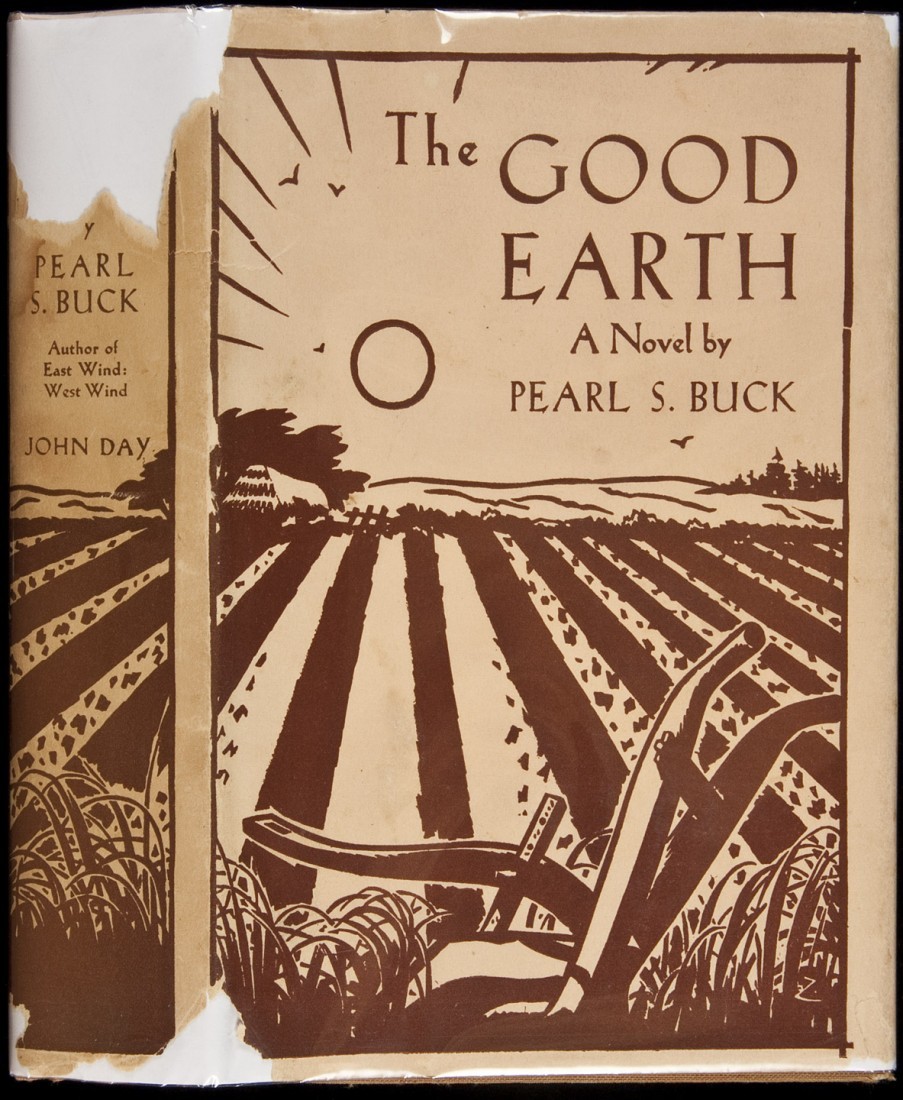
The Good Earth
The first book to benefit from the shift came along four years later. In 1932, Sai Zhenzhu — also known as Pearl S. Buck — won the novel prize for The Good Earth. The story focuses on the shifting fortunes of Wang Lung, a Chinese farmer, his wife, O-Lan, and their love for the land.
The Good Earth broke ground in its portrayal of Asia and Asian women. For many readers it was a first glimpse into the life of the Chinese people. At a conference in 1992, Chinese-American novelist Maxine Hong Kingston paid tribute to Buck for bringing attention to Asian voices. By representing Chinese characters with “such empathy and compassion,” Kingston said, Buck “was translating my parents to me and she was giving me our ancestry and our habitation.”
Toni Morrison, who won the 1988 Fiction Pulitzer for Beloved, humorously expressed a similar sentiment: “She misled me ... and made me feel that all writers wrote sympathetically, empathetically, honestly and forthrightly about other cultures.”
Translated into 30 languages and a bestseller during both its year of publication, 1931, and the year it won the Pulitzer, 1932, Buck’s tale of family life in a Chinese village in the years before World War I became a runaway success. In 1938, she won the Nobel Prize in Literature “for her rich and truly epic descriptions of peasant life in China and for her biographical masterpieces,” becoming the first American woman to receive that honor.
Buck was writing what she knew. A daughter of Presbyterian missionaries, she left her hometown of Hillsboro, West Virginia, for China before her first birthday and grew up speaking both English and Chinese. Although she traveled back to the United States at 17 to attend Randolph-Macon Woman’s College, she and her first husband, John Lossing Buck, returned to China shortly after she graduated. (She divorced John Buck in 1935 and married her literary agent, Richard Walsh, but kept the last name Buck.)
The Good Earth was the unanimous first choice of the Pulitzer jury, which in 1932 consisted of frequent jurors Jefferson B. Fletcher (Columbia University) and Robert M. Lovett (The New Republic) in addition to newcomer Albert B. Paine. Paine was an author, biographer and good friend of another frequent Pulitzer juror, William Allen White.
In a January 26, 1932, note to the Novel Jury, Frank Fackenthal, secretary of the Pulitzer Prize Advisory Board, asked the jurors to make no reference to jury disagreements, if any, in their report. He asked them to “list the books in the order of the jury’s choice without indicating the ins and outs of the vote.” In its report the jury conceded that it had also “favorably considered” Shadow on the Rock by Willa Cather and The Lady Who Came to Stay by R.E. Spencer, noting “it’s a rare year when three such excellent novels appear.”
Preference was given to The Good Earth “for its epic sweep, its distinct and moving characterizations, its sustained story-interest, its simple and yet richly colored style.” The jury also noted that Willa Cather had won the Novel Prize for One of Ours in 1923, but that her previous win did not affect the decision.
The Good Earth was Buck’s second novel. She wrote all of it one year, 1929, while living in Nanking. Owen and Donald Davis adapted it as a play in 1932. Even though the stage production was poorly received, it was made into a successful MGM film in 1937. As a young woman eager to contribute to her family’s meager earnings, Buck had begun publishing essays and stories in magazines such as Asia and The Chinese Recorder. Her first novel, East Wind, West Wind, a look at the marriages of two brothers — an unhappy arranged marriage to a Chinese woman and a defiant marriage to an American girl — was published in 1930.
Buck published more than 70 books, including novels, stories, biographies, an autobiography, poetry, drama, children's literature and translations from the Chinese. In her later years, she also had become a humanitarian and advocate for adoption of interracial and Asian children. She died in 1973 at the age of 80.