Finalist: The New York Times, by Nicholas D. Kristof
Nominated Work
By Nicholas D. Kristof
LESBOS, Greece — Ben Carson has compared Syrian refugees to rabid dogs. Donald Trump says that he would send them back.
Who are these Syrian refugee monsters who terrify American politicians?
Meet Heba, a frightened, desperate 20-year-old woman who dreams of being an artist and has just made a perilous escape from territory controlled by the Islamic State in northern Syria.
She was detained two months ago with her sister by Islamic State enforcers because her sister’s baby girl had too short a skirt — even though the baby was just 3 months old.
“That was crazy,” Heba said, shaking her head. “This was an infant!”
Heba says she and her sister argued that infant girls should have a little leeway in showing skin, and eventually the family was let off with a warning.
But Heba, strong-willed and self-confident, perhaps had been too outspoken or too sarcastic, and the police then cast a critical eye on her clothing. She was covering even her hands and face, but the authorities complained that her abaya cloak wasn’t loose enough to turn her into a black puff that concealed her form. The police detained her for hours until her family bailed her out by paying a $10 fine.
Heba was lucky, for other women have been flogged for violating clothing rules. Her sister saw a woman stoned to death after being accused of adultery.
“If I were wearing this,” Heba told me, pointing down at the tight jeans she was wearing as we spoke, “my head would come off.” She offered a hollow laugh.
I spoke to her after she left her mother and siblings behind in Syria (her father died years ago of natural causes) and fled with a handful of relatives on a perilous journey to Turkey, then on a dangerously overcrowded boat to this Greek island. I took Heba and her relatives to a dinner of pizza — Western food is banned by the Islamic State — and as we walked to the pizzeria she made a game of pointing out all the passers-by who would be decapitated by ISIS for improper dress, consorting with the opposite sex or sundry other offenses.
“It’s a million percent difference,” she exulted of life in the West. “Once you leave that area, you feel so good. Your whole body relaxes.”
Americans are understandably afraid of terrorism after the Paris attacks, and that fear is channeled at Syrian refugees. So pandering politicians portray the refugees as menaces whom the vetting process is unable to screen out, and Americans by nearly two to one oppose President Obama’s plan to admit 10,000 Syrians over a year.
In fact, despite the impressions left by American politicians and by the Islamic State, Syrians are in general more educated and middle class than many other people in the region, and the women more empowered. Heba’s aspirations to be an artist aren’t unusual.
Security concerns are legitimate, but the refugee screening is a rigorous two-year process. It would be far simpler for the Islamic State to infiltrate the U.S. by dispatching European passport holders (like those who carried out the Paris attacks) on tourist visas, or just use supporters who are already American citizens.
The anti-refugee legislation that overwhelmingly passed the House of Representatives would effectively end the intake even of Christians and Yazidis who have been particularly targeted by the extremists.
In person, Syrian refugees are less scary than scared. Heba wouldn’t allow me to use her last name or publish her photo for fear of getting her family in trouble, and she cannot contact her mother for the same reason. (I’m not mentioning the town she lived in because she’s terrified that the Islamic State might try to identify and punish her family for her escape and for her candor to a Western journalist.)
Really, Ben Carson, you want to compare this freedom-loving woman to a rabid dog?
Donald Trump, when you said of Syrian refugees, “If I win, they’re going back,” do you really intend to deport Heba back to the Islamic State to be flogged or decapitated?
Heba is fed up with violence and extremism — but now in the West she encounters a new kind of political extremism that targets refugees like her. These Syrian refugees find themselves accused of potentially being the terrorists they flee.
“We have no connection to terrorism,” she told me, mystified that anyone could fear her. “We’re running away from all that.”
Heba showed me her abaya, which she keeps in her backpack. She says she never wants to wear it again, so I asked why she doesn’t discard it.
“I’m scared,” she admitted. “If they send us back, I will need it.”
Ben Carson and Donald Trump, Heba is neither a rabid dog nor a crazed terrorist, but a desperate young woman whose life is on the line. Let’s drop the fearmongering and let Heba cast away that abaya forever.
By Nicholas D. Kristof
Desperate refugees flee persecution and war, but American politicians — worried about security risks — refuse to accept them.
That’s the situation today, but it’s also the shameful way we responded as Jews were fleeing Nazi Germany in the 1930s. In the shadow of one world war, on the eve of another, Americans feared that European Jews might be left-wing security threats.
“Jews are not Communists,” Rabbi Louis I. Newman of Manhattan noted, pleadingly, in December 1938, trying to assuage the xenophobia. “Judaism has nothing in common with Communism.”
Yet in January 1939, Americans polled said by a two-to-one majority that the United States should not accept 10,000 mostly Jewish refugee children from Germany. That year, the United States turned away a ship, the St. Louis, with Jewish refugee children; the St. Louis returned to Europe, where some of its passengers were murdered by the Nazis.
That is a stain on our conscience that risks being repeated. Some 26 Republican governors are trying to block entry of Syrian refugees. All the Republican presidential candidates say that we should bar Syrian refugees or apply a religious test and accept only Christians.
Gov. Chris Christie of New Jersey says we shouldn’t accept Syrians even if they are toddlers and orphans. And the House of Representatives may vote this week on legislation to impede the resettlement of Syrian refugees.
One Syrian family — a man who once ran a clothing store, his wife and their 4-year-old child — were supposed to arrive in Indiana this week. Then Gov. Mike Pence announced that Syrians were unwelcome, and the family is settling in Connecticut instead.
Remember what a Syrian immigrant looks like — the father of Steve Jobs.
Thank goodness that when my father came to America as a refugee from Eastern Europe in 1952, politicians weren’t fearmongering. My dad sailed to New York, bought a copy of the Sunday New York Times to teach himself English, and took the train across the country to a welcoming Oregon.
When Indiana today shuns desperate refugees, it is shunning people like my family.
Yes, security is critical, but I’ve known people who have gone through the refugee vetting process, and it’s a painstaking ordeal that lasts two years or more. It’s incomparably more rigorous than other pathways to the United States.
If the Islamic State wanted to dispatch a terrorist to America, it wouldn’t ask a mole to apply for refugee status, but rather to apply for a student visa to study at, say, Indiana University. Hey, governors, are you going to keep out foreign university students?
Or the Islamic State could simply send fighters who are French or Belgian citizens (like some of those behind the Paris attacks) to the U.S. as tourists, no visa required. Governors, are you planning to ban foreign tourists, too?
Refugee vetting has an excellent record. Of 785,000 refugees admitted to the United States since 9/11, just three have been arrested for terrorism-related charges, according to the Migration Policy Institute in Washington.
If Republican governors are concerned about security risks, maybe they should vet who can buy guns. People on terrorism watch lists are legally allowed to buy guns in the United States, and more than 2,000 have done so since 2004. The National Rifle Association has opposed legislation to rectify this.
Although Donald Trump fulminates about President Obama supposedly wanting to bring in 250,000 or more Syrian refugees, that’s preposterous: Obama proposes admitting 10,000 Syrian refugees over a year. That’s tiny, just 1 percent of the number that Lebanon has accepted.
The Islamic State is trying to create a religious divide and an anti-refugee backlash, so that Muslims will feel alienated and turn to extremism. If so, American and European politicians are following the Islamic State’s script.
Let’s be careful not to follow that script further and stigmatize all Muslims for ISIS terrorism. As a young British Muslim man, Kash Ali, wrote in a post that went viral on Twitter: “I don’t understand why non Muslims think we British Muslims can stop ISIS. Mate, I can’t even get a text back from the girl I like, and you expect me to stop a terrorist organization?”
Look, accepting 10,000 refugees is not a solution. Indeed, there is a risk that Angela Merkel’s admirable compassion will lead far larger numbers to undertake the difficult journey and die on the way. The top priority must be making Syria habitable so that refugees need not flee. This is where I believe President Obama has failed — Syria is his worst foreign policy failure — but it’s good to see him push back at the hysteria about Syrian refugees.
Helping Syrian refugees today doesn’t solve the Middle East mess any more than helping Jewish refugees in 1939 would have toppled Hitler. But it’s the right thing to do. Syrians, no less than those Jewish refugees, no less than my father, are human beings needing help, not flotsam.
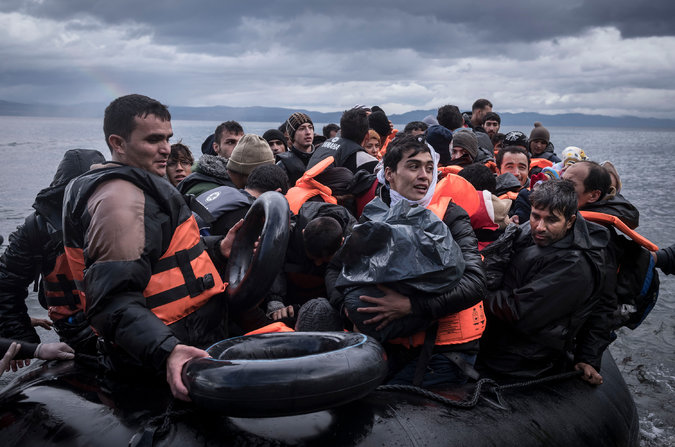
Migrants arriving on the Greek island of Lesbos in late November. (Sergey Ponomarev/The New York Times)
By Nicholas D. Kristof
LESBOS, Greece — For three weeks American politicians have been fulminating about the peril posed by Syrian refugees, even though in the last dozen years no refugee in America has killed a single person in a terror attack.
In the same three weeks as this hysteria about refugees, guns have claimed 2,000 lives in America. The terror attacks in San Bernardino, Calif., and at the Planned Parenthood clinic in Colorado Springs were the most dramatic, but there’s an unrelenting average of 92 gun deaths every day in America, including suicides, murders and accidents.
So if politicians want to tackle a threat, how about developing a serious policy to reduce gun deaths — yes, including counterterrorism measures, but not simply making scapegoats of the world’s most vulnerable people.
The caricatures of Syrian refugees as jihadis who “want to kill us,” as one reader named Josh tweeted me, are unrecognizable to anyone who spends time with these refugees. I think some of the harshness might melt if readers could stand with me on a beach here in Lesbos and meet the refugees as they arrive on overloaded rubber rafts after a perilous journey. The critics would see that Syrian refugees are people like us, only wet, cold, hungry and exhausted.
If you think me naïve, meet a 16-year-old Syrian boy here whom I’ll call Ahmed. He lived in a part of Syria controlled by the Islamic State and decided to flee to the West after, he says, he was flogged by ISIS bullies.
Ahmed had to leave his family behind, and he can’t contact them directly for fear of getting them in trouble. I’m not sharing his real name or hometown, to avoid harming his family, but his relatives who have also fled confirmed his account.
Schools have been suspended since ISIS moved into the area, so Ahmed found a job in a pharmacy. When he ran out of a medicine one day, he went to borrow some from another pharmacy — but that was run by a woman, allowed to serve female customers only. Ahmed was arrested.
“They wanted to chop my head off because I spoke to a woman,” Ahmed explained.
Eventually, he was released, but Ahmed has seen more beheadings then he can count. The executions take place every Friday in the town square, and all the people are summoned to watch the swordsman do his work. The bodies are left on public display, sometime in a crucifixion position.
“If someone didn’t fast during Ramadan, they put him in a cage in public to starve for up to three days,” Ahmed added. Ahmed himself was accused of skipping prayers and sentenced to 20 lashes. A Saudi man administered the flogging with a horsewhip.
After that, Ahmed’s family members gave their blessing to his flight because they feared that he might be forced into the ISIS army.
So what should I tell this 16-year-old boy who risked his life to flee extremism? That many Americans are now afraid of him? That the San Bernardino murders may only add to the suspicion of Syrian refugees? That in an election year, politicians pander and magnify voter fears?
Here in Lesbos, the fears seem way overdrawn. Some of the first aid workers Syrian refugees meet when they land on the beach are Israeli doctors, working for an Israeli medical organization called IsraAID. The refugees say they are surprised, but also kind of delighted.
“We were happy to see them,” said Tamara, a 20-year-old Syrian woman in jeans with makeup and uncovered hair. The presence of Jews, Muslims and Christians side by side fit with the tolerance and moderation that she craved.
Iris Adler, an Israeli doctor volunteering with IsraAID, said the refugees were often excited to receive assistance from Israelis. “We are still in close touch with many of them,” she said, including a mother whose baby she delivered on the beach after landing. Hostility to Israeli aid workers, she said, came not from refugees but, rather, from some European volunteers.
Historically, we Americans have repeatedly misperceived outsiders as threats. In 1938 and again in 1941, one desperate Jewish family in Europe tried to gain refugee status in the United States but failed, along with countless thousands of others. That was Anne Frank’s family.
So while it was the Nazis who murdered Anne, we Americans were in some sense complicit.
“We’re facing a great threat from Islamic extremists like ISIS, and we need to be smart about how we confront it,” said Peter Bouckaert of Human Rights Watch, who has focused on refugees. “By humiliating and rejecting those who are fleeing from ISIS, we create a sense of anger in much of the Middle East. The ultimate outcome of rejecting Syrian refugees is a propaganda victory for ISIS.”
If politicians want to tackle a threat to our safety, they might cast an eye not far off on desperate refugees but closer to home — on potential terrorists and also on guns. It’s absurd that the Senate refused to block people on the terror watch list from buying guns; suspected terrorists can’t easily board planes but can buy assault rifles? Presidential candidates and governors should stop fear-mongering about refugees: After all, 785,000 refugees have been admitted to the United States since 9/11 and not one has been convicted of killing a person in a terrorist act in America.
“We, too, are human, and we have a right to live,” an 18-year-old woman named Rahaf, who wants to be a lawyer, told me on a drizzly day in a camp here. “We’re not terrorists. We’re running away from war. I just want to have children who can grow up in peace.”
By Nicholas D. Kristof
IN THE MARSHLAND OF SOUTH SUDAN — Barefoot and shellshocked, the survivors trickle into a village here with unimaginable stories of rape, castration and mass murder committed by a government that the United States helped install.
This civil war here in South Sudan will be a top item on President Obama’s agenda during his visit to Africa this month, and I wish he could talk to these survivors.
Gatkuoth Kueah Yak tells me he watched from a distance as South Sudan government soldiers tied up his 15 children and put them in a grass hut. And then, he says, he watched as the soldiers torched the hut and burned his family alive.
Gatwech Them Manuar says he saw three young boys, aged 3 to 7, who had been castrated by government soldiers and left to bleed to death. He says he also saw two infants who were killed by soldiers bludgeoning them against a tree.
Nyakong Riek tells me that when government soldiers attacked her village, she ran with her 2-year-old son. “I was trying to pull him along,” she said. “But bullets were flying, and I couldn’t pull him fast enough. So I left him.” Dazed and sleepless, she says wistfully that she just hopes that the boy died quickly.
These survivors are of Nuer ethnicity, and they say the South Sudan Army — disproportionately composed of the rival Dinka tribe — targeted them for that reason. Indeed, they say some Dinka soldiers mockingly cut the faces of Nuer women they raped to replicate the kind of decorative scarring used by Nuer men.
I interviewed survivors on a grassy island, surrounded by rivers and marshland, where they have taken refuge (I reached the area by helicopter with a team from the United Nations World Food Program). The predations the Nuer describe happened in May in Unity State, and they say thousands of other survivors are stuck in the marshes, preyed upon by crocodiles, still trying to reach safety.
I shared the world’s exhilaration in 2011 as South Sudan celebrated independence from Sudan and became the world’s newest nation. But now it’s difficult not to feel despair.
South Sudan is rived by civil war and collapsing economically; it may be on a trajectory to a failed state with far-reaching consequences for the region. The country suffers worsening famine and mind-boggling corruption. It is led by a president, Salva Kiir, whom President George W. Bush and President Obama both tried to nurture. I’ve known Kiir for a decade and he surely faced huge challenges — but he and other leaders have failed his country.
South Sudan’s civil war erupted 18 months ago between Kiir’s army and the forces of the vice president, Riek Machar. Sudan has armed Machar, and all factions in the war have behaved brutally. The recent slaughter by government soldiers may be a response to horrific massacres by Machar’s forces a year ago.
The accounts of the displaced people I interviewed are supported by a new United Nations report describing a “new brutality and intensity” to attacks in the area, citing nine separate instances in which government forces raped women or girls and then burned them alive in huts. A different United Nations assessment used satellite imagery to count some 250 structures burned in a single village, Ngop. The International Committee of the Red Cross has said that its compound in Leer was looted and that 100,000 fled that county alone.
“The violence against children in South Sudan has reached a new level of brutality,” warned Anthony Lake, executive director of Unicef, alluding to the army’s assault. “Survivors report that boys have been castrated and left to bleed to death. … Girls as young as 8 have been gang raped and murdered. … Children have been tied together before their attackers slit their throats.”
On his Africa trip, Obama should work closely with Kenya, Uganda and Ethiopia to impose targeted sanctions on the families of recalcitrant leaders in all factions, so they pay a price until there is peace. The United States has donated $1.1 billion in aid to South Sudan since the civil war began, but what is most needed isn’t money but tough, hands-on diplomacy to pressure all sides. Ethiopia has been trying to hammer out a peace, and it deserves more Western backing.
This is urgent, because the cycle of violence makes it ever more difficult to put South Sudan together again.
“I hate the Dinka now,” says Nyaluak Ngeach Tuak, whose 8-year-old son is missing and presumed dead.
Another woman, Nyabuol Rik Puol, says she wants counterattacks as vengeance against the soldiers who tried to rape her 11-year-old daughter and then killed her sister when she protested.
“What happened to us,” she told me venomously, “should happen to the Dinka, too.”
By Nicholas D. Kristof
IN THE NUBA MOUNTAINS, Sudan — It’s not clear whether the Sudanese Air Force was trying to bomb the village of grass huts, or the girls high school next to it.
Hamida Osman, 23, simply knew that a Sukhoi fighter jet was roaring toward her village. She grabbed her only child, Safarina, 2, and jumped into the foxhole that the family had built for those frequent occasions when Sudan decides to bomb its people.
Inside the foxhole, Hamida used her own body to try to shield her daughter. They heard the sound of bombs whistling downward, and then there were two enormous explosions.
The next thing Hamida knew, she was covered with blood and had shrapnel wounds to her arms and legs. She looked down. A piece of shrapnel had taken away much of Safarina’s head.
Another day, another dead civilian. President Omar Hassan al-Bashir of Sudan, having committed crimes against humanity in South Sudan and Darfur, is now waging them with equal impunity in the Nuba Mountains in the far south of the country, and major nations are once more reacting mostly with indifference. With President Obama headed to East Africa shortly, let’s hope he raises these atrocities and pushes for humanitarian access to the Nuba Mountains.
Limping from her injuries, Hamida showed me where the bombs had struck beside her now-incinerated hut.
“I don’t know what they’re trying to hit,” she said, “but they’re always dropping bombs on homes here.”
Sudan is deliberately bombing civilians and girls schools as part of its brutal counterinsurgency campaign against tens of thousands of armed rebels in the Nuba Mountains. The aim seems to be to terrorize the population and depopulate the area.
To keep out aid and eyewitnesses, Sudan bars visits by aid workers, diplomats and journalists. I slipped in through rebel lines without a visa, as I did on my three previous visits to the Nuba Mountains.
In the village of Endeh, schoolchildren gave me an impromptu lesson in the sounds I should listen for: the whoom-whoom of an Antonov bomber, the roar of a Sukhoi fighter, and the warbling of a bomb as it falls through the air. It was eerie: One moment they giggled as they mimicked the sounds, and the next moment they described how a bombing at their school had killed a teacher and three students.
The village rebuilt the school near caves used as shelter during bombings. When the children showed me the caves, I noticed a freshly shed snake skin, from a spitting cobra. The villagers gently explained to me that cobras are, on balance, less terrifying than bombs.
The bombs have fallen in Nuba for four years and they accelerated early this year. Nuba Reports, a monitoring organization, counted 1,764 bombs dropped between December and February, more than ever before in a three-month period.
This isn’t exactly the same as Sudan’s slaughter in Darfur, for that has involved militias burning villages. Here in the Nuba Mountains, the rebels keep out militias, so Sudan kills from the air with bombs, artillery shells and cluster munitions. President Bashir also blockades the area to keep out all food, medicine and supplies. Sudan even bombs trucks carrying food, and its denial of food and medicine probably kills more civilians than the bombings do directly.
The blockade of medicine is particularly infuriating. Only 5 to 10 percent of children in rebel-held areas get vaccinated, and one of the biggest measles outbreaks in Africa last year occurred in the Nuba Mountains.
Unicef and Gavi, the Vaccine Alliance, are reluctant to send in vaccines for fear of antagonizing the Sudanese government and losing access in other parts of Sudan. So parents see their children dying not only from shelling but also from measles.
Let’s demand humanitarian access — and if it is not granted, aid agencies should send in medicine anyway. It’s unconscionable to let children die because of diplomatic protocol.
There are precedents. In the late 1980s, Sudan similarly blocked aid to rebel-held areas in the south, and the Reagan and first Bush administrations worked with Unicef to start Operation Lifeline Sudan, sending in aid directly to needy areas. Today we need a new Operation Lifeline.
To his credit, President Obama has quietly provided food to the Nuba Mountains, thus averting starvation. It’s a model of what could also be done with medicine. But Obama overall has been weaker than the four previous presidents in standing up to Sudan.
As for Safarina’s killing, it’s unclear whether Sudan was aiming for her village or the girls school. It speaks volumes that Sudan regularly targets both villagers and schoolgirls.
It’s a brutal way to live, and in the case of children like Safarina, to die. And as long as world leaders and aid agencies acquiesce and Sudan pays no price for its savagery, nothing will change.
IN THE NUBA MOUNTAINS, Sudan — IF you subscribe to the caricature of devout religious believers as mostly sanctimonious hypocrites, the kind who rake in cash and care about human life only when it is unborn, come visit the doctor here.
Dr. Tom Catena, 51, a Catholic missionary from Amsterdam, N.Y., is the only doctor at the 435-bed Mother of Mercy Hospital nestled in the Nuba Mountains in the far south of Sudan. For that matter, he’s the only doctor permanently based in the Nuba Mountains for a population of more than half a million people.
Just about every day, the Sudanese government drops bombs or shells on civilians in the Nuba Mountains, part of a scorched-earth strategy to defeat an armed rebellion here. The United States and other major powers have averted their eyes, so it is left to “Dr. Tom,” as he is universally known here, to pry out shrapnel from women’s flesh and amputate limbs of children, even as he also delivers babies and removes appendixes.
He does all this off the electrical grid, without running water, a telephone or so much as an X-ray machine — while under constant threat of bombing, for Sudan has dropped 11 bombs on his hospital grounds. The first time, Dr. Tom sheltered, terrified, in a newly dug pit for an outhouse, but the hospital is now surrounded by foxholes in which patients and the staff crouch when military aircraft approach.
“We’re in a place where the government is not trying to help us,” he says. “It’s trying to kill us.”
Given the shortage of resources, Dr. Tom relies disproportionately on makeshift treatments from decades ago.
“This is a Civil War-era treatment,” he said, pointing to a man with a broken leg, which he was treating with a method known as Buck’s traction, using a bag of sand as a weight.
“Sometimes these actually work,” Dr. Tom said. “You use what you have.”
Pope Francis seems to be revitalizing the Vatican and focusing on the needy, and I have a dream — O.K., an implausible one — that he’ll journey to this Catholic hospital in the Nuba Mountains as a way of galvanizing opposition to the evil of Sudan’s bombings.
One reason I’m so impressed by Dr. Tom is that most of the world, including world leaders and humanitarians, have pretty much abandoned the people of the Nuba Mountains. President Obama and other global leaders have been too silent about the reign of terror here, too reluctant to pressure Sudan to ease it.
That’s the context in which Dr. Tom stands out for his principled commitment. Dr. Tom has worked in the Nuba Mountains for eight years, living in the hospital and remaining on call 24/7 (the only exception: when he’s unconscious with malaria, once a year or so).
Dr. Tom acknowledges missing pretzels and ice cream, and, more seriously, a family. He parted from his serious girlfriend when he moved to Africa, and this is not the best place to date (although hospital staff members are plotting to introduce him to eligible Nuban women as a strategy to keep him from ever leaving).
For his risks and sacrifices, Dr. Tom earns $350 a month — with no retirement plan or regular health insurance. (For those who want to support his work, I’ve posted how to help on my blog.)
He is driven, he says, by his Catholic faith. “I’ve been given benefits from the day I was born,” he says. “A loving family. A great education. So I see it as an obligation, as a Christian and as a human being, to help.”
There also are many, many secular aid workers doing heroic work. But the people I’ve encountered over the years in the most impossible places — like Nuba, where anyone reasonable has fled — are disproportionately unreasonable because of their faith.
I’ve often criticized the Vatican’s hostility to condoms, even as a tool to fight AIDS, and we shouldn’t tolerate religious bigotry against gays (which the latest Supreme Court ruling may chip away at). But we also shouldn’t tolerate another kind of narrow-mindedness, irreligious bigotry against people of faith. Diversity is a virtue, in faith as well as race.
Certainly the Nubans (who include Muslims and Christians alike) seem to revere Dr. Tom.
“People in the Nuba Mountains will never forget his name,” said Lt. Col. Aburass Albino Kuku of the rebel military force. “People are praying that he never dies.”
A Muslim paramount chief named Hussein Nalukuri Cuppi offered an even more unusual tribute.
“He’s Jesus Christ,” he said.
Er, pardon?
The chief explained that Jesus healed the sick, made the blind see and helped the lame walk — and that is what Dr. Tom does every day.
You needn’t be a conservative Catholic or evangelical Christian to celebrate that kind of selflessness. Just human.
By Nicholas D. Kristof
LUBANGO, Angola — This is a country laden with oil, diamonds, Porsche-driving millionaires and toddlers starving to death. New Unicef figures show this well-off but corrupt African nation is ranked No. 1 in the world in the rate at which children die before the age of five.
“Child mortality” is a sterile phrase, but what it means here is wizened, malnourished children with twig limbs, discolored hair and peeling skin. Here in Lubango in southern Angola, I stepped into a clinic and found a mother carrying a small child who seemed near death. He was unconscious, his eyes rolling, his skin cold and his breathing labored, so I led the mom to the overburdened nurses.
Just then, 20 feet away, a different mother began screaming. Her malnourished son, José, had just died.
Westerners sometimes think that people in poor countries become accustomed to loss, their hearts calloused and their pain numbed. No one watching that mother beside her dead child could think that — and such wailing is the background chorus in Angola. One child in six in this country will die by the age of five.
That’s only the tip of the suffering. Because of widespread malnutrition, more than one-quarter of Angolan children are physically stunted. Women have a 1-in-35 lifetime risk of dying in childbirth.
In a Lubango hospital, I met a 7-year-old boy, Longuti, fighting for his life with cerebral malaria. He weighed 35 pounds.
His mother, Hilaria Elias, who had already lost two of her four children, didn’t know that mosquitoes cause malaria. When Longuti first became sick, she took him to a clinic, but it lacked any medicine and didn’t do a malaria test. Now Longuti is so sick that doctors say that even if he survives, he has suffered neurological damage and may have trouble walking and speaking again.
Yet kids like Longuti who are seen by a doctor are the lucky ones. Only about 40 percent to 50 percent of Angola’s population has access to the health care system, says Dr. Samson Agbo, a Unicef pediatrics expert.
Angola is a nation of infuriating contradictions. Oil and diamonds give it a wealth that is rare in sub-Saharan Africa, and you see the riches in jewelry shops, Champagnes and $10,000-a-month one-bedroom apartments in the capital, Luanda.
Under the corrupt and autocratic president, José Eduardo dos Santos, who has ruled for 35 years, billions of dollars flow to a small elite — as kids starve.
President dos Santos, whose nation’s oil gives him warm, strong ties to the United States and Europe, hires a public relations firm to promote his rule, but he doesn’t take the simplest steps to help his people. Some of the poorest countries, such as Mauritania and Burkina Faso, fortify flour with micronutrients — one of the cheapest ways possible to save lives — yet dos Santos hasn’t tried that. He invests roughly three times as much on defense and security as on health.
“Children die because there is no medicine,” lamented Alfred Nambua, a village chief in a thatch-roof village on a rutted dirt road near the northern city of Malanje. The village has no school, no latrine, no bed nets. The only drinking water is a contaminated creek an hour’s hike away.
“Now there’s nothing,” said Nambua, 73, adding that life was better before independence in 1975.
“In the colonial period, when I was sick, they were afraid I would die and gave me good care,” he said, and he pretended to shiver in imitation of malaria. “Now when I’m sick, no one cares if I die.”
“Death in this country is normal,” said Dr. Bimjimba Norberto, who runs a clinic in a slum outside the capital. A few doors down, a funeral was beginning for Denize Angweta, a 10-month-old baby who had just died of malaria.
“If I lived in another country, I could still be playing with my daughter,” Denize’s father, Armondo Matuba, said bitterly.
It may get worse. With falling oil prices, the government has proposed a one-third cut in the health budget this year.
I’ve often criticized Western countries for not being more generous with aid. Yet it’s equally important to hold developing countries accountable.
It’s difficult to see why Western countries should continue to donate to Angola and thus let rich Angolans off the hook as they drive Porsches.
There are many ways for a leader to kill his people, and although dos Santos isn’t committing genocide he is presiding over the systematic looting of his state and neglect of his people. As a result, 150,000 Angolan children die annually. Let’s hold dos Santos accountable and recognize that extreme corruption and negligence can be something close to a mass atrocity.
By Nicholas D. Kristof
We’ve mourned too often, seen too many schools and colleges devastated by shootings, watched too many students get an education in grief. It’s time for a new approach to gun violence.
We’re angry, but we also need to be smart. And frankly, liberal efforts, such as the assault weapons ban, were poorly designed and saved few lives, while brazen talk about banning guns just sparked a backlash that empowered the National Rifle Association.
What we need is an evidence-based public health approach — the same model we use to reduce deaths from other potentially dangerous things around us, from swimming pools to cigarettes. We’re not going to eliminate guns in America, so we need to figure out how to coexist with them.
First, we need to comprehend the scale of the problem: It’s not just occasional mass shootings like the one at an Oregon college on Thursday, but a continuous deluge of gun deaths, an average of 92 every day in America. Since 1970, more Americans have died from guns than died in all U.S. wars going back to the American Revolution.
When I reported a similar figure in the past, gun lobbyists insisted that it couldn’t possibly be true. But the numbers are unarguable: fewer than 1.4 million war deaths since 1775, more than half in the Civil War, versus about 1.45 million gun deaths since 1970 (including suicides, murders and accidents).
If that doesn’t make you flinch, consider this: In America, more preschoolers are shot dead each year (82 in 2013) than police officers are in the line of duty (27 in 2013), according to figures from the Centers for Disease Control and Prevention and the FBI.
More than 60 percent of gun deaths are suicides, and most of the rest are homicides. Gun enthusiasts scoff at including suicides, saying that without guns people would kill themselves by other means. In many cases, though, that’s not true.
In Great Britain, people used to kill themselves by putting their heads in the oven and asphyxiating themselves with coal gas. This accounted for almost half of British suicides in the late 1950s, but Britain then began switching from coal gas to natural gas, which is much less lethal. Sticking one’s head in the oven was no longer a reliable way to kill oneself — and there was surprisingly little substitution of other methods. Suicide rates dropped, and they stayed at a lower level.
The British didn’t ban ovens, but they made them safer. We need to do the same with guns.
When I tweeted about the need to address gun violence after college shooting in the Roseburg, Ore., a man named Bob pushed back. “Check out car accident deaths,” he tweeted sarcastically. “Guess we should ban cars.”
Actually, cars exemplify the public health approach we need to apply to guns. We don’t ban cars, but we do require driver’s licenses, seatbelts, airbags, padded dashboards, safety glass and collapsible steering columns. And we’ve reduced the auto fatality rate by 95 percent.
One problem is that the gun lobby has largely blocked research on making guns safer. Between 1973 and 2012, the National Institutes of Health awarded 89 grants for the study of rabies and 212 for cholera — and only three for firearms injuries.
Daniel Webster, a public health expert at Johns Hopkins University, notes that in 1999, the government listed the gun stores that had sold the most weapons later linked to crimes. The gun store at the top of the list was so embarrassed that it voluntarily took measures to reduce its use by criminals — and the rate at which new guns from the store were diverted to crime dropped 77 percent.
But in 2003, Congress barred the government from publishing such information.
Why is Congress enabling pipelines of guns to criminals?
Public health experts cite many ways we could live more safely with guns, and many of them have broad popular support.
A poll this year found that majorities even of gun-owners favor universal background checks; tighter regulation of gun dealers; safe storage requirements in homes; and a 10-year prohibition on possessing guns for anyone convicted of domestic violence, assault or similar offenses.
We should also be investing in “smart gun” technology, such as weapons that fire only with a PIN or fingerprint. We should adopt microstamping that allows a bullet casing to be traced back to a particular gun. We can require liability insurance for guns, as we do for cars.
It’s not clear that these steps would have prevented the Oregon shooting. But Professor Webster argues that smarter gun policies could reduce murder rates by up to 50 percent — and that’s thousands of lives a year. Right now, the passivity of politicians is simply enabling shooters.
The gun lobby argues that the problem isn’t firearms; it’s crazy people. Yes, America’s mental health system is a disgrace. But to me, it seems that we’re all crazy if we as a country can’t take modest steps to reduce the carnage that leaves America resembling a battlefield.
By Nicholas D. Kristof
On university campuses across the country, from Mizzou to Yale, we have two noble forces colliding with explosive force.
One is a concern for minority or marginalized students and faculty members, who are often left feeling as outsiders in ways that damage everyone’s education. At the University of Missouri, a black professor, Cynthia Frisby, wrote, “I have been called the N-word too many times to count.”
The problem is not just racists who use epithets but also administrators who seem to acquiesce. That’s why Mizzou students — especially football players — used their clout to oust the university system’s president. They showed leadership in trying to rectify a failure of leadership.
But moral voices can also become sanctimonious bullies.
“Go, go, go,” some Mizzou protesters yelled as they jostled a student photographer, Tim Tai, who was trying to document the protests unfolding in a public space. And Melissa Click, an assistant professor who joined the protests, is heard on a video calling for “muscle” to oust another student journalist (she later apologized).
Tai represented the other noble force in these upheavals — free expression. He tried to make the point, telling the crowd: “The First Amendment protects your right to be here — and mine.”
We like to caricature great moral debates as right confronting wrong. But often, to some degree, it’s right colliding with right.
Yes, universities should work harder to be inclusive. And, yes, campuses must assure free expression, which means protecting dissonant and unwelcome voices that sometimes leave other people feeling aggrieved or wounded.
On both counts we fall far short.
We’ve also seen Wesleyan students debate cutting funding for the student newspaper after it ran an op-ed criticizing the Black Lives Matter movement. At Mount Holyoke, students canceled a production of “The Vagina Monologues” because they felt it excluded transgender women. Protests led to the withdrawal of Condoleezza Rice as commencement speaker at Rutgers and Christine Lagarde at Smith.
This is sensitivity but also intolerance, and it is disproportionately an instinct on the left.
I’m a pro-choice liberal who has been invited to infect evangelical Christian universities with progressive thoughts, and to address Catholic universities where I’ve praised condoms and birth control programs. I’m sure I discomfited many students on these conservative campuses, but it’s a tribute to them that they were willing to be challenged. In the same spirit, liberal universities should seek out pro-life social conservatives to speak.
More broadly, academia — especially the social sciences — undermines itself by a tilt to the left. We should cherish all kinds of diversity, including the presence of conservatives to infuriate us liberals and make us uncomfortable. Education is about stretching muscles, and that’s painful in the gym and in the lecture hall.
One of the wrenching upheavals lately has unfolded at Yale. Longtime frustrations among minority students boiled over after administrators seemed to them insufficiently concerned about offensive costumes for Halloween. A widely circulated video showed a furious student shouting down one administrator, Prof. Nicholas Christakis. “Be quiet!” she screams at him. “It is not about creating an intellectual space!”
A student wrote an op-ed about “the very real hurt” that minority students feel, adding: “I don’t want to debate. I want to talk about my pain.” That prompted savage commentary online. “Is Yale letting in 8-year-olds?” one person asked on Twitter.
The Wall Street Journal editorial page denounced “Yale’s Little Robespierres.” It followed up Wednesday with another editorial, warning that the P.C. mind-set “threatens to undermine or destroy universities as a place of learning.”
I suggest we all take a deep breath.
The protesters at Mizzou and Yale and elsewhere make a legitimate point: Universities should work harder to make all students feel they are safe and belong. Members of minorities — whether black or transgender or (on many campuses) evangelical conservatives — should be able to feel a part of campus, not feel mocked in their own community.
The problems at Mizzou were underscored on Tuesday when there were death threats against black students. What’s unfolding at universities is not just about free expression but also about a safe and nurturing environment.
Consider an office where bosses shrug as some men hang nude centerfolds and leeringly speculate about the sexual proclivities of female colleagues. Free speech issue? No! That’s a hostile work environment. And imagine if you’re an 18-year-old for whom this is your 24/7 home — named, say, for a 19th-century pro-slavery white supremacist.
My favorite philosopher, the late Sir Isaiah Berlin, argued that there was a deep human yearning to find the One Great Truth. In fact, he said, that’s a dead end: Our fate is to struggle with a “plurality of values,” with competing truths, with trying to reconcile what may well be irreconcilable.
That’s unsatisfying. It’s complicated. It’s also life.
By Nicholas D. Kristof
YAMHILL, Ore. — THE funeral for my high school buddy Kevin Green is Saturday, near this town where we both grew up.
The doctors say he died at age 54 of multiple organ failure, but in a deeper sense he died of inequality and a lack of good jobs.
Lots of Americans would have seen Kevin — obese with a huge gray beard, surviving on disability and food stamps — as a moocher. They would have been harshly judgmental: Why don’t you look after your health? Why did you father two kids outside of marriage?
That acerbic condescension reflects one of this country’s fundamental problems: an empathy gap. It reflects the delusion on the part of many affluent Americans that those like Kevin are lazy or living cushy lives. A poll released this month by the Pew Research Center found that wealthy Americans mostly agree that “poor people today have it easy because they can get government benefits without doing anything in return.”
Lazy? Easy? Kevin used to set out with his bicycle and a little trailer to collect cans by the roadside. He would make about $20 a day.
Let me tell you about Kevin Green. He grew up on a small farm a couple of miles from my family’s, and we both attended the same small rural high school in Yamhill, Ore. We both ran cross country, took welding and agriculture classes and joined Future Farmers of America. After cross country practice, I’d drive him home to his family farm, with its milk cows, hogs and chickens.
The Greens encapsulated if not the American dream, at least solid upward mobility. The dad, Thomas, had only a third-grade education and couldn’t read. But he had a good union job as a cement finisher, paying far above the minimum wage, and he worked hard and made sure his kids did, too. He had no trouble with the law.
Kevin and his big sister, Cindy — one of the sweetest girls in school — both earned high school diplomas. Kevin was sunny, cheerful and astonishingly helpful: Any hint that something needed fixing, and he was there with a wrench. But then the dream began to disintegrate.
The local glove factory and feed store closed, and other blue-collar employers cut back. Good union jobs became hard to find. For a while, Kevin had a low-paying nonunion job working for a construction company. After that company went under, he worked as shift manager making trailer homes. He fell in love and had twin boys that he doted on. But because he and his girlfriend struggled financially, they never married.
Then, about 15 years ago, Kevin hurt his back and was laid off. Soon afterward, his girlfriend moved out, took the kids and asked for child support. The loss of his girlfriend, kids and job was a huge blow.
“It knocked him to the dirt,” says his younger brother, Clayton, also a pal of mine. “It destroyed his self-esteem.”
Kevin’s weight ballooned to 350 pounds, and he developed diabetes and had a couple of heart attacks. He grew marijuana and self-medicated with it, Clayton says, and was arrested for drug offenses.
My kids would see Kevin and me together and couldn’t believe he had run cross country with me, and that he wasn’t 20 years older.
Kevin eventually got disability benefits, but he was far behind in child support and was punished by losing his driver’s license — which made it pretty much impossible to get a job in a rural area. Disability helped Kevin by providing a monthly check that he desperately needed, but it also hurt him because he might have looked harder for a job if he hadn’t been getting those checks, Clayton says.
Yet it’s absurd to think that people like Kevin are somehow living it up. After child support deductions, he was living on about $180 a month plus food stamps and a small income from selling home-grown pot. He supplemented this by growing a huge vegetable garden and fishing in the Yamhill River.
Three years ago, Cindy died of a heart attack at 52. Then doctors told Kevin a few weeks ago that his heart, liver and kidneys were failing, and that he was dying. He had trouble walking. He was in pain.
He was also worried about his twin boys. They had trouble in school and with the law, jailed for drug and other offenses. The upward mobility that had seemed so promising a generation ago turned out to be a mirage. Family structure dissolved, and lives become grueling — and shorter.
Kevin wrote a will a few days before he died. He bequeathed his life’s savings of $3,500 to his mom for his funeral expenses. Anything left over is to be divided between his children — and he begs them not to fight over it. His ashes will be sprinkled on the farm.
I have trouble diagnosing just what went wrong in that odyssey from sleek distance runner to his death at 54, but the lack of good jobs was central to it. Sure, Kevin made mistakes, but his dad had opportunities for good jobs that Kevin never had.
So, Kevin Green, R.I.P. You were a good man — hardworking and always on the lookout for someone to help — yet you were overturned by riptides of inequality. Those who would judge you don’t have a clue. They could use a dose of your own empathy.
No question, 2015 was the Year of the Refugee. News organizations were all over the story of migrants from Syria and the Middle East. So, too, was Nicholas Kristof, columnist for The New York Times — but Kristof went a lot further. He revealed to the world the wretched plight of the far larger number of refugees and oppressed peoples in overlooked countries like South Sudan, Sudan, Angola and Myanmar.
There is a gripping vitality about Nick Kristof’s work. He continually speaks up for the disadvantaged and voiceless, the forgotten, the ignored, both abroad and at home. But while some columnists pontificate from behind desks, Kristof does original reporting from the field, sometimes at great risk to himself, typically from places few other journalists go. His fresh insights and eyewitness details greatly enrich the public debate.
Invariably, he puts a human face on suffering. On a Greek island, he introduced readers to one of those “Syrian refugee monsters who terrify American politicians.” Meet Heba, he wrote, “a frightened, desperate 20-year-old woman who dreams of being an artist and has just made a perilous escape from territory controlled by the Islamic State in northern Syria.”
Recalling the Jews whom the United States turned away before World War II and the story of his own father, a refugee from Eastern Europe who arrived, dead broke, right after the war, Kristof shamed the Republican presidential candidates and 26 governors for their efforts to block entry of Syrian refugees.
“If Republican governors are concerned about security risks, maybe they should vet who can buy guns. People on terrorism watch lists are legally allowed to buy guns in the United States, and more than 2,000 have done so since 2004. The National Rifle Association has opposed legislation to rectify this.”
And: “In the last dozen years no refugee in America has killed a single person in a terror attack. In the same three weeks as this hysteria about refugees, guns have claimed 2,000 lives in America.”
Kristof reached far and wide to report on atrocities. Camping in a tent in the marshes of South Sudan, he interviewed the survivors of massacres, mass rape and mutilation by the military forces of South Sudan, a regime the U.S. backs. “This brilliant journalism, reporting horrific and depraved events, could/should make a difference,” tweeted Peter A. Singer, a prominent Canadian health expert.
The reporting did indeed make a difference. After his column criticizing the White House’s passivity, 14 senators wrote to President Obama, citing Kristof’s reporting. The administration dramatically stepped up peace efforts and threatened sanctions on South Sudan. A month after the columns, the United States helped broker a peace deal in South Sudan.
After his column on hunger in South Sudan, the ambassadors of the United States and several European countries traveled to the town from which Kristof wrote and spoke to the same people. An improved famine relief effort followed.
Sudan sealed off the rebellious Nuba Mountains region as it tried to bomb the area into submission. Characteristically, Kristof sneaked in, using a mud-daubed vehicle on dirt tracks and driving at night without lights, to evade the Sudanese military and report on its crimes against humanity — and lament that Western nations were reacting mostly with indifference.
There he profiled a saintly doctor, Tom Catena, to whom Times readers afterward donated $560,000.
Playing no favorites, Kristof criticized Unicef, the World Health Organization and other humanitarian agencies for failing to provide vaccines and medicines to Nubans. Afterward, the U.N. agencies stepped up delivery of such vital supplies.
He visited Angola, “a country laden with oil, diamonds, Porsche-driving millionaires and toddlers starving to death,” with the world’s highest death rate for children. His columns emphasizing corruption led to reviews at the World Bank and the U.S. Agency for International Development. Later, the World Bank’s president joined him for a public Facebook discussion and urged citizens to read the columns. After Kristof described an Angolan journalist who was facing a long prison sentence for covering corruption, the man was unexpectedly released. A Huffington Post writer described Kristof’s Angola reporting as “stellar journalism.”
At home, Kristof, an Oregon farm boy who once toted a .22, focused insistently on gun violence as a virulent killer of Americans. He preached the need for “an evidence-based public health approach — the same model we use to reduce deaths from other potentially dangerous things around us, from swimming pools to cigarettes.” Geneva Overholser, a former chairwoman of the Pulitzer board, tweeted that the column shows “what richly reported, measured, constructive journalism looks like.”
A favorite on campus, Kristof didn’t hesitate to warn that in the racial debates at colleges across the country, “moral voices” can too easily become “sanctimonious bullies.” He urged the protection of “unwelcome voices that sometimes leave other people feeling aggrieved or wounded.” And he used the sad death of a high school friend, down on his luck, to illustrate a troubling “empathy gap” in America.
Hassan Zillur Rahim, a California scholar and writer, wrote that “no one has done more to motivate Americans to engage with people from other countries and cultures in the last two decades than Nicholas Kristof.” That’s partly because Kristof is unique in daily journalism for his constant attention to injustices far removed from the spotlight.
A master of new media, Kristof has attracted hundreds of thousands of fans among young people who are not newspaper readers. He has more than 1.7 million followers on Twitter, 1.4 million on Google Plus and 633,000 on Facebook. He was the first Times journalist to make videos, and his opinion videos from places like South Sudan, Angola and Myanmar help reach new audiences.
Kristof’s writing “has reshaped the field of opinion journalism,” The Washington Post, an admiring competitor, wrote. Ezra Klein, now editor in chief of Vox, called Kristof “the rare journalist who combines the instinct of a great reporter for the human side of every story and that of a great opinion columnist to identify the issues people ought to be talking about but aren’t.”
We couldn’t have said it better. Kristof “shines a light on brutal oppression” and shakes governments into action. No one better embodies the power of committed journalists to shape the public agenda and make our planet a better place. We are proud to nominate Nicholas Kristof for the Pulitzer Prize for Commentary.