Finalist: Los Angeles Times, by Steve Lopez
Nominated Work
Martin Saldana, 51, and hundreds of other Boeing employees have lost their jobs in recent months
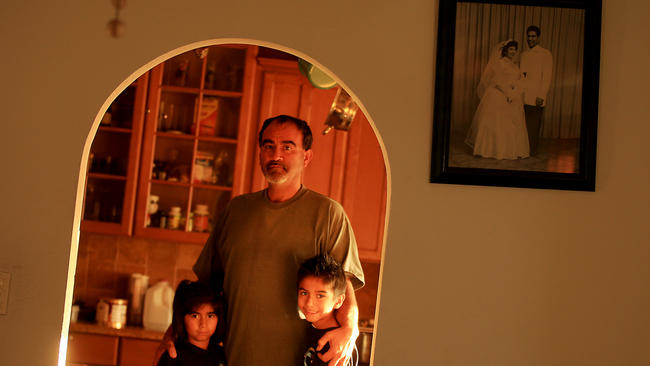
MARTIN SALDANA, here with son Dimaggio and daughter Darlene, walked out of the Long Beach Boeing plant for the last time Friday afternoon. “I lose a lot of sleep,” he said. “I’ve still got to provide for them.” (Luis Sinco / Los Angeles Times)
By Steve Lopez
Martin Saldana, 51, walked out of the Long Beach Boeing plant for the last time Friday afternoon. Behind him were 29 years of steady work building commercial and military aircraft. Ahead of him: absolute uncertainty.
"I lose a lot of sleep," Saldana had told me earlier in the week, before helping his 9-year-old son and 6-year-old daughter with their homework. "I've still got to provide for them."
Saldana and hundreds of other Boeing employees have lost their jobs in recent months, as the company phases out the C-17 after making more than 270 of them. The U.S. military has all it needs of the low-bellied military transport planes, and foreign demand has dried up.
If Boeing sticks to its plans, the last C-17 will be finished by late summer, and in a region that was once an aerospace giant, an era will come to an end.
"This is the last large-scale manufacturing line making airplanes in Southern California," said USC professor Peter Westwick, author of "Blue Sky Metropolis: The Aerospace Century in Southern California."
"When it closes," said Westwick, "for the first time in 100 years, nobody will be actually making airplanes in Southern California."
Westwick put the closure in context:
Aerospace, he said, was always boom and bust here, following cycles of global conflict, cold wars and economic slumps. But rising land and labor costs, among other factors, moved manufacturing jobs to other states.
Los Angeles still builds satellites, drones and rockets. But those jobs are fewer in number and more white-collar than the massive assembly line operations that bolstered the local economy and lifted tens of thousands of families into the middle class.
So where does that leave the likes of Martin Saldana, an Air Force veteran who lives in Carson, across the street from a Shell tank farm and next door to the house he grew up in?
It leaves him with 13 weeks of severance pay and three months of medical coverage, and one rejection after another of the job applications he tenaciously fires off.
Saldana has always had three passions — baseball, trains and airplanes — and since he's about 30 years too old to begin a baseball career, he's trying desperately to get on with a railroad company.
But he struck out at Burlington Northern Santa Fe, and Union Pacific rejected five of the six job applications he filed there, he said. The company doesn't mince words, either.
"Status: Not qualified," said one letter after he tested for a diesel mechanic opening.
"Thank you for taking the time to test with us. We have scored your test and regret to inform you that you have not met the minimum test requirements. Your interest in Union Pacific is appreciated. We wish you success in your future endeavors."
Saldana is hoping the sixth time is the charm. He's trying for a track laborer job that would pay $21 an hour.
"That would be ideal," he said — even though he's been making $39 an hour in his union job at Boeing. That's about $80,000 a year, and Saldana said there were years when he topped $100,000 by working seven days a week and taking all the overtime that was offered.
"Unfortunately, I've been spoiled," he said, but then he edited himself. He worked hard and had a number of highly skilled jobs at McDonnell Douglas/Boeing, he said. "I don't know if I want to call it spoiled. I've been fortunate for the last 29 years, and now I'm going to get a taste of the real economy."
The real economy isn't bad if you're highly educated and technically skilled, or if you work in hospitality or healthcare. But if you're 51, with only a community college degree like Saldana, it can be a living wage desert out there, with no concession to the high cost of Southern California living.
"It's all over," Saldana said of the time when good jobs were there for the taking. His late father, or Pops, as he calls him, worked at a tuna packing plant and raised a family on it. Who could have known that manufacturing and aerospace, backbones of the local economy, would get hit so hard?
Not that Saldana regrets his career choice. He was a teenager when he fell for the TV show "Baaa Baaa Black Sheep," starring Robert Conrad as a swaggering U.S. Marine Corps aviator. Saldana wanted some of that, so he joined the civil air patrol, learned how to fly and enlisted in the Air Force, where he worked as a jet mechanic.
One day in 1986, the year after his discharge, Saldana was driving on Lakewood Avenue and decided to pop into McDonnell Douglas to see if they needed any jet mechanics. No, they told him, but they had a job in the supply shop on a commercial airliner assembly line.
What a deal it was. A union job, good pay and benefits, and a pension. Saldana's will pay him about $2,000 a month before taxes, with no medical, but it won't kick in until he's 55.
So he needs work, and he needs it soon. Maybe he can become a welder, he told me in his kitchen, popping a slab of ribs into the slow cooker. Or maybe he can become a heavy-equipment operator.
But what if the rejections keep piling up?
"I might have to rent out some rooms of the house," he said.
His situation is not helped by the fact that he and his wife are in the midst of a divorce. She has primary custody of the kids, and he's got to keep coming up with support payments.
On Friday, when Saldana joined the handful of employees who punched out for the last time, Randy Sossaman, president of United Aerospace Workers Local 148, was there to shake his hand, as he is for all the departing employees.
Sossaman figures he'll be the last one out the door, and like many of the others, his future is uncertain. His knees are wrecked "from crawling around in airplanes for 30 years," and he wonders if any employer will want a broken-down guy of 52.
Saldana and Sossaman, who are buddies, had good reason to make plans for a drink Friday evening.
"Just give me a second here," Saldana said, choking up. "Twenty-nine years. It's tough. What can I say? It was not only memorable, but unforgettable."
Saldana wasn't the first departing employee to tell me he loved his job and regarded his co-workers as family. When the last C-17 rolls out later this year and does a flyover, soaring like a winged gray whale across the South Bay sky, Saldana plans to be there.
Earlier in the week, I asked him what thoughts he wrestles with at night, when he can't get to sleep.
He answered immediately.
"What's going to happen tomorrow?"
A middle class O.C. family seemingly did everything right. Why then are they ‘circling the financial drain’?
By Steve Lopez
Dan Jones made it unscathed through his reconnaissance missions over Vietnam.
He wasn't as lucky after returning to the states. An unstable employee at Raytheon, where they both worked, shot Jones in the back.
"They thought I was dead," said Jones, 29 at the time.
He survived that experience, too. But he is having trouble surviving this economy.
Jones is a sharp, well-spoken guy with a strong resume and an even stronger desire to work, but his job drought is now entering its seventh year and his prospects are dimming.
Next month, he turns 66.
Dan's wife, Suzanne, told me about him. She saw my column about a 60-year-old Boeing employee who got laid off, like hundreds of his colleagues, and finds himself on the brink of losing his home and his hopes for a comfortable retirement.
"There's so many of us in similar circumstances out here," wrote Suzanne, saying that Dan had been laid off in 2008 and has been looking for work ever since.
He goes to job fairs. He joins networking groups. He relentlessly fishes for jobs on the Internet.
And he can't catch a break.
"We're circling the financial drain," said Suzanne, who works three days a week in a medical/clerical job and would take a better deal if she could find one. But at 57, age is not working in her favor, either.
In their long, unbroken fall from the middle class, the Joneses have lost just about everything. They had to sell their house in Huntington Beach at a low point in the market. Then they cashed in savings bonds and sold wristwatches and cameras.
"I sold my wedding ring, my engagement ring and my anniversary ring," said Suzanne.
"We'd be living in the car," Dan Jones said, but for the generosity of Suzanne's sister, a registered nurse who took them into her Huntington Beach home two years ago. But Dan and Suzanne would like to move on just as much as Suzanne's sister would like to get her privacy back, they told me when I went to visit last week.
Some people live beyond their means and dig a giant hole for themselves. What's so scary about the Joneses' cautionary tale is that they lived fairly responsibly and still went from well-situated to flat broke.
Dan Jones had decades of marketing and engineering success working for the likes of Mitsubishi and Samsung as well as Raytheon, making as much as $150,000 a year. When Samsung shut its Irvine plant, he took a six-month severance and figured he'd quickly find another job.
At 59, he didn't feel old. And with six or seven more years on someone's payroll, he'd be able to sell the house in Huntington Beach, trade down to less expensive digs in the desert, and live happily ever after with Suzanne on their Social Security and 401(k)s.
"We were almost there," said Suzanne. "We were within six years of it."
But the "perfect storm," as Dan Jones calls it, was gathering on the horizon.
"Everything was collapsing in my profession," he said. "Companies just froze because they didn't know what was going to happen. So they started laying people off left and right, and there were no jobs."
The market crash mugged their 401(k)s. Their home equity, another big piece of their retirement plan, shrunk by about $200,000, but they had no choice but to sell low.
Dan Jones filed "hundreds of applications" without landing a thing. He even set his sights lower, applying for retail jobs. He thought he was close to getting lucky at The Home Depot, but lost out yet again.
They did make one mistake in managing their misfortune, said Jones, and he greatly regrets it.
"It was extremely stupid, but a lot of people do it," said Jones. "I started to pay bills with credit cards."
"We raided everything else first," said Suzanne, so it wasn't as if they had any good choices.
Dan Jones wanted to hold out until 66 to draw Social Security, but had to opt for the lower monthly amount of $1,750 when he turned 62. They now live on that check along with Suzanne's monthly net of about $600, and they still have $20,000 in credit card debt.
She takes no comfort in knowing they are not alone.
"He's got a friend who lives in a garage," said Suzanne. "We know lots of people in the same predicament and they're all good people, highly educated but over 45, and they can't get their foot in the door."
Dan is one of hundreds of unemployed managers and executives who attend regular meetings of CafeNet, a job networking group set up by Cindy Pickens when she lost her executive position at a computer company in 2002.
Prospects for executives have improved since then, said Pickens. And yet CafeNet grew from one chapter to three and has 1,000 members. Some find their way back into the workforce, but it can be harder for someone like Jones, she said. Employers look askance at anyone who's been out of work for several years.
Be that as it may, Jones still hustles. He's mastered social media, not just to stay sharp on modern marketing strategies but to keep his name in play. He set up his own consulting business and has done a few marketing jobs for clients on a contingency basis. If and when they make money, he gets a cut.
"When he was working with me, he would go out of his way to make sure things were done and done right," said Ken Colby, who was Jones' last boss at Samsung and had nothing but good things to say about him. "He always had ways to help support our business initiatives and came up with ideas that were different than what we were doing."
When I asked Jones his thoughts on what's wrong with this economy, in which an accomplished man is reduced to camping out with a relative, he began by saying too many people are going after too many jobs.
But as he warmed to the topic, he said he thinks Washington should do less posturing on social issues and less feuding over partisan differences. And it should do more to address the increasing concentration of wealth and the cracks in the foundation. Last week, he bristled when he read the story about SoCal Edison's plan to dump 400 information technology employees and outsource the jobs to two companies in Bangalore and Mumbai.
"I'm angry at the government," said Jones. He began to choke up. "They let companies do that and I understand those companies need to stay competitive. But there needs to be some kind of compromise. What's happening is that this small core of people is getting wealthier and the middle class is going away. The promise that your kids would have a better life than you, with the house, the two cars, the dog and everything else, it's gone."
Jones told me his prayer is that he'll finally land something, and he and Suzanne can reconstruct their modest dreams.
Rod McIntosh, 36, can’t find a tech job despite years of military training and employment in that field
By Steve Lopez
In the haves and have-nots economy of Southern California, Air Force veteran Rod McIntosh is currently embedded with the nots.
The 36-year-old can't find a tech job despite years of military training and employment in that field, so he's had to temporarily settle for a $10-an-hour post in men's clothing at Bloomingdale's.
He has no car, and digging out of a rut is all the harder when you travel by bus. For a while, he slept on a cousin's couch. These days, he's renting space in a house in South Los Angeles.
In other words, McIntosh lives like multitudes do here in the stratified kingdom of hillside castles and cardboard cities. So he's got plenty of perfectly good reasons to be discouraged.
But he isn't.
Frustrated, yes. Discouraged, no.
"One thing I've been told is that I am very persistent," said McIntosh.
Yes, that's one thing that seems to have impressed people I spoke to about McIntosh. Another is how focused and determined he is.
And then there's his bold plan to reverse his fortunes.
But before I tell you about it, let's go back to 1997, when McIntosh graduated from high school in North Carolina and enlisted, figuring he'd learn a trade and carry it back to civilian life. The Air Force trained him in information technology and satellite communications, and when McIntosh was discharged after nine years, he had no trouble landing defense contract work in the U.S. and later Europe, where he had served.
But there was one big bump on his way to having it made. McIntosh got married while in the Air Force, had a son, and then the marriage fell apart, with his wife and son anchoring in Sacramento. Last May, when a defense contract ended in Europe, McIntosh moved to Los Angeles. He reasoned that he'd be better able to keep up his support payments by fishing in the vast L.A. job market and heading north on weekends for some family time.
For a brief moment, it looked like a smart plan. McIntosh got a couple of bites and thought he'd landed a tech job, but his heart was broken at the finish line when the company went with someone else.
After that, he stockpiled a stack of rejections. It's not as if there are no jobs in his field, McIntosh said. But the competition is stiff for every one of them, and although he may be qualified experience-wise, he began thinking he lacked one essential thing: a college degree.
"I'm just not getting the callbacks," he said. "I guess I don't have what they're looking for."
He's not alone in that regard, and he happens to be in two demographic groups with staggeringly high rates of unemployment and under-employment: He's a veteran, and he's African American.
A USC study found that nearly 25% of the L.A. region's veterans have annual incomes at or below poverty level. And Sherri Bell, of the Los Angeles Black Worker Center, said 50% of L.A.'s African American adults are either unemployed or make $12 an hour or less.
McIntosh linked with Bell's group (he met her at a job fair) and the local Raise the Wage coalition, attending rallies to speak up for the L.A. City Hall plan to raise the minimum wage. About 800,000 workers in L.A. County earn minimum wage, meaning they make about $20,000 a year in a region where that puts you a half-inch from homelessness.
To McIntosh, news of record profits for some companies at a time of gross income inequality suggests the system is rigged. And SoCal Edison crossed a line, in his opinion, in recently announcing it would lay off 400 IT workers (his very field) and replace them with cheaper labor in India.
"To me," said McIntosh, "that's not ethical."
But he's not going to wait patiently for fair play and economic justice to gain a stronger foothold in the American workplace. He's decided he needs to be more aggressive, and smarter, about elbowing his way back into the middle class, and he has made a college degree his first priority.
"Sir I start class at 1400," he texted me on the day I met up with him at El Camino College, where he's a freshman with a full load of classes.
McIntosh is taking advantage of the GI Bill, going to school two days a week, going to work three days a week, and studying every day. He found temporary help with transportation and housing costs through a veterans assistance program administered by PATH, or People Assisting the Homeless.
"I have no doubt that he will be successful," said PATH's Luz Angelica Vazquez, who steered McIntosh to Bloomingdale's in Century City because the store seeks out veterans and offers flexible hours, allowing McIntosh to concentrate on school.
And El Camino is just a start, as McIntosh sees it. Last fall, he went to a veterans job fair at Dodger Stadium and was drawn to the bright orange Caltech booth, which was manned by job recruiter Stephanie Hancock.
"He came right over and said he wanted to go to Caltech," said Hancock. "I did clarify that I was recruiting for staff positions, and he said he'd be really happy to work at Caltech because he really, really wanted to go to Caltech."
Which is, of course, one of the most competitive schools in the universe.
So what did Hancock tell him?
"I said, 'If that's what you'd like to do, then great.' I'm not going to discourage anyone who wants to further their education."
McIntosh told me he's dead serious about Caltech.
"I'd want to transfer as soon as possible," he said.
I'm with Hancock; far be it from me to tell him the odds are a little intimidating. McIntosh does recognize the possibility that Caltech might not work out, so he's already looking into two backup options, neither of which is too shabby.
USC and UCLA.
"I've been making my face known," McIntosh told me, saying he had visited USC five or six times on reconnaissance missions. "I go into the office of admissions and I've been to the school of engineering to ask questions about what path I should take" and what courses to complete at El Camino College.
Getting to school and back home, by the way, is a four-bus ordeal. Same with work, and McIntosh leaves the house at 7 a.m. to make sure he's not late for his 9 a.m. start.
McIntosh started in housewares at Bloomingdale's but moved to men's clothing, where he now gets a commission if he exceeds a weekly sales target. If not, he gets $10 an hour, which is the way it usually works out. That means he can't shop in the store he works at; he got his only suit at Hollywood Suit Outlet.
But he said he likes the challenges of the job — you've got to know the merchandise, polish your schmoozing skills and develop a stable of regular customers who seek you out.
I asked if it can be discouraging to sell things he can't afford to well-heeled customers from Beverly Hills and environs.
Not really, McIntosh said.
"That's what keeps Caltech as my No. 1 goal."
By Steve Lopez
Jose and Ana Sanchez ran for their lives during El Salvador's civil war, resettled in Los Angeles and joined the working class.
They landed minimum-wage jobs in the garment district, then started Ana's Ice Cream, motoring through the city to peddle frozen treats. Together, they brought in just enough money to pay the rent and raise two kids.
But now, after 31 years in the same modest house in the hills of Echo Park, they and their daughter are being forced out by gentrification.
"My parents are here stressing every day, not knowing where they're going to go or how they're going to do it," the Sanchezes' 29-year-old daughter, Rocio, said when I met with the family.
The Sanchezes say they have benefited from a rent stabilization ordinance that limits increases to 3% a year, and they currently pay $942 a month for a modest three-bedroom, one-bath house. They can handle that with income from three jobs — Rocio makes $11.50 an hour as a home health aide, Ana works about 30 hours a week for minimum wage at two Domino's Pizza franchises, and Jose gets a disability check while undergoing dialysis treatment.
But last year their landlord sold the property, and the new owners — 4SITE, Responsible Real Estate and Development, as the website has it — notified the Sanchezes of plans to demolish the house. 4SITE will build a cluster of five homes on the lot, and a 4SITE employee told me each unit could go for $800,000 or more.
It’s not just their home that they’re losing, Rocio Sanchez said. Like a lot of other longtime residents, many of them Latino, they’re effectively being squeezed out of Echo Park, where apartments smaller than the home they live in are going for twice what they pay, and corner bodegas give way to $5 coffee shops.
"In the '90s, people wouldn't even walk their dogs down the street" because of concerns about crime, said Rocio. But now Echo Park is a destination community with $1-million homes, and they can't afford to stay.
I'm not one who believes gentrification is necessarily evil, and high-density housing — five homes where one now stands — can sometimes make sense in Los Angeles as an alternative to continued sprawl. 4SITE and other investors who are buying up Echo Park, Highland Park, Boyle Heights and other gentrification hotbeds have every right to do so.
But having said that, gentrification has winners and losers, and so does this resurgent economy. In fact, the improving economy is crushing people like the Sanchezes, because while real estate goes up, their incomes don't, and they sink deeper into the ranks of the working poor.
Can the revolution be very far off when Oscar nominees are handed $160,000 swag bags and there's a $195-million manse on the market in Beverly Hills (you can lease it for a mere $475,000 a month), but we're the homeless capital of the United States and have a catastrophic shortage of affordable housing?
Rocio Sanchez said she and her parents recently looked at a $1,500-a-month house in Boyle Heights, the cheapest acceptable home they could find. But before they move, they're contesting the terms of their departure.
4SITE offered them $12,000 in relocation costs. The family didn't respond initially because Mr. Sanchez was hospitalized, Rocio said. She later did some research and concluded that as residents of a multi-family dwelling, they were entitled to $19,000 in relocation costs under city guidelines.
For many years, Sanchez said, a second family lived in a separate downstairs portion of the house, and I confirmed that with the family. The other family had a separate address, and property records listed the house as a two-unit dwelling. Sanchez always figured that was why her family was eligible for rent stabilization.
But 4SITE disputes that. Todd Wexman, chief principal, emailed me to say the city told his company the home is a single-family dwelling with no record of permits for a second unit. "As such," he wrote, "if there was ever another unit, it was illegal."
Wexman contends he therefore is not obligated to pay any relocation fees to the Sanchezes.
The offer of $12,000 was a take-it-or-leave-it proposition with a one-week deadline, he said. "Nonetheless, we have now offered $4,650 and two weeks of free rent," he added.
The Sanchez family has retained the nonprofit Eviction Defense Network, where three attorneys — Elena Popp, Magda Madrigal and Jennifer Ganata — told me they think the Sanchezes have a good chance of prevailing if the case goes to court.
When I visited their office, by the way, it was swamped with tenants fighting eviction, and the attorneys said some of their booming business is due to displacement caused by gentrification.
"All I want is what is right for my family," a weeping Rocio Sanchez said as her father listened and her mother wiped away tears. "My parents know where we stand. We're lower-class and we accept that. What we don't accept is anyone coming here and thinking that we're insignificant."
Whatever happens to them, the intensifying squeeze on affordable housing in Los Angeles and beyond is proof positive that something is seriously out of whack in this so-called rebounding economy. Multiple families are forced to share apartments, college grads have to move back home, people are moving farther from job centers and then schlepping long distances to work, and let's not forget those living in cars and tents.
For the most part, thanks largely to the powerful real estate lobby, policymakers have been useless in crafting remedies for what California Assembly Speaker Toni Atkins (D-San Diego) has called "one of the biggest crises" in the state.
Atkins has pitched a plan of real estate fees and tax credits to produce $500 million worth of housing assistance for low-income Californians, but the Republicans are taking shots at the plan and Atkins is getting hammered by those who say her spouse's affordable housing consulting business would benefit.
Occidental College professor Peter Dreier told me there are three ways to address the affordable housing shortage, aside from raising the minimum wage and developing a living-wage economy:
Local lawmakers could create inclusionary zoning, in which developers are obligated to set aside a portion of any apartment or condo development for moderate and low-income earners (developers would fight this to their death).
The state could take action to allow cities to impose rent control mandates, to keep landlords from forcing out tenants so that they can then raise rents.
And the government could support nonprofit ownership of buildings, making more affordable units available.
We need to do something, Dreier said, because even people who make decent money can barely afford a place to live.
"There's prosperity for a few and stagnation and declining income for the majority," he said, "and that's true across the country, but it's particularly true in Los Angeles."
The Sanchez family knows this all too well.
They have until April 15 to vacate their home of 31 years.
By Steve Lopez
It’s not uncommon on the Westside of Los Angeles for people to shell out $20 million or more for a house.
And then take a wrecking ball to it.
Jeff Hyland, of the high-end Beverly Hills real estate agency Hilton & Hyland, had a recent tear-down sale of $35 million in the Trousdale section.
"It was in absolutely magnificent condition," noted Hyland, who would not reveal the owner's name but said his client was happy to pay all that money "just for the dirt," with plans to erect a dream house.
Tearing down a $35-million house in a region where the middle class is disappearing, affordable housing is scarce and multiple families are crammed into homes or apartments — not to mention the tens of thousands living on the streets — is the kind of thing that makes you think the world is about to end.
But that's the way things are in the Westside hills, where there's no shortage of buyers from around the world snapping up estates. Longtime residents, suffering in cramped 10,000-square-foot quarters, are squawking about new and rebuilt estates the size of aircraft carriers.
One house just sold for north of $80 million, right around the time the Economic Policy Institute published a study concluding that "more than half" the residents of metro Los Angeles "are struggling to achieve economic security."
The year 2014 was the biggest on record for his agency, said Hyland, with $2.9 billion in sales across Beverly Hills and Bel-Air, through Brentwood and out to Malibu. But that mark could be topped in 2015, with Hilton & Hyland's 100 agents chasing a target of between $3 billion and $3.2 billion.
"We've sold, I think, 10 houses this year for over $20 million," Hyland told me while we toured some of the most expensive homes on the U.S. market in his Rolls-Royce Ghost.
"The Chevrolet of Beverly Hills," Hyland said of his car, which rides like a dream. The base price for a new Ghost is about $300,000, or roughly the median price of a new house in the United States.
Hyland said he used to get clients who had a nice leafy ramble in Bel-Air and wanted to add a weekend compound on the beach in Malibu. Now he gets clients who already have several homes somewhere in the world but there's a missing piece, and they've just got to have something special in 90210 with go-to-hell views, vineyards, gymnasiums and lagoons. Tennis courts, Hyland said, are practically passe.
"The money is coming from everywhere," he said. "For a while it was Middle Eastern money and then it was Russian money and then South American money and then Asian money. Now it's all of those."
And how'd these sultans, titans, royal runaways and rogues come by all that cash? Hyland said some worked for it, some inherited it, some managed to get their hands on a lot of foreign cabbage and needed to replant it in the U.S. "as a tax-avoidance system."
When someone pays $50 million or more for a home, Hyland said, it's not uncommon for them to spend only several weeks a year in the house. They may buy such a place as an investment, or a party palace, or to avoid the nuisance of five-star hotels while visiting their kids at UCLA.
Hyland's all-time highest transaction was the $85-million sale of the 56,000 square-foot Candy Spelling home in 2011. But he now has a listing for 50,000-square-foot mansion once owned by newspaper tycoon William Randolph Hearst. That one has a sticker price of $130 million, but if you don't have that kind of money, no problem.
You can lease it for just $600,000 a month.
Hyland seems to think the former Hearst home is a better deal than the most expensive listing in the United States: the $195-million Beverly Hills estate owned by architect Jeff Greene.
That one, by the way, sits high on a hill like a giant tombstone marking the death of humility. It has a name, as well it should. It's called the Palazzo di Amore and it has a bowling alley, 50-seat theater, 12 bedrooms, 23 bathrooms, 128-foot reflecting pool, 5,000-square-foot master bedroom suite and 27-car garage — all of which is good to know in case you're looking for an unassailable definition of obscenity.
I suppose you could argue that people with ridiculous money are an industry all their own, and when one of them can't stand the layout of the kitchen or wants the water pressure pumped up in bathroom No. 23, that means work for plumbers and electricians. And let's not forget all the other hired help needed to carry the Beverly bourgeois through each trying day — maids, gardeners, chandelier dusters, pool boys and diaper changers.
Well, maybe, says Edward Kleinbard, a USC professor of business and law and author of "We Are Better Than This: How Government Should Spend Our Money." But if you can pay $45 million cash for a house you seldom occupy, Kleinbard says, why not do something more productive with the money, like start a business that creates good full-time jobs?
Kleinbard doesn't necessarily take issue with "real estate porn," as he called it, nor does he recommend higher taxes on the 1 percenters, as some do. But he argues that real estate factors heavily in wealth inequality. How? The government subsidizes home ownership through various tax credits and deductions, when it should instead help level the playing field by investing more in "working-class and middle-class Americans" through education, infrastructure and the social safety net.
Hyland, for his part, laments the shrinking of the middle class, calling it "the biggest crime of this generation." But fixing that is not part of his job description. He makes good money because wealthy people want his services, and he said he's able to support his pet causes, including music enrichment for children.
He added that when houses sell for tens of millions of dollars, property taxes pour into city treasuries, benefiting everyone.
"This is Charlie Chaplin's house with the red tile roof," Hyland, author of a coffee table book called "The Estates of Beverly Hills," said as we purred under palms and past cascading bougainvillea in the Rolls.
On one short stretch, Hyland pointed out the $35-million tear-down, a $70-million house his agency just sold to the creator of a computer game, a house he once sold to Frank Sinatra, and another house — the former residence of Elvis — that he has sold three times in two years.
But Hyland is more than just an agent. He's a partner in a development called The Vineyard, and he drove me up to the 157-acre site at the top of Benedict Canyon. A perfect spring breeze blew across this perfect plateau, with its stunning views of the city from downtown L.A. to the Pacific.
On this spot, Hyland said, six 40,000-square-foot homes will be built.
Each will have a gym, a subterranean theater and a 10,000-square-foot master suite.
The planned sales price?
One hundred million dollars apiece.
If you're on the fence, keep in mind that a pinot vineyard will be planted on the site.
"Each house is going to get 60 cases a year," said Hyland, who flashed a $600-million smile.
By Steve Lopez
Doris Tillman got a jump on the rest of us when it comes to water conservation.
The 71-year-old South Los Angeles homeowner had no choice.
Last August, the Los Angeles Department of Water and Power shut off the church-going widow's water service because Mrs. Tillman had fallen behind on her payments after a series of setbacks. She lost her job as a delivery driver, her leaky pipes left her with a $7,000 plumbing bill she's still paying off, and her Social Security check wasn't covering her expenses.
The things we take for granted — flushing the toilet, running a bath, washing the dishes — all became additional challenges for Mrs. Tillman. But she's learned to improvise.
"I'm going to write a book on how to survive in L.A. without water," Mrs. Tillman told me as she demonstrated how she hoists the five-gallon water jugs she fills at a nearby water machine.
She bent over, tilted one of the heavy jugs and rolled it along the floor of her living room toward the kitchen.
"Let's say I wanted to put this one on the kitchen sink," said Mrs. Tillman. She then squatted like a sprinter in the starting blocks, raised one knee, and hoisted the jug onto it with a grunt.
"Then I lift, using my knee to balance it, until I stand up straight and then take it wherever I need to go."
It was a considerable display of strength and willpower, at once impressive and sad. Most of us think of water and electricity as part of the deal in a civilized country of unsurpassed wealth. But all around us, there exists a Third World reality.
A DWP official told me the utility shuts off service to roughly 8,000 customers every month. Some people don't pay their bills, and the DWP certainly can't give its services away for free. But a class-action suit charges that many customers have been over-billed, and some may have lost service as a result.
Mrs. Tillman admits she stopped paying her DWP bills, partly because she thought the charges were too high and must be a mistake and partly because she couldn't afford to pay after her unemployment insurance ran out. So now she's in a big hole, with the DWP claiming she owes $11,000-plus in back charges for water, power, sewer and trash, even after she made a $1,000 payment through a low-income energy assistance fund.
On Friday, the DWP told me it's willing to negotiate a payment plan that gets Mrs. Tillman's water turned back on. But Mrs. Tillman still doesn't know if she can come up with enough money to make that happen.
She said she'd take in a boarder, except that no one would rent a room in a house without running water.
Friends have told her to sell the house, but Mrs. Tillman says she can't do that under the terms of a state-sponsored mortgage assistance program she signed up for.
So she's stuck, and her job-hunting isn't going so well.
"No one's hiring a 71-year-old person," said Mrs. Tillman.
When I paid my first visit, she let me in and said: "I've turned my house into a factory."
Several sewing stations were set up in the living room, with spools of yarn all around, and fabric draped over hangers.
"I have to do anything and everything I can to make a dollar," she said.
So she's begun making clothing, scarves and crocheted items, all of which she says will be labeled "Made in America." Business is off to a slow start, though, and she welcomes new orders at [email protected].
She's calling her company Dreams Hoped For ... Visions Fulfilled.
At the risk of getting too personal, I asked Mrs. Tillman how a person bathes in a house without running water. Last year she signed up for swimming lessons, she said, so she could shower at the rec center. And she's showered at yoga class, too, as well as at the home of a granddaughter.
But she has a system at home, as well.
Mrs. Tillman took me into the kitchen to show me the 2-gallon stock pot and 1.5-gallon crock pot she fills with water. She heats the water, pours it into the bathtub, climbs in and sits down.
"It's just enough to cover my ..." she said.
Then she uses a 1-gallon jug to rinse.
"I take one bath a week," she said, and "and every day, I do what we call a PTA."
A sponge bath, in other words.
Cooking is another exercise in conservation.
"I recycle my recycled water," she said.
She'll save pasta water and use it to steam vegetables, or strain it and use it to clean the sink, or pour it into the toilet tank so she can flush.
"In using the toilet, I used to go at the drop of a hat," Mrs. Tillman said. "Now I hold it in until there's more serious things that have to happen."
When it's cold at night, she doesn't sleep in her bedroom, where too many windows add to the chill. It's a bit warmer in the living room, but she's been kept awake lately by some tapping in the ceiling. She suspects it's rodents, and that's another bill she'll have to pay.
For all her troubles, Mrs. Tillman still visits the sick and elderly as a volunteer at her church, and she said she never speaks to them of her trials.
"You don't go to help somebody and give them your problems," she said.
Mrs. Tillman said if she could do it all over again, she'd have better prepared herself for bad breaks like losing a job and losing a husband too soon. But it seems to her the margin for error in today's world is too thin, that there's too much greed, and too many people left behind.
"You have to fight to survive in this economy," she said. But she hasn't lost her faith.
One thing she's learned, Mrs. Tillman said, is that water is precious. She survives on just under 50 gallons a week, paying about 25 cents a gallon.
If she ever gets the water turned back on, she said, she'll never waste a drop of it.
People cling to the fringes in Los Angeles’ tough housing market
By Steve Lopez
In Reseda, an elderly couple fret about where they will go at the end of the month, when they are forced out of the one-room apartment they have lived in for 29 years.
In Tujunga, a retired woman lives in a backyard shed, treating her high blood pressure with tea made from her garden and bathing in an outdoor tub with water heated by the sun.
In Arleta, a supermarket employee rents a makeshift room in a house that is home to 10 people, and often waits in a long line to shower before work.
I didn't set out last Wednesday to tie these stories together; I was following leads in search of the small dramas that play out daily, beyond the headlines, in homes that do not make the Hot Property column.
I traveled the 101 and the 405, the 118 and the 210, and the stories intersected as the highways do, here in a land where all too often plans fall apart, and the daily challenge is to adapt, to endure, to survive.
***
"Help!!!!" Caroline Malloy pleaded in an email to me.
Her parents, Charles and Bernice Malloy, 80 and 70, are being evicted from the Reseda retirement home they moved into in 1986.
"At the end of last year, the owner called me and said, 'We'd like you to move out,' " says Bernice. "I was just speechless."
Bernice worked for the retirement home as a live-in receptionist and medication technician, among other jobs, and in return she got a modest paycheck and the studio was rent-free. She pressed for an explanation and was told her job was being eliminated, and the room went with the job, so she was out.
This is our life," Bernice said, showing me her modest setup at the Ambassador Garden on Canby Avenue. Their one-room home has no kitchen, which has made for three decades of cooking challenges, and a clothes rack serves as a room divider.
A wooden LOVE carving is perched atop a curtain rod and a shelf displays a greeting card with pink butterflies and the words: "To My Beautiful Wife. You're a Gift From God."
The card is from Chuck, a former U.S. Marine who now steadies himself with a walker. His wife and daughter — that's Caroline — confide that he's in the early stages of dementia.
Chuck worked as a delivery man back in the day, but neither he nor Bernice ever brought home a big paycheck, and medical expenses have taken a bite out of their limited funds.
So what are their options in one of the most expensive real estate markets in the country, with scant affordable housing and waiting lists for subsidized senior living?
"They have to come live with me," said Caroline, 40. "I'm an only child and they're my only parents, and I can't let them go somewhere else."
Caroline's rent-controlled studio apartment is no bigger than her parents'. She lost her job as a bookkeeper when the recession hit and the new job she found pays less. And still, she notes with pride, she's never missed a rent payment — and is fully confident that she can afford the rent on a larger apartment in the building.
So it really ticks her off that the management at Talavera Apartments in Reseda first insisted that she include her parents on the application for the new apartment — and then summarily rejected the family because her parents' credit rating isn't high enough.
"So what?" asked the Malloys' attorney, Robin Paley. "Can't they make an exception?"
I suggested that Caroline combine her salary with her parents' retirement income and move into a bigger unit somewhere else, but she said market rates are exorbitant, and having once lost a job, she fears being stretched too thin.
Her apartment managers did not return my calls, and my conversation with the manager of the Ambassador Garden was brief. He said only that Mrs. Malloy's job was being eliminated and that I should call back next week because he was on a beach in Mexico. Then he hung up.
On July 1, barring any developments, Caroline Malloy and her parents will begin living together in an apartment the size of the average garage — an arrangement not at all uncommon in Los Angeles.
***
I drove high into the hills of Tujunga, stood at a locked gate on a country road and called out to Agneta Dobos. She didn't answer.
I heard the trickle of water, peered through the vegetation, and saw a woman in a bathtub under a peach tree.
Long ago I stopped being surprised by the way people live in Los Angeles.
Some make do in cars for years on end.
Some live in converted garages.
Some wedge themselves under freeway overpasses.
And I have just gotten to know a woman who went nine months without running water in her home.
Still, an outdoor bathtub was new to me.
"I bought it for $40," Dobos told me, opening the gate with a towel on her head when she realized I was not there to evict her.
Dobos has been at this property for 27 years, and the 1994 Northridge quake damaged her house. Years later, she signed a deal with the city to have the house demolished and rebuilt with a HUD loan, but that plan fell apart in disputes between Dobos, the contractor and the city.
So she moved into a backyard shed eight years ago to await a resolution that never came, and now the city is evicting her because the shed doesn't meet safety standards.
"They're going to put me in the street and I'm going to die," said Dobos, 67, a former registered nurse who said she has heart trouble and multiple other health problems.
The shed she lives in is about 8 feet by 10 feet, with a portable grill and toaster oven powered by a line that runs from the street. There is no toilet; she goes to the nearby YWCA. The only place for a small table is on the bed, and she slides her feet under it when she sleeps.
To heat the water for her daily bath, Dobos fills about two dozen plastic jugs from a garden hose and sets the jugs on the foundation of the house that was never built. About 2 p.m., she dumps the sun-heated water into the tub and climbs in.
It's a hard life, but she loves the home she shares with her cats and three chickens, who lay green eggs. During those spells when she can't afford to shop, she eats her own tomatoes, walnuts, apricots, grapes and oranges. When her blood pressure rises or her diabetes flares up, she brews teas from her loquats, celery leaves and nopales.
Dobos seems to have a history of disagreement with neighbors, employers and inspectors.
I can't believe, though, that the best solution is to force her onto the street, adding her to the 44,000 homeless people countywide who have set up tents and built "cardboard condos" almost everywhere, including within blocks of City Hall.
Maybe, rather than evict her, the city could arrange for a social worker to help resolve her problems and upgrade the shed to make it safe for her to live in — and then restart the rebuilding of her house.
***
It took 20 minutes to drive from Tujunga to Arleta, where I met with Reina Rosales at a one-story home that serves as a kind of hostel for people who work low-wage jobs.
Rosales' room at the back of the house is a wooden, corner-cutting add-on, and she has to walk out of her unit and back into the house to use the one bathroom shared by nine renters. The owner keeps one bathroom to himself.
"If I'm scheduled to start at 7, I have to get up at 5 in the morning because the bathroom is very busy," Rosales said.
She used to have a better place, but the rent was too high at $600 a month. This one goes for $350.
The 48-year-old works in the deli at an El Super grocery. The chain offers rock-bottom prices to a mostly Latino clientele. This week, peaches are 79 cents a pound, tilapia is $1.47 a pound, and a 24-ounce bottle of Hunt's ketchup is 99 cents. It's a business model that elevated the owner of the Mexico-based company into the ranks of the world's billionaires in 2013.
"It's off the backs of the workers," said Rosales, who makes less than $10 an hour, which is significantly less than wages at many supermarket chains.
She had to work last Wednesday, so she was unable to join hundreds of El Super employees who marched in Highland Park demanding better pay and benefits. And even with the new minimum wage increase approved by Los Angeles city officials, Rosales has to wait until July 2016 for a bump to $10.50 an hour.
Rosales sends as much of each paycheck as she can to her family in El Salvador for education and basic needs. What's left is just enough for food, bus fare and the little room with a mattress on the floor and photos of her family on a dresser.
She said she sticks to herself in the house, watches movies in English to improve her language skills and dreams of one day going to college.
"I need to find a better job, and opportunities don't just come to you," Rosales said. "You have to look for them."
***
Last week, the California Supreme Court cited an affordable housing shortage of "epic proportions" and issued a ruling that makes it easier for municipalities to require developers to sell some housing at below-market rates.
Los Angeles Mayor Eric Garcetti applauded the ruling, but he needs to do more than clap. He needs to lead the way on a plan to make it happen.
Raising the bottom on minimum-wage jobs is a nice boost, but that's the easy part. The bigger challenge is the creation of middle-wage jobs.
The striking thing about the stories I have told today is that they are not exceptional.
Thousands of people in our city live in circumstances that are equally challenging.
What's depressing is that we, as a city and county, are so inept at helping them.
What's inspiring is witnessing how the Malloys, and Agneta Doboses, and Reina Rosaleses adapt, endure and survive, their dignity intact.
By Steve Lopez
Oscar Martinez isn't certain, but he thinks his starting pay as a Disneyland busboy and later a cook was just above $1 an hour. As you might have guessed, that was a long time ago.
He started in 1956, when the federal minimum wage was $1 an hour, and he still works there.
With 59 years on the job, Martinez has climbed the pay scale to about $21 an hour. Now 80, he said he still cooks occasionally, but because of his remarkable longevity, he spends much of his workday posing for photos with VIP guests who want to meet him.
"I love my job," Martinez said, telling me he'd rather not think about retirement.
I checked in with Martinez because with all the news lately about sky-high CEO compensation, a reader had a suggestion for me on the subject of growing income inequality:
Check out what Walt Disney was paid, relative to regular employees when he ran the mouse empire. And then take a look at how the compensation of current boss Bob Iger compares to typical workers.
That's easier said than done, because detailed information about Walt Disney's income is hard to come by. The New York Times reported in his 1966 obituary that Disney's base pay was $182,000, and that he also had a "deferred salary of $2,500 a week, with options to buy up to 25% interest in each of his live-action features."
In other words, Disney had some perks and sweeteners that added to his total compensation, as Iger does today. I think I'd much rather have Iger's deal, though. His base pay in 2014 was $2.5 million, which isn't much more than Walt Disney's base pay adjusted for inflation. But Iger's performance-based bonus lifted him to a staggering $46.5 million in total compensation.
That was a 35% increase over his tidy 2013 windfall of $34.3 million. "Performance pay," as it's called, became wildly popular in the 1990s because of corporate tax advantages.
Don't get me wrong. Iger's job isn't to create a new cousin for Goofy. It's to make money for the company and its legions of shareholders, and he's worked magic there, with billions pouring in from around the world.
Meanwhile, down in the ranks, a new contract for food and beverage workers at Disneyland Resorts will take average pay for thousands of employees from roughly $11.85 an hour to $14.35 over the next five years. Chris Duarte, president of Workers United Local 50, told me he was pleased with the bump.
That's understandable. When you're making barely enough to survive, while doing the grunt work that inflates executive bonuses, a couple more dollars an hour means a lot.
On the other hand, if workers on the Disney food line made near the minimum wage of $1.50 in the mid-1960s, their hourly wage has increased by just eight- or 10-fold in half a century, from about $3,120 a year to about $25,000.
What do you think Bob Iger would say if the Disney board told him his compensation would be a mere eight or 10 times Walt Disney's?
By the way, my intent here is not to pick on Iger or single out the Disney company. Income inequality is coast to coast. It's as American as "Snow White and the Seven Dwarfs," and while executive pay soars to obscene levels, wages are stagnant — "Frozen," you might say — for average working folk.
How grotesque is the haul by the 1 percenters?
A June report from the Economic Policy Institute said the chief executives of the nation's largest companies make three times as much as they did 20 years ago, or 300 times more than typical working stiffs. Between 1978 and 2014, inflation-adjusted CEO compensation increased 997%, while a typical worker's compensation increased 10.9%.
In Walt Disney's day, back in 1965, the CEO-to-worker pay ratio was 20 to 1. It peaked at 376 to 1 in 2000, and is currently at 303 to 1.
With the recent stock market tumble, CEOs could lose a bundle on paper, at least temporarily. But a favorite Wall Street tactic for raising revenue and stock prices is to cut costs by dumping employees, so watch your back.
"This is not just something that might seem aesthetically displeasing to some," said Larry Mishel, president of the Economic Policy Institute. "It's a matter of this group grabbing a larger share of our national pie, and by doing so, there's less pie available to other people."
You hear the argument that CEOs are merely reaping the benefits of their brilliant leadership, but Mishel says compensation has been nearly double the growth of the stock market in recent decades.
And don't forget this:
"People who make a lot of money get to keep most of it these days compared to Walt Disney. If you had doubled his salary, 70% or more of it would have gone to the treasury," Mishel said, because that's how high the income tax rate was before President Reagan came to the rescue of the wealthiest Americans.
Another report from Mishel's institute, scheduled for release Wednesday, looks at how much money it takes for a family of four to pay for basics such as housing, transportation and healthcare. The Los Angeles-Long Beach area, unsurprisingly, is among the top 15% among 618 regions in the country.
It would take an annual household income of nearly $74,000 a year to secure "a decent yet modest standard of living." That's nearly $20,000 more than the L.A. County median household income.
Oscar Martinez told me he's done OK on his Disneyland paycheck over the years. He bought a house and raised a family. For a while, his wife, Shirley Ann, worked at the park, too, and recalls serving milkshakes to Mr. Disney.
Martinez told me he's aware of the big compensation packages at the top, but he doesn't give it much thought. He knows that's just the way things work, and he thinks he's been treated well.
He keeps working at 80 because he likes the job, but he said he's feeling a lot of pressure now. His wife is sick, and his health insurance leaves him with about 20% of the medical costs.
"I need the money to pay the bills," he said.
By Steve Lopez
On a steamy October day in the town of Orange, a white van with an Uber sign in the front window ran out of gas in the parking lot of a plasma donation center.
Call it a snapshot, if you will, of an economy that for many folks continues to sputter.
A woman named Crystal, who had just sold her plasma, lent a one-gallon gas can to the couple in the van. Crystal, 28, told me she carries the can in her 1998 Nissan because it's tough to keep up with the bills and she's often running on fumes.
The couple with the van were in a hurry and I didn't get much information out of them, except that the man sometimes drives for Uber and the woman has a rare blood type, so she makes decent money having Biomat USA draw it through a needle at regular intervals.
Crystal told me she's studying to become a registered nurse, and began selling plasma several months ago to help pay for school. She's already a licensed vocational nurse but couldn't find steady employment, so she works part time as a medical assistant.
"A lot of people don't understand that if you go to school, it's still not easy to find a job," she said.
Jessica Wade has developed scar tissue on her arm from so many needle pricks. The 25-year-old Cal State Long Beach student is studying to be a teacher, works 40 hours a week at Starbucks, lives in a studio apartment with her working boyfriend and donates plasma twice a week.
"No one who's working full time should be struggling in poverty," said Wade.
I saw quite a few students and young adults in my visits to plasma centers in Orange, Van Nuys, Lake Balboa and Bellflower, which are open every day of the week. But I also saw some older people.
"The line was too long," a middle-aged woman named Joyce Rogers said as she got into her car outside Octapharma Plasma in Van Nuys.
Rogers, a certified nurse assistant, told me she was going to a job interview and would return later to see if the line had thinned. But it seldom seems to. I've seen dozens of people reclined on lounges, fat 17-gauge needles in their arms, while dozens more wait in the packed lobby and the parking lot, some of them with children in tow.
The going rate for plasma donation, which can take a couple of hours, is about $25 or $30. But Octapharma is offering $50 for the first five visits, and a poster in the lobby says: "Donate 10X by the end of October for a chance to win a TV!!!"
"When you get that $50, you feel good," Rogers said. "I paid my gas bill."
At the same center, three veterans sat in a skunky-smelling car in the parking lot and told me they pay a different kind of bill with their plasma money.
"Medical marijuana," said one of the three. "It helps with my anxiety."
Whatever the motive of the sellers, the plasma business is a booming, $20-billion-dollar international enterprise, according to Patrick Robert, an industry analyst. Demand for plasma is growing worldwide, he said, because the body fluid is used to manufacture drugs that treat immune disorders, protein disorders, shock, severe burns and other maladies, with business expanding into developing countries.
Octapharma and Biomat USA are each a division of a European-based pharmaceutical company, but the vast majority of the world's plasma providers are in the United States, where screening and handling regulations are considered safe, and selling fluids is more culturally acceptable.
"We have all kinds of donors, under-employed or unemployed," said Vlasta Hakes, spokeswoman for Grifols, the Spanish company that owns Biomat USA.
She said Grifols has 150 plasma centers in the U.S., with five in California including huge, sleek facilities in Bellflower and Lake Balboa. On average, 1,000 people sell plasma weekly at each center.
Like other industry reps, Hakes refers to plasma "donors" rather than plasma sellers, which may sound a little better from a marketing perspective. She emphasizes the great benefit of plasma-based drugs.
But it's disturbing to see so many people so destitute — even if they're working — that they've resorted to selling body fluids. For their trouble, they make something akin to minimum wage while billions of dollars flow into corporate bank accounts.
Dr. Roger Kobayashi, a Nebraska physician who teaches immunology at UCLA, takes it a step further. He raises moral and ethical questions about the commodification of a body fluid by international businesses that sometimes behave in ways that hurt patients.
"Prices keep going up, and it's becoming harder to get the drugs to patients because they can't afford it," Kobayashi said. "The people who are making a lot of money are the investors and the corporations."
And they are well aware that for many people living on the edge, personal economics is all that matters.
"This is my first time," a middle-aged woman named Elizabeth told me at the Lake Balboa Biomat USA. She said she took time off from a job to care for her ailing mother, and now she can't find work.
"If you would have told me five years ago that I'd end up in here, I wouldn't have believed it. It's reality, and it's humbled me for sure."
At the Orange Biomat, Navy veteran Tim Edwards told me he makes about $13.50 an hour setting up alcohol displays in stores, and he was waiting to hear if he got a better job he'd applied for.
"I can't pay my debts," he said. "I have mixed feelings because I don't want to have to do this. At the same time, it feels good to be doing something positive for other people."
Wade, the Long Beach student, told me she shares that do-gooder motivation. But she does get uncomfortable thinking about the huge business she is a small part of, pumping plasma so she can pump gas into her Scion.
"I feel kind of powerless," she said.
I asked Crystal, the woman with the gas can in her car, what she spends her plasma money on.
"I'm saving right now," she said.
For what?
"Christmas presents."
By Steve Lopez
Miriam Antonio left her Koreatown apartment just past 6:30 Friday morning and walked in darkness to her bus stop on Wilshire Boulevard. It's a two-bus journey to Fairfax High School, where Antonio is an 18-year-old senior with a dream that seems tantalizingly within reach.
"I live with my Mom and two younger brothers...The four of us share a bedroom," says the draft of an essay she is writing as part of her college application to several University of California schools.
She writes of a neighborhood that "reeks with urine and alcohol," a place where she sometimes feels unsafe.
"I keep in mind that in order to be successful, we must be greater than what we suffer."
Antonio boarded a bus that was packed with people on their way to work, many of them standing and swaying as the vehicle lurched westward into the first light of day. She took a seat next to a middle-aged woman from Compton who said it takes her 90 minutes on two trains and a bus to get to her nursing job at the VA hospital.
In the narrative Antonio has been constructing for herself since middle school, she'll have an important, high-profile job one day. The cost of a college education will certainly be out of reach, but she'll get around that by earning a scholarship.
She will not lose focus despite having to tutor and care for her brothers while her mother, who works a graveyard shift as a janitor, is resting for the next shift. Nor will she be deterred by distractions like her parents' estrangement.
Antonio tells herself she will get through all that, complete her undergraduate work, go on to study constitutional law, enter politics, pull her family out of poverty and lift the hopes of those born into circumstances like the ones she has known since birth.
"My life has not been easy," Antonio says in her essay, "but I always keep in mind that it could be worse and that keeps me motivated to get through all the challenges and obstacles that I might face."
On the way to school, Antonio flipped through the last pages of a yellowed hard-bound copy of Oscar Wilde's "The Picture of Dorian Gray," which a friend recommended. It's a book whose many great lines include, "The basis of optimism is sheer terror."
Antonio can relate. Her future is filled with possibilities, and she has to believe she can succeed. But she has her heart set on attending a top-tier university such as USC or UCLA, and she knows that getting accepted is no sure bet. Her grades are strong, but not spectacular, same as her SAT score.
Another concern:
What if she makes the cut, but doesn't earn a large enough scholarship to cover all the costs, even with student loans and a part-time job?
College, even for middle-class families, can be a crushing burden. Antonio's fallback plan is to go to community college, get a job, save money and transfer later to a great four-year-school. But after several years of imagining herself in a bigger dream, she can't let go of it.
"I feel like I've put a lot of hard work into preparing for this," said Antonio, and she was talking about more than schoolwork.
When I met her, in January, she was attending a forum for Los Angeles Unified school board candidates and leading a voter registration drive at her school. Now she heads a club focused on tamping down campus bullying and racism.
Summer was no break from being busy. Antonio went to a youth leadership conference in Washington, D.C., and began researching scholarship opportunities. She preaches the gospel of civic engagement as a member of the United Way Student Leadership program, and she was a paid clerical intern for a school board member.
"She's extremely self-taught and self-motivated and wants to give back to her family and her community," said Sara Mooney, a United Way mentor who is helping Antonio with her college applications. "I'm always so humbled by her."
Earlier this year, Antonio told me she admired Martin Luther King Jr., Rosa Parks and Cesar Chavez for addressing injustice in ways that made for lasting change.
But the hero in her life, she says, is her mother.
"She always wanted me to go to college. That's how she raised me.... She says, 'If you get into the university of your dreams, don't worry about money because we can always get loans.'"
Her mother, whose name is Araceli, works hard seven days a week, Antonio said, and she doesn't want to add to her mom's burdens. So she hasn't told her about the SAT prep courses she should probably take, if she gives the test one last try. That would be expensive, but her mother would say yes, of course, as she did when Antonio needed braces that weren't entirely covered by insurance.
Antonio still feels sick about having once begged her mother for money to go to a friend's birthday party at Six Flags. Of course her mother gave in, dipping into the small stash she keeps for emergencies or something nice, like a family trip to the movies.
Antonio hasn't told her mother about the $500 graduation package that includes tickets to the ceremony, graduation robe, photos and class trips. Her plan is to finish her college applications and then get a part-time job so she can pay for that herself.
I wonder, though, if these are things her mother already knows.
"I'm very proud of her," Araceli said in the family's small apartment, which they share with two relatives — six people, total, in a two-bedroom. The soft, late-afternoon light, streaming through the window, caught the tears that streaked Araceli's face as she spoke of her daughter's drive to do good and to do well.
With so much going on right now, Antonio is getting no more than five or six hours of sleep at night, but still likes to be up at 5:30 so she can get to school early, relax and review her notes before class. She's taking Advanced Placement statistics, Advanced Placement government and politics, honors English, French, physics and law, so the load is heavy.
I bumped into one of her teachers, Bonnie Robinson, and asked what kind of student Antonio is.
"The kind of student who comes in on the first day and sits in the front row so she doesn't miss anything," Robinson said.
The kind of student whose closing lines in a college application are these:
"I know I have high goals and aspirations but that's what pushes me to work hard. Ellen Johnson Sirleaf once said, 'If your dreams do not scare you, they are not big enough.'"
To the Judges:
A common topic in the current presidential campaign is one that has vexed Los Angeles Times columnist Steve Lopez for years. How can the middle class be dying in the richest country on Earth, specifically here in Los Angeles, home to the nation’s greatest income disparity?
Lopez dedicated himself to explore that divide in 2015. He roamed this “stratified kingdom of hillside castles and cardboard cities,” looking at the lives of the very rich and contrasting them with those of the working poor and the squeezed middle class, two groups that have rapidly become one in Los Angeles.
After 40 years in journalism, Lopez wanted to help his beloved city understand what he regards as its most pressing problem.
He took us along in a real estate agent’s Rolls Royce to see $35-million “tear downs” and $45-million estates bought with cash.
High in the hills above the city, he found the future site of six $100-million homes, each outfitted with a gym, movie theater and 10,000-square-foot master suite.
Down in the flatlands, he took us to a tiny shack occupied by a former registered nurse who bathes outside so sunlight can heat her water.
He wrote about an aerospace worker squeezed out of an assembly line who was unable to find a job to cover the mortgage. He found a couple forced out of the family rental house by gentrification. He showed us a 71-year-old woman who carted every ounce of water to her home because she couldn’t afford the accumulated debt of her water bill.
He wrote about the pay of Disney’s chief executive, documenting how it rose astronomically while most Disney employees saw only marginal increases. Then, in a parallel that approaches sacrilege in L.A., he compared the CEO’s pay with the relatively modest salary taken by Walt Disney himself.
At his heart, Lopez is a reporter. His secret sauce is to be tireless. He reports and reports and reports, believing, as the best documentarians do, that simple facts go farther than smart opinion.
It’s an old-fashioned approach, and it made a difference. The aerospace worker got a job with a company whose owner read Lopez’s column. The woman without water got it turned back on through reader donations. And contributors pledged more than $25,000 for a young woman to study to raise her SAT scores.
By this stage in his career, Lopez has file drawers stuffed with columns that have made this city a better place. But he has never had a year like 2015, when he cast a brilliant spotlight on stark inequality in the stratified kingdom.
Sincerely,
Davan Maharaj