Mosab Abu Toha, contributor, The New Yorker
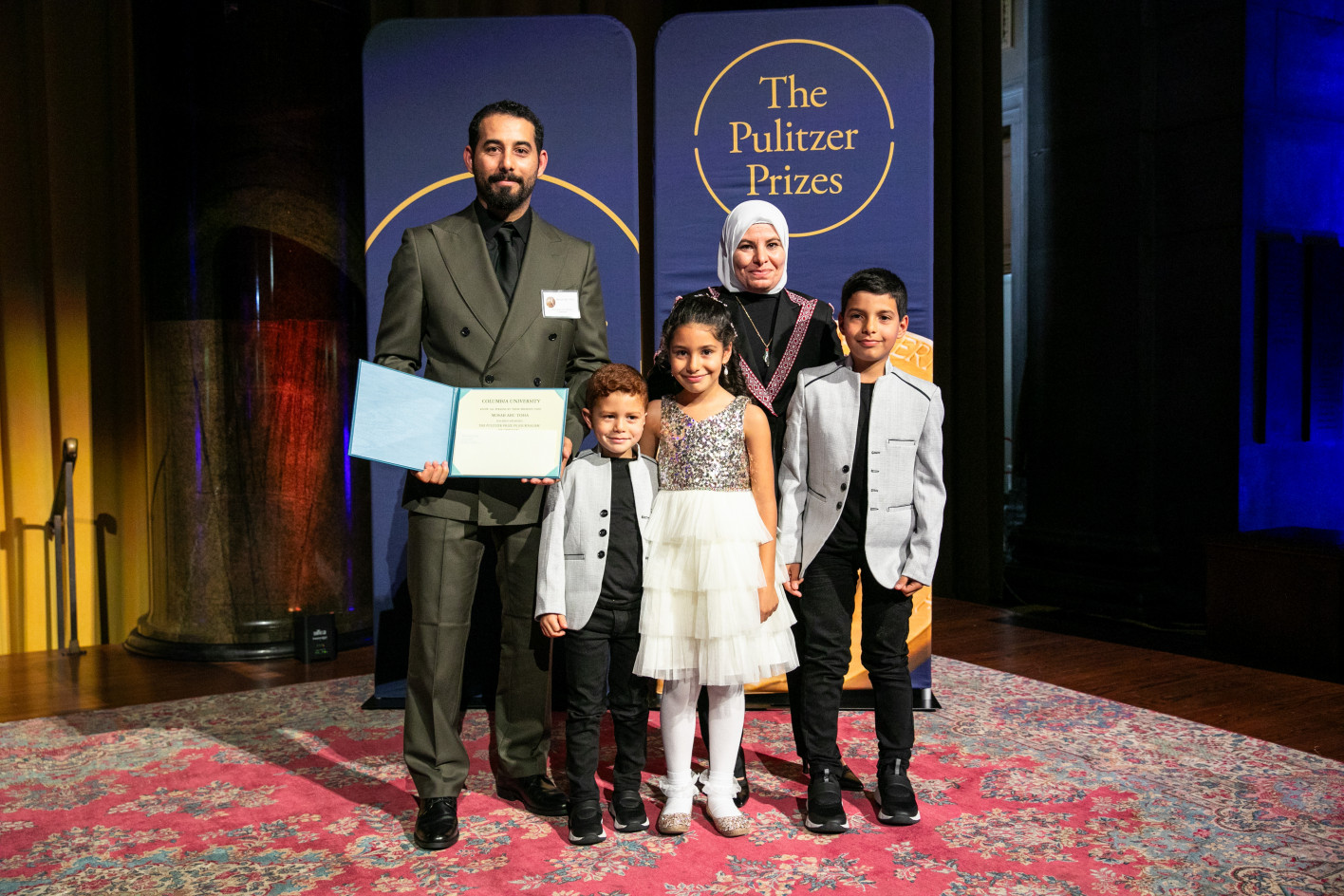
New Yorker contributor Mosab Abu Toha (left), Maram Abu Toha and their children accept the 2025 Pulitzer Prize for Commentary. (David Dini/The Pulitzer Prizes)
Winning Work
In October, 2023, I could not imagine anything worse than the destruction in Jabalia refugee camp. But what is happening now outstrips anything I saw there.
Whenever I hear the Arabic word mukhayyam, or camp, my mind leaps to Jabalia refugee camp, in northern Gaza. I was born in Al-Shati refugee camp, a few miles away, but Jabalia was where my maternal grandparents were born, grew up, and had my mother. It is the largest of Gaza’s camps, a place that more than a hundred thousand people call home, and over time its informal settlements grew into a dense collection of concrete structures, which expanded as families added rooms and floors. I studied in Jabalia between fifth and ninth grade. On Fridays, I went shopping there with my mother, and later with my wife.
When I was a boy, I saw how a narrow street in the camp could turn into a sort of makeshift café. On a summer afternoon, someone would bring out a chair to escape the indoor heat and humidity. Another neighbor would join. Soon, a dozen people would be chatting in the street about work, soccer, food, border crossings, family. Each person would talk like a political analyst, a sports commentator, or a food critic. Children would sit on squares of cardboard cut from boxes, listening.
My mother’s parents lived on Hawaja Street, just a twenty-five-minute walk from our house in Beit Lahia. On our way to visit them, we always passed a trash bin so big that people called it “the ship.” Their home had two bedrooms, a living room, and a storage room, which contained a sack of wheat flour and a mattress for guests like me. The kitchen was smaller than a bedroom and had no table, so we ate meals on the living-room floor, our chewing drowned out by the sound of people talking as they shuffled by.
In Jabalia, almost every wall was spray-painted. I remember seeing jokes, messages, phone numbers for cooking-gas providers, and the names of people killed in Israeli strikes. Once, I saw a dark joke: “Neighborhood for Sale.” When there was a big soccer match, the streets and shops emptied. Every café with a TV filled up with Palestinians of all ages. If you weren’t watching, you still knew when there was a goal by the rumble of voices that shook windows and doors. The special thing about life in the camp was that we created our own reasons to celebrate, even if they didn’t last.
After October 7, 2023, my family had to flee Israeli strikes in Beit Lahia and move into a relative’s apartment in Jabalia. We all felt like refugees, but the camp was still alive with its old spirit. On October 28th, I was sitting in the street when I heard one boy tell another that Real Madrid had beaten Barcelona, 2–1. They were probably in seventh grade. That same day, an air strike blew up the home we had left behind.
Israel was also carrying out strikes in the camp. On the afternoon of October 31st, we heard explosions, followed by my father shouting at us to disperse across the apartment. When my kids stopped screaming, I went out onto the street. I saw two men carrying a headless body. With my phone, I filmed a first responder desperately trying to resuscitate a young girl. A teen-aged girl was crying, “My eye!” Then I came to a view of hell—an area of at least twenty-seven thousand square feet, flattened and ablaze. I had never witnessed such devastation in my life. When I returned to my family, I told them, “There cannot be more destruction like this.” I could not imagine anything worse.
What is happening in Jabalia now, however, outstrips anything that I saw there. Buildings that were already bombed are being bombed again. It is as though Israeli forces are taking revenge on the camp itself, by erasing it. In many photographs, the camp looks like a landfill. There are no people in sight.
Recently, I scrolled through a Hebrew-language Telegram account that describes its posts as “security updates.” In one video, the camera spins in a circle, showing a three-hundred-and-sixty-degree view of broken concrete and ruined buildings. A voice, speaking in Hebrew, says the word “Jabalia.” The few structures that are still standing do not look inhabitable.
Another video, apparently filmed from a drone, shows a field of rubble from above. An explosion shakes the camera, and two skeletal buildings—the only ones visible on the entire block—collapse in a mushroom cloud. On social media, someone had taken a screenshot and labelled it with Arabic place names. I knew the entire neighborhood. I could see the location of Maysara, an electronics shop where I used to get my wireless router serviced. In the middle of the photo is Hawaja Street, where my grandparents once lived.
***
For a long time, I wondered what my paternal grandparents, Hasan and Khadra, experienced in 1948, when Zionist militias expelled them from their homes in Jaffa. After they moved into the newly formed Al-Shati refugee camp, on the banks of the Mediterranean, did they keep their bags packed, ready for the day when they would return home? How many weeks or years did it take them to unpack for good, realizing that Al-Shati was now their home? My father, his siblings, and most of my siblings were born there. Decades later, when Hasan and Khadra died, they were buried in a nearby cemetery.
What if Hasan and Khadra could have filmed what happened to their homes in Jaffa? What if they had footage of their journey to Gaza and the start of their lives in the camp? If Palestinians had live-streamed the start of the catastrophe that we are still living in, could it have been prevented? What became of their house, and the mulberry tree in their yard? I don’t have answers to these questions. But, in 2024, I felt that I started to understand my grandparents.
A few years ago, seventy per cent of Gazans were refugees. In 2024, the U.N. reported that ninety per cent of Gazans were displaced. All of Gaza’s universities are gone. About ninety-five per cent of schools have been damaged or destroyed. Whole neighborhoods are filmed as they get blown up. A house where one of my aunts lived, on the edge of Jabalia, was hit by an air strike that killed sixteen relatives, including one of her daughters. My grandmother’s sister, Um Hani—whom I called sitti, or grandma—was killed, too. Her body is still under the rubble.
My wife’s family has moved to a soccer stadium in Gaza City, where they live in tents without enough clothing or bedding for cold winter conditions. My father and some of my siblings are in northern Gaza. My mother is in Qatar with one of my sisters, who is ill. My wife, children, and I left Gaza in December, 2023, and are now nearly six thousand miles away in Syracuse, New York. We have all had to flee refugee camps in order to find refuge, and so we are twice removed from the places our grandparents once lived. More than a year after October 7th, there are barely any families left in Jabalia. There are hardly any streets in which to gather or chairs in which to sit.
In 2023, for all of the horror around me, the devastation in Jabalia camp could be lived with. Gaza still had kindergartens, colleges, and clinics, even if they, too, were becoming shelters and being attacked. The hope of returning to some kind of normal life, after a ceasefire that we kept waiting for, never faded. We kept telling ourselves, “It shall pass.” I never forgot how, nine years earlier, an air strike had levelled our neighbor’s home and blown out walls in our bedrooms. We had lived through a cold winter, stayed in our house, and built new walls.
I have less hope now. I do not hope that we will return to a normal life, or return to these places as they were before. The most important thing is that people I care about survive so I can see them again.
On the morning of December 19th, Human Rights Watch, following in the footsteps of Amnesty International, concluded in a meticulous report that Israel was committing acts of genocide in Gaza. Later that day, I looked through recent satellite photos of Jabalia in Haaretz and the Guardian. On my iPad, I searched for the same places on Google Maps, which showed the camp as it used to be. In both sets of photos, before and after, I recognized the Abu Rashed rainwater-harvesting pool, which I used to pass on the way to my grandparents’ house. I followed familiar streets to the location of Khadamat Jabalia Club, where I used to play soccer with workmates and friends, and where people used to watch our matches from their windows. I found the site of Falouja Cemetery, where we buried some of my aunts and uncles.
In the new photos, I could see little more than piles of concrete, blurred by dust that probably came from non-stop bombardments. There were no green areas, no soccer fields, no colorful buildings or roofs. Only the streets and clearings could be made out. I looked at the photos again and again, and an image of a graveyard that grows and grows formed in my mind.
One of my mother’s sisters, my Aunt Iesha, lived in the Jabalia camp and helped teach me English. She was born at the house on Hawaja Street, and when she got married, to a man who was also from Jabalia, she moved into another house in the camp. She only left when she had to. This month, I sent Aunt Iesha a message, asking what she missed about Jabalia. “Hard to live without your neighbors,” she wrote. “Hard to live without seeing all the buildings of my camp that I had memories in.”
I asked her what she thought the camp would be like after a ceasefire. “The first year is so difficult even to imagine,” she told me. “If it will be in fact . . .” When that day comes, she said, she hopes to go to the house where she grew up, and to visit the grave of her father—my grandfather, who passed away in 2024. We can rebuild the camp, she wrote, but not as it was. I keep thinking of a line that is attributed to the Palestinian poet Mahmoud Darwish. I cannot find the original source, but the words have become a sort of proverb to Palestinians: “If they bring back to you the old cafés, who will bring back to you the old friends?”
I no longer recognize many parts of my homeland. Only my memories of them remain.
On a summer evening many years ago, my father and I sat on the roof of our family home in Beit Lahia, in northern Gaza, and we talked about my grandfather Hasan. I never met Hasan. He died forty years ago, before my father was married, after a lengthy struggle with diabetes that required him to use a wheelchair. I craved stories about him from my father and his sisters. I wanted to know what Hasan used to drink, eat, watch, and wear. I felt like hearing my family’s memories opened up a room in my mind, where I could stand and paint my own portrait of Hasan.
“Did my grandfather ever travel abroad?” I asked.
“Sure, he visited Lebanon and Jordan,” my father replied. But he could not tell me when, with whom, or for how long. We sat there a while, trying to escape the heat of the house. The electricity was off, and it was getting dark.
Recently, I called my father from Syracuse, New York, where I have taken refuge with my wife and three kids. He continues to live in northern Gaza. He told me that he has been trying to grow vegetables in our neighborhood. “I waited for hours to fill some buckets of water for the plants, but no luck today,” he told me. Then I brought up Hasan. “I know it’s not appropriate to ask this now,” I said. “But do you know if anyone from the family has my grandfather’s passport?”
My father laughed. “How can I know? It was a long time ago.”
I expected that answer, but it made me want to weep. Even before Israel invaded Gaza last year, I could not find my grandfather’s grave. My parents had told me that he was buried in a cemetery in the Sheikh Radwan neighborhood of Gaza City. How will I ever find it, now that so many cemeteries have been damaged in the war? No one could even tell me Hasan’s birthday. All I knew was that he was seven years older than his wife, my grandmother Khadra, who was born in 1932. The date of his death, too, was like a math problem. I knew that one of my cousins was born two months later, which suggested that he died on October 30, 1984.
Whenever I visit friends in the United States, I see portraits of parents, grandparents, and even great-grandparents on the wall, and my heart stings. Why haven’t I inherited such treasures? Was it because Hasan lived and died in a refugee camp? If he saved the documents and photographs that could answer my questions about him, would they still exist now, after all that Gaza has endured?
When I think of how little I know about my grandfather, I think of my three children, and what I myself can pass down to them. When Hamas attacked Israel on October 7, 2023, three generations of my family lived together under one roof. Five days later, Israeli forces dropped leaflets that ordered us to evacuate the area. We left everything behind except some clothes and food. On October 14th, after an air strike hit my neighbor’s house, I checked on our home and found broken windows, fallen books, and dust covering every pillow, mattress, and blanket. I tried to clean off the couches. I thought my house, my books, and my writing desk would be there for us when the war ended. I took pictures of the damage so that I would remember.
Two weeks later, our house was destroyed in an Israeli air strike. When I risked returning, days after the bombing, I felt compelled to spend an hour or so digging through the rubble, hoping to salvage some clothes or shoes or blankets. It was autumn, and the ghost of winter was looming. All I saved was a notepad and one copy of my début poetry book.
Only recently did I remember something that I was unable to recover: a photo album that contained photos of me, my siblings, my parents, and my grandparents. As soon as I thought of the album, I texted my brother Hamza. “Can you try and see if you could find the photo album in the ruins of my library room?” I felt embarrassed to ask this of him at a time when he can hardly find food for his family. But those photos were precious to us. They were our way of remembering.
My family in Beit Lahia could not find the album or the remnants of the room it was in. To this day, there is no visible trace of our beds, couches, closets, or even the walls of my bedroom and kitchen. Only our memories of them remain.
***
I'm a person who loves taking pictures. I feel grateful to have a phone with enough storage to save them. My photos from Gaza show my family in lush green fields, and on the beach at sunset. I have a photo of the clay oven where my mother used to bake bread and sometimes roast chicken. I have a photo of my daughter, Yaffa, throwing flower petals on a peaceful street. I have a photograph from late September, 2023, of my youngest child, Mostafa, wearing a Spider-Man costume and jumping off a bench in my bedroom.
For twenty-three years, I had the same neighbors, the same trees around me. I passed by the same schools, clubs, cafés, and graffiti-covered walls. I bumped into the same teachers, coaches, barbers, and baristas. Before October 7th, people rarely moved away. There was this tender relationship between us and things.
I miss my small neighborhood in Beit Lahia. I miss when my mother-in-law, who lived next door, would make maftoul and send us some. I miss when my three married sisters and their children visited us on weekends, and the eldest, Aya, would call me beforehand to ask me to make tea. My sisters loved my tea, and I enjoyed preparing it for them. I miss bringing the kettle and the cups out to a table under the orange or the guava tree. I miss going with my brother-in-law Ahmad to his cornfields. Around the edges, he planted eggplant, peppers, green beans, cucumbers, and pumpkins for his relatives. I vividly recall the time we had a barbecue there, and Ahmad invited each of us to pick ears of corn and put them directly onto the grill.
Over time, it has become hard for me to recognize the places I knew in Gaza. Since October 7th, whole neighborhoods have been levelled. These days, many streets and lanes cannot be seen under the rubble, and there is too little fuel for bulldozers to clear them. When I look at photos and videos in the news, I can’t tell whether I am seeing the remains of a pharmacy, a restaurant, an ice-cream shop, or a kindergarten. We loved these places. Each one is a loss.
I often think of the places I will not be able to show my children or my grandchildren, the memories I will not be able to share: the kindergarten I attended in Al-Shati refugee camp, the nearby field where I did cartwheels as a kid, the streets in Beit Lahia where I used to ride my bike at sunset. The soccer field where I used to play with my colleagues in the evenings, the hall where I had my wedding party. The mulberry tree where I played marbles with my childhood friends. Some of those friends have been killed.
I also think of the new memories I had hoped to make. Yaffa and her older brother, Yazzan, wanted to learn to swim, something that I never did because of problems with my ear. I wanted them to ride their bikes along the beach on Al-Rashid Street, which had been recently paved with asphalt. I wanted to take Yazzan to soccer practice in the summer. I wanted to introduce my students to the Edward Said Public Library, an English-language library that I founded in Gaza. On Saturday, a fellow-teacher told me that my best student was killed while looking for firewood for his family.
I have always loved a line from “Open the Door, Homer,” a song by Bob Dylan. “Take care of all of your memories,” he sings, “for you cannot relive them.” The words made me want to hang on to my memories, and to make good ones. In the past year, I have lost many of the tangible parts of my memories—the people and places and things that helped me remember. I have struggled to create good memories. In Gaza, every destroyed house becomes a kind of album, filled not with photos but with real people, the dead pressed between its pages.
***
Last May, I got a call from my friend Basel, a tennis player from my home town. He was living in a tent in Rafah, the city in southern Gaza that became a refuge for displaced Palestinians. Israel was preparing to invade the city, despite objections from the international community. Basel was preparing to move his family yet again. He could hear tanks and gunfire in the distance. He and thousands of others were looking for a ride to Khan Younis.
Basel was in the process of dismantling his family’s tent. I listened as he explained the painful process of building toilets and water faucets nearby. His family had not wanted to live there, but now they did. They had learned to tell the difference between their tent and all the others. They had learned how to get around. They had started to make new memories there. “Now we are leaving this for the unknown,” he said. This year, Gazans have done this again and again.
I thought back to the five weeks I spent in Jabalia refugee camp, shortly after the war began. Back then, it was still possible to find an intact apartment or U.N. school where you could take shelter with your family. After a while, I recalled, I became familiar with new shops and pharmacies, with the cafés where you could access the Internet and charge your phone. I learned new shortcuts and developed a routine. Many of those places are gone now. Still, I can close my eyes and imagine them. I can navigate the alleys of Jabalia in my mind. Just as easily, I can imagine the camp in ruins.
On October 13, 2023, my friend Refaat Alareer posted a poem called “If I Must Die” on Instagram.
If I must die,
you must live
to tell my story
to sell my things
to buy a piece of cloth
and some strings,
(make it white with a long tail)
so that a child, somewhere in Gaza
while looking heaven in the eye
awaiting his dad who left in a blaze—
and bid no one farewell
not even to his flesh
not even to himself—
sees the kite, my kite you made, flying up above
and thinks for a moment an angel is there
bringing back love
If I must die
let it bring hope
let it be a tale
I saw the poem a few days later. It struck me so powerfully that it kept knocking at the gate of my imagination, and of my fear. Refaat wanted to live. He did not write when I die. Rather, he was communicating that if his death must happen, then everyone who lives after him must live to remember—to tell the story of him, of the murdered, of so many Palestinians.
In early November, while I was trying to escape Gaza with my family, I wrote a poem in response to Refaat. I wrote that if I die, I hope that no rubble, no broken dishes or glasses, will cover my corpse. On December 3rd, I was able to cross into Egypt with my wife and three kids. Days later, an Israeli air strike killed Refaat and many members of his family. I didn’t want to believe it.
On my phone, I have a photo of Refaat from the spring of 2022. He is standing in a green field, wearing a blazer and glasses that make him look like the professor he was. Behind him is a blue sky filled with white clouds. He is holding a large wooden box, which is filled with more strawberries than anyone could eat in one sitting. Refaat loved strawberries. We used to pick them together. That day, Refaat filled two boxes, one for his family and one for his parents. In the photo, he is gingerly taking one out of the box, smiling.
This year, I learned the difference between a traveller and a refugee.
The first time I travelled outside of Gaza, I was twenty-seven years old. Growing up, I had always thought of “travel” as riding a taxi, bus, or bike within the borders of the Gaza Strip. My family lived not far from Railway Street, but there were no trains there. I had heard stories about the Gaza International Airport, but Israel had bombed it when I was eight. I remember asking my childhood friend Izzat, a soccer fan, about the places he wanted to visit one day. “Barcelona,” he told me. “I want to play alongside Messi, Xavi, and Iniesta.” In 2014, a few days after Izzat graduated from college, he was killed in an Israeli air strike. Our freedom of movement was just another victim of the occupation.
The first place I tried to visit was Boston. I needed a U.S. visa, but was not allowed to travel forty miles to the U.S. Embassy in Jerusalem, or to drive four hours through Israel to the U.S. Embassy in Amman, Jordan. Instead, my brother-in-law drove me to the Rafah border crossing with Egypt, in southern Gaza, so I could fly to Jordan for my visa interview. I remember standing in the travel hall in Rafah, surrounded by the young, the old, and the sick, and thinking that my suitcase, like me, had never been on a real journey before. When my plane took off from Cairo International Airport, I had the feeling that my legs were shrinking below me.
At the U.S. Embassy in Jordan, an officer handed me a list of personal information that I would need to provide: home addresses, phone numbers and e-mail addresses, the names of my siblings and children. My fifteen-year travel history was blank. I did not know how long the decision would take—only that I could not go back to Gaza while I was waiting. After forty days of limbo, living in a rented apartment in Amman, I finally got the visa. In the years that followed, I was lucky to go on many trips.
Since October 7th, it has been difficult to exit Gaza at all. My immediate family was able to leave in November because my youngest son, Mostafa, has a U.S. passport. On our way to Egypt, however, Israeli soldiers separated me from my family, beat me, and interrogated me. In December, my mother applied to travel to Qatar with my twenty-year-old sister, Afnan, who needed medical care for a rare genetic disorder. They were not approved until late March. Afnan, who has the vocabulary of a four-year-old, could barely understand the broken Arabic of Israeli soldiers at a checkpoint. My mother nearly fainted during a four-kilometre walk in the sun. In Gaza, this is what travel means now.
In June, I took another trip. My family was relocating from Egypt to Syracuse, New York, and we planned to visit my mother and sister in Doha on the way there. We were excited. In the two-hour van ride to the airport, I took photos, and Yazzan, my eight-year-old son, looked out the window and asked questions. In Doha, my mother and sister greeted us at the entrance to their building. I laughed when I looked in their fridge, which was stocked with fresh foods that were impossible to find in wartime Gaza. “Look what you have!” I told my mother. “Mango, cherry, cucumber, cheese, and more.”
She looked guilty, not happy. “I wish I stayed with your father and your siblings and their kids,” she told me. She had waited months to come to Doha, only to wonder if she never should have left. She said that Afnan was so afraid of going home that she was refusing to leave the apartment for days on end.
We stayed for a week. Then, on the morning of June 18th, we woke up early and collected our suitcases. My mother stood in silence, avoiding our eyes. I promised her that we would meet soon in Gaza, but both of us knew that we might be away from home for a long time.
***
On our way to the airport, the sun shone gracefully above the Persian Gulf. I felt proud that we had made it this far. We were sitting and waiting for our flight when a young man, who was tapping something into his phone, looked up at me and spoke in Arabic. “Are you Mosab? Mosab Abu Toha?”
I pretended not to know the name, but my kids gave me away. “Yes, this is Mosab!” my daughter Yaffa said. “He is kidding.”
The man smiled. I smiled at the kids, then at him. “How do you know me?”
“I know your story. Is it not you who was detained by the Israeli Army?”
“Yes. In fact, I was kidnapped, not detained.”
The young man was Palestinian, like us. He studied at M.I.T. but had recently helped his family evacuate Gaza and resettle in Qatar. I was amazed that two Gazans could meet by accident, like two fish finding each other in an ocean. That is the nature of the diaspora: Palestinians who might once have met in Gaza now bump into one another in airports.
When my family landed in Boston, for a layover, Mostafa jumped on one of our carry-on suitcases and asked me to pull him along. This was becoming his favorite kind of travel. In line for immigration, he started to sneak under the stanchions, laughing, his little face triumphant. Then it was our turn to step up to a booth. I handed over our passports and visas to a woman in a uniform.
When I saw the woman’s reaction, I started to wonder whether something was wrong. She spoke into a radio. Then a muscular young man with a metal badge, who had a Taser, a pistol, and handcuffs on his vest, escorted us to a waiting area. After my experience with Israeli soldiers, I was nervous, but I didn’t want my family to notice. “We need to go to our new house,” Yazzan said impatiently. Finally, a young customs officer came over to talk to me.
I was surprised by the officer’s kindness. He seemed concerned about whether my family in Gaza was safe and had enough food. When he was done asking questions, he gave our passports back and even offered to help us with our suitcases. I was starting to relax, and I texted a few friends. “All good,” I wrote to them. “Collecting our bags.”
Before we could board our connecting flight, we had to pass through security again. My boarding pass seemed to trigger another alert. The officer reached for a radio and said, “Supervisor!”
The supervisor appeared behind the officer and looked at the screen. They chatted in a low voice before eyeing me. It turned out that a string of four letters had been printed on my ticket: “SSSS,” for Secondary Security Screening Selection. “Your wife and kids can proceed,” the supervisor said. “I will have to ask you to follow me.”
This time, I was told to pass through a metal detector and then a millimetre-wave scanner. Neither seemed to find anything. A T.S.A. employee asked if he could pat me down. I said yes. The employee ran his fingers around my collar and down my chest. Bystanders seemed to avert their eyes. I scanned the crowd and spotted my wife, Maram, in the distance, seeming to look for me. I wanted to shout to her, to reassure her, but I feared that would only make things worse. Then, with the back of his hand, the officer touched my private parts and my bottom. I knew that this sometimes happened to travellers. But for a moment, I felt as upset as I had been in Israeli custody.
While the officer swabbed my palms for explosives, Yaffa finally spotted me and tried to beckon me over. “I will join you when Uncle is done,” I said in Arabic, acting like the T.S.A. agent was a relative so she would not be scared. Finally, the supervisor left to photocopy my passport. When he came back, he said we were done.
“Before I go, I have to tell you something,” I replied. He listened.
“I was kidnapped by the Israeli Army in November, before being stripped of my clothes,” I told him. “Today, you come and separate me from my wife and kids, just like the Army did a few months ago.”
He nodded, looking embarrassed. I asked him whether he would do the same to travellers from Israel. I thought about how Israeli settlers, who live on Palestinian land in violation of international law, can travel to the U.S. without a visa. “This is random selection,” he told me. “It’s not meant for you.”
I fought back tears. My children could see me. “For me, it’s not random,” I said. “I travelled to the U.S. three times before. Nothing like this happened to me.” He gave me a business card for complaints to the T.S.A.
I carried my shoes, watch, and travel documents over to where my family was sitting. We ate some lunch. On the final leg of our flight, the kids quickly fell asleep. In Syracuse, five old friends picked us up and loaded our ten suitcases into their three cars. Their warmth, the smell of the trees outside, the hot meal that was waiting at our new home, pushed my exhaustion and frustration away.
***
I could not have guessed that my next trip would be much worse. Around noon on July 1st, a friend took me back to the Syracuse airport. I was flying to a book festival in Sarajevo by way of Washington, D.C., and Frankfurt. I was unable to access my boarding pass from my phone, so I tried a self-service kiosk, which told me that my travel document required verification. “Please alert the nearest United representative,” the kiosk said.
The United representative at the check-in counter stared at her screen for so long that a colleague came over to help. Then, struggling to pronounce the name of my destination, she asked, “Where is Sarajevo?”
“It’s the capital of Bosnia and Herzegovina.”
Another moment of silence. I asked if there was a problem.
“We think you can’t transit in Germany,” one of them said. I was surprised. I had flown through Germany several times in the past.
The first woman pointed to my passport number. “They only allow numbers that start with four, eight, and nine,” she said. “Yours begins with a six.”
They found me a new route via Washington, D.C., and Athens. I wasn’t happy—the trip would be longer than before—but I didn’t think I had a choice. I accepted my new boarding passes and walked to security.
The T.S.A. agent who scanned my ticket looked me over, then called his supervisor. My ticket said “SSSS” again. A young man read me the secondary-screening rules—two pages of tiny print—very quickly.
My bags went through the scanner. I went through the metal detector and millimetre-wave machine. An officer asked me whether I had been patted down before. “Unfortunately,” I said. I knew what to do. He ran his hands over every part of my body, and I thought again of Israeli soldiers. Finally, I was allowed to rejoin the other travellers.
I found my gate and pulled out my phone. When I looked up the rules for travel through Germany, I realized that the United representatives had made a mistake. They had been looking at a list of prohibited I.D.-card numbers, not passport numbers. The number on my I.D. card started with an eight; I was allowed to travel through Germany. But now it was too late. I needed to board or I would miss my flight.
When we landed in D.C., I called United. An agent told me that I was still booked on a Lufthansa flight to Frankfurt. “Are you sure?” I said. The boarding pass in my hand said Athens. For a moment, I felt relieved. It was 5:20 p.m. and my flight to Frankfurt was at six.
At the gate, the Lufthansa staff had trouble printing my “new” boarding pass. They, too, called a manager, and I rushed through my story. I was now so frustrated that I was thinking about cancelling the entire trip. Then the manager told me, “You need to go and re-check in, I’m afraid.” She pointed to my new boarding pass. It said “SSSS.”
Shocked, I told her that I had been screened just three hours before. “I’m sorry,” she said. “You cannot board the plane without this.” It was now 5:33 p.m.
The directions to the T.S.A. checkpoint were complicated, so a kind female staff member ran there with me as my backpack bounced on my back like a door knocker. A T.S.A. supervisor confirmed that I would have to be screened again, and the officer who searched my bag appeared to touch every item in my luggage—tea bags, pens, a notebook, a comb. She put her hand into each of my socks, as though searching for something to justify the “SSSS” on my ticket. About five T.S.A. employees stood around as I was patted down, watching me realize that my trip was already ruined.
After seventeen minutes, the supervisor stamped my boarding pass four times in red. When I told him that I had been treated unfairly, he told me about an online portal where I could complain. By the time I returned to the gate, it was 6:30 p.m. The plane was gone.
***
United gave me a convoluted new itinerary with a total of five legs: Syracuse to Washington, Washington to Munich, Munich to Frankfurt, Frankfurt to Zagreb, and Zagreb to Sarajevo. My next flight would not take off until after midnight, and I struggled to stay awake. I thought about giving up and flying back to Syracuse—a day of travel, wasted. But I reminded myself of the readers I would meet in Bosnia, of the excitement of signing my book of poems in Bosnian.
Two hours before the flight, I requested my boarding pass at the Lufthansa gate. Again, the staff could not print it and called a manager. When he arrived about an hour later, he asked me whether I had a Schengen visa for travel in the European Union.
“Why do I need a Schengen visa? I’m not staying in a country that needs one.”
“You need a Schengen visa because you cannot transit in more than one Schengen country.”
I could not believe this was happening. The airline had given me an itinerary that I was barred from following. “You have to find a solution for this,” I said. I was twelve hours into my trip and I had not even left the United States. The manager seemed kind, but after making some calls he concluded that I would not be allowed to board. “Maybe you should try finding a flight where you don’t have to transit in the Schengen area,” he said.
When I called United and demanded a new flight, the woman on the other end of the line told me, “We can get you a trip to Sarajevo, but I cannot get you a stay in a hotel.” She connected me with her supervisor. “It’s your job to know whether I can take a flight or not,” I told him.
I stayed on the phone for eighty-six minutes, until 1:55 a.m. I was tethered to an outlet so that my phone would not run out of charge. The only flight that could get me to the festival in time, the manager finally said, was leaving for Vienna in more than fifteen hours. The airline would not book me a hotel.
I was lucky that my new gate was near an airport chapel. I went inside and found a pile of prayer rugs in a closet. The room was empty, so I arranged them into a makeshift pillow and blanket, lay down, and slept on and off for more than twelve hours. Before walking to the gate, I made up for all the prayers that I had missed.
***
On July 3rd at 2 p.m., I landed in Sarajevo. Forty-four hours had passed since I had arrived at the airport in Syracuse.
Sarajevo reminded me of Gaza. I saw bullet holes in the walls of some buildings and craters in several streets. I thought back to 2014, when Israeli forces had bombed my neighbor’s house and my family had patched holes in our home. I thought of the day last year when Israeli strikes reduced our home to rubble.
In my four days in Sarajevo, I met many writers and artists. One of them invited me to an upcoming festival there, which several Gazan photographers and artists were expected to attend. At first I said that I would be glad to come. Then I thought about the airports and the screenings and the days away from my family, and I changed my mind. When I wrote to the editor of my forthcoming book about how difficult the trip had been, he told me, “For your book tour, maybe we should arrange events in cities near you so you don’t have to enter airports.” I had hoped that travel would make my world seem larger, but I felt like it had clipped my wings.
To my amazement, the return journey went smoothly. There was no “SSSS” on my tickets. When I checked in at the Sarajevo airport, an agent took a few minutes to confirm with a colleague that I could board, then waved me through. I made it to Syracuse as scheduled, feeling like I had got away with something. A friend picked me up at the airport. Later, I looked up an online ranking of passports from around the world. Israeli passports, which allow for visa-free travel to a hundred and seventy destinations, were ranked eighteenth in the world. Passports from the Palestinian Territories, which allow for visa-free travel to just forty destinations, were near the bottom of the list.
In the weeks after my trip, I tried to understand what had happened to me. My friend Hasan, a U.S. citizen who spent most of his life in Gaza, told me that he is regularly stopped at airports and asked intrusive questions—for example, what he is doing in his own country of citizenship, or whether he is carrying a weapon. I also called three experts on the surveillance of travellers.
Shezza Abboushi Dallal, an attorney at an organization that works to hold law enforcement accountable, housed at the City University of New York, told me that the U.S. government maintains a watch list, which includes travellers, that it calls the Terrorist Screening Dataset. The most famous part of the database is the no-fly list. “But there is also the selectee list,” she said. People on this list are often pulled out of line for secondary screenings, as I was.
I learned from Faiza Patel, the senior director of the Liberty and National Security Program at the Brennan Center for Justice, that even experts don’t know how many watch lists there are, or how people are added to them. A person can also experience secondary screenings without being on any list. Some passengers are flagged because of where they’re going, or because they have a one-way ticket.
I kept wondering whether I was on a list because I come from Gaza, or because the Israeli government had wrongly labelled me a threat. Dallal said that many Palestinians have reported problems at U.S. airports since October 7th. “There’s a lot of intelligence sharing between Israel and the United States,” Patel told me. But we had no way of knowing whether that had played a role in my case. Saher Selod, the author of “Forever Suspect: Racialized Surveillance of Muslim Americans in the War on Terror,” connected my experience to the Bush era, when the screening database was expanded. She also mentioned another policy from that time, the now-defunct National Security Entry-Exit System, in which people from twenty-four Muslim-majority countries (and North Korea) were made to register for fingerprinting, photographing, and interviews. “If you’re wondering if being Palestinian is part of this . . . absolutely,” she said.
I kept checking the Web site where the Department of Homeland Security, which oversees the T.S.A., reviews complaints. For ten weeks, my case was “in progress.” Then The New Yorker sent the T.S.A. questions about my experience. Two and a half hours later, I received a “Final Determination Letter” from the D.H.S. It said, in part, that some airport screenings are random, and that the agency “can neither confirm nor deny any information about you which may be within federal watchlists.” The letter referenced “systems which contain information from Federal, state, local and foreign sources” that can sometimes lead to the misidentification of travellers. It also said that the agency has “made any corrections to records that our inquiries determined were necessary, including, as appropriate, notations that may assist in avoiding incidents of misidentification.”
In response to questions from The New Yorker, a spokesperson for the Israeli Army said, “We do not comment on information shared between Israel and its strategic partners.” The T.S.A. shared background information about secondary screenings and said, “TSA works closely with the intelligence and law enforcement communities to share information.” It declined to comment on my experience at the airport.
***
On a Friday in August, I was at home in Syracuse when the doorbell rang. The kids were playing outside, and I heard a male voice ask them, “Is your father home?” Maram and I found two men at the door. For a moment, I thought they worked for the school district where we were trying to enroll the kids. Then I saw that one of them was wearing a badge and a pistol. “Hi. We’re from the F.B.I.”
One of the agents told me that he had heard about my experience with the T.S.A. at Logan Airport. He asked if I had a few minutes to talk about it. They remained standing while I sat on the couch; one took notes on a tiny pad. I told them about my airport experiences. Then they started to ask about a wide variety of other topics—how we felt about the neighborhood, what we had done in Egypt and Qatar, what our lives were like in Gaza. Then they asked me about my “interaction” with the Israeli Army.
I told them that I had already described my experience in this magazine and on CNN, but they wanted me to talk about it. I was starting to explain how I was blindfolded and handcuffed when I realized that Yazzan was sitting next to me. I did not want him to experience my pain again, so I sent him upstairs before I continued. I explained that, since October 7th, I had lost thirty-one members of my extended family in a single air strike, an Israeli sniper had killed one of Maram’s uncles outside a school shelter, and Maram and I had each lost a grandparent to illnesses that were exacerbated by conditions in Gaza. Many of our relatives now live in tents. I got the feeling that they had not really come to ask me about my experience in the airport.
After nearly an hour, one of the agents asked me if I had any questions or concerns, or if I wanted to tell them anything. He sent me a text message and invited me to reach out. Before they left, I asked for help with my T.S.A. complaint, or with removing my name from any watch list I might be on. They said that they couldn’t help with other government agencies. They gave me a nameless business card for the local F.B.I. office and left.
Maram came downstairs with Yazzan. We ate lunch together, but I was unable to enjoy it. She told me that when I had sent Yazzan upstairs, he had asked her, “Are they going to take Daddy?” When The New Yorker asked the F.B.I. about my experience, a spokesperson declined to comment on where the agents had got my name or why they had visited me.
***
A couple of years ago, I wrote on Facebook that I was in Cairo for a visa interview, and my friend Ahmad saw my post. “I’m in Egypt, too,” he messaged me. We spent a few serendipitous days together. Ahmad is a foodie, and one afternoon, we met for lunch in a restaurant that overlooked the Nile. Another day, we travelled together to the Red Sea—two Palestinians, exploring a place that was usually out of reach.
Earlier this year, I wrote to Ahmad in Gaza. “You just came into my mind yesterday,” I told him in Arabic. “Do you remember our time together in Suez the summer before last? How are you doing?”
“I’m just doing some travelling, like you,” he joked, wryly. “But I’m doing it from one school shelter to another.” He had recently been in Rafah, where more than a million displaced Palestinians had taken refuge, and had tried to raise the money needed to leave Gaza with his family. Then Israeli forces had invaded Rafah, shuttering the border and displacing many families again. As of late August, Ahmad was living in a tent with his wife and three kids, in the Mawasi neighborhood of Khan Younis—the fifth place where they have stayed in the past year.
Ahmad begins each day at 6:30 a.m. “You cannot have a moment of sleep after that, because of the flies in the tent,” he told me. He lines up to buy bread while his wife prepares breakfast, usually from canned food. “To make tea, I have to find someone who has lit a fire,” Ahmad said. Then he spends about an hour and a half waiting to fill buckets of water. In photographs, he looks much thinner than he does in my memory.
Ahmad always dreamed of taking his wife and kids on a trip to Egypt, and beyond—to ride with them on trains, to try restaurants and cafés, to take pictures of new places. Now he dreams of adopting some other nationality, so he can escape in times like this. He is a refugee, not a traveller. “I’ve lost hope that we will return to our previous life,” he told me. “I feel like we will remain refugees forever.”
In my homeland, where we used to cook and celebrate together, my relatives are eating animal feed to keep from starving.
Recently, my wife’s distant aunt, Leila, invited me, my wife, and our three children to her home in the Faisal neighborhood of Cairo. She promised to cook us maftoul, a Palestinian dish that we had not eaten since we fled Gaza in December. Back home, making maftoul was often a family affair. One person cooks a rich stew from pumpkin, onions, tomatoes, and chickpeas. Someone else mixes wheat flour into a dough. A third person rubs the dough through the holes of a sieve, creating tiny balls that are similar to pearl couscous. Finally, the balls are steamed and served with a hot ladleful of the stew. We looked forward to tasting it again.
Leila speaks with the same warmth as my mother, and she cooks the same familiar foods. When we arrived at her sixth-floor apartment, I felt the comfort that comes from shared history. Only months ago, my family survived Israel’s bombardment of northern Gaza, and I was detained by Israeli forces. Leila’s husband, who was deaf, was killed during Israel’s 2014 offensive in Gaza. The moment I sat down, their eleven-year-old son, who lost his father as a toddler, took out a box of dominoes and taught me to play. I thought about how none of us meant to live in Egypt. Leila and her brother came here for her son’s medical treatment, and they can no longer go home.
While the maftoul was cooking, sending a delicious smell through the apartment, I got a video call from my brother Hamza, a father of three with a fourth on the way. He was in northern Gaza, picking through the rubble of the house that we once shared. In the background was the recognizable sound of military drones, and I urged him to get to safety. Instead, Hamza passed the phone to my mother, who was there, too. She looked pale and tired, and she told me that they were running out of food, but she still thanked God for what they had. She was scouring the area for edible plants such as cheeseweed.
It is difficult to find maftoul in Egypt, and Leila’s was good. I felt lucky to taste it with my wife and kids. But, lately, hearing about unprecedented starvation in Gaza, I have felt a sort of hatred for the food in front of me. As I eat simple meals of chicken, rice, salad, and olives with my family, I think of the hunger in my homeland, and of all the people with whom I want to share my meals. I yearn to return to Gaza, sit at the kitchen table with my mother and father, and make tea for my sisters. I do not need to eat. I only want to look at them again.
***
When I was growing up in northern Gaza, food marked our saddest and happiest occasions. You could tell that someone had died when you saw people walking in a line with trays of food balanced on their heads: bread, boiled eggs, fried potatoes and eggplant, pickles, falafel. The neighborhood came together to feed grieving families and their guests. People also delivered refreshments before and after weddings: coffee and tea in winter; soda, juice, and ice cream in summer. During the month of Ramadan, we fasted while the sun was up, so we knew how hunger felt. But, after the evening prayer, we gathered as a family for iftar, the meal that breaks the fast.
Until recently, Gaza had enough flour. Before the war, about five hundred supply trucks arrived each day, and every three months the United Nations Relief and Works Agency for Palestine Refugees in the Near East (UNRWA) gave rations to most of the families in my neighborhood: flour, rice, sugar, milk powder, lentils, sunflower oil, and canned food. I started buying flour only after the agency hired me as a teacher, because I could no longer receive aid. As recently as last year, I could purchase twenty-five kilograms of flour for about ten U.S. dollars. I helped my mother bake it into sfiha, a flatbread baked with minced meat. I loved to tear a warm piece of bread and scoop up a bite of falafel, avocado, or cheese.
Even when Israeli forces began their 2023 offensive, in the wake of Hamas’s October 7th attack, I could buy a kilogram of bread for about a dollar. unrwa helped keep the price down by taking sacks of flour out of storage and distributing them to bakeries. After Israel invaded, however, the lines for food began to grow; nothing could come through Gaza’s northern borders. I often waited for hours to buy a few loaves, and when bakeries ran low on fuel I sometimes returned with nothing. And, when I read about air strikes that destroyed bakeries in Gaza City and central Gaza, I became scared to stand in line.
In the final weeks before my wife, my kids, and I fled south, my neighbors grew desperate. One day, in the Jabalia refugee camp, I heard police sirens and came upon a crowd of people in the street. They were so hungry, I learned, that they had broken into a bakery. I saw three people hide sacks of flour on a donkey cart, under a blanket. I also recognized a young man, one of my former students, in the custody of two policemen. They were holding him by the neck. “I want to feed my family,” he cried. “You cannot do this to me.”
In December, a U.N. report said that ninety-three per cent of Gaza residents—more than two million people—were experiencing crisis levels of food insecurity, or worse. “In Gaza, pretty much everybody is hungry,” Arif Husain, the chief economist at the U.N. World Food Program (W.F.P.), told The New Yorker in January. To meet the need, aid groups would need to triple or quadruple the flow of supplies into Gaza, he said—something that seemed possible only with a humanitarian ceasefire. “In my life, I’ve never seen anything like this,” Husain said. After that, Hamza sent me a video of our parents, who are staying in the Jabalia refugee camp with some relatives. My mother was sorting out clean grains from a dirty pile of rice. Apparently, someone had salvaged it and sold it to my family at the market.
On February 9th, Hamza sent me a WhatsApp voice message. He had succeeded in buying three kilograms, or six and a half pounds, of wheat flour on the black market. It had cost him a staggering forty U.S. dollars, he said, and would probably run out quickly. Still, there was a note of triumph in his voice.
Three days later, on social media, Hamza posted a photograph of what he was eating that day: a ragged brown morsel, seared black on one side and flecked with grainy bits. “This is the wondrous thing we call ‘bread’—a mixture of rabbit, donkey, and pigeon feed,” Hamza wrote in Arabic. “There is nothing good about it except that it fills our bellies. It is impossible to stuff it with other foods, or even break it except by biting down hard with one’s teeth.”
In his post, Hamza wrote about how his kids were faring. “When I hold the new bread that you are bringing me, I want to hide it so that I don’t run out of it,” his youngest daughter, Awatef, told him. “Dad, God willing, today we will eat bread like the bread of the past,” his eldest daughter, Razan, added. His two-and-a-half-year-old son, Hayyan, simply placed a hand over his rumbling stomach. Hamza’s wife, Kawthar, was now nine months pregnant.
***
The baby arrived on the evening of February 16th. Hamza walked with Kawthar and her mother from his in-laws’ home to Kamal Adwan Hospital, in our home town, Beit Lahia. They were terrified, Hamza told me, because they could hear drones and warplanes and see the distant lights of air strikes. Only two months earlier, Israeli forces had raided the hospital and the World Health Organization had deemed it no longer functional.
They reached the hospital at about 9 p.m., but they couldn’t find a doctor. Instead, a nurse joined them in a windowless room that was running low on blankets. “Kawthar gave birth while bombs were falling all around us,” Hamza told me. After ten tense minutes, their new son, Ali, was born.
Hamza told me that the hospital had no food to offer Kawthar, and no diapers for Ali. A woman gave them one syringe of milk. Then hospital staff asked them to go home. “Ali continued to cough and vomit for hours after his birth,” Hamza said.
Our brother Mohammad sent his congratulations from a tent in Rafah, the city in southern Gaza that is currently home to more than a million Palestinians. Most of them are, like him, refugees from elsewhere in Gaza. In a voice note, Mohammad told me about his “gift” for his newborn nephew. “I have told Hamza about two sacks of wheat flour in my bombed apartment,” Mohammad said. “I had the feeling that they survived the air strike.”
On February 18th, Hamza shared some good news. “The baby has brought luck to us,” he told me. He had gone back to our destroyed home and found one of the sacks in the rubble. “I have split the sack between me and my parents and sisters, although part of it was spoiled by rainwater,” he said. In the background of our video call, I could see one of our teen-aged cousins digging through stones and glass with his bare hands, looking for the second sack. A few days later, Hamza wrote on social media that he’d bought his wife a small gift of rice and beef. One plateful of uncooked white rice cost him twenty-five U.S. dollars, he said, and a fist-size heap of raw beef cost a shocking seventy dollars.
U.N. agencies no longer dare to send aid trucks north. In early February, CNN reported that Israeli forces had fired on an unrwa food truck in central Gaza, prompting the agency to halt deliveries to the north. Last weekend, the W.F.P. resumed its own deliveries, but desperate people crowded its trucks; later, people took food and beat one of its drivers. Its convoys have now been halted again for safety reasons. “The decision to pause deliveries to the north of the Gaza Strip has not been taken lightly, as we know it means the situation there will deteriorate further and more people risk dying of hunger,” the W.F.P. said. “Gaza is hanging by a thread.”
***
A few days ago, I sat with my wife, Maram, in the back yard of our apartment in Cairo, watching sprinklers water the grass. Our youngest child, Mostafa, was playing on a swing while his siblings were at school. “The sprinklers remind me of my family’s farm,” Maram told me. “My dad and uncles and cousins used to water the strawberry plants and cornstalks.”
I thought of times when I picked strawberries and corn from her family’s fields. We barbecued the corn under a grapevine at night. I still have photographs of the harvest. But, this year, there may not be any strawberries or corn to pick. When Maram and I look into each other’s eyes, we both see sadness.
This past Monday, an ear doctor who treated me in Gaza, Bahaa al-Ashqar, managed to cross into Egypt through the Rafah border. I woke up to a call from him at one o’clock in the morning, and two hours later a taxi dropped him off at our apartment.
I was overjoyed that Dr. Bahaa was still alive. We hugged. But, as I stared at him, I saw how thin and weak he looked. This is not the doctor I used to know, I thought. He had lost thirty-seven pounds since the start of the war. In Rafah, he’d survived on canned food.
Dr. Bahaa had been on a long journey, and I felt like I should help him with his things, but all he had was a backpack. It was mostly full of travel documents. Still, he had managed to ferry a few small gifts from my brother Mohammad, for Maram and me. He unpacked barbecue and shawarma spices that we couldn’t find in Egypt, along with a bottle of dark-green Palestinian olive oil. When I smelled them, I felt a wave of love for my brother.
In the morning, Maram cooked tomatoes and fried some eggs. Dr. Bahaa told us that it was his first normal breakfast in months. We dipped bread and feta into the olive oil. It smelled of the trees that grew the olives, and it tasted like Gaza.
Dr. Bahaa spent the day trying to repair his phone and prepare for his onward journey. His wife and children, who escaped Gaza early in the war, were waiting for him in Europe. In the evening, he returned to our apartment for a meal of chicken and rice.
Over dinner, my children dropped some grains of rice on the floor. Dr. Bahaa didn’t want us to throw them away. “Pick them up and put them on my plate,” he told the kids. “I’ll eat them.” We had to convince him that there was no need. We have plenty of fresh rice, we said. But we could not stop him from wiping his plate clean. He understood that, in Gaza, this food could save a person’s life.
Biography
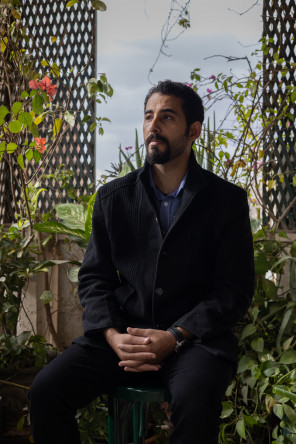
Mosab Abu Toha is a Palestinian poet from Gaza. He is the author of “Forest of Noise” and "Things You May Find Hidden in My Ear,” which was a finalist for the National Book Critics Circle Award and won an American Book Award.