Newsday, by Bob Keeler
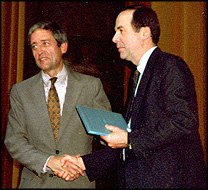
Bob Keeler is awarded the 1996 Pulitzer Prize by George Rupp, Columbia University President.
Winning Work
Led by a progressive pastor, a multicultural congregation in Westbury embodies modern Catholic life.
By Bob Keeler
It is a nondescript winter Tuesday night in the third week of Ordinary Time, the gray expanse of not-Lent, not-Easter, not-Advent, not-Christmas that makes up most of the church calendar. No holy day of obligation, no palm, no ashes, no prospect of pageantry to draw the crowds.
Still, a respectably ample group of parishioners has slid into the wooden pews in the cozy, Norman-style confines of St. Brigid's church, to attend "a parish enrichment evening."
The pastor stands before his congregation in a plain black clerical suit. Officially, he has the honorary title of monsignor, but there are monsignors and there are monsignors. Some seem to enjoy sweeping grandly into a room, wearing the monsignor's red-fringed cassock and bright red sash. This monsignor doesn't even own one. In the bulletin, his name is at the bottom of the staff list, not as monsignor but simply as Rev. Francis X. Gaeta. Everyone calls him Father Frank.
"Parish is wonderful, because parish is people," Gaeta begins. Then he likens this parish in Westbury to the synagogue and the community in the Galilean hills that shaped Jesus. "This community transforms us and makes us into something we could never be by ourselves," he says. "Our spirituality is not just all by ourselves. Our spirituality is in community."
In that spirit, Gaeta asks people to think of moments when the parish has touched them. He begins by recalling an experience of his own in 1990, on his first Good Friday as pastor. The Italian community had staged its outdoor passion play, ending with the death of Jesus at St. Brigid's school, a few blocks from the church. Then the Hispanic community had carried a life-sized statue of the dead Jesus through the streets to the church, where others had been inside, enacting a contemporary version of the Stations of the Cross. The Hispanic parishioners had carried the statue into the crowded, darkened church, lighting it up with their vibrant, emotional faith.
"It was one of the most extraordinary, liberating, life-giving moments of my whole life," Gaeta tells them. "Then I understood what it is to be in a multicultural parish."
To give others a chance to share their recollections, deacon Phil Matheis -- 79 years old but still full of puckish humor and always ready to trade cracks with Gaeta -- carries a wireless microphone around the church. Anne Josey takes the mike and tells of the day Matheis baptized her grandson, who was born weighing only a pound and a half. One woman tells of her granddaughter wanting to bring her puppy to a blessing of the animals at St. Brigid's: "She says, `Maybe if God gets His hands on him, he'll last longer.' "
Gaeta introduces the guest speaker, a Jesuit priest named Thomas Sweetser, co-director of the Illinois-based Parish Evaluation Project. Sweetser has been in town only a few hours, but he has already gained a sense of the place, first from a bountiful, laughter-filled Italian meal at the rectory, and now from the enthusiastic, hands-raised worship style in the church.
"I have a feeling that you have a great spirit going here, right?" Sweetser says, stirring a ripple of applause. "I also have a feeling that your pastor has something to do with that. Am I right?" More applause. "What is it about you that you pray so well here? You pray a lot. You get a lot of practice."
In many parishes, people make little contact with those around them except for a perfunctory handshake at the sign of peace. Here, the contact clearly is warmer. For example, the people tell Sweetser, everyone automatically joins hands to pray the Our Father. "Wow!" Sweetser says. "The word is `Amen'," says Josey, whose loud, distinctive `Amen' has become a signature of worship at St. Brigid's.
Toward the end of the evening, Lillian Morris asks for the microphone and offers a summation: "Personally, I think nothing is perfect, but this is almost a perfect parish."
St. Brigid's may not be quite a perfect parish, but in atmosphere and attitude it seems a fitting place to serve as the focus for an examination of parish life on Long Island 30 years after the Second Vatican Council launched a major rethinking of what parishes should be.
There are 133 parishes in the Diocese of Rockville Centre, which covers Nassau and Suffolk Counties. Some are lively and engaging, some staid and cool. And while any number of them could serve as a window into modern Catholic life, St. Brigid's, with its crackling energy level, its intriguing mix of ethnicities, its enthusiastic and emotional liturgies, seems particularly engaging. It is a parish that draws people from great distances, a parish that people elsewhere seem to know about. During the next year, in an occasional series of stories about St. Brigid's, Newsday will examine the joys and sorrows of parish life through the stories of its people.
More than 50 percent of Long Island's population is Catholic, and for many of them, parish is a central focus of life. It is the place where Catholics, in the words of sociologist the Rev. Andrew Greeley, play out their distinctive "sacramental imagination," a tendency to see God as present in the world and to view the everyday realities of that world as revealing that presence. So Catholics place great emphasis on community and ceremony. Parish is where they bring together the stuff of their lives with the ritual that brings meaning to it all.
"If there is any doubt about how important the parish is to those who live in it, one must merely consider the outrage that inevitably erupts whenever the chancery tries to close a parish or a school or tear down a church," wrote Greeley, a sociologist and novelist, in "The Catholic Myth," a 1990 book that flowed from three decades of sociological inquiry into Catholic life. "The American neighborhood parish is one of the most ingenious communities that human skill has ever created."
But it is not a static community. Parishes are still working to figure out what they should be, 30 years after the Second Vatican Council initiated a movement toward more lay involvement. "Ownership" of the parish is shifting from pastor to people, and geographical parish boundaries are becoming less important as Catholics display an increasing willingness to travel outside of their home parish to find one that meets their needs. The available number of priests is shrinking, which accelerates the shift of responsibility to lay people. And the number of parish schools is declining as dioceses economize by establishing regional schools to serve several parishes.
"The American Catholic parish is in the midst of a paradigm shift," Sweetser wrote with Carol Holden, co-director of the Parish Evaluation Project, in "Leadership in a Successful Parish," a 1992 book. The project is an independent parish consulting group that helps parishes evaluate themselves and plan for the future. "The parish is at a most critical moment in its history."
At this pivotal moment, the parish is moving toward a firmer grasp of the concept that parish is people -- not just a building or a hierarchy, but the place where the people gather together to be church for one another.
In the house on Lewis Avenue where they have lived for 40 years, Bill and Mary Goode raised seven boys and five girls. Bill worked days at the Westbury post office and nights at Roosevelt Raceway's pari-mutuel windows. When he came home, Mary would head to her nursing job at Mercy Hospital in Rockville Centre. The demands of work and child-rearing didn't leave them time to be active in the parish. Once the children were grown, Mary became a eucharistic minister and, at Gaeta's request, started a hospital visitation ministry.
In late 1991, one of their children, Kitty Millan of Westbury, gave birth to a daughter, Megan, and the Goode children gathered for the baptism at St. Brigid's. Their daughter, Peggy Kilinski, came down from Schenectady with her husband, Paul, and their children, Jay Paul, 2, and Lauren, 7. On the eve of the baptism, Peggy put the children to sleep in the attic of her parents' home and returned downstairs to continue the reunion with her family.
Late that night, fire broke out in the attic, killing Jay Paul and leaving Lauren terribly injured. First Lauren and later her father were taken to the burn unit at Nassau County Medical Center, where Gaeta joined the family and kept vigil. "Peggy and Father Frank and I stayed until about five o'clock in the morning," Mary Goode said.
Over the next six weeks, as Lauren lay in the burn unit, the tragedy gripped the whole parish. Parishioners prayed for Lauren daily at mass and did what they could for the family. "I don't think we cooked one meal from October 26 to December 10," Mary said, her voice breaking. "Somebody sent a meal every night."
When this all began, the Goodes had not yet developed a close relationship with Gaeta. "Now he's like one of our family," Mary Goode said. "He came every single night to the hospital." When Lauren died, he sat with the family for hours, and later traveled to Schenectady to participate in her funeral mass.
Last year, Gaeta baptized two new members of the family: James, the second child of Kitty and Chuck, and Francis, the third child of Paul and Peggy Kilinski, who named him for Gaeta. For the pastor, accustomed to dealing with death, this numbing level of tragedy was something he had never experienced, and he realized there were no adequate words he could say. But it drew him close to the family. "I just developed a bond with them," Gaeta said. "Honestly, their faith was just so incredible that I'd go there to be restored myself."
All this had a profound effect on Chuck Millan, who had grown up Lutheran but began thinking about conversion. "He saw our faith at work," Kitty Millan said. The Easter after the fire, he was received into the Catholic church. Peggy's strength in coping with her grief and the parish's response helped all of them to grow in faith. "It changed all our lives so much," Kitty said. "We've all gotten so much closer to God."
The idea for a parish system arose in the Fourth Century, when the primary pastors, the bishops, could no longer adequately tend their growing flocks in outlying areas, away from the central worship center. The bishops divided the rural areas into parishes, each to be served by a resident priest. So the parish became the most local manifestation of Catholicism, where people gathered to celebrate the "dangerous memory" of Jesus, whose commands of selfless love and limitless forgiveness could be so costly to follow, and to participate in the mass, the central act of Catholic worship. In ways impossible to quantify, parishes have helped people to cope with life's unfathomable tragedies, to utter gratitude for its exquisite joys, to grapple with its most profound mysteries.
But there is no such thing as an average parish. Though they all offer the same sacraments and share the same mission, parishes can be very different -- depending on the pastor, the people and the synergy that they achieve together.
Vatican II and the 1983 Code of Canon Law moved the emphasis from pastor to people, making it clear that every member of the parish community, simply by virtue of baptism, has a share in responsibility for the life of the parish. But the pastor still sets the tone, for better or worse. The pastor is so crucial that some parishes have fallen into prolonged acrimony after a change at the top. But for 20 years, St. Brigid's has not only survived but thrived under two pastors with sharply different styles.
Arriving in 1975, the Rev. Fred Schaefer (now a monsignor) was the educator who gave lay people a real role and nudged them into the training they needed. He was the community-builder, developing liturgies for the different language groups that had come to populate the Westbury area. He was the prophet who stood up and told the difficult truth: The gospel of Jesus required the parish to reach out and help the refugees who flooded into Westbury from El Salvador in the 1980s. "He was a priest of the poor, and the poor knew it," said Joan Echausse, one of those who acquired a master's degree in theology with Schaefer's encouragement.
When Schaefer left in 1989 for St. Francis de Sales parish in Patchogue, feeling it was time for the people to hear the gospel preached in another voice, Gaeta succeeded him. The primary lay leaders are still people who received their theological training under Schaefer, and Gaeta acknowledges that reality gratefully. He also admires Schaefer's stand for the poor. "I think Fred was prophetic, and he just had a sense of the church and a beautiful compassion and love of the poor," Gaeta said. "I think he was right on the money." But stylistically, the two men could hardly be more different.
Gaeta has a far more emotional personality than Schaefer's, a more raucous sense of humor, a penchant for wide-open liturgies, a flair for the unusual. It was Gaeta who hired as music director a rock musician, Tommy Thorell, with a life story full of twists and turns and stunning epiphanies that rescued him from the fast lane. Gaeta led the way to save the parish school and nearly erased the parish debt. But his real genius lies in offering a wide variety of worship experiences, to attract different parts of the community. "Frank would say, `If it leads you to God, let's do it,' " said Manuel Ramos, one of the leaders of the Hispanic community.
But ultimately, parish really is people. "Frank is a moving force behind it," said the Rev. Michael Maffeo, one of the three priests assigned to work full time with Gaeta, "but if the people don't do it, it doesn't get done." With 23,000 Catholics, the parish is so huge the clergy can't handle it alone, even with four priests and five deacons - an unusually large collection of ordained staff in an era of dwindling clergy numbers. So lay people plan the liturgy, feed the poor, teach the faith to the children, comfort the elderly -- in short, make the parish go.
The people are extraordinarily diverse. The parish got its name from a Fifth-Century abbess, one of three patron saints of Ireland, because when the parish started in the 1850s, the Irish were Westbury's predominant immigrant group. But its ethnic makeup now reflects later waves of immigration: Italians, Mexicans, Salvadorans and other Spanish speakers, plus African-Americans from the South, Haitians, Filipinos and others.
That diversity produces emotional events such as the epic Good Friday pageantry and multicultural liturgies several times a year, bringing all the language communities together. "We're working so hard to make our diversity not something that separates us, but something that unites us," Gaeta said at the Thanksgiving mass. "My dear sisters and brothers, what we are doing here in St. Brigid's parish is what the whole world is supposed to be about."
A few weeks later, Gaeta gave a Sunday homily about a painting of the Last Supper. A young man just out of prison had come up to the pastor and presented him with the painting, which represented Jesus and his 12 apostles as black. Gaeta liked it and had it hung inside one of the entrances to the church.
During his homily, Gaeta told the congregation about the painting's origins and walked over to it. St. Brigid's, he said, is a black church. It is also an Italian church and an Irish church and a Haitian church and a Hispanic church and a Filipino church. As he spoke, the congregation started applauding -- far from the usual etiquette for a homily.
"It was a Moment," said Joan Echausse, who as lector proclaimed the day's Scripture readings. "You knew you're part of something where time is standing still."
Who would be Jesus? That was the problem that kept vexing Vincenzo Iannucci, until one day when the door of his Post Avenue delicatessen opened, and Jerry DeLucia walked in.
DeLucia and Iannucci are both from Italian families that originated in Durazzano, a small valley town in the shadow of Monte Taburno, northeast of Naples. In fact, there are roughly as many people from Durazzano living in St. Brigid's parish as there are in Durazzano itself.
Most of them live just west of the church in a section called Breezy Hill, named for an area in Durazzano. Several have businesses along Post Avenue, including Giuseppe Telese, who runs Joe's European Haircutters and owns a home on the oldest street in Durazzano. "To me, over here is like living in Durazzano," Telese said.
People from Durazzano stick together. DeLucia's father, Vincenzo, for example, was a construction foreman and helped new arrivals from Durazzano to find construction jobs. They also work to preserve Durazzano culture. In their home, Vincenzo and Margherita DeLucia and their children spoke Italian. "When I started kindergarten, I didn't know a word of English," Jerry DeLucia said. Now he and his wife, Anna, are doing their part. Their children, Margherita and Vincenzo, students at St. Brigid's school, speak Italian at home.
With that devotion to the culture, DeLucia was more than willing when he walked into the deli nine years ago and Iannucci asked his help in staging an Italian-style Good Friday pageant. Iannucci had cast every role but Jesus. Everyone was reluctant. "I said, `Yeah, I'll do it,' " DeLucia recalled. "He didn't believe me. I said, `Vinny, I'll do it.' He said, `But you have to carry the cross and you have to do this . . .' I said, `Vinny, I'll do it.' "
Every Good Friday since, DeLucia, the owner of a plumbing business and now the president of the Italian community at St. Brigid's, has carried the cross in the passion play -- preserving a bit of Italian tradition that has become a keystone of the legendary St. Brigid's Holy Week liturgies.
The question caught parishioners at parish enrichment night by surprise. "Are you any better than any other parish?" Sweetser asked. Some said no, apparently out of an egalitarian sense that that was the correct answer. But the negative sounded tentative. The people of St. Brigid's really do think other parishes could learn from them. And there's evidence that people elsewhere agree.
Traditionally, Catholics almost always went to church in the parish where they lived. But those who don't feel adequately "ed" emotionally and spiritually in their own parishes are more willing now to "shop" for a different parish. "I believe you have to do it, because in some places the church is dead, as far as I'm concerned," says Sister Joan Staudohar, who drives from Hicksville to Westbury to attend mass. "I want to be in a place where there's worship going on."
That's why Chuck Cutolo and his wife, Denise Pratesi, decided to buy a house in Westbury: to live near St. Brigid's. Cutolo is the former legislative director for U.S. Sen. Carl Levin (D-Mich.), and now works for Catholic Charities. Pratesi teaches English and theater at Deer Park High School. Their primary volunteer work for the parish involves the rock mass on Sunday evenings, which they say attracts young people who otherwise might not attend church.
"Many other parishes look to say no; this parish may not always say yes, but it looks for ways to say yes," Pratesi said. "There doesn't seem to be the fear of lay inclusion here that there is in so many other places. Here, they're asking you to be involved."
For all that, St. Brigid's has its share of financial and administrative struggles. It is also still learning how best to deal with its diversity, which is one of the parish's great strengths, but also a continuing challenge. Every weekend, in addition to nine masses in English, there are three in other languages: Creole, Italian and Spanish. Several times a year, such as the feast of Our Lady of Guadalupe, the language groups get together for complex, uplifting multilingual liturgies, with sections in those four languages, plus some Tagalog, for the Filipinos. At the Guadalupe liturgy, for example, the Rev. Thomas Costa, new to St. Brigid's but not to foreign languages, preached in English, Spanish, Italian and French.
Costa's language skill is a major asset to the parish, but even he agrees with others that the multicultural liturgies are an imperfect step toward unity. "Multicultural masses aren't really satisfying to anybody," Costa said. Because the liturgies reflect so many languages, they don't provide enough of any one language to satisfy. "Probably the English-speaking people of the parish are more positive about them than any of the language groups." At a recent meeting of the parish liturgy board, where the issue of multicultural liturgies arose, Estelle Peck, the director of liturgy and family life, acknowledged that although the parish is trying its best, "At times, people feel like they're being patronized and they're getting a bone."
Beyond the liturgies, Gaeta and lay leaders say, there is still work to be done to knit the different communities together in a continuing way. "Unity is the ultimate goal, certainly, but we have a ways to go," said Stephanie Clagnaz, leader of the children's choir and a composer of some of the parish's liturgical music.
Ethnicity is not the only form of diversity at St. Brigid's. The parish is also inclusive enough to address the concerns of many constituencies: such as carrying in the bulletin an affirmation of the dignity of gay people and offering a liturgy for their parents, arranging a Christmas-time turn-in of violent toys, and providing statues and more traditional forms of devotion. Every parish has different constituencies to serve, but St. Brigid's seems to have a wider-than-usual spectrum and seems to invest more energy in addressing that diversity than do many parishes.
Its tent is big enough to include peace-and-justice liberals such as Cutolo and Pratesi, as well as conservatives such as Michael Posillico, a member of Catholics United for the Faith, a watchdog group that demands doctrinal and liturgical orthodoxy. Posillico, whose great-grandfather was one of the first Italians to migrate here from Durazzano, runs a disc jockey business with his twin brother, Marco.
Together with five or six members of his family, Michael attends mass daily at St. Brigid's, though he attends Sunday mass at a parish in Massapequa Park to hear a more conservative preacher. He likes some of what Gaeta has done, but he thinks St. Brigid's, like other parishes, uses too many lay eucharistic ministers to distribute communion, which traditional Catholics feel detracts from the respect for the sacrament. He also thinks too many churches preach too little morality.
"Many parishes today, including St. Brigid's, talk about love, love, love," Posillico said, sitting in his basement, amid the huge speakers, vinyl records and other paraphernalia of his disc jockey business. "My general complaint is priests in general should talk more about hell and about sinning."
Pratesi said: "That's precisely why we're here: a lot of eucharistic ministers and not a lot about sin and hell."
Tommy Thorell, St. Brigid's director of music, says the parish "doesn't lock anyone out." And he should know. Thorell came to St. Brigid's after a career in rock, a dramatic conversion, a new life in Christian music, a falling out with the Catholic church and an experiment as pastor of a storefront church. Then Gaeta hired him, when a more mainstream music director left.
"I'm not liturgically correct or traditional at all," Thorell said. At first, not everyone liked his caress-every-syllable crooning. "They thought, `Who's this guy? He's like this slick performer,' " Thorell said. But his singing is now a keynote of the parish's worship. "He's an entertainer, but he's also a man of prayer," Peck said. "It took a lot of guts for Frank to hire him."
This openness helps to draw people in and make the parish central to their lives. "St. Brigid's is a perfect example of a type of primal community," said the Rev. Robert McGuire, a Jesuit who has given retreats at St. Brigid's and runs the Spirit Life Center in Plainview, which offers healing and prayer in a variety of settings. "The primary life of many people at St. Brigid's is the church."
One of those drawn into the orbit of St. Brigid's is Ed Ward, executive assistant to Hempstead Town Presiding Supervisor Gregory Peterson. Ward's father died at age 40, when Ward was 11, and his mother's death in 1986 affected him deeply. He wasn't going to mass, and he wasn't coping well. "It was a low point, emotionally as well as spiritually," Ward said.
One day in 1989, near his mother's birthday, he was visiting her grave in Holy Rood Cemetery, which surrounds St. Brigid's. "I heard the bells ringing; I went over to mass," Ward said. What he heard was not hellfire, but love and forgiveness. "In terms of what I had been through, the loss of both parents, it was a punishing God I had grown up with," Ward said. "And here was this young, fresh, spiritually inspired guy, talking about the love of God."
The priest was John White. Over the next few weeks, Ward kept going to mass, and White always seemed to be the celebrant. Soon, Ward and White became friends. Though White has now been reassigned to diocesan Catholic Charities, Ward still drives from Seaford to attend St. Brigid's, where he helps run programs for young adults and is a regular at "The Six," the Sunday rock mass at 6 p.m.
That mass is one good place to see St. Brigid's unusually high energy. In many Catholic churches, liturgies are staid, predictable and proper, with hymns chosen from the same missalettes and song books that can be found anywhere. At St. Brigid's, for every Sunday and every special liturgy, Estelle Peck produces a pamphlet containing the songs and readings, and the worship itself bursts with spontaneity and high spirits.
Even the most solemn occasions turn out differently at St. Brigid's. In December, Gaeta offered a funeral mass for Doris Matheis, the wife of Deacon Phil. She had been as active in the church as her husband. So, when Gaeta met her casket at the door and draped it in the cloth used at funeral masses, he said: "Doris, we clothe your body with this white garment, which, by the way, you made, and did a very good job of it." Later, he produced from the pulpit a bishop's mitre that she had made for his St. Nicholas costume, put it on his head, then on the casket. Matheis, honoring his wife's request for a joke at her funeral, told one about the length of St. Brigid's liturgies.
The church, patterned after Norman country churches in France, holds fewer than 500 people, making Sunday masses look full and special liturgies look jammed. "What reinforces some of the theater of St. Brigid's is the structure of the church itself," Chuck Cutolo said. "It has this Old World, Mediterranean atmosphere to it."
With its diverse constituencies and ethnic groups, its imaginative clerical and lay leaders, St. Brigid produces an astounding level of activity -- as reflected in a Sunday bulletin that often runs 22 pages, compared with four to eight for the average parish. On one Monday evening in January, the peace and justice committee and the program for bringing adults into the church met; the rock band and the children's choir practiced; boys played basketball; the church itself had an Italian mass and a candlelight rosary; and the Haitian community offered religious education.
The liturgies are also joyful, filled with small physical symbols. On the feast of St. Patrick, Gaeta gives out shamrocks. On the feast of St. Joseph, it's zeppoles. On the feast of St. Brigid, Feb. 1, he gave out scrolls with a funny poem about Brigid. At the end of that liturgy, as he often does, Gaeta reminded parishioners that there would be food and drink in the parish hall across the street. Holding out his hand to elicit a response, he offered the cue: "We of course go from holy hour to . . ." The congregation, well trained, chimed in: "Happy hour."
And always there are jokes -- often directed at Gaeta, on such subjects as the plastic Santa he displays over the rectory door. But for all the laughter, it is a place of serious purpose.
"This parish absolutely is what the bishops had in mind when they talked about what a Vatican II parish is all about: word, sacrament and action in behalf of justice," said White, who served in St. Brigid's as a seminarian when Schaefer was pastor and later as a priest with Gaeta, and now sees dozens of parishes in his diocesan job.
If St. Brigid's vibrancy is a hallmark, it is also ultimately a parish, like others, where much of life revolves around the comfort of the routine. The central act of its worship, the mass, goes on day after day, with the same essential words and actions. Three times a day on weekdays and a dozen times over the weekend, the people of St. Brigid celebrate the mass. You can set your clock by people like Jack Renison, now retired from the plumbing and heating business, who is a past grand knight of the Knights of Columbus and current president of the Nocturnal Adoration Society, which several evenings a month keeps a prayerful vigil in front of the consecrated host, publicly displayed in the church. Most weekday mornings, Renison attends the seven o'clock mass, then says part of the rosary at church and part of it during his daily walk at Jones Beach. He is there because attending daily mass is a Catholic ideal, not because he expects anything out of the ordinary. But extraordinary things can happen.
In her hospital room after giving birth to a girl, Barbara Kellman was struggling to cope with the news that her daughter Carolyn had Down syndrome. A parade of professionals streamed through to offer advice.
"I said to my mother, `Mom, I don't want to see another soul come into this room,' " she said. At the time, Kellman attended Our Lady of Hope in Carle Place. But her mother, Marie Verzi, went to St. Brigid's, and she persuaded her daughter to receive one more visitor, John White.
"That was the beginning of a whole new world for me, because Father John sat with me for maybe three hours or four hours," Kellman said. "I thought I'd never stop crying until Father John came and talked to me."
When she brought Carolyn home, Kellman started going to the nine o'clock mass on weekdays at St. Brigid's. "I listened to everything they had to say, because my heart was so broken, and I needed guidance," she said.
Before Carolyn was a year old, Gaeta told Kellman about the children's Christmas pageant and said: "We'd love your baby to be the baby Jesus." The day of the pageant, Kellman's mother sat in the front row and watched Carolyn as an ornate star of Bethlehem slid on ropes from the choir loft to the front of the church, where Carolyn lay. Verzi could see her watching the star's progress -- a promising sign of Carolyn's development.
Carolyn became a regular at the monthly healing mass, and in the summer, during Kellman's vacation from her teaching job in Carle Place, she took Carolyn to the nine o'clock weekday mass. There, in the summer of 1992, Carolyn's life intersected with the lives of Harry and Jane McLoughlin.
McLoughlin, a supervisor at a large mechanical construction company, had just been laid off after 19 years, and his wife was losing her job, too. "I was in a very deep state of depression, and my wife said to me, why don't we go to the nine o'clock mass," he said. "I thought God had forgotten about us." But he agreed to go.
A few days later, they noticed a young woman in the pew in front of them, trying to control her squirming daughter. "Suddenly, this kid just jumps over her mother's shoulder and into my arms," Harry said.
Carolyn Kellman stopped screaming, put her arms around McLoughlin and kissed him. "When I got a good look at her and saw she was Down syndrome, I just broke down," he said. "This poor kid has to carry all this weight on her shoulder, and I'm just out of a job . . .Even though she had this affliction, God had given her the wisdom to know that what we needed at that moment was love. It was the most beautiful moment of our lives."
Kellman and her daughter are still regulars at the healing mass, and she also attends the charismatic prayer group. Carolyn is in the children's choir. In December, she played an angel in the Christmas pageant. Her brother, Steven, played one of the three "wise ones," and Barbara Kellman narrated. Even her husband, Howard, who is Jewish, often shows up at St. Brigid's. "He knows that the church means a lot to me," she said. McLoughlin later got his job back briefly, lost it again, got work repairing the World Trade Center after the bombing, and then was badly injured in an auto accident. But he and his wife, who later baby sat for Carolyn for months, have only to look at her to put their problems in perspective. "Jesus was in Carolyn that day when she came across the pew into our arms and brightened our lives at a time when we needed brightening," he said. "I don't know anybody who doesn't love that child."
Farmhouse Beginnings Of `The Mother Church'
Beneath the drawing of St. Brigid's church in the weekly bulletin, a caption labels it "the Mother Church of all Nassau County." It's not that simple.
People attended mass at a Westbury farmhouse even before 1850, the year that the new Archdiocese of New York bought land there, south of the Long Island Rail Road station. A lay building committee converted a farmhouse into a church. In 1856, Bishop John Loughlin of the new Diocese of Brooklyn dedicated it.
For a time, Westbury had to borrow a priest from a Glen Cove church built in 1861. St. Brigid's got a full-time pastor in 1892. "They put us rather late in terms of being a parish, because that was when the first resident pastor came here," said the Rev. Michael Maffeo, who was a substitute history teacher before his 1991 ordination and assignment to St. Brigid's, and now specializes in the parish's history.
The parish built a larger church in 1894, the current church in 1915 and the rectory in 1918. Soon after the completion of the current church, the old church building was moved across Post Avenue and became the school. But as the population grew, the school became inadequate. The Rev. James Sullivan, pastor from 1944 to 1954, led two major construction projects: a new school building on Maple Avenue, about a mile from the church, and a chapel to serve growing Carle Place.
When the parish celebrated in 1956 the centenary of the original church's dedication, the pastor was Msgr. Thomas Code, an Irishman with a strong singing voice and sharp sense of ecclesiastical politics. "Code was the epitome of the old-time Irish schmoozer," deacon Jack Falls said. "He was a delicate, gentle, wonderful individual with great compassion," said U.S. Circuit Court Judge Frank Altimari, who also saw Code's political skill. "He worked the room better than any person I evr saw."
But when the Vatican Council ended in 1965, with its call for renewal and greater lay involvement, Code was already elderly, and he did not speedily adopt all the council's reforms. "I think some of the changes may have been a little difficult for him, but he did what he had to do," said Jack Graham, a key lay leader. Code moved the altar so that the priest could say mass facing the people, but made few changes beyond that.
It was the arrival of the Rev. Fred Schaefer in 1975 that began bringing the parish into the post-Vatican II era, followed by Msgr. Francis X. Gaeta in 1989. "Fred very much embraced Vatican II," Graham said. "He was really the one who brought to the attention of the laity that St. Brigid's was not his church; it was their church. Frank has done a magnificent job in following up on that."
Diocese at a Glance
A look at the Diocese of Rockville Centre. All figures are from 1993.
Parishes: 133
Catholics served: 1.3 million
Infant baptisms: 21,524
First communions: 15,455
Confirmations: 15,814
Marriages: 8,867
Parish and regional elementary schools: 61
Students in parish and regional elementary schools: 27,079
Parish-run high schools: 2
Students in parish-run high schools: 1,409
Religious education for students in public schools: 103,297 students
SOURCE: P.J. Kenedy manual; Diocese of Rockville Centre
© 1995, Newsday
By Bob Keeler
In the autumn twilight, Audrey Schencman steered her car into the parish parking lot, turned off the ignition and began to struggle with powerfully opposing impulses.
She got out of the car and started toward the Father Schaefer Parish Center, a former convent that housed the offices of St. Brigid's parish in Westbury. After a few steps, she succumbed to her fears, reversed direction, climbed back into the car, turned on the radio and sat there -- undecided.
The journey to that indecision in 1993 had begun in another parking lot, nearly three years earlier. Driving home to Wantagh from her boyfriend's Westbury house, Schencman had fallen asleep at the wheel and awakened when the car slammed into a concrete divider in a shopping center parking lot. That accident, in December, 1990, totalled her car and jolted her, forcing her to think about her attitude toward religion. Her father told her: "It's God's way of telling you to wake up."
Schencman's father is Jewish and her mother is Catholic, but they hadn't raised her in either religion. As an adult, she had tried various churches and a temple. "None of them touched me, including the Catholic Church," she said. But after the accident, she began attending mass, usually with her boyfriend, Nick Viscardi, who lived a short walk from St. Brigid's. Still, she couldn't fully participate. "I didn't know any of the prayers," she said. "I couldn't receive communion."
Then, in August, 1993, Schencman received a letter from Msgr. Francis X. Gaeta, the pastor of St. Brigid's, inviting her to an introductory meeting of a program for adults who want to become Catholics -- the Rite of Christian Initiation of Adults (RCIA). "I couldn't figure out how he got my name," she said. At the time, she felt he must be "this spiritual, powerful being." (Only months later did her boyfriend admit he had submitted an application to the program for her.)
So she decided at least to try the program. But as she began to leave her car that first night, second thoughts overwhelmed her. "I never had a really great comfort level with clergy," she said. "I was terrified." On the third try, she persuaded herself to cross the street and go upstairs to Gaeta's meeting in the former convent chapel.
When the pastor offered his bear-like handshake, she recoiled, fearful that the warm welcome implied a commitment that she wasn't ready to make. "I said, `Look, I'm just here to check this out,' " she recalled. A few minutes later, it was her turn to introduce herself to the others. "I thought I was going to pass out," she said.
Another source of disorientation and mystery at the meeting was the presence of people who called themselves members of the RCIA team. "I couldn't figure out why the people who were already Catholic would want to just sit there and watch other people become Catholic," she said.
Impelled as much by curiosity as anything else, Schencman kept attending the meetings. "I thought, `I'll just learn about the Catholic religion, and I can drop this at any time,'" she said. "In the very beginning, I had absolutely no intention of becoming Catholic." Months later, she heard a homily urging people to trust Jesus and let him act in their lives. Those words galvanized her. "At that point, everything changed."
On the evening of Holy Saturday, 1994, at the long Easter Vigil services, Gaeta anointed Schencman with oil, administering the sacrament of confirmation. "I felt like the happiest, cleanest, most wonderful person in the world," she recalled. "My life hasn't been the same since."
A few months later, she made a commitment that she could not have imagined. The lay leader of the 1994-1995 RCIA program, Jack Graham, wrote to ask if she would be one of the sponsors for a new group. "I jumped all over it," she said. "This is my chance to give back to someone what the team gave to me."
At the start of her own conversion, she had not understood what RCIA team members were about. But then she began to develop strong ties to the other candidates and catechumens, as well as to the team. Her initial desire to make her confirmation and then melt into the background had turned into a need to remain part of the process and the community.
In fact, community is a key element in RCIA. Only 25 years ago, a person who wanted to become a Catholic would usually go through weeks or months of instruction by a parish priest, in private. That provided information, but not a sense of community. But after the Second Vatican Council (1962-1965), the church adopted a new rite for receiving adults, emphasizing community. "It's not just father and me," said Sister Sheila Browne, who coordinates the RCIA program for the Diocese of Rockville Centre. "It's father and me and all of us."
The year-long RCIA process is designed to prepare people to receive at Easter the sacraments that they need to enter into full communion with the church. Those who need to receive baptism and confirmation are called catechumens. Those who have already been baptized and need only confirmation are called candidates. They meet weekly throughout the year, to study scripture and life, to learn about spreading the gospel and building Christian community, rather than focusing primarily on dogma, as in the past. Often, a priest supervises the process, but they receive significant support from the lay members of the team, who are already Catholics -- either from birth or after going through the program themselves.
The small RCIA community connects with the larger community of the parish by attending parish events and being visible at liturgies. "It's in the community where they come to see and know and understand a living faith," Graham said.
During Lent, as they near their reception into the church, they are the center of attentionat a series of liturgies. That begins with the rite of election, the first Sunday in Lent, when they declare formally to a bishop their intention to acknowledge God's call and join the church. This year, in the Diocese of Rockville Centre, 681 people declared that intention.
The current class donned their white robes at an exuberant, richly textured, four-hour Easter Vigil liturgy. By then, they had developed a real unity with each other and with their mentors on the RCIA team, but they had all come to the process with their own stories and sharply contrasting personalities. The parish had sown the seeds of that unity last summer with the annual bulletin item about the start of a new RCIA group.
In past summers, Michael Lynch had regularly shown that item to his wife. Lily had grown up in Taiwan, with a Buddhist father and a Christian mother, but she was not actively religious. In 1980, she and her family immigrated to America and soon moved to Westbury. There, a neighbor introduced her to Michael, then an import-export clerk, now a postal worker. He was Catholic from infancy, but at the time they were married in 1981, he was not a frequent churchgoer.
Their lives had begun to change when their daughter, Christina, entered St. Brigid's school in the second grade, asked to be baptized a Catholic and joined the children's choir. She is now in seventh grade and a regular soloist. Over those years, her singing has drawn her parents more and more often to St. Brigid's. Lily didn't feel quite right going to mass, but a Catholic friend of hers told her: "Don't feel awkward going to church. Maybe some day when the time is right, Jesus will call you and you'll become Catholic.' "
Something about St. Brigid's and its pastor appealed to Lily. "A couple of times, Father Frank's sermon really touched me," she said. Still, when Michael annually raised the subject of her studying to become a Catholic, she hesitated. She was attending mass often and becoming more interested, but even last summer, she didn't jump at the idea. "I filled out the application anyway," Michael said. "She went along with it. I think deep down in her heart she felt that she was ready." THE PARISH had also worked its charm on Jennifer Dowden Stokes, a banking consultant originally from Tennessee, who came to Long Island more than two years ago on a contract, and the assignment has just kept on going. During the week, she lives in a hotel. Most weekends, she has left the island -- first to her home in Phoenix and more recently, after selling the home, to Syracuse, where her boyfriend lives. But some weekends, she stays here to entertain out-of-town friends, many of them Catholic. She takes them to mass at St. Brigid's.
"The first time I went there, I said, this place is great," Stokes said. But she was still a Methodist, still not eligible to receive communion. "The last couple of years, I've been thinking about converting." So she joined the RCIA at St. Brigid's, despite the uncertainties of her nomadic career. "I just thought I'd take a chance that I would be here long enough to complete it."
For them and the others, the primary guide for the journey was Jack Graham, a lay leader with master's degrees in both business administration and theology, whose personality blends the silver-haired self-assurance of a Central Casting corporate executive and the uninhibited, speaking-in-tongues spirituality of the charismatic renewal movement.
Unlike the candidates and catechumens, Graham is a cradle Catholic. In high school, he attended a preparatory seminary briefly, but decided against the priesthood. After earning an MBA at Hofstra, he launched a business career, specializing in marketing. He and his wife, Marilyn, moved to the parish in 1958, becoming heavily involved in its life.
Marilyn was among the founders of the charismatic prayer group in 1974, and she continued going even after Graham decided that its worship style was too demonstrative for him. But he soon saw how the group's spirituality seemed to make her even more warm and caring. "I said, `I don't know, I've gotta get some of what she's got.'" Since then, he has rarely missed a Tuesday night prayer meeting.
The former pastor, Msgr. Frederick Schaefer, later nudged Graham to get a theology degree. In 1987, he persuaded the Grahams to run the RCIA. For years, the Grahams led the weekly sessions together in their Westbury Gardens home -- a non-threatening environment for catechumens who might still be uncomfortable meeting in a church setting. Some of them would come early to ask questions and some would stay past midnight. With his training, Graham handled the theological questions. "Marilyn focused on welcoming them into the church community," Graham said. "It was a good mix."
Even when Marilyn was diagnosed with cancer, she continued with the RCIA. But by her 59th birthday, in September, 1992, it was clear that she was dying. For her birthday, Gaeta showed up at their home with his brother priests -- Malcolm Burns, Michael Maffeo and John White - carrying a dozen roses and a pan of baked ziti. "She just cried tears of joy," Graham said. That December, she died. Gaeta promptly proclaimed her an uncanonized saint, installed her photo and a plaque in the chapel at St. Brigid's school, and declared: "She did ordinary things with extraordinary love, and that's what we're called to."
Graham took a leave of absence from RCIA during the 1992-1993 class -- a time when he suffered not only the death of his wife but the loss of his position as a corporate president, when a member of the firm's controlling family took the job. In 1993-1994, Gaeta asked him to fill in occasionally. Then, last summer, Gaeta asked him to take RCIA over again.
One of his tasks, even as he continued his search for employment, was to assemble a team of sponsors. "Each candidate has a spiritual friend," he said. "It's easier for a catechumen or a candidate to relate to someone who made the journey a year or two ago." Some had just received the Easter sacraments, such as Schencman, Tracey Tiberia and Floyd Rosenberg, an intense bundle of energy who had come to the church from Judaism and told his life story in a powerful, moving testimony at Pentecost.
Rosenberg grew up in the East Bronx, taught English in the city and later became an accountant. Though he had grown up in a non-religious family, when he moved to Long Island in 1969, he eventually became a lay leader at Suburban Temple in Wantagh.
His journey toward the joy of the Easter Vigil began in years of misery and brokenness. "There is none of the ten commandments I haven't shattered," Rosenberg said. After a particularly difficult divorce, he dated a woman who had problems with drugs and alcohol. He put her through a rehab program, but when it was over, she left him for a 20-year-old man she met in the program.
Stunned, Rosenberg went into a deep slide. "I would go to a bar and pick the three biggest guys in the bar and pick a fight with them," he said. One of his accounting clients bought him a boat, and Rosenberg dropped out of society, living on the boat for almost two years, reading the Bible and the Koran. "I was searching for why I had been deserted by the Lord."
Then, suddenly, at the end of 1992, his fortunes reversed. Invited to a wedding, he found himself sitting with a divorced woman who is very active in St. Brigid's -- the incarnation of stability and steady virtue. "All I saw was a glow around her," Rosenberg said. "We spoke for hours that day."
They began dating, Rosenberg attended mass with her regularly at St. Brigid's, and he thought more and more about conversion. The humanity of Jesus, portrayed in the film, "The Last Temptation of Christ," had attracted him, and the goodness of his girlfriend, plus the spirit of St. Brigid's drew him in. "Every day in this place to me is like a fairy tale," he said. "There is something that's going on here. When you walk past those big doors, every bit of hate just doesn't get in."
So Rosenberg joined the RCIA, formed close bonds with the others, became calmer, more in control of his temper, and channeled immense energy into parish activities such as the parish newspaper, RCIA, a men's prayer group, and the family mass. After his time of alienation, he has found a home, something that became clear after his recent heart attack. While he was in the hospital, a stream of parishioners visited him. His first day back in church, Father Mike Maffeo offered him the host and didn't simply say "Body of Christ," as he would for anyone. "He smiled and said, `Floyd, it's great having you back.' I never felt as at home as I did then."
Along with the newly accepted Catholics, Rosenberg, Schencman and Tiberia, the team had a mix of others. The recent converts included Linda Schoenberg and Liz Hegarty. Schoenberg had come from the same temple as Rosenberg and was entering her third year on the team. The cradle Catholics were Maria Sarra, a friend of Schoenberg; Arthur Solar, whose wife had been through RCIA, and Mary Teddy-Freedman, who had joined the team in 1993, after her husband Eliot's baptism.
Eliot Freedman grew up in Lakeview and went to high school in Malverne, in an observant Jewish family. He didn't contemplate conversion, but he liked what he saw of Jesus in popular films. "There was something positive about it that stayed with me," he said. In 1984, when he was working in the pathology lab at Winthrop-University Hospital, he met Mary Teddy , a social worker at Creedmoor Psychiatric Center. She had grown up in a Catholic home in Westbury, but was not then a practicing Catholic. At their wedding in 1985, a rabbi and a Presbyterian minister presided, in a Unitarian church, with a Unitarian minister present. "Neither of us had any strong faith," Mary said.
Just before their marriage, Eliot's father and Mary's father died within six weeks of one another, and the young couple began going to church occasionally. But it wasn't until the arrival of their son, Andrew, in 1990 that they became more serious.
"I remember being pulled back in during Lent and being in awe of the [post-Vatican II] changes," Mary said. Then Eliot expressed an interest in attending Good Friday services, even though that has always been an uncomfortable time for Jews. He even went up to the altar with the others who were kneeling to venerate the crucifix by touching it or kissing it. "It was a new experience," he said. "I didn't have any conflict."
In 1990, they also took a suggestion from Gaeta and were married in the church. But perhaps the most dramatic event for Eliot was Andrew's baptism at the weekly family mass, when Gaeta took the boy from their arms and paraded up and down the aisle holding him, inviting the applause and welcome of the community. The family mass was getting to Eliot -- the sharing of love and the sounds of children's voices in the choir. "I remember one day saying, `This feels like it could be heaven. If there was a heaven on Earth, this could be it,' " he said. "That kind of feeling just tipped the scale."
So he joined the 1992-1993 RCIA group. Mary decided to attend the weekly sessions with him, which turned out to be almost a conversion process for her. "It was also a good bond for us," Eliot said. His baptism in 1993 was a moment of high exhilaration. "He had such an incredible look on his face as he was being baptized," Mary said. "It was just the most beautiful moment that I can remember."
At Pentecost, the end of the RCIA process, Eliot offered a public testimony about his conversion. "I can see Jesus was always there, creating a path before me," he said then. When it was all over, they were both reluctant to let go of RCIA. So they became part of the team that guided Schencman and Rosenberg's class. Mary stayed on the team for the current class, but Eliot's work prevented him from continuing.
At first, Graham worried that the new group wasn't bonding or responding to the scripture sharing. For some, such as the slight, soft-spoken Lily Lynch, the prospect of opening up before other people was intimidating. "Father Frank said, `Don't worry. Just come to the class and relax and see how you feel,' " she said. But at first, when Graham would ask the catechumens to share their views on the scripture, Lynch would routinely say: "I have nothing to add."
Normally not inclined to cry, Lynch found herself growing increasingly "sentimental." One night, she tearily expressed a sense of unworthiness, of inability to live up to Catholicism and the example of Jesus. But after the session, a group of the others soothed her and told her that Catholics make plenty of mistakes. "Everybody tried to calm me down, saying, `Don't worry. Relax. Just do whatever you can.' "
For the chatty, self-confident Jennifer Stokes, speaking out in a group comes naturally, but she surprised herself at the first meeting she attended, by tearfully recounting her pain over the suicide of a close friend. "I cried in front of them the first time out," she said. "I bared my soul to people I don't even know."
That sharing caught Stokes by surprise. "I thought I was going in for instruction, that they were going to sit down and say, `Now these are da-da-da-da-da and this is what you're supposed to do,' " she said. "All the things that are kind of easy to be seen about Catholics, I thought those would be the things that I would learn. And it turned out to be completely the opposite."
They did get factual information, but mostly in readings assigned outside of the sessions. "The key thing is not going to be how much Catholicism any of us knows, but how much of Jesus we know," Gaeta told them one night. "Ultimately, if you don't personally know and love Jesus, there's no sense in going through this." At another meeting, Mary Teddy-Freedman told of her own growth. "I never could have imagined ten years ago that I could say I have a personal relationship with Jesus," she said. "This is like the best relationship I've ever had."
By the end of Lent, they had detected genuine growth. "I feel myself changing," Lynch said. Once, she could not express herself. "But right now, I cannot hold back the feeling I have." The process has also affected her husband and daughter. "I've been getting closer to God," said Christina, glowingly happy that her mother was joining the church. Michael said: "It's made me more open to Jesus. That's for sure."
Throughout Holy Week, the catechumens and team members were heavily involved in the liturgies. On Palm Sunday evening, for example, at the first of three nights of candlelight services called Tenebrae, Tracey Tiberia was the prayer leader and Linda Schoenberg the preacher. "Conversion is not only about changing our religion," Schoenberg said in her homily. "It is about being touched by the Holy Spirit and becoming something more and better."
On Monday evening, after Tenebrae, their last meeting before the Easter Vigil, Gaeta tried to calm them down about the prospect of making their first confession on Wednesday evening. And the team members reassured them. "That sweating and that nauseous feeling will pass," Schencman said, recalling her own nervousness. "It's not scary," Mary Teddy-Freedman said. "It's a very comforting sacrament."
Somehow, they got through that first confession and arrived, renewed and relieved, at the Mass of the Lord's Supper on Holy Thursday, followed by the solemn, day-long series of Good Friday services, the quiet of Holy Saturday and their marquee moment, the Easter Vigil.
They had been joking in advance about the length of the vigil. One year, it lasted five hours, with a break in the middle. But they found that the hours slid by lightly, in the uniquely Catholic kaleidoscope of sounds and sights: the lighting of the paschal candle from a fire on the lawn outside, the procession of the candle into the darkened church, with Deacon Phil Matheis chanting, "Lumen Christi, Christ Our Light," and the series of seven scriptural readings. Through much of the evening, the Rev. Thomas Costa translated the proceedings into sign language for Bruce Geffen, who has a hearing impairment and received his instruction from Costa.
At the end of the readings, all the lights in the church came on. Just before 10:30, two hours into the vigil, Gaeta began his homily. "The church is not asking you to reject who you are and what your traditions have been," he told the catechumens. "God has led you tonight to take another step. We hope and pray that you will always be Jewish and Protestant, that you will always keep these holy traditions living in your hearts." Then he invited the catechumens to gather around the altar for the blessing of the water to be used in the baptisms.
The catechumens knelt in a circle around the altar: 10 adults, joined by three school children who have received their instruction through the Rite of Christian Initiation of Children, led by a laywoman, Terry Patterson. One by one, members of the RCIA team went to each of the catechumens and placed hands on their heads in blessing. Then the catechumens returned to their pews and began coming forward, one at a time, with their sponsors and families, to receive the sacraments - starting with those who needed both baptism and confirmation, then those who needed only confirmation.
Costa baptized and confirmed Geffen, simultaneously saying aloud the sacramental words and signing for Geffen. Then Gaeta took over. Those to be baptized knelt at a miniature waterfall installed near the altar for Easter, and Gaeta poured the baptismal waters with a silver dish. Then, using spiced oil blessed for the occasion, he liberally anointed their heads, administering the sacrament of confirmation.
"He was holding onto our hands very tight," Jennifer Stokes said. "He's a very strong person, and you get a lot of feeling coming through his hands . . . It was just me and Father Frank and the Lord. I didn't even think about people watching or people being there."
Following the confirmation, Gaeta helped each to don a white robe, handed each a lit candle and said, "Receive the light of Christ." Accompanied by loud applause, each in turn took a place behind the altar, holding the candles.
"When I went back to standing behind the altar and the oil was dripping on my face and everything, I was just very happy," Lily Lynch recalled. "I don't know how to describe it. I felt so happy to become Catholic, like a part of the family."
After they had all received the sacraments, they took candles and spread the light among the congregation. Then, Gaeta invited people to come forward and sprinkle their faces with baptismal water. The brand-new Catholics stood there in their white robes, offering towels to members of the congregation. Only then did Jennifer Stokes realize she had already begun to spread the faith. For weeks, she had been telling her manicurist about St. Brigid's. So the young woman had showed up for the young adult community's stations of the cross on Good Friday and now for the Easter Vigil.
The vigil finally ended past 12:30. Many of the catechumens and sponsors stayed awake all night, at a coffee-and-cake reception, and went directly to the 5:30 sunrise service at Nassau Beach. But Stokes went back to the hotel with her out-of-town guests and got to sleep at about 2 a.m. She didn't set the alarm.
"I said, `God, if you wake me up at four o'clock, I'll go,' " she recalled. She woke at exactly 4. Her mother declined to stand in the cold of the beach, but her boyfriend, Jim Gavin, joined her for the two-hour liturgy. Her hair was still wet with the sacramental oil. "I didn't want to wash it, because it smelled so good, and it just reminded me of what had just happened to me," she said. Jim Gavin, the son of a devout Catholic family, stood there, with his arms around Jennifer, taking in the sunrise and the joy. And at the beginning of the week, he called her from Syracuse to say how much the weekend had meant to him.
"He was very happy for me," Stokes said. "The other thing is he was really envious, too. When he was young and confirmed, you're a child. It's so different when you're an adult and you see adults making a choice to live their lives a certain way and to join something that you've always been a part of. It kind of makes you proud that you're part of it and kind of renews your faith."
The new Catholics still have a few weeks of study left before the year ends at the Pentecost Vigil on June 3. But on the Monday following their reception of the sacraments, they celebrated mass together, spending nearly two hours sharing their reactions to RCIA. Even the quietest had a lot to say, such as Barbara Garaguso, who had been reticent in the weekly sessions, but spoke up to thank Audrey Schencman for getting her through the process. Then they adjourned to the rectory for supper, ending with a cake made by enthusiastic new Catholic Heide Cherubini. The message on the cake put a period to their year: "Catlics R Us."
A Week of Celebration
As the congregation surged forward toward the large, Spanish-style statue of the dead Jesus at the close of a long day of Good Friday liturgies, Estelle Peck smiled and admitted: "I can't get enough of it."
Peck is the director of liturgy at St. Brigid's, where Holy Week is almost an Olympic event -- a liturgical endurance test that offers a bracing reinforcement of faith to those who stick with it.
It is a challenge for the whole parish staff, and especially draining for the key musicians, director of music Tommy Thorell, organist Susan Porteus and children's choir director Stephanie Clagnaz. But it is Peck who coordinates it all, and the pastor, Msgr. Francis X. Gaeta, who sets the more-is-better tone. All parishes have Holy Week, but few pack as much into it.
Not every parish has three nights of candlelight services called Tenebrae. "Lay people are your leaders in prayer, Sunday, Monday and tonight," said Manuel Ramos in his Tuesday homily. "A woman, a black woman at that, with a French accent, is the celebrant. What this reflects is a profound sense of what church is all about."
Not every parish has a priest translating the readings at Holy Thursday's Mass of the Lord's Supper from English, Spanish and Creole into sign language, as the Rev. Thomas Costa did, or a candlelight procession through the streets afterward.
Not every parish has children's versions of both the Palm Sunday procession into Jerusalem and the Good Friday passion service -- with a girl, Caitlin Cassidy, playing Jesus in both.
Not every parish has Good Friday services from 9 a.m. to almost 10 p.m. The evening requires precise timing, as the Italian community's passion play winds from the church through the streets of the Breezy Hill section to the school, and the Spanish community goes from there back to the church carrying the life-sized statue of Jesus, arriving just at the end of the young adult community's stations of the cross.
And not every parish has an Easter Vigil so long that it almost runs into the Sunday sunrise mass. At 1 a.m. Sunday, after the vigil, Gaeta was heading to another event, but the Rev. Michael Maffeo was going to sleep, knowing that they'd be up at 4 a.m., and Maffeo would be walking into the cold surf at Nassau Beach to fill an urn with water to be blessed. So Maffeo, poking fun at Gaeta's inexhaustible energy, did his Gaeta impression, crowing: "I'm so excited, I could never sleep."
But Maffeo was there at 5:30 a.m., greeted by a chorus of "We came to see Mikey," and "For he's a jolly good father." Moments later, standing beside Gaeta at an outdoor fire, Maffeo started the chilly liturgy with a comment on Easter that could well be the motto of St. Brigid's: "Celebration seems to be the only thing that makes sense at this moment."
© 1995, Newsday
Quality and Quantity in the Classroom
By Bob Keeler
AS SHE STRUGGLED toward a pivotal decision about sending her daughter to a parochial school, memories of her own Catholic school childhood lurked in Lynn Kennedy's mind.
At the time, 1989, Lynn and her husband, Michael, were not very active Catholics. But Michael felt it was time for a change for their oldest daughter, Morgan. She was in pre-kindergarten at a Quaker school, and he wanted to enroll her in St. Brigid's in Westbury. But Lynn had formed some negative images about Catholic school as a child in Peekskill.
"I definitely felt that I did not get the math and science background that I needed, but at the same time I had such a wonderful time then, in some ways," Lynn said. "I learned to love literature, and I learned to love writing in Catholic school." Her love of literature led to a career as a high school English teacher, but her schooling had another side. "There were a few teachers -- very few, when I think of the whole spectrum of teachers I had -- who loomed in my memory as being cruel, uneducated and very frightening."
This was on her mind as she checked out the building. "I looked at the school, and it looked Fifties," she said. "So what I did was I walked into the school and didn't announce myself and started sort of snooping around. I wanted to see whether there were cheerful pictures on the wall that reflected a happy population. I wanted to see whether the rows were neat, and therefore the teachers would be too rigid. I wanted a mingling of chaos and order."
Later, Lynn asked some probing questions of the principal, Sister Carlann Buscemi. "She looked at me very deeply and she said, `You're looking for something for yourself, aren't you?' " Lynn recalled. "She was right, and as I grew to know her, she encouraged me very much on my own personal journey, and I'll always love her for that."
That journey has been shaped by the decision to enroll first Morgan and then her younger sister, Sarah, in St. Brigid's. The school converted both parents from skeptics about Catholic education to high-profile players in the struggle to save the school's life -- Michael as a former president of the school board and now leader of the bingo operation that raises $20,000 to $30,000 a year for the school, and Lynn as the vice president of the Parents Association. It also enlivened their faith. "Our children really brought us back to the church," Michael said.
Andrew and Eileen Simons also wrestled with the decision to send a child to St. Brigid's, even though their two older children had already gone there and done well. Michael had graduated from the eighth grade at St. Brigid's in 1978, went on to Chaminade High School in Mineola, the College of the Holy Cross and Harvard Law School. Katie had graduated from St. Brigid's in 1983, went on to Sacred Heart Academy in Hempstead and was a Phi Beta Kappa graduate of Holy Cross in Worcester, Mass. While they were at St. Brigid's, their parents were very involved. Andrew, an attorney, served as president of the Parents Association and, at another time, as president of the school board. So did Eileen, who teaches math education at Hofstra.
But from Katie's graduation in 1983 until young Andrew was ready to start in 1986, the Simonses had not been as active in the school, and they were hearing rumors it had declined. "I asked around to a lot of people: `What do you think?' There was not a great deal of enthusiasm," Eileen said. But her own observations convinced her that it was sound educationally. It also had something they couldn't find in their public school district -- diversity.
"The atmosphere in the school is what we wanted," Eileen said. Though the East Meadow school district has become more diverse in recent years, she said, at the time of their decision on Andrew, it was virtually all white. "That's not the reality of the world." In Andrew's reading group at St. Brigid's, however, there were children of several ethnic groups, all doing very well. His parents liked the lesson: Ethnicity has nothing to do with talent.
But in an era already marked by increasing tuition, that atmosphere wasn't attractive to enough other parents. "The enrollment went down every year from 1977 until 1993," Eileen said. The question for her was: "Is the school going to be there long enough for him to graduate? I had to answer: I don't know. I'm not sure."
So they threw themselves into the survival struggle. When parents had to raise large amounts to plug the budget hole, Eileen led the fund-raising. When the school became a regional school with Our Lady of Hope parish last September -- a key step in the fiscal salvation of the school -- Andrew agreed to be on the regional school board. The past few years have been a turbulent time. "We almost went out of business," he said.
For now, with the funding situation improved as a result of the regionalization, times are calmer. St. Brigid's has the qualities that attract parents to Catholic schools: educational excellence in a caring, value-laden environment. But it faces the same problems that have troubled Catholic schools for 30 years: rising tuitions that depress enrollments, plus inability to pay teachers salaries competitive with public schools. On top of that, it has the challenge of being a proudly multicultural school that finds it hard to attract students from mostly white areas nearby. Now, there are new signs of hope: more financial stability and increased enrollment in the past two school years, to a current total of 435, at the same time as Catholic school enrollment is increasing nationally as a result of a new push by Catholic leaders and an aggressive marketing campaign.
Over its first half century the school grew steadily. It opened in 1918, with 150 children and five nuns from the School Sisters of Notre Dame. To accommodate increasing enrollment, the parish opened a new building on Maple Avenue in 1955 with 934 children. Within a decade, enrollments soared to 1,600, and in 1965 the parish opened a 14-classroom addition and a new convent. That was the zenith for St. Brigid's, right after national Catholic elementary and secondary enrollment peaked at 5.5 million in 1964.
Soon after, new religious vocations dwindled and thousands left the convents, cutting the number of nuns by 74,000 in three decades. Many nuns left teaching for other ministries. Catholic schools had to hire more lay teachers, at salaries well above the stipends of the nuns they replaced (though below public school wages). With the increased costs, schools could no longer rely solely on the traditional source of revenue, Sunday church collections. Tuitions rose, and enrollments fell almost constantly until the increases of the past three years. Elementary and secondary enrollment is now 2.6 million.
On top of these national factors, St. Brigid's faced another overwhelming reality in the 1980s: a wave of Central American refugees -- mostly from El Salvador. Many could not afford the tuition. The pastor, the Rev. Fred Schaefer, had put together a scholarship fund - starting with $10,000 left in a will by one of his priests, the Rev. Basil Ellard -- and used it to help refugee families. "So they weren't being carried by the other children," Schaefer said.
Despite that, some parents saw the refugees as a financial drain, and some worried that their language problems would take teaching time away from other children, even though the school had a staffer to teach English as a second language. But the parish did not flinch. "We felt we were carrying out the gospel message in doing this," said Sister Marie Patrick McDermott, who came to St. Brigid's in 1980. "I think it caused some of the people to take their children out of school and, I think, to get very upset with Fred."
It is not clear how much of the enrollment loss was attributable to this gospel commitment to the poor, and how much to tuition increases. But tuition did increase. It was $500 when Sister Carlann became principal in 1984. This fall it will be $1,500 for each in-parish child, kindergarten through eighth grade, and $2,195 for each out-of-parish child. There are reduced rates for families that send more than one child and slightly different rates in nursery and pre-kindergarten. And enrollment did go down during Sister Carlann's seven years as principal. "It continuously declined, roughly by about forty each year," she said.
In the '80s, the school hired a full-time computer teacher, started a nursery school and pre-kindergarten program and expanded its kindergarten to a full day -- making it a nursery-through-eighth-grade school. But enrollment losses spawned annual rumors of closing. "I've heard it since I started here," said Kathleen Battistini, a teacher recruited by Sister Carlann eight years ago to start the pre-kindergarten.
In addition to the school's problems, in 1988 the parish took a hard financial hit. As St. Brigid's kept growing, Schaefer had suggested it be divided into two parishes. The diocese agreed and chose Ellison Avenue as the border. That put a relatively well-to-do area of homes in the new parish, Our Lady of Hope, based in a Carle Place chapel that St. Brigid's had run as a mission since 1938. When most of those families began contributing to the new parish, revenue from collections at St. Brigid's dropped sharply.
"Worse than the finances, in my estimation, it drew the color line," Schaefer said, "and it affirmed Carle Place as being lily-white forever and a day."
In 1989 Schaefer left and Msgr. Francis X. Gaeta became pastor, and he had to make debt reduction a priority. One step was to lease the mostly empty convent to the Nassau County Police Department for office space. Four nuns moved to a house owned by the parish, and two retired to the motherhouse. The lease was painful, but it brought in revenue. "It was a logical move," Sister Carlann said
The next decision meant more pain. The school board members liked Sister Carlann, but they felt they needed a new principal to turn around enrollment losses. "It was a consensus," said Michael Kennedy, then board president. But in his own home it was a controversial decision. His wife Lynn had grown very close to Sister Carlann. "The only way we ever survived at that time is we agreed not to talk about it," Lynn said, "because I disagreed very strongly."
On the first school day of 1991, Gaeta showed up at the school, looking uneasy and asking to speak with Sister Carlann. "He called me a holy person, a wonderful person, a prayerful person. I kept waiting for the punchline," she recalled. "He was wonderful about the whole thing - very gentlemanly, very nervous." The message still hurt: At the end of the school year, the parish would have a new principal.
Gaeta called it one of the most difficult things he has ever done. "She really was just a beautiful, beautiful lady, a very compassionate heart," he said. "But I just felt that she didn't have what was needed for basically a crisis kind of a time." He also replaced the leaders of the religious education program, Patricia McDonough and Sister Barbara Schwarz.
To succeed Sister Carlann, Gaeta and the school board chose Christine Lombardi, who had been an assistant superintendent in Port Jefferson for 25 years and retired when the district began to downsize. They liked her educational knowledge. "She already knew what the cutting edge of research was," said Eileen Simons, a teacher of teachers. Though Lombardi is Catholic, she did not attend or work in Catholic schools, but she has a spirituality of her own.
"Having been in the public system, you realize how much of gospel values and values in general are missing," she said. "I really feel that this is ministry here, and that I've been called by God to do this, because there were circumstances in my life that led to a deepening of my faith."
She believes in the injunction in the teacher's handbook to "teach as Jesus taught," but she has also focused on updating the curriculum and keeping teaching standards high. She asked some teachers to leave, and some left on their own. "Three-quarters of the staff is basically new."
The other reality the school had to face was tight finances. It couldn't raise tuition too high without further eroding enrollment, and the new pastor couldn't increase the parish's subsidy to the school without shortchanging other parish needs. So Gaeta set an annual ceiling of $215,000 on the subsidy. To fill the gap, the parents would have to raise $90,000 a year.
"What Father Frank did was he threw down the challenge: `How much do you want the school?' " Eileen Simons said. Parents wanted it enough to do almost constant fund-raising in 1992-93 and 1993-94. "Eileen was our commander-in-chief at the time," said Nancy Silvestro, whose twin sons Bryan and Scott sold their share of chocolate and wrapping paper to fill the gap. "There was just one event right after another."
Not all parents were happy. Some grumbled about the fund drives, because they already pay tuition. "It's just part of the Catholic school experience," said Paul Clagnaz, who sees the issue from both sides, as a parent and as a teacher and assistant principal at the school. With improving finances, this year's goal was only $50,000. "The resentment has diminished, because the number of fund-raising activities has diminished," said Luis Navia, the outgoing president of the Parents Association.
The reason for the financial improvement was regionalization. "We had to regionalize," Lombardi said. "Otherwise, we were going to close." Knowing that many parishes could no longer afford their own schools, the Diocese of Rockville Centre in 1990 set up 27 regions, in which several parishes could combine resources to run a regional school.
St. Brigid's was in a region with Our Lady of Hope, St. Aidan's in Williston Park and Corpus Christi in Mineola. Since Our Lady of Hope had no school of its own, it had to give a share of its collections - eventually 15 percent -- to the three parishes with schools. Then the diocese agreed to a plan that would create a new St. Brigid / Our Lady of Hope Regional School in the Westbury uilding, allow St. Aidan's and Corpus Christi to keep running their parish schools, and permit Our Lady of Hope to give its entire subsidy, nearly $65,000 a year, to St. Brigid's. That helped St. Brigid's financially and didn't cause real pain, as plans in some regions had. "There was no closing of any school," Clagnaz said. "There was no loss of staff.
The regionalization also helped win a three-year, $100,000-a-year diocesan grant for St. Brigid's. (Despite the school's jaw-breaking new official name, most people still use the old one.) To get the grant, schools must have a legitimate deficit, must be regionalized and must have a minority population of more than 40 percent. In effect, the school's diversity has saved it and become its guiding spirit. Teachers, parents and students see that spirit in the way the children get along, without racial or ethnic division.
"To me, this school represents the world, the United Nations," said Idali Arnes, who has four children in St. Brigid's. The students notice diversity, she said, but positively. "They're aware of it in its beauty," she said. "I think it excites them and intrigues them and makes them more tolerant."
The students agree. "They try to bring everybody together -- not just teaching math, one plus one," Morgan Kennedy said. One of those who graduated on Saturday, Andrew Simons, said, "It really depends what kind of tastes you have, who you hang out with. It's mixed that way, not by race." Two of his classmates are Scott and Bryan Silvestro. "When I see my friends I don't really see their race; I just see my friends," Scott said. "It makes you color-blind," Bryan added. "You just see what's inside a person."
But Navia and others believe the diversity also causes some parents to choose other schools. "There are sometimes white parents who come, take a look at the school and say, `Thank you, no,' " Navia said.
Even though it is a two-parish school, for example, it has few students from Our Lady of Hope. Parents there send children to St. Brigid's for pre-kindergarten and nursery, which the Carle Place public schools don't have, but they don't keep them in the school later. "Carle Place is lily-white," said Sister Carlann, who now teaches at Our Lady of Victory in Floral Park. "They don't want to send their kids to this multicultural school. I openly spoke at school board meetings of racism." Gaeta agreed. "That is definitely a big part of it," he said. "But there's also another big factor, that the Carle Place schools are excellent."
The quality of the Carle Place schools, plus finances, were the key factors for JoAnn Moreno, one of two lay representatives from Our Lady of Hope on the regional board, who sent three children to the public schools and not St. Brigid's. "I would not have been able to afford the tuition," she said
When Donna Fitzgerald came to St. Brigid's as a teacher in 1990, she was hesitant about teaching in Catholic school. But the diversity has helped bond her to St. Brigid's. "To me, this is what school desegregation was supposed to lead to," she said. "It's very hard to explain to people who are not here how important it is." As assistant principal, Clagnaz often speaks with parents who have opted against St. Brigid's. "I think that if people would just come in and take a look, it would serve them so well, because the kids get along beautifully," he said.
In fact, Jennifer Gallagher, a music and math teacher, said that teaching children to love one another is the whole point: "I think that's the mission of Catholic education. It isn't better discipline anymore. It isn't better education." Though the school does have a code of conduct, the ruler-swinging nun image does not fit. "I tell parents very clearly, if they're coming to this school because in their minds is the old, traditional Catholic school discipline, they're not going to find that," Lombardi said.
She also has to face stereotyping of teachers. "People are under the impression that we have uncertified people, just warm bodies in the classroom," Lombardi said. That isn't true, but even Donna Fitzgerald remembers having that impression before she arrived. "I expected to walk into a school with people who couldn't find jobs anyplace else," she said. "That's not what I walked into."
In fact, parents who are professional educators applaud the educational quality. "My children have had teachers whom I consider to be master teachers," Lynn Kennedy said. "I would want to student-teach under Sister Marie Patrick," the last remaining nun teaching in the school. Consistently, Lombardi said, 100 percent of the students score above the state reference point on program evaluation tests of reading, math, writing and social studies.
Navia, dean of the School of Liberal Arts and Sciences at New York Institute of Technology, is also an evaluator for the Middle States Association of Colleges and Schools, an accrediting agency. He hopes to see St. Brigid's apply for and win accreditation, which not even all public schools have achieved. "If Middle States were to come to St. Brigid's, they would be very impressed," he said. They might want better computer education, but he said that is solvable. "The most critical thing is the spirit, the commitment, the enthusiasm. It is here."
Nationally, a federal study showed that Catholic school students spent more time on computers than those in public schools, said Robert Kealey, executive director of the Department of Elementary Schools at the National Catholic Educational Association. In the most recent federally sponsored National Assessment of Educational Progress, Kealey added, Catholic school students scored higher than public school students in the fourth and eighth grades.
"The Catholic schools in the past didn't have to be competitive educationally; today they do," said Eileen Finn, a former St. Brigid's teacher, whose parents never had any doubt that they'd send her to Catholic school. "I don't think anyone today, at the prices the Catholic schools charge, could say that."
Finn is an example of one area in which Catholic schools cannot compete: salary. The starting pay in the diocese for 1995-96 is $14,558, and the top pay after 28 years of experience is $38,625. As a single parent with four children, Finn decided, after her separation from her husband, to go into teaching. But when she finished her master's degree at Queens College in 1991, she could not find work in public schools. So she accepted a job at St. Brigid's. "I wouldn't have thought of working for that kind of money unless I had to," Finn said.
Like other good teachers who can't find work in public schools and take jobs for less pay in Catholic schools, Finn ended up loving it. But last year, out of the blue, she was offered a New York City public-school job. Her salary at St. Brigid's was just under $19,000, and she would start in the city at about $32,000, with a chance for considerable overtime. Still, it was tough for her to leave St. Brigid's. She had an emotional discussion with Lombardi, an advocate of better teacher pay, who understood why Finn had decided to leave. "We both cried," Finn said.
Finn's son, Jimmy, has been accepted at a Catholic high school, Chaminade, and they can now afford to think about it. "If I was still teaching in Catholic school," she said, "my son couldn't [afford to] go to one." But she misses St. Brigid's, where she had state-of-the-art books and the freedom to teach, rather than worry about discipline. In public school in Far Rockaway, she has neither.
On Catholic-school pay, it is difficult for single people to live. Donna Fitzgerald, who lives with her parents, manages. Her friend, Donna Krauss, lives alone. She lost her job at St. Anne's in Brentwood when the school closed in a regionalization in 1993, then found work at St. Brigid's. But she has to supplement her $15,000 teaching salary by waitressing. "I make sure I work at a restaurant that's not anywhere near here," she said.
"The teachers who are involved in Catholic education see it as ministry, because they cannot survive on this pay," Lombardi said. That ministry teaches values, starting early. "We don't have any religion textbooks, but we live our religion every day," said Kathy Battistini, one of two pre-kindergarten teachers. The children pray before snack, they learn not to fight and at Christmas they get to put hay in the manger if they've done a good deed. "We talk about Jesus and the love of Jesus."
The lessons take hold early. Lynn Kennedy remembers Morgan's insisting in first grade that she wanted to give her piggy bank to the poor. Morgan made Lynn take her to the rectory, where Morgan presented it directly to Gaeta. Nor have the school's values been lost on Sarah, a charming, friendly child who often tells Lynn: "Sister Marie Patrick is close to Jesus."
About 25 percent of the students are non-Catholic. Lombardi explains to the parents that the school imparts Catholic values, and that non-Catholic children learn religion with the others. It has not been a problem. "To teach them to be good Christians is to teach them to be good people," Fitzgerald said.
For all that, the school is still not out of the woods. This spring, projected enrollment for the fall dropped below expectations, and Lombardi had to delay for weeks giving letters of intent -- promises of employment -- to some teachers. The school's diocesan grant expires after the 1996-97 school year, and there is no guarantee that they can get it extended indefinitely. There is also no way of knowing how enrollment will be affected by two changes next fall: a 5 percent tuition increase and a $200 "participation fee." Parents pay at the start of the year and get back all or part of it, based on how much they volunteer.
But the parents and teachers remain optimistic that the worst of the school's travails are behind it. Sister Joanne Callahan, the diocesan schools superintendent, is also hopeful. "I do think they're going to make it," she said. "St. Brigid's is a wonderful school and should be saved."
© 1995, Newsday
Church's Teachings about Love and Marriage
By gathering long-married and soon-to-be wed couples in a living room setting, St. Brigid's brings home the church's teachings about love and marriage.
By Bob Keeler
THE QUESTION for the small group of engaged couples seemed simple enough: In their marriages, what would they do about credit cards?
It was one of several questions posed by two married couples who were leading a Pre-Cana group for Catholic couples preparing to be married at St. Brigid's Church in Westbury. The object was to get the couples talking about their relationship. But Ron and Mary Grossi, who were hosting this session in their basement, didn't expect the answer they got.
One man spoke up and said that they wouldn't be using credit cards. His fiancee disagreed. "She said, `Of course we're going to have charge cards. In fact, I have two now, and I have $20,000 on them,' " Mary recalled. "I think he was in shock. The only thing I remember him saying was: 'And you will pay that off before we get married.' "
The questions don't usually evoke such pyrotechnics. But that answer, early in the Grossis' 16 years of Pre-Cana work, shows how the process can help. "We felt if that question hadn't been there," Mary said, "they might have gone all the way to the altar and gotten married without him finding out."
Sometimes, after the self-examination that Pre-Cana fosters, couples decide not to marry. "Now is the time to break it off, if it is not meant to be, rather than wait," said Herb Doscher, who has been a Pre-Cana volunteer for 15 years, with his wife, Sandy.
In the Doschers' first group, one young woman decided that the marriage was a bad idea. The groom-to-be telephoned the Doschers, frantic. "He wanted us to call her and convince her to go back to him," Herb recalled. "We said, `We can't do that. That's what the whole purpose of this is. We are here to make sure that you're not doing something that's wrong.' It was hard. It really was."
Virtually every diocese requires engaged couples to undergo some form of marriage preparation program before they can be married in the Catholic church. Pre-Cana, named after the site of the first recorded miracle of Jesus, the changing of water into wine at the wedding at Cana, is perhaps the most familiar term for marriage preparation. A more recent development is Engaged Encounter, an intensive weekend experience for engaged couples. In either case, the goal is to prepare the couples, not to break them up. But honest discussion can produce that result.
At St. Brigid's, the program begins with an opening liturgy and general meeting. It also closes with two general events: a night of prayer one week and a concluding mass the following week. In between, in a series of four small-group sessions, four to six engaged couples in each group meet in the homes of two married couples to discuss communication, conscience formation, sexuality and spirituality.
Young couples don't initially find it easy to discuss these issues with married couples they've just met. But this approach, with engaged couples in dialogue with married couples, offers a better chance of improving the relationship than the old system did.
Before their marriage in 1969, the Grossis attended a Pre-Cana conference in Queens that lasted three or four hours. "It seemed like a very long time -- I mean, to be talked at," Mary Grossi said. The engaged couples sat passively in a large group, without married couples. "A young priest spoke for most of the afternoon, and then a doctor came in with some charts and talked about sexuality," Ron Grossi said. "No dialogue at all."
The experience of the Doschers, who teamed with the Grossis in this spring's Pre-Cana cycle, was even more cursory: an hour with a priest in an upstate rectory in 1968. He asked them if they'd raise their children Catholic, even though Herb was Protestant. They said yes. "Then he told my husband that it really wasn't important that he convert, as long as he's the best Methodist he can be and I'm the best Catholic I can be," Sandy said. "That was the extent."
Sometimes the program entailed a session with a married couple, but in a large room, with no real opportunity for intimate dialogue. "It was totally impersonal, it was totally boring, and it was totally dictatorial," said Msgr. Frederick Schaefer, who ran the religious education program and the family life bureau for the Diocese of Rockville Centre in the 1960s and early 1970s. "It was felt that there had to be a better way of communication."
The key move was taking Pre-Cana out of large halls and putting it into the homes of married couples. The germ of this idea came from the way St. Thomas More parish in Hauppauge had reshaped its high school religious education program.
Meeting in the parish's large public room, in a former factory, the St. Thomas More program had dropped from 150 students to 35. In 1970, the Rev. John Cervini asked some married couples to "open their homes to the kids one night a week and just love them to death," discussing values, scripture and anything else the teenagers felt important. The RAP (Religion and People) program drew 35 students the first night and 400 in the second year. "The word started to spread," said Cervini, who tried it again when he was transferred to St. Martin of Tours in Amityville. He is now pastor of Our Lady of the Miraculous Medal in Wyandanch.
Schaefer liked Cervini's in-home approach and began applying it to Pre-Cana. Then, in 1975, Schaefer left the diocesan staff and became pastor of St. Brigid's. There he started recruiting couples for an in-home Pre-Cana ministry. The Doschers and the Grossis were among the volunteers.
For the Doschers, the impetus to join was a request from Schaefer, who also played a pivotal role in Herb's conversion to Catholicism. For the Grossis, the path to Pre-Cana ran through Marriage Encounter, a program designed to help couples communicate better and strengthen good marriages. After an encounter weekend, they were anxious to become more involved in the parish. They chose to work in Schaefer's Pre-Cana program.
"His program became the model for the diocese and beyond the diocese," said the Rev. John White, who worked in the parish as a seminarian in 1980-82 and again later, as a priest.
But over the years, the number of married couples has dropped off. All parish ministries wax and wane, as volunteers grow tired or move on to other ministries. "So many leaders who began in Pre-Cana are now doing other things," said White, the moderator of the program under Schaefer's successor as pastor, Msgr. Francis X. Gaeta, who arrived in 1989. And recruiting new couples isn't easy, because in so many marriages both husband and wife work. The program is down to between 20 and 26 married couples, from a high of about 55, Ron Grossi said. The Grossis coordinate Pre-Cana, with another couple, Dick and Diane McIver.
Now that White has left the parish to work at Catholic Charities, Gaeta and the Rev. Michael Maffeo are moderating Pre-Cana together and hoping for a new burst of energy. Gaeta cares about Pre-Cana because young families are one of his top priorities, and the program is about giving new marriages the strongest possible start.
"The plan of God is that in each of your relationships the church is born again," Gaeta said at the first general meeting for the spring cycle, after mass on a Sunday late in April. "The building block of the church is the Christian family."
For the engaged couples in that room, the program could be "four of the most important weeks of your life," Gaeta told them. Pre-Cana is mandatory, and some couples grumble about it, taking an attitude that Gaeta described as: "What have they got to tell me? We're in love. Nobody has ever been as in love as we are." Gaeta conceded the uniqueness of each relationship, but argued that they can profit by exposure to the "wisdom of the community," found in the married couples.
In the group of five young couples who went through Pre-Cana with the Doschers and Grossis this spring, some were more talkative than others, but none of them displayed hostility to the process. One couple, Michael Rafanelli and Stephanie Ann Vivona, were positively eager. "We were looking forward to having Pre-Cana that was structured and not one afternoon, as some churches do," Michael said.
In recent years, most engaged couples in Pre-Cana have seemed mature. "They're so much more sophisticated now," Sandy Doscher said. "They have their careers on course, they have their houses bought. They're set." In fact, Michael and Stephanie Ann not only have firm ideas about where they're going, but an engaging sense of mission. "I believe God put us together," she said.
Stephanie Ann had grown up in Bayville and moved to Westbury at 15 with her father, when her parents separated. Michael grew up in Holliswood. They were both Catholic, but she had attended public schools and he had been in Catholic schools through college.
They first met on Feb. 9, 1991, while visiting a mutual friend, Michael Terranova, in his hospital room. "I knew when I met him there was something special," Stephanie Ann said. Michael was intrigued, but Terranova thought their age difference might be a problem. She was nearly 21, and he was 19. Eventually, Stephanie Ann told Terranova he could give her phone number to Michael. He called her immediately, and they talked for 45 minutes. That was June 7, 1991. "I know all the dates," she said. On their first date, they saw the film "City Slickers," then sat in the car for three hours, talking.
Three years later, on the day that Stephanie Ann graduated from Queens College, Michael asked her to marry him. The engagement was not a surprise. "I knew on our first date that we were going to get married," Stephanie Ann said. The timing, however, caught her off guard. So did his method of making the proposal: He bought her a VCR for her graduation, played a romantic videotape about their relationship, then knelt before her with an engagement ring.
They started planning immediately. "That's all we do, is plan," Michael said. They settled on the wedding date: Feb. 9, 1996, five years from the day they met. And they decided to see Father Mike Maffeo to make the arrangements.
"I really had only started going back to church the year before we got engaged," Stephanie Ann said. In that time, she had been drawn to Maffeo's down-to-earth style. "I just always love what he has to say," she said. "St. Brigid's makes religion, God, spirituality human. When we met him, he was in a shirt and a pair of jeans . . . He told us he could sense that there was God in our life and that there was something really special about us."
A week after the opening Pre-Cana liturgy, the Grossis opened their home on a Sunday afternoon to Michael and Stephanie Ann and four other couples: Robert Siri and Irasema Amaya, David Vargas and Adriana Mejia, Ronald Winicki and Kerry Upton, and David Schrage and Donna Verderber. This was the first of four sessions: two at the Grossi home and two at the Doschers'.
Though the married couples in Pre-Cana receive diocesan training for the program, to put the engaged couples at ease, the married couples try to make clear that their role is simply to talk about their own marriages and elicit discussion. "The whole premise of this is the honesty and the fact that we don't have a special marriage," Herb Doscher said. "We're not here to pass judgment or teach or lecture. We're just here to tell them, `This is what it's going to be like.' "
Sometimes that preview sticks with a young couple. One couple who went through Pre-Cana with the Doschers in 1991, John and Lois McCourt, still remember those talks, now that they have an active 18-month-old son, Tyler. "I remember Herb and Sandy said when they had children they set aside Thursday night every week," said John McCourt, a vice president in regional administration at Chemical Bank. "That was their date night. We just started doing that. That's something that really stuck out."
The first session this spring began with the couples describing how they met. Then they completed an "ice-breaker" questionnaire, to help them figure out how much they know about each other and where they may disagree. Finally, the Grossis asked for someone to read some questions on communication issues, and Winicki volunteered. The questions, each written on a separate piece of paper, formed the core of the four sessions.
Another key to making the discussion fruitful is the honesty of the married couples about their own ups and downs.
"I told them I can be impatient, I can be bitchy, I can be not a morning person; I tell them I'm not easy to live with," Sandy Doscher said. "There are couples that go into marriage thinking that it's going to be just as wonderful for the rest of their life as it is right now . . . That's why we tell them, this is what we've been through. This is what 27 years can bring . . . We're not divorced. We do fight, but we're still together."
For the Grossis, one of the most difficult hurdles was Mary's diabetes. The initial diagnosis came during her first pregnancy, but it wasn't until 15 years into the marriage that she began to realize that Ron didn't comprehend what the disease was doing to her emotionally.
"I wanted Ron to understand that so desperately," Mary said. "He listened and he heard it, but he just couldn't grasp it." If her blood sugar numbers were on target, he felt things were fine. "That's what I wanted him to understand, that even if everything looked okay on the outside, it didn't always feel okay on the inside. We were just starting another Pre-Cana group, and I just felt very distant from him."
Then, at the opening talk for Pre-Cana, something that Schaefer told the engaged couples struck Mary. "He said, `The married couples will teach you how to pray,' " she recalled. But she didn't feel equipped to teach prayer. "Even though we went to mass together and we had been on retreats together, we never actually formally prayed together."
So they began a habit that they still follow: Every night, before going to sleep, they hold hands and say the Lord's Prayer together. Mary no longer has the sense that Ron doesn't understand her diabetes. "And it's gotten us through even more difficult things than that," she said.
Even though the Grossis and Doschers were sharing honestly, there were times when the engaged couples seemed not to feel as comfortable sharing, such as the second session, on conscience formation, dealing with the couples' views on difficult issues such as euthanasia. "I think they sometimes feel that we're asking them what their morality is," Herb Doscher said. "They're a little bit more on guard about that."
The sexuality session can be tricky. "We were scared of it," Michael said. But it turned out fine. "It touched on topics that people don't think of when they think of sexuality," Stephanie Ann said. "It was more about being a human being. It was very spiritual also."
In the sexuality session, the conversation does not focus as much on the physical aspects of sex as on developing emotional intimacy. And it is not a forum for the married couples to beat the drum for the church's opposition to artificial contraception and abortion. The engaged couples receive written material on that teaching, but it is not a major topic of the sessions.
"We did not put our personal feelings or stands on abortion or birth control in front of them," Sandy Doscher said. "Unless we are asked directly about these matters, we don't really discuss them. I am, of course, anti-abortion, and so is my husband, but you can waste a lot of time and get into heated discussions about right to life."
The priority, in other words, is not studying doctrine but helping the engaged couples to examine their relationships intelligently and to realize the centrality of those relationships for the church and the world.
The in-home session that Michael and Stephanie Ann seemed to find the most rewarding was the final one, about spirituality. In their relationship, Michael is more knowledgeable about the facts of the faith, due to his Catholic education, but Stephanie Ann is more spiritual. "She's been like that since I met her," he said. It was just before he met her that her life turned. "God came into my life," she said, "and then He brought him into my life."
From their first date, they have talked seriously about issues, and they have a plan for life. She is studying for a master's degree in social work at Adelphi University and working with mentally ill adults at Hillside Hospital in Queens. He teaches pre-kindergarten children in special education at a private school in Brooklyn and is working on his master's in education at Queens College. But as focused as they are, they still felt Pre-Cana had something to offer. "I feel it deepened our communication to another level and made the love and the commitment even deeper," she said.
In the church's view, the program wasn't just for them, or just for the other couples. "Your marriage is a sacrament that Christ is going to use to touch the whole world," Gaeta told them on the evening of prayer after the in-home sessions were over. "There are so many people that you haven't even met yet that are going to know that there's a God of love because you're in their life. This sacrament isn't just for the both of you."
The following week, at the closing mass, Maffeo and Gaeta gave crosses to the engaged couples. Michael and Stephanie Ann plan to use theirs in the wedding ceremony next February. They also plan to attend the weddings of the other four couples in the group, as the married couples usually do.
Sitting in the back of the church at these weddings, the married couples get to see the first step on the journey. They get to hear young couples exchange words of commitment -- words that Gaeta used in crafting a good summary of what Pre-Cana really means, in his homily at an end-of-cycle liturgy just for the married couples. "When they say those words," he told the married couples who make Pre-Cana happen, "they mean more than they would have meant without you."
© 1995, Newsday
The Rite of Confession is, for Some, a Celebration of Mercy For Others, It Evokes Memories of a Scary Ordeal in a Dark Box
"People really do come if they see that you believe in it," said Msgr. Francis X. Gaeta, the pastor. "It sets a precedent that every single day anybody can just walk in and say something to a priest."
Stepping nervously into St. Brigid's Church for the 7 o'clock weekday mass, Perri Caldera decided that the only suitable place to sit was the last pew. "I didn't feel like I belonged any closer," she recalled.
Her Catholic upbringing had provided the positive example of nuns, which had launched her on a long teaching career. But it had also contributed to her image of God as judge -- all-knowing, ever-lurking, recording every sin -- and of herself as unworthy. "I was very hard on myself," she said. She had reinforced her feelings of unworthiness by marrying a divorced man and divorcing him 11 years later. Religion had been absent from her marriage.
For years, she was what she calls an absentee Catholic. But then she worked as a campaign volunteer for Nassau District Attorney Denis Dillon, a committed Catholic who became her friend and began a gentle campaign to nudge her back into the life of the church.
One day, as she wrestled with some difficulty in her life, someone suggested that she go to a church and just sit there for a while in silence. She dropped in briefly at Sacred Heart Church in North Merrick and later started going to mass there.
At about that time, Caldera drove her sister, Josephine Beaudoin, to the Westbury railroad station, passing St. Brigid's Church. She was already familiar with the church, and on this morning she happened to notice people entering for the 7 o'clock mass. "I said to myself, maybe I should come to St. Brigid's."
Later that week, she walked in and sat in the last pew, feeling like an outsider, as the Rev. John White celebrated mass. "John was talking about God's love and God's forgiveness, and lift up your heart to God," she recalled. "I said, `This is a man I have to talk to.' " Her schedule and his didn't mesh right away. But she kept going to daily mass and finally decided that she should go to confession, even if it weren't with White. After her years away, she approached it with dread.
Even though she made her confession face-to-face in a reconciliation room, a far friendlier environment than the old dark confessional box, she was still nervous. "I looked like death," she recalled. "I think I cried through the whole confession." She hadn't yet finished her long, tearful self-accusation when the priest, the Rev. Robert Fulton, held up his hand and said gently: "That's enough." She had expected him to assign her some heavy penance to perform. But he didn't. "He said to me, `I want you to go home, and I want you to stop beating up on yourself.' I remember coming out of there and feeling this tremendous relief."
She wrote to White, thanked him for the impact that his words at mass that day had made on her life, and volunteered to work in the church's youth ministry. Later, she gave her time for three years to develop a garden behind the rectory, dedicated to Mary. Now, six years after that confession, she still travels often from her East Meadow home to take part in the parish's life -- as a lector, a eucharistic minister, and a member of the peace and justice committee, the liturgy board and the outreach advisory board.
During Holy Week this year, Caldera was asked to preach at one of three evening services called Tenebrae. Her homily, an emotional account of the events leading up to that confession, set off sustained applause and, at the end of the liturgy, an outbreak of hugs. "I was amazed at the reaction of people," she recalled. "They were so supportive, just accepting everything that I said."
For her audience that night, confession is still a vivid reality. In fact, confession flourishes at St. Brigid's -- despite a national decline in reception of the sacrament of penance, or the sacrament of penance and reconciliation, as confession is also called. Beyond the normal Saturday evening setting, St. Brigid's priests hear confessions every day after the 12:10 p.m. mass. At the Jesus Evening, a healing mass held on the first Friday of every month, long lines of penitents often occupy priests until midnight. And during Holy Week and just before Christmas, there is a day of morning-to-night confessions.
"I think we probably have far more opportunities to celebrate the sacrament than most parishes," said the Rev. Thomas Costa, who came to St. Brigid's last year. "I don't know any place that has the all-day marathons that we have."
That abundant availability is a key reason why confession still thrives at St. Brigid's. "People really do come if they see that you believe in it," said Msgr. Francis X. Gaeta, the pastor. "It sets a precedent that every single day anybody can just walk in and say something to a priest."
Another crucial element is the palpable sense of welcome and forgiveness that the parish radiates. "The whole theological atmosphere in this parish is one of: `God loves you. There's nothing you can do that will ever change that love,' " said Jack Graham, one of the parish's lay leaders.
In many American parishes, however, the practice has declined. Only four decades ago, weekly or monthly confession was the norm. But in a 1990 report by a committee of the National Conference of Catholic Bishops, only 4 percent of the laypeople surveyed said they go weekly, 5 percent monthly, 17 percent every two or three months, 55 percent once or twice a year. Almost one Catholic in five surveyed, 19 percent, said that they never go to confession.
What makes that survey more striking is that the respondents seem not to be alienated from the Catholic Church itself -- just from confession. Of those surveyed, 86 percent reported going to mass weekly, and 82 percent said they receive communion weekly.
The roots of the sacrament of penance lie in the preaching of Jesus. He scandalized religious leaders by offering forgiveness of sins, a prerogative that they held to be reserved for God. Nonetheless, Jesus forgave bounteously and gently: the frequently married woman at the well, the woman caught in adultery, the men who nailed him to a cross. And he told his apostles: "Receive the Holy Spirit. Whose sins you shall forgive, they are forgiven; whose sins you shall retain, they are retained."
The Catholic church teaches that the sacrament reconciles penitents with God and with the church itself. Even if a penitent has only minor sins to confess, the Catechism of the Catholic Church says regular confession "helps us form our conscience, fight against evil tendencies, let ourselves be healed by Christ, and progress in the life of the Spirit."
In the first five or six centuries of the church, when people received baptism late in life, if a person committed a serious sin after baptism, penance was available, but usually only once in a lifetime. It was a public event, reserved for serious sins such as murder, adultery and heresy. Those who committed lesser sins sought forgiveness through such practices as almsgiving or fasting.
The practice of private confession grew up in Irish monasteries by the Seventh Century, and it later became the norm for laity. At the Council of Trent in 1551, the church's leaders adopted a theology of the sacrament that has lasted four centuries. It required the penitent to be sorry and determined not to sin again, to present all serious sins to a priest, and to perform some kind of penance to make up for the sins.
The sacrament is based on a mystery truly to be celebrated: the endless mercy and compassion of God, made visible in Jesus. But many Catholics approach it not as mercy to be celebrated, but judgment to be feared. To many it has been the scariest sacrament: a sweat-inducing ordeal in a dark, closetlike box, where the sinner kneels and waits for the sound of a small panel to be slid back, revealing behind a screen the fuzzy outline of a priest who may or may not act with compassion.
This accretion of dread around a sacrament of mercy has created a whole narrative genre for Catholics of a certain age: Confession Stories.
Take Maggie McCartin, a theologically sophisticated woman who serves on a committee that plans the weekly family liturgy at St. Brigid's. She can still recall a confession that she made three decades ago, in fourth grade. For the first time, she and her younger sister, Eileen, had made chocolate chip cookies. They'd eaten a lot of the batch as cookie dough, and when the cookies had come out of the oven, they'd set upon them voraciously. That night, their mother, Agnes, asked them to produce the dessert, but they had nothing to show for their labor.
"My mother sat us both down and explained to us that this was a sin of gluttony," McCartin said. It was already too late that Saturday night to go to confession, but the following Saturday Agnes drove them to Notre Dame Church in New Hyde Park and sat there, to make sure they went into the box. "My knees were shaking when I was standing on line," McCartin recalled. "This was the worst sin I ever had to confess in my life." When they reached the confessional, Eileen went in on one side of the priest and Maggie on the other.
"I went first," McCartin recalled. She recited a thin litany of pallid childhood sins, then mentioned the gluttony. "He said, `Wait a minute, wait a minute. What was that?' He said, `How exactly did you do that?' " And when she explained, his reaction was swift. "He burst out laughing." At that moment, she might have been a bit humiliated, but he had helped her to put it into perspective. "It didn't harm me. I wasn't scarred by that. That's the way the church was."
But some people do carry away scars. "I can remember having a very bad experience as a child going to confession," said Mary Kennedy, a co-coordinator of the parish's small Christian communities, who still goes to confession three or four times a year. "It upset me terribly, and it was a long time before I could really go to confession. The priest was extremely nasty, and he screamed at me and yelled at me. He complained I was not speaking loud enough, and he couldn't hear me, and didn't I realize he had a war disability."
Priests themselves condemn that kind of behavior. "If I'm a priest and I'm supposed to be there continuing the mission of Jesus and receiving sinners the way Jesus would receive them, how could I possibly yell at someone?" Costa said. "I also think it's a tragedy that people would deprive themselves of the benefit of the sacrament because one priest had a bad day and yelled at them."
The seriousness of the offense itself is no excuse for yelling. It would be a rare sinner who could present a priest with a sin so heinous that it hasn't come up before. "Within the first year I heard everything," Costa said.
The Rev. Claude D'Souza, who came to St. Brigid's last year after serving in three other parishes since his arrival from India in 1983, approaches the sacrament as a healer -- appropriate for the author of a book on Indian country medicine. He likes to tell penitents: "God is our father, not a tyrant.' " And when people come in after being away from the church, he reminds them about a Francis Thompson poem, "The Hound of Heaven," which depicts God as a relentless, loving pursuer. D'Souza tells them: " `God has caught up with you today. He is the one who has brought you to confess.' And they begin to weep."
In the past, whether a priest was gentle or sharp, the penitent still faced another stumbling block: the notion that people had to go to confession every week in order to receive communion on Sunday.
That was the attitude of Jack Graham's late father-in-law, Andy Eschmann. One Saturday Eschmann had not made it to his own church, St. Joseph's in Garden City. His daughter, Graham's late wife Marilyn, told him that he still had time to get to confession at St. Brigid's chapel in Carle Place. So he went. The priest, the Rev. Basil Ellard, greeted him by asking how old he was, and Eschmann said he was nearing 80. Ellard asked him why he was there and what an 80-year-old could do that would separate him from God's love. Eschmann insisted on confessing. Ellard heard his confession, told him that he really hadn't done anything to lose God's friendship and assigned him an unusual penance: Go out and walk the dog and think of God's love.
Weekly confession could be especially excessive for small children, who had few real sins of any importance to confess. "I always found out that I told the same sins over and over again, like stealing out of the refrigerator and taking the black-eyed peas out of my grandfather's bin," said Anne Josey, who grew up Catholic in heavily Baptist Georgia.
Between the old approach to confession and the current practice, the great divide was the Second Vatican Council. Its Constitution on the Sacred Liturgy, promulgated at the end of 1963, contained a sentence that led to major change: "The rite and formulas for the sacrament of penance are to be revised so that they give more luminous expression to both the nature and effect of the sacrament."
In 1974 the church published a new document outlining the rites of the sacrament. Among other things, it provided a setting for face-to-face confession, leading to the development of reconciliation rooms, where penitents can either kneel and confess through a screen or sit in a chair facing the priest.
"I think some of those changes were made for people like me," McCartin said. "I always had difficulty going into the little black box and not being able to look at somebody. I'm more relational than that. I see confession and the sacrament of reconciliation as part of my whole relationship with God and my brothers and sisters in Christ. I need to be able to look at another person in the eye."
Once, after going face-to-face with a confessor in another parish regularly, she went at Easter to her own parish at the time, Our Lady of Loretto in Hempstead. Expecting to find the confessional altered to allow face-to-face confession, she was shocked to find the traditional dark box. She knew the priest, the Rev. Thomas Coby, but she couldn't see him through the screen. She said: " `Tom, it's me. It's Maggie. I can't do this in here." So they both stepped outside, and he heard her confession face-to-face, as they sat in the pews.
The face-to-face approach does not appeal to everyone. At first, it seemed like a good idea to Linda McGowan, editor of the parish newspaper, The Spirit of St. Brigid's. Now she's not so sure. "When you talked to that screen you were focusing in on a relationship between you and God," she said. But for her, face-to-face confession changes that emphasis. "It's so much more a person-to-person situation now, rather than a person-to-God situation."
Nationally, about half of the penitents choose face-to-face, and half prefer anonymity, the report to the bishops said. Whatever setting penitents choose, and whether they go to priests in their own parish or are so active in the parish that they prefer to go elsewhere, they now find priests handling the sacrament differently.
"The old approach was very juridical; the new approach is much more relational," Gaeta said. Formerly, the priest's role was primarily to determine whether the penitent had made a good confession and whether to grant absolution. "No longer is the clergyman a judge and jury dispensing sentences," Jack Graham said. "Today they seem to focus on bringing the person closer to God through the actions of their lives."
In that spirit, priests don't just assign a few Our Fathers or Hail Marys as penance. "I have told people to tell each person in your family that you love them," Costa said. "I have told people to do something nice for yourself."
Anne Josey recalled a similar penance from another priest. "Once, one told me to go out and the first stranger that I saw, to walk up and introduce myself to them and just say something about God to them." Never hesitant to proclaim her faith, she found a suitable stranger. "I said, `Hello, my name is Josey. I just want to say to you, God bless you, and I hope you have blessings all the time.'"
In te face of changes that make the sacrament seem less fearsome than before, the level of participation has still been declining. In 1983 the world's bishops held a synod on the sacrament, and the following year Pope John Paul II issued an apostolic exhortation based on their work. In that document, he acknowledged a statement frequently made during the synod's work: "The Sacrament of Penance is in crisis." Among other things, he cited a "lessening of a sense of sin."
It isn't that people don't like talking about themselves -- with talk-show hosts or bartenders. "There is a phenomenon in our society of people wanting to `confess' to lots of other people," said Rev. Philip Murnion, director of the National Pastoral Life Center in Manhattan. "There seems to be no diminishment of the need to have a forum for being able to voice one's weaknesses and failings."
So why do so many people go to psychotherapists, at the same time fewer people are going to confession? "Psychotherapy explains why you're not responsible for the way you're behaving," Murnion said. One expert, the Rev. Peter Fink, who teaches sacramental theology at Weston Jesuit School of Theology in Massachusetts, said: "There's a growing cultural dispersion of responsibility. It's, `The devil made me do it.' " He also pointed to the spread of the victim mentality, which allows people to feel they are not individually responsible.
It is one thing to hear a paid professional or a friend affirm your worth. But Catholics believe that a priest, for all his faults, is acting as God's representative. "It's the priest as another Christ, alter Christus, standing in for Jesus, saying you are valuable, you are worth something in God's sight, you are precious," Costa said. "We have the opportunity as priests to say that in a way nobody else can say it."
For priests, even though it can be tedious to listen to the same grubby sins over and over, and to sit alone for long stretches between penitents, confession can be a powerful experience when they witness the relief of someone returning to the church. D'Souza recalled hearing a little girl's confession in preparation for her first communion. Her father, waiting outside, saw the smile on her face as she emerged from confession and was stricken by it, because he'd been away from the church. Minutes later, he came to D'Souza and told him: "I don't have that joy in my heart." Then he made his confession.
Though the quantity of confessions has declined, there are some good side effects. "What we call the quality of the confession is vastly improved," Gaeta said. Instead of simply listing a "scorecard" of sins, he said, people are taking a more relational approach, examining more deeply how they have fallen short in their relationships with God, with the people in their lives and with themselves.
With shorter lines and more use of face-to-face, priests can give more spiritual direction and guidance. "What's happening, I think, is that the rote confession for many people is a thing of the past," Fink said. "With the numbers diminishing, the context is becoming more and more conversational. I, as priest, can react to you according to your needs, not according to the line that's waiting outside."
Even for those who still find it difficult, it has real benefits. "You say `confession' and I squirm," McGowan said. "On the other hand, confession itself, intellectually I think it's a very good thing. It makes you stop and seriously think about what you're doing."
It could be better, of course, and in a 1987 volume of the "Alternative Futures for Worship" series, Fink and others tried to imagine new ways of celebrating the sacrament.
The church already has a public penitential rite at which people also confess individually. But with a shortage of priests, that is difficult. So Fink's book imagined a public penance service that would let people confess individually to specially trained laypeople, who would then present the penitents to the few priests present for absolution. He also imagined a ritual based on the Jewish feast of Yom Kippur. Catholics could atone for the social sins that don't come up in individual confessions -- including the sins of the church. "If the model only allows you to pin down personal responsibility, all of those larger things remain untouched," Fink said.
Whatever it looks like in the future, Fink imagined confession as playing a significant role in a world where forgiveness is in short supply. "The real challenge and the real need of the sacrament is only secondarily that we be forgiven but primarily that it become a school of forgiveness, that we be formed into reconcilers," he said. "The only way I can forgive you is if I'm humble enough in my own life to feel as if I have been forgiven."
© 1995, Newsday
A Look at Deacons, Their Lives and Their Roles in the Catholic Church
By Bob Keeler
The gospel of the day was about Zacchaeus, a rich tax collector who was short of stature but long on curiosity about Jesus of Nazareth. Knowing that Jesus was passing by, Zacchaeus climbed a sycamore tree for a good view. Jesus saw him, called him by name and invited himself to the tax collector's home.
For weeks before Deacon Bob Broyles was to preach on this reading on Nov. 5 at St. Brigid's parish in Westbury, he kept turning it over in his head. As he thought about it, he recalled a story about his grandson, Michael DeSantis, who had heard this gospel in nursery school and told his teacher: "I know someone like Zacchaeus: my grandfather. He's short, he's always running around doing things, and he climbs trees with us."
Whatever else Broyles decided to say in his homily, he was certain that he wanted to include the story of his grandson. And why not? One of the strengths of deacons is precisely that they are married men, who can enliven their homilies with parenting stories or tales from the world of work.
"I like to preach, because I think I have something to say," said Jim Morris, another of the five deacons at St. Brigid's, who taught in New York City schools for 35 years and now works three days a week for the United Federation of Teachers. "I have a perspective from my life's experience."
The deacon has a foot in two worlds. Like laymen, he has a job, a mortgage, children and often grandchildren. But he is not a layman. His ordination makes him a cleric. He has powers to baptize, to preside at weddings, to preach the homily at mass. When he vests for liturgies in a long white vestment called an alb and drapes over it a stole, the symbol of clerical office, he looks like a priest, and is often mistaken for one. "The minute you put your `pajamas' on, you're `Father,' " said Jack Falls, another St. Brigid's deacon.
But the deacon cannot offer mass, hear confessions or administer the sacrament of the anointing of the sick. Some of that may change, though. Late this month, the Vatican's Congregation for the Clergy meets in Rome to discuss questions about the future of the diaconate, such as: Should the church allow deacons to anoint the sick? Should it ordain women as deaconesses?
Up to now, the restored diaconate has been totally male. But the Canon Law Society of America, a group of lay people and clerics that studies church law, accepted a report last month saying that canon law could easily be amended to make possible the ordination of deaconesses. One reason offered by those who oppose ordination of women as priests is that there is no evidence of female priests in Christian scripture or tradition. But there is clear scriptural and other historical evidence of women serving as deaconesses.
Ordination of deaconesses is not the only question. As the number of deacons increases and the number of priests declines, the hierarchy is looking anew at the roles of clergy. "I think the diaconate is really in a serious transition situation, because the church itself is going through a significant redefining of ministries," said Deacon John Pistone, executive director of the National Association of Diaconate Directors.
The origins of the diaconate lie in the Christian scriptures, which refer to the office of deacon -- from the Greek diakonos, meaning servant or helper. For centuries the diaconate had ceased to exist in the Western church as a separate, permanent office, though seminarians were ordained deacons as a temporary step on the way to priesthood. The Second Vatican Council (1962-65) set in motion a restoration of the permanent diaconate. In 1967 Pope Paul VI issued guidelines for this ministry, and in 1968 the American bishops received permission to establish the permanent diaconate.
Since then it has expanded rapidly. The Diocese of Rockville Centre has 199 deacons and 359 active diocesan priests, and the Diocese of Brooklyn has 141 deacons and 492 active diocesan priests. There are 11,452 deacons in the United States, with 1,938 in training. "They've grown about five percent a year," Pistone said. That growth is in sharp contrast to the declining numbers of priests, a decline that is partly related to mandatory priestly celibacy. If both trends continue, early in the next century deacons will outnumber priests.
Though there is no certainty about what will come out of the meeting in Rome, it seems clear the role of deacons will keep growing. "I see them as a tremendous possibility for the church," said the pastor of St. Brigid's, Msgr. Francis X. Gaeta. "I think now is the time to say, `Here is this body of men. How can we better employ them?' " Falls said.
The deacons at St. Brigid's were all very active in parish work before they applied for the diaconate, which fits the national pattern. "Most men who are called to the diaconate are already serving the church through ministries of service," Pistone said. Usually the men have stable families and stable jobs, which means they are mature -- at least in their late 30s and early 40s, when they decide to apply.
Falls, Morris and two other St. Brigid's deacons, Bill Byrne and Phil Matheis, were in the first class to study for the diaconate at the Seminary of the Immaculate Conception in Huntington, starting in early 1977. Broyles was in a later class. Other dioceses had established the diaconate several years earlier.
"We watched while some other dioceses got started first, and we saw the need and saw the value of having it in our own diocese," said Auxiliary Bishop Emil Wcela, who served on a diocesan committee on the diaconate, in his role at that time as rector of the seminary.
For St. Brigid's, the first formal step toward the diaconate took place a few months before the training began, when the pastor at the time, the Rev. Frederick Schaefer, arranged a meeting at the School of the Holy Child in Old Westbury. It included Byrne, Falls, Matheis, Morris and two others who were later ordained deacons but have since moved out of the parish. Each of the men had a firm grounding in parish life, and each felt a call to the diaconate.
"There are two people responsible for the call, as far as I'm concerned: my wife Eileen and Fred Schaefer," said Byrne, who had worked his way up from office boy to executive vice president in a Manhattan advertising firm by the time he felt the call.
For years Byrne had been going to daily mass at St. Brigid's, but he still sensed a lack in his spirituality. One morning after mass Schaefer invited him to the rectory for coffee, and they talked about prayer. Later, Byrne's wife became involved in the charismatic prayer group, but its emotional worship style was not to his taste. Then Eileen was diagnosed with cancer. The evening before her surgery she went to the prayer group, but he stayed home.
"I'm sitting here saying to myself, `You bastard, you know that she wants you to be with her," Byrne said. So he went to the meeting. "It was all the weird stuff that I imagined it was, and yet, in the midst of that weirdness, there was obviously a love and a warmth in that room." He kept going. Not long after, Schaefer called and asked if he'd thought about the diaconate. Since his family had already put up with his 10 years as a Village of Westbury trustee, Eileen and the kids were amenable to this new demand on his time. "She said, `If that's what you want to do, by all means,' " he recalled. "The kids said to me, `You ought to do that, Daddy.' "
The charismatic prayer group was also an element in Jim Morris' growth toward the diaconate. He and his wife Dorothy had long been active in the parish, launching a high school religion program and working in Pre-Cana instruction for engaged couples. But Morris also felt an incompleteness. "There was a point in my life when I said, `My spiritual life is not as good as it used to be when I was in high school or college,' " he said. So he started going to mass daily at Elmhurst Hospital, where he worked with emotionally disturbed children. Together he and Dorothy went on a number of couples' retreats. "We were looking for more," he said. "There was a yearning that we had."
At a training day at the seminary, Morris met a nun who taught at Holy Trinity Diocesan High School in Hicksville. She invited him to a charismatic prayer group at the school. "It was just such a beautiful experience," he said. But Dorothy, coping with five kids, was reluctant at first. "This one night, I had everybody ready for bed," she recalled. "I just said, `I'll be going with you tonight.' " Then they began having charismatic meetings in their own home, which evolved into the parish charismatic prayer group.
His attraction to the diaconate grew from that quest for a deeper spirituality, combined with a sense that it would be an opportunity for service to others, as teaching had been. In the years after he was ordained, doctors, nurses, therapists, beauticians and others at Elmhurst Hospital began to seek him out for spiritual counseling. For Morris and his wife, who has always worked closely with him in his ministry, the diaconate is not an isolated reality, in some separate box. "My work life and my spiritual and diaconal life are one," he said.
The oldest of the St. Brigid's deacons-to-be was Phil Matheis, now 80, whose long career included a Silver Star in World War II, high visibility in the Long Island building industry as a vice president of Title Guarantee Co., and an array of volunteer projects, such as work at the A. Holly Patterson Geriatric Center in Uniondale. He had also volunteered for Catholic Charities, winning its Caritas Award, and served as the diocesan chairman of the Nocturnal Adoration Society. But he had never felt any attraction to ordination.
One weekend he and his wife Doris were having lunch at the Shelter Island parish of Msgr. James Griffin, the director of the Nocturnal Adoration Society. Some visiting nuns said that they had just attended the first ordination of deacons in another diocese. "Jim Griffin says to me, `Did you ever think of becoming a deacon?' " Matheis recalled. "I said, `I don't even know what the heck they are.' "
But once he learned that the diocese was accepting applications, he signed up -- even though he was nearing retirement age. It seemed a natural progression. "I've been a very fortunate person that's never been separated from his church," he said. "I never had a period of being angry with the church or being out of step with the church."
Like Matheis, Falls came to the diaconate with experience in the military, business and volunteer work. After World War II his Marine Corps battalion was on a Mediterranean cruise when a small launch sank and he saved the lives of eight men, winning the Navy and Marine Corps Medal. Back home, influenced by Thomas Merton's autobiography, "The Seven Storey Mountain," Falls thought about becoming a Trappist monk. He hitchhiked to Merton's monastery in Kentucky and spoke with him. "He told me go out and get some life experience, fall in love," Falls said.
Falling in love was easy. In 1951, after a second tour in the Marines, he married someone he had known since elementary school in Ozone Park. As he began his business career, as a buyer at American Can Co., he and Ginny started what became a family of seven girls. Then, through a Trappist friend, they became involved in a lay apostolate among the poor of Chile. In 1962 they sold their 22 shares of American Can, their house in Seaford and their car and moved with their first five daughters to work in the slums of Chile for three years. "It solidified our willingness to give of ourselves," Falls said.
That commitment to service made a decision for the diaconate easy, and it led Falls to leave the private sector to work for 10 years at the diocesan level as associate director of human development. Only one element seemed jarring: the requirement that, if a deacon's wife should die, he must not marry again. "It sounded very adolescent," Ginny said. To at least one of their children, the concept was confusing. When Jack started his training, Rosemary, then 8, expressed reservations to Ginny. "She put her arms around me and said: `In two years, when daddy becomes a deacon, do you have to die?' "
The classes at the seminary, open to both the deacons-to-be and their wives, began in January, 1977 -- every other Saturday from 9 a.m. to 9 p.m. In June, 1979, Bishop John R. McGann ordained the first class of deacons for the Diocese of Rockville Centre: 24 for Nassau and 25 for Suffolk. At the start, there was some uncertainty about what their roles should be.
"Pastors asked me, `What am I supposed to do with this guy?' " said Byrne, who began working in the diocesan office of the diaconate right after his own ordination, then became the first deacon to serve as its director, from 1980 to 1988.
The most visible role was to assist the priest at mass, by proclaiming the gospel and reciting some parts of the liturgy. They also began presiding at baptisms, weddings and at wakes. But in the early years some parishioners complained about having a deacon officiate instead of a priest.
During one baptism one man raised his hand with a question. "He said, `Where are the priests today?' " Matheis recalled. "So I said, `I've been assigned to do the baptisms.' " The man persisted. " `What authority do you have to do baptisms?' I said, `By the faculties granted to me by Bishop John McGann after my ordination.' " They went on with the baptism, and later the man's wife apologized to Matheis. "I'm sure he said, `My kid's getting second-class treatment,' " Matheis said.
Similarly, Morris recalled the wake of a local public official, whose relatives made their feelings clear to the pastor. "They called down and told Fred, `We don't want a deacon. We want a priest,' " Morris said. Schaefer, supportive of the deacons' role, responded: "The deacon is going to do the wake, or else you're not going to have anybody."
In the years since, that has changed. "There's less and less of that kind of story," said Deacon Gerard Wilson, the director of the diaconate for the Diocese of Rockville Centre. "I think the support is getting much, much better."
When the first class of deacons was ordained after two and a half years of study, they were permitted to preach at weddings, wakes and baptisms, but not to preach at Sunday mass, for which they had to take additional training. But this year Wilson asked McGann to change that, so the diocese wouldn't ordain deacons not fully prepared to give homilies.
"We asked that it become a three-year program where all the training would take place before ordination," Wilson said. McGann agreed. Before entering the program, deacon candidates must first complete two years in the diocesan pastoral formation institute, which trains lay people for a variety of roles. Once they have completed that, they go through the three years of the diaconate program, receiving training for preaching throughout those three years.
In effect, it now takes five years to become a deacon. Then he becomes available as he is needed: during the work week at his secular job, for counseling people who ask for help; in the evenings, for wakes, meetings with engaged couples and parents preparing for baptisms; on the weekends, for marriages, baptisms, proclaiming the gospel at mass and preaching.
For deacons, as for priests, preaching well is not easy. "I agonize. I'm up all hours of the night," Falls said. "I drive Ginny crazy." The priests preach weekly, but the deacons only once a month. That gives them more time to prepare, but it has drawbacks. "We don't preach enough," Broyles said. "To me, it's like bowling. You've got to play enough to get a decent score."
Another difficult role of the deacons is comforting mourners at wakes. "I accomplished it by saying, `Here's a chance to be with people who are really hurting,' " said Matheis, who lost his wife last year and feels that the loss made him more compassionate. His wit, down-to-earth style and wide circle of friends make him a comforting figure. "Phil is like family to us," said Anne Josey, after Matheis had led the prayers at her daughter's wake last month. Such relationships often help. Broyles recalled one wake for a young woman. "My daughter played ball with this girl," he said. "I knew the family, and I could relate to it."
At baptisms and weddings the deacons also frequently have connections with families. One of Matheis' employees had a baby and waited until after Matheis' ordination to have the baby baptized, "the first sacrament I ever celebrated," he said. Matheis officiated at the wedding of his own son, Felix Jr., and at the weddings of five children of his niece, Anne Marie Nataro. He often reminds John, her only remaining unmarried child: "I'm getting closer to the Lord every day. Get going. Get somebody."
When couples come in seeking a wedding, the parish's executive secretary, Adriana Miller, assigns them to either a priest or a deacon, on a rotating basis. Whoever interviews the couple later performs the wedding. If the couple ends up with Broyles, they sometimes have a surprise when the wedding date approaches and they show up for a license at Hempstead Town Hall: Broyles works there, and he issues licenses. He also serves as an advocate for couples seeking annulments.
Broyles spent most of his business life working in the office end of the construction industry, until downsizing struck. He went to work in the Nassau County senior citizen department, then took the Hempstead job. Broyles grew up in a large family, the youngest of eight children -- including one who became a Christian Brother, the principal of Bishop Loughlin High School in Brooklyn, and one who became a Dominican nun. His wife Millie is the oldest of eight. They have eight children.
For years he had been active in the parish, serving as president of the Holy Name Society, working in the Catholic Youth Organization and running a variety of fund-raisers. "I was not too aware of the diaconate," he said. Then he heard that Matheis was becoming a deacon. "I said, `What is that old renegade doing?' " Broyles recalled. "I got very interested in it. I applied for it." He was ordained in 1985.
Millie Broyles is shy, but her support has been pivotal to her husband's ministry. "She's the rock in back of me," he said. The same is true of the other deacons' wives. Doris Matheis, for example, made her husband's albs and stoles, but she made no fuss about the time he had to spend on his ministry. "She made it possible by making it comfortable," Matheis said.
Now that he is a widower, Matheis must stay unmarried if he is to remain a deacon. "I didn't know that Doris was going to predecease me, but I knew if it happened, this was the way it was going to be," he said. "I was willing to take that chance, even if Doris died two days after I was ordained."
The death of Byrne's wife, Eileen, put him in the same position. "The church does not understand the void that is created by the loss of a partner of over fifty years. Particularly when you're married to a babbling brook, as she was, the silence is sometimes deafening," he said. "I really have no interest in getting married. I have a real need for companionship, for somebody to hug and be hugged by."
Whatever their marital situation, the deacons have also assumed the role of sympathetic listeners -- both in the parish and at work. Byrne remembered a colleague who approached him on the fairway. "He said to me, `How'd you get mixed up in this church stuff?' " Byrne told him it was through prayer. The man said he never remembered to pray. "I reached down and picked up a pebble," Byrne recalled. "I said, `Put this in your pocket. Every time you touch it, just say, `Jesus, help me.' I said, `That's prayer.' For five years the guy walked by me in the locker room and said, `I still have it.' "
One of the most moving moments of Matheis' diaconate was in one of those quiet interactions. It was during a hospital visit in Glen Cove, with the Rev. Michael Maffeo, one of the priests at St. Brigid's. Maffeo is young enough to be his son, but they have similar senses of humor and enjoy each other's company. During their visit to a terminally ill woman, she and her husband celebrated their 50th anniversary, with the whole family present, and renewed their marriage vows. Then Maffeo went to his car, got the anointing oils and administered the sacrament of the sick. "It certainly was a very touching moment," Maffeo said.
Administering the sacrament of the sick is one role that many deacons would like to perform themselves. In addition, Broyles said people seeing him in church before daily mass have sometimes assumed he is a priest and asked him to hear their confessions. "Why shouldn't I be able to help somebody like this?" he said. "I absolutely wish I could do it for them.' "
Whether or not deacons acquire a larger role, the key to the diaconate will not be its liturgical functions, but the spirit of service to others that is the root of the word deacon and the core of the Christian gospel.
"The most important thing I am is a sign of what the whole church is called to be," Morris said. "When you think about that, it's an awesome responsibility. This is what I want people to understand, that what I am, what I'm called to do, is what the whole church is supposed to be."
© 1995, Newsday
The worship experience at St. Brigid's is meant to be an act of people in community-not a collection of individuals worshiping in isolation.
By Bob Keeler
MOMENTS after the last notes of the multilingual recessional hymn had closed the Thanksgiving liturgy at St. Brigid's, Eileen Ruesterholz turned to someone in her pew and asked: "Where would you see something like this?"
The unique "this" was a resounding liturgy that filled the small Westbury church to overflowing with parishioners from different cultures, praising God in English, Italian, Spanish, Creole and Tagalog. The offertory procession, usually a staid affair in which a family brings to the altar the bread and wine to be consecrated, was a rhythmic dance: Three Haitian girls carried baskets of fruit and two carried bread and wine, swaying toward the altar to the beat of a drum and a Creole hymn.
These multicultural celebrations are among the many crescendoes of the year-long symphony of liturgy at St. Brigid's, where public worship is the pastor's top priority, where a larger-than-usual liturgy staff spends an immense amount of time planning and executing liturgies that have set a standard for innovation, spirit, participation and length.
That length is both a fond parish joke and a sure sign that people care enough about their public worship to stay as long as it takes to say the words and offer the gestures that express the parish's exuberant prayerfulness. Even when the liturgies end, parishioners seem reluctant to let them go, moving smoothly from the "holy hour" to the "happy hour" of refreshments such as coffee and cookies that follow many liturgies.
The symphony of liturgy at St. Brigid's is a richly varied work, rising and falling with the changing seasons of the church year and always filled with color: a Holy Week schedule that tests endurance but provides a powerful, palpable experience of the sacrifice-death-resurrection cycle that lies at the heart of the Christian mystery; shamrocks on the feast of St. Patrick; zeppole on the feast of St. Joseph; special services thrown together hastily, but with equal care, for the illness of a parishioner or the sudden martyrdom of Jesuits in El Salvador; rock music that packs the school auditorium with young people every Sunday at a mass called simply "The Six."
This is not the place for Catholics who want an easy-in, easy-out liturgy, quiet and sterile, devoid of interaction with the others in the pews. St. Brigid's embodies the Second Vatican Council's vision of the church as the people of God and its worship as an act of people in community, not a collection of individuals who happen to be in the same space but focus on their private prayer, isolated from others. This parish is about being together in prayer, and the multicultural liturgies are a particularly effective example.
"It's holy ground; it's spirit-filled," said Ruesterholz, who worships at St. Brigid's, although she lives in North Massapequa. "The liturgy and the congregation is so blended. You don't feel that you're separated racially."
But creating meaningful liturgies for a parish with so much diversity is not easy. Liturgy, the public worship of the church, comes from a Greek word meaning "work of the people." And multilingual liturgies, like all good liturgy, really do require work.
Only 2 1/2 weeks before Thanksgiving, the parish's newly created multicultural planning team had met in a small upstairs room at the parish center, to figure out ways to involve the language communities more in liturgical planning, to give them each a larger role.
"How do we do that in a predominantly English-speaking world?" asked Estelle Peck, the parish director of liturgy, who chaired the meeting. "Do we make sure that it's equally distributed? It's really, really hard. I don't want to just throw bones. I'm trying to get everybody together, so that everybody can own it."
One evidence that not everybody "owns" the multicultural liturgies yet is attendance. Every Sunday, the parish offers mass in four languages: English, Spanish, Italian and Creole. Those masses are well attended -- especially the Spanish liturgy, which draws about 700 to the chapel in the school. But when the language communities all come together on such occasions as Holy Thursday, Thanksgiving and others, it becomes obvious who is still in the majority.
"It's predominantly the English-speaking community that comes to the multicultural celebrations," Peck told the planning group. "How do we celebrate a liturgy that's really going to get to the hearts of all our people?"
In the past, the parish staff had done the planning, but Peck made it clear that in the future, the communities should take the lead. "This is going to be a working committee," she said. "I expect us to laugh and to struggle and to fight. If you think you're getting deprived of something, let's get that out in the open."
The first step was a suggestion from Sheila Dunphy, a representative of the English-speaking community. She proposed that one language community should take responsibility for planning a whole multicultural event, with another community planning the next event, throughout the year. The others quickly agreed, and the Haitians volunteered to plan for New Year's Day.
Here are folks in rims today: WITH THE Thanksgiving liturgy fast approaching, however, they had no time for long-term planning. They had to do it right then, sticking close to the format of the 1994 liturgy and dividing up the parts among the communities. The result was like a friendly horse-trading session.
Peck started with the basic question: Do all the communities actually celebrate Thanksgiving? The Haitians acknowledged that they don't have a November feast, but that they have adapted to America. "We eat a lot of turkey," said Yvenet Decessa, one of the Haitian representatives. The other, Darly Allonce, said the Haitian community would like to do the offertory procession. Last year, it was in English and Italian.
"Domenic, you've just given up a song," Peck told Domenic Abbatiello of the Italian community, who answered: "We're going to get something in return, right?" And Jose Castillo of the Spanish community, apparently tongue in cheek, added: "We'll give you the Amen." Not much of a prize, since it is essentially the same in all the languages.
In the end, each of the communities seemed satisfied with the distribution of readings and hymns for the liturgy. At a final rehearsal the Sunday before Thanksgiving, they all worked at blending their voices, so that when one of the communities sang in their own language, the others tried to join.
"For the Anglos to have to struggle to learn to pronounce Tagalog is the experience of the other communities, who struggle to learn English," said Stephanie Clagnaz, who leads the children's choir, acts as a cantor at many liturgies, and directed the Thanksgiving rehearsal because the music director, Tommy Thorell, was ill.
Trying to blend the different languages into one choir, as they did on Thanksgiving, is less disruptive to a liturgy than trying to move around 100 to 150 singers from different choirs. "It's just unbelievable, just the logistics of getting the people where they're supposed to be," Clagnaz said.
The homily also is a knotty problem. If the priest preaches only in English, many non-English speakers won't understand much of it. But preaching in four languages also poses problems. At an ordinary mass, the homily would usually run 10 minutes, but at the multicultural liturgies, if the celebrant preached 10 minutes in each language, the homily would run 40 minutes. So the only realistic alternative is to preach a briefer homily in each of the languages. Last Holy Thursday, for example, the pastor, Msgr. Francis X. Gaeta, did exactly that.
Gaeta wrote his homily in English, got help translating it into the other languages, worked on the pronunciation and spoke it all himself.
"I think you should try to do as much as you can to give people a sense of being included, but they have to be charitable towards your limitations," Gaeta said. That is what happened. "What I've heard from the other communities is that they're just so touched that he would give that much time," Peck said.
The apportioning of parts, movement of choirs, blending of voices and preaching of homilies are some of the liturgical complexities that accompany the parish's ethnic diversity. Beyond that, in creating its liturgies, it also must cope with the same challenges that face all parishes after the Second Vatican Council (1962-65), which considered liturgy so important that the first document it completed was the Constitution on the Sacred Liturgy.
One of the pivotal insights of the council was its teaching that Jesus is present at the mass not only in the consecrated bread and wine, but also in the assembly itself. This places stronger emphasis on the worshiping community than on individual piety. For many Catholics who grew up before the council, this emphasis on community, including such rituals as an exchange of a hug or handshake of peace, has been such a jarring distraction that some have even stopped going to church. Not all who have stayed are happy.
"I do think that there are people who are in our pews on Sunday that are longing for a contemplative experience that sets them apart from other people," said Sister Mary Alice Piil, who teaches liturgy at the Seminary of the Immaculate Conception in Huntington. The challenge is to remind people that they find God in each other, not alone. "Liturgy is about the corporate body at prayer," she said. "It's not just that we're together praying personally. We are together praying as one body."
Explaining the essence of liturgy to her students, Piil gave them an article by the Rev. Robert Taft, a Jesuit liturgist. His opening metaphor is Michelangelo's fresco in the Sistine Chapel, showing God, the creator, reaching out but not quite touching Adam, the created.
"That space is what liturgy needs to fill," said Clagnaz, who is studying with Piil, working toward a master's degree in theology. "That analogy of bringing the believer closer to God is sort of how I walk into every liturgy . . . Our focus is to teach people week after week what the face of God looks like."
At St. Brigid's, no other activity has a higher priority. "To me, liturgy is number one," Gaeta said. "You've got people for an hour a week. You've got to give them the best you can give them." Whatever it takes, no matter how unorthodox it may seem, St. Brigid's does it - even hiring a rock singer to lead the people in song. THE DEFINING prophecy in Tommy Ciotti Thorell's life came from his grandmother, Theresa DeFilippo, who taught him about Jesus, exerted a profound spiritual influence, and often told him: "Tommy, one day you're going to sing for God."
As a boy, he was so serious about being a Catholic that he even got into fights with people who violated church law by eating meat on Friday. For a time, he thought of becoming a priest, but other influences prevailed. "The world drew me in," he said, "and my dad."
Peter Ciotti, a singer, began early to nudge his son toward the music business. Thorell studied tenor saxophone at the High School of Performing Arts in Manhattan, but grew tired of commuting from Queens. So he graduated from Francis Lewis High School in 1965. He started Queens College, but soon left to travel with a rock band as a lead singer.
Then, when he was 18, his grandmother died. Among her final words was a reminder of her prophecy: "Never forget what I told you." But in his bitter grief, he had no desire to sing for God. His attitude toward God was: "If you're that kind of guy, I don't need you."
In the years that followed, his life was a blur of travel and relationships, of starts and stops. The further he got into his career, the more he had to mold his image to what his managers wanted, like wearing his hair a certain way and adding a less ethnic name than Ciotti. He took the name Thorell from a business associate of his brother.
By the early 1980s, his career was going well. Doing benefit work for St. Francis Hospital, he wrote a song called "One Heart." In 1984, he was booked to sing it before an audience of 3,000 at the Waldorf-Astoria Hotel, including Nancy Reagan. Before the concert, Thorell stood in his suite, wearing a white tuxedo and looking down at Manhattan's dazzling lights. At this moment of apparent professional triumph, he felt empty. "I said, `There's got to be something more,' " he recalled.
Almost two decades after his grandmother's dying reminder, Thorell felt a summons from God. "There was no way, as far as I could see, to walk away from His calling," he said. "I couldn't get away from Him. I tried."
Faced with a sudden health problem that required serious surgery, Thorell became intensely focused on his effort to straighten out his life. Awaiting the surgery, he bargained with God. "I said, `Lord, you got me 100 percent. If I get out of this hospital alive, I give you every song I ever write and give you my entire life. You got my attention.' " Soon after that, he told his manager: "I'm leaving to sing for God."
In his new life, he began to sing in the ministry of the Rev. Robert McGuire at the Spirit Life Center in Plainview, an outgrowth of the Catholic charismatic renewal; started a traveling music ministry, Just for Jesus Ministries; dropped out of the Catholic Church and became a music leader at St. Thomas Episcopal Church in Malverne; married Claudia Grappone, whom he had known since childhood; took a job at North Shore Assembly of God in Oyster Bay; studied at an Assembly of God institution; got ordained, and started his own church in North Hempstead. In a few months, he realized he wasn't meant to be a pastor. So he returned to working with McGuire.
Thorell joined McGuire in giving retreats, or missions, in Catholic parishes. One of them was St. Brigid's, where Gaeta saw what Thorell could do. Soon after, when Gaeta was seeking a new music director, Thorell was on his short list. Estelle Peck wrote Gaeta a long letter from her vacation in Maine, urging that he hire Thorell.
There were good reasons for Gaeta to resist. Thorell wasn't a traditional organist, for one thing, and he had once left the Catholic Church. "That didn't bother me at all," Gaeta said. "I was very, very taken with Tommy from the beginning, simply because he really brought people into prayer."
Still, Thorell didn't fit right in. "The first six months was a little rough," Thorell said. "I wanted to make St. Brigid's into a charismatic church. They weren't ready for that music."
Some parishioners also disliked his emotional, crooning style of singing. "People will still comment on that, but from what I've seen working with him, it comes from his desire to minister to people," said the parish organist, Susan Porteus, who met him through the Spirit Life Center and came to St. Brigid's with him. "He sings it with feeling. He doesn't just sing and count measures and notes. That's not ministering to people.
Thorell had to learn some of the daily duties of a music director almost from scratch, such as singing for funerals. "It took a good six months, and Susan was a very big part of it," Gaeta said. "They worked very hard together on that. She's been playing in churches for years. So she has that whole sense. But Tommy didn't have that sense at all."
Gaeta, who didn't want Thorell to be a traditional music director, has been open to the rock singer's creativity. Once, Clagnaz recalled, Thorell asked Gaeta if he could put secular songs in the Christmas song book. Gaeta answered: "Tom, you're the doctor. I'm the patient." Thorell also offered to play soft piano during the eucharistic prayer at the mass, which is usually silent. Gaeta gave it a try. "When I go someplace else now and I don't have it, I feel like I'm flat," Gaeta said. "There's something missing."
The bottom line is prayer. "He has called us into another way of praying -- the expression, the feeling, the humanity," Gaeta said. "I ultimately feel that that is what people are looking for, when people come here, when they come from other places. They want to experience something. They want to be communicated to, in the whole package: the preaching, the liturgy, the singing. Tommy's a very, very big part of that."
* * *
For the average parish, the liturgy staff consists of a volunteer choir and one paid music director, who usually doubles as organist. At St. Brigid's, the lineup includes a children's choir, an adult choir, Italian, Spanish, Haitian and Filipino choirs, a director of liturgy, a director of music, an organist and a children's choir director.
That means there are four paid, professional parish staff members focusing on the public worship of its people. Despite the sparks that sometimes fly, they mesh well. "Although we don't have things written out that we're each individually responsible for, I think each of us recognizes each other's gifts," Clagnaz said. "It's not like we're four people who are all strong in the same thing."
At the center is Peck, who has been running the liturgy for a decade, now in close coordination with Gaeta. "He gives me tremendous freedom and leeway to be able to be creative," she said. Peck brings to it a master's degree in theology, a profound love of liturgy, a cherubic smile, an artistic touch with a computer and a flair for organizing. She pulls together the planning meetings and coordinates everything. In church, she hovers gently around the periphery, making sure it all works.
Clagnaz, who studied voice at Juilliard, has a master's degree in education and a gift for teaching. That uniquely suits her to run the children's choir and the sacramental liturgies, such as first communion and confirmation. She has a powerful voice and a strong personality. Sometimes, she and Thorell differ on musical issues -- quick flashes of harmless, short-lived lightning between two highly charged people.
Thorell is a multi-talented musician who composed much of the parish's trademark music -- from the traditional "Agnus Dei" and "Kyrie Eleison" to the catchy, triumphant "He's Alive" -- and also has a genius for improvisation. Influenced by the charismatic renewal movement, which emphasizes the everyday presence of the Holy Spirit, he flourishes in situations such as the monthly Jesus Evening, a free-form healing mass that allows him to take the music where he feels the Spirit is leading.
Porteus, the only one on the team proficient on the organ, provides a steady, disciplined musical anchor and a counterpoint to Thorell's piano. "Musically, we blend, because of my training in reading and organ and his ability to just play off the top of his head," she said.
With so many players and so much going on liturgically, St. Brigid's does a prodigious amount of planning. The average parish gets by with one liturgical committee. St. Brigid's has a liturgy board that sets policy, a committee that meets monthly to plan the weekly family mass in minute detail to make it meaningful and engaging for the children as well as the parents, a group that plans the rock mass, and now, the new multicultural committee. "I just think it's important that everybody has a say in it," Peck said.
The parish provides more printed liturgical material than most, which Peck produces on computer. One unusual touch has been Gaeta's daily reflections during the Advent season. Last year, they appeared weekly in the bulletin. This year, Peck compiled them into a booklet, "What Shall I Give Him, Poor as I Am?" She creates song sheets for the masses every week. She finds them a good planning tool, but they also convey a subliminal message to parishioners
"It's wonderful, because it really personalizes it for that community," Piil said. "People take it much more seriously, I think, when they see that people have put that much into it."
Thorell chooses the music for the adult masses. The overall tone of that music reflects his background in the charismatic renewal - uplifting, emotional, spirit-filled. That music is one of the parish's widely loved hallmarks.
But one worshiper, who drives to St. Brigid's from another parish specifically for the liturgy, said that her only complaint is that the lyrics of the music sometimes focus too much on individual relationships with God, not on the community. "It's too privatized for me," she said. "It's community worship and it's supposed to lead us outward."
As crucial as the music is, however, it is only one element in the liturgy. "You need good prayers, you need good leaders of prayer, you need good ministers," Peck said. The parish has been lucky in having pastors -- Gaeta and his predecessor, Msgr. Frederick Schaefer -- who place a strong emphasis on good liturgy, and priests who are open to the liturgy's spirit and capable of powerful preaching. But good liturgy needs more than priests. Those who distribute communion must look people in the eye as they say "the Body of Christ." The ushers must smile, offer a palpable sense of welcome and pray with the assembly before taking up the collection, to help sanctify the moment.
In addition, Peck said, liturgical leaders need to focus on events that are preoccupying the people, such as Mother's Day or Father's Day, and issues that have engaged their attention. When Israeli Prime Minister Yitzhak Rabin was assassinated on a Saturday afternoon, for example, she rushed to the church to include prayers for Israel in the prayer of the faithful. "To me, those little things speak very clearly to people that we are concerned about the whole world," she said.
Another hallmark of the liturgy is willingness to try something different. This Advent, for example, the leaders of the Sunday evening rock mass are distributing "Give Peace a Chance" slips, inviting people to write their own name and the initials of someone with whom they are trying to make peace. The idea is to get people to make a commitment to peace-making, and the identity of those represented by the initials will remain confidential. The slips will be used as chances in a drawing for an appropriate rock mass Christmas prize, a Tower Records gift certificate.
Above all, though, the liturgy touches people on an emotional level. Frank Pesce, an attorney and a former editor of the parish newspaper, The Spirit of St. Brigid's, recalled how closely Peck, Thorell and the Rev. John White worked with him in planning and personalizing his mother's funeral in 1993, and how comfortable the parish made his family feel. His daughter, Jeannine, read one reading, and his son, Danny, read the prayer of the faithful.
"After the funeral, it was amazing how many people were coming up to us and saying how beautiful it was," Pesce said. One of them was his uncle from the Bronx, Ted Tobia, whose reaction was the kind of review any liturgist would want. "His statement was: 'Love was bouncing off the walls in there.' "
© 1995, Newsday
Biography
Robert Keeler probably knows more about Newsday than anyone at the newspaper. He literally wrote the book.
In 1990, he published, "Newsday: the Respectable Tabloid,"an exhaustive study of the nation's largest suburban newspaper that took three years to complete.
When he finished, Keeler was given a much different assignment. He became the paper's religion writer. Almost immediately, Keeler shifted the focus of the beat from short stories on the latest parish controversy or theological trend to in-depth examinations of spirituality. That led to a series on St. Brigid's Catholic parish in Westbury. But as Keeler said in a short address to colleagues after winning the Pulitzer Prize for beat reporting, it was his experience as a young reporter covering the Town of Brookhaven that prepared him to tell the St. Brigid's story.
Keeler started at Newsday in 1971 and was sent to Brookhaven, where he covered board meetings and local politicians -- the basic stuff of town reporting. With an eye for detail and a penchant for organizing his work that borders on the compulsive, Keeler became a whiz at political journalism and was assigned the post of Albany bureau chief and later state news editor.
After his state duties, Keeler did a stint on the national desk and then took over the now defunct Newsday Sunday magazine. In a 1985 magazine story, Keeler movingly told of his younger brother, Richie, who died at the age of 35 after having been exposed to the chemical Agent Orange in Vietnam -- a piece that left little doubt that the author believed U.S. soldiers had likely been put in harm's way by their own country.
Keeler was no stranger to the military. He served as a U.S. Army first lieutenant in Korea and was stationed 30 miles south of the Demilitarized Zone. He was an intelligence officer and in that role managed classified documents. But Keeler had another task that proved more formative. He helped produce a monthly newsletter called the ``Missile Command News'' -- Keeler's introduction to journalism.
Coincidentally, Keeler's co-editor at the "Command News," John R. Camp, won a Pulitzer Prize in 1986 for feature writing at the St. Paul Pioneer Press and Dispatch.
Keeler, who lives in Stony Brook and teaches a journalism course at the State University at Stony Brook, is a loyal Mets rooter -- from the minors to majors -- and an even more devoted fan of his wife, Judith, his two daughters, Rebekah and Rachel, and his grandaughter, Hailey.