New York Daily News, by E.R. Shipp
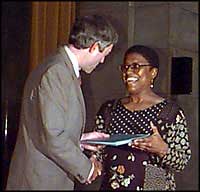
E.R. Shipp receiving the 1996 Pulitzer Prize for Commentary from George Rupp, Columbia University President.
Winning Work
By E.R. Shipp
LENOX, Mass. -- My family roots run deep in the South, like the Mississippi, Yadkin and Yellow rivers along which we've toiled. I am among the first generation of black Shipps not born on a hardscrabblefarm or hired out to pick cotton at harvest time. I'm among the third generation of Shipps born in Georgia after slavery was legally abolished and the last to have lived through America's apartheid. With the exception of a couple of years in the projects, we lived in raggedy houses without indoor plumbing but often with rats that frightened even my father.
Being the oldest of six kids, I learned responsibility early: toting buckets of water into the house a couple of times a day for cooking,cleaning and, especially on Saturdays, bathing; then toting a different kind of bucket out every morning to dump into the outhouse.
But here I sit today, at an ashram on the banks of Lake Mahkeenac in the Berkshires, getting in touch with myself for a few days at this yoga center.
I'm a graduate of an Ivy League institution Columbia University and I also teach there. I've written for two of the largest newspapers in the county. I travel. I live life in the city to the fullest. I do all right.
If I were anybody else, many people let me be clear here, many white people would say that I've realized the American Dream. I've made something of myself, they might say. But, no. Because I am black, they will always say that I am where I am solely because of affirmative action. That I am filling some quota. That I am not worthy of whatever job I hold. That they and their father and their brothers and their cousins are better.
It infuriates me that the least among white folks thinks himself superior to me. So conservative Republicans leading the charge to dismantle this nation's commitment to equal opportunity for all people strike a nerve when they question affirmative action in the 1990s.
People like me also see a downside to a policy whose raison d'etre is that blacks are damaged goods and need special help. Few people like me will ever say this publicly because we are not allies of those out to do in affirmative action while trading on insecurities of white Americans. Many of them dyed-in-the-wool racists who have always sought to keep blacks "in their place" do not come into this debate with clean hands.
But, for a moment, let's forget them and what's in their hands or hearts. Affirmative action as a permanent feature of the landscape is an abomination. Talented young blacks an entire generation of them have grown up thinking of themselves as "minorities" whose only entree into schools or the work place is through some special program.
I refuse to seek anything marked "minority set-aside." I have three nephews, ages 10, 5 and 3 months. When it's time for them to get into prep schools or college or corporate America, if they walk through the side door marked "Affirmative Action Only," I'm disowning them.
Having said this, however, I won't go so far as to say, Do away with affirmative action as a guiding principle. That's because I, like most other blacks, don't trust white men who talk about a color-blind society. We know, as Roger Wilkins writes in the current issue of The Nation: "Without the requirements calling for plans, good-faith efforts and the setting of broad numerical goals, many institutions would do what they had always done: Assert that they 'couldn't find anyone qualified,' and then go out and hire the white man they wanted to hire in the first place."
Let's be honest. Affirmative action programs need to be reviewed and refined. But not eliminated. Not yet.
As a federal judge recently ruled in Texas: "Until society sufficiently overcomes the effects of pervasive racism, affirmative action is necessary."
© 1995, Daily News
By E.R. Shipp
The dream of unity dies hard. But even as skin color may bind us, economics, education and lifestyle become points of divergence. We shouldn't be afraid of that.
That gathering at the Apollo Theatre a couple of Saturdays ago was not about the widow of Malcolm X reconciling with Louis Farrakhan, the man she believes at least partly responsible for her husband's death. And it was most assuredly not about the unification of all of us black Americans who supposedly have been divided into competing Shabazz and Farrakhan camps. But, then, it's typical of the news media to miss the story when it comes to blacks and it's typical of activists to manipulate the media's stupidity.
"It was an extraordinary sight," a CNN correspondent breathlessly reported. Well, excuse me, but I seem to recall Shabazz and Farrakhan meeting, with almost as much cordiality, at a well-publicized leadership summit in Baltimore last June. How quickly we forget! Hundreds packed the Apollo, and thousands more apparently watched via satellite broadcast. They were waiting, waiting, waiting. . . . Well, by the time Farrakhan walked over to Shabazz and shook her hand several hours into the rally, the audience had been primed to see something that did not happen what a Washington Post correspondent described as "a bid to end one of the oldest and deepest rifts in the black community."
The Amsterdam News trumpeted "SOLIDARITY REIGNS!" and "Min. Farrakhan and Betty Shabazz restore unity to African-Americans." At the risk of giving away state secrets, I've got to say that just ain't so. The relationship between Betty Shabazz and Louis Farrakhan is just about as big a deal among black folks as the rift between Booker T. Washington and W.E.B. Du Bois. In other words, it's not exactly at the top of anyone's list of everyday concerns. We should not delude ourselves: Black America is no more united today than it was last month or last year or 130 years ago, when freedmen held state and national conventions to develop a common agenda for advancing the black cause. One might even say that blacks are less united today than we were 50 years ago, when there was some consensus about seeking basic civil rights.
We are no more united than we were in 1972, when thousands gathered in Gary, Ind., for the National Black Political Convention. And we are certainly no more united than we were after Benjamin Chavis' first Baltimore summit, where he told a gullible press corps: "There is going to be dancing in the streets of black America because we have defied the forces that want to divide us." Or after his second summit, held the day after he was fired as executive director of the NAACP. "This is unity time," he said.
Don't fear differences
The dream of unity dies hard. But even as skin color may bind us, economics, education and lifestyle become points of divergence. We shouldn't be afraid of that. Nor should we fret that all of us aren't marching toward a single goal in lockstep behind a single leader, whether that leader is Farrakhan or Chavis or Myrlie Evers-Williams, who sounded the unity theme last weekend at her inauguration as the NAACP's new chairwoman.
Back at the Apollo, Betty Shabazz seemed to want to be anywhere but there. But she was there because of her daughter Qubilah, who had been involved in a plot to kill Farrakhan. Caught on tape, Qubilah had referred to him as "a slimy pig." While the case was settled out of court, Betty Shabazz and her advisers feared that one of Farrakhan's followers might retaliate against the family. They remembered the violence that followed Malcolm X' death as various Muslim factions sought to settle the score. What better way to stave off any zealots who might want to harm Qubilah than to have a love-in with Farrakhan as keynote speaker, pledging his support for the entire Shabazz family?
"I would like to thank Mr. Louis Farrakhan you know him as Minister Farrakhan," she said rather coolly before thanking him for his "gentle words of assurance" after her daughter's arrest. For Betty Shabazz, it was not unity day or reconciliation day or forgiveness day. It was Mother's Day.
© 1995, Daily News
By E.R. Shipp
When I was a youngster, we slipped far enough down the economic ladder to qualify for public housing. In fact, that apartment on Griggs St. in Conyers, Ga., was the first place we lived that had indoor plumbing. But we weren't on Griggs St. long. After a few years in the projects two-family brick dwellings nothing like the high-rise monstrosities in New York we were deemed capable of making it on our own. And we did, though not without a struggle.
The notion of taking a little government help to tide oneself over one of life's rough spots, and then moving on and hopefully up, seems lost on many aid recipients today, whether they are on welfare or live in the projects. Back home I have cousins and former schoolmates who have never held jobs in their adult lives; while drinking, drugging and watching the soaps and Oprah, they live for their checks from the government.
When we hear the words "welfare reform," many of us no doubt think of someone as infuriating as my cousins and old classmates. But in the rush to cut their Gordian knot of dependency, we should not forget that spirit of extending a helping hand that New Yorkers codified six decades ago when they amended the constitution to make clear that the "aid, care and support of the needy are public concerns that shall be provided by the state."
We should not throw out the babies along with the adult able-bodied in the name of reform. If some politicians in Washington and Albany have their way, that's what could happen. Several months ago, Gov. Pataki vowed "sweeping changes to a failed welfare system." He would have kicked childless adults off Home Relief after 60 days, whether or not they had jobs; slashed benefits to families with children by up to 25%, and discontinued rent subsidies.
Thankfully, however, there's such a thing as the political compromise. As state budget negotiations finally picked up steam, legislators forced Pataki to back away from such drastic measures while still taking steps to force more people to work, in public works jobs or for nonprofit organizations, if not the private sector.
For some reformers conservative and liberal the major goal is instilling pride, dignity and confidence in long-term welfare recipients. "The cost of welfare is not to the taxpayer," Andrew Cuomo, an assistant secretary at the Department of Housing and Urban Development, said at a business conference in Harlem last week. "The cost of welfare is to the person who has to take that check every week because that person, that woman, pays with her self-respect when she takes that welfare check."
For others, of course, welfare reform means saving money, pure and simple. They don't consider the consequences of drastic cuts coming from the feds, state and city all at once. That's what's so offensive about the approach taken by the governor and state legislative leaders: As they debated recently behind closed doors, they offered no opportunity for "we the people" to take part in a comprehensive discussion of this state's direction and priorities.
Reforming the welfare system is not necessarily cheap, so the issue must not be seen solely as a budget-balancing measure. Where are the private-sector jobs that these able-bodied Home Relief recipients are supposed to look for? Who's going to teach them how to go about looking for work, how to develop a work ethic, how to deal with authority, how to hold onto a job? Who's going to pay? And what about helping these new workers handle the inevitable crises the sick family member, the abusive mate, the transportation breakdown, the letter demanding that they show up at the welfare office during working hours to be recertified?
Peter Cove, whose America Works finds jobs for recipients of Aid to Families with Dependent Children and then provides them with ongoing supportive services, says that is the key to permanently moving people off the welfare rolls and onto payrolls. Isn't it time we have a serious discussion about how to achieve true welfare reform?
© 1995, Daily News
By E.R. Shipp
The approach of the Fourth of July seems an appropriate time to remind certain would-be black leaders that their tyranny is no more acceptable in 1995 than King George's was more than 200 years ago.
Whether the issue is affirmative action, welfare reform, gangsta rap or Mike Tyson's homecoming, diversity of opinion should be encouraged, not suppressed. Yet when blacks, especially black women, differ from whichever male-dominated coalition declares itself to be speaking for "the black community" at any time, they increasingly risk condemnation and ostracism. Despite their track records, if they stray from the party line, they are accused of dancing to the tune of others, incapable of thinking for themselves or taking principled stands.
After The Amsterdam News threw itself behind plans for a hero's welcome for Mike Tyson earlier this month, black columnists writing for the Daily News and other dailies questioned the wisdom of bestowing such honors on a convicted rapist and admitted wife beater.
On the streets and on the airwaves, many blacks followed the lead of Bill Tatum, publisher of The Amsterdam News. Rather than squarely addressing the issue, Tatum came out swinging in the only way he knows how: condemning blacks who write for "white media" and accusing them of being mere puppets of those who "would leave the black community hopeless, helpless, broke and leaderless."
"We are the people," Tatum declared at a decidedly scaled-back celebration last week, going on to blame the city's dailies for intentionally creating a controversy designed to divide blacks.
The blame does not fall on the white media or any other white conspirators or any black collaborators. It falls on the Bill Tatum-Don King-Al Sharpton team of party planners who assumed that blacks would be so enthusiastic about seeing a celebrated athlete walk in their midst that no one would raise objections about the message being conveyed to women and to children.
In the pages of Tatum's newspaper, critics of the Tyson wing-ding were, with no apparent sense of irony, castigated as "opportunists" who were "self-serving" and "playing to mainstream cameras."
Jill Nelson, the writer who helped form a group to protest violence against women generally and the homecoming specifically, was accused of trying to boost sales of her popular 1993 book, "Volunteer Slavery." Councilwoman C. Virginia Fields, who represents central Harlem, was accused of participating "in what was clearly an effort by someone else to further damage Mike Tyson and spoil his return to the community."
Other members of the coalition who, unlike Sharpton, Tatum or Tyson, actually live in Harlem, were nevertheless depicted as interlopers.
These tactics are not solely a local phenomenon, as C. Delores Tucker can attest. In her three-year, little-publicized crusade against gangsta rap, Tucker, the president of the National Political Congress of Black Women, has won the praise and support of the likes of Jesse Jackson, Ben Chavis, the Black Leadership Forum and the Congressional Black Caucus.
But then she joined forces with a conservative Republican, William Bennett, to take her campaign to national television and op-ed pages. Since then Sharpton and others have dismissed her as a puppet of the "right wing." As if this 67-year-old woman, Pennsylvania's former secretary of state, does not have a history of acting on her convictions.
"Why weren't they standing with me? Why are they so silent?" Tucker asks of the naysayers. "I will talk with anyone and be happy to have the support of anyone on this issue."
Those who would control public discourse within the black community know that all they need do to cast doubt on the credibility of dissenters is use buzz words like "conservative," "right wing" "white media" or "outsiders." Their task is made especially easy if the dissenters are black women, who some black men still see as more privileged than they are in this society.
This Independence Day, we should toss off the yoke of oppression from within our community and test competing ideas through principled debate. Without that struggle, there can be no progress.
© 1995, Daily News
By E.R. Shipp
Three of my fellow Georgians stand at the forefront of our painful national debate on racism and remedies: House Speaker Newt Gingrich, the self-proclaimed leader of the Republican revolution; Rep. Cynthia McKinney, whose racially gerrymandered congressional district the Supreme Court deemed unlawful, and Clarence Thomas, the Supreme Court justice who, if you listen to some folks, was single-handedly responsible for that decision and an earlier one limiting the federal courts' role in the area of school desegregation.
Thomas has been pilloried, "called everything but a child of God," as we say in Georgia. But rather than being "an Uncle Tom," as so many are so quick to say, at times he sounds to me like W.E.B. Du Bois, the scholar, founding member of the NAACP and Pan-Africanist whose bona fides has not been called into question as far as I know.
You probably think I'm nuts, but consider what Du Bois had to say 60 years ago when educators like himself and lawyers such as Charles Hamilton Houston and Thurgood Marshall were debating what to do about segregated schools. Work to raise their quality, while conceding the reality of American apartheid? Or sue to end state-mandated segregation, arguing that integration was the only assurance black children could get a decent education?
In the July 1935 Journal of Negro Education, leading scholars, including E. Franklin Frazier, Ralph Bunche, Horace Mann Bond, Alain Locke and Du Bois, weighed in on the subject. Du Bois chastised blacks for their "utter lack of faith" in their own schools. "[A]s long as American Negroes believe that their race is constitutionally and permanently inferior to white people, they necessarily disbelieve in every possible Negro institution." The quality of the education should be paramount, he said, not whether black kids sat next to white kids in integrated classrooms. "The Negro needs neither segregated schools nor mixed schools," Du Bois declared. "What he needs is Education."
Thomas seemed to echo Du Bois a few weeks ago in finding that a federal judge had gone too far in requiring an elaborate desegregation plan to achieve racial balance in the public schools of Kansas City, Mo., where, in some instances, schools were 90% black. Looking at black students' poor academic performance, the federal judge concluded that there was a link between the high proportion of blacks and the low quality of the schools.
"It never ceases to amaze me that the courts are so willing to assume that anything that is predominantly black must be inferior," Thomas wrote in a passionate critique of the Kansas City plan. Of the Missouri court's insistence on racial balance, he said: "This position appears to rest upon the idea that any school that is black is inferior, and that blacks cannot succeed without the benefit of the company of whites."
Thomas, like Du Bois, would say to local school officials and parents: Fix the schools to make sure that they are indeed educating kids. Demand that every school gets its fair share of education dollars. Let kids go to school in their own neighborhoods if they choose. And forget about what proportion of students are of what race. Thomas agrees with Du Bois that it's wrong to use children as "battering rams" in the elusive goal of creating an integrated society.
Admittedly, Thomas is a strange bird, but he seems to have more faith in the ability of blacks to stand on their own two feet than do some of those who berate him. His is an Old Testament-style tough love. He is yes, I do believe this a proud black man. But a confused one.
"We're a mixed-up generation, those of us who were sent to integrate society," Thomas once said.
I'm part of that generation that was the first to integrate this, that or the other. We've got the bruises psychic, if not physical to show it. So who better than us the expeditionary troops, the cannon fodder to force Americans to confront racism and shape remedies that make sense for the 1990s? Black thought on racism did not begin with the 1954 Brown vs. Board of Education case. The remedies we seek should not end with it.
© 1995, Daily News
By E.R. Shipp
Susan Smith may be the most reviled mother in the United States. But if I were on that jury that must determine her fate, I know what I would say: She does not deserve to die.
Capital punishment is a barbaric vestige of an earlier time. We profess to be a civilized society that values life. But even those who disagree whether in Union, S.C., or New York City must see how pointless capital punishment is in a situation like Smith's. Her case is further evidence of how arbitrary prosecutors can be in seeking it and juries in imposing it.
Smith may escape the death penalty because of sympathy, or she might get it because of a thirst for revenge. And if the jury had accepted the judge's last-minute invitation to find her guilty of involuntary manslaughter instead of murder, she would not now be wondering whether the jury her former neighbors will recommend that she spend many years behind bars or be executed as soon as possible.
According to a CNN/USA Today poll, 68% of the public wants Smith executed for strapping 3-year-old Michael and 14-month-old Alex into their car seats last October and sliding her Mazda into a lake. That's about 8 miles from the courthouse where she now listens to witness after witness unveil secrets that William Faulkner would have had a hard time portraying with credibility and that Union, S.C., would prefer not to know.
Many people in her hometown seem to want to be rid of her so they can go back to deluding themselves that Union is a model of small-town virtue where everyone gets along just fine, thank you. Despite their homespun denial, Union is more Peyton Place than Mayberry R.F.D.
In the weeks preceding the murders, Smith allegedly had sex with her estranged husband, her boyfriend, her boyfriend's father and her own stepfather.
The stepfather, a successful businessman and leader of the local Republican Party and Christian Coalition, has acknowledged a sexual relationship with Smith that goes back to when she was 15. He has recently said that he is "responsible for and ashamed of what happened" and is "finally getting the professional help that I need."
With hypocrisy, broken marriages, suicides and attempted suicides abounding in Smith's circle of family and friends, it's obvious what a defense lawyer meant when she told the jury last week: "This case goes way back, well before the night of Oct. 25, 1994."
Does a sordid history of mental illness and sexual abuse absolve Smith? No. But it's too easy to denounce her as a modern-day Medea, send her to the electric chair and be done with her. Smith is mentally ill. She needs psychiatric treatment, not a charge of electricity.
Townspeople say they feel betrayed because for nine days Smith lied to them and to the nation, claiming that her car had been stolen and her boys abducted by a black man. The people of Union, blacks as well as whites, believed her. They searched. They wept. They prayed. And then she confessed. But betrayal her abuse of her neighbors' trust and so many people's abuse of Smith's trust over the years is not a capital offense.
Emotional judgment
"Burn her!" these pious people screamed outside the courthouse after her arrest. If a trial had taken place then, she would surely been sentenced to death.
Since that time, some people have calmed down and are holding prayer vigils on her behalf. They realize that she is one of them, a product of their community. Moreover, they know that only a very troubled woman would drown her babies.
But that change of attitude says as much about the arbitrariness of a death sentence as it does about the people of Union. What's often decisive is if the trial is held right away and if the accused is from a leading family, from the wrong side of the tracks or is a stranger.
If Smith is condemned to die, she would join 45 other women on Death Row, U.S.A., where the total population is about 3,000. Most of them are poor, a disproportionate number are black and an overwhelming majority had lousy lawyers.
Who gets life and who gets death is the luck of the draw unless you're rich and famous. Smith is lucky. Her lawyers are among the best in the state. Maybe her luck will hold out and she'll have a jury with good sense.
© 1995, Daily News
By E.R. Shipp
PHILADELPHIA -- Judge Lance Ito wasn't impressed with the O.J. Simpson defense team's legal work earlier this week, but over the weekend Johnnie Cochran had hundreds of journalists convinced that the Simpson case is not just the "trial of the century," but the civil rights trial of the century.
"Smooth operator" doesn't begin to describe Cochran, who works on behalf of his main client "Mr. O.J. Simpson," as he always calls him in public even when he is ostensibly taking the weekend off.
Cochran, a maestro in the courtroom, demonstrated his skill outside that forum when he played a Philadelphia gathering of black journalists like a keyboard tuned only to racial chords, major and minor. Disturbingly, he viewed the audience as "supporters," as members of Team O.J., with "all of us in this room work[ing] together."
"We will go forth. We will not let you down," Cochran declared, as if he were the general of an army going off to protect the nation's borders from marauders. "We will do our absolute best win, lose or draw. We do expect to win."
More disturbing than Cochran's message was the rousing ovation he got from many, though not all, of the 1,000 or so journalists present. One person shouted, "Bravo!" The scene was slightly nauseating.
I am not a member of Team O.J. or of the Johnnie Cochran Fan Club. But give him credit. Cochran is a superb advocate, fighting for his client, obfuscating the truth when necessary and playing to the audience in this case, people who help dictate which evidence is heard in the court of public opinion.
The scene was a reminder of just how confused some people are. This is a trial to determine if Simpson is guilty of slaughtering Nicole Brown Simpson and Ronald Goldman. It is not a trial of all black people. While it obviously has implications for the Los Angeles Police Department, it is not a trial of all police departments. But Cochran says otherwise in a bid for support among the race.
Cochran says that for more than a year he's been searching for "a meaning of this case beyond Mr. O.J. Simpson." He says he found it five or six weeks ago in the form of taped conversations in which Mark Fuhrman, then a Los Angeles police detective, bragged about planting evidence and abusing suspects while also disparaging women, blacks and Mexicans.
"These tapes that you will hear this week are very, very important to this trial and beyond this trial," Cochran predicted, asserting that they reveal "a police culture" that prevails throughout the nation. That may be true, but without further investigation by reporters and government oversight agencies, all we know for sure is that the tapes reveal something about Fuhrman's brand of policing.
Cochran denies "playing the race card" while doing just that. Masterfully, I might add. When he says, "We know that our cause is right and our cause is just," he knows that his listeners are probably thinking about the broader struggle for justice and equality.
But the notion that Simpson is now the symbol of a quest that began when blacks arrived on these shores nearly 400 years ago is laughable.
"We are fighting for dignity. We're fighting for integrity," Cochran said. "We're hopefully saying that competence comes in all colors. It is no respecter of age, race or gender." Whether the "we" is Cochran and O.J. or Cochran alone, he can count on many of his listeners to think about their own precarious place in a profession in which more than half the nation's newspapers still don't employ any people of color. So Team O.J. is representing all black professionals. Right.
Perhaps that "Bravo!" was in order, for we were treated to a bit of the artistry Cochran demonstrates in Judge Ito's courtroom. If the jurors are as receptive as the journalists were, can there be any doubt about the eventual outcome of Mr. O.J. Simpson's trial?
By E.R. Shipp
At the African-American heritage parade in Harlem a couple of weeks ago, a vociferous crowd of malcontents booed black men and women in uniform cops, firefighters, correction officers, military folks accusing them of being sellouts, traitors, brainwashed fools.
That they gave no thought to the courage it takes for these men and women to do their jobs or to the battles they're still fighting against their respective bureaucracies was troubling but emblematic of a disquieting spirit aloft among black New Yorkers.
President Clinton talks about a "funk" that has enveloped much of America; years ago, President Jimmy Carter referred to a "malaise." I think what I'm sensing is an abiding distrust and cynicism that threatens to discourage black youth from being all they can be (to borrow an old Army advertising slogan). At the same time, this mood discourages many people from participating in civic life and discourages nonblacks from reaching out to us in a spirit of cooperation.
We sing of marching on " 'til victory is won" in our anthem, "Lift Ev'ry Voice and Sing," but we're so accustomed to marching that we fail to acknowledge the victories that we are winning.
For years blacks sought entry into the uniformed ranks and fought through their fraternal organizations to tear down barriers to their advancement. Blacks took pride in their achievement; theirs was one more victory won.
But that respect seems to be dwindling as we increasingly make no distinction between the few bad apples and everybody else.
The same people who booed the uniformed men and women at the Harlem parade also spoke with glee that Mayor Giuliani did not march; they talked of how they and other blacks heckled him earlier this month during the West Indian-American Day Carnival Parade in Brooklyn.
What they fail to realize is that it's one thing to disagree with him; it's another to chase him away figuratively and literally. We are a part of the city; he is mayor of all of us. When we demand a more responsive city administration and he makes an effort to reach out to us, that's a victory.
To his credit, the mayor seems to be getting it. I was impressed when he showed up at the Abyssinian Baptist Church in Harlem on Sunday to worship and to report to the people. He needs to do more of that.
He talked about the public school system and about crime and acknowledged blacks' long-standing complaints of police brutality.
"It's as much a priority for me to reduce crime," Giuliani said, "as it is to have a Police Department that is respectful of the rights of everyone."
That brought murmurs and applause, probably because it was unexpected from this mayor. More startling was his passionate plea for greater civility among the city's diverse populace. "We're all children of the same God," he declared.
Of course, the mayor didn't win over everyone. A neighbor of mine said, "I can't stand him." But making the effort is important. And, for our part, giving him a hearing is just as important.
That brings me to the Colin Powell phenomenon. That he might make a run for the presidency is not nearly as astounding as is the support he seems to have among white Southerners and Midwesterners and the distrust that engenders in blacks. Many blacks say that if whites say he's right, then he must not be. They don't see this as a victory we've sought in race relations all these years: That someone can indeed be judged by the content of his character rather than the color of his skin.
We demand that doors to hiring and promotions be opened; we stigmatize those who enter. We demand a responsive city administration; we boo the mayor and his aides. We demand access to the halls of power; we're suspicious of the man who just might have the best chance of getting there.
Something's wrong with this picture. And it'll take more than marching to address such an extreme alienation from the commonweal at a time when more of us need to be engaged as role models, as voters, as public officials.
© 1995, Daily News
By E.R. Shipp
The media-driven hoopla over who's the baddest black man in America is the wrong issue to emerge from the Million Man March. More critical is this: Now that Louis Farrakhan has our attention, what are we as a nation going to do about racism and its power over us?
President Clinton took a major step in a passionate call for racial healing just hours before Farrakhan took the stage in Washington. "America, we must clean our house of racism," he said. Yet some Republican leaders sought political capital by skirting the issue and heaping scorn on Clinton for not being tough enough in his denunciation of Farrakhan.
By their absence from the Washington rally, black men and women said they would choose for themselves whom to follow, thank you very much. And by their presence, men and a considerable number of women said the same thing.
"Our house is on fire and my children are in the house and I've come to put out the fire," said Joseph Lowery, president of the Southern Christian Leadership Conference, "and I don't care who else is bringing the water. I join with them to put the fire out in the black community."
Those who really care about race relations and rebuilding American cities must acknowledge that the Million Man March was not just a pep rally for black men. It was a wakeup call and a symposium at the same time.
Probably hearing a Louis Farrakhan speech for the first time, millions of people watching on television could judge for themselves the messenger, the message and the audience.
Except for the fact that he did not castigate black Christians; black sororities and fraternities; the NAACP, or the National Urban League and he did not single out Jews it was a pretty typical Farrakhan jeremiad. Long-winded. Rambling. Entertaining. Spellbinding. Ridiculous. Humorous one minute, full of fury the next. Compassionate. Excoriating. Conciliatory. Messianic.
I'd heard it before, so what he said was less riveting than what the hundreds of thousands of black men said by their presence and their pledges.
"Brother, my brother," said Kurt Schmoke, Baltimore's mayor, "let's get busy. Today we ask nothing of the government. Today we ask everything of ourselves."
"Stand up, black man!" Al Sharpton exhorted.
Measuring a message
How do we gauge whether the well-staged pledge taking, hugging and exchanges of "I love you, my brother," actually transform black men and, by extension, the nation?
Let's watch the police blotters and the court calendars. If the men are true to their word, then domestic violence, child neglect, juvenile delinquency and drug and homicide cases should drop precipitously.
And, if they are true to their word, they should register to vote by the millions. Farrakhan, a nonvoter who preached against voting until a decade ago, now joins with Jesse Jackson and others in vowing to register some 8 million blacks.
If they are true to their word, the next PTA meeting you attend should be filled with black parents; houses of worship should be teeming this weekend; membership in the NAACP and the Urban League should surge, and some 25,000 black orphans soon should find permanent homes.
That's how to measure the meaning of the Million Man March, not by polls and polemics on who's the No. 1 black man in America.
© 1995, Daily News
By E.R. Shipp
Contrary to myth, blacks own at least half the businesses on 125th St. This is not the 1930s, when blacks boycotted 125th St. businesses, all white-owned, because they refused to hire blacks.
There are no innocents among the Harlem politicians and business leaders who are offering condolences and, in the case of the Greater Harlem Chamber of Commerce, offering scholarships for children of the victims of last week's arson at Freddy's Fashion Mart. Nice, but where were they a few weeks ago when the nastiness on 125th St. got nastier?
A berserk -- and racist -- Roland Smith shot employes and set the fire that took seven lives plus his own. But had political and business leaders stepped in long before, perhaps a landlord-tenant dispute involving a black church (the landlord), a white-owned clothing shop (the primary tenant) and a black-owned record shop (the subtenant) would not have become murder.
They certainly had their chance. Sikhulu Shange, owner of the record shop that was losing its lease, says he wrote Rep. Charles Rangel, State Sen. David Paterson, Assemblyman Keith Wright and Councilwoman C. Virginia Fields.
Only Rangel responded, he says, with a promise to write a letter on his behalf. Wright has said he had planned to meet with the parties at the landlord's behest. The proprietor of the clothing store whose plans to expand into the space occupied by the record shop set off the conflict turned to the police.
So Shange turned to the Rev. Al Sharpton and to Morris Powell, the leader of a vendors group with a warped sense of ownership of 125th St.
"If other people had responded, maybe we wouldn't be here today," Sharpton said after the arson. He's right. Mayor Giuliani says he didn't know about problems on 125th St., but that just proves he's out of touch.
The street has been the site of racial, ethnic and class conflict for years, all centered on who owns or should own businesses there, who works or should work there. Amid what looks like an economic rebound, the conflict has intensified.
Politicians say they didn't know the situation was so volatile. But why didn't they, when they all have offices on 125th St., as do the Chamber of Commerce, the 125th St. Business Improvement District and the state's Harlem Community Development Corp.?
Sharpton, who also has an office there, is not completely off the hook. He doesn't preach violence or hate. But by indiscriminately allying himself with other blacks no matter what their message is, he abdicates responsibility as the leader he is and wants to be.
When Sharpton joined the picketers Dec. 2 just about the time that the hateful taunts and the threats escalated he became in the eyes of casual observers a leader of that protest, embracing its message and its methods. Never mind that, as he now says, he was there to mediate. "I am a preacher, not a prophet. I could not know in advance what this was going to come to."
No one expects clairvoyance, just clarity. Sharpton knows the "BUY BLACK" rhetoric of Powell's vendors group and its threats to punish white-owned businesses and their black customers. They said and did the same thing last year, when Sharpton joined them in a futile effort to force Mayor Giuliani to rescind his ban on sidewalk peddlers on 125th St.
Contrary to myth, blacks own at least half the businesses on 125th St. This is not the 1930s, when blacks boycotted 125th St. businesses, all white-owned, because they refused to hire blacks.
But Powell's group encourages the myth, while responsible leaders remain quiet. That encourages black wackos like Roland Smith. Based on flyers and the chants outside Freddy's and not, by the way, outside the church's temporary meeting place pickets no doubt thought they were protesting solely against white business owners who are taking their street.
"We all blew it," says Lloyd Williams, president of the Chamber of Commerce. Yes, and seven white, Hispanic and black employees of Freddy's paid dearly.
© 1995, Daily News
Biography
E.R. Shipp joined the Daily News as an Op-Ed Page columnist in 1994. Through her weekly opinion column, Shipp has distinguished herself as one of New York's most intelligent, unpredictable and interesting voices. She tries to leave no feathers unruffled as she examines a broad array of public policy issues, including violence, the quality of our schools and education system, affirmative action and the future of Africa.
In addition to writing her weekly Daily News column, Shipp is an assistant professor at the Columbia University Graduate School of Journalism.
Shipp was a reporter and editor at The New York Times for 13 years before leaving to pursue graduate studies in American history. She was a co-author of the 1990 book Outrage: The Story Behind the Tawana Brawley Hoax (Bantam Books).
Born and raised in the rural south, Shipp is proud to now call Harlem home.