LA Weekly, by Jonathan Gold
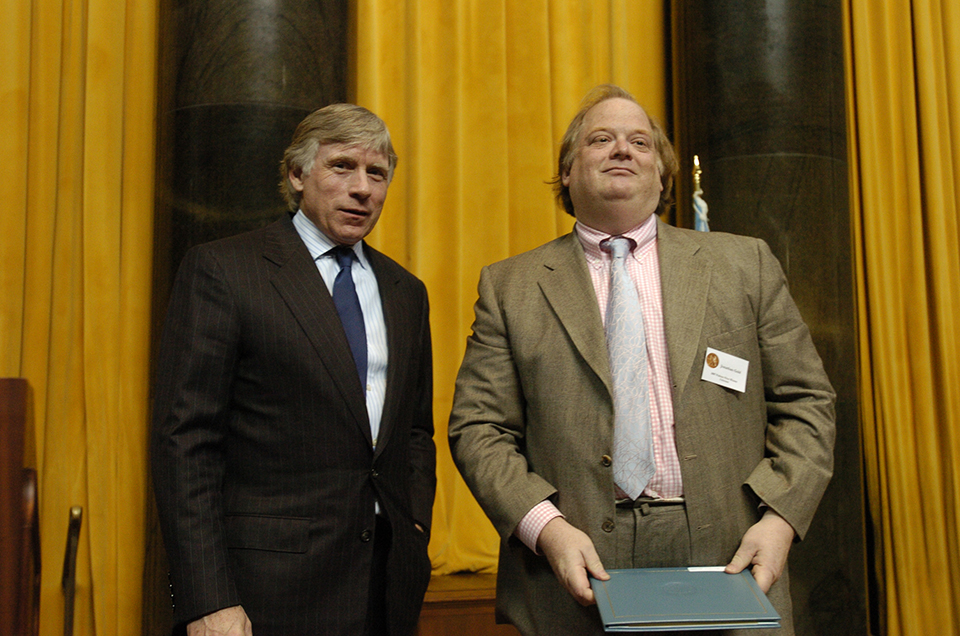
Columbia University President Lee C. Bollinger (left) presents Jonathan Gold with the 2007 Pulitzer Prize in Criticism.
Winning Work
By Jonathan Gold
What are tamales and quesadillas doing on a plate with the very French hare? It is hard to know, but they at least do the animal no harm.
Bistro K is almost too civilized on a busy Thursday night -- a tiny, candlelit dining room with Ray Charles on the stereo, fresh flowers on linen tablecloths, couples bent over glasses of Beaujolais. Dinner-party groups of well-fed Pasadenans, the ones who haven't quite scraped the Kerry/Edwards stickers off the bumpers of their Volvos, debate whether to have the apple tart or the sour-cherry clafouti for dessert. Sharp knives dissect partridge, wild hare and other buckshot-speckled delights rarely encountered outside of Dickens novels. Sea salt is sprinkled into a crock of pot au feu. A young woman dismantles a complex parfait of smoked eel, green apples and duck liver. I taste a grand-cru Alsatian riesling that has lain hidden in my basement for the past 15 years. I am beginning to like Bistro K. I am beginning to like it a lot.
Bistro K, to put it plainly, is a restaurant out of a daydream, with a kitchen that may rank among the few dozen best in town, run by a gifted and accomplished French chef, with a BYOB wine policy and no corkage charge (you must bring your own wine); a place where a fine, intimate dinner costs rather less than a quick meal of cheeseburgers and drinks at Houston's. Mineral water is available, but the delicious filtered water infused with lemons and cucumbers is free, and pushed by some of the waiters as if they were selling it on commission.
The menu is missing bistro clichés like steak frites or roast chicken, but is well stocked with the game and innards elsewhere unavailable in Los Angeles, oddities like the braised snips of veal tendon garnishing the medallions of rare venison, and such seasonally appropriate things as oeufs en meurette, a wintry harvest dish of eggs poached in a red-wine reduction with meaty slivers of bacon. Plus, there will be ant eggs in spring! A warm salad of duck gizzards sautéed with cèpes, chanterelle mushrooms and hot chiles, one of the most satisfying appetizers I have ever eaten in Los Angeles, costs only $7; a bowl of perfect mussels steamed with lime and curried coconut milk less than eight; an impeccable marquise au chocolat less than six.
In his American Fried, upon seeing a demonstration of what must have been the very first computerized restaurant finder 35 years ago, Calvin Trillin asked the machine's owner to find a three-star French restaurant with moderate prices and a headwaiter who believes that accepting bribes is unethical. The computer was unsuccessful, as Trillin suspected it would be: "If [the programmer] found such a place, he would know better than to say anything about it to a machine."
Bistro K may be such a place.
The chef/owner, Laurent Quenioux, was famous as the chef of the Seventh Street Bistro downtown in the '80s -- I have never forgotten his eel mousse with cucumber or his pumpkin soup with popcorn. His style was rooted in the clean flavors and unusual juxtapositions of classic nouvelle cuisine, but even then he seemed to be obsessed with the play of textures: the rubbery pop of mustard seeds against the juiciness of roast meat, the liquid crunch of undercooked zucchini against the softness of poached fish. Then he dropped out of sight at the end of the '80s boom, a regular subject of the restaurant gossip columns for a while, until he joined the likes of Gordon Naccarato and the late Billy Pflug, kitchen geniuses thwarted by the sterner restaurant climate of the '90s.
But in this tiny dining room, a former funeral parlor attached to a small playhouse, Quenioux seems to thrive, drawing customers with his artichoke-heart confit with goat cheese and basil; violet-flavored foie gras terrine; and tiny, Provençal-scented pizzas topped with roasted garlic, dried tomatoes and a dozen poached snails, black and glistening and full of mellow, earthy flavor, unmasked by melted butter. Chunks of black cod are fried in a crisp coat of batter and laid atop a sort of goulash of chiles and blood sausage that tastes like first-rate Mexican chorizo. (Quenioux often combines influences from the American Southwest and from southwest France.) The cassoulet of duck hearts, tender nuggets of meat braised with turnips and slippery bits of poached duck's tongue, served in a cardamom-scented mushroom sauce on a sort of footed cake plate, is worthy of a multistarred Michelin laureate.
And there are few chefs in Los Angeles who have Quenioux's touch with game: a soft, gloriously stinky Scottish hare stewed in something approximating the traditional foie gras-inflected blood; the most delicate roast squab with eggplant; a wonderful, substantive braised boar shank; a whole-roasted red-leg partridge with the funky, steroidal, locker-room smack of the best shot game.
What are tamales and quesadillas doing on a plate with the very French hare? It is hard to know, but they at least do the animal no harm.
Bistro K, 1000 S. Fremont Ave., South Pasadena, (626) 799-5052, www.lqmanagementservices.com. Wed.-Sat., 5-9 p.m. AE, MC, V. Free corkage. Lot parking. Dinner for two, food only, $60-$80. Recommended dishes: cassoulet of duck hearts and tongues with turnips; civet of wild boar; pot au feu.
© 2006 LA Weekly, LP
By Jonathan Gold
A waitress will try to sell you a third or fourth martini. The skull of Simon Le Bon splats on your forehead and his brains trickle down your cheek like warm yolk.
Do I love The Lodge for its double-fisted Tanqueray martinis or for the thick-cut pepper bacon put out like peanuts at the bar? For the big chunks of blue cheese in the house chopped salad or for the onion rings as golden as the bangles on a Brahmin woman's arm? For the dripping-rare New York steak or for the bone-in rib-eye as big as some models of compact car? For the sommelier, Caitlin Stansbury, who seems to purr like a cat when you order her favorite Madiran or Spanish Syrah on the wine list? When this dining room was Tiny Naylor's, my mom used to take us here for patty melts when she didn?t feel flush enough to spring for the onion rings across the street at Ollie Hammond's. When it was reborn as an upscale coffee shop, at least one of the waitresses used to slip punk-rock dudes warm beer in teacups after the bars closed. And now that it has been reinvented as a wood-paneled post-Googie ski lodge, I find it pretty hard to get a reservation. It must have something to do with the bacon.
The Lodge, it must be said, represents almost everything I loathe about the Los Angeles restaurant circa 2006. The designer is Dodd Mitchell, for whom the X-Box and Dungeons & Dragons must stand as primary muses, whose aesthetic of fire, wood, leather and stone seems to have been lifted whole from an early edition of Halo. (Mitchell's influence extends to interiors many, many ZIP codes away from his sphere of impact, which is not necessarily to the good.) The owner is Adolfo Suaya, whose projects, from Gaucho Grill through Sushi Roku, Katana, Dolce and Rok Bar, have represented the dark, anti-chef wing of the local restaurant scene for almost 20 years. (I still remember ducking into corners to avoid the Weekly's first editor when he stalked down the hall with the unmistakable 'review Gaucho Grill' look in his eye.) The Lodge's chef, nobody bothered to mention. Suffice it to say, if you crave anything they serve at Boa, Dakota or Sterling, you will probably be able to find it here too.
To get to The Lodge, you dump your Lexus off with the valet, march down a breezeway -- it looks like the path to Thunder Mountain at Disneyland -- and face down a maitre d' as formidable as the frontline of the Pittsburgh Steelers, only wearing a much nicer suit. If you are on his list, you will be admitted to the bar, where you will nibble those peppery bacon strips and rosemary-toasted almonds until your name is called -- usually 40 minutes or two $15 martinis after the designated time of your reservation, or until the lesser hits of Duran Duran and Earth, Wind & Fire sear themselves into your soul.
If the front desk has not forgotten you completely, you will eventually be transferred a few feet to a tiny table fashioned from a sliced log, like an expensive, matte version of the ones that Topanga hippies used to sell by the side of the road. A waitress will try to sell you a third or fourth martini. The skull of Simon Le Bon splats on your forehead and his brains trickle down your cheek like warm yolk. The $75 porterhouse-for-two starts to seem not only possible but desirable in the heat of The Lodge moment, and if you take a moment to do the math, it is one of the least costly items on the menu. The waiters push the Cajun rib-eye, but $45 per person is probably a little too much to pay for second- or thirdhand bam.
But have I mentioned that The Lodge makes me deliriously, irrationally happy, prey to whatever generational hooks or serotonin enhancers Suaya and company have managed to insinuate into the food?
Every steak house in town has a wedge-of-iceberg salad at the moment, frosted with blue cheese and bacon and a nominal vinaigrette, but The Lodge ups the ante by pairing its wedge with another wedge, which it moistens with the devil's own version of the Thousand Island dressing you used to enjoy in first grade. The shrimp cocktail may not be the best in Los Angeles, but the slightly mealy shrimp are certainly the biggest -- banana-size creatures the sight of which could empty a beach as quickly as the fin of a great white shark. It's not just a baked potato, but a salt-baked potato, crunchy-skinned, accompanied by a salad bar's worth of condiments, so that you can crank the vibe from Ornish all the way up to Atkins with just a few dips of the fork.
The steak comes -- bone-in rib-eye, medium-rare for maximum succulence, is my call-- but by that time you are already happy, inoculated against the $2 surcharge for a spoonful of steak sauce or horseradish whipped cream; liquidly blissful enough to slide into the multisauced banana split, the $5 cup of coffee and the sartori of the ride home.
The Lodge, 14 N. La Cienega Blvd., Beverly Hills, (310) 854-0024. Open nightly 5 p.m.-1 a.m. AE, MC, V. Full bar. Valet parking. Dinner for two, food only, $90-$140. Recommended dishes: double-wedge salad; bone-in rib-eye; salt-baked potato; banana split.
© 2006 LA Weekly, LP
By Jonathan Gold
It is the coldest night of the year, the winds have started to blow, and I am driving along Olympic Boulevard in East Los Angeles, ravenously hungry, looking for one of the itinerant flame-throwing taco carts that sprout in that neighborhood around midnight. You also may belong to L.A.'s great brotherhood of taco eaters, huddled around trucks late at night, balancing three ounces of highly spiced meat and drawing furtively from an icy bottle of imported Mexican Coke.
There's something about the smell of charring meat, the fire, the island of warmth and light in the cold dark, that can practically compel you to stand around, to eat off soggy paper plates balanced on the roof of your car, to inhale varieties of sweet, dilute fruit juice that you ordinarily wouldn't drink on a bet, to watch the cone of marinated pork blackening on its flame-licked spit as if it were the final minutes of the World Cup. You munch still-muddy radishes to sweeten your breath, but the stink of onions and garlic and cilantro and pig flesh will haunt you like a friendly ghost for days.
You might actually strike up a conversation with your fellow devotees if not for the certainty that all that is beautiful and holy about the mess of corn and gristle in front of you would evaporate as soon as you said hello. If you've been there, you know: The chi, the elusive fire-energy of tacos, vanishes seconds after the tacos are served. Unless you happen to be standing outside in the dark, you'll never experience it at all -- the moment when the guy who owns the cart dips the tiny tortillas in a fetid-looking vat of oil, toasts them on his propane-fueled griddle, and sprinkles them with a few grizzled scraps of freshly grilled al pastor and a sliver of burnt pineapple that has been roasting atop the tower of flesh. You eat the tacos when they are still hot enough to raise small blisters on the roof of your mouth. There is no better food on earth.
Does it matter that my favorite stand, set up most evenings in front of an auto body shop, has no name, no license, and may not be there tomorrow or next week? Does the stand's precariousness, the fact that its lights are powered through cables attached to the battery of a constantly running old car, and the surreptitious nature of the transaction flavor the experience? Or is it the lashings of cumin in the meat's marinade, the careful grilling and the elegant green salsa that has a family resemblance to a hotly spiced Punjabi chutney?
There are few things in this world more primal than bits of meat and bread snatched off the communal fire, a form of eating as old as mankind itself, and there is scarcely a culture outside the Arctic that does not have its version of the ritual. Anthropologists tend to point to the transition from grilling to pot cooking as one of the earliest signs of civilization, but there is something about the smell of smoke, the dripping grease, the feeling of teeth tearing into flesh that awakens the hungry animal in us, probes the deepest pleasure center in our brains.
The meals that have meant the most over the years have almost always involved live fire -- the plate of wild mushrooms roasted by the side of the road in the mountains of northern Catalonia; the sizzling skewers of lamb cooked by elderly Malay men on braziers set up near Singapore's municipal cricket pitch; the flattened chickens crisping over a hot wood fire around the corner from Perugia's cathedral; the magnificent skewers of beef heart grilling on half the street corners in downtown Lima.
When my wife and I hitchhiked across Gascony to eat lunch at Michel Guerard's restaurant in Eugenie-les-Bains, the foie gras and the caramel dessert may have been the best of their kind in the world, but it is the buttery, fragrant chimney-smoked lobster that still inhabits my dreams almost 20 years later. Italians are geniuses of fire, and although I have eaten in many of the famous palaces of cuisine, it is the thick steaks cooked in the fireplace of a country house, the spit-roasted quail, the Umbrian flatbread born out of an olive-wood blaze, the cracker-thin Roman pizzas pulled out of wood-burning ovens, that speak most profoundly. I have never been able to go to a famous restaurant in Italy without looking longingly at that loud trattoria just off the main square, the one with grilling sausages in the window, a house wine grown within sloshing distance, and a menu of the gnarly local specialties that will never make it to Beverly Hills.
The welcome of the smell of wood smoke -- the slightly acrid reek of mesquite, the spicy note of oak, the rustic, burnished sweetness of hickory -- lets you know, from the moment you walk into a dining room, that you are someplace warm, safe and companionable, where nothing bad could ever happen to you. The inability of chefs to get certain dishes quite right in their traditional form -- paella, bouillabaisse or even carnitas -- may have less to do with the availability of ingredients than it does with the lack of a roaring, wood-fueled blaze.
Southern California cooking is an easy cuisine in its most basic form: Dad on the patio grilling steaks, Mom making a big salad, a pot of beans on the stove, a cold, sweaty beer. Los Angeles is a young city, but it has always had its own cuisine, based on the quality of its produce, the ease of its style, the pleasantness of being able to barbecue outside in your shirtsleeves almost every day of the year. The vaqueros ate like that in California's early days, and so did the Midwesterners when they settled here at the beginning of the last century. The Sunset magazine, men-grilling paradigm of the 1950s was a continuation of the aesthetic. When it is 72 degrees outside and the surf is up and Vin Scully is on the radio, who has the patience for casseroles or stews? People may be flexible about Chinese noodle shops, but they will defend their favorite barbecue pit to the death.
Still, traditional high-end restaurant cooking has always shied away from live-fire cooking. Exalted Italian chefs leave the grilling to their country cousins. French chefs, I suspect, think that the flavors developed by the grill are too strong, too alarming, too likely to overpower the delicate bouquet of an old La Lagune.
"When I worked at the old Ma Maison," says Mark Peel, feeding an oak log into a firebox at his restaurant Campanile, "we didn't even have a grill in the restaurant. When somebody ordered a steak, we'd heat a metal rod until it was red hot, and then -- sssss, sssss, sssss -- we'd brand grill marks into the meat before we sautéed it. It looked great, and I don't think anybody ever knew the difference."
In 1982, the chef at Ma Maison, Wolfgang Puck, opened the original Spago on the Sunset Strip, the restaurant that took wood-fire cooking out of the patio in Los Angeles and placed it squarely in the context of fine dining, possibly the first kitchen in the United States to put the grill man (who happened to be Peel) at the number-one position on the hot line. At Spago, not just the steaks but the squab, the chicken, the John Dory, the tuna, the calves' liver and the salmon came off the big grill. The duck and the lamb and the sea bass passed through the wood-burning oven, which also cooked the pizzas. There was a new kind of cooking in Los Angeles, with a flavor as old as time.
Nearly 25 years later, live fires still burn everywhere in every neighborhood, baking bread in Indian tandoors and Iranian tanours, charring Japanese yakitori and Indonesian satay, blackening Mexican carne asada and Peruvian chickens and African-American ribs. When Mario Batali, the most notorious Italian chef in the country, came to Los Angeles to open an upcoming restaurant with Nancy Silverton, the first thing they looked for was a space that would let them fire their ovens with wood.
But ironically, in the recent resurgence of fire in Los Angeles, Spago has reverted to its haute-cuisine roots, and less than a third of the food at the Beverly Hills restaurant ever sees live flames at all.
"The grill man is still the number-one guy," says executive chef Lee Hefter. "But now he has to do the pan roasts too."
The Sajj of the Orient
Alcazar is a garlic-powered vision of a seaside Lebanese café, a terrace perfumed with apple tobacco puffing from a dozen bright hookahs, the sharp scent of fried fish with garlic and tahini, the sweet aroma of chicken kebabs grilling over charcoal. Late on weekend evenings, when the patio fills with live Armenian music and the restaurant becomes a nightclub lubricated with Almaza beer and the tasty arak imported from Beirut, a cook fires up a special cooking device in a corner of the courtyard, a sort of vast, inverted wok fixed over a powerful flame, and bakes ultrathin sajj bread, smoky and pliant and as broad as a sailboat sail, to wrap around grilled meat or make into the thin, crisp, thyme-scented Arab quesadillas called k'llej. 17239 Ventura Blvd., Encino, (818) 789-0991.
The Tandoor Trap
Tandoor ovens are among the most ancient of cooking devices, efficient, superheated earthen vessels that have served as communal hearths in Asia for more than 5,000 years; ovens that bake bread in a few seconds and roast meat in a couple of minutes. Wood ovens tend to burn hot, but tandoors are practically infernos. The halal Pakistani restaurant Al-Watan, whose kitchen is often obscured in a fragrant fog, serves what may be among the best tandoor-cooked meats in the United States, deeply spiced, properly tenderized and smacked with resinous flavor from the mesquite charcoal Al-Watan uses to fire the clay oven: smoky boneless chicken squirted with citrus and tossed with slivered onion; cubed lamb with the smoky chewiness you might associate with the best Texas pits; Cherokee-red tandoori chicken that has a family resemblance to the best barbecue. Even badly marinated meats seared in a gas-fired tandoor are pretty good, but Al-Watan's charcoal-cooked chicken is remarkable. 13619 Inglewood Blvd., Hawthorne, (310) 644-6395.
Crust Rules
L.A.'s notorious sushi-bar Nazis have nothing on Pepe Miele, the proprietor of Antica Pizzeria above the Gelson's in Marina del Rey and more importantly the man who brought the elaborate bylaws of the Vera Pizza Napoletana movement from Naples to the United States. A certified pizza crust must be made with nothing more than yeast, water and flour, must not exceed 30 centimeters in diameter, and must be baked directly on the floor of a hot, wood-burning brick oven. A margherita, by fiat, must be topped with nothing more than sieved tomatoes, fresh mozzarella, olive oil, basil and salt. The crust must be soft and not crunchy; risen and not thin; and notably higher at the edges than in the middle. As far as I know, Miele has never booted anybody from the premises for daring to order a pizza with duck sausage and goat cheese, but I suspect it could happen.
If you get to Miele's pizza the second it emerges from the oven, there is a faint smokiness to the crust, and a mild crisp skin that yields, like an artisanal bagel, to a pleasant, bready chewiness underneath. Even if you prefer muscular Brooklyn-style pies, the crust is unimpeachable. Still, the rigor of the basic structure is not necessarily carried through when it comes to the rest of the pie. The basic margherita tends to become soggy by the time it makes it to the table, and a topping of sausage and broccoli raab just lays there like yesterday's spinach -- you need to cook those particular ingredients together to bring out their succulence, not just toss pre-cooked clumps of them onto a freshly baked crust. 13455 Maxella Ave., Marina del Rey, (310) 577-8182.
The Grill Next Door
You may not think of Beacon as a center of grill cooking. The restaurant, which in its scant year of existence has already helped to stoke the renaissance of Culver City's downtown business district, is better known for its udon with pork belly, its miso-marinated cod and its delicious avocado salad. But chef Kazuto Matsusaka, who worked with Wolfgang Puck for more than a decade, is a past master of the big fire/big taste school of California cooking, and his shiso-flavored yakitori, grilled lamb kushiyaki and grilled hanger steak with wasabi relish are superb. 3280 Helms Ave., Los Angeles, (310) 838-7500.
Whistling Past the Boneyard
Chefly barbecue, of course, is supposed to be an oxymoron. Decent barbecue is the stuff of distant roadsides, lonely highways and the wrong side of town. Until recently, creative American chefs spent their time reinterpreting stuff like burgoo, tamales and macaroni and cheese, but left the barbecue, which tends to leave dining rooms rather fragrant, to the other guys. But Leonard Schwartz, who practically invented the idea of high-end American comfort food, left his well-regarded kitchen at Maple Drive to open Zeke's, a barbecue chain. Carolina-style pulled pork is showing up in upscale kitchens almost as often as goat cheese. And Aaron Robins, whose resumé includes a long stint with über-chef Charlie Trotter in Chicago, opened Boneyard Bistro, a full-fledged, beef-intensive barbecue restaurant with a strong side competency in things like pistachio-crusted baked Brie, whiskey-brined pork chops and porcini-crusted salmon.
Does the barbecued brisket match up well with Woody's? Is the smoked duck spring roll as skillfully put together as it would be at Chinois? It's not even close. But sometimes it is pleasant to eat spareribs and drink Chateauneuf du Pape. 13539 Ventura Blvd., Sherman Oaks, (818) 906-7427.
Blame It on Rio
This is the essential appeal of the Torrance churrasceria By Brazil: You eat meat until you die, massive, garlicky heaps of short ribs and spare ribs and sausage and rump and chicken, roasted above a seething bed of live mesquite charcoal and sliced off metal spears onto your plate by a meat-bearing waiter, one hunk of protein at a time. Sausages are pink, garlicky things, like Portugese linguiça; short ribs are chewy, with a distinct tang of smoke; tri-tip is pink and profoundly meaty. Roast picanha, a dripping, rainbow-shaped slab of meat sometimes known as the rump cap, is crusted black, possibly the only piece of cow you'll ever find that tastes better well-done than medium rare. Churrasco, this Brazilian barbecue feast, seems to be the favorite meal of everybody who goes to Rio on vacation, and By Brazil, where dinner also includes a pass through a rather extensive Brazilian buffet, is about as classic as they come. 1615 Cabrillo Ave., Torrance, (310) 787-7520.
Log-o-philia
Mark Peel may be the most prominent chef in the country whose reputation largely rests with his prowess on the grill, and his Campanile may showcase more shades of fire and heat than any restaurant on Earth. Salmon grilled atop cedar planks takes on the cigar-box fragrance of that wood, and leg of lamb is sometimes flavored with the smoke from smoldering herbs. Rack of lamb is sometimes grilled directly on fresh rosemary, which is a different thing entirely. Thin, broad sheets of veal scallopine pick up all the heady fragrance of the cured oak logs burning beneath them. Sometimes there are even grilled live oysters, put directly over the flame just long enough for their shells to open and their liquor to swell with the essence of smoke. Grilled-fish soup is a sort of deconstructed bouillabaisse, a dish involving four or five sea creatures, each with a different cooking time and a different capacity for heat, taken off the grill and combined at the last moment -- a feat of kitchen virtuosity with the same degree of difficulty as a 360-degree slam dunk. 624 S. La Brea Ave., Los Angeles, (323) 938-1447.
The Right Flank
Charles Perry, the well-known arbiter of both medieval Arab cuisine and Summer of Love Haight-Ashbury, likes to talk about the diet of his 1960s roommate Owsley, who was well known as an LSD millionaire. Owsley, who ate nothing but flank steak, had come to believe that all vegetables were poison. If you had access to as much high-quality windowpane as Owsley, you might harbor sinister thoughts about broccoli too. Argentineans may eat more vegetables than Owsley, but not much: In The Voyage of the Beagle, Charles Darwin marveled that "the Gaucho in the Pampas, for months together, touches nothing but beef." At the Buenos Aires-style Carlitos Gardel's, the idea of an appropriate salad runs to matambre, the classic Argentine roulade of cold flank steak rolled around roasted red peppers and chopped boiled eggs. As with almost any Argentine restaurant, the menu revolves around its parrillada, a cavalcade of charcoal-grilled meats -- sweetbreads, blood sausage, skirt steak, short ribs, Italian sausage -- served on a smoking iron grill, accompanied only by a small bowl of well-garlicked chimichurri and a large plate of mashed potatoes. Don't miss the garlic fries. 7963 Melrose Ave., Los Angeles, (323) 655-0891.
Old Flame
If you spend much time watching period Asian movies, you will remember scenes of dark inns, a scrim of pale steam, a crew of women tending an ancient grill, prodding battered cookpots licked with yellow flame. The classic Koreatown tavern Dansungsa is nothing like a relic of the 19th century. In fact, its ambiance is supposed to recall a Seoul movie palace of the 1940s. But the guttering flames, the strong Korean spirits, the big, smoky plates of baby octopus and barbecued pork ribs and eel, the charred skewers of grilled garlic cloves, shrimp or hot dogs, the crudely delicious kimchi, all seem as if they came from another time and place. The spicy cabbage soup, which comes along with your first soju or beer, is served in a bowl so battered that the only possible explanation is 15 rounds with a chimpanzee. 3317 W. Sixth St., Koreatown, (213) 487-9100.
Tacos al Carbon
If you're into tacos, at one time or another you've probably noticed the conflagration outside El Gran Burrito, a stand tucked away near LACC. Like most great Los Angeles taco places, El Gran Burrito is less notable for the food served inside the restaurant than for the food served out back on evenings and on weekends, when the big grill is set up under an awning, and the aroma of charred beef permeates the air for blocks. El Gran Burrito is Hollywood's entrepôt of carne asada, grilled beef, snatched from the fire, hacked into gristly nubs, and made into tacos in less time than it takes you to fish a couple of dollars from your jeans. They are grand tacos, sizzling hot, oily, glowing with citrus and black pepper. In the world of food, a truly fine taco may be as close as you can get to nirvana. 4716 Santa Monica Blvd., Los Angeles, (323) 665-8720.
The Other Red Meat
I have been going to El Parian for many years now, grabbing a table in the long, stark dining room, settling in to a cold bottle of Bohemia, and preparing to devote myself to a sloshing bowl of birria, the roast goat served with amplified pan-drippings that is the café's great Guadalajara specialty. I went on record in 1990 claiming that El Parian's birria was the single best Mexican dish in Los Angeles, and nothing in the thousand L.A. Mexican meals I have eaten since then has done anything to sway me from that belief.
In the last few months, people whom I have cause to trust have been telling me that El Parian also has the best carne-asada tacos in Los Angeles, that the kitchen succeeds better than anybody else in town at drawing a sweet, meaty, garlicky taste out of thin, charbroiled steak. (The corn tortillas, of course, have always been homemade.) I hadn't been aware that El Parian actually served carne asada -- I hadn't been aware that the restaurant actually had a menu -- so I drove to the Pico-Union district to put the theory to the test. And it did serve carne-asada tacos, although given the choice between an unknown quantity and El Parian's birria, I naturally ordered the birria instead. It's a good thing I brought a friend along, because otherwise I never would have gotten to taste what did turn out to be probably the best carne asada in town, well-blackened, beautifully marinated, peppered with delicious pockets of liquified fat that exploded under my teeth. Will I order the carne-asada taco the next time around? Of course not. But I'll at least think about it. 1528 W. Pico Blvd., Los Angeles, (213) 386-7361.
Peruvian Flake
The window of the original El Pollo Inka opens onto a log-heaped fire pit, flames leaping three feet into the air, and a barnyard's worth of chickens riding through the inferno on a sort of diabolical Ferris wheel -- skewered and spinning, crisping over the hardwood heat in a haze of garlic and smoke. To a passing motorist who has never noted the phenomenon of El Pollo Inka and its notorious Peruvian chickens, it looks very much as if the restaurant is on fire. El Pollo Inka is a big-city Peruvian restaurant, its menu filled with ceviches and fish chowders, sophisticated stews and vaguely Chinese-influenced stir-fries. All this is irrelevant: You will certainly order spit-roasted chicken when you come to El Pollo Inka, and probably another whole bird to go. 15400 Hawthorne Blvd., Lawndale, (310) 676-6665. Also in Gardena, Torrance and Hermosa Beach.
Sword Play
Fogo de chão is the Brazilian term for campfire, more or less, overlaid with strong connotations of nostalgia and cuisine. In the window of the Beverly Hills restaurant of that name, a sort of fogo de chão smolders on a platform, slowly cooking a few racks of beef ribs, scenting the enormous dining room with its lazy smoke. Fogo de Chão, the expensive local outlet of a São Paolo-based chain, is less a restaurant than a sizzling theme park of meat -- a quarter-acre of sword-wielding gauchos, crackling logs, batallions of military-grade knives, and all the dripping, smoking flesh you can eat for about what you'd pay for an afternoon at Disney's California Adventure. The oily cut of beef rump called picanha may be cooked over mesquite charcoal instead of a campfire here, but it is like that caramelized strip of crusted steak fat devoured alone in your kitchen -- oily and crunchy and salty and seasoned with flame, the crack cocaine of the meat world. 133 N. La Cienega Blvd., Beverly Hills, (310) 289-7755.
Precision Short Ribs
In automobiles, technology is usually a good thing, making cars easier to drive, more pleasant and safer. In cuisine, this isn't necessarily the case: Wood-burning ovens are capable of tastier bread than the most advanced electric model, and even the most expensive computerized steamers are less capable of perfect rice than a simple heavy pot on a stove. Live-fire Korean barbecue, although it tends to cook your clothing as efficiently as it does your meat, is delicious. But live-fire Japanese tabletop barbecue, sometimes called yakiniku, is pretty good too -- the Korean experience re-engineered into sleek ritual, the meat and the smoke and the companionship without the stink, most of the garlic, or the funk. The Gyu-Kaku chain, which extends to 800 restaurants in Japan (and with the opening of the Pasadena restaurant later this month to four restaurants in the Los Angeles area), is the user-friendly Lexus of yakiniku restaurants, miso-marinated skirt steak, basil-flavored chicken, and pricey Kobe-style short ribs, sweet potatoes and broccoli, shrimp and chicken, small plates stretching on to the inevitable grill-your-own s'mores. 10925 Pico Blvd., West Los Angeles, (310) 234-8641. Also at 163 N. La Cienega Blvd., Beverly Hills, (310) 659-5760; 24631 Crenshaw Blvd., Torrance, (310) 325-1437; 70 W. Green St., Pasadena; 14457 Ventura Blvd., Sherman Oaks, (818) 501-5400.
Corporate Firing Squad
California cooking as it was defined in 1982 is a species mostly extinct; the expensive but democratic restaurant featuring big flavors, buttery sauces and grilled everything mostly superseded by velvet ropes and the charismatic power of raw fish. Even nods to ethnic cuisines may have become too rarefied -- does anyone but a specialist know what to do with romesco sauce, what espelette pepper is supposed to taste like, or the composition of chibouste? Houston's may have a sushi counter too, but the megachain is where the 1980s went to die: open kitchens and gigantic dining rooms that at least smack of capital-A architecture; composed salads and flavored oils; and a menu turbocharged by the grill. Many locations, citywide.
Island Cuisine
Jay-Bee's House of Fine Bar-B-Que would seem to have everything going for it: an epic pork-shoulder sandwich, decent ribs, super-hot barbecue sauce, and a location on a traffic island equally convenient to the Japanese commercial district of Gardena and the part of Compton that N.W.A made famous. And it goes without saying -- the dining room is the front seat of your car. 15911 S. Avalon Blvd., Gardena, (310) 532-1064.
Q Rating
Barbecue stands tend to be basic in their amenities, but J&J Burger & Bar B Que is probably the closest thing you are going to find to a country-road shack within the confines of Los Angeles, a ramshackle structure, a couple of blocks from the Santa Monica Freeway, that looks as if it is being held up by woodsmoke and prayers -- unless somebody has tipped you off to the place, you could drive by the restaurant 300 times without ever being tempted to stop. (It is the only restaurant I have ever been to where the televised Lakers game is aimed inward, at the cooks rather than at the dining room.) The beans at J&J are pretty wonderful, a sticky, complex glop dense enough to hold a spoon upright, and the thick hot sauce, lashed with a couple different kinds of chile, reminds me of the superb sauce at the long-deceased Carl's down on Pico. But it is the spareribs -- blackened, saturated with hickory and profoundly spicy even without the sauce -- that make J&J so compelling. 5754 Adams Blvd., Los Angeles, (323) 934-5390.
Domo Arigato, Mr. Robata
What sort of barbecue is compatible with Pilates, $300 Tracy Cunningham highlights (honey-blonde) and the kind of size-zero clothes that you find at Kitson's? The robata-yaki at Katana, apparently: exquisite skewers of meat, vegetables and fowl seared over imported bincho charcoal and meted out in portions that should probably be measured in milligrams. 8439 W. Sunset Blvd., West Hollywood, (323) 650-8585.
Fowl Intent
O, sing of grilled chicken parts, of skin carefully pleated onto skewers, of hearts smeared with hot mustard, of unborn eggs, coiled intestines and wisps of chicken breast wrapped around okra. Dream of muscly slabs of breast meat textured like tuna sashimi, grilled over hardwood charcoal just until the center begins to film with heat, and double-strength chicken consomme served instead of miso soup, and chicken meatballs loosely packed as proper balls of pie dough. The word yakitori may mean "grilled chicken," but it carries strong intimations of well-being, companionship and having enough to drink, and Kokekokko, whose menu is practically a thesaurus of what a talented Japanese kitchen can do with everything but the squawk, is as convivial as your best friend's living room. 203 S. Central Ave., Little Tokyo, (213) 687-0690.
Rotisserie League
Just look at those spit-roasted meats, bursting with juice, caressed by flame, kissed with sweet wood heat: glistening slabs of pork belly stuffed with fennel and dill; drippingly rich duck with orange; mahogany-skinned squab enveloping a rich stuffing of shiitake mushrooms flavored with strong herbs. What Gino Angelini is attempting at La Terza may be no less than re-imagining California food through the prism of his advanced Italian technique, and even the simplicity of his thick, smoky grilled rib steak is a revelation. 8384 W. Third St., Los Angeles, (323) 782-8384.
It's the bacon
Do I love The Lodge for its double-fisted martinis or for the bowls of bacon chunks put out like peanuts at the bar? For the Thousand Island dressing on the twin-wedge salad, or for the onion rings as golden as the bangles on a Brahmin woman's arm? For the dripping-rare New York steak or for the bone-in ribeye as big as some models of compact cars? For the banana-scaled crustaceans in the shrimp cocktail or for the Madiran on the wine list? When this dining room was Tiny Naylor's, my parents used to take me here for patty melts. When it was reborn as an upscale coffee shop, the waitresses used to slip me after-hours beer in teacups. And now that it has been reinvented as a wood-paneled Googie-style ski lodge, I find it pretty hard to get a reservation. It must have something to do with the bacon. 14 N. La Cienega Blvd., Beverly Hills, (310) 854-0024.
Afternoon Delight
Around three o' clock at Musso & Frank Grill, an ashtray smell of cold, burnt things comes off the grill behind the counter's middle, and a man in a white chef's jacket pokes among the dead ashes. Within a couple of minutes, he coaxes the grill into crackling life. The warm scent of woodsmoke spreads across the room. A red-jacketed waiter comes over and pours a clear, cold martini from a pony into a tiny, frosted glass. It may be impossible to describe Musso & Frank as a restaurant, rather than one's relationship to Musso & Frank, and the menu's eccentricities and inconsistencies have been well discussed. But in the late afternoon, when you're working on a Caesar salad and a cook flips a fat lamb chop onto the grill just for you, it is hard to avoid feeling that everything is pretty all right in the world. 6667 Hollywood Blvd., Hollywood, (323) 467-5123.
Old Hickory
The line outside the original Phillips' Barbecue bastes in hickory smoke, breathes it in like purest oxygen, soaks it into its pores to the extent that I always suspect that after a couple of hours even Luke Walton would glow with the dark, complex chiaroscuro of an unrestored Renaissance painting. At Phillips', supper sometimes takes more dedication than some people think is strictly necessary. And if the atmosphere outside Phillips' seems almost edible, the coarsely ground hot links, the lean, sinewy pork ribs and the shillelagh-size beef ribs are manifestly so. Foster Phillips has had his run-ins with the AQMD, sure, but to the barbecue connoisseur, requiring Mr. Phillips' to comply with air-pollution controls is nearly as nonsensical as it would be for OSHA to make Jasper Johns stop using cadmium red. 4307 Leimert Blvd., Leimert Park, (323) 292-7613. Also other locations in Los Angeles.
Pizza Inferno
From the nearby municipal parking lot, Pitfire smells like a barbecue pit, a Girl Scout campsite, a hamburger stand -- anything but what it is, which is a franchise-ready pizzeria. But the pies, given a slow, two-day rise and fired on the floor of a ceramic oven, are superb examples of the breed, puffy in the Neapolitan manner and tinged with smoke, fresh mozzarella browned at its top like a toasted marshmallow, fennel sausage and roast pumpkin and other high-quality ingredients blackened and sizzlng and crisp. You have had better pizza than this -- Casa Bianca comes to mind -- and the guy who came up with the recipes probably didn't apprentice in Naples. I have heard that the crust was racier in the beginning, when it was grilled in the manner of Rhode Island's Il Forno instead of baked. Still, this is the kind of neighborhood pizzeria we should all have in our neighborhoods, a testament to the goodness of flame. 108 W. Second St., Los Angeles, (213) 808-1200; 5211 Lankershim Blvd., North Hollywood, (818) 980-2949.
Brasaville
The tiny patch of asphalt behind Pollo a la Brasa seems more like a lumberyard than it does like a parking lot most of the time, great stacks of cured oak, the smell of fresh sawdust in the air, muscled men cutting logs down into firewood. The savory fumes billowing from the smokestack perfume the noodle shops and brasseries across the street into Koreatown. Inside, spitted birds twirl on the restaurant's creaking old rotisserie, chorus lines of pale, raw, skewered chickens alternating with their juicy, well-bronzed brethren, whose marinade of garlic and peppers is so intense that you can practically see the Hanna-Barbera smell lines rising off their crunchy skin. Does the Peruvian-style pollo taste like a shotgun marriage between a chicken and a smoldering log? It does indeed. Many aficionados consider this to be among the finest roasted chickens in town. 764 S. Western Ave., Los Angeles, (323) 382-4090.
Heavy Metal Parking Lot
Does there exist a flame duller, more devoid of purpose than the weak, blue sputterings emitted by a propane barbecue? Is there a less-promising kitchen crew than an army of suburban dads? Could there be a more prosaic setting than a motel parking lot? Yet the clouds of spicy smoke billowing from behind the Duarte Inn on Saturday afternoons are entrancing in their intensity, and the cook in charge of the satay station works his bank of burners like Keith Emerson working the keyboards in a concert film. His skewers of grilled lamb and chicken are just great; caramelized, sizzling, dripping sweet juice. Pondok Kaki Lima is a weekly Indonesian food fair featuring 10 or so vendors pumping out fragrant beef soup, chile-red fried rice, ultra-hot combination rice plates and strange, translucent Indonesian desserts, most of them to go. The right bowl of pressed-rice cake with curry has the potential to change your life. Saturdays, 10 a.m-2 p.m., behind Duarte Inn, 1200 E. Huntington Dr., Duarte.
Volcano Love
Every Thai restaurant worthy of the name does at least a little live-fire cooking. It is hard to imagine a Thai meal without a skewer of satay, a charred-beef salad or Isaan-style barbecued chicken. Red Corner Asia describes itself as a Thai grill, and although you will find all the usual Thai curries, pan-fried noodles and crocks of chicken-coconut soup, the accent is on the big, flame-belching monster that dominates the open kitchen: chicken satay, grilled squid, honeyed spareribs. The signature attraction here is a phenomenon known as Volcano Chicken, a rotisserie-cooked creation brought to the table impaled on a vertical frame, tightly trussed, trailing liquid streamers of fire. Is the more orthodox Thai barbecued chicken better here, crisper, more tender? Perhaps, but there isn't nearly the show. 5267 Hollywood Blvd., Los Feliz, (323) 466-6722.
Red State, Blue Smoke
The Central Texas towns of legend have long since been turned into prettified versions of themselves, century-old hardware stores transformed into antique shops, saloons into genteel restaurants, and old clapboard houses into bed-and-breakfast joints with lace curtains in the windows. And sad as it is to say, the good barbecue place in Texas towns these days is less likely to be that scenic dining room in the square than it is to be in a prefab industrial building out by the Wal-Mart on the highway, a building that happens to be decorated with the old license plates and cow skulls and splintered butter churns that shriek louder of eBay than they do of tradition. Robin's Wood Fire BBQ, which occupies the destination-restaurant slot in an east Pasadena shopping center, is a Texas-style barbecue of the latter-day ilk, splattered with rusty street signs and old advertisements for feed, beer neon and sports paraphernalia, crushed peanut shells, bottles of blue cream soda and dusty chicken bones. The menu prose gladhands the local city council and the Rose Bowl committee, butters up the owner's in-laws, and describes the actual food in an overheated tone you haven't seen since the 1970s. Robin's is awfully, awfully proud of catering the tri-tip at Irwindale Speedway. Every order of barbecue comes with a giant slab of blueberry coffee cake and a bowl of cole slaw with blue cheese and pecans. The sauces are too sticky by half. But do they get the oak into the meat? They do, actually, especially into the beef ribs, a blackened, smoking order of which is the closest thing I have ever seen to that rack of brontosaurus ribs that tips over Fred Flintstone's car. Robin's, which may be more authentic than the owners even know, sets the standard for suburban barbecue. 395 N. Rosemead Blvd., Pasadena, (626) 351-8885.
Persian Heat
At the back of Shaherzad, through the elegant dining room and set off in an enclosure of glass, the restaurant's fiery tanour must put out enough heat to temper steel, a spherical oven that looks like a giant, blue-tiled eyeball whose iris seethes with yellow flame. The baker slaps huge ovals of dough against the oven's hot stone walls, then snatches them up with an iron hook and twirls them through the flame to toast them to an ethereal crispness. When he is done, the tanouri are fragrant sheets of soft, hot flatbread, perforated like matzo and mottled with crisp bits of carbonized char. The regulars wrap entire lengths of grilled kebabs or ground-meat koobideh onto the bread, perhaps with some raw onion, a sprinkle of tart sumac powder and a handful of fresh herbs: delicious. Shaherzad is one of the better cafés on Westwood's Iranian restaurant row, a sleekly modern center of kebabs, stews and the intricate rice dishes called polos, but it is the tanouri that pulls in the crowds. 1422 Westwood Blvd., Westwood, (310) 470-3242.
Killer Kushiyaki
Of the many ways to translate the flavor of sputtering hardwood into meat, the Japanese art of kushiyaki is perhaps the most efficient, a straightforward gesture of toasting skewers of marinated protein over a hot, fragrant charcoal fire until the surfaces brown, the smoke insinuates its way into the flesh, and the chicken tails, or bacon-wrapped asparagus, or bits of beef tongue cook to a luscious medium-rare: the center barely touched by the heat and the outside brown and crisp. As practiced at ShinSenGumi, a mini-mall kushiyaki bar on the southern edge of Gardena, the process is extraordinarily precise, with each delicate meatball, each chunk of chicken thigh, cooked just enough and no more, and with an entire busy restaurant being fed from a grill that looks not much bigger than two or three steel shoeboxes welded end-to-end. 18517 S. Western Ave., Gardena, (310) 715-1588.
Coal Chillin'
Other Korean barbecue restaurants in Los Angeles are more refined. Many serve more elaborate side dishes, and use pricier meat. Perhaps all of them feature tableware more elegant than the singed, battered, half-melted bowls, most of which have strayed too close to the flames of the inset tabletop grills. But the pop and crackle of the glowing live coals, the thick, blue haze that cloaks the dining room, the drifting embers that burn tiny holes in your sports jacket or sizzle when they hit the surface of your beer -- nowhere else is the aesthetic of flame expressed quite so profoundly as it is at Soot Bull Jeep, where the deep, round aroma of smoldering hardwood charcoal plays across the sizzling, blackened surfaces of marinated short ribs, beef tongue or squid the way that last night's best dream still flits around your mind. The first thing you see when you walk in the door at Soot Bull Jeep is a sign that reads "This Is a Non-Smoking Area.'' Nothing could be further from the truth. 3136 W. Eighth St., Los Angeles, (213) 387-3865.
Primordial Fire
The original Spago on Sunset was to New American Cooking what the Armory Show was to modern painting or Meet the Beatles was to rock & roll: the one that changed the rules. Designer pizza got its start in that Sunset Strip dining room, the casual miscegenation of Asian flavors and European technique, and the idea that fine dining could be casual and fun. It launched the idea of the celebrity chef. And it was also probably the first serious restaurant in the United States to put the grill station at the No. 1 position, so that an enormous percentage of the protein that passed through the kitchen (as well as the clothing worn in half the dining room) ended up being flavored with mesquite. The modern American grill has been such a dominant part of the restaurant culture for so long that it is hard sometimes to remember where it actually had its start.
When Spago moved to its current Beverly Hills location six years ago, chefs Lee Hefter and Wolfgang Puck, moving toward a new vision of the traditional luxury restaurant, de-emphasized the grill that they had made so famous -- practically everything but steak is pan-roasted, seared or sautéed. Pizza is only served at lunch now, but game birds and rabbit are baked in the wood-burning oven, which tightens the skin and flavors their flesh in such a subtle way that you probably wouldn't notice unless somebody pointed it out to you -- the rabbit comes out of the oven especially autumnal and delicate, with a practically subliminal hint of burning leaves. Hefter points out that the iron grate of his grill is designed to flip up, so that he can cook seafood directly in the high heat of the charcoal flames as if he were using an Indian tandoor. If, as Levi-Strauss suggests, pot cultures are more advanced than fire cultures, Spago is leaving its atavistic ways behind. 176 N. Cañon Drive, Beverly Hills, (310) 385-0880.
Put 'Em on the Glass
If live-fire cooking is like sex, the kitchen at Spark Woodfire Cooking is its peepshow, a glassed-in wonderland of shooting flames, ashy coals and hissing slabs of meat, carbonized pizza crusts and fire-roasted chickens, char-speckled vegetables and big, sloppy plates of lasagna that are smoking and blackened from their voyages through the ovens. Does the food approach the ethereal quality of Alto Palato, the old West Hollywood restaurant that was the progenitor of this tiny chain? Not yet. But as with a peepshow, quality may not quite be the point. 9575 W. Pico Blvd., Los Angeles, (310) 277-0133. Also at 11801 Ventura Blvd., Studio City, (818) 623-8883; 300 Pacific Coast Hwy., Huntington Beach, (714) 960-0996.
Big Meat
One of the mysteries of the universe may be the recent popularity of steakhouses among the former arugula set, sparked by a newfound female proclivity for strong alcohol and gargantuan hunks of charred Angus beef. Maybe it's the license granted by Atkins, maybe it's the music, maybe it's the bartenders' enthusiasm for cocktails that don't happen to be vodka martinis, but for beef eaters, these are brand-new times. Sterling may be the ultimate Hollywood steakhouse, a discreetly marked VIP restaurant grand enough for premiere parties but sleek enough for a night out with the girls, a palace of $50 filets and $14 martinis that may actually be worth the expense. The hostess may have told you she was saving all the good tables for Gwyneth Paltrow, although Ms. Paltrow is probably sucking down macrobiotic twig tea at M Café instead, but when the meat arrives, prime and rare and dripping with butter, the satori of flesh is enough. 1429 N. Ivar Ave., Hollywood, (323) 463-0008.
Into the Fryer
Sure, there's the gumbo, the best in town, now served every day of the week. But the heart of Stevie's on the Strip may be the big, black smoker out in the parking lot, through which runs the raw material for what the restaurant straightforwardly calls Smoky Fried Chicken, delicious chicken that carries a lovely smack of hickory underneath its crisp, peppery coat. Stevie's smoky chicken is the stuff that makes house parties legend. 3403 Crenshaw Blvd., Los Angeles, (323) 734-6975.
Roastmasters
The mastery of the wood-burning oven at Vincenti can be deduced from a single bite -- a scallop, say, sprinkled with bread crumbs and baked in its shell until it just sizzles. The scallop itself is impeccably sourced, still sparkling fresh, and the bread crumbs are buttery and lightly browned. There is a sharp herbal note in the mix, just enough to slice through the richness, and the scallop is marked with not so much the taste as the presence of smoke, of forests, stone chimneys and chilly afternoons. It is a spectacular mouthful of food. The oven exerts its alchemy on Dover sole, lightly breaded and elegantly flavored with garlic, on cuttlefish and octopi arranged into a salad, on a buttery-soft roast squab. The adjacent rotisserie turns out the best restaurant version of porchetta I have ever tasted in California, loin and belly wrapped into a spiral, seasoned with fennel, and spit-roasted to a crackling, licorice-y succulence. Perfection does not come cheap, and it is certainly possible to eat several mediocre Italian meals elsewhere in this neighborhood for the price of a single superb one here. At these times, it is good to remember that on Monday nights, pizza also comes out of these ovens. 11930 San Vicente Blvd., Brentwood, (310) 207-0127.
Cubist Masterpiece
First-time diners at the old Ginza Sushi-Ko were invariably surprised at the sight of Masa Takayama gracefully wrestling a squat clay brazier, adjusting its draft, fiddling with the single sculpted lozenge of bincho charcoal until it burned clear and true. The sushi bar took on a subtle, woodsy scent, not enough to detract from the clean, seashore aromas of the fish so expensively flown in from Japan, but a single note in the chorus. Takayama fussed with the grilling surface as if he were adjusting a complicated machine instead of a fine wire grate, making sure that the precious food was darkening to his satisfaction, and only after long minutes was his masterpiece ready to be served: the most exquisite toast points in human history. Hiro Urasawa, whose splendid restaurant Urasawa succeeded Sushi-Ko, also uses the pricey charcoal, but he uses it to grill ghost-white Kobe beef to a crisp-edged liquid succulence, like all the best steaks you've ever had compressed into a single two-by-two cube. Later, if he feels like it, Urasawa may grill a rare Japanese mushroom for you and make it into sushi. The charcoal, as well as the chef, has moods. 218 N. Rodeo Drive, Beverly Hills, (310) 247-8939.
Pit Boss
In the late '90s, in a year when I happened to end up at dozens of the country's greatest barbecue pits, from St. Louis to Lockhart, Texas, from Kansas City to Oakland to Tuscaloosa, perhaps the most startling discovery was that the best Los Angeles barbecue does just fine by national standards, thank you. What persuaded me of that fact? A slab of Woody's powerfully scented small-end ribs picked up on the way home from the airport, a slab good enough to make pleasant memories of Bob Sykes' in Bessemer, Alabama, and Lem's on the South Side of Chicago seem as irrelevant as the box score from a Cleveland Cavaliers game. 3446 W. Slauson Blvd., Los Angeles, (323) 294-9443. Also 475 S. Market St., Inglewood, (310) 672-4200.
Votive Confidence
The current aesthetic of Los Angeles restaurant design suggests that certain of its architects might spend more than a little time in front of their Xboxes. Their interiors resonate with dark wood and leather, stone and iron, surfaces oozing water and flame, like the fifth level of any first-person shooter you could name. You never know quite whether to order a Dirty Martini or to search the ground for a pulsing golden key. Wilshire, a serious, farmers-market-driven restaurant cleverly disguised as the kind of place where one might consort with supermodels, practically seethes with fire in its sprawling patio dining room, flickering votive candles in great cathedral banks, roaring bonfires, and seeping waterfalls of flame -- it's like the Backdraft set crossed with the patio at Koi. To the latent pyromaniacs among us, the pan-roasted kurobuta pork chops, the terrific wine list and chef Christopher Blobaum's justly famous deep-fried poached egg are just icing on the organic, artisanally produced cake. 2454 Wilshire Blvd., Santa Monica, (310) 586-1707.
© 2006 LA Weekly, LP
By Jonathan Gold
A Nanjing duck is cold and ghostly white, a seemingly goose-fleshed fowl that has been pressed, cooked and brined until the meat firms, becomes scented with mild spice, and is fatless. When you press your finger into it, the flesh springs back almost as quickly as hard rubber, but the texture of the flesh is fine and delicate, yet with little of the immediate pleasure you might associate with Cantonese roast duck, air-dried Beijing duck or even duck confit. Nanjing duck may be the least-likely candidate for duck-dish greatness in the world.
Nanjing duck is very difficult and time-consuming to prepare. It began as a preservative process -- so did sushi, bacon and confit. And yet upon seeing a Nanjing-style duck leg, pale and frigid, whomped into neat slices with a cleaver and served absolutely plain, your first impulse might be to dream about the Shanghainese braised duck you might have had for dinner last week, or at least to look ahead to the noodles to come.
Nanjing Kitchen, the local specialist in Nanjing duck, is a bare, tiny restaurant plunked down in a San Gabriel pocket mall, finished with jazzy tile that suggests a rural diner. When you hear the occasional lonely moan of a train whistle from the tracks that run a few blocks south of here, it seems exactly right, as if you are eating your lunch at some railroad-station restaurant a hundred miles out in the countryside instead of in the middle of multicultural San Gabriel.
Presiding over Nanjing Kitchen is John Zhang, a rumpled, erudite man, his English as inflected with British idiom as by the accent of his native Nanjing, who seems very much like a Graham Greene character devoted to protecting the integrity of his spare, precise Nanjing dishes from the wild spices and lush, tropical Southeast Asian cooking in the storefronts surrounding his own.
"The ducks in California are terrible," he says. "Good for nothing but roasting. I have to get special ducks all the way from Indiana."
His restaurant is dominated by a huge refrigerator running the entire length of the dining room, displaying neat arrays of boxed appetizers behind its glass doors. On my first visit to the restaurant, I had cold boiled peanuts, a delicate salad made from slivered pressed tofu, and a seaweed salad. Zhang plucked a container of Nanjing-style simmered meatballs from the cold case, tawny orbs about the size of golf balls, much firmer and much plainer than Shanghainese lion's-head meatballs, which they superficially resembled. There was a bowl of fragile won ton in a strong chicken broth, each dumpling stuffed with minced pork and a green vegetable Zhang imports from China. We had a couple bowls of the jingsu noodles (No. 8 on the minimalist menu), spaghetti-thick strands tossed with bean sauce, steamed bok choy and either spicy braised pork shank or chewy pork ribs. It was a delicious meal -- a meal with no duck at all.
Nanjing duck does not appear on the menu. There are no obvious ducks in the cold case. When we had finished, surprised to find a Nanjing-style restaurant that didn't seem to serve the most famous Nanjing-style dish, I asked Zhang whether his restaurant served Nanjing duck.
He snorted. "If you were able to read Chinese," he said, "you would see our sign advertising Nanjing duck in characters 1 foot high. If you look in the refrigerator, you will see Nanjing duck wings, Nanjing duck legs, Nanjing duck gizzards, Nanjing duck feet and Nanjing duck neck, which is most delicious. We have Nanjing duck whole, half or quartered. Our specialty is in fact Nanjing duck."
There are millions of people who think Nanjing duck is the single greatest duck dish in the world. I am not one of them. But Zhang's Nanjing duck, if you are into austere cuisine, is in fact pretty delicious once you get past the salt: complex and flowery, with an almost vanilla-like undercurrent to the taste. It is a dish for connoisseurs, the caviar of the duck world. If you are of a certain mind, Beijing duck, Shanghainese braised and Cantonese roast duck may seem unspeakably vulgar.
Nanjing Kitchen, 706 W. Las Tunas Dr., San Gabriel, (626) 281-8968. Open Wed.-Mon., 11 a.m.-9 p.m. Cash only. No alcohol. Lot parking. Takeout. Lunch or dinner for two, food only, $9-$15. Recommended dishes: won ton, dry jingsu noodles with pork shank, Nanjing duck.
© 2006 LA Weekly, LP
By Jonathan Gold
Today's subject: the potato taco or, to be more specific, the wonderment of civilization that is the potato taco at El Atacor #11, a taquería chain's grungy outpost on the fringes of Glassell Park. You have, no doubt, tasted a potato taco, perhaps the basic model of the starch bomb tricked out with chopped onion and a bit of salsa, or perhaps one of the fancy examples of the breed, cooked with the roasted-chile mixture called rajas or embellished with all manner of sautéed vegetables.
On most taquería menus, tacos de papas are what you eat when you happen to be a vegetarian yoked to a companion whose needs include drippy hunks of steamed cow's intestine, or when the severity of your hangover precludes even a token three or four tacos made with turtle or spicy pork al pastor. As with the original po' boy sandwich in New Orleans, which was stuffed with stale French fries and sold to striking newsboys whose poverty drove even the cheapest meat sandwich out of reach, the potato taco is inexpensive and filling, engineered to stave off hunger for just a while longer. Nobody has ever driven across town for a potato taco, no matter how artfully combined with sautéed zucchini or golden achiote.
I was tipped off to El Atacor #11 by an unsigned e-mail a couple of months ago, a message instructing me to Google the phrase "porno burrito." I did. A healthy percentage of the results pointed toward the restaurant. The potato taco may be El Atacor's enduring glory, but its fame in the online world comes mostly from its Super Burrito, a foil-wrapped construction the size and girth of your forearm, which drapes over a paper plate like a giant, oozing sea cucumber or, perhaps more to the point, like an appendage of John Holmes. It is impossible to look at a Super Burrito without marveling at the flaccid, masculine mass of the thing. It is probably even harder to bite into it without laughing. (There are mock-porn videos on YouTube of what I assume is the Super Burrito being sensuously consumed, tortillas stretched with firm, white teeth, the distended tube making its way down any number of eager throats.) The Super Burrito, a standard composition of beans, rice, sour cream, guacamole, meat, lettuce, etc., is a formidable item of food and a proper subject of veneration, but it may be more admirable as an object than as an actual burrito.
The chokingly fragrant menudo leaves no doubt as to the part of the animal from which the meat was excavated -- menudo may be L.A.'s favorite hangover remedy, but it is hard to imagine confronting this menudo on a stomach trembly with drink. The tacos made with carne asada, beef tongue, carnitas, buche and such are perfectly fine, but lack the particular energy snap that marks the very best tacos. (They are cheap, though: Family packs include 25 tacos for about $20.)
The tacos de papas at El Atacor #11, however, are different beasts entirely: thin corn tortillas folded around bland spoonfuls of mashed spuds and fried to an indelicate, shattering crunch. The barely seasoned potatoes exist basically as a smooth, unctuous substance that oozes out of the tacos with the deliberate grace of molten lava. The glorious stink of hot grease and toasted corn subsumes any subtle, earthy hint of potato, and tacos de papas evaporate so quickly that you are thankful they come 10 to an order, slicked with cream and thin taquería guacamole, piled together in a foam takeout container like so many lunch-truck taquitos. Ten tacos de papas may seem like an excessive quantity, and you could probably share an order if you were in the mood, but I have seen families of five sit down to five separate orders, 50 tacos in all, and afterward there wasn't a crumb or a spatter of sauce to be seen.
El Atacor #11, 2622 N. Figueroa Ave., Los Angeles, (323) 441-8477. Open 7 a.m. to 4 a.m., seven days. Beer 10 a.m.-10 p.m. only. Takeout. Street parking. Cash only. Lunch or dinner for two, food only, $7-$8. Recommended dish: tacos de papas. Also at El Atacor #8, 6506 Whittier Blvd., East L.A., (323) 832-9263.
By Jonathan Gold
When it is 109 degrees in Pasadena, when the live oaks droop and the front range of the San Gabriels burns with a terrible heat, there is no better place to be in the city than the shaded courtyard of the Pacific Asia Museum, among the Japanese statues and the swimming koi, the muscular Myron Hunt architecture, and the frail cart that houses Bulgarini Gelato, whose pistachio is fragrant as a lyric poem, whose lemon tames the sun, whose peach-moscato sorbetto is even more delicious than a chilled Bellini, even more delicious than a chilled Bellini made from a peach you have plucked from your own tree.
Los Angeles is thick with skilled gelato makers at the moment, with the product of Tai Kim at Scoops, whose cucumber-mint ice is among the most refreshing things you will ever taste, and the artisans at Pazzo Gelato in Silver Lake, whose crowded shop has created a scene reminiscent of high noon on the Via Veneto. But Bulgarini, the love child of Rome native Leo Bulgarini and his Altadena-raised wife, Elizabeth Foldi, is a singular, perfect blossom in a world of international sweets conglomerates and by-the-book mixes.
All the best gelato makers have the texture down, the almost supernatural creaminess without cream, the weightlessness, the way that a spoonful feels as if it is suspended in your mouth -- a pistachio-flavored caesura in the time-space continuum -- until that moment when it slides down your throat in a clean, cold, ectoplasmic rush. The gelato at San Crispino in Rome is like that, a creature of perfect smoothness, as well as the gelati that sometimes make it onto the menu at Campanile, any number of places in Florence, and a shop near the northern wall of Viterbo that I was never able to find again. If you get a good batch, you can approximate the sensation with a quart of Ciao Bella from the freezer case, although freshness in gelato may be as important as it is in black raspberries or Left Bank baguettes.
Anybody can learn to make decent gelato, and the principals of Bulgarini certainly apprenticed with some of the best gelato makers in Rome. But not everybody has the gift. It is a kind of alchemy to capture flavors in their truest, most flattering form, like pinning a butterfly under glass in a way that displays the majestic iridescence while making you forget that you are looking at a bug.
Bulgarini's chocolate gelato, for example, may use the same Valrhona product that most pastry chefs keep around in massive bars, but instead of emphasizing the winy acidity of good chocolate, this gelato brings out the elusive smokiness, a gentle autumnal tang that usually stays hidden in the mix. In the zabaglione gelato, based on the popular Roman egg-yolk custard, the flavor is so vivid, so pure, that you could swear you're experiencing not just the particular essence of the egg, but also what the hen in question had for supper the night before last. The chocolate-hazelnut gelato, which 99 chefs out of 100 will make with Nutella spooned straight out of the jar, has the smack of freshly roasted nuts. And the putty-colored pistachio, made with nuts Foldi specially imports from Sicily, traps and magnifies the high, slightly fermented flavor of first-rate pistachios with such purity that you may realize that you have never really tasted a pistachio at all.
Great gelato makers specialize in capturing the ephemeral, the flit of resinous complexity across the midrange of a white peach, the bare hint of sweaty afternoon sex in the scent of a juicy midsummer melon, the phenolic fugue inscribed in the taste of a ripe banana. When you look at a Chardin painting of fruit, the cherries are sweeter, riper, more impossibly aromatic than an actual cherry could ever be. When you taste the cassis sorbet at Paris' Berthillon, it is more than cassis: rounder, subtler, more exquisitely perfumed than cassis, which in its natural form is a fairly boring kind of black currant. And then there is Bulgarini's pistachio.
Does Mr. Bulgarini enjoy talking about his gelato? No. He would much rather discuss the last game of the World Cup, kick by kick by kick.
Bulgarini Gelato, in the courtyard of the Pacific Asia Museum, 46 N. Los Robles Ave., Pasadena; (626) 441-2319, www.bulgarinigelato.com. Open Fri.-Sun. 11 a.m.-6 p.m. Scoops, 712 N. Heliotrope Dr., Los Angeles; (323) 906-2649. Open Mon.-Sat. noon-10 p.m. Pazzo Gelato, 3827 W. Sunset Blvd., Silver Lake; (323) 662-1410. Open Tues.-Sat. 11 a.m.-11 p.m., Sun. 11 a.m.-8 p.m.
© 2006 LA Weekly, LP
By Jonathan Gold
Simon L.A., the new restaurant in the Sofitel across the Beverly Center, is not a bad place to experience a giant shellfish platter, a carefully composed beet salad with goat cheese or a $48 bone-in ribeye steak with glazed cippoline onions, especially slouched into one of the overstuffed banquettes that flank the patio like a conga line of king-size beds. It is a handsome, airy restaurant -- booths set into curved, carved wooden pods that look like exploded German woodcuts, an open kitchen at one side of the room and heated terrace at the other.
Kerry Simon, the restaurant's soulful, long-haired chef, helped create the modern crazes for reduced vegetable juices and flavored oils when he was Jean-Georges Vongerichten's chef de cuisine at New York's Lafayette in the '80s, and the legendary Interview parties he oversaw in the kitchen of the Plaza Hotel may have been the Studio 54 of the early '90s. He was the chef at the well-regarded Blue Star in Miami Beach during the birth pangs of the South Beach scene, and his sybaritic steakhouse in the Hard Rock casino in Las Vegas has probably seen more Champagne-fueled debauchery than any restaurant since the ascendancy of Maxim's a hundred years ago. Rolling Stone once dubbed him the Rock 'n' Roll Chef, a title he bears with the pride that other chefs tend to reserve for their James Beard Awards. Mick Jagger has eaten his food. And he has conquered the competition on Iron Chef -- Battle Ground Beef, I think it was. Simon knows exactly what to do with a truffle, a pheasant and a lobe of foie gras.
But the emblematic dish at Simon L.A. so far, the one on the lips of the people whose names are inscribed in indelible ink on all the best clipboards in town, is the mammoth concoction Simon calls the Junk Food Sampler: a $25 dessert so insiduous, so awe-inspiring, that it may as well have been designed by a consortium of work-deprived Beverly Hills dentists.
The centerpiece of the sampler is a giant blob of pink cotton candy affixed to a paper cone kept erect by a few fistfuls of housemade Cracker Jack. There are Rice Krispies marshmallow treats, in chocolate as well as the traditional blond, a heap of freshly fried doughnut holes, two reasonable facsimiles of pink-marshmallow-frosted Hostess Sno Balls and two more of miniature Hostess Cup Cakes, a jiggerful of vanilla milkshake and a bag of cookies -- oatmeal raisin and chocolate chip -- that may or may not make it back with you to the car. If you are interested in feeling the way you might have after gorging on funnel cake, ice cream and caramel apples at the state fair when you were 13, the Junk Food Sampler may be for you. This isn't a dessert; it's a diabetic coma on a plate.
Many of the finest artifacts in American culture in the last decades have come from the collision of formidable technique and trivial obsession. Bill Irwin's juggling comes to mind, as do Jeff Koons sculptures and Peter Sellers' setting of Don Giovanni outside a Harlem crackhouse. And Simon L.A. is practically a shrine to the reimagining of America's vernacular cuisine: meatloaf and shrimp cocktail, caesar salad and onion rings, truffle-oil-enhanced macaroni and cheese, and hand-chopped steak tartare paired with horseradish-painted beefsteak tataki. He grills the vegetables he whirs into an gazpacho, and although you can't really taste the smokiness, the flavors are sweetened, intensified by the flame.
When Simon ventures into the world of Asian flavors, it is to scent tuna tartare with lemongrass oil, to replicate the red chicken curry at your local Thai restaurant with highbrow ingredients, to mash potatoes with wasabi, to laminate thin sheets of raw yellowtail onto a plate with a sort of deconstructed ponzu sauce. When he pays homage to sushi, it is not to the exquisite work of Kyoto masters but to tuna dynamite: the gooey, spicy mainstay of minimall sushi bars across the country. (To his credit, the glob of diced tuna, fresh lump crabmeat and red-chile aioli that blankets the dense blocks of sushi rice is very tasty.)
He has become obsessed with raw food lately, and although his raw "pasta," ribbons of zucchini and daikon tossed with olive oil and clear tomato water, may not replicate many of the sensations of pappardelle, it is very delicious as salad. And the pizza topped with raw beef carpaccio, blue cheese and a little truffle oil -- Simon may have a defter hand with truffle oil, generally an ingredient I loathe, than any chef in Los Angeles -- is surprisingly good. The steaks, on the other hand, tend to be just okay, although the lamb porterhouse is a juicy, formidable plate of meat.
And then there is his dessert. If the Junk Food Sampler is a bit much after a dinner of shrimp and beef, and I rather suspect it might be, there are always cinammon-sprinkled grilled doughnuts or a giant chocolate truffle made with raw avocado instead of butter or cream. The avocado may not make the truffle taste any better, but just think of the Vitamin E!
Simon L.A., 8555 Beverly Blvd., (in the Sofitel), Los Angeles, (310) 358-3979. Open daily, 11 a.m. to 11 p.m. Full bar. Validated valet parking. AE, MC, V. Dinner for two, food only, $52-$92. Recommended dishes: carpaccio pizza, lamb porterhouse, junk food sampler.
By Jonathan Gold
Initial reports on the new Macau Street have focused on the fried duck chins, the grilled chicken knees and the waiters in yellow pirate blouses who could double as extras in a dinner-theater production of a Gilbert and Sullivan operetta. Also there is the café's popularity. The wait for a table is long, especially for a Chinese restaurant in a stretch of Monterey Park where good Chinese restaurants are as thick as pigeons on the ground, and the parking lot is filled with an awful lot of Mercedes AMGs for a place whose menu doesn't crack 10 bucks even for whole steamed fish or shark's fin soup. Flat-screen TV sets are tuned to ESPN and Nickelodeon, so that both suburban dads and their offspring can zone out during dinner. If you try to muscle your way toward a seat that may not officially belong to you, a stooped Chinese woman will cut you off at the knees like an All-Pro free safety with vengeance on her mind.
But when you finally get to your table, all around you everybody has ordered the same thing: the house-special crab, which is to say a plump, honestly sized crustacean dipped in thin batter, dusted with spices and fried to a glorious crackle, a pile of salty, dismembered parts sprinkled with a handful of pulverized fried garlic and just enough chile slices to set your mouth aglow. There are a lot of fried crabs in the San Gabriel Valley at the moment, but I have never tasted one nearly this good. If you are lucky, you may draw an animal whose goopy, delicious innards crisply laminate the inside of its carapace. At $8.95, Macau Street's house-special crab may be the single greatest bargain in Los Angeles. The one time I tried to order the curry crab, a famous Macanese dish also listed on the restaurant's photo-menu of specialties, the waitress shot me a look that I last remember receiving from an algebra teacher in eighth grade. She let me have the curry crab (which mostly went uneaten), but I ended up with the house-special crab too.
Like everybody else, or at least everybody whose idea of the Macau table comes from cookbooks, travelogues and the occasional plate of "African" chicken at local Hong Kong-style cafés, I had assumed that the cuisine was all about Portuguese influence and trade routes, Cantonese cooking inflected with exotic spices, spicy crab and a dozen kinds of salt cod, almond cookies and suckling pig, creamy tea and thin red wine. The Portuguese introduced thick curries, flaky pastry and coffee to East Asia, also chiles, peanuts and the delicate art of deep frying. Macau is famous for its cuisine, which is legendarily good enough to lure Hong Kong residents onto hourlong hydrofoil trips to the former Portuguese colony, but the food that everybody talks about is the earthy Eurasian crossover fare.
Macau Street, dubbed after a local name for the crowded outpost, may be many things, but a fusion restaurant is not one of them -- the cooking is almost purely Cantonese, even the dishes on the Traditional Macau Dishes section of the menu, which includes most of the best food in the place. Pork neck, which I have never seen on another Chinese menu, rubbed with seasoning, extravagantly salted and slow roasted, so that the slices are rich and sweet and tender as a caress, could pass for the best cha shiu pork in town, even without its house-made fermented-bean dipping sauce. The roasted squab is as crisp of skin as it is moist of flesh; the roasted pork includes lacquered slabs of suckling pig almost too soft to pick up with chopsticks. There is a daily tong shui, long-simmered healthful soup, served in a ceramic pumpkin, and the Saturday soup of chicken and Asian pears was as balanced and superconcentrated as a great French chef's consommé.
The noodles at Macau Street tend to be rather ordinary, but it is possible to have an astonishing meal even if you stray from the menu of Macau specialties. I liked the hollow-stem vegetable ong choy served with a stingingly tart sauce of fermented tofu, the string beans dry-fried with salty crumbles of pork enriched with Chinese olives, and the fried duck tongues -- called "chins" on the menu -- soured with lemongrass. The clay-pot rice, baked to order and served scorching hot, is especially good here; in the version prepared with chunks of preserved duck and blackened slivers of the house's dense, fragrant Chinese sausage, the perfumed oil from the cured meat insinuates itself into every grain. And when the clay finally cools, you can peel the crust off the bottom of the vessel and eat it like a big, crunchy potato chip.
A meal here is unthinkable without at least one dessert order of the Macau egg-custard tarts, sun-yellow things encased in flaky pastry so intricately layered that it makes puff pastry seem crude as Wonder Bread. And I have become strangely addicted to the "small cookies," crisp, chewy, sweet, salty disks that are studded with tiny cubes of cured lard the way that oatmeal cookies are studded with raisins. "Small cookies" are as close as you may ever come to the Wonka-designed product in Charlie and the Chocolate Factory that reproduced all the sensations of a three-course meal in a single stick of chewing gum.
Macau Street, 429 W. Garvey Ave., Monterey Park, (626) 288-3568. Open daily 11 a.m.-1 a.m. No alcohol. Takeout. Lot parking in rear. MC, V. Dinner for two, food only, $18-$28. Recommended dishes: house-special crab, roast squab, roast pig neck, egg tarts.
© 2006 LA Weekly, LP
By Jonathan Gold
The last time I went to Izayoi, a sleekly modern izakaya on the edge of Little Tokyo, my party was seated in a front dining room not quite wide enough for a stout man to stand in sideways. The particularly delicious morsels of grilled yellowtail collar, stewed radish and sticks of plum-flavored mountain yam tended not to make it all the way to the far end of the table, which was fashioned from a long plank that a self-respecting pirate would have found too narrow to walk. It's a good thing I ordered extra sardine burgers. There might have been a mutiny halfway through the meal.
Izayoi's mastermind is chef Junichi Shiode, the whiz who used to run Sushi Ryo, on Santa Monica at Highland, a fairly spectacular if traditional place that was empty most nights, possibly because Shiode's traditional dishes were more austere than what used to be served at Ita-Cho when it was in that location, and possibly because the seediness radiating from the adult-video store next door was ultimately too much for some customers to handle. Sushi Ryo was one of those rare secret addresses in Los Angeles, beloved by chefs (Fred Eric, Mary Sue Milliken and Susan Feniger were regulars) for a cuisine that many customers didn't even know it served: classic Japanese izakaya dishes prepared with the touch of an accomplished sushi chef. It was possible to dine superbly on sushi and sashimi without knowing that the other food even existed.
There is a rhythm to an izakaya meal that is unlike any other. Glasses of cold sake and big bottles of beer appear at regular intervals, then bits of raw fish and grilled meat and savory custard are served individually or all at once. It's a waltz-time snack-sip-chat, snack-sip-chat dynamic that can go on for the length of a Mahler symphony... animal-vegetable-mineral, warm-hot-cold, sweet-salt-funk... until, before you know it, the restaurant is empty, the lights have been turned high, and the waitress is suggesting that you might want to start finding your way home. It is cruel, the end of the evening at an izakaya. At the end of a night at Izayoi, you can always walk around the corner to Haru Ulala, a loud, bare-bones izakaya with late hours and Kirin sloshing like water, but the fried croquettes and tumblers of sake are never quite the same.
Izakaya menus are typically long and hard to follow, with a host of different sections unfamiliar to anyone not versed in the style, and a list of daily specials often as long as the menu proper that seem randomly thrown onto the page. Here is the secret: Order lots of stuff.
Dinners at Izayoi proceed with glorious chaos, arrangements of gooey octopus sashimi popping up after ramekins of roughly chopped Spanish mackerel, bowls of room-temperature egg custard topped with sea-urchin gonads preceding chilly bowls of house-made tofu slicked with sweet miso paste, yakiniku skewers of grilled tongue coming simultaneously with a plate of braised tongue in brown sauce that could have been served at any tapas bar in Spain, but always -- almost always -- a bowl of ochazuke, brothy rice, at the end.
One night there were slices of marinated squid liver, which came as a surprise to everyone at the table -- I have cleaned a lot of squid in my life, but I never knew that squids even had livers, much less livers the color, texture and very particular flavor of raw calves' liver. This must have been a very large squid.
I liked the cream cheese flavored with bonito, even when I found out the flavoring was actually fermented bonito intestines. There are also dried and grilled skate fins cut into little salty curls. A glass of chilled Otokoyama sake might be the proper accompaniment for dried skate fin. Then again, Otokoyama is the proper accompaniment for just about everything.
Shiode has a particular deftness with sardines, which are bound to appear at any time (providing you order them, of course), grilled plain, chopped and stuffed into shiso leaves, which are then deep-fried, or mixed with green onions, patted into a scallop shell and broiled into a sizzling patty of deliciousness -- the infamous "sardine burger," which is as close to a mandatory order as you will ever find on a hundred-item menu. Hell -- have some more sardine burgers for dessert.
Izayoi, 132 S. Central Ave., dwntwn., (213) 613-9554. Lunch Mon.-Fri., dinner Mon.-Sat. Beer, sake and wine. Parking in Office Depot lot on Second St. at Central Ave. AE, MC, V. Inexpensive lunch specials. Dinner for two, food only, $25-$45 and up. Recommended dishes: "sardine burger," ox-tongue stew, house-made tofu with uni.
© 2006 LA Weekly, LP
By Jonathan Gold
Have you ever tasted Kobe beef? Not the admittedly decent Idaho-raised wagyu/Angus cow, but the real stuff, the $200-a-pound steaks imported from Japan?
A whole fillet of Japanese beef, as wrapped in ninja-black cloth and carried around by the beef sommelier at Wolfgang Puck's steak house Cut, is as ghostly white as an alabaster slab, like steak as seen in a photographic negative, like something Francis Bacon might have carved out of soft stone. Cooked, a single mouthful of Japanese rib eye from Kyushu pumps out flavor after flavor after flavor, every possible sensation of smoke and char and tang and animal you can imagine until your teeth have extracted all the juices. If you happen to be at Cut, and you happen to have in front of you what would ordinarily be a perfectly splendid corn-fed Nebraska strip steak, aged 35 days, seared at 1,200 degrees, then finished over oak to a ruddy, juicy medium rare -- or even an example of American wagyu rib eye -- you would take one bite of your neighbor's Japanese Kobe steak, cooked the same way, and look around for rocks to throw at your own hunk of meat.
If you have $120 million to spend on a painting, you might as well buy yourself a Klimt. If you have $120 to spend on a steak, you might want to consider visiting Cut -- and splitting the Kobe strip four or five ways, because unless you happen to play in the NFL, there is no way you can digest even a small example of the plutonium-dense meat by yourself. There are always the American Kobe short ribs cooked into a jelly with Indian spices, the extra-juicy brined Kurobuta pork chops or the apple salad with dates and curls of Parmesan cheese to try as well.
Inserted into a new Richard Meier-engineered space in the Regent Beverly Wilshire, Cut is one of the most designed restaurants in the universe, a remodel of the room that used to house the Mandarin -- and more to the point, Romanoff's, which was probably the most fashionable Hollywood restaurant of the '40s and '50s, the Spago of its day. The dining room is in the shape of a pure, white semicircle whose angles make you feel as if you're dining in a white-on-white mid-'60s Frank Stella painting, cut obsessively by architectural lines parallel to the diameter, drawing the eye toward a mysterious spot in the fuzzy middle distance rather than toward the windows, which face out, after all, onto the hotel's unglamorous lobby and valet-parking zone. Meier also designed the plates, the chairs and the flatware, which is a neoclassic design probably influenced by Mackintosh, and if he could have, I suspect he would have found a way to design the plating of the food.
But if Spago is Wolfgang Puck's restaurant, its menu plumped out with his easygoing air, his enriched stocks, his Austrian favorites, his signature tinge of wood, Cut, despite obvious signs of the master's touch, is actually the love child of Puck's senior chef Lee Hefter, whose obsessions lie as much in technique as they do in product, whose menus of warm veal-tongue salads, succulent maple-glazed pork bellies, and warm asparagus salads surmounted with dripping, barely fried eggs tend to be more modern but a bit less user-friendly than what one suspects Puck would turn out on his own. Sherry Yard, Spago's resident dessert genius, is all over this kitchen too -- a lot of the appetizers are stamped with her miniaturist aesthetic. Dana Farner, the indie-rock goddess sommelier, is perfectly cheerful selling Bordeaux or big-ticket Cabs, but she seems happier when you let her talk you into a bruising Nero d'Avola from southern Italy, a Malbec from the Mendoza area of Argentina or a supple, earthy wine from Languedoc. You'll be happier too.
Cut, 9500 Wilshire Blvd., Beverly Hills, (310) 276-8500. Dinner Mon.-Sat. Full bar. Valet parking. AE, D, MC, V. California Contemporary. Main courses, $38-$160. Recommended dishes: bone-marrow flan, warm veal-tongue salad.
© 2006 LA Weekly, LP
Biography
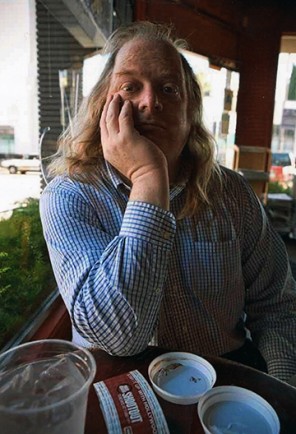
Jonathan Gold is the LA Weekly's restaurant critic and the author of "Counter Intelligence: Where to Eat in the Real Los Angeles." He began to write about food for the LA Weekly in 1984, when the paper's former owner admired a piece he'd written about health insurance and invited him to edit the biannual restaurant guide, and the "Counter Intelligence" column first appeared in the Weekly in 1986.
He has been restaurant critic for California, the Los Angeles Times, Los Angeles magazine and Gourmet, where he was the first food writer ever to be nominated for a general national award in criticism, and he has won James Beard Awards for both magazine and newspaper restaurant reviews.
Gold also wrote frequently about music and popular culture for Spin, Rolling Stone, Details and Vanity Fair, and contributes to the radio shows Good Food and This American Life.