
Pulitzer Prize Board 1960-1961

This Board presided over the judging process that resulted in the 1961 winners and finalists.

(Courtesy of The New York Times)

Barry Bingham Sr. Is Dead at 82; Louisville Newspapers' Publisher

By Alex Jones

August 16, 1988

Barry Bingham Sr., whose newspapers in Louisville, Ky., were leading liberal voices in the South, for decades, died yesterday at his Louisville home. He was 82 years old and had been undergoing treatment for cancer.

The Bingham newspapers, The Courier-Journal and The Louisville Times, championed such unpopular causes as civil rights and strip-mining reform, and won seven Pulitzer Prizes after coming under Bingham ownership in 1918.

In large part, their success was a result of Mr. Bingham's long-standing policy of sacrificing profit for editorial excellence. For instance, each paper had its own art critics, which most owners of papers the size of his two would have considered a great extravagance.

In 1971, Mr. Bingham retired from active management of the family companies, though he remained chairman. The family businesses included Louisville television and radio stations and a printing company.

Mr. Bingham was again thrust into the public eye in January 1986 when he decided to sell the papers and other enterprises to escape bitter family strife. His decision was characterized as a betrayal by his only surviving son, Barry Bingham Jr., who had managed the family businesses since 1971.

At the time, Barry Bingham Jr. was locked in a struggle over the future of the companies with his sisters Eleanor Miller, who favored the sale and has remained close to her parents, and Sallie Bingham, who also favored selling but has denounced the family as sexist and is estranged from the family.

The sale of the properties brought about $435 million, $300 million of which was paid by the Gannett Company for the newspapers.

Barry Bingham Sr. said in 1986 of his decision to sell the companies that his children had never learned to compromise, a practice he considered essential. Though the family remains divided over the wisdom of selling, he was attended closely by Eleanor and Barry Jr. in the months of his sickness.

Mr. Bingham was born in Louisville, where his father, Robert Worth Bingham, was a lawyer and politician and, later, United States Ambassador to Britain. After Mr. Bingham's mother died in an automobile accident, his father remarried Mary Lily Kenan Flagler, one of the nation's richest women. She died within a year, and left Robert Worth Bingham $5 million with which he acquired the Louisville newspapers.

After graduating magna cum laude from Harvard in 1928, Barry Bingham Sr. returned to Louisville to enter the family business. He married Mary Clifford Caperton of Richmond, Va., who graduated from Radcliffe in the same year.

After his father died in 1937, Barry Bingham became sole owner of the family enterprises. He hired Mark Ethridge, a celebrated liberal Southern publisher, as operating head of the companies. Advocate of Civil Rights

Mr. Bingham, as editor, directed the editorial page. Though the papers' later support for civil rights prompted a violent backlash, he said that in 1939 and 1940 his vigorous advocacy of the United States entering World War II was even more unpopular in isolationist Kentucky.

In May 1941 Mr. Bingham went on active duty in the Naval Reserve, mainly in response to taunts by his isolationist critics. He left Mr. Ethridge in charge of the newspapers in his absence, directing him to pay close attention to Mrs. Bingham, who was her husband's closest adviser.

He directed public relations for the Navy in Europe and was praised by reporters for his energetic efforts to speed articles through censorship. Upon returning to Louisville in 1945, he elected to remain editor and president of the papers so he could retain the services of Mr. Ethridge, who kept the title of publisher until 1961. That was the year Mr. Ethridge retired.

The arrangement freed Mr. Bingham to accept a wide array of other tasks. For example, in 1949 he began a year's service as chief of the Marshall Plan in France, and was given the rank of Commander, Legion of Honor, by the French Government. In 1955, he gave a series of lectures in the Fourth Fulbright Conference on American Studies at University College, Oxford.

Mr. Bingham took a very active role in local affairs. The companies contributed 5 percent of their pretax earnings to local charity, and even late in life, Mr. Bingham was deeply involved with community projects, especially arts endeavors like the Kentucky Center for the Arts Endowment Fund, of which he was chairman.

But the elegant appearance and glamorous living style of the Binghams, as well as their wealth, power and liberal politics, set them apart from many of their Louisville neighbors. They moved with a patrician grace through the cosmopolitan world outside Kentucky that occupied much of their time. Mr. Bingham was an overseer at Harvard University for 12 years, a trustee of the Asia Foundation and involved with many national and international organizations.

He was an ardent Democrat and devoted himself full time to Adlai E. Stevenson's 1956 Presidential campaign, not an unusual move for newspaper executives of that era.

Mr. Bingham's editorial page usually endorsed Democrats and he was at his most combative when he was writing editorials. He was also a man who loathed confrontation and sought common ground, and that made him less a kingmaker than his Republican and conservative critics contended he was.

Instead, to exert leadership behind the scenes, he used a talent for charm and tact and the influence of his communications empire.

Two of Mr. Bingham's sons, Jonathan and Worth, were killed in accidents in the mid-1960's, and his third son, Barry Bingham Jr., was stricken with Hodgkin's disease soon after taking charge of the family businesses in 1971. Though Barry Jr. recovered, the series of misfortunes aroused in Mr. Bingham a sense that the family was ill-fated.

Maintaining family ownership, especially of the newspapers, had been the central purpose of Mr. Bingham's life. But after deciding to sell, he said that he felt the outcome was almost destined.

Mr. Bingham lived from childhood on the family estate overlooking the Ohio River at Glenview, Ky., and had a summer house at Chatham, Mass.

He is survived by his wife, two daughters, and son, all of Louisville, and nine grandchildren.

(Courtesy of United Press International.)

PROVIDENCE, R.I. -- Sevellon Brown III, veteran Washington correspondent and reporter for the Providence Journal-Bulletin, died Wednesday at Rhode Island Hospital. He was 70,

Brown worked at the Journal-Bulletin from 1939 to 1968 when he retired because of ill health.

He was born in Washington on April 23, 1913, the son of Sevellon and Elizabeth Barry Brown.

His family had an association with the Journal-Bulletin that began in 1904 when his maternal grandfather, David S. Barry, left his post as Washington correspondent for the New York Sun to become editor-in-chief of the Providence newspapers.

Two years later, Barry returned to Washington as Journal-Bulletin correspondent. In 1919, he was elected sergeant-at-arms of the U.S. Senate.

The elder Sevellon Brown succeeded his father-in-law as Washington correspondent after service in World War I. He then moved to Providence as managing editor and later became editor and publisher of the newspapers.

The younger Brown, known as Jeff, was Journal-Bulletin Washington correspondent from 1939-1942 and as bureau chief from 1942 to 1944.

After World War II and service with the OSS in London, Brown returned to the Journal-Bulletin as assistant to the editor (his father) from 1946 to 1949, then as associate editor from 1949 to 1953. He was appointed editor on Feb. 4, 1953 and held the post until his retirement.

For several years he served on the advisory board of the American Press Institute, chaired the American section of the International Press Institute, served on Columbia University's Pulitzer Price selection committees, and on the committee that selected Nieman fellowships for Journalists at Harvard.

Brown was a board member and later president of the New England Society of Newspaper Editors and chaired the New England Associated Press News Executives Association.

He is survived by his wife, the former Janice O. Van DeWater, two daughters by a previous marriage, five grandchildren, and a brother, Barry Brown, of Washington.

A memorial service was scheduled at 1 p.m. Friday at Swan Point Chapel. Burial will be private.

Erwin D. Canham, who guided The Christian Science Monitor as its chief news executive for nearly three decades, died yesterday in Agana, Guam. It was under Mr. Canham's leadership that the churchsponsored paper attained its reputation for thoughtful, analytical coverage. Mr. Canham was 77 years old.

Mr. Canham underwent abdominal surgery on Guam two weeks ago. He and his wife, Patience, maintained homes on Saipan, where he had served as resident commissioner of the Northern Marianas Islands in the 1970's, and at Cape Cod, Mass.

Mr. Canham, a soft-spoken, genteel man with a puckish sense of humor, served the internationally circulated newspaper for 49 years as reporter, Washington bureau chief, columnist, managing editor, editor and editor in chief. He became editor emeritus in 1974 and five years later retired.

Strengthened Foreign Coverage

As the newspaper's editor from 1945 to 1964 and as editor in chief for the next 10 years, he strengthened The Monitor's coverage of foreign news and developed staff specialists in that and other areas.

"The paper had had expert editors before him, and they were competent professionals, but a more intense journalistic competence was developed under Canham,'' said Saville R. Davis, former managing editor of the paper.

Mr. Canham was also respected for his knowledge of international affairs, familiarity with political and business leaders around the world and his many outside interests.

''He was extremely speedy as a thinker and a writer,'' turning out a column and serving on outside comittees while putting out a newspaper, said the paper's editor, Earl W. Foell.

Paper's Charter From Miss Eddy

The Boston-based newspaper, which has a circulation of 180,000, has carefully adhered to the philosophy of Mary Baker Eddy, the founder of Christian Science who established the publication in 1908 and said its goal would be ''to injure no man, but to bless all mankind.''

In practice, this meant little emphasis on crime, violence and disasters, and greater attention to topics of long-term significance. In a departure from the practice at most other newspapers, The Monitor has given little attention to medical news because of the church's emphasis on spiritual healing. However, Mr. Canham said, this had its compensations because much medical news was of transient significance.

In explaining the newspaper's approach, Mr. Canham argued that, by the mid-1960's, radio and television had forced newspapers to go beyond ''the mere reporting of the event'' and that editors should ''press the task of reporting more deeply and widely.'' However, he warned that reporters must avoid coloring their articles with opinion.

Mr. Canham's career was an unusual combination of two deep interests: religious concern and a nose for news. A lifelong Christian Scientist, he taught a Sunday school class of college students at the Mother Church, near his office.

In 1966, he was given a one-year term in the largely honorary post of president of the church. In a worldwide lecture tour, he argued that the estrangement of science and religion was a mistake, adding, ''It is important to see that truth -spiritual truth - runs through all aspects of life.''

Robert P. Hey, The Monitor's managing editor, said: ''He had quite an extraordinary gift for combining the big, broad canvas, in terms of national and international coverage, with the importance of the individual, no matter what his job. He made it his business to know something about and to care about you.''

Erwin Dain Canham was born Feb. 13, 1904, in Auburn, Me. His father was agricultural editor of The Lewiston (Me.) Sun and Journal. Mr. Canham recalled that when he was 8 years old he stood on a chair in f ront of an old-fashioned wall telephone and took down items for publication. At 14, he became a general repor ter for the paper in theWorld War I manpower shortage.

He worked as a correspondent for up to eight daily newspapers while attending Bates College in Lewiston. Received Rhodes Scholarship

After graduating in 1925, he reported for The Monitor for a year before attending Oxford University as a Rhodes scholar. While there he covered the League of Nations for The Monitor.

Rejoining the newspaper full time, Mr. Canham covered national and international events, served as chief of the Washington bureau from 1932 to 1939, and was general news editor until 1942, when he became managing editor. Four years later he became the editor.

A year after being named editor emeritus, Mr. Canham was sent to Saipan by the United States Government to administer a plebiscite in which residents of the Northern Marianas Islands voted to withdraw from the American-administered Trust Territory of the Pacific Islands. He was Resident Commissioner from 1975 until 1978.

Accepted Outside Positions

Unlike some newspaper editors, Mr. Canham accepted a variety of outside posts. In 1948 he was vice chairman of the United States delegation to the United Nations Conference on Freedom of Information. In the Eisenhower Administration, he was chairman of the National Manpower Council and a member of the Commission on Information, which helped shape United States policy on information and propaganda.

In 1959, he was president of the Chamber of Commerce of the United States. In the 1970's, he was a member of President Nixon's Commission on Campus Unrest and a member of the board of the Public Broadcasting Service. He was president of the American Society of Newspaper Editors in 1948-49.

Mr. Canham's first wife, the former Thelma Whitman Hart, died in 1967. In addition to his wife, he is survived by two daughters, Carolyn Shale Paul and Elizabeth Davis. -- (from The New York Times, Jan. 4, 1982 by William Dickie) Edward D.

Canham joined the Pulitzer Board in 1958.

(Courtesy of Mississippi Writers & Musicians)

By Jennifer Phillips (SHS)

“The South is so often damned for social backwardness, for reaction entrenched in smugness and lethargy, that it is a pleasure to introduce a young Southerner who represents a totally different school of thought and action.”    Saturday Evening Post Feb.23, 1946, on Hodding Carter’s 1946 Pulitzer Prize   

William Hodding Carter II, the son of William Hodding and Irma Dutarte Carter, was born on February 3, 1907, in Hammond, Louisiana (USM-McCain Library and Archives).  As a young child, Carter spent his summer days with his grandmother in the Mississippi Delta along the Mississippi River. At the age of eighteen, Hodding Carter moved away to attend Bowdoin College in Maine, were he received his B.A. in 1927.  Carter then transferred to Columbia University to study journalism for one year before taking a teaching fellowship at Tulane University in 1928. Upon completion of his fellowship at Tulane, Carter began writing for the New Orleans paper, Item-Tribune. He then took a job working as the Night Bureau manager for United Press in New Orleans. His competence and determination brought him to Jackson, Mississippi, in 1930 as the Bureau Manager of Associated Press (Current Biography 1946).

On October 31, 1931, Hodding Carter married Betty Werlein.  However, their  happiness  immediately met with turmoil. In April of 1932, Hodding Carter was fired from his job at Associated Press for “insubordination.” The supervisor who made the decision to release Carter from his position wrote a letter to Carter. Carter says  that the letter stated that he “had some good qualities, but I would never make a newspaper man, and I ought not waste any time getting into another business” (Carter 3). The man’s attempt to persuade the young writer from a career in journalism failed miserably.  The young couple moved back to Carter’s hometown of Hammond, Louisiana, where they intended to open a daily paper, the Daily Courier. An attack on his abilities had only made the Carter more determined, “We had to prove to our families and ourselves and the man who had written the letter that the letter was wrong.”(Hodding Carter in his biography Where Main Street Meets the River). The main goal of Carter’s Daily Courier was to focus on the wrong doings of Congressman Huey Long. Carter’s newspaper was so strong that “theirs was the only district in the state [Louisiana] that never sent a Long henchman to congress,” (Time Magazine 20May46). Amidst the battle against Huey Long, the Hammond Daily Courier took the time to print such articles as the birth of Hodding and Betty’s first son, William Hodding Carter III, on April 8, 1935 (Current Biography:  1946).

In 1935 Carter attended a literary conference in Baton Rouge, Louisiana.  While there, he met David Cohn, a Greenville, Mississippi, writer and author.  Cohn convinced Hodding that Greenville needed his talents as an experienced newspaperman.  On July 7, 1936, Hodding Carter drew up an outline for his new paper, and, with help from William Alexander Percy, author of Lanterns on the Levee (yet unpublished), the Delta Star was up and running (Waldron 69).

In 1938, Carter and Betty bought out the only other daily in Greenville, the Democrat Times, and merged the two papers to form the Delta Democrat-Times.  The paper was a steady success, and Hodding gained more recognition for his talents as a editor and writer.

On September 29, 1938, Neville Chamberlain and Daladier met with Hitler and Mussolini in Munich.  On the 30th, the Munich “Peace in our times” Pact was signed.  Hodding’s feelings on this matter were so stong in opposition to the pact that he signed with the National Guard (Waldron 87).

In April of 1939, Carter was offered one of the prestigious Neiman Fellowships at Harvard University. After much debate and long conversations with his wife, Percy, and other shareholders of the Delta Democrat-Times, Hodding decided to accept the fellowship. In October of 1939, their second son, Philip Dutartre Carter, was born.  In January of 1940, Hodding and Betty set off with their two boys to Cambridge, Massachusetts.  While at Harvard, Hodding had time to think about an offer Ralph Ingersoll had made to him–to be the editor of Ingersoll’s creation, PM.  On June 1, 1940, Carter reported to work in New York, New York. While Carter did gain some recognition at PM, he wanted to return to the Delta and his newspaper. On September 21, 1940, he was on his way out the door and back to Greenville, Mississippi,  to take up his old job (Where Main Street Meets the River).

In November, 1940, the National Guard mobilized, and Carter was, once again, on the move– this time to Camp Blanding, Florida.  While there, he became Public Relations Officer for the regiment.  He also suffered an accident while training that cost him his sight in one eye.  Sent overseas with the war, Carter wrote for the Middle East versions of the patriotic papers, Yank and Stars and Stripes in Cairo, Egypt. In 1945, Hodding Carter received an Honorable Discharge from the United States Armed Services and returned home to Greenville, Mississippi (Current Biography:  1946).

Upon arrival home, Carter took up his fight against Senator Theodore Bilbo.  He wrote a series of articles dealing with racial, economic, and religious problems in Mississippi.  His editorials were published at a very rocky time in the South, and Hodding’s  articles stood apart from other debate and speculation on the status of African-Americans in society at the time.  The magazine PM stated in an article published on August 5, 1945, that “The chief reasons for the silence are the fear of being labeled a ‘nigger lover’ or the feeling–even among many of those unsympathetic with such views–that the South should present a united front un racial matters” (Current Biography: 1946). Widely acclaimed and criticized, Hodding received national recognition as a writer when he won the Pulitzer Prize for Editorial Writing in May of 1946. In August of ’46, Carter established a second paper, the Delta Star, which received attention when Hodding published an article dealing with the beating–death of a black boy by five white boys (Cox Mississippi Almanac).

Tragedy struck the Carter family on April 27, 1964, when Hodding and Betty’s third son, Thomas Hennen Carter, shot himself while playing Russian Roulette. That same day, Hodding had been hospitalized for separating his retina.  He was temporarily blind (Waldron 305).

In 1964, Congress passed the Civil Rights Bill. Hodding continued to contribute editorial  to the Delta Democrat-Times, which his son now ran unofficially.  He also contributed two articles to the New York Times Magazine dealing with the South’s judicial system and the degradation of the Confederate flag (Waldron 317). In 1965, Hodding gave  the very first Carlos McClatchy Memorial Lecture at Stanford University.  In June of 1966, when son Hodding Carter III came back from Harvard, Hodding officially handed the paper over to him. Betty and Hodding spent the summer in Maine, trusting “Young” Hodding to take care of the business without his father watching over him.

In 1968, Hodding was asked to give the Lamar Memorial Lectures at Mercer University in Macon, Georgia.  He was so ill that he was unable to speak, and his wife was forced to read from notes he had prepared for himself.  He also received the Tenth Annual First Federation Award for his service to Mississippi (Waldron 321). He was not able to travel to Columbia University in 1971 when he received the Columbia University Journalism Award.

Eventually, Hodding Carter’s condition deteriorated even more.  On April 4, 1972, Hodding Carter died. Both of his sons wrote editorials about him in the Delta Democrat-Times. The following day. Philip, who runs the paper today, recalled, “We called him Big because he was; Hodding Carter was the biggest of his clan, a legend, first of all in his own tribe.” (Waldron 325).

“If I have gained anything in life, it is a belief in the soul and the destiny of man.”
                                                                 Hodding Carter

(Courtesy of The New York Times)

Turner Catledge Dies at 82; Former Editor of The Times

Turner Catledge, former executive editor of The New York Times, died at home in New Orleans yesterday of a long illness after a stroke. He was 82 years old.

In a journalism career that spanned five decades, Mr. Catledge began as a reporter covering floods and murders, went on to the White House and national politics and for 17 years oversaw the work of several hundred reporters and editors.

Mr. Catledge expanded the coverage of foreign and national news in The Times and stressed the importance of writing, as he put it, ''in terms of people and how they lived.'' 

Under Mr. Catledge, the paper also stepped up its reporting on religion and other specialized subjects, began devoting more space to biographical material about people in the news and covered politics with the general reader in mind, rather than the political specialist.

''I had no master plan, no magic formula for solving the paper's problems,'' he once said. ''I was dealing with people - talented, sensitive, sometimes stubborn people - and they were constantly surprising me, one way or the other. I proceeded by trial and error, always pragmatic, trying to learn from experience.''

Editors and reporters who worked with the tall, courtly Southerner say that in addition to changing the content of the newspaper, he also passed along to a generation of developing journalists a passionate concern for fairness in news coverage and the need for a strong sense of ethics.

''Turner Catledge made a vital contribution to American journalism,'' said Arthur Ochs Sulzberger, the publisher of The Times. ''His was a unique talent with an unfailing sense of mission. He never lost sight of journalism's ultimate purpose - to inform the reader, to bring him each day a letter from home and never to permit the serving of special interests. His love of his craft and his deep affection for those who practiced it well have left an enduring imprint on The Times.

''He was loved and we will miss him.'' Mr. Catledge, who was born on a farm in central Mississippi and worked his way through college as a waiter, had a beguiling manner that helped him build a large and effective network of news sources as a reporter and win the friendship of several Presidents.

He liked to entertain friends and colleagues with homespun anecdotes and imitations of Southern politicians. When he addressed large groups, he once told a reporter, ''I ad-lib a great deal and I syncopate it.''

Colleagues said it was a combination of gifts - intelligence, enterprise and courage - that made Mr. Catledge an esteemed newspaperman. In 1926, he investigated fraud in Tennessee's Democratic primary so vigorously that followers of the state Democratic Party's leader, Edward Hull (Boss) Crump, beat him until he bled.

Opportunity, in the form of two Memphis city detectives, knocked on Mr. Catledge's door one morning in 1927. Alarmed by the fierce pounding, his widowed mother, Willie Anna Turner Catledge, answered the door of the apartment that she shared with him.

The detectives demanded to see Mr. Catledge, then a 26-year-old reporter for The Memphis Commercial Appeal. Even though she was afraid that he was being arrested, she woke him; he was sleeping late because he was exhausted from two weeks of covering a vast and devastating Mississippi River flood.

By plane and car he had been across six states to chronicle the destruction -taking pictures, telephoning his reports back to Memphis, even doing newscasts for his newspaper's radio station. A Meeting With Hoover

The detectives rushed Mr. Catledge to the elegant old Peabody Hotel and into a suite that was occupied by Herbert Hoover, then the Secretary of Commerce, who had just arrived in Memphis. President Calvin Coolidge had sent him down from Washington to oversee relief efforts in the flood area.

Mr. Hoover, who had been told by the Mayor of Memphis that The Commercial Appeal's reporter was highly knowledgeable, began bombarding Mr. Catledge with questions about the flood.

He gave detailed answers, and the Secretary paid careful attention to the eager young man with the shrewd eyes, pink-cheeked good looks and easy Southern courtesy.

Mr. Hoover was impressed - so impressed that he later wrote a letter about Mr. Catledge to Adolph S. Ochs, then publisher of The New York Times and grandfather of the present publisher. 

Mr. Hoover suggested that The Times hire Mr. Catledge as a reporter, and it did - but not until 1929, after Mr. Hoover had repeated his recommendation, this time as President of the United States.

Before long, Times executives, too, were impressed with Mr. Catledge's talents - so impressed that they made him deputy chief of the Washington bureau, from 1936 to 1941; national correspondent, 1943-44; an aide to the managing editor, 1944-51; managing editor, 1951-64, and executive editor, 1964-68. He was a director of The New York Times Company from 1968 to 1973 and a vice president from 1968 to 1970 before retiring.

Reminiscing about his editing years, Mr. Catledge once wrote: ''My career was not without drama, but the hardest decisions tended to be those within the organization, within the family, decisions regarding policy and people, decisions that demanded a crusading spirit less often than a careful balancing of complex issues.'' A Visit to Pacific Island

Mr. Catledge was a valued friend and counselor to three publishers of The Times, as well as chief steward of their family-controlled enterprise. Arthur Hays Sulzberger, Mr. Ochs's son-in-law and successor as publisher, found Mr. Catledge to be a congenial traveling companion even under difficult circumstances. When they were visiting the Pacific island of Peleliu in 1944 shortly after American soldiers had occupied it, a Japanese sniper's bullet narrowly missed them.

Undisturbed, Mr. Sulzberger remarked to their Army escort, ''I don't think all resistance has stopped.'' Mr. Catledge, with a skilled reporter's reflexes, took shelter behind a jeep.

In later years, Mr. Catledge used to eat sandwich lunches in Central Park with Arthur Hays Sulzberger's son-in-law and successor as publisher, Orvil E. Dryfoos. And he was fondly nicknamed ''Professor'' by Mr. Dryfoos's successor, Arthur Ochs Sulzberger. 

Mr. Catledge's ideas and convivial nature also led him to be active in the Associated Press Managing Editors Association and the American Society of Newspaper Editors, which he served as president in 1960 and 1961. He helped to establish another journalistic organization, the American Press Institute, and was on its advisory board for many years.

As he noted in his autobiography, ''My Life and The Times,'' Mr. Catledge also had his flaws and foibles. During his rough-and-tumble apprenticeship in Southern journalism, he sometimes stole photographs of newsworthy people from their homes. As a writer, he was not notably polished. As an editor, he noted in his autobiography, he was often irritable about small errors.

Mr. Catledge was born on March 17, 1901, in Choctaw County in central Mississippi. In his ''Who's Who'' biography he gave his birthplace as Ackerman, a lumber-milling town, but he was actually born on his paternal grandfather's 300-acre farm near a hamlet called New Prospect. 

The people of that part of Mississippi are known for being tough and shrewd; many of them are small cotton and soybean farmers scratching a living from the red clay soil. The Catledges were farmers, while the Turners, Mr. Catledge's family on his mother's side, had gone into shopkeeping.

From his father, Lee Catledge, a political enthusiast who became Mayor of Philadelphia, Miss., Mr. Catledge acquired a passionate interest in politics. And from his mother, a strong-willed seamstress who ran a boardinghouse in Philadelphia, he acquired much of his ambition and drive.

Mr. Catledge spent most of his boyhood in Philadelphia, a cottonginning center in east central Mississippi. The town's high school gave Mr. Catledge a sound grounding in Latin, Greek and English composition.

Mr. Catledge went on to major in business at Mississippi State University near Starkville, 50 miles north of Philadelphia. His family was financially hard pressed, and while he was an undergraduate he worked as a waiter to help make ends meet. When he went on dates, he used to borrow clothes from a student who was better off - John C. Stennis, who later became a United States Senator from Mississippi.

After graduating in 1922, Mr. Catledge went to work running The Tunica Times, a small weekly newspaper in Tunica, in the northwestern corner of Mississippi. At the owner's behest, he published articles designed to make local blacks feel at home and not want to move to the North. He also wrote a series of articles denouncing the Ku Klux Klan.

''I thought very little about the plight of Negroes during my early newspaper career,'' Mr. Catledge wrote in his autobiography, which was published in 1971. ''Separate but equal was the law of the land, and it did not occur to me to challenge it. My thinking changed slowly, as did the nation's. When the great Supreme Court decisions of the 1950's came down, outlawing various forms of segregation, I realized that they were right, that segregation in public institutions and facilities cannot be tolerated.''

From Tunica, Mr. Catledge moved 100 miles southeast to Tupelo, Miss., a cattle-marketing center, where he served briefly as managing editor of The Tupelo Journal, a biweekly paper, at a weekly salary of $22.50.

Seeking greater opportunities, he soon moved on to the nearest big city, Memphis. He arrived there by train during a blizzard in February 1924 with $2.07 in his pocket.

After a brief stint on The Memphis Press, Mr. Catledge went to work for The Commercial Appeal and soon impressed his bosses and coworkers with his touch typing, his vocabulary and his large repertory of hymns, in addition to his reportorial skills.

In 1927 Mr. Catledge took a job as a reporter for The Baltimore Sun, where, he later recalled, ''I learned to write better, to dress better, to act better - in short, to behave in a more civilized style than prevailed among Memphis newspapermen.'' It was in Baltimore, he wrote, ''that I first learned there are better things to drink than corn whisky.''

After two years The Times beckoned, and Mr. Catledge went to work briefly as a Times reporter in New York, covering Jewish affairs and later serving as a general-assignment reporter. Then he joined the Washington bureau, where his first job was covering the House of Representatives. 

Soon after arriving in the capital, he paid a call on Mr. Hoover in the White House. The President asked how much The Times was paying him, and when Mr. Catledge told him $80, Mr. Hoover remarked that it was too little. Mr. Catledge said the salary was not all that important, but the President admonished him, saying, ''You don't want to be too idealistic where money is concerned.''

Although Mr. Catledge was a lifelong Democrat, he tried to be impartial in his Washington reporting. ''I am a Democrat for the same reason the Pope is a Catholic,'' he liked to say. ''I was born one and subsequent developments persuaded me to remain one.''

In 1936, President Franklin D. Roosevelt summoned Mr. Catledge to the White House and, saying that he did not get along with Arthur Krock, the longtime head of the Washington bureau, he proposed to bypass the bureau chief and disclose news directly to Mr. Catledge. Out of loyalty to Mr. Krock, Mr. Catledge refused the President's offer. 

The following year, Mr. Catledge covered Mr. Roosevelt's attempt to ''pack'' the Supreme Court with additional justices who would be sympathetic to the President's views, which Congress refused to approve.

After the attempt, Mr. Catledge and Joseph Alsop, then a Capitol Hill correspondent for The New York Herald Tribune, wrote a book about it entitled ''The 168 Days.'' It became a best seller.

In 1941 Mr. Catledge, still seeking greater opportunities, left The Times to work for The Chicago Sun. He began as chief correspondent, then became editor in chief. But he felt out of place on the paper.

''We just didn't fit,'' he later said in an interview. ''I'd become so much a part of The Times.'' So after 19 months, he recalled in his autobiography, he went back to Washington with The Times, taking a cut in his annual salary, from $26,500 to $12,000. 

In January 1945, Mr. Catledge moved to New York, and for seven years was the chief assistant to Edwin L. James, the managing editor. Mr. Catledge had begun as an assistant to Mr. James with the primary assignments of adding youth and vigor to The Times's editing and reportorial staffs and improving its internal organization.

Mr. Catledge duly set about trying to bring more unity among what he later called The Times's ''many pockets of bureaucracy'' and its ''various dukedoms'' - notably the Washington bureau - which he said were ''fiercely jealous of their prerogatives.''

He handled the problem in various ways, including the initiation of daily editors' meetings and the relaxation of jurisdictional boundaries within the newspaper.

In addition, Mr. Catledge tried to improve the paper's foreign news coverage, although it was already widely admired. In his memoirs he recalled urging Mr. James to increase coverage of Latin American affairs.

''I argued that we had a responsibility to develop an audience,'' Mr. Catledge wrote, ''that our readers should never be surprised by anything that occurred in the world.'' And, in due course, Times readers were served larger helpings of staff-written news from Latin America.

When Mr. Catledge became managing editor in December 1951, after the death of Mr. James, he assumed overall supervision of the paper's daily news staff. He did not direct the editorial page or the Sunday sections; their chiefs reported directly to the publisher.

In various ways, Mr. Catledge tried to brighten the paper. He particularly wanted reporters to write shorter sentences. In this effort his chief aide was one of his editor-proteges, Theodore M. Bernstein, who was named an assistant managing editor. Decision on Article on Cuba

Mr. Catledge also spent much time and energy on personnel matters, including the advancement of outstanding staff members. Among them were Clifton Daniel, a foreign correspondent, who became his chief assistant and succeeded him as managing editor, and A.M. Rosenthal, also a foreign correspondent, who was named metropolitan editor by Mr. Catledge and is now executive editor.

It was as managing editor that Mr. Catledge made the decision on how to handle one of the most debated articles ever published by The Times, a report by Tad Szulc that counterrevolutionaries were training in the United States and in Central America for an invasion of Cuba in 1961.

The article was published 10 days before anti-Castro forces backed by the Central Intelligence Agency landed in Cuba at the Bay of Pigs. While some executives of the newspaper argued that the article should be withheld out of concern for national security, Mr. Catledge contended that The Times was obliged to present the story. But he deleted from the article the reporter's characterization that the invasion was ''imminent,'' because he felt the newspaper should not be making a prediction. He also replaced all references to the C.I.A. with the term ''United States officials.''

President Kennedy accused The Times and other newspapers of disregarding national security in their reporting of the anti-Castro activities. But Mr. Catledge said in his autobiography that the President later told him privately, ''If you had printed more about the operation you would have saved us from a colossal mistake.''

Mr. Catledge wrote that, in hindsight, he thought the newspaper should have printed more than it did and, ''if we had, we might have caused a cancellation of the invasion.''

''But,'' he added, ''that judgment is based on knowledge I did not have at the time - that the invasion was in fact imminent and, most important, that it was destined to utter failure.''

In 1964, when Mr. Catledge became executive editor, he undertook overall supervision of the Sunday sections as well as the daily paper. Then, in 1968, he was named a vice president and became in effect a senior adviser to James Reston, his successor as executive editor, and to Arthur Ochs Sulzberger, who had become the publisher. In 1970, he retired to live in New Orleans.

Mr. Catledge was a member of the Century Club in New York, the Metropolitan Club in Washington and the Boston Club in New Orleans, among others, and held honorary degrees from Tulane and Washington and Lee Universities and the University of Kentucky.

Mr. Catledge was married in 1931 to Mildred Turpin, whom he had met when he was a young reporter in Baltimore. They were legally separated in 1949 and divorced some years later.

In 1957, while in San Francisco to deliver a speech to a meeting of the American Society of Newspaper Editors, Mr. Catledge met Abby Ray Izard of New Orleans. In his memoirs he wrote: ''Mrs. Izard fell under the spell of my oratory, which I repeated, in various settings and forms, during the next seven months until she became Mrs. Turner Catledge.''

Mr. Catledge is survived by his wife; two daughters by his first marriage, Mildred Lee Sampson of Stratford, Conn., and Ellen Douglas Catledge of McLean, Va.; a sister, Bessie Catledge Porter of Memphis; four grandchildren, and one great-granddaughter.

No funeral service is planned. The family suggests that in lieu of flowers, contributions be made to the Turner Catledge Fund for Journalistic Studies, Mississippi State University (care of the Development Office), Mississippi State, Miss. 39762.
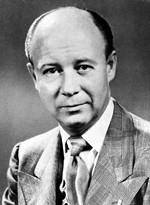
(Courtesy of Encyclopedia Britannica.)

Norman Chandler, (born September 14, 1899, Los Angeles, California, U.S.—died October 20, 1973, Los Angeles), American newspaper publisher who helped change the Los Angeles Times from a conservative regional journal to one of the largest and most influential newspapers in the world.

After attending Stanford University, Norman Chandler joined the Los Angeles Times in 1922 as secretary to his father, Harry Chandler, the paper’s owner. Norman became president and general manager of the paper in 1941. In 1960 he stepped aside as publisher in favour of his son, Otis, under whose direction the newspaper gave more editorial space to liberal and opposing viewpoints. He modernized the Times Mirror Company’s operation and made the Times one of the most automated newspapers in the United States. After he relinquished the day-to-day operations of the Times in 1960, Norman concentrated on expansion and diversification, buying the daily Newsday in Garden City, New York, the Orange Coast Daily Pilot in Orange county, California, and the Dallas Times Herald in Texas.

In 1991 Otis Chandler stepped down as board chairman after 10 years in that position. The Los Angeles Times had won 16 Pulitzer Prizes during his tenure. In March 2000 the Chandlers, who owned the majority of Times Mirror stock, sold the company to the Tribune Company of Chicago. (See Chicago Tribune.)

(Courtesy of The New York Times)

John Hohenberg, 94, Former Pulitzer Prize Official, Dies

By Douglas Martin

August 8, 2000

John Hohenberg, who began his journalism career as a teenager by snatching an interview with the president of the United States and went on to become administrator of the Pulitzer Prizes, died Sunday morning at his home in Knoxville, Tenn. He was 94.

Mr. Hohenberg also taught journalism for many years at Columbia University and wrote a widely used textbook on reporting. In all, he wrote 22 books -- including a novel at the age of 80 -- and maintained an arduous professional itinerary.

He wrote for numerous New York newspapers and taught at universities from New York to Tennessee to Florida to Kansas to Syracuse. He traveled the world, particularly Asia, lecturing for the State Department and other federal agencies. He began the practice of publishing the names of Pulitzer jurors and of drawing jurors from regions beyond New York.

Mr. Hohenberg came from the golden age of competitive newspapering, covering the 1935 trial of Bruno Richard Hauptmann -- who was convicted of kidnapping Charles Lindbergh's baby -- hanging out with Hemingway in Paris and reporting on the birth pangs of the United Nations and Israel. Tom Goldstein, dean of the Graduate School of Journalism at Columbia University, speaks of ''the John Hohenberg legend.''

Mr. Hohenberg's larger mission was elevating journalism itself, and he viewed the painstaking selection of Pulitzer winners as another means of raising the bar.

''Our news media, our reporters and editors -- if they are serious people and if they really mean business and aren't merely sensation-minded -- should be the conscience of the American people,'' he said in a 1988 interview in The New York Times.

He abhorred pomposity and wordiness, regarding journalism as a spontaneous ballet that could seldom be perfect because of daily deadlines. His motto, first growled to him by a crusty editor, was, ''Go with what you got.'' Generations of journalism students at Columbia committed the slogan to memory and the class of '69 had it printed on sweatshirts.

Mr. Hohenberg was born on Feb. 17, 1906, in a tenement on the Lower East Side of Manhattan, the son of Louis Hohenberg, a Hungarian immigrant, and Jettchen Scheuermann, an immigrant from Germany. When he was 18 months old, the family moved to Seattle, where his father set up several small businesses.

He started as an engineering student at the University of Washington but did not like it. His father refused to pay for the liberal arts education he wanted, so the gangling 17-year-old showed up at The Seattle Star, now closed, to ask for a job.

The response was brusque, he later recalled. ''Listen, kid,'' the city editor said, ''the president of the United States is coming to Seattle tomorrow. You get me an exclusive interview and I'll give you a job.''

When the Secret Service demanded to see his nonexistent press credentials, employment seemed unlikely. He called the office, fearing that his name would mean nothing.

''Mercifully,'' he wrote later, ''by grace of the kindly Jehovah that watches over babies, pretty girls and addled young men, the city editor remembered me and was sportsman enough to clear me for passage to the pier as a Star reporter.''

The result was a second's conversation in which President Warren G. Harding allowed that he liked Seattle. Mr. Hohenberg turned the remark into a three-page story. ''For better or worse, I had become a newspaperman,'' Mr. Hohenberg said.

The family soon moved back to New York to be nearer relatives. While attending journalism school at Columbia, Mr. Hohenberg worked for The New York Graphic, his first stop in 25 years of working for New York papers. After graduating, he toured Europe as the recipient of a Pulitzer Traveling Scholarship.

In 1948, as he was reporting on the establishment of the United Nations at Lake Success, N.Y., he was asked to substitute for a Columbia journalism teacher who had broken a leg. The students liked him, he liked the students and a new career began.

In 1960, he published what became the basic reporting and writing textbook used at many journalism schools, ''The Professional Journalist'' (Holt, Rinehart & Winston), which went through five editions and has been translated into Chinese, Japanese, Arabic and Spanish.

His 21 other books ranged from several histories of the Pulitzer Prize to an exhaustive history of foreign correspondence, recounting its beginnings in the Napoleonic Wars and offering long analyses of the challenges facing journalism.

Soon after his appointment in 1953 as administrator of the Pulitzer Prizes and secretary of the Advisory Board on Pulitzer Prizes, he nudged at least two members of the Pulitzer board into seeing all the plays under consideration for the drama prize, something not necessarily done before.

In later years, he wrote about how the Columbia trustees, as final arbiters, refused to accept the Pulitzer board's recommendation that The New York Times be given a prize in 1972 for its publication of stories based on the Pentagon Papers, the government's classified history of the Vietnam War.

The trustees were uneasy over the newspaper's decision to report classified material, an unusual action for journalists in that period. Columbia's president, William J. McGill, persuaded the trustees to reverse their decision.

Then, Mr. McGill and Mr. Hohenberg persuaded the trustees to yield veto power over the Pulitzers, perhaps the biggest procedural change during Mr. Hohenberg's tenure, which ended in 1975. The year before, he had accepted an appointment as professor of journalism at the University of Tennessee. That was the first of a chain of academic stops over the last two decades of his life.

Mr. Hohenberg married Dorothy Lannier, a classmate at Columbia, in 1928. She died in 1977. They had no children. He is survived by his second wife, JoAnn Fogarty Johnson, and her two children, whom he adopted: Pamela Green of Knoxville and Eric of Dawsonville, Ga.

In 1986, Mr. Hohenberg's wife found a yellowing manuscript on newspaper copy paper in the basement that turned out to be the skeleton of a spy novel he had abandoned in the 1920's. He whipped it into shape and sold it, under the title ''The Parisian Girl.''

In 1976 he received a Pulitzer Prize special award for his service to journalism. The citation said thousands of journalists had learned to value his tough integrity.

''From you they learned to respect the language,'' it read. ''They might split an infinitive because you taught them how. But they dare not dangle a participle. You forbid it.''


(Courtesy of The New York Times)

Grayson Kirk, 94, President of Columbia During the 1968 Student Protests, Is Dead

By Karen W. Arenson

November 22, 1997

Grayson Louis Kirk, the scholarly president of Columbia University whose ill-fated decision in the spring of 1968 to turn 1,000 police officers in riot gear against student protesters became an emblem of the generational conflict characterizing the Vietnam War era, died early yesterday morning.

He was 94 and died in his sleep at his home in Bronxville, N.Y., his son, John G. Kirk, said.

For many years, the university grew and prospered under Dr. Kirk's leadership. An exponent of broad, liberal education of the sort Columbia offered, he proved adept at relating to the trustees and to raising money. Under him, the university quadrupled the size of its endowment. It also expanded its library, introduced new academic programs and built more than a dozen new buildings.

But toward the end of his tenure, Dr. Kirk was widely viewed as no match for the enormous pressures for social change surging through the institution in the late 60's. He resigned shortly after the student protests of 1968.

Dr. Kirk became the university's president in 1953, succeeding Dwight D. Eisenhower after his election as President. A portly, pipe-smoking man, he presided over a period of enormous growth for the university. But as the 60's swept by, Dr. Kirk repeatedly found himself and Columbia at the center of public controversies: for deteriorating relations with the surrounding community, capped by the university's decision to build a gymnasium in Morningside Park; for taking a controlling interest in a cigarette filter whose sale would bring revenues to Columbia; and finally, for the way he handled the student demonstrations of 1968. Those demonstrations were directed against the building of the gymnasium and the university's affiliation with a consortium that did military research for the Government.

Students took over five campus buildings and the president's office. The pressure built as the police stood outside the campus gates while faculty and student negotiating committees tried to end the protest. Finally, on April 30, 1,000 helmeted police officers swarmed onto campus and began dragging away the protesters, kicking and beating those who did not move fast enough. Hundreds of students were arrested and dozens injured. Dr. Kirk said the decision to call in the police was ''obviously the most painful one I ever made.''

As the students left, they chanted: ''Kirk must go, Kirk must go.''

A second campus protest a month later resulted in another battle between student protesters and police, but Dr. Kirk resisted leaving office, declaring repeatedly that he would not bow to the protesters and resign.

But in August 1968, just four months after students had first occupied his office, he stepped down, saying that he hoped his retirement would ''insure the prospect of more normal university operations.''

He became president emeritus, and said he would continue to help raise money for the university.

As college administrators everywhere faced campus protests and challenges to their authority, the actions of Dr. Kirk and Columbia administrators were closely examined. The Cox Commission, a panel established by Columbia's faculty to investigate the campus uprisings, said that Columbia's administration and trustees had ''too often conveyed an attitude of authoritarianism and invited mistrust.''

The 222-page report, delivered in October 1969 and written largely by the panel's chairman, Archibald Cox, a Harvard Law School professor and former Solicitor General of the United States, was sharply critical of Dr. Kirk's tenure.

''The hurricane of social unrest struck Columbia at a time when the university was deficient in the cement that binds an institution into a cohesive unit,'' the report said.

It took Columbia to task for the ''unhealthy relations'' with the largely black community of Harlem, pointing to its ''indifference'' to the poor and the manner in which the university had expanded its presence in Morningside Heights.

But the commission pointed to equally poor relations on the campus itself, and criticized the administration for its handling of the student protests. ''The trauma of the violence that followed police intervention intensified emotions, but support for the demonstrators rested upon broad discontent and widespread sympathy for their position.''

After Dr. Kirk stepped down, the university began to try to change the imperious manner emanating from the president's office. In sharp contrast to Dr. Kirk's continued resistance to expanding the governance of the university to include more input from students and faculty, Andrew Cordier, his successor as acting president, said he would stress ''the human values and participatory possibilities of university life.''

Grayson Kirk grew up in a bucolic Middle Western town far removed from the turmoil-ridden urban campus he would later inherit. He was born on a farm in Jeffersonville, Ohio, a town of 800, on Oct. 12, 1903. His father was a farmer, his mother a schoolteacher.

Although he first wanted to be a foreign correspondent, he moved into educational administration as a young man, serving briefly as a high school principal even before he graduated from Miami University in Ohio. After earning a master of arts degree at Clark University in Worcester, Mass., and studying at the Ecole Libres des Sciences Politiques in Paris, he completed a doctorate at the University of Wisconsin in 1930, where he taught for a decade.

Dr. Kirk arrived at Columbia in 1940 as an associate professor of government. With Columbia as a base, he moved in and out of international affairs. He took a leave in 1942 to head the security section of the State Department's political studies division, and then left again in 1944 to serve on the United States staff at the Dumbarton Oaks Conference. He also participated in the establishment of the United Nations Security Council in San Francisco in 1945.

Back at Columbia, he became the director of Columbia's new Institute for European Studies, and from there, took charge of planning for the installation of Eisenhower as Columbia's president in 1948. A year later, Dr. Kirk was made provost.

A man of few words, he said he found administration ''better that I had anticipated.'' He said he had had to take an earlier train from Scarsdale -- the 8:15 A.M. instead of the 9:07 -- and had had to give up golf and his woodworking shop in his home cellar. ''It's full of headaches, as I expected,'' he said in 1950, ''but more interesting that I thought it would be. And then, too, I'm pretty good at delegating things.''

When Eisenhower was elected President of the United States in 1952, Dr. Kirk was an easy choice as his successor at Columbia. He had served as acting president of the university when Eisenhower took a leave to head NATO forces in 1951. When Eisenhower left Columbia on January 5, 1953, Columbia's trustees asked Dr. Kirk to step out of the boardroom for a few minutes. Minutes later, he was named Columbia's 14th president.

Under him, Columbia's endowment ballooned from about $100 million to more than $400 million. And in 1966, he initiated a $200 million, three-year capital-fund drive. In the first 14 months, with Dr. Kirk's active solicitation of alumni and others, Columbia raised more than $70 million in gifts and pledges, which was said to be a record at the time.

Academically, the university expanded, too. It introduced a variety of new research programs and institutes, from the Southern Asian Institute to the Division of Urban Planning in the School of Architecture. With a $10 million grant from the Ford Foundation, Columbia also created a Center for Urban Community Affairs, aimed at improving employment, education, health, housing and cultural opportunities in Harlem.

During Dr. Kirk's tenure, the university also doubled the size of its library to four million volumes and added more than a dozen new buildings, both on its Morningside Heights campus and farther afield, including the Columbia-Presbyterian Medical Center and the Lamont Geological Observatory in Palisade, N.Y.

But as the 1960's unfolded, Dr. Kirk found himself increasingly embroiled in controversy. He was criticized in 1967, when Columbia tried to profit from a cigarette filter whose value many found questionable. He drew fire from students and Harlem residents for Columbia's plan to build a gymnasium in Morningside Park, which was seen as a symbol of the university's distance from the Harlem community and its interests. He was attacked personally for his membership in the Institute for Defense Analyses, a consortium of universities doing research for the Government.

But even as student protests mounted, there were signs that Dr. Kirk had at least some understanding of the problems facing the nation and campuses like his. In a speech at the University of Virginia in early April of 1968, just weeks before Columbia erupted in battle, Dr. Kirk called for the United States to get out of Vietnam ''as quickly as possible,'' saying that none of the country's social, economic or political problems could be managed until the war was ended.

''In many ways, our society is in a more perilous condition than at any time since the convulsive conflict between the states a century ago,'' he said. Disrespect for law and authority had reached such a level of acceptance, he added, that ''its natural concomitant, resort to violence, has almost achieved respectability.''

But if he understood the nature of the problem intellectually, he showed little capacity to deal with it practically. Less than two weeks later, students occupied his office.

Although President Kirk said he would put the issue of the gym before the trustees, and the university initially resisted bringing in police for fear of worsening tensions, it ultimately filed trespassing charges against the students occupying five buildings, and the police charged in to clear the buildings.

But protests continued, and student demands for Dr. Kirk's resignation escalated. The president said that since he was 64, he had discussed retirement with the trustees before the protests began. But, he declared, ''I am not going to resign under fire, because that would be a victory for those who are out to destroy the university.''

But his presidency encountered growing difficulties. He was accompanied by heavy security. And in June, rather than risk disruption of commencement ceremonies, he stayed away and let his academic vice president preside.

Then, in August, he announced that he would step down, saying that ''campus events'' prevented him from devoting enough time to raising money as would be desirable.

The trustees accepted his resignation ''with deep regret,'' and stressed that it was voluntary.

Dr. Kirk served out his terms as president of the Council on Foreign Relations and of the Association of American Universities, and continued to help raise money for Columbia.

But after 1968, Dr. Kirk largely faded from public view. His wife, Marion Sands Kirk, died last year. He is survived by his son, John G., as well as by four granddaughters and two great-grandchildren.

But whenever the events of the '60's are replayed, as on the 25th anniversary of the Columbia protest in 1993, Dr. Kirk and his legacy are remembered. There were campus protests around the country, but Columbia's was one of most explosive.

Correction: December 3, 1997, Wednesday An obituary on Nov. 22 about Grayson L. Kirk, the president of Columbia University who called the police to confront student protesters in 1968, misstated his role in that year's commencement. Dr. Kirk presided; he did not stay away. But the address traditionally given by the president was delivered instead by Prof. Richard Hofstadter to reduce the chances that the ceremony would be disrupted.

Kenneth MacDonald worked at the [Des Moines Register] for 50 years, starting at the age of 21. In 1926, MacDonald, a journalism graduate from the University of Iowa, came to see William Waymack, who was the managing editor. There was some mistrust of journalism graduates by the old guard, and Waymack didn’t give MacDonald much hope for a job, but he did mention that the news editor could use a copyreader. MacDonald walked out of Waymack’s office, into the newsroom and told the news editor he was ready to start.

He was known for wanting the paper to remain statewide and Iowa to be progressive. Under his leadership, the papers were among the first general circulation newspapers to scrutinize conservation, education, medicine, religion and the arts as regular sources of news. The newspapers became known for coverage of agriculture and as one of the few outside newspapers whose voice was heard in Washington. -- (from blogs.desmoinesregister.com

Kenneth MacDonald joined the Pulitzer Prize Board in 1958.

(Courtesy of Marquis Who's Who)

Son of Harry Lincoln and Grace (Beck) M.; student De Pauw U., 1917-20. D.Litt (hon.), 1952; U. Chgo., 1920; married Marjorie Thomas, Dec. 20, 1920; 1 son, David Beck. Reporter Chicago Tribune, 1920-22, copy reader, 1922-25, sports editor, 1925-30, news editor, 1930-38, city editor and assistant managing editor, 1939-51, managing editor and editor, 1955-69; 1st vice president Tribune Company, 1961-75; director Asso. Press, Ontario Paper Co., Ltd. Trustee McCormick-Patterson Trust; mem. bd. trustees Robert R. McCormick Charitable Trust, Northwestern U. Mem. Phi Kappa Psi, Sigma Delta Chi. Republican. Methodist. Clubs: Commercial, Mid-Am., Tavern, Skokie Country, Chicago, Lake Zurich. Home: Evanston, Ill. 


(Courtesy of NCPedia)

McKelway, Benjamin Mosby

By Betty J. Brandon, 1991

2 Oct. 1895–30 Aug. 1976

Benjamin Mosby McKelway, newspaperman, was born in Fayetteville of Scottish ancestry. His father was Alexander Jeffrey McKelway, Presbyterian minister, journalist, and child labor reformer; his mother was Lavinia Rutherford (Ruth) Smith, the daughter of the Reverend Benjamin Mosby Smith, a professor at Union Theological Seminary in Virginia. Journalism and the ministry drew numerous members of McKelway's family. His great-uncle, St. Clair McKelway, was editor of the Brooklyn Daily Eagle, his brother St. Clair was a staff writer for The New Yorker, and his brother Alexander Jeffrey was a Presbyterian minister and navy chaplain during World War II. Successive generations inherited not only one another's names but also dominant character traits, especially determination and optimism.

At the time of McKelway's birth, his father was pastor of the Fayetteville Presbyterian Church. In 1898, when Alexander McKelway assumed the editorship of the Presbyterian Standard, the state organ of the church, the family moved to Charlotte. The senior McKelway's affiliation with the National Child Labor Committee in 1904 prompted moves to Atlanta in 1906 and permanently to Washington, D.C., in 1909, when he became the organization's chief congressional lobbyist. Although the McKelways lived modestly, they retained a Scottish housekeeper and, as an intimate family, frequently entertained relatives.

Vacations at eastern seashores, football, and hunting highlighted Benjamin's upbringing. Nicknamed "Bo," he possessed a "winning and forceful personality" which enchanted his younger brothers and sister who emulated his example as the oldest male. McKelway attended Western High School in the District of Columbia and entered Virginia Polytechnic Institute with ambitions to be a "scientific farmer." Service in World War I in 1917 and 1918 as a first lieutenant in the U.S. Army Infantry interrupted his education. A newspaper career apparently attracted him first in 1916, when he was briefly a reporter for the Washington Times, which employed his father as an editorial writer in 1917. Although McKelway studied at George Washington University and the University of Virginia, he was never graduated from college; instead, he began a practical apprenticeship as news editor and editorial writer with the New Britain (Conn.) Herald in 1919 and 1920. In 1921 he initiated his distinguished fifty-five-year association with the Washington Star. From 1921 to 1946 he rose through the paper's ranks as reporter, city editor, news editor, managing editor, and associate editor. Selected as the first nonfamily editor in 1946, he retained that position until 1963, when he assumed the title of editorial chairman, which he held for the remainder of his life.

His colleagues honored him by electing him president of the Associated Press (1958–63), president of the Grid-iron Club (1958), and president of the American Society of Newspaper Editors (1949–50). A resolution of tribute by the board of directors of the Associated Press in 1963 emphasized McKelway's devotion to freedom of the press, the shibboleth of his career. The theme of his 1964 Pulitzer Memorial Lecture at the Columbia University Graduate School of Journalism was resistance to any form of press censorship.

His role in the inspection of German concentration camps and his advocacy of the Nazi war crimes trials demonstrated that he had acquired his father's commitment to public service and social justice. Although McKelway identified with no political party, as a concerned citizen of the District of Columbia he campaigned for presidential suffrage for District residents and promoted civil rights before the cause was popular. As a trustee of the District of Columbia Public Library, the Rockefeller Foundation, George Washington University, the National Geographic Society, and the Washington National Monument Society, McKelway supported education and philanthropy. He served as president of the Washington Board of Trade in 1945 and 1946. Social memberships in the National Press, Gridiron, Alibi, Cosmos, Chevy Chase, and Metropolitan clubs reflected his gregariousness. A member of Delta Tau Delta, he was an adviser to the Pulitzer Prize Committee and was honorary president of Sigma Delta Chi. He continued his family's affiliation with the Presbyterian church.

In 1920 he married Margaret Joanna Prentiss, who died in 1974. He was the father of three sons: Benjamin Mosby, Dr. William Prentiss, and John MacGregor. John maintained tradition as a reporter for the Washington Star. McKelway succumbed to kidney failure at Sibley Memorial Hospital and was buried in Rock Creek Cemetery, Washington, D.C. A portrait of him on a sailboat in Maine hangs in his son John's home.

(Courtesy of The New York Times)

Paul Miller, 84, Former Chairman Of Gannett and the A.P., Is Dead

By Dennis Hevesi

August 23, 1991

Paul Miller, who presided over the Gannett Co. for 16 years as it grew into the nation's largest newspaper group, died Wednesday at Good Samaritan Hospital in West Palm Beach, Fla. He was 84 years old.

Mr. Miller, who had homes in Palm Beach and Pittsford, N.Y., outside of Rochester, died of pneumonia, according to The Assocated Press, which Mr. Miller also headed during his tenure as president and chairman of Gannett.

He was the first employee of The A.P. to lead the news service, a cooperative operated for its member newspapers.

Although much of his career was spent as an executive, Mr. Miller always thought of himself as a reporter. He was one of only three reporters who, in 1945, boarded an Army C-54 Skymaster, the "Globester,"for a 151-hour, globe-circling flight that took off and landed in Washington, D.C. The flight marked the opening of a weekly service by the Army's Air Transport Command and presaged global commercial service. Inspired Acclaimed Series

Even after he became an executive, Mr. Miller seized opportunities to write a story. In 1971, while vacationing in the Far East, he interviewed Eisaku Sato, then Japan's prime minister, and filed a story.

In 1963, while president of Gannett, Mr. Miller inspired a series of articles on the positive aspects of integration that would win a Pulitzer Prize for Public Service for his newspaper chain.

Born in Diamond, Mo., on Sept. 28, 1906, Mr. Miller's career in journalism began when at the age of 15 he won a national editorial-writing contest for high school students. "Inflated by this triumph," he said, "I hung around the Pawhuska, Okla., Daily Journal until they gave me a job."

Mr. Miller left Oklahoma A&M, now Oklahoma State University, to edit The Daily Leader in Okemah, Okla. Okemah "was a tough town," Mr. Miller once said. Readers there were not satisfied to write a complaining letter to the editor.

"The phone would ring," Mr. Miller said, "and the call always went about like this: 'Is this the editor? Well, get set. I'm coming down to beat the hell out of you.'

On March 10, 1932, Mr. Miller was hired as a rewrite man by The A.P.'s office in Columbus, Ohio. There he met Louise Johnson, an editor for The Columbus Journal, whom he would marry seven months later. Move to Gannett

Over the next decade, Mr. Miller worked his way through a series of reporting positions with The A.P. to become the service's bureau chief in Washington.

Mr. Miller joined Gannett in 1947, serving as executive assistant to the founder, Frank E. Gannett. He soon took on added duties as editor and publisher of The Rochester Times-Union in New York, an afternoon paper, and publisher its morning counterpart, The Democrat and Chronicle.

Retaining his positions on the Rochester papers, Mr. Miller succeeded Mr. Gannett in 1957 as president and chief executive officer of the chain.

The Gannett group then included 19 daily newspapers in four states. Under Mr. Miller's leadership, it began making acquisitions, not in big cities but in growing communities.

By the time he became chairman of Gannett in 1970, the company's holdings included 53 daily newspapers in 16 states and on Guam. Gannett now owns 82 daily newspapers with a total circulation of 6.4 million, making it the nation's largest newspaper group.

Mr. Miller's successor at Gannett, Allen H. Neuharth, devotes a chapter of his autobiography, "Confessions of an S.O.B.," to describing how he maneuvered to replace Mr. Miller as chief executive in 1973.

Mr. Miller was elected president of The Associated Press, a part-time position, in 1963. The title was changed to chairman in 1972.

That year, he and other executives of The A.P. negotiated an agreement with the Chinese news agency, Hsinhua, for the exchange of news and photos. It marked the first time in 22 years that an American news organization had established a regular news link with China.

Mr. Miller retired as chairman of The A.P. in 1977, and as chairman of Gannett a year later.

Besides his wife, he is survived by a daughter, Jean Miller Gordon; three sons, Ranne, Paul, and Kenper; two sisters, Elizabeth Wright and Louise Campbell; a brother, Horace; 10 grandchildren, and one great-grandson.

Joseph Pulitzer Jr. Is Dead at 80; Publisher Was Avid Art Collector

by DENNIS HEVESI

Published: Thursday, May 27, 1993

Joseph Pulitzer Jr., chairman of the Pulitzer Publishing Company and owner of one of the world's finest collections of modern art, died yesterday at his home in the Central West End of St. Louis. He was 80.

Mr. Pulitzer died of colon cancer, the publishing company said in a news release.

Tall, elegant and reserved, Mr. Pulitzer had, for the last seven years, served primarily as chairman of Pulitzer Publishing, which owns three newspapers, seven television stations and two radio stations. He had led Pulitzer Publishing and its flagship publication, The St. Louis Post-Dispatch, for 38 years, serving for 31 of those years as editor and publisher of the newspaper.

Mr. Pulitzer relinquished his positions with the paper in 1986 to devote his attention to the company, which went public that year. From 1955 to 1986, he served as chairman of the board of the Pulitzer Prizes, the highest awards in journalism, which were established by his grandfather.

Avid Collector of Art

Though principally identified with journalism, Mr. Pulitzer was widely recognized for the art collection he began as a student at Harvard University, a collection that ultimately became one of the most important and generously shared in the world.

Art News magazine called Mr. Pulitzer's acquisitions "one of the most brilliant and comprehensive collections of modern art in the country," and John Russell of The New York Times described it as "one of the most discriminating" in the nation, saying it was "as remarkable for range as for quality."

Born on May 13, 1913, Mr. Pulitzer was baptized in the Episcopal Church as Joseph Pulitzer 3d, but he later adopted the junior designation, which his father had dropped after the death of the first Joseph Pulitzer.

Mr. Pulitzer graduated from St. Mark's School in Southborough, Mass., in 1932, and went on to earn his bachelor's degree in fine art from Harvard in 1936. His newspaper career began with a stint as a cub reporter for The San Francisco News in 1935, the summer before his senior year at Harvard. After graduating, he joined The Post-Dispatch news staff and helped cover the Roosevelt-Landon campaign of 1936.

'Illuminate Dark Places'

Over the next 20 years, he worked in every department of the paper, including periods as editor of the daily magazine and editor of the Sunday rotogravure, or pictorial. In 1948, he became associate editor, a position he held until he became editor and publisher on the father's death in 1955.

In an editorial he wrote on the day he took over the paper, a week after his father's death, Mr. Pulitzer pledged that The Post-Dispatch would maintain its tradition as one of the nation's great crusading papers. "We will not only report the day's news but illuminate dark places, and, with a deep sense of responsibility, interpret these troublous times," he wrote.

At the time, besides the newspaper, Pulitzer holdings included only a radio and television station in St. Louis. But under Joseph Jr.'s guidance, the company bought The Arizona Daily Star in Tucson and The Southtown Economist in Chicago, six other television stations and another radio station.

In 1986, the Pulitzer company faced its greatest financial challenge. It had accrued a large debt, and a group of dissident relatives who owned stock in the privately owned company found a buyer, A. Alfred Taubman, a Michigan real estate developer, who offered $625 million for the company. The company successfully resisted the takeover bid, going public with the stock in order to offset its debt.

In 1989, the company faced another challenge when Ralph Ingersoll 2d began publishing The St. Louis Sun. Although that newspaper failed after only seven months, its presence spurred the staid Post-Dispatch to improve its coverage.

A Litany of Firsts

During Mr. Pulitzer's tenure as editor, The Post-Dispatch won five Pulitzers, including prizes for commentary and editorial cartooning. In 1987, Mr. Pulitzer received a special citation from the Pulitzer Prize board, citing his "extraordinary services to American journalism and letters."

The Post-Dispatch was one of the first newspapers in the country to oppose the war in Vietnam, and it was also one of the first to publish excerpts from the Pentagon Papers, the secret history of the war.

It was also the first paper in the country to replace the old letter-press printing process with offset cold-type printing, which allowed high-quality color printing. "Color was of special interest to an art connoisseur like Mr. Pulitzer," the company's statement yesterday said, "and at his insistence The Post-Dispatch moved early into color publication."

Hobby Became a Passion

Mr. Pulitzer's art collecting began simply enough in 1936 when as an undergraduate he bought Modigliani's "Elvira Resting at a Table." Three years later, at an auction in Lucerne, Switzerland, he bought "Bathers With a Turtle," by Matisse for $2,400, a piece that is now easily worth 10,000 times that amount.

Mr. Pulitzer's father had no enthusiasm for modern art and sometimes took his friends into his son's room to ridicule the purchases. "He was convinced that I had been fleeced by shrewd and unscrupulous New York dealers," Mr. Pulitzer said in a speech earlier this year.

Later, when his father realized the value of his collection and asked where he learned so much about art, Mr. Pulitzer told him that the knowledge had been acquired at Harvard and that the elder Pulitzer had footed the bill.

The Pulitzer Collection came to include 86 pieces, all of which were shown at the Fogg Art Museum in Cambridge, Mass., in 1988. The collection could have included Picasso's seminal work "Demoiselles d'Avignon," but Mr. Pulitzer had bought it before World War II and then donated it to the Museum of Modern Art.

Mr. Pulitzer always insisted on anonymity when lending his works to museums.

His collection included Vuillard's "Self Portrait," and "Head of a Man" by Degas, one of Monet's "Water Lilies," as well as works by Braque, Picasso and Miro.

Mr. Pulitzer's first wife, Louise Vauclain, died in 1968. He married again in 1973, to the former Emily S. Rauh, who at the time was curator of the St. Louis Art Museum.

He is survived by his son, Joseph Pulitzer 4th; his half brother, Michael of St. Louis, two sisters, Kate Davis Quesada of Hobe Sound, Fla., and Elinor Hempelmann of Rochester, and four grandchildren.

SELTZER, LOUIS B. (19 Sept. 1897-2 Apr. 1980), long-time editor of the CLEVELAND PRESS, was born in Cleveland to Chas. Alden and Ella Albers Seltzer, and quit school to work as an office boy at the CLEVELAND LEADER at 12, quickly becoming reporter and writer of a Sunday column, but being fired 2 years later.

A year later, Seltzer was a police reporter for the Cleveland Press, in 1916 being named city editor, but, feeling his lack of experience, voluntarily resigned after 3 months, becoming political editor.

Appointed editor in 1928, Seltzer held that position 38 years. Stressing the public-service role of the newspaper, Seltzer established close ties with the city's neighborhoods by personal involvement in civic and charitable endeavors. He became "kingmaker" in Ohio politics, notably through the Press's successful sponsorship of Frank J. Lausche and Anthony J. Celebrezze. Beginning in 1937 Seltzer was editor-in-chief of Scripps-Howard Newspapers of Ohio.

Seltzer's autobiography, The Years Were Good (1956), was in the classic Horatio Alger mold, emphasizing Seltzer's rise through application and industry to professional preeminence.

Stepping down as editor of the Press in 1966, Seltzer wrote occasional columns for suburban newspapers. He also published a short collection of character sketches, Six and God (1966). He was affiliated with more than 50 organizations, including the Pulitzer Prize Advisory Board from 1956-68.

He married Marion Elizabeth Champlin in 1915. Seltzer died in the Medina County home of his daughter, Mrs. Shirley Cooper. His son, Chester E. Seltzer, was also a newspaperman and writer.

-- biography courtesy of Encyclopedia of Cleveland History -- photograph courtesy of Cleveland Memory