Finalist: Gustavo Arellano of the Los Angeles Times
Nominated Work
JD Vance could have bungled Sen. Alex Padilla’s name in any number of ways. Al. Allen. Alexis.
But no, he went straight to José.
After the vice president parachuted in last Friday to basically troll Los Angeles, Vance made his now-infamous remark:
“I was hoping José Padilla would be here to ask a question. But unfortunately I guess he decided not to show up because there wasn’t a theater.”
“Theater” is how Vance described what happened a week earlier, when Padilla was handcuffed and detained at the federal building in Westwood for trying to pose a question to Homeland Security head Kristi Noem at a news conference.
The only wannabe thespian that day was Noem, who channeled her inner Evita when claiming that the deployment of nearly 5,000 National Guard troops and Marines to clamp down on L.A. activists trying to stop la migra from conducting immigration raids was necessary “to liberate this city from the socialist and burdensome leadership” of Gov. Gavin Newsom and L.A. Mayor Karen Bass.
“José” is what Vance thinks of Alex. Anyone who thinks this was a slip of the tongue doesn’t know their anti-Latino history.
For over a century, Americans have used Spanish first names as catchall slurs against Latinos. Mexican men were dismissed as violent Panchos and stupid Pedros. Latinas of all backgrounds have endured being typecast as a slutty Maria or subservient Lupe.
“José” was originally deployed against Puerto Ricans, according to the Historical Dictionary of American Slang. By the 1970s, because of the name’s ubiquity, racists had adopted it to describe all Latino men. The Social Security Administration lists José as the most common Hispanic name for boys over the last 100 years.
Vance’s misnaming of Padilla “was the perfect linguistic and class storm,” said San Diego State English professor William Nericcio, who has spent his career documenting the psychology behind anti-Latino racism in this country. “The vice president was proclaiming to Sen. Padilla, ‘Yeah, I know you. I don’t even remember your name. That’s how little you mean. You’re a José. You’re a nothing, a nobody, a dirty Mexican.’”
“It was the cherry on top of them actually throwing Padilla to the ground,” Nericcio added, referring to federal agents’ handcuffing of Padilla, which was captured on video.
Padilla went on MSNBC over the weekend to call Vance’s jab “petty and unserious,” adding, “He knows my name,” since the two of them served in the Senate together, and the vice president presides over the Senate.
He was too polite. When I saw the video of Vance’s “José” crack — a flash of a grin on his face just after he uttered it, his eyes flitting around as if expecting a laugh — my blood boiled just as much as after watching footage of migra agents roughing up undocumented immigrants.
I thought of all my friends who had their name butchered as children and even adults — “Joe-zay,” “Josie” or pronounced correctly but in an exaggerated tone.
I thought of my grandfathers, José Miranda and José Arellano, who came from isolated Mexican mountain towns that are brothers from another madre to Vance’s ancestral home in Appalachia, but who never let hard times sour their outlook — unlike the vice president’s clan. I thought of my Tía Maria’s oldest son, José Fernandez, whom everyone calls “Chepe.” We cousins all love him for his gregarious attitude, delicious carne asada and a career in cement that saw Chepe advance from laborer to supervisor.
None of the Josés in my family were jokes. Neither were the Josés I admire — Cuban revolutionary José Martí, Mexican singer-songwriter José Alfredo Jiménez, farmworker-turned-astronaut José M. Hernández. Nor was Joseph, the earthly father of Jesus — José is what we call him in Spanish. Vance, a professed Catholic, should know better than to use such a holy name as a joke.
That Vance reduced Padilla’s attempted questioning of Noem to a charade shows what a clown he is. Spitting out “José” like a villain in a low-budget western reveals his rank racism. And if you think I’m exaggerating, consider how Vance’s press secretary, Taylor Van Kirk, responded when Politico asked her to elaborate on his José insult: She said her boss “must have mixed up two people who have broken the law.”
Not only did Alex Padilla not break any laws, but Van Kirk’s vague allusion to a second supposed criminal confirmed the point I made a few weeks ago: to Trump and his crew, all Mexicans are interchangeable, not to be trusted and most likely felonious.
So to repeat: Vance misnames Alex Padilla during a press conference. His press flak insinuates it’s because the senator’s name sounds like that of a nameless criminal.
The common dehumanizing thread is “José.”
I called up two Josés I know to see how they were feeling after Vance’s verbal ballet of bigotry.
José R. Ralat represents the sixth generation of men in his family with the same name. Yet that pedigree meant nothing when he moved to the mainland from his native Puerto Rico.
The taunts of “No way, José!” followed Ralat throughout his childhood in North Carolina — the same line his father had heard from gringos in 1960s New York. An elementary school teacher didn’t even bother to try to pronounce “José,” instead calling Ralat “Whatever your name is.” A middle school instructor called all the Latino students “José.”
“At first I was really confused,” said Ralat, who’s the taco editor for Texas Monthly. “It’s the most boring-ass name in Spanish, where I came from. Make fun of that? But it just kept happening. It was weird. It was awful. It was almost as awful as being called ‘spic.’”
That’s why when Ralat heard Vance’s José dig, “I rolled my eyes and thought, ‘Here we go again.’ It’s such a childish, boring insult. Shakespeare he is not.”
José M. Alamillo is chair of Chicana/o Studies at Cal State Channel Islands. Named after his father, he has traced the Josés in his family tree all the way back to 1759. But growing up in Ventura as a Mexican immigrant, the 55-year-old said the mockery he endured over his first name was so pervasive that he went by Joe through high school.
Alamillo only started calling himself José again at UC Santa Barbara, after a professor on the first day of class pronounced it like it was any other name.
“The move was small,” he said, “but it gave my name back some dignity.”
When Alamillo saw the clip of Vance misnaming Padilla, he immediately thought of Ricardo “Pancho” Gonzalez. The L.A.-born Mexican American tennis player dominated the game during the 1950s, yet was labeled “Pancho” by opponents and the media — a nickname he eventually adopted but always hated.
“What Vance did was really messed up,” Alamillo said. “I can see a staff member doing that, but not the vice president of the United States.”
The profe quickly corrected himself. “Actually, I’m sure he did it to appease to his followers and especially Trump — ‘Yeah, you got him! Way to show up Padilla!’”
Alamillo laughed bitterly. “To them, we’re all just a bunch of Josés.”
Huntington Park High School Principal Carlos Garibaldi was preparing to host a graduation on his campus when frantic colleagues radioed him: Immigration is coming.
A fleet of trucks and vans was speeding up Miles Avenue in front of the school’s main building.
School staffers followed the emergency plan that Garibaldi had discussed with them a day earlier. Secure the gates. Calmly urge parents streaming into the auditorium to hurry up. Let them know what’s going on. Prepare for the worst.
But the fleet didn’t swoop in. They made a quick right toward a Home Depot next to the high school’s baseball field.
Armed federal agents swarmed out to chase after day laborers and food vendors. Eyewitnesses said at least four people were detained. The crowd was smaller than usual that morning, though. That’s because Huntington Park City Councilmember Jonathan Sanabria had arrived minutes earlier, after receiving a tip, to yell out that la migra was coming.
“Some people didn’t believe me,” the first-term councilmember told me, his voice catching.
The June 9 Home Depot raid kicked off a month of chaos in a city synonymous with Latino immigration in the Southern California imagination. Once a hub for blue-collar white families, Huntington Park is now 97% Latino, with 89% of households speaking a language other than English and 47% of residents foreign-born, according to the Census.
The city’s transformation has long drawn national attention, little of it positive.
Some have blamed the corruption scandals that seem to spring up every few years on the makeup of the City Council, which has been majority Latino for the past generation.
Then-Mayor Tom Jackson stepped down in 2000 after he was caught on tape saying, “We have to come to the realization that the entire country of Mexico cannot come to California, and if we make it tough for them to come here, they won’t come.” By 2015, however, Huntington Park had become so hospitable to immigrants that a city councilmember appointed two of them living in the country illegally to serve on city commissions — a first in California.
Sanabria feels this reputation has led the Trump administration to punish Huntington Park with high-profile actions, using force better suited to a battlefield: “They know our demographics. They know exactly who we are.”
On June 12, Department of Homeland Security Secretary Kristi Noem accompanied ICE agents to Huntington Park, with a film crew tailing her. Two weeks later, federal agents blew out the front door of the home of a U.S. citizen who had accidentally crashed into a government vehicle. At least four raids have hit the city’s Home Depot. Sightings of migra are broadcast on social media almost daily.
A senior DHS official did not respond to Sanabria’s allegation or say how many people have been detained in immigration sweeps in the city, noting only the total number of “illegal aliens” detained across Southern California in recent weeks.
Whatever the exact number, the federal show of force has driven many in the city — one of the densest in California — underground.
Businesses aren’t open or display signs stating that walk-ins aren’t welcome. Popular restaurants like El Gallo Giro and Tam’s are mostly empty. The weekly farmer’s market at Salt Lake Park is a proverbial ghost town. Traffic flows faster. Events and classes are canceled. Once-buzzing neighborhoods are quiet.
At a resource fair organized by local nonprofits a few weeks ago, Isabel Rangel and some friends picked up free fruit cups and toiletries. It was the first time the women had left their homes in weeks — and only because the giveaway was on their street.
“I haven’t even gone to work,” Rangel said in Spanish as her friends nodded. A DJ spun cumbias whose melancholy words clashed against happy rhythms.
“The kids don’t even want to go outside, even though they’re from here. They just say, ‘La migra, la migra,’” added Rangel, a Mexican immigrant who works in a factory and has lived in Huntington Park for 24 years.
Pacific Boulevard, where mid-century buildings evoke a bygone era, is desolate. Even a victory by Mexico’s men’s soccer team over the U.S. in the July 6 Gold Cup final, which would usually inspire fans to spill onto the sidewalks and streets, drew only a few cars waving the Mexican flag.
On a recent day, Juan Perez stood outside a quinceañera shop that houses his photography business. He leaned on a plastic display with postcards highlighting his work and red business cards educating people about their rights if ICE detained them.
“It’s been so dead that business owners now get to park right in front of our stores,” the 37-year-old said with a weak laugh, as if he needed to find a silver lining. “We’ll be lucky if we can get to the end of the year this way.”
A few blocks down, Paola Martinez sat in front of her mother’s massive clothing depot, which has stood on Pacific for 35 years. It was 1 p.m., and I was the first person she had greeted all day.
“There’s a sadness here, but what are we going to do?” the native of El Salvador said. “We can’t do anything.”
Yet the longer ICE agents sweep through town, the more residents are doing something about it.
Iris Delgado, 33, has strolled the Home Depot parking lot nearly every day with a cart of water bottles for day laborers and a cellphone to occasionally livestream. The L.A. County Department of Health epidemiologist is a co-founder of the Huntington Park Run Club, which regularly met up for jogs until the raids.
“We would go on runs and realize, ‘Hey, ICE picked up someone there. Oh, God, there’s another place,’” she said shortly after helping to lead a morning protest calling for a boycott of Home Depot for repeatedly allowing ICE onto its properties. “I don’t identify as an activist. But are we going to let this happen? The basic guideline of a good community is to take care of each other, so we’re here.”
She checked in on Susana Moreno, who has sold burritos and tortas from the back of her SUV at the Home Depot for two years. The Mexican immigrant witnessed the June 9 raid.
“There used to be five of us vendors here,” Moreno said in Spanish. “Now, I’m it. I’m a citizen. But believe me, I’m scared.”
Huntington Park Mayor Arturo Flores, a former Marine, has appeared at news conferences with other Southern California mayors, including L.A. Mayor Karen Bass, demanding that ICE stop its campaign. In media interviews, he has denounced the deployment of his fellow Marines across Southern California — despite his concern that his appearances will put an even bigger bull’s eye on his city.
“At this point, there’s no point in trying to tone down our voices,” said Flores, whose parents, grandparents, aunts and uncles became U.S. citizens through President Reagan’s 1986 amnesty. “Now, we have to be as loud as possible.”
In the 1970s, when Rosario Marin was a teenager recently arrived from Mexico City, deportations were a part of daily life in Huntington Park.
“My mom would come home from work and say ‘Mija, la migra came,’” said Marin, who served on the Huntington Park City Council from 1994 until she was appointed U.S. treasurer in 2001. “They’d come in, and people would just run. They’d be caught, and you’d see them within a week.”
Her family was part of a stream of Mexican migrants who moved into Southeast L.A. County as the region’s factories shut down and white residents left.
Nearby cities, including Cudahy, Maywood and South Gate, also saw dramatic demographic shifts. But nothing matched what happened in Huntington Park, the region’s oldest city. The percentage of Latino residents went from 36% in 1970 to 97% just 20 years later.
The local and national media were transfixed. A 1990 Times story reported, “Nowhere in Southern California has the dramatic influx of Latin American immigrants been more acutely felt than in Huntington Park.” A New York Times article that same year called the city a “testing ground” for whether California could successfully acclimate Latinos into its fabric; a 2000 follow-up deemed it “a citizenship incubator.” Frequent clashes between Mexican soccer fans and police on Pacific — especially a 1998 free-for-all that led to 31 arrests — prompted dispatches painting the place as an out-of-control Mexican colony.
Sanabria, the city councilmember, grew up during this era in unincorporated Walnut Park, on the south side of Florence Avenue from Huntington Park. His parents were Salvadorans who entered the U.S. without papers after fleeing their country’s civil war. But deportation wasn’t a fear for his family and friends. The 37-year-old remembers the city he affectionately calls “HP” as a cultural oasis, where he played soccer in parks and spent weekends walking up and down la Pacific.
“It was such a safe bubble for me that I didn’t realize what we were until I went to school at UCLA,” he said. “Everywhere else as a Latino, you’re the ‘other.’ In HP, you’re the ‘normal.’”
Marin also came back after her time in D.C., drawn by the area’s Latino essence.
“I have seen who we were, and am very proud of who we are,” she said. “No matter where I go, I say I’m from Huntington Park, and there’ll be someone who says, ‘Mi tía llego allí [My aunt first arrived to this country there].’ Everyone knows Huntington Park because we’ve [Latinos] been there for a very long time.”
That’s why Marin, who now lives in Walnut Park, thinks the mass deportations hitting Southern California are “heartless” and that Homeland Security’s claim of focusing on violent criminals is “nonsense.”
As a councilmember and mayor, she pushed for police to crack down on gangs and people selling fake green cards.
“They [criminals] threatened me and followed me around, so I know how difficult it is. Let’s take them out,” Marin said. “But el paletero? Give me a break.”
“I’m the former treasurer of the U.S., and I now feel like I have to carry my passport with me at all times,” she concluded. “That shows you the level of fear this community feels toward its government.”
On July 7, the city council unanimously declared Huntington Park a sanctuary city. The council has set aside $150,000 to fund food distributions and connect residents with legal aid, also approving a requirement that federal agents identify themselves to police when asked.
Flores knows that the federal government has sued Los Angeles over its sanctuary policy and that Noem published a list of similar municipalities in May, stating that they were “endangering Americans and our law enforcement in order to protect violent criminal illegal aliens.” But he’s willing to take the chance of angering the feds even more.
“You know how in school, we talk about moments in history that are blemishes?” Flores said. “We are in the middle of one of those historical blemishes — we’re literally at the heart of it. That doesn’t mean that we stay home with our arms crossed. That means we need to show up.”
Garibaldi, the Huntington Park High principal, is preparing for a school year of uncertainty. Meanwhile, band and cheer camps are happening on campus. The football team is holding summer practices. The staff has been trained in case la migra shows up. And he’s already counseling nervous students.
“I don’t want them to accept this as the new normal,” Garibaldi said. “It’s not. It can’t be. Because it would mean brown communities are being attacked and that’s OK. No way. It can never be accepted.”
My dad’s passport is among his most valuable possessions, a document that not only establishes that he’s a U.S. citizen but holds the story of his life.
It states that he was born in Mexico in 1951 and is decorated with stamps from the regular trips he takes to his home state of Zacatecas. Its cover is worn but still strong, like its owner, a 74-year-old retired truck driver. It gives Lorenzo Arellano the ability to move across borders, a privilege he didn’t have when he entered the United States for the first time in the trunk of a Chevy as an 18-year-old.
The photo is classic Papi. Stern like old school Mexicans always look in portraits but with joyful eyes that reveal his happy-go-lucky attitude to life. He used to keep the passport in his underwear drawer to make sure he never misplaced it in the clutter of our home.
At the beginning of Trump’s second term, I told Papi to keep the passport on him at all times. Just because you’re a citizen doesn’t mean you’re safe, I told my dad, who favors places — car washes, hardware stores, street vendors, parks, parties — where immigrants congregate and no one cares who has legal status and who doesn’t.
“Exagera,” my dad replied — Trump exaggerates. As a citizen, my dad reasoned he now had rights. He didn’t have to worry like in the old days, when one shout of “¡La migra!” would send him running for the nearest exit of the carpet factory in Santa Ana where he worked back in the 1970s.
Then came Trump’s summer of deportation.
Masked migra swept across Southern California under the pretense of rounding up criminals. In reality, they grabbed anyone they thought looked suspicious, which in Southern California meant brown-skinned Latinos like my father. The feds even nabbed U.S. citizens or detained them for hours before releasing them with no apology. People who had the right to remain in this country were sent to out-of-state detention camps, where government officials made it as difficult as possible for frantic loved ones to find out where they were, let alone retrieve them.
This campaign of terror is why the ACLU and others filed a lawsuit in July arguing that la migra was practicing racial profiling in violation of the 4th Amendment, which prohibits unreasonable searches. A federal judge agreed, issuing a temporary restraining order. The Trump administration appealed, arguing to the Supreme Court that it needed to racially profile to find people to kick out of the country, otherwise “the prospect of contempt” would hang “over every investigative stop.”
On Monday, the Supreme Court agreed.
In a 6-3 vote, the justices lifted the temporary restraining order as the ACLU lawsuit proceeds. L.A.’s long, hot deportation summer will spill over to the fall and probably last as long as Trump wants it to. The decision effectively states that those of us with undocumented family and friends — a huge swath of Southern California and beyond — should watch over our shoulders, even if we’re in this country legally.
And even if you don’t know anyone without papers, watch out if you’re dark-skinned, speak English with an accent or wear guayaberas or huaraches. Might as well walk around in a T-shirt that says, “DEPORT ME, POR FAVOR.”
The ruling didn’t surprise me — the Supreme Court nowadays is a Trump-crafted rubber stamp for his authoritarian project. But what was especially galling was how out of touch Justice Brett M. Kavanaugh’s concurring opinion was with reality.
Kavanaugh describes what la migra has wrought on Southern California as “brief investigative stops,” which is like describing a totaled car as a “scratched-up vehicle.” A citizen or permanent resident stopped on suspicion of being in this country illegally “will be free to go after the brief encounter,” he wrote.
The justice uses the words “brief” or “briefly” eight times to describe what la migra does. Not once does he mention plaintiff Brian Gavidia, the U.S. citizen who on June 9 was at a Montebello tow yard when masked immigration agents shoved him against the fence and twisted his arm.
Gavidia’s offense? He stated he was an American three times but couldn’t remember the name of the East L.A. hospital where he was born. A friend recorded the encounter and posted it to social media. It quickly went viral and showed the world that citizenship won’t save you from Trump’s migra hammer.
Would Kavanaugh describe this as a “brief encounter” if it happened to him? To a non-Latino? After more cases like this inevitably happen, and more people are gobbled up by Trump’s anti-immigrant Leviathan?
Anyone who applauds this decision is sanctioning state-sponsored racism out of apartheid-era South Africa. They’re all right with Latinos who “look” a certain way or live in communities with large undocumented populations becoming second-class citizens, whether they just migrated here or can trace their heritage to before the Pilgrims.
I worry for U.S.-born family members who work construction and will undoubtedly face citizenship check-ins. For friends in the restaurant industry who might also become targets. For children in barrios who can now expect ICE and Border Patrol trucks to cruise past their schools searching for adults and even teens to detain — it’s already happened.
Life will irrevocably change for millions of Latinos in Southern California and beyond because of what the Supreme Court just ruled. Shame on Kavanaugh and the five other justices who sided with him for uncorking a deportation demon that will be hard to stop.
Justice Sonia Sotomayor recounts Gavidia’s travails in her dissent, adding that the Real ID he was able to show the agents after they roughed him that established his citizenship “was never returned” and mocking Kavanaugh’s repeated use of “brief.”
“We should not have to live in a country where the Government can seize anyone who looks Latino, speaks Spanish, and appears to work a low wage job,” she wrote. “Rather than stand idly by while our constitutional freedoms are lost, I dissent.”
I will also dissent, but now I’m going to be more careful than ever. I’m going to carry my passport at all times, just in case I’m in the wrong place at the wrong time. Even that is no guarantee la migra will leave me alone. It’s not a matter of if but when: I live in a majority Latino city, near a Latino supermarket on a street where the lingua franca is Spanish.
And I’m one of the lucky ones. I will be able to remain, no matter what may happen, because I’m a citizen. Imagine having to live in fear like this for the foreseeable future for those who aren’t?
There’s nothing “brief” about that.
When my father was crossing the U.S.-Mexico border like an undocumented Road Runner back in the 1970s, la migra caught him more than a few times.
They chased him and his friends through factories in Los Angeles and across the hills that separate Tijuana and San Diego. He was tackled and handcuffed and hauled off in cars, trucks and vans. Sometimes, Papi and his pals were dropped off at the border checkpoint in San Ysidro and ordered to walk back into Mexico. Other times, he was packed into grimy cells with other men.
But there was no anger or terror in his voice when I asked him recently how la migra treated him whenever they’d catch him.
“Like humans,” he said. “They had a job to do, and they knew why we mojados were coming here, so they knew they would see us again. So why make it difficult for both of us?”
His most vivid memory was the time a guard in El Centro gave him extra food because he thought my dad was a bit too skinny.
There’s never a pretty way to deport someone. But there’s always a less indecent, a less callous, a less ugly way.
The Trump presidency has amply proven he has no interest in skirting meanness and cruelty.
“The way they treat immigrants now is a disgrace,” Papi said. “Like animals. It’s sad. It’s ugly. It needs to stop.”
I talked to him a few days after a gunman fired on a Dallas ICE facility, killing a detainee and striking two others before killing himself. One of the other wounded detainees, an immigrant from Mexico, died days later. Instead of expressing sympathy for the deceased, the Trump administration initially offered one giant shrug. What passed for empathy was Vice President JD Vance telling reporters, “Look, just because we don’t support illegal aliens, we don’t want them to be executed by violent assassins engaged in political violence” while blaming the attack on Democrats.
It was up to Homeland Security secretary Kristi Noem to try and show that the federal government has a heart. Her statement on the Dallas attack offered “prayers” to the victims and their families but quickly pivoted to what she felt was the real tragedy.
How ungrateful critics are of la migra.
“For months, we’ve been warning politicians and the media to tone down their rhetoric about ICE law enforcement before someone was killed,” Noem said. “This shooting must serve as a wake-up call to the far-left that their rhetoric about ICE has consequences…The violence and dehumanization of these men and women who are simply enforcing the law must stop.”
You might have been forgiven for not realizing from such a statement that the three people punctured by a gunman’s bullets were immigrants.
This administration is never going to roll out the welcome mat for illegal immigrants. But the least they can do it deal with them as if ... well, as if they are human.
Under Noem’s leadership, Homeland Security’s social media campaign has instead produced videos that call undocumented immigrants “the worst of the worst” and depict immigration agents as heroes called by God to confront invading hordes. A recent one even used the theme song to the cartoon version of the Pokémon trading card game — tagline “Gotta catch ‘em all” — to imply going after the mango guy and tamale lady is no different than capturing fictional monsters.
That’s one step away from “The Eternal Jew,” the infamous Nazi propaganda movie that compared Jews with rats and argued they needed to be eradicated.
Noem is correct when she said that words have consequences — but the “violence and dehumanization” she decries against ICE workers is nothing compared with the cascade of hate spewing from Trump and his goons against immigrants. That rot in the top has infested all parts of American government, leading to officials trying to outdo themselves over who can show the most fealty to Trump by being nastiest to people.
If there were a Cruelty Olympics, Trump’s sycophants would all be elbowing each other for the gold.
Politicians in red states propose repulsive names for their immigration detention facility — “Alligator Alcatraz” in Florida, for instance, or “Speedway Slammer” in Indiana. U.S. Atty. Bill Essayli, Trump’s top prosecutor in Southern California, has trumpeted the arrests of activists he claimed attacked federal agents even as video uploaded by civilians offers a different story. In a recent case, a federal jury acquitted Brayan Ramos-Brito of misdemeanor assault charges after evidence shown in court contradicted what Border Patrol agents had reported to justify his prosecution.
La migra regularly harass U.S. citizens even after they’ve offered proof of residency and have ignored court-ordered restraining orders banning them from targeting people because of their ethnicity. Border Patrol sector chief Gregory Bovino continually squanders taxpayer dollars on photo ops, like the Border Patrol’s July occupation of a nearly empty MacArthur Park or a recent deployment of boats on the Chicago River complete with agents bearing rifles as if they were safari hunters cruising the Congo.
Our nation’s deportation Leviathan is so imperious that an ICE agent, face contorted with anger, outside a New York immigration court recently shoved an Ecuadorean woman pleading for her husband down to the ground, stood over her and wagged his finger in front of her bawling children even as cameras recorded the terrible scene. The move was so egregious that Homeland Security spokesperson Tricia McLaughin quickly put out a statement claiming the incident was “unacceptable and beneath the men and women of ICE.”
The act was so outrageous and it was all caught on camera, so what choice did she have? Nevertheless, CBS News reported that the agent is back on duty.
Noem and her crew are so high on their holy war that they don’t realize they’re their own worst enemy. La migra didn’t face the same public acrimony during Barack Obama’s first term, when deportation rates were so high immigration activists dubbed him the “deporter-in-chief.” They didn’t need local law enforcement to fend off angry crowds every time they conducted a raid in Trump’s first term.
The difference now is that cruelty seems like an absolute mandate, so forgive those of us who aren’t throwing roses at ICE when they march into our neighborhoods and haul off our loved ones. And it seems more folks are souring on Trump’s deportation plans. A June Gallup poll found that 79% of Americans said immigration was “a good thing” — a 15% increase since last year and the highest mark recorded by Gallup since it started asking the question in 2001. Meanwhile, a Washington Post/Ipsos September poll showed 44% of adults surveyed approved of Trump’s performance on immigration — a six-point drop since February.
I asked my dad how he thought the government should treat deportees. Our family has personally known Border Patrol agents.
“Well, most of them shouldn’t be deported in the first place,” he said. “If they want to work or already have families here, let them stay but say they need to behave well or they have to leave.”
That’s probably not going to happen, so what should the government do?
“Don’t yell at people,” my dad said. “Talk with patience. Feed immigrants well, give them clean clothes and give them privacy when they have to use the bathroom. Say, ‘sorry we have to do all this, but it’s what Trump wants.’
“And then they should apologize,” Papi concluded. “They should tell everyone, ’We’re sorry we’ve been so mean. We can do better.’”
Well, that ain’t happening, dad.
One May morning in 1961, 21-year-old Manuel Alvarado strapped on his huaraches, stuffed three changes of clothes and a thin blanket into a nylon tote bag and bid his parents farewell. He was leaving their rancho of La Cañada, Zacatecas, for el Norte.
The United States had been kind and cruel to his farming family. His uncles had regaled him with tales of the easy money available for legal seasonal workers — known as braceros — which allowed them to buy land and livestock back home.
His father, however, was one of a million-plus Mexican men deported in 1955 during Operation Wetback, an Eisenhower administration policy of mass removal in the name of national security and taking back jobs for Americans.
“They sent my father to the border with only the clothes on his back,” Alvarado, now 85, told me in Spanish while sinking into a comfy couch at his daughter’s well-kept Anaheim home.
His father’s mistreatment didn’t scare Alvarado back then. He boarded a train with his uncles and cousins bound for Chihuahua, where a Mexican health official checked everyone’s hands at a recruiting office to make sure they were calloused enough for the hard work ahead. The Alvarados then crossed into a processing center near El Paso. There, American health inspectors typically forced aspiring braceros to strip naked before subjecting them to blood tests, X-rays, rectal exams and a final dusting of their bodies and clothes with DDT.
Next came an overnight bus ride to their final destination: tiny Swink, Colo., where Japanese American farmers had previously employed Alvarado’s wealthier uncles, writing a letter of recommendation this time to make crossing over easier. Alvarado stayed there until November before returning home. For the next three summers, he worked as a bracero.
“No regrets,” Alvarado said of those years.
He was dressed in standard Mexican grandpa attire: long flannel shirt, blue hat, jeans and sneakers along with a salt-and-pepper mustache and a leather cellphone case hanging from his belt. A nice Stetson was nearby for when it was time to take his portrait. Photos of his grandchildren decorated the living room, along with a Mickey Mouse statue in a skeleton costume and a glass cabinet filled with commemorative tumblers.
“We were very poor in the rancho,” Alvarado said, recounting how he had to gather and sell firewood as a child to help out his parents. “If it didn’t rain, there would be no harvest and pure misery. The Bracero Program helped a lot of people.”
Alvarado is a family friend. He knew my paternal grandfather, José Arellano, who grew up one rancho away and toiled in orange groves in Anaheim as a bracero in the 1950s, across the street from the elementary school my sister and I would later attend. My Pepe was one of the estimated 2 million Mexican men who took advantage of a program that fundamentally changed the economies of both their home and adopted countries.
My dad suggested I speak to Alvarado after I asked him and my uncles about my Pepe’s experience and they admitted to not knowing anything. I especially wanted to hear Alvarado’s insights at a time when farmers are pleading with Donald Trump to stop his deportation tsunami because crops are rotting in the fields — something the president acknowledges is a problem.
“We can’t let our farmers not have anybody,” Trump told CNBC in August, musing in the same interview that he wanted to figure out a way to allow agricultural workers to work legally because “these people do it naturally,” while “people that live in the inner city are not doing that work.”
That’s why Texas Rep. Monica De La Cruz introduced the Bracero 2.0 Act this summer, arguing that the original program — which ended in 1964 after civil rights activists complained that it exploited migrant workers — “created new opportunities for millions and provided critical support for Texas agriculture.”
When I told Alvarado about a possible revival, he sat up and shook his head.
“If that happens, those people will be treated like slaves,” the ex-bracero responded. “Just like what happened to us.”
Though two months shy of 86, Alvarado remembers those bracero days like they happened last week. The amount he was paid: 45 cents an hour in Colorado to harvest onions and melons. Fifty cents for every box of tomatoes in Stockton the following year. $2.25 per pound of cotton in Dell City, Texas, where the farmer’s son frantically biked into the fields to yell that John F. Kennedy had been assassinated. The farmer then gathered everyone around his truck to hear about the tragedy on the radio.
Fourteen hours a day, seven days a week was the norm. Saturday evenings were spent going into the nearest town to buy provisions and a few hours of entertainment — movies, dancing, drinking. Sometimes, the farmers gave the braceros free food, which was required per the agreement between the U.S. and Mexican governments. Most of the time, they didn’t.
“At night, you couldn’t even stand up straight anymore,” said Alvarado, flinching at the memory. His uncles ribbed him — “They’d tell me, ‘Now you know what el Norte is, so you know how to win money. Learn to love it.’”
But not everything went terribly.
In Swink, the Japanese American bosses gave Alvarado and his relatives a private cottage, although baths were limited to wading into irrigation canals or boiling water for themselves, “al estilo rancho.” The Hiraki family talked to the Mexican workers about their incarceration by the U.S. government during World War II, to show that racism could be overcome. In Texas, a white foreman stopped Alvarado and his group from picking in cotton fields just before a plane covered the crop with DDT.
“The Americans were very kind,” Alvarado continued. That included the Border Patrol. “They’d go up to us in the field. ‘Good morning, everyone. Please let us see your papers.’ They were always very respectful.”
My father scoffed. “No, I don’t believe that.”
Alvarado smiled at my dad. “Sí, Lorenzo. Not like today.
“What I didn’t like were the Mexican bosses in California,” he continued. “They were the ones who treated us like slaves. They’d yell all the time — ‘¡Dóblense [Get to it], wetbacks!’ — and then they used even worse words.”
As the years passed, it became harder to get papers to work legally in the U.S. Since La Cañada was so small, the Mexican government only allowed three of its residents to become braceros each year via a lottery. The Japanese Americans in Colorado never sponsored Alvarado again, after he declined an offer to enlist in the military. He won the lottery in 1962, then bought someone else’s number the following two years.
In 1965, La Cañada’s men waited for the annual arrival of Mexican government officials to allot the bracero slots. But no one came.
Alvarado laughed. “That’s when people started to come to el Norte another way.”
And that’s what he did too, entering the country illegally a few years later to work in Pasadena restaurants before moving to Anaheim for its large jerezano diaspora. His wife and eight children eventually followed. They became citizens after the 1986 amnesty, and Alvarado frequently spoke of his bracero past to his family — “so they know how people came here to sacrifice so their children could study and prepare for better things.”
All of his children bought homes with their blue-collar incomes. His grandchildren earned college degrees; two of them served in the military.
I asked him if a guest worker program could succeed today.
“It wouldn’t be good, and it makes no sense,” Alvarado said. “Why not let the people here stay? They’re already working. Deporting them is horrible. And then to bring people to replace them? The people who’ll come will have no rights other than to come and get kicked out at the will of the government.“
In the 2000s, braceros brought a class-action lawsuit after discovering that the U.S. had withheld 10% of their earnings each year and handed the money to Mexico. The Mexican government agreed to pay up to $3,800 to each surviving bracero who lived in the U.S., but Alvarado never applied.
“One’s ignorant about those things or just gets too busy to bother,” he said. “Besides, I found my good life my own way. But it reminded me that when you signed that contract, you had no opportunities besides whatever mercy farmers gave you.”
Could Trump find American-born workers to do agricultural work? Alvarado’s face scrunched.
“They wouldn’t hire people from here. They don’t want it. I never saw white people work alongside us Mexicans. White people have another mentality, different expectations. They think different from someone from the rancho.”
“They want easy jobs,” my dad joked.
“No, Lorenzo. They don’t want to suffer.”
Alvarado’s soft voice became even more tender. “They shouldn’t.”
On Thanksgiving evening, as Americans offered grace for their blessings and feasted with loved ones, President Trump’s contribution to the country’s dinner table was the digital equivalent of a flaming turd pie.
On social media, he published a screed that drew from his tried-and-true playbook — personal insults against political enemies, slanders against immigrants, oscillating between calling his opponents “nice” and “STUPID.”
This time, though, Trump went lower and nastier than he has ever gone before — no, really.
Freely switching between “refugee,” “foreign national,” “migrant” and “illegal,” he declared immigration “the leading cause of social dysfunction in America” and insisted that “only REVERSE MIGRATION can fully cure this situation.”
That’s an idea the farthest fringes of the American right have preached going back to the days of slavery, when some wanted freed Black people sent back to Africa, lest they poison democracy. In recent years, it’s been proposed by so-called Heritage Americans who insist the United States rightfully — and only — belongs to folks whose ancestors were roughing it on the frontier back in the days when passenger pigeons blotted out the sun.
But don’t sit too comfy if you can trace your family back to William Bradford. Trump also wrote that he wants a “major reduction” in “disruptive populations” — “anyone who is not a net asset to the United States, or is incapable of loving our Country ... or non-compatible with Western Civilization.”
What ostensibly sparked all this vitriol was the Nov. 26 shooting of two National Guard troops near the White House that left one dead and another in critical condition. The suspect is an Afghan national granted asylum for helping the American military.
But who is anyone kidding?
Demonizing, detainment, detention, deportation — this is what Trump has gleefully pursued against undocumented immigrants from the start of his second term. But it was never just about the “worst of the worst,” as the dozens of American citizens rounded up in his indiscriminate raids can attest. It was always about anyone who wasn’t white.
It was always about anyone who stood in Trump’s way.
It’s why Trump wants to send in the military at the slightest protest against his policies, why he called Democratic lawmakers “traitors” for daring to remind military members that they swore an oath to uphold the Constitution and not illegal commands by rogue leaders.
Trump is using the deadly attack on the National Guard troops as cover not just to halt all asylum applications but also to propose booting from this country anyone who isn’t 100% with him — even if you’re a citizen or a legal resident.
In other words, we “nice” Americans are now all illegal to Team Trump. If you dare show decency or even tolerance to people without papers, you want to “destroy everything that America stands for,” and “you won’t be here for long!” per the president. Not even your passport or your birth certificate will save you if he carries through on that squalid Thanksgiving message.
His declaration of deportation comes at a politically perilous time. Xenophobia has been the rocket fuel of Trump’s political career, delivering him presidential victories in 2016 and 2024. Too many American voters needed a scapegoat for the malaise that has set upon this land, and he found it by lambasting immigrants in an increasingly multicultural America.
Trump may have succeeded in terrorizing millions of people with his deportation deluge and causing a decrease in the number of immigrants in the U.S. for the first time since the 1960s — but his obsession might be costing him supporters when he’ll soon need all of their votes to keep Congress under his command.
A Gallup poll released Friday showed that even Republicans are tiring of Trump — while 84% of them approve of his performance, that’s 7 points lower than in January. And while 92% gave him a thumbs-up on immigration back then, now 83% do — still a supermajority but one that’s sliding downward.
A CBS News/YouGov poll found that 53% of Americans feel immigration enforcement has been “too tough,” and 58% feel agents shouldn’t wear masks while grabbing people.
Turns out Americans aren’t as “STUPID” as Trump believes. But like a gambler who’s already lost everything at Texas hold ‘em, Team Trump isn’t wise enough to walk away from the deportation table — they’re doubling down on their one, tired hand.
Stephen Miller, the Homeland Security advisor and immigration Iago, peppered his sulfurous social media stream in the wake of the National Guard D.C. attack with photos of Afghan nationals who were legally admitted to this country and stand accused of crimes. So did White House Press Secretary Karoline Leavitt, who has continually railed against an immigrant “invasion” while her own nephew’s mother sits in an immigration detention facility in Louisiana.
Meanwhile, the Department of Homeland Security is amplifying Trump. “The stakes have never been higher, and the goal has never been more clear: Remigration now,” stated one post on X over the Thanksgiving holiday.
The white-power cat is out of the bag — again. As Trump builds a surveillance state worthy of the Eye of Sauron, who feels safe about pushing back? How many Trump supporters will take his praise of remigration as a license to be bigoted?
As the economy continues to tank and ICE launches more cruel raids, Trump will only escalate his rhetoric — if we’re lucky. But if there’s a silver lining, it’s that more Americans might adopt the mindset of someone who’s “illegal.”
To live under a regime that wants you disappeared is no fun. As someone whose elders used to be undocumented and who grew up in a world where la migra loomed over too many loved ones like the sword of Damocles, I wish that status on no one.
But I’ve always stood in awe of the resilience and resourcefulness of those who live under that threat. It’s their spirit and pluck — not the eternal whine of Trumpworld — that reminds me why this country and its principles are worth defending, as bad as the times may be. Being a de facto enemy of the state quickly teaches you where it is safe to be yourself, who your allies are, when to lie low — and when to fight back.
The time is now.
Welcome to being illegal, “nice” Americans. Good to have you here. Let’s talk.
The setting: a two-story home in Whittier prettied with holiday decorations, pet beds, American flags and a shelf of tchotchkes dedicated to John Wayne.
The face-off: 63-year-old Gloria Valles and her daughter, 33-year-old Brittney Valles-Gordon.
The debate: What else these days? Politics. For two hours on a recent morning, the two went at it like the philosophical equivalent of UFC fighters.
Trump. Abortion. The economy. Democrats. Whether ICE agents should wear masks. Trump. Trump. Brittney, a Democrat who works in L.A.’s dining scene, lobbed barbs from the comfort of a couch with an elder shih tzu mix named Chuy by her side; Gloria stood her Republican ground from a recliner covered in a giant Dallas Cowboys blanket.
Soon they were going mano-a-mano over an issue roiling many Latinos: Trump’s unleashing of ICE and Border Patrol in many of their communities.
“Grandma came here as an illegal immigrant,” Brittney reminded her mother, referring to Gloria’s mother.
“But she made sure to make herself legal.”
“ICE doesn’t care about that — they would’ve netted Grandma.”
They’re one of many families across Southern California and the country split right now about what President Trump has wrought upon us in his second term. The divisions are especially pronounced among Latinos, a demographic that voted for him in record numbers last year — Gloria and three of her brothers included.
Trump had made historic gains among Latinos in the last presidential election, only to drop those gains faster than Tommy “The Hit Man” Hearns did Pipino Cuevas.
Among the likely reasons, which include the shaky economy: His rancid, malevolent policy toward immigrants, especially those in the country without papers.
Too many Latino families I know in this situation aren’t talking right now because of these deep political divisions — including some in my own life.
Such scenarios sadden me. But so do the public and private shamings I’m seeing on social media and in my private world of Trumper tíos or cousins who now regret their choice as the president has unleashed the dogs of deportation on Latinos regardless of citizenship status.
While it’s fun to be right, is schadenfreude really the best way to wean them off Trumpism once and for all?
The Valles family provide an intriguing case study that says as much about how Latino politics have evolved over the decades as about the power of patience with those you love.
Born in El Paso, Gloria grew up in L.A.’s Eastside in a family where John F. Kennedy was held in such esteem that one of her nieces was named Jacqueline.
“It was Democrat, Democrat, Democrat all the way,” she said, a party preference further instilled in her by a mother who raised five children on her own with the help of welfare.
“But they [the federal government] told her, ‘You need to go get trained into a job,’ and she did,” eventually working for the Housing Authority of Los Angeles. “Now, we’re just giving out welfare to anyone. ‘You’ve never been here? Here you go.’”
Gloria’s politics changed in 1979, after she met her husband. They shared El Paso and Eastside roots — but, unlike her at the time, Jaime Valles was a “straight up Republican.”
“He would get political pamphlets for us to read and say, ‘Think for yourself. Don’t vote one way just because people think Mexicans should vote one way.’”
For her first presidential election, she chose Ronald Reagan — “He was handsome, and he believed in rehabilitation [for welfare recipients]. ‘You’re not going to get free money if you’re not going to better your life.’”
The couple raised their four children on the values of hard work and faith. Jaime specialized in satellites for Northrup Grumman; Gloria volunteered as a catechist at the San Gabriel Mission while employed as a school health clerk, a job she still holds. Brittney remembers nights sitting alongside her late father watching Fox News. At Gabrieleno High School in San Gabriel, she started a Republican Club — “just six members” — that mostly amounted to “me telling everyone else, ‘You are all idiots.’”
Brittney was such a committed Republican that her AOL Instant Messenger handle was a tribute to John McCain and Sarah Palin’s failed 2008 presidential run. But the first seeds of political doubt started at a confirmation retreat, where she became upset when someone said her brother wouldn’t get into heaven because he was gay. Other family members said homophobic things about him — “the Venn diagram of being Catholic, Republican and Latino,” Brittney said as Gloria shook her head in disagreement.
Working in the food industry exposed Brittney to anti-Latino discrimination. Then she went to Rio Hondo College — “You take one Chicano Studies class, and wow. ... My dad always said he regretted letting me go to higher ed,” Brittney said, as Gloria laughed.
Brittney nevertheless voted for Mitt Romney in 2012 for her first presidential vote and admitted that Trump initially intrigued her when he announced his candidacy in 2015.
“I read ‘The Art of the Deal’ and thought, ‘Maybe this is what we need.’ But then you quickly saw his cruelty on display,” mentioning his infamous remark secretly recorded about grabbing women “by the pussy.”
“There was times I was offended, but sometimes he said the truth and the truth hurts,” her mother responded. “How can I say it…”
“Just say it, girl!” Brittney exclaimed.
“We needed new blood.”
Brittney went with Hillary Clinton in 2016 and has voted for every Democratic presidential candidate since. But she became frustrated as progressives kept dismissing Latino Trump supporters like her parents as assimilated anomalies even as more Latinos drifted toward Trump every time he ran. The end result: 48% of them chose him in 2024 — the highest share of the Latino vote by any Republican presidential candidate.
“Liberals can be intolerant,” said Brittney, a flash of her old GOP days emerging. “You don’t change someone’s opinion by being a bully to them. You do it with empathy. And don’t expect someone to flip overnight. It makes them hold on to their beliefs more when you tell them that they’re dumb.”
Gloria voted for Trump a third time in 2024 because she felt Kamala Harris was “going to continue [Joe Biden’s] bulls—” but also because Trump’s promise to deport violent criminals resonated with her. She remembered shopping trips in Ciudad Juarez with family members that had to end because of cartel violence in the Mexican border town.
“Yes, this is what we need — clean it up,” she thought. “We want him to take out everyone who’s breaking laws and not trying to do things right.”
Then for the first time all afternoon, her tone turned serious in a kind of self-correct.
“That’s not happening.”
“Deporting people who are making an honest living — that’s wrong. Or people who are trying to legalize themselves. They’re doing it the right way and what we want them to do, but you’re killing their hope” by grabbing them during court appointments,” she said. “That upsets me a little.”
Gloria sounded like the living incarnation of a recent Pew Research Center poll that showed an 11% drop in support for Trump among Latinos who voted for him and that 47% of Latino Republicans think the Trump administration “is doing too much” on the deportation front — up from 28% in March.
Then, just as quickly, the Republican in her roared once more.
She said Trump didn’t deserve the blame for the cruelty of immigration agents (“His rhetoric is what inflames them,” Brittney countered) and blasted pro-immigrant activists for their protest tactics. She described how a family member earlier this year was nearly pulled out of their car when high school students protesting Trump marched on the 101 Freeway waving the flags of Mexico and other Latin American countries.
“They should be chill,” Gloria said.
“Mother! What ICE is doing is very violent!” Brittney replied. “It’s insane to say we [pro-immigrant activists] should be the ones to chill out.”
“Fine,” her mother agreed. “Both sides should be chill.”
Brittney shrugged. “No lie on that one.”
I concluded my visit with the Valles ladies by asking why it’s important for politically split families to not reject each other. Gloria pointed to the wall beside her. High school graduation portraits of her, Jaime and their four children hung on the wall.
“If we had a world where everyone agreed on everything, it would be boring. I don’t expect my kids to be like me and my husband. My kids, we trust them.”
She then looked at Brittney.
“You shouldn’t lose out on your child’s life because you’re not the same politics. You’ll miss out and regret it.”
Biography
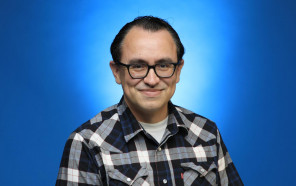
Gustavo Arellano is a columnist for the Los Angeles Times, covering Southern California everything and a bunch of the West and beyond. He was a finalist for the 2025 Pulitzer Prize in Commentary and the Mike Royko Award for Commentary and Column Writing and was part of the team that won the 2023 Pulitzer Prize in Breaking News for reporting on a leaked audio recording that upended Los Angeles politics. Arellano previously worked at OC Weekly, where he was an investigative reporter for 15 years and editor for six, wrote a column called ¡Ask a Mexican! and is the author of “Taco USA: How Mexican Food Conquered America.” He’s the child of two Mexican immigrants, one of whom came to this country in the trunk of a Chevy.