
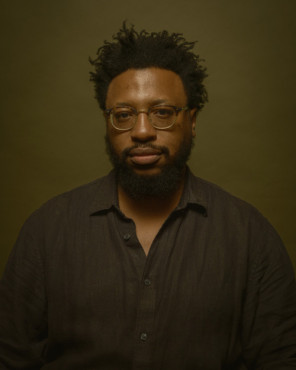
Finalist: Vinson Cunningham of The New Yorker

For sophisticated, accessible essays on the media, with an emphasis on television, that address shifts in culture, politics and American life with clear-eyed authority.

Nominated Work

January 20, 2025

On Inauguration Day, the forty-seventh President cast himself as an especially favored vessel of the Almighty.

It’s usually gauche to take pictures in church. But at St. John’s, the Episcopal Church just across a sedate Lafayette Square from the White House, photography is inevitable at least once every four years. Every Inauguration Day, many of the most powerful representatives of the United States government, past and quickly matriculating, go to the so-called Church of the Presidents, notionally to pray. The intimate sanctuary, with its air of contemplation, is, in this way, a small part of the theatre of American continuity. Presidential Administrations, so often wildly divergent one from the other in tone and in political direction, are concatenated by this littlest nod toward God.

Back in 2020—a lifetime ago politically, but just yesterday when you think about it—the air outside that church was thick with tear gas. Troops deployed by Donald Trump’s orders beat back a crowd gathered in the square to protest police brutality. Trump needed the space to stand in front of the church’s marquee and hold up a Bible: a photo-op dense with symbols over which Trump—a producer of spectacle, yes, but seldom of deep meaning—had no interest in exerting control. He just wanted a picture.

On Monday morning, just before his Inauguration, Trump was back inside the church, juicing its ceremonial power for a few more drops of self-aggrandizement. There were pictures from the pews, most notably of the gaggle of tech titans who have taken to following Trump around, from Mar-a-Lago to D.C., throwing laurels at his feet and offering him sacrificial gestures. They all want to be seen wanting him to succeed. It’s been a long way down from their kind’s originary pose as benign geniuses who wanted to bring peace, love, and connectedness to the world one byte or bit of binary code at a time. These are the people who used to use Gandhi’s likeness in TV commercials for personal computers. Maybe they were fated for this recent rendezvous with Trump: they’re all wishing someone would notice that they’re the messiahs, not the guy bleeding out up there on the cross.

Nobody looked especially pious; you’d be silly to expect it. Mark Zuckerberg’s floofy hair and blank aspect could be glimpsed, as could Jeff Bezos’s shiny face, which is each time somehow plumper and more moist-looking than it was the last time you saw it. A few rows ahead of the techies was the “comedian” and podcaster Joe Rogan, who used to pretend to “just be asking questions” but has lately become convinced that everybody in the world but him is always being unfair to his new friend Don.

Soon Trump loped out of his limo looking how he usually does at moments like this: like a kid already restless to be let out of church. Because he has no sense of his own continuity with the past or debt to the future, he seems baffled by the choreographies and ceremonial duties of the state. He understands a nice big desk—it’s where you fire people, or get on the horn with whichever big shot will take your call (these days, it’s most of them), or take pictures of yourself looking busy and important. But an altar, where you kneel, will always be alien to Trump. He was accompanied by his wife, Melania, who was ready to do another tour of duty, wearing a sharp-looking, wide-brimmed navy-and-white hat that brought Michael Jackson to mind. The razor blade rim said “Stay away” and “I’d rather not have to see this” all in one breath. The Trumps are experienced at their version of this job now, and so, woefully, are we.


After church, Trump cruised to the White House, where he had his obligatory staged meeting with Joe Biden—Trump opted out of this encounter back in 2020, because, again, he thinks this kind of stuff is for chumps unless it’s him on the winning end—and then went to the Inauguration ceremony, inside the Capitol, yet another locale that he has found astounding ways to desecrate. You’d think he’d feel funny standing there on the dais in the rotunda, about to be sworn in not so long after inciting a riot in the very same building. But Trump’s sense of humor—you have to admit that it exists; like it or not, his Dangerfield act is one of the reasons for his continued political relevance—doesn’t extend far. He certainly has no irony when it comes to interior décor. His great aesthetic talent is at turning austere environments into staging grounds for schlock.

The rest of the crowd, seen through the roving, irony-hungry cable-news cameras, was all farcical adjacency: Jared Kushner sat not far from Zuckerberg, both shaking hands robotically and otherwise playacting at human social skills. Jill Biden—who reportedly gave her husband some of the worst advice of this American century, already somehow a quarter spent—looked stricken, and sometimes seemed, at least to my eyes, to be choking back tears. She should’ve spent that emotion on a selfless talk with Joe long before July. A piano rendition of Thomas Chisholm’s hymn “Great Is Thy Faithfulness” played as Elon Musk looked around with his gonzo eyes and inexplicable body language. A fickle billionaire set to advise a faithless President—a version of American greatness only the tartest satirist could love.

There were cameras set up in a hallway to the rotunda, so television viewers could see former attempts at national stewardship enter the building. Bill and Hillary Clinton strolled in looking strained. Barack Obama, who has taken to showing up stag at this sort of thing—Michelle said no thanks a couple of weeks ago to Jimmy Carter’s funeral, another set piece for the assertion of a thinning American civic religion—did his usual bop, a cool-guy act that’s starting to get old as real emergencies keep licking at our heels. Joe Biden and Kamala Harris, those totems of Democratic impotence, entered together and acted as if they’d been instructed never to shoot each other so much as a passing glance. The old bipartisan establishment that somehow keeps giving way to the New York real-estate fraud looked every bit as blithe and befuddled as Trump has twice now shown them to be. Trump is a disaster, but he has confirmed the growing sense, almost everywhere in our country, that these people deserve to be defeated, over and over, until they change or, better, pass the baton of leadership for good.

Trump’s consistently bad taste in music is almost funny. He brought on the yowling Christopher Macchio—apparently a favorite of his late brother Robert—to sing not one but two numbers at the inaugural ceremony. As things got going, Macchio wrestled with his own pitch, and, while singing a mushy version of the song “Oh, America,” struggled against the tempo set by whoever was on the drums.

Timothy Dolan, the publicity-friendly Catholic Cardinal Archbishop of New York, impressed upon the assembled that “without God our efforts turn to ashes.” That’s a quote from Martin Luther King, Jr., whose holiday—yet another irony, probably sadder than the others but no less natural an outgrowth of this nation’s continually multiplying paradoxes—was made, this year, to share space with the unstinting agitator of the Central Park Five. Franklin Graham, son of Billy—one of those classic, homegrown examples of slight decline from one American generation to the next; his dad could sometimes be a bigot, but at least the man could preach—kowtowed to Trump, directing his prayer more to the man than to God. “The last four years, there were times I’m sure you thought it was pretty dark,” he said. “But look what God has done.”


When Trump was sworn in by Chief Justice John Roberts, he gave a little fourth-wall-breaking smirk. He knows better than most where the cameras are and who his real audience is: the folks back home huddled around their TVs. What he said with that gesture was: Now would you look at this? These losers are letting me back in!

Without full knowledge of the past few days of Trump’s life, it’s impossible to claim this as a fact, but I felt sure, watching Trump deliver his Inaugural Address, that he was reading it for the first time. His energy was low, especially at first, and his vocal tone was that of an elementary-school kid thrust toward the front of the class and made to recite. He emphasized the wrong parts of several longish sentences and rushed through whole paragraphs whose content he manifestly found boring. “Sunlight is pouring over the entire world,” he said, inanely. When he read his speechwriter’s promise that the incoming Administration would “not forget our God,” Trump added, in his faux-solemn mocking way, what seemed to be a glib ad-lib: “Can’t do that.” And it’s true: you can’t forget what you’ve never given a thought.

It’s strange, though: Trump clearly has no real respect for religion and its adherents—for at least part of his swearing-in, his hand was not on the Bible that Melania held for him, but hanging at his side—and no connection to the strong, sometimes unhinged belief in providence that has hummed under all kinds of American glories and American malfeasance, but he has chosen, this time around, to cast himself as an especially favored vessel of the Almighty. He’s still using the genuinely shocking attempt on his life last July in Pennsylvania to give himself the glowing cast of true religion. “I was saved by God to make America great again,” he said. If you believe in God, it’s hard to deny that he was spared on that day. But in order to keep your faith and like life as it presents itself to us—let alone like America—one has to keep a rich sense of divine comedy and cosmic inscrutability. Who can know, until time has finished its unfolding, what Trump’s really still around to accomplish? Maybe just to keep repeating lies so grand that we can all assume their opposite meanings to be uncontroversially true—such as this tossed-off whopper later on in the speech: “That’s what I wanna be: a peacemaker and a unifier.”


Somehow, though, those supposed pacific yearnings live alongside Trump’s recently discovered yearnings to be a neo-frontiersman. “The spirit of the frontier is written into our hearts,” he said. He indulged in a long riff about all kinds of expansion:

The United States will once again consider itself a growing nation, one that increases our wealth, expands our territory, builds our cities, raises our expectations and carries our flag into new and beautiful horizons. And we will pursue our manifest destiny into the stars, launching American astronauts to plant the stars and stripes on the planet Mars.

Mars. O.K. Him first! He promised that he’d make us, once again, a “free, sovereign, and independent nation,” then—zipping through his text like the longest blah blah blah—soon wrapped up.

Before the show was over, a Black pastor from Detroit named Lorenzo Sewell approached the podium and made a damn fool of himself. He mimicked the tones of Dr. King, taking snippets and rhythms from his “I Have a Dream” speech—which is always being misused for some awful reason or another—and turned them toward the greater glory of Donald Trump. Here’s just one of his brazen riffs:

Heavenly Father, in the name of Jesus, we are so grateful today that you will use our forty-seventh President so we will sing with new meaning, ‘My country, ’tis of thee, sweet land of liberty, of thee I sing; Land where my fathers died. Land of the pilgrims’ pride. From every mountainside, let freedom ring.’ And because America is called to be a great nation, we believe that you will make this come true.

He closed his speech as King once had: “Free at last, free at last. Thank you, God Almighty, we are free at last.” Trump was behind Sewell, looking on with a condescending smirk, as if to say, Get a load of this guy! Guys this full of shit recognize one another instantly. Heavenly Father, the name of Jesus, God Almighty, Dr. King, the list goes on and on: there’s nothing good that the Trumpist attitude can’t make curdle. Sewell should be ashamed to use the styles and sounds of Black church worship to adorn such a proceeding, but he’s not the first and he won’t be the last. He’s a symptom of something sick, just like the new President he likes so much. Later on in the day, Musk—the genius and poet who has inspired Trump’s Martian aspirations—showed up to a rally and saluted the crowd with what looked like a Nazi salute. A straight arm and a cold eye. Free at last, indeed.

As for Trump himself, he’s back. It’s good that he got scared of the cold and decided to have the Inauguration inside: better not to let these noxious fumes out into the open air. Now he’s the master of American ceremonies, the chief celebrant of the American civic religion, however little he thinks or knows of it. If I were him, I’d just leave that stuff alone. When I was a kid, the worst and most dangerous thing you could do in the elders’ eyes was, as they used to say, to “play church.”
March 17, 2025

Widowers drive the plots of “Paradise,” “Severance,” and “American Primeval,” to poignant effect.

In the very first shot of the pilot episode of “Paradise”—a recent dystopian political thriller from Hulu—a man played by Sterling K. Brown lies alone, unrestfully, in bed. His eyes are bolted open. A watercolor wash of blue light floods his face. He blinks a bit and looks around the room, then caresses the unused pillow next to his own. The man—soon we learn that he’s a hyper-competent, scrupulously moral Secret Service officer named Xavier Collins—is manifestly unhappy, and so the color of the light through the window is a bit of a pun. Xavier’s got the blues.

As it turns out, he’ll soon have more immediate troubles than his unsubtly drawn sorrow: his protectee, the U. S. President, Cal Bradford (James Marsden), is found dead—bloody, facially disfigured, surely murdered—in his palatial bedroom not much further into the episode. A tablet containing precious national-security secrets has been stolen from President Bradford’s safe. Xavier tells his underlings to hold off from reporting the killing until he can peruse the scene undisturbed. Already, instinctively, he knows not to trust the organs of justice that will be tasked with figuring out the truth. Because of the delay, he’s briefly a suspect. Oh, and—little detail—the earth’s surface has, apparently, been wiped clean by a world-historic climate event and a nuclear war, and everybody who survived is living in a bunker gussied up by its billionaire overlords to look like a perpetually temperate American suburb.

Questions keep coming: Who killed the President? What are the oligarchs, led by an increasingly suspicious tech entrepreneur nicknamed Sinatra (Julianne Nicholson), hiding about what really happened up on the surface? How does the vegan nut cheese melted over the fries at the town’s only diner really taste? Everybody who eats it makes a cooking-show facial fuss and professes to love it, but let’s get real. Maybe most pressing: who in this subterranean world can Xavier trust? Like Plato’s allegorical cave dwellers, he can apprehend his situation only in blurs and intimations, shadows and whispers. In order to really know, he’ll have to fight his way out.

“Paradise” does an exciting and sometimes moving job of managing so much plot and making its scenarios seem darkly plausible, given the real-life crises that, these days, are steadily encroaching upon its viewers. But, after watching all eight episodes of the show’s first season (a second one is in the works), I’m still thinking of that quiet first few seconds and its wordless picture of grief. Sad Xavier is a widower. That lonely pillow should belong to his wife, Teri. (That’s Dr. Teri Rogers-Collins to you: she was tough, and Xavier never fails to point this out.) She couldn’t make it in time to escape into the cave—she was on a work trip, that ancient eroder of marital bonds—and now Xavier’s left to serve the interests of a political order that couldn’t be bothered to save her life. He’s got two kids, a boy and a girl, over whom, even during his deepening investigation, he frets with a special intensity. He can’t stand to lose another thing, another face.

“Paradise” does an exciting and sometimes moving job of managing so much plot and making its scenarios seem darkly plausible, given the real-life crises that, these days, are steadily encroaching upon its viewers. But, after watching all eight episodes of the show’s first season (a second one is in the works), I’m still thinking of that quiet first few seconds and its wordless picture of grief. Sad Xavier is a widower. That lonely pillow should belong to his wife, Teri. (That’s Dr. Teri Rogers-Collins to you: she was tough, and Xavier never fails to point this out.) She couldn’t make it in time to escape into the cave—she was on a work trip, that ancient eroder of marital bonds—and now Xavier’s left to serve the interests of a political order that couldn’t be bothered to save her life. He’s got two kids, a boy and a girl, over whom, even during his deepening investigation, he frets with a special intensity. He can’t stand to lose another thing, another face.

One potential message of the weird new season—I love it, but it’s been controversial, leaving lots of people impatient with its proliferating strangeness—is that the life of intimate grief, one lover losing the other, quickly meanders from a strict chronological or causal rhythm. Henry Adams, the brahmin descendent of two American Presidents, called his life after the death of his wife, Clover, “posthumous.” He was a wanderer, a traveller, a vagabond historian and critic whose great midlife shock had left him feeling unfettered, sorrowfully free.

The same might be said of Mark Scout and Xavier Collins: the loss of their beloveds has wounded them but also cleared the way for the courage they display amid thickening intrigues. Marital life is liquid—it spreads to fit the containing shape of the self. When the bottle breaks, a livid flood comes rushing out. The widower becomes dangerous, breaks some glass against the wall of civilization. Mark and Xavier are both flailing against power in high places: Mark has the monolith Lumon, an entity that has sprouted its own kind of mystery cult, coöpting legislators and popular sentiment as it nears its nefarious ultimate goals. Xavier has the increasingly psychopathic Sinatra, who, we learn early on, has been dealing with a loss of her own: the death of her young son.

Both guys come from occupational backgrounds—education and law enforcement—that, at least in the popular imagination, tend to bolster society and keep it rolling on toward the future. But these posthumous men have already survived an apocalypse of a kind. Why not instigate another?


What televisual future does this kind of man portend? The long era of the antihero—Tony Soprano, Stringer Bell, Don Draper, Walter White, Bill Hader’s Barry—seems to have exhausted itself, at least for now. TV, newly chastened by shrinking studio budgets and a slowing pipeline of projects, seems to be retreating to familiar genres: the medical drama, the murder mystery, the police procedural, the thriller. Now, though, the old tropes unfold with a glossy sheen left over from the high point of so-called “prestige” TV. Sterling K. Brown, with flexible expressions and quivering eyes, has never been so well lit. You could call the high-concept “Severance” a more classic prestige product than “Paradise,” but its outer encasement as a whodunit (and the creative stewardship of its executive producer Ben Stiller, a severely underrated maker of TV) makes it, perhaps deceptively, legible to an impressively wide audience, at least at first. Maybe this latest swivel in sensibility, back toward a kind of crowd-pleasing populism, necessitates the emergence of a new male archetype: Mr. Hurt but Good. Old Sad Eyes.

The quite violent and wildly entertaining recent Netflix Western miniseries “American Primeval”—you can’t get more traditional than a tale about the untamed American roughlands—features a loner named Isaac (Taylor Kitsch) who’s hired to guide a woman and her young son across the treacherous Utah territory. Isaac’s a white man but knows Native folkways and is accepted by Native people. He survives cold nights by heating up rocks and burying them in the soil beneath his body. His wife and child were murdered years ago, we learn. He’s got nothing to lose; the outdoors has become his home.

As the series draws to a close, Isaac springs into sacrificial action—one last gesture of protection toward a little family he’s come to love. You can’t really process it as a loss. When we met him, he was already dead. 

May 5, 2025

The city’s least self-conscious, Rupert Murdoch-owned daily newspaper sticks to its story, new information be damned, yet holds real clout in liberal New York.

Last fall at the Philharmonic, I was seated near a guy reading the New York Post. As often happens when I see the notorious tabloid in public, I tried to read it discreetly, out of the corner of my eye. The header said “Israel Under Attack.” The two articles below—flagrantly contradicting the banner under which they appeared—were about Israeli air strikes on Lebanon and Iran. I squinted and tried to skim both pieces until the lights went down.

That page was pure Post: New York’s most dastardly, least self-conscious daily newspaper chooses heroes and villains and sticks to its own story, new information be damned. The paper deals in overstatement and unsubtle deception, and its bold headline fonts make it a kind of small-scale, endlessly serialized work of public art. It’s meant to be read, sure, but also seen. You glimpse it on a newsstand or on the train and become sickly intrigued by some ingenious pun or awful image.

Like its longtime owner, Rupert Murdoch, the Post is right-wing and gleefully biased. It casts students protesting Israel’s war in Gaza—where more than ten thousand children have now been killed—as apologists for Hamas and has cheered on President Donald Trump’s crackdown on activists and college administrators. It has crassly opposed the influx of asylum seekers to the city, which crested between 2022 and 2024. A story of malfeasance with an immigrant near its center gets a sensationalist spin. A street fight in Gerritsen Beach, Brooklyn, for instance, became a “Bloody Migrant Brawl.” Any uptick in crime, real or perceived, is an occasion for the paper to declare New York—according to a favorite page-header—a “CITY IN CRISIS.”

Democrats, generally, get hammered by the Post. (In April, a front-page story about the former governor Andrew Cuomo headlined “CREEP TRICK”—not its best—was about how state taxpayer money has been used “to settle Handsy Andy’s sex-harass suit.”) But if a Dem is sufficiently conservative, especially on crime, he might get a pass. Eric Adams, now tarnished by petty corruption, probably owes his mayoralty to months of good press in the Post during his 2021 campaign. “Having been a police officer for 22 years, Adams understands the crisis,” the editorial board wrote in its hearty, heavily pro-cop endorsement. “He articulates a clear, firm and common-sense route to cleaning up our streets.”

And yet the paper holds real clout in notionally liberal New York. It editorializes on perennially important local issues—mass transit, real estate, the ever-fluctuating fortunes of the Knicks—and leads substantive political investigations. No other outlet in the city has as thoroughly covered the struggle between Governor Kathy Hochul and Donald Trump over the construction of the new Penn Station, or their ongoing political fight about New York’s congestion-pricing law, which took effect in January, or the recently—and quite dubiously—dropped federal corruption case against Mayor Adams, the Post’s former golden child.

The Post’s dedication to this kind of fisking, oppositional metro reporting is rarer than ever, if hopelessly slanted. Its tabloid archrival, the Daily News, is still kicking, but its circulation has steadily fallen, and its staff has radically shrunk, after its parent company was acquired by a hedge fund with a reputation for gutting newsrooms. The Times, meanwhile, has become a colossus, raking in money in large part because of its cooking app and its arsenal of addictive games, casting a large shadow over an imperilled industry. But when it comes to the home front the Times has—shamefully, I think—retreated. Last year, it was announced that the paper would no longer issue endorsements in local elections, and the ambit of the excellent Metro section has narrowed considerably.

Here’s a big urban problem: How do you speak to an entire city using only one loud voice? Most politicians can’t pull it off. The Post has an answer: make a daily billboard so neon in its message, so portable in its form, that citizens will volunteer—or, better, pay—to carry it around on your behalf.

The paper works as a way to broadcast your own identity, too. During the program at the Philharmonic, one composer gave an evangelistic speech about how her concerto had been inspired by the climate crisis. Many audience members erupted in applause. But my neighbor, impassive, lethargically tapped his forefinger against his Post. I felt I could read his mind: he’d come for the music, not this Greta Thunberg routine. I didn’t know him, but for a moment, if only archetypally, I sort of did. Rudy Giuliani—a sadist, yes, but our sadist—knows passages from Verdi’s “Rigoletto” by heart.

One minor tension of my life is that I can’t bring myself to hate the Post. I find its politics detestable but its voice irresistible. I read the famous gossip section, Page Six, and skim the horoscopes. I whiz through the local politics and government coverage—often well reported, spin notwithstanding—and try to read the articles on national and international affairs as a fun-house mirror of the reality I usually inhabit. On one page, the entertainment critic Johnny Oleksinski cracks me up with his staccato phrasing and his uncareful way with celebrity self-regard. (“The Rocket Man keeps crashing,” he once wrote of Elton John. Recently, he so badly peeved the Broadway producers of the Denzel Washington-led “Othello”—having kvetched about high prices—that the show’s publicist yanked the customary offer of free critics’ tickets.) A few pages later, the neocon columnist Michael Goodwin inverts the truth so egregiously, and with such smug certainty, that I want to set the whole rag on fire. The Post and me: it’s a bad relationship I can’t figure out how to leave for good.

Worse, I’m not sure I want to. If I’m away and something big happens, I usually ask a friend if he can stop by a newsstand so I don’t miss the hard copy of a good front-page headline. If I’m somewhere with a critical mass of vacationing New Yorkers, I set out on foot, knowing there’s likely a Post nearby. In August, 2022, just after the F.B.I. raid at Mar-a-Lago, in search of allegedly mishandled classified documents, I rushed into a liquor store on Martha’s Vineyard and scored a copy. On the cover was Trump, cheeks ablush. The headline: “YOU COULDA JUST ASKED.”

Maybe I’m simply interested in that voice, that loud, familiar sound—the demotic tone, the direct address, the sense of a great organ yelling into power’s ear and being overheard everywhere, from Dyckman to Dyker Heights.


The Post, the oldest daily newspaper in the United States, was founded in 1801 by Alexander Hamilton. With a group of his fellow-Federalists, Hamilton had scrounged together the money to establish the upstart broadsheet, then called the Evening Post, in order to express the group’s disapproval of the newly elected President, Thomas Jefferson, and his party of populist libertarians, the Democratic-Republicans. That year, Jefferson avoided giving an annual state-of-the-nation speech to Congress and, instead, delivered a message in the form of a letter. Hamilton—taking his new paper for a spin like a Ferrari through the backstreets of a small town—wrote a series of acidic articles refuting, one by one, the “strange absurdity” of his adversary’s arguments. The President’s message, he wrote, was “a performance which ought to alarm all who are anxious for the safety of our Government, for the respectability and welfare of our nation.” Anxiety asserted as a kind of duty, high stakes made existential, personal vendetta masquerading as the news—it was lurid overstatement from the start.

Through the decades and editorships that followed, the Post took up many causes, including abolitionism, collective bargaining, opposition to central banking. (One strain of continuity is its interest in the performing arts: it has almost always employed a theatre critic.) In 1939, the finance heiress Dorothy Schiff bought the paper and transformed it into a largely liberal tabloid, especially popular among the Jewish upper-middle classes. Socially conscious journalist heroes such as Murray Kempton and Pete Hamill worked as columnists. By the seventies, a comfortable sleepiness had set in; the paper was more respected than read. In 1962, Schiff had declared herself editor—according to Nora Ephron, a Post alumna, she “changed the focus of the paper from hard-hitting, investigative, and liberal to frothy, gossipy, and woman oriented”—but she resisted spending the money necessary to compete in a crowded tabloid market.

The popular narrative tends to be a bit unfair to Schiff, focussing too much on the late decline and ignoring the real excellence to which her Post often rose. Kempton and Hamill were icons of their era, and in 1975 Schiff hired Frank Rich, who turned out to be one of the finest drama critics of the late twentieth century. Under Schiff’s watch, the paper even showed up in great works of art. In the poem “The Day Lady Died,” a potent ditty of avoidant grief, from 1964, Frank O’Hara name-checks the Post as having informed him of the death of one of his heroes, Billie Holiday:

then I go back where I came from to 6th Avenue
and the tobacconist in the Ziegfeld Theatre and
casually ask for a carton of Gauloises and a carton
of Picayunes, and a NEW YORK POST with her face on it


“Paper of Wreckage: An Oral History of the New York Post, 1976-2024” (Atria Books), by the former Posties Susan Mulcahy and Frank DiGiacomo, picks up at the end of the Schiff era. The book is a fun pile of quotations from Post employees and other voices on the paper’s past half century. By the end of Schiff’s tenure, the Post “needed a shot of adrenaline,” the former City Hall bureau chief David Seifman says.

April 27, 2025

He built his lovable persona not on the page but via pictures and improvised chat, the stuff of screens.

Shortly after Pope Francis died, on Monday, the Vatican released a brief document he had authored in 2022, outlining his last testament: how and where he should be buried, how the proceedings should be handled. The Pope, famous—perhaps foremost—for his insistence on simplicity and aversion to clerical glitz, wanted to be buried not at the Vatican but at the Papal Basilica of St. Mary Major, where before and after each of his international trips he went to pray. His tomb, he wrote, “should be in the ground; simple, without particular ornamentation, and bearing only the inscription: Franciscus”—his papal moniker, rendered in Latin.

These instructions foregrounded a paradox in Francis’s radiant personality. On the one hand, he insisted that the Church he stewarded should be less interested in visible surfaces and stylistic curlicues, the distracting aesthetics of lace-frilled priestly vestments and fussy liturgical preferences, and focus instead on the heart of the Christian message: an affection for the poor, a preference for the geographical and existential “margins” and those who inhabit them, the contours of Christ’s face made plain by an ethos of joy and peace and love. And yet, pursuing these themes, the Pope revealed himself, throughout the twelve years of his papacy, to be a canny maker and promoter of imagery. He had his own style—plain clothes, humble plazas, his friendly hand clasping yours—and, in his self-expression, he could be just as controlling as the incense-obsessed traditionalists he sometimes antagonized in his public remarks.

Francis was a lifelong reader. In a public letter on the role of literature in the formation of priests, he lamented how audio-visual media such as television could be reductive. “The time allowed for ‘enriching’ the narrative or exploring its significance is usually quite restricted,” he wrote. Literature for him had deeper, further-reaching dimensions:

A book demands greater personal engagement on the part of its reader. Readers in some sense rewrite a text, enlarging its scope through their imagination, creating a whole world by bringing into play their skills, their memory, their dreams and their personal history, with all its drama and symbolism. In this way, what emerges is a text quite different from the one the author intended to write. A literary work is thus a living and ever-fruitful text, always capable of speaking in different ways and producing an original synthesis on the part of each of its readers.

It’s strange, though: Francis was a TV Pope. His writings could be ravishingly beautiful. His encyclical on the environment, “Laudato Si’,” will surely be read for many years to come; “Fratelli Tutti,” on the siblinghood of all human beings, is a lovely articulation of Christian humanism. But his greater talent was for imbuing images, broadcast everywhere, with the “drama and symbolism” he advised young priests to go searching for in books. And even his most memorable utterances came across as tossed-off sound bites: asked about gay priests during an impromptu press conference on his airplane, he replied, “Who am I to judge?” Moments after being elected Pope, he strode out on a high balcony and so casually called out to the crowd, “Buona sera!”—good evening. He built his lovable persona not on the page but via pictures and improvised chat, the stuff of screens.


It’s possible, then, to view Francis’s final instructions as the meticulous notes of a producer who knew he wouldn’t be there to captain the show. Watching his funeral on Saturday morning (tuning in from the East Coast meant waking up just before 4 A.M.), it was hard not to pause the live stream every few seconds and let the brilliant images of the day inspire “a whole world” of recollections of the deceased Pope.

The Papal Gentlemen—laymen who attend to the Pope’s private needs and aid in his displays of hospitality and diplomacy—acted as pallbearers in black suits, carrying the unadorned wooden casket that held Francis’s body. The casket entered St. Peter’s Square, under the balcony from which Francis had issued that first informal greeting. The square itself, gleaming impassively under what looked like a pure, high sun and bright-blue sky, was full of well-wishers—lapping, hectic, applauding when they saw the casket, unpredictably shifting like waves in an open sea.

More than five years ago, Francis stood in the very same square in the evening, to issue a prayer amid the worsening COVID pandemic. In the empty piazza, the Pope slowly approached the altar, and his labored movement seemed to symbolize the pain coursing through the wider world. The man in white, the stillness around him, the emergency vehicles in the background: an unforgettable picture.

An edition of the Gospels was laid on Francis’s casket. As Giovanni Battista Re, the dean of the College of Cardinals, delivered a touching homily, the pages rustled in the wind. Francis, Re said, was a “Pope among the people.” The other cardinals sat together, their tall white mitres looking like model cathedrals, their brocaded red capes like martyr’s blood, or like the Sacred Heart of Jesus, about which Francis had recently written his final encyclical:

Reconciliation and peace are also born of the heart. The heart of Christ is “ecstasy”, openness, gift and encounter. In that heart, we learn to relate to one another in wholesome and happy ways, and to build up in this world God’s kingdom of love and justice. Our hearts, united with the heart of Christ, are capable of working this social miracle.

Theology, for Francis, often ended up there, not in the abstract or the celestial but in the world of the “social.” He was always trying to herd people back into community with one another, always insisting that a true religion could never be purely spiritual, that faith played itself out, finally, in the streets. Even if the square was empty and the city quiet, you were never truly alone. This made sense: the Pope from Buenos Aires was, by nature, an urban guy. He liked proximity. In one photo, from before he ascended to the papacy, he’s sitting on a train, wearing all black like the denizens of cities often do, reciprocating the camera’s gaze with an unbothered, cosmopolitan stare.


When the preaching and singing was done and the funeral ended, the Gentlemen picked up the casket again and carted it onto the back of the white truck often called the Popemobile. That thing needs a better name. Being buried at St. Mary Major felt right for Francis for a multitude of reasons. He had a special devotion to Mary, Christ’s mother; a prayer to her often punctuated his longer writings. And St. Ignatius Loyola—the founder of the Jesuit order, to which the Pope belonged—had celebrated his first Mass there. But perhaps the most classically Franciscan outcome of the choice was that the Pope’s body had to be driven away from the Vatican grounds, across the Tiber, and through the streets of Rome. One last tour of the teeming city.

The drive was short, only four miles, but, as the Popemobile rolled on slowly, the journey took on what seemed to me to be a radical significance. The truck toting the Pope’s body glided down narrow streets, the dome of the Vatican slowly fading into the distance. As it went through a tunnel, it was flanked by men on motorcycles. On a broader avenue, people stood on the sidewalks, cheering and mourning and taking pictures with their smartphones—thousands of real-time, utterly personal interpretations of the Pope’s final symbolic journey.

The Popemobile passed a construction site. Workers in neon craned their heads and snapped pics. Machinery towered overhead. The imposingly ornate feel of St. Peter’s—stone statues, high spires—had given way to the awkward improvisations of the city. Sometimes the truck passed down shady streets canopied by fertile trees. Then it passed the Colosseum, that reminder of bloodthirsty martyrdom, popular entertainment, and fading empire. The Pope had revealed himself once more, as a restless democrat at heart.

The Western world, now in thrall to lunatic voices and struggling to reconcile itself with the feeling of decline, could learn from Francis’s last engagement with the former imperial seat of Rome. He rolled past grandeur and decay with equal ease. It was an eloquent way to end an admirable life. As Francis’s body approached the place where it would rest, children brought flowers to lay at the altar.


July 12, 2025

If human workers don’t have to read, write, or even think, it’s unclear what’s left for them to do.

If a recent crop of commercials touting the benefits of artificial intelligence is any indication, lots of Americans these days feel unduly burdened by the demands of everyday cognition. Apparently, it’s asking way too much to expect a human to figure out how to make a small repair, or write a note to a friend, or plan a meal to feed a child. Let alone read.

I’ve got a perverse favorite among these ads, for Apple Intelligence. (You can look it up on YouTube, in an archival effort by Apple that I would kibosh if I ran the company, but who’s asking me?) A sharp-looking Black man of maybe fifty named Lance sits down at a drab, clean conference table full of colleagues. Somebody asks him if he’s read a “prospectus,” and Lance decides to lie about it. Of course he read the prospectus! “Oh, yes,” he says, his face reeking of guilty and guileless dishonesty. “It was wonderful.” As these things go, he’s asked to offer a synopsis to the rest of the team. Then, crisis established, comes a bit of surrealist slapstick nonsense. In full view of everybody, Lance slowly scoots off in his rolly chair into a hallway, where he consults Apple’s A.I. about the prospectus that’s already sitting right there on his laptop. The thing spits out a few summarizing bullet points, and Lance, newly confident, slowly rolls back to his spot at the table, ready to contribute. “O.K., guys,” he says, his confused colleagues looking on, “let’s get into the prospectus.”

The spot plays as a joke: Lance isn’t exactly a hero, and neither are his largely silent co-workers. But, still, the point is to sell us something, less a consumer item or a user interface than a life style unmarred by pesky intellectual tasks like reading a text and then verbalizing what you read. When I was a kid, people were always telling Black boys they had to be twice as good—at comprehending, at composing, at thinking, at speaking—as the other faces around the table, lest they be banished from the aspiring classes altogether. Maybe Lance is evidence of progress: be ostentatiously mediocre, even forget how to read—who needs it?!—and succeed. The young Frederick Douglass, enslaved, riskily contravening the laws of his time, learned to read from young white boys in Baltimore. Literacy was a symbol for the larger freedom Douglass would later achieve. But those days are over, right? Lay that struggle down once and for all.

Lance seems to be some kind of middle manager, of unclear authority. He’s achieved enough seniority to speak aloud at meetings, instead of, say, writing down the minutes (another role that A.I. cheerfully promises to abrogate; if you want it to, it’ll pay attention on your behalf and take your notes), but he’s still sufficiently subordinate to be put on the spot, called on without previous consent or forewarning. High-ranking executives these days sometimes play the role of so-called “creatives,” supposedly executing corporate and technological maneuvers with the sensitivity of artists. But a guy like Lance is a train on a track, playing out his career with a deterministic energy. When he’s called on, he answers: that’s the gig.

He doesn’t look like he glories in his work. I’m not mad at him for squeezing past a homework assignment or two. A new ad for the note-taking A.I. tool Plaud, powered by GPT and other reasoning tools, shows a Lance-like office drone drowning in jargon at a meeting he’s taking notes for: “KPI,” “optimize,” “ROI,” “stakeholders,” “deliverables.” Then he placidly presses the button on a little toy that starts recording and transcribing what people in the room are saying, and then offering “instant insights.” So many of these new gadgets are straightforwardly presented as salves for the massive ennui that plays bass notes beneath the music of contemporary corporate culture. The preferred state, it seems, is a zoned-out semi-presence, the worker accounted for in body but absent in spirit.

I do wonder what else Lance has got to do, what freedom he thinks he’s winning by allowing his powers of thought to be supplanted by some whirring machine. Does a person with this much contempt for texts by day insist on reading aloud to his kids at night? (A spot for Qualcomm’s Snapdragon features a dad so shaken by the momentary absence of his wife—she’s working late—that he has to ask A.I. what to feed his children. It also helps him “create” a story to read at bedtime. No domestic improv for these types.) Does he check out the paper and catch up on current events? Does he carry on deep conversations with his spouse? Does he go to an Elks Lodge or a community-board meeting or a church or a soup kitchen to kibbitz with his neighbors and make sure they’re doing all right? Does this fella even have friends?

I don’t know. That kind of stuff takes effort. To me he looks sort of sad. I can more easily imagine Lance in bed at night, his face lit up by the screen of the same laptop from work, just a browser tab over from that poor, unread prospectus, placing semi-automated online bets on sporting events he may or may not watch and will almost certainly not attend in person. The implicit idea of commercials like this one is that by spending less energy on thinking, you’ll get more time to act. But in what way? That part seldom comes up.


It used to be somewhat more obvious that the ability to think was the mark of the human animal, not a tedious backstage task but the entire substance of our tragicomic show. The drama of reasoning—applying abstract principles to real dilemmas, starting in one mental region and ending up in another faraway place, changing one’s mind, undergoing a conversion of the heart—is the admittedly humble glory of our species. It’s not always fun. Filling up a blank page is a daunting symbol for the tough challenge posed by this sort of freedom, which might be why new “large language model” concerns seem so dead set on identifying writing as an adversary for the humans of the future to finally vanquish. (My colleague Hua Hsu recently reported on what this mind-set is already doing to the practice of writing at institutions of higher learning.)

July 21, 2025

CBS and its parent company, Paramount, have set an end date for one of the last public pipelines to some version of the truth.

Nothing to see here! CBS’s cancellation of “The Late Show,” an institution so basic to the texture of our rapidly thinning common entertainment culture that it feels like a quasi-public utility, as profligately available as water or electricity, has nothing to do, we are told, with Stephen Colbert—the show’s peppy, shrewdly wholesome host for the past decade—and his steady stream of critique aimed at President Donald Trump. Never mind that Paramount, CBS’s parent company, recently forked over sixteen million dollars to Trump, following his lawsuit against “60 Minutes.” Or that only three days before the cancellation was announced, Colbert inveighed against that settlement—calling it a “big fat bribe”—on the show. And don’t worry about the fact that Paramount now desires to sell itself to the entertainment behemoth Skydance Media, owned by the mega-rich David Ellison, and that it might help to offer up a nice, juicy Colbert-size sacrificial lamb to the Trump Administration—known, of course, for its susceptibility to bribes and ostentatious displays of forced loyalty—in order to clear the way to get the deal done.

In a statement, the CBS executives George Cheeks, Amy Reisenbach, and David Stapf insisted that the cancellation was “purely a financial decision” and—protesting so much—“not related in any way to the show’s performance, content or other matters happening at Paramount.” That’s some stressed-out syntax and an oddly specific chain of denials, but, sure, let’s say that’s true. We could consider ourselves fully briefed and move on. One of the signature features of life under the recrudescent Trump regime is that a constant sandstorm of casual lies and destabilizing ambiguity keeps obscuring important facts—the kinds of facts atop which a constitutional republic, ruled by self-governing, notionally informed citizens, is supposed to be built.

For instance: the Wall Street Journal recently reported that Trump allegedly wrote a summer-camp-style love note to the plutocrat pervert Jeffrey Epstein on the occasion of Epstein’s birthday, cooing suggestively that “enigmas never age,” and that “we have certain things in common, Jeffrey,” and wishing that “every day be another wonderful secret.” What to make of this skeevy epistle? Who knows. Trump says that this is “not my language.” Great, thanks. As goes Epstein, so goes CBS—the answer may just end up being that the world will never know. So many big questions with scant answers! Little wonder that conspiracy theories, centered on government and the high spires of business and finance, flower so easily in this era’s soil.


We get by these days reading signs, divining codes, analyzing symbols and attitudes in search of hints that might lead us to the truth. What CBS obscures, maybe a few of Colbert’s recent performances can help illuminate.

On the night that he joshed around, perhaps fatefully, with Paramount, his corporate overlord, about its settlement with Trump, Colbert was in a particularly zany mood. He’d recently been on vacation in Turkey (“I’d heard so many great things from Mayor Adams about it,” he said), and had come back stateside sporting an olive tan and a thin, suavely trimmed salt-and-pepper mustache. The ’stache, urged upon him by an insistent barber in Istanbul, became the anchoring reality for a new alter ego, “Mr. Stephen,” an “international purveyor of scented oils and rose-flavored candies,” languidly willing to set the record straight.

“Tonight, ladies and gentlemen, my mustache comes to you with a heavy heart,” Colbert said, with a falsely grave expression. “While I was on vacation, my parent corporation, Paramount, paid Donald Trump a sixteen-million-dollar settlement over his ‘60 Minutes’ lawsuit. As someone who has always been a proud employee of this network, I am offended. And I don’t know if anything will ever repair my trust in this company. But, just taking a stab at it, I’d say sixteen million dollars would help.”

After that joke landed, Colbert leaned closer to the camera and futzed coolly with his mustache, clearly feeling himself. As he swaggered through the rest of the routine, he kept his body loose and bendy, at several points breaking out into dance, as if his own chutzpah had occasioned an ecstatic experience. (“What can I say? Mr. Stephen loves to dance!”) This dead-serious silliness reminded me of Colbert’s early televisual appearances, on the twisted turn-of-the-century sitcom “Strangers with Candy.” Back then, Colbert played the closeted high-school teacher Chuck Noblet, who sometimes broke out into theatre-kid raptures of sudden song and choreo, mixing Colbert’s goody-goody sincerity—the center of his power as a performer—and his career-long interest in the darkest corners of the national mind. As a dismayed citizen and a gleeful satirist, he was on bivalent terrain that he recognized and enjoyed.

“I believe this kind of complicated financial settlement with a sitting government official has a technical name in legal circles—it’s big fat bribe,” he said.

On Thursday night, Colbert was equally effective as a TV presence, if playing a totally opposite emotional tune, when he announced the cancellation of “The Late Show.” The tan had worn off, for one thing. Sitting sedately behind his host’s desk instead of standing up and jigging, Colbert informed the viewers about his guest, Senator Adam Schiff—another bugaboo to Trump—then quickly transitioned to telling the bad news. “I want to let you know something that I found out just last night,” he said. “Next year will be our last season.” As shocked boos and cries rained down from the studio audience, Colbert raised his voice a bit and deadpanned, “Yeah, I share your feelings.” He thanked all of his collaborators, even CBS, seeming to get emotional only when he shouted out his band.

The conventional wisdom is that late-night television is doomed, whether Colbert is one of its practitioners or not. People have too many self-directed other ways to spend their time and feed their hunger for interpretive takes on the news of the day. But Colbert, on both of these nights, displayed a kind of sly subversion that can only be achieved under the odd dual circumstances of his antiquated form—having both the constraints of a boss and the freedom of frequent live broadcasting. To clue a public in on a high-level corporate communication that was delivered only “last night” is to say, in a way, that the truth has a narrow channel from the seat of power to the cheap seats where they are. The thrill of the original so-called “late-night wars,” between NBC and CBS (and their avatars, Jay Leno and David Letterman), was that a real-life corporate competition, involving not just the careers of the hosts but billions of dollars, could play out with more or less reliable clarity, right before our eyes. You could turn on your TV and get some version of the truth.

Fewer Americans believe that anymore. And on Thursday Colbert told us what had happened. We all had to assume why.

July 27, 2025

A few hours after the news of Malcolm-Jamal Warner’s death began to spread, one of my closest friends called me. I knew before I picked up that he wanted to talk about Warner. We commiserated in low, disbelieving voices. This friend and I were not raised under identical circumstances, but we’d both felt the spectre of “The Cosby Show” ’s Theo Huxtable—easily Warner’s most famous role—hovering over the memories of our childhoods. Theo was funny, cool, affable, confident around adults, often charmingly sneaky, a bit of a trickster. He was always getting into something. He had a troublemaking friend named Walter, whom everybody called Cockroach. The two boys came up with a pretty corny rap to help them understand Shakespeare, which Theo initially thought “wasn’t even written in English.” Great Caesar’s ghost! When he messed up with his girlfriend Justine, he asked his dad for advice and ended up learning how to sing the blues. His room was a godforsaken mess.

Theo’s parents were impressive Black professionals who lived in an impossibly large Brooklyn brownstone, and sometimes he felt—and boldly expressed—the strain of the expectations that followed. In the very first episode of “The Cosby Show,” Theo’s in serious trouble because of his lacklustre grades. Theo, fighting back, gives a long, impassioned speech about how, despite the material successes of his parents—Heathcliff (Bill Cosby) is a doctor, Clair (Phylicia Rashad) a lawyer—he simply wants to be like “regular people.” You know, drive a truck, open a gas station, get his hands dirty, and otherwise embrace a more tactile, grounded way of living. There’s life beyond brownstones.

The speech plays like a moment of rare adolescent wisdom, a brave scolding for an élitist dad. All the kid wanted, classroom performance notwithstanding, was the love and easy acceptance of his folks.

Then his father bursts the warm and fuzzy bubble. “Theo, that is the dumbest thing I’ve ever heard in my life,” the doctor bellows. “No wonder you get D’s in everything!” His point is, Yeah, we love you, but, as long as you live here, you’ll work as hard as you can and keep your standards high.

The rest of Theo’s story, across the eight years of “The Cosby Show” ’s run, unfolds like a vindication of that idea. He is eventually diagnosed as having dyslexia, which explains his lifelong struggles in the classroom. Then he goes off to N.Y.U., and later presides over a rowdy after-school program for teens less privileged than himself, often cajoling them with tough-love lectures quite similar to the ones he’d received from his mom and dad.

He was the meritocratic Black boy par excellence. His life story was what the civil-rights movement was supposed to have won. He was a good kid, who ended up using his advantages in life to give a hand to others. He’d persevered. Whenever I’d felt, growing up, that I was letting my mother down, I told my friend, the feeling of shame had often been accompanied by a nagging suspicion that she wished I could be a bit more like Theo.


You could say all of this in another way: Theo Huxtable was a nicely realized character but also a lofty ideal. What he meant was too much for any real person to carry around. Malcolm-Jamal Warner seemed miraculously able to pull it off. He’d been famous and highly visible at an alarmingly young age, but, unlike many other former child stars, he never seemed to feel much rancor about the experience, or resentment about lugging pure-minded Theo around with him for the rest of his life.

When he played roles in shows like “Suits,” “The Resident,” and “Malcolm and Eddie,” you couldn’t help but think about Theo. But that wasn’t a bad thing: it only meant that the archetype that the earlier character had prodded into being was now commonplace in all kinds of representations of reality—that Theo had done the impossibly difficult cultural work of affixing a face upon a new, then suddenly ubiquitous, kind of person.

Warner helped this process along by always comporting himself with an ambassadorial cheer. He knew what he meant. One of “The Cosby Show” ’s unspoken assertions—now much more controversial than in the eighties, when the show premièred—was that polished personal presentation was part of a Black man’s arsenal of tools to survive an unpredictable world. If you could turn problems into laughter, ashes into beauty, misdirections into opportunities to learn, all while remaining a credit to your race, that was success. Probably without meaning to, Warner supported that argument merely by seeming like he’d be fun to meet. He was great at playing Theo, perhaps because he was genuinely a Theo at heart.

Recently, I was hanging out with some people who are younger than I am by at least a decade and therefore were not raised on the Huxtables—it’s always a shock when I am reminded that there are rent-paying Black adults to whom this description applies. I made a reference that nobody understood. I said the words “Gordon Gartrelle” and watched my buddies’ faces go blank. Nothing!

The reference is to another episode in “The Cosby Show” ’s first season. Theo wants to impress a date—the kid is consistently girl crazy, another reason to relate—and enlists his sister Denise, played by Lisa Bonet, to make for him a knockoff of a shirt by a popular designer of the day, Gordon Gartrelle. Denise plays it off like the task is no big deal; she could do it in her sleep. But, when Theo comes back downstairs wearing the glossy blue-and-gold shirt, all hell breaks loose. The sleeves are mismatched in length, the shoulders are off-kilter, the collar looks like a clown’s. Theo is hilariously enraged. Warner is brilliant: he stomps and rolls his eyes, looks genuinely ready to cry, seems to be visualizing his whole teen-age reputation gone up in unstoppable flames. The shirt is so awful and Warner’s face so Pagliaccian in intensity that the moment resembles something lifted from “I Love Lucy.”

Then something wonderful happens. His date shows up and likes the shirt. Theo, instinctively, plays along, acts like he’s discovered the freshest new style, goes out, has a ball. I think guys my age love this scene because it amounts to a mantra: keep improvising and something decent might just happen. Whenever I say “Gordon Gartrelle,” I’m talking about a comeback victory.

You grow up and end up knowing better. Sometimes a loss is just a loss, and youthful failures can’t always be redeemed by a charming outlook on life. An appealing exterior can’t always ward off the storm. Sometimes the guy who plays your wisecracking dad ends up being a sinister creep. Even a seemingly invincible person like Malcolm-Jamal Warner can die well before his time.

One of the points of the family sitcom is that these facts don’t always matter. Some of the tougher stuff can wait. Maybe the unfair burden of the kid who plays a role in that world is that, when he grows up, people keep looking for that heartwarming spark in his eyes. In May, Warner put out a video on Instagram. All he wanted you to know is that, if you think about it, there’s always a reason to smile. 

Biography

Vinson Cunningham joined The New Yorker as a staff writer in 2016. Since 2018, he has served as a critic for the magazine, writing about theatre, television, and more. He was a finalist for the Pulitzer Prize for criticism in 2024 and 2025, and was awarded the George Jean Nathan Award for Dramatic Criticism for 2021-2022. In 2020, he was a finalist for a National Magazine Award for his Profile of the comedian Tracy Morgan. He teaches at the Yale School of Art and Columbia University’s School of the Arts, and is a co-host of Critics at Large, The New Yorker’s weekly podcast about culture and the arts. His début novel, “Great Expectations,” came out in 2024.
 

Winners

Prize Winner in Criticism in 2026:

Mark Lamster of The Dallas Morning News

For his rigorous and passionate architecture criticism, using wit and expertise to amplify his opinions and advocate for city residents. Criticism

Finalists

Nominated as finalists in Criticism in 2026:

Michael J. Lewis of The Wall Street Journal

For informed and insightful writing about architecture that brings the inanimate to life and reflects a deep understanding that buildings are at once visual and civic spaces.

The Jury

Betsy Morais(Chair)

Editor-in-Chief, Columbia Journalism Review

Lyndsay C. Green

Dining and Restaurant Critic, Detroit Free Press

Wesley Morris*

Critic, The New York Times and Host, Cannonball

Emily Nussbaum*

Staff Writer, The New Yorker

Pamela Paul

Writer at Large, The Wall Street Journal

Winners in Criticism

2026 Prize Winners

M. Gessen of The New York Times

For an illuminating collection of reported essays on rising authoritarian regimes that draw on history and personal experience to probe timely themes of oppression, belonging and exile.