Azam Ahmed, Matthieu Aikins, contributing writer, and Christina Goldbaum of The New York Times
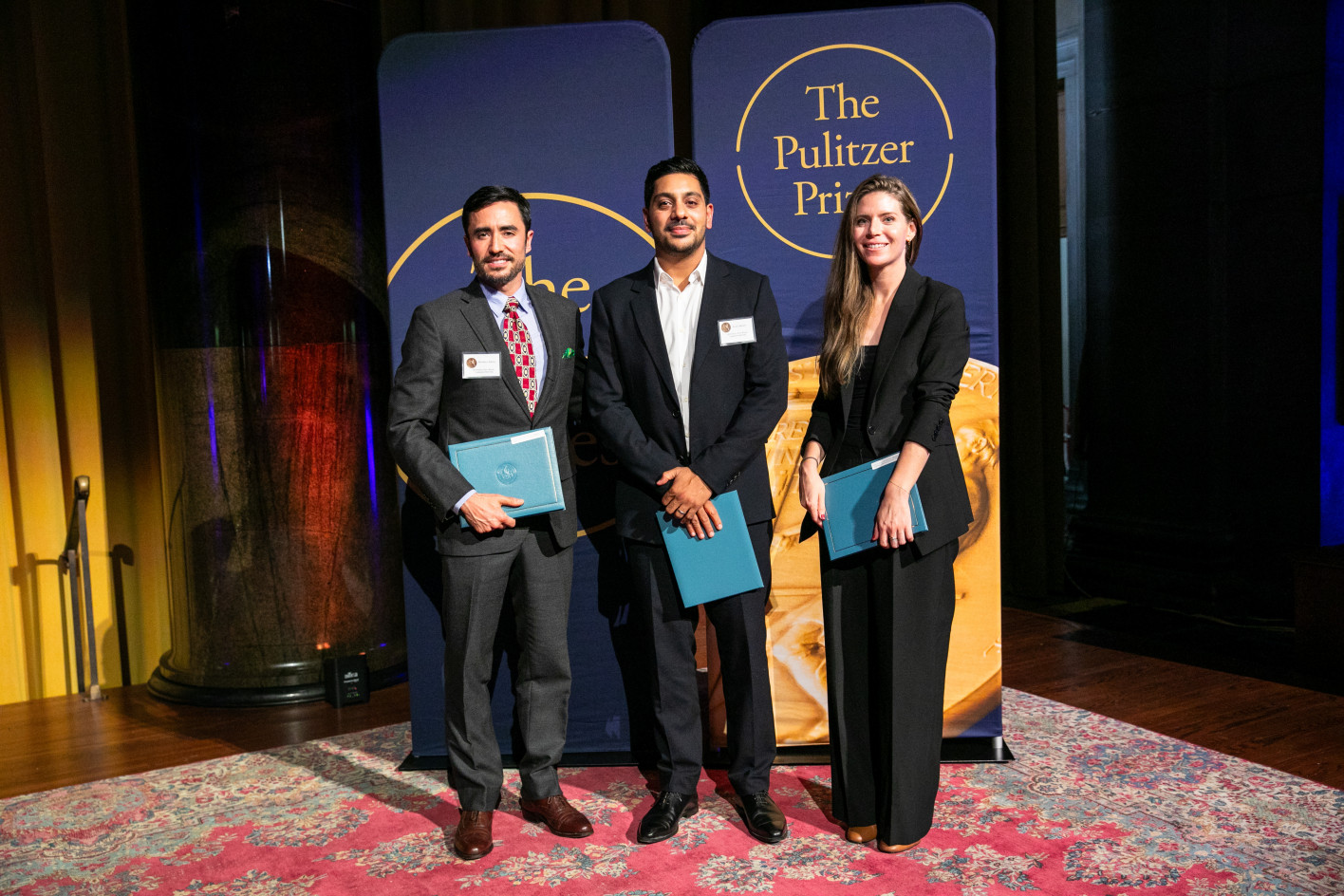
Matthieu Aikins (left), Azam Ahmed and Christina Goldbaum of The New York Times accept the 2025 Pulitzer Prize for Explanatory Reporting. (David Dini/The Pulitzer Prizes)
Winning Work
By Azam Ahmed and Matthieu Aikins Photographs by Bryan Denton
The convoy rumbled into the Taliban heartland, a white desert littered with stones. Over the loudspeakers at the local mosque, the Afghan police officers ordered everyone to gather: The commander was here.
Dozens assembled in the mud square to listen as Abdul Raziq, one of America’s most important partners in the war against the Taliban, stood before the crowd, gesturing at two prisoners he had brought along to make his point.
The prisoners knelt with their hands bound as Raziq spoke to his men. A pair of his officers raised their rifles and opened fire, sending the prisoners into spasms on the reddening earth. In the silence that followed, Raziq addressed the crowd, three witnesses said.
“You will learn to respect me and reject the Taliban,” Raziq said after the killings, which took place in the winter of 2010, according to the witnesses and relatives of both men. “Because I will come back and do this again and again, and no one is going to stop me.”
For years, American military leaders lionized Raziq as a model partner in Afghanistan, their “if only” ally in the battle against the Taliban: If only everyone fought like Raziq, we might actually win this war, American commanders often said.
He ruled over the crucial battleground of Kandahar during a period when the United States had more troops on the ground than in any other chapter of the war, ultimately rising to lieutenant general thanks to the backing of the United States. American generals cycling through Afghanistan made regular pilgrimages to visit him, praising his courage, his ferocious war fighting and the loyalty he commanded from his men, who were trained, armed and paid by the United States and its allies.
The Americans were by his side until the very end. When he was gunned down by an undercover Taliban assassin in 2018, he was walking next to the top American commander in Afghanistan, Gen. Austin S. Miller, who celebrated him as a “great friend” and “patriot.”
But to countless Afghan civilians under his reign, Raziq was something else entirely: America’s monster.
His battlefield prowess was built on years of torture, extrajudicial killings and the largest-known campaign of forced disappearances during America’s 20-year war in Afghanistan, a New York Times investigation into thousands of cases during his rule found.
The Times obtained hundreds of pages of documents written by the former American-backed government, more than a decade’s worth of hidden ledgers bearing clues to his campaign of abuse. He transformed the police into a fearsome combat force without constraints, and his officers abducted hundreds, if not thousands, of people to be killed or tortured in secret jails, The Times found. Most were never seen again.
The culture of lawlessness and impunity he created flew in the face of endless promises by American presidents, generals and ambassadors to uphold human rights and build a better Afghanistan.
And it helps explain why the United States lost the war.
For nearly two decades, the American public saw only part of the war in Afghanistan. Large parts of the country and its people were off limits to outsiders, impossible to chronicle fully during the fighting. Now that it’s over, the Taliban are no longer planting roadside bombs, and many have swapped their AK-47s for three-ring binders and a stifling bureaucracy.
The Times spent more than a year visiting parts of Afghanistan that were once active battlefields, trying to figure out what really happened during America’s longest war.
We interviewed many hundreds of people who said their fathers, husbands, sons and brothers had disappeared under Raziq, the police chief responsible for security across Kandahar Province, the birthplace of the Taliban. They saw his rule as little more than a brutal campaign against civilians, underwritten by the United States.
His acts not only discredited the American war effort — breeding profound resentment that pushed people to support the Taliban — but embodied it in many ways as well. Across Afghanistan, the United States elevated and empowered warlords, corrupt politicians and outright criminals to prosecute a war of military expediency in which the ends often justified the means.
The Taliban committed countless atrocities of their own against civilians, including suicide attacks, assassinations and kidnappings for ransom.
But it was a mistake to “keep a really bad criminal because he was helpful in fighting worse criminals,” said Gen. John R. Allen, who said he tried to limit cooperation with Raziq when he was overseeing coalition forces in the Afghan war from 2011 to 2013.
While Raziq’s tactics worked in some respects, beating back the Taliban in Kandahar and earning him the admiration of many who opposed them, the strategy came at a clear cost. It stirred such enmity in parts of the population that the Taliban turned his cruelty into a recruiting tool, broadcasting it to attract new fighters. Many Afghans came to revile the American-backed government and everything it represented.
“None of us supported the Taliban, at least not at first,” said Fazul Rahman, whose brother was abducted in front of witnesses during Raziq’s reign. “But when the government collapsed, I ran through the streets, rejoicing.”
Even some who cheered the ruthlessness Raziq wielded against his enemies lamented the broader corruption and criminality he helped enshrine, a key part of why the Afghan government collapsed in 2021. After his death, his commanders expanded their predation further, extorting ordinary people and stealing from their own men’s wages and supplies.
“What they brought under the name of democracy was a system in the hands of a few mafia groups,” said Qari Mohammad Mubarak, who ran a girls’ school in Kandahar and initially supported the government. “The people came to hate democracy.”
Many American commanders, diplomats and their allies in Afghanistan knew at the time they were bankrolling a war that strayed far outside international law.
“Sometimes we asked Raziq about incidents of alleged human rights abuses, and when we got answers we would be like, ‘Whoa, I hope we didn’t implicate ourselves in a war crime just by hearing about it,’” said Henry Ensher, a State Department official who held multiple posts on Afghanistan, including as the top civilian representative in Kandahar in 2010 and 2011, when he worked with Raziq.
“We knew what we were doing, but we didn’t think we had a choice,” Ensher said.
Most American leaders — including more than a dozen interviewed by The Times — said that Raziq had been seen as the only partner capable of beating back the Taliban in the heartland of the insurgency, where a pitched battle for dominance was underway.
“In the moment, we might have succeeded, but so what?” Ensher said. “The entire enterprise was flawed.”
Many Afghans say Raziq used the Americans and their military might to pursue a personal vendetta, taking vengeance against the rivals his tribe had been fighting for decades.
In interviews, many former senior American officials acknowledged that they never grasped that dynamic. It was a defining characteristic over a generation of combat — how little the United States understood about the war it was waging.
The United Nations, human rights groups and news outlets raised serious concerns about Raziq and his forces, but independent investigations were limited, especially with the region so impenetrable during the war.
To determine the extent of the abuses, The Times combed through more than 50,000 handwritten complaints that had been scrawled into the Kandahar governor’s ledgers from 2011 through the end of the war in 2021. In them, we found the rudimentary details of almost 2,200 cases of suspected disappearances.
From there, we went to hundreds of homes across Kandahar and tracked down nearly 1,000 people who said their loved ones had disappeared, been killed or been taken by government security forces.
All together, The Times collected detailed evidence of 368 cases of forced disappearances and dozens of extrajudicial killings attributed to American-backed forces in Kandahar. We counted only cases that were corroborated by at least two people, many of them eyewitnesses to the abductions, and they were often documented with police reports, affidavits and other government records as well.
In all of the cases of forced disappearances, the person is still missing.
These figures are almost certainly a gross undercount of the atrocities during Raziq’s reign. We could not canvas all of Kandahar, home to more than a million people. And the more than 2,000 suspected cases we found in the government’s ledgers were most likely just an inkling of what really happened. Most of the families we interviewed had never formally reported their loved ones missing, out of fear of retribution or the danger of traveling during the war.
Beyond that, the police destroyed many of their records as the Taliban reached the outskirts of Kandahar City in 2021, former senior officials said. The exact number who were abducted and never seen again may be impossible to know.
What is clear, however, is who was responsible: Only the American-backed government consistently engaged in forced disappearances in Kandahar, former officials, combatants and families of the victims said.
“The Taliban didn’t need to disappear people — they just killed them where they found them,” said Hasti Mohammad, a former government official in charge of the Panjwai district in Kandahar. “The government disappeared people because what they were doing was illegal. They were hiding from the law.”
The cases confirmed by The Times amount to the largest campaign of forced disappearances in Afghanistan since tens of thousands went missing after the Soviet-backed communist coup in 1978, an assessment of previous atrocities shows.
As the victims mourned their loved ones, they confronted their own powerlessness. Raziq was untouchable, thanks to the ironclad support of the United States and its NATO allies.
“We would ask ourselves: ‘Are we creating something here that we may regret later?’” said Col. Robert Waltemeyer, a former Special Forces officer who worked with Raziq.
But there was no one better at fighting the Taliban, he said, adding that he never witnessed Raziq do anything illegal. When the United States sent tens of thousands of American soldiers to Afghanistan during the so-called surge announced in 2009, hoping to wrest control of the south, Raziq was central to the effort.
“He was probably the most important person in the entire surge,” Waltemeyer said.
The United States pushed for Raziq to lead the police forces who fought alongside American troops, he said, because “he showed up, and his troops showed up, to fight, not just to watch the Americans fight.”
In effect, Waltemeyer said, “We created Raziq.”
“You look at every U.S. war and it’s the same,” he said. “We create regrets.”
‘Abdul Raziq’s work’
Fazul Rahman raced to the grease-stained motorcycle shop the moment he got the call: His brother, a mechanic, had just been kidnapped.
In a panic, the shop workers told him that three men in civilian clothes had pulled up in an unmarked Toyota Corolla on the morning of Sept. 3, 2016, asking his brother to take a look at a generator in the trunk.
Then, in full view of a crowd of onlookers, they said, the men wrestled Fazul’s brother, Ahmad, 28, into the car and sped away.
To Fazul and everyone else present, the culprits were obvious: the police. Under Raziq, Kandahar’s security forces had become notorious for snatching anyone they suspected of working with Taliban insurgents. Many simply disappeared. Others turned up as mutilated corpses, discarded in the streets. A lucky few were released alive, bearing wounds and accounts of torture.
Some of the missing were, in fact, Taliban, their families said. Others, their relatives insisted, were not. Many were simply part of the working class: mechanics, tailors and taxi drivers who had nothing to do with the war, their families said.
Desperate to find his brother, Fazul gathered elders and hurried to the local police station. The officers denied arresting his brother, so he headed to the palace of the American-backed governor, joining the line to submit complaints.
The handwritten government ledgers reviewed by The Times show his plea: Volume 4 from 2016, Entry No. 591 — Ahmad, son of Abdur Rahman.
There were thousands of families just like his, all with the same burning question. What had the government done with their loved ones?
After filing his complaint, Fazul worried. What would happen if he pushed too hard? The police were abducting and disappearing people on mere suspicions, never mind someone openly accusing them of kidnapping.
“The police were getting angry,” he said. “They’d beat us and say, ‘Why do you keep coming?’”
Still, another force, more potent than fear, was driving him: his mother, Malika.
Women were rarely seen or heard making public demands in conservative Afghanistan, especially in the south. But Fazul and Ahmad were all their mother had; their father had died of cancer more than 20 years earlier, leaving her to raise them on her own.
“For months, from morning to night, I went from the police to the governor’s offices and waited for someone to see me,” she said.
Outside the offices, scribes charged a small fee to write out complaints for people who, like Fazul and his mother, were illiterate. Many of the petitions were in Malika’s name, and the family provided copies of them to The Times.
“Please help find and release my innocent son,” one said. It carried the signatures of 11 local elders, all attesting that her son was not in the Taliban.
Soon, Fazul and his mother got to know other families searching for missing people. Having a relative arrested on suspicion of being an insurgent tarred them with the same brush. But the presence of women gave them some license to make demands.
Aliyah’s son, Salahuddin, a rickshaw driver, had been snatched from outside his home as he walked to the mosque.
“There was nowhere that I wouldn’t go to find my son,” Aliyah said. “But we had no idea whether he was dead or alive.”
A third man, Daud, had been taken in 2015. With no immediate family to look for him, a neighbor, Seema, became his advocate.
Frustrated by how often the families returned, an employee at the governor’s palace told Fazul to put together a list of the missing. A scribe helped Fazul take down the names in his impromptu group: 17 families, at first.
The list, scribbled on a sheet of plain white paper, was soon expanded, passed around, photocopied and texted.
Like Ahmad, many of the victims had been grabbed off the streets or from workplaces by armed men in plainclothes in front of witnesses. Some had simply vanished, like Abdul Wahid, whose brother, a butcher, last saw him when he sent him home with some meat for dinner. Others, like Habib Rahman, had been arrested by uniformed officers while out with friends.
Their relatives clung to the hope that they might still be alive in one of the many unofficial detention sites, often called “private prisons,” maintained by Raziq’s forces.
The families went to the Red Cross to study photos of unidentified bodies that had been collected and buried, and then to the morgue to see the newly discovered corpses. Some had been suffocated, shot in the head or dumped with their hands still tied.
The group paid bribes to find answers. Most had already shelled out money to unscrupulous police officers, to no avail. Then, in late 2016, a break: One of their missing was returned, finally offering a clear account of what was happening to their loved ones.
Nisar Ahmad, 23, had been abducted a month earlier, not long after a bomb attack targeting one of Raziq’s commanders left the area on edge. Two men in plainclothes took him at gunpoint.
Inside a shipping container, a group of men, some in police uniform, took turns beating him, he said. They stuffed a plastic bag into his mouth and poured water over his face, nearly suffocating him. Most shamefully, he said, they twisted his genitals, permanently damaging them.
The police told him to make a confession, and recorded it, he said: “After I confessed, they didn’t torture me anymore.”
That night, he was blindfolded and driven to another location. Through a barred window, he saw a spindly mountaintop and the green, red and black flag of Afghanistan, he said. (A former police detective said the site appeared to be the District 9 station in Kandahar City.)
Eventually, Nisar’s father, Mohammad Fazluddin, received a phone call from a police officer, he said, demanding the equivalent of $900 — a staggering amount — to release his son. Mohammad agreed, dropping off the money at an auto repair shop as instructed, and his son was let go, he said.
“It’s a miracle,” he said, taking the release as a sign that the police knew his son was innocent.
In private, the families said, some of the police acknowledged they had taken their loved ones. So, Fazul and the others buttonholed every official possible.
They insisted there was nothing they could do, he said.
“They all knew exactly what was happening,” Fazul said. “They said: ‘We have nothing to do with this. This is Abdul Raziq’s work.’”
Finally, Fazul got a meeting with the governor of Kandahar. The mothers joined more than a dozen men to plead and scold for the missing on their list.
Malika, Fazul’s mother, was furious, accusing the officials of corruption and cowardice, of robbing her of the most precious thing in life. At one point, they recalled, the governor’s guards warned her not to speak so bluntly.
“You people have taken my son,” she responded, looking at the governor, people in the room recalled. “If you want to kill me, then kill me, but I won’t hold my tongue.”
The hectoring paid off. Their list landed on the desk of Raziq himself.
He summoned them for a meeting.
The other war
Disappearances were hardly new in Kandahar, a place ravaged by more than four decades of war. Even Raziq had lost someone.
His father had been a driver, often going to the border with Pakistan. One day, while Raziq was still a boy, his father disappeared on a routine trip, vanishing in the vast desert.
His family, members of the Achakzai tribe, blamed their longtime rivals: the Noorzai. The two tribes had been locked in a deadly feud that stretched back decades, long before the Taliban came to power.
“He was killed because he was Achakzai,” Tadin Khan, Raziq’s younger brother, told The Times. “His body disappeared.”
Raziq went on to author the most brutal campaign of enforced disappearances in his country in decades. And it often targeted this rival tribe, the Noorzai, many of whom supported the Taliban.
That is something the Americans generally failed to understand: A tribal and family dynamic, not just a hatred of the Taliban, animated Raziq’s war. In fact, the cluster of villages where Raziq summoned the crowd, killed the two prisoners and then threatened the onlookers was mostly made up of Noorzai.
“He killed them like dogs,” said Haji Dilbar, a villager who described being in the crowd that Raziq had assembled to witness the killings.
As his friends tell it, Raziq first picked up a gun as a teenager, fighting under his uncle during the civil war that came after the collapse of the Soviet-backed government. In 1994, his uncle was killed by the Taliban, who hanged his body from the barrel of a tank.
When the U.S. invasion began in 2001, Raziq started fighting on the American side, joining a militia to clear the Taliban out of Kandahar. Later, those same forces became the border police and served under Raziq, still in his 20s at the time.
Largely illiterate, he compensated with his intelligence and charisma, distinguishing himself as a fearless fighter who knew the deserts straddling the border, as his father did.
By 2010, as the Taliban gained ground across the south, Raziq had held back the insurgents in the areas around his home district, called Spin Boldak. American commanders knew he was corrupt, running a mafia-style racket on trade across the border. He was suspected of being involved in the poppy trade.
Allegations of extrajudicial killings also dogged Raziq for years, dating back to the early days of the American-backed government. Noorzai elders said they had complained of murders to American military officials, but were ignored.
Lt. Col. Andrew Green, who worked closely with Raziq in 2010 and 2011, said that confirming the allegations had been impossible because the events happened deep in Taliban territory.
Moreover, he said, law enforcement in Afghanistan was barely functional. The courts were corrupt, and most people could pay their way out of jail, leaving the police with few options.
“In Afghanistan, the police shoot people,” he said. “While you can’t say it’s a good thing, it’s sort of what is done.”
The worries about Raziq spread. A State Department report documented a 2006 episode in which he executed 16 men he accused of being Taliban. In 2009, he was accused of torture and keeping private prisons by the Afghan human rights commission.
The so-called surge became a major turning point for him. In 2009, hoping to beat back a resurgent Taliban, President Barack Obama announced that he would send thousands of additional troops to Afghanistan, focusing on Kandahar and Helmand Provinces, two Taliban strongholds.
The Americans wanted a partner who was unafraid to confront the Taliban head-on, like Raziq. Yet they were also debating what to do about “bad actors” who undermined the legitimacy of the Afghan government, also like Raziq.
“There were lots of conversations about whether we should mentor Raziq or imprison him,” recalled Green, the American officer, who had investigated him for other issues, including graft.
The Americans chose the former. They needed him.
After the police chief of Kandahar was assassinated in 2011, Raziq was given the job. He became a general and appointed commanders from his Achakzai tribe to key positions in Kandahar.
United Nations investigators called four of them — three of whom were his relatives — the “four horsemen” for the many allegations of torture and extrajudicial killings against them. One of them, a Raziq family member, was responsible for organizing death squads, according to police officers who worked with him. His men roved the city in unmarked cars, wearing plainclothes.
Deeming the court system corrupt, Raziq ordered his commanders to kill suspected Taliban, former officers and officials said. Those who refused to kill captives were dismissed.
“He told me: ‘Why are you bringing these Taliban to the station? Why aren’t you killing them? What are you afraid of?’” said one former city district chief who, like some others, spoke on the condition of anonymity out of fear of retribution.
The victims were taken for a “sand picnic” and dumped in remote areas, down wells or where the shifting desert sands would cover them, according to former police officers and internal United Nations reports.
One senior police officer said he had complained to Raziq about finding bodies dumped in his district.
“I told him, ‘They’re in my area; it’s going to be blamed on me,’” the officer said. He recalled Raziq laughing before agreeing to tell his men to be more careful.
A 2013 United Nations report noted a surge in unidentified bodies, some still handcuffed, dumped in Kandahar City and dozens of reported disappearances, citing the “increased level of brutality” and torture under Raziq.
Within two months of his appointment as police chief, the Americans stopped transferring detainees to Afghan security forces in Kandahar because of reports of abuses and executions.
“I pulled the intel on the guy and it was pretty horrific,” Allen, the American general, said.
Still, American support continued to flow to Raziq, who was popular with U.S. officers and considered vital to winning the war.
While Col. Bill Carty, the head of U.S. Special Forces in Kandahar, was visiting Raziq in 2012, a suicide bomber struck. Carty threw himself on top of Raziq to shield him, and then gave the general his own body armor to wear, according to an account Carty gave in the book, “One Hundred Victories,” and confirmed to The Times.
“Why did you give me your vest?” Raziq asked.
“There are thousands of me,” Carty recalled replying, emphasizing the importance of Raziq’s role as police chief. “But there is only one of you.”
Guests of the general
At his headquarters, Raziq greeted Fazul and the other family members in his white civilian robes. Because he couldn’t read, his secretary said aloud the names on the list Fazul had provided for him.
Getting the meeting was no easy feat. By then, the Taliban had made so many attempts on the general’s life that he joked to friends that he had lost count.
But in person, Raziq was polite, several of the attendees recalled, and allowed each of them to speak their minds. When everyone finished, the general spoke.
He did not trust the courts, the families recounted him saying. The judges let criminals go free, the prosecutors were ineffective, and justice could always be bought for a price. He preferred to administer his own justice.
He spoke to a few family members directly, including Shah Mohammad, whose brother, Neda, was on Fazul’s list. The general told him that Neda had been involved in the murder of police officers, an accusation he struggled to believe; Neda sold vegetables from a pushcart in the market.
Before the meeting ended, the general turned to Seema, whose adoptive son Daud had disappeared months earlier. He would be returned, the general said without explanation.
Not long after, Daud was set free.
After getting out, Daud told the families how he had been kept in a dark cell for months at an unofficial detention site. He was beaten and abused regularly, until, after the general’s intervention, he was transferred to a formal prison before being let go. He told the others that he had not seen any of their loved ones.
Still, a painful wave of hope washed over the families. They began to dream that, perhaps, their children might still be alive. But that is the problem with hope, and not knowing: Without the closure of death, they could never properly grieve.
For the perpetrators, disappearances carry a cruel logic. Though they can be crimes against humanity, there is little evidence without a body, especially when someone is snatched without witnesses or by officers in civilian clothes and cars.
Yet the disappearances inflicted unique wounds for many Afghans. Often, wives were told they could not remarry until their husbands were proved dead. Some with young children were left unable to support themselves.
“What General Raziq did in terms of killing and disappearing was worse than everything else that happened in the rest of Afghanistan,” said Sayed Abdul Karim, the father of one of the young men on Fazul’s list. “I wish that we could bury his bones somewhere. If we had a grave, we could go there and pray.”
The cruelty bred other cruelties, like the cottage industry of hustlers that emerged to take advantage of parents’ desperation. Fazul and his mother fell victim to a scam, traveling to Kabul to pay an intelligence official several thousand dollars for Ahmad’s return, a trip that nearly ended with Fazul himself getting kidnapped. Others paid more.
Some decided their families should be joined by more than tragedy alone. Fazul’s cousin married the son of the missing rickshaw driver, Salahuddin.
He had been gone so long that, by then, his son was of marrying age.
The insurgents rise
The shock came on Oct. 18, 2018: Raziq was gunned down by a Taliban assassin who had infiltrated the governor’s guards.
The Taliban crowed.
They had long used Raziq’s brutality to recruit fighters and whip up anger in videos and pamphlets that showcased his abuses.
But his death allowed the insurgents to broadcast their ability to kill even the most protected commanders — one who was walking just paces away from Miller, the top American commander in Afghanistan, at the time of his death.
The Taliban said they had chosen to target Raziq over anyone else at the meeting, including the American four-star general, who escaped injury.
“He was more important to us than Scott Miller,” said Maulavi Ebrar Ahmad Habib, a Taliban commander who oversaw assassinations in Kandahar during those years.
Fazul and the others hoped things would change with Raziq’s death. For the most part, nothing did.
Raziq’s brother, Tadin, took over as police chief of Kandahar. He told The Times that neither he nor his brother had waged campaigns of forced disappearances. Officials said he simply continued the system his brother had built.
When the war began, Fazul and the others imagined the Americans would bring investment and opportunity. They envisioned good jobs, better homes, prosperity. But their good will evaporated quickly as their loved ones disappeared.
It was not that everyone embraced the Taliban, residents said; they just came to detest the Afghan government and the Americans who propped it up.
That erosion of support — not just among the families of the missing, but also among many Afghans disenchanted by the broader corruption and unchecked abuses of the Americans and their Afghan partners — was part of the collapse of Kandahar, as it was elsewhere in the country.
The impunity and criminality that Raziq fostered metastasized after his death, eating away at Kandahar from within. As the Taliban grew stronger, wage and supply theft within government forces devastated morale, as did infighting among his commanders, paralyzing their ability to fight.
Fazul’s group prayed for an insurgent victory, clinging to the hope that once the government was toppled, they might discover what had become of their relatives.
And once the United States withdrew from Afghanistan, leading to the collapse of the Afghan government in 2021, the Taliban went from prison to prison, emptying cells.
Thousands of people from across the province flooded into Kandahar City. Fazul heard that hundreds of prisoners had been extracted from the basement of the police headquarters. Huge crowds gathered outside of the governor’s compound, jostling for a look at those who exited.
Fazul joined them, racing downtown to scour public facilities. Having no luck in Kandahar City, he and others descended on Spin Boldak, where Raziq got his start. Hundreds waited there, too, scanning the crowds for their missing loved ones. Fazul counted the people freed from unofficial detention sites. His brother wasn’t one of them.
Rohullah Akhunzada, who was part of Fazul’s group, looked for his own brother in a basement prison, its dank, low ceilings a harrowing indication of what so many Afghans had been forced to endure. He found no sign of him.
“We still don’t know,” he said.
Having looked everywhere, another of Fazul’s compatriots, Fazl Raheem, approached the Taliban to ask for news of his brother.
The Taliban told him that all of the prisons had been emptied. Everyone still alive is already with their families, he recalled them saying.
The crowds drifted, hoping for one more place their loved ones could materialize. Many went to the crowded bus station in Kandahar City to scan the prisoners returning from Bagram Air Base, where the Americans, and later the Afghans, had kept thousands of detainees.
The urgency and desperation rose like a fever. So, too, did the familiar despondence when Fazul’s brother was nowhere to be found.
A legacy ignored
Since the collapse, mass graves have turned up in Kandahar, prompting renewed searches from relatives who show up at desert sites and hospital morgues, or share photographs of skeletal remains. But there is no organized search for the missing in Kandahar.
After years of pressure from the United States, prosecutors at the International Criminal Court have said they are de-prioritizing investigations into abuses committed by American-backed forces. The United Nations has focused on abuses carried out by the new Taliban government, accusing it of its own campaign of extrajudicial killings and torture.
The Times sued the American government for its files on Raziq. Nearly a year later, the military and the State Department have turned over only a handful of documents. Few military leaders from that era had any interest in revisiting his legacy, and what it reveals about the American war effort.
“The reason you have insurgencies is because of injustice, and Raziq represented the very worst,” said Allen, the American general. He added: “Raziq created the very injustice that gave the Taliban its edge on us.”
To commemorate Raziq, the former Afghan government had begun erecting a mausoleum for him, a giant, mosque-like structure beside the governor’s palace, a memorial fit for a national hero. Many see him that way, as a champion of those who oppose the Taliban.
Rather than destroy it, the Taliban have surrounded the edifice with concrete blast walls, careful not to antagonize the large swathe of the population that still reveres the general. It is blocked but visible, its dome and minarets peeking over the barrier.
There are no monuments to the missing. Of the 17 people on his original list, Fazul knows of only three who came home alive.
“I still have hope that he will return, even though I know he is probably dead,” said Malika, Fazul and Ahmad’s mother. “My tears have not dried since he disappeared.”
Abdul Nafi and Shir Ali Farhad contributed reporting from Kandahar. Produced by Sean Catangui, Leo Dominguez and Rumsey Taylor. Photo Editing by Craig Allen, Mikko Takkunen and Gaia Tripoli.
By Matthieu Aikins Photographs by Victor J. Blue
I first heard about Abdul Raziq in early 2009, when I was a young freelance journalist newly arrived in southern Afghanistan. By chance, I had befriended two drug smugglers who told me that a powerful police commander in the area was helping them ship two metric tons of opium to Iran each month. Raziq, I learned, had a fearsome reputation in his hometown, Spin Boldak, on the border with Pakistan. Everyone I spoke to knew about the Taliban suspects tortured and dumped in the desert. Just as they knew that Raziq was a close ally of the U.S. military. My smuggler friends had offered to introduce me to Raziq, and 10 days after my arrival in Spin Boldak, he returned to town for his grandmother’s funeral.
When I arrived at Raziq’s compound, I saw him sitting cross-legged on a carpeted platform, receiving a long line of guests. He was not what I expected. Trim and cheerful, clean-shaven and barely 30, he wasn’t much older than I, yet he was leading several thousand men under arms. I reached the front of the line, and Raziq shook my hand to welcome me before turning to the next guest. We would never get the chance to meet again, but that was the beginning of my long quest to understand the paradox he represented.
As inexperienced as I was, I knew enough to be puzzled by Raziq’s success. Why was the U.S. military, which was supposed to be supporting democracy and human rights in Afghanistan, working closely with a drug trafficker and murderer? One of his commanders, his uncle Janan, even wore a U.S. Army uniform given to him by his advisers, complete with a First Infantry Division patch and the Stars and Stripes.
Thanks to American patronage, Raziq was promoted to police chief of Kandahar and would eventually rise to the rank of three-star general. Famous across Afghanistan, he became the country’s most polarizing figure. The Taliban hated him, of course, but so did the ordinary people his commanders and soldiers extorted and abused. Journalists and human rights groups assembled damning evidence against him and warned that his brutality would backfire.
But Raziq beat back the suicide bombers and brought stability to Kandahar. In doing so, he became an icon for many war-weary Afghans who sought security at all costs. In a nation divided by ethnic and regional loyalties, you could find Raziq’s photo in taxis and at checkpoints from north to south. And he never lost his American backing: When he was assassinated by the Taliban in 2018, he was walking next to the top U.S. commander, Gen. Austin S. Miller. That day, it seemed as if half the country was in mourning; Miller hailed him as a friend and patriot.
Three years later, the United States withdrew, and the Islamic Republic of Afghanistan collapsed. I was working as a journalist in Kabul at the time, and as soon as the dust settled, I went south to Kandahar. With the fighting over, I was able to visit people and places nearly impossible to access before. Here was a chance to reckon with Raziq’s legacy. I met with survivors of torture inside his prisons and visited morgues where skeletons had been unearthed from desert graves. Like a great tree in a storm, the republic had toppled and exposed the hidden places among its roots. The American war was far more brutal than we had known.
Since then, over repeated trips to the war’s fiercest battlegrounds, I found that many of Raziq’s former police officers were willing to talk about the torture, execution and cover-ups they witnessed. I also spoke with a dozen American military officers and diplomats who worked with Raziq and obtained new documents through a Freedom of Information Act lawsuit and other sources, which reveal just how much the American government knew about Raziq’s crimes. And with colleagues at The Times, I interviewed hundreds of witnesses and discovered a republican archive that exposed Afghanistan’s largest campaign of forced disappearances since the Communist coup in 1978. We documented 368 cases of people who were still missing after being abducted by Raziq’s men; the true toll was most likely in the thousands.
The scale of Raziq’s abuses, carried out with American support, was shocking. But the fact that they seem to have brought security to Kandahar has even more disturbing implications. Raziq’s story complicates the comforting belief that brutality always backfires and undermines the U.S. military’s claim to have fought according to international law. Raziq’s violence was effective because it had a logic particular to the kind of civil war that the United States found in Afghanistan, one where the people, and not the terrain, were the battlefield. The reasons for this are well documented by scholars of civil war and counterinsurgency but glossed over by our generals and politicians and obscured by the myths of American exceptionalism and our righteous war on terror.
But Raziq saw those reasons clearly. He murdered and tortured because he believed it was the only way to win against the Taliban. And America helped him do it.
Two harsh realities defined Raziq’s childhood: the war and the border.
The desert around Spin Boldak and its twinned Pakistani town, Chaman, stretches westward hundreds of miles to Iran, through vast wastes and dune seas crossed by nomads. The clans of two rival Pashtun tribes dominate the area, feuding like Hatfields and McCoys of the borderlands. Raziq was from the Achakzai, who competed with the Noorzai over land and smuggling routes.
Not long after Raziq was born in a mud-walled village, the Afghan Communists seized power in Kabul, and in response rebels rose up against the government, plunging the country into a conflict that lasted for more than four decades. Although both superpowers and neighbors like Pakistan and Iran intervened for their own ends, at heart this was a civil war fought by Afghans against Afghans for control of the state. Even at the peaks of the Soviet and American occupations, Afghans constituted a majority of casualties on each side.
In times of civil war, neighbors are often at one another’s throats because of local dynamics, even if they justify their actions through religion or nationalism. In Kandahar, many Noorzai joined with the mujahedeen rebels, who were supplied by the C.I.A. and the Pakistani military, while Raziq’s Achakzai relatives eventually sided with the Soviet-backed Communists. Raziq was still a boy when the war brought grief to his home: His father, who drove people and goods to the border, disappeared. His family was never able to find his body and blamed their tribal rivals. “The Noorzai did it,” said Ayub Kakai, Raziq’s uncle. “They threw him down a well.”
In 1991, after the Soviets cut off funding, the Communist government collapsed. Kandahar’s rival warlords carved up the province with a patchwork of checkpoints, where robbery and rape were common. Raziq’s uncle Mansoor took control on the road from Spin Boldak to the city, and Raziq, by then a teenager, joined him, attracted to the thrills of war. “Raziq loved cars and guns,” his younger cousin Arafat told me.
Three years later, an armed movement of religious students known as the Taliban rose in the farmlands west of Kandahar City and swept through the province, capturing Raziq and his uncle. They hung Mansoor from the barrel of a tank but spared young Raziq, who fled with his family across the border to Chaman. For seven years in exile, Raziq worked as a driver near the border, where he peddled used car parts.
Then came Sept. 11, 2001. For the Achakzai, the Americans’ decision to invade and depose the Taliban came as a miraculous reversal of fortune. That December, the C.I.A. and Special Forces assembled an army of exiles, with many Achakzai, including Raziq, among them. With the help of U.S. air power, they routed the Taliban and seized control of Kandahar, once again trading places with their Noorzai rivals, who escaped across the border to where the Pakistani military, playing a double game, gave them safe haven.
In the new republic, the Achakzai militia was transformed into the area’s Border Police. They partnered with American troops and were trained by contractors from Blackwater and DynCorp. Like the rest of the republican forces, their weapons, ammunition and salaries were paid for by the United States and its allies. But beneath the surface, the civil war still festered, even though the Americans saw it through stark binaries: the government versus the terrorists, the Afghans versus the Taliban.
“Our viewpoint was this was a war on terrorism or a war against a group trying to overthrow a democratic government,” said Carter Malkasian, a former State Department official who advised the U.S. military in Afghanistan for more than a decade. “We don’t want to view this as us getting involved in another country’s civil war.”
Thanks to his family connections, Raziq quickly rose through the ranks. He was a natural leader who fought fearlessly and earned the loyalty of his men. Although nearly illiterate, he had a capacious memory for places and faces and was a canny operator in the spy games and smuggling rings of the borderlands, using his illicit gains to fund a growing network of sources. Early on, Raziq learned that power would earn him money, which bought the intelligence that could attract U.S. patronage, giving him more power. American officers who worked in Spin Boldak remembered Raziq as an eager and valued partner in the hunt for the Taliban and Al Qaeda.
“My brother was very close to the Americans,” said Tadin Khan, Raziq’s younger brother. “They trusted him, and he never tried to deceive them.”
Raziq was as generous with his friends and family as he was ruthless with his enemies. Not long after the Achakzai appointed him leader of their militia, Raziq’s older brother, Bacha, was gunned down in the bazaar in Chaman. “Bacha and Raziq were very close,” said Arafat, his cousin. “He was killed because of Raziq.”
Raziq blamed a tribal rival, a smuggler named Shin Noorzai. In March 2006, he kidnapped Shin and 15 people he was traveling with and shot them all in a dry riverbed near the border. The massacre led to a local outcry, and Raziq was summoned to Kabul. But President Hamid Karzai intervened to protect him, according to Western diplomats involved in the case, and he was never charged. (Through a spokesperson, Karzai declined to comment for this article.) The incident, however, made it into that year’s State Department report on human rights, the first public documentation of Raziq’s abuses.
Raziq’s role in the drug trade also attracted attention from American investigators. Although the Taliban had banned poppy cultivation, opium came roaring back under Karzai’s administration, and Spin Boldak sat on one of the main trafficking routes. Classified U.S. military and Drug Enforcement Administration reports, obtained through FOIA requests, described the involvement of Raziq and his men, detailing convoys in the desert, secret meetings and the use of green ink for letters of safe passage. One referred to Raziq as “the main drug smuggler in Spin Boldak.” (His brother Tadin denied that Raziq or anyone from his family was involved in drug trafficking, murder or other crimes. “All these accusations of corruption, smuggling and abuses are because of propaganda from the Taliban,” he said.)
As it turns out, by the time Raziq and I shook hands in 2009, the United States already knew he was accused of murder and smuggling but worked with him anyway. Yet Raziq’s position had become precarious, for the U.S. military’s concept of the war was changing. When I published an article about the accusations that fall, Raziq’s career had reached a dangerous point — one where his foreign patrons might have chosen to stop supporting him.
The U.S. war in Afghanistan was going badly. Faced with a growing insurgency that threatened the Afghan government’s survival, President Barack Obama ordered a surge of tens of thousands of troops. His generals had advised him that, fixated on the enemy, the United States had neglected the true battlefield: the hearts and minds of the Afghan people.
The surge would be guided by a military doctrine known as counterinsurgency theory, or COIN, which was held to have saved the day in Iraq. “Our strategy cannot be focused on seizing terrain or destroying insurgent forces; our objective must be the population,” Gen. Stanley A. McChrystal wrote upon taking command in 2009. The U.S.-led coalition “can no longer ignore or tacitly accept abuse of power, corruption or marginalization.”
According to “population-centric” COIN, the Afghan people had to be protected against the insurgency and motivated to support their own government. Criminal officials like Raziq threatened the legitimacy of the republic, and therefore the success of the war.
Given the hundreds of thousands of Afghans and Iraqis who died as result of the U.S. invasions, this emphasis on protecting civilians may seem hypocritical. But the laws of war, which forbid targeting noncombatants or harming prisoners, are essential to how the United States distinguishes its own use of force from that of rogue states and terrorists. “I believe the United States of America must remain a standard-bearer in the conduct of war,” Obama said as he accepted the Nobel Peace Prize the same year as the surge. “That is what makes us different from those whom we fight. That is a source of our strength.”
Since the decline of the antiwar movement after Vietnam, both the U.S. military and its liberal critics have become increasingly united in the conviction that war must be fought humanely by exempting civilians, as much as possible, from its violence — a shift, the historian Samuel Moyn has argued, that risks legitimizing endless war. Underpinning this is the assumption that there is no contradiction between waging war both lawfully and effectively. “The law of war is a part of our military heritage, and obeying it is the right thing to do,” states the U.S. military manual on the subject. “But we also know that the law of war poses no obstacle to fighting well and prevailing.”
In this vein, COIN reassured the American public that the surge would be just. Because the United States needed the support of the Afghan population, it could not just kill its way to victory. Brutality would backfire by producing more resistance. In a speech, McChrystal explained “COIN mathematics”: If a military operation killed two out of 10 insurgents, instead of eight remaining, that number was “more likely to be as many as 20, because each one you killed has a brother, father, son and friends.”
But while McChrystal took prompt steps to reduce civilian casualties from airstrikes, dealing with so-called bad actors like Raziq was not as simple. It turns out that the way the United States implemented its strategy provided a test of whether COIN really worked as promised.
The surge was focused on the two neighboring provinces in the south where Taliban activity was strongest. Both received roughly equivalent investments of troops and money. In Helmand, the Marines and the British pushed for the good governance prescribed by COIN, successfully pressuring Kabul to replace corrupt officials with technocrats.
“You didn’t have a power-broker-run government at the provincial level,” said Malkasian, who served as an adviser in Helmand. But the opposite proved true in Kandahar, where U.S. commanders prioritized security and encountered dogged pushback from Kabul on anticorruption efforts. “Kandahar was just more important for the Afghan political system, for Karzai, than Helmand was.”
As so often happened during the war, Washington’s grand strategy was interpreted by a multitude of American agencies and actors. In Kabul, specialized anticorruption and counternarcotics teams had Raziq in their sights. A D.E.A.-led republican unit seized an enormous stockpile of hashish in Spin Boldak and arrested a district police commander who ran narcotics shipments for Raziq. There were plans to go after him next.
But the Army officers working with Raziq saw things very differently. He and his men were a rare example of an effective, homegrown force that delivered security on a vital supply route. The U.S. commanders were in the middle of a high-stakes offensive against the Taliban, and their own troops’ lives were on the line. Karzai supported Raziq, and according to former military and intelligence officials, so did the C.I.A. With his cross-border networks, Raziq was a valuable source of intelligence on Taliban havens and bomb-making networks in Pakistan. And he could cross lines the United States couldn’t: A declassified military report from 2010 noted that Raziq was giving shelter to Baloch rebels fighting the Pakistani government and that he used “these tribesmen to carry out assassinations and killings in Pakistan.”
And so when, in February 2010, senior U.S. officials met to discuss action against corrupt Afghan officials, no one could agree on what to do about Raziq. “There was a lack of consensus,” according to Earl Anthony, who as deputy U.S. ambassador was a co-chair of the meeting. “Some highly valued his work on the security front against the Taliban.”
In the end, McChrystal, who declined to comment for this article, sided with his commanders on the ground. Raziq, they reasoned, could be mentored to change his ways. According to a leaked cable, the senior U.S. diplomat in Kandahar even offered to craft a media plan for him, including radio spots, billboards and “the longer-term encouragement of stories in the international media on the ‘reform’” of Raziq.
In March, McChrystal visited Raziq in Spin Boldak and posed beside him for television cameras. “I am very optimistic that with the plans that I’ve heard,” he said, as Raziq looked on smiling, “we can increase efficiency and decrease corruption.”
From that point on, the U.S. military would openly promote Raziq and make him an integral part of the surge. A series of personal advisers were brought in to coach and protect the young commander; the first was Jamie Hayes, who as a Special Forces lieutenant colonel led a team assigned to Raziq in July 2010. Shortly after he arrived, Hayes was ordered to help Raziq plan a major operation to clear Malajat, an outlying neighborhood of Kandahar City where the Taliban were entrenched.
At first, Hayes was puzzled about why Raziq and his Border Police were given the job, rather than the republican army or commandos. His superiors explained that it was a political decision by Karzai and the U.S. command. “This is a guy that we want to make successful,” Hayes recalled being told. “He’s an aggressive, strong leader that we want to make sure gets the chance to shine.”
Raziq’s charisma undoubtedly played a role in why U.S. officers were so willing to support him. Like most of the Americans I spoke to who worked with Raziq, Hayes quickly took a shine to him. Raziq was full of enthusiasm and energy, and Hayes was especially impressed by how he seemed to genuinely care for the welfare of his men, unlike many other republican commanders.
For his part, Raziq was a careful student of his foreign patrons. “He liked to learn about what made Americans tick,” recalled Hayes, who said he was never shown evidence of Raziq’s massacres or drug smuggling. Raziq understood what American officers appreciated: hard work, aggression and loyalty. To show his gratitude, he even insisted on taking part in a medal ceremony for Hayes’s troops. “He knew them by name,” Hayes recalled.
Soon after a successful operation to clear Malajat, Hayes and his team were reassigned to train the police in the provincial capital. During the spring of 2011, the situation in Kandahar City was dire. The Taliban hammered the government with gunmen and suicide attacks and, in April, freed nearly 500 inmates after tunneling into the main prison. Police morale was abysmal. “Drug use was rampant,” Hayes said. “Discipline was poor.” In the same month as the prison break, a suicide bomber got inside police headquarters and killed the provincial commander. Hayes, who narrowly missed the bombing, helped put the chief in a body bag. He was the second in two years to be killed.
Cleaning up Kandahar might have been the toughest job in Afghanistan, and both Karzai and the U.S. command wanted Raziq to do it. He agreed to become police chief on one condition: He wanted to keep his position with the Border Police. He would wear both hats, so to speak, in order to maintain his power base in Spin Boldak and would bring his own men into the city. If Raziq was going to be sheriff in Kandahar, he was going to do it his way.
The battle Raziq faced in the provincial capital, a city of nearly 400,000, was very different from the rangy desert warfare in the borderlands: Here, a tribally and ethnically mixed population lived and worked in closely packed homes and narrow alleys, industrial zones and trucking warehouses. Hiding amid them, Taliban guerrillas, the cheriki, terrorized government supporters, leaving menacing “night letters,” assassinating civil servants and imams and deploying suicide bombers whose blasts tore apart crowded streets.
The first phase of the American COIN strategy in Kandahar had called for securing the capital. To that end, the U.S. military poured in resources, building a network of checkpoints and bases for republican forces and expanding the number of police districts from 10 to 16, each with its own substation chief. Trained and equipped by American troops and contractors, the Kandahar police more than doubled in size. Raziq was the fulcrum of it all: A team of American mentors lived next to his headquarters, and he met often with U.S. brass to coordinate operations.
Raziq’s underground enemies, the cheriki, relied on an extensive network of local supporters, many of whom cooperated out of religious and nationalist fervor. Rooting them out required accurate intelligence. And because Karzai had resisted creating a system of wartime detention, those who were caught had to be criminally prosecuted, convicted and sentenced.
But for Raziq, the republican courts, corrupt and easily intimidated, were a central reason the insurgency was thriving. Too often, Taliban suspects were freed and returned to the battlefield. In Spin Boldak, he had solved this problem by becoming judge, jury and executioner. For all their rhetoric about human rights and the laws of war, the foreigners had chosen him to pacify Kandahar. Actions spoke louder than words.
Raziq brought his Achakzai militia, in their distinct spotted uniforms, into the city and placed trusted lieutenants in key posts like the substations. Raziq didn’t seem to relish cruelty — I never heard stories of him personally torturing people, for instance — but he cultivated men who did. Some were his own cousins, like Jajo, who became notorious for the atrocities he committed as commander of District 8, a predominantly Noorzai area. (Jajo was assassinated in 2014.) According to police officers and internal United Nations documents, another relative from Spin Boldak ran death squads out of a special battalion at headquarters. “They had detective badges and guns,” one substation deputy told me. “They threw the bodies in the desert.”
These plainclothes teams roamed in cars with tinted windows, snatching suspects and taking them for da reg mela, “a sand picnic.” The desert wells and dunes hid countless corpses; others were dumped in the streets. Many bore signs of horrific torture. “I saw things which made me wonder whether a wild beast or man had done them,” Dr. Musa Gharibnawaz, who oversaw the city morgue as the director of forensic medicine, told me.
Those who survived to see formal detention were also tortured for confessions, which the courts relied on almost entirely for convictions. The police didn’t have the education or capacity to collect basic technical evidence, nor did most judges understand it. This problem was much broader than just Kandahar. The same year Raziq became police chief, investigators from the United Nations interviewed more than 300 detainees across Afghanistan and found that torture was widespread in republican detention. Their report documented beatings, electric shocks and the “twisting and wrenching” of genitals. The most severe abuses by the police were in Kandahar, where a follow-up report also noted a large number of bodies found with gunshot wounds to the chest and the head after Raziq took power; by contrast, the investigators found significantly less torture in Helmand, where the Marines had stuck to the COIN playbook.
The persistence of torture in the republic — which the U.N. continued to document until 2021 — illustrates how, in wartime, certain useful but prohibited acts can be implicitly authorized as regular practices. As the U.N. reporting makes clear, those accused of torture rarely faced punishment. Their work, which ceased after confession, was instrumental, unlike the gratuitous abuse meted out by poorly supervised American soldiers at the Abu Ghraib prison in Iraq.
In Kandahar, torture was exacerbated by the surge, which overloaded the court system with detainees captured by U.S. forces; one internal military report worried that it would most likely “produce more — perhaps far more — prisoners” than the main prison could handle. During the summer of 2011, as the U.N. prepared to publish its findings, intelligence reports from the south filtered up to Western diplomats and military leaders in Kabul. The torture of detainees had already led to scandals in Britain and Canada; now the U.S. command would be forced to take notice. For the third time in Raziq’s career, his job would hang in the balance as a result of his crimes.
On July 18, 2011, two months after Raziq became police chief, John R. Allen, then a four-star Marine general, took command of U.S. and allied forces in Afghanistan. He was shaking hands with his guests during the ceremony in Kabul when a trio of Western officials, led by a senior British diplomat, told him that they needed to speak immediately. It was about Raziq.
Alarmed by what he heard, Allen had his staff pull up the raw intelligence reporting, which described executions and torture by Raziq’s forces in Kandahar. “I wanted a sense of the frequency,” he told me. “The reporting was pretty standard and pretty awful. It had been going on for some time.”
Allen went to the presidential palace to see Karzai. “I said that he needed to be aware that he had a senior police commander who was a serial human rights violator, and he should remove him,” Allen told me.
But at that moment, Karzai needed Raziq more than ever. In the week before Allen arrived, two of the president’s most important allies in the south were killed, including his own brother. For years, Karzai had seen the United States waffle on corruption and human rights abuses, even as they partnered with warlords, and as he often had, he called the Americans’ bluff. At a follow-up meeting, Karzai told Allen that he had checked his own sources and hadn’t heard similar allegations.
Frustrated, Allen ordered the United States and its allies to stop transferring captives in the south. “Karzai wasn’t going to do anything about Raziq, and I couldn’t permit us to continue to feed detainees into his hands,” he told me. From then on, when he traveled to Kandahar, Allen made a point to dodge the young police chief, who was eager for a photo op. “I wasn’t going to play into Raziq’s hands and appear to be an ally of his under any circumstances.”
The State Department’s diplomats also avoided meeting Raziq. But that was as far as it went. “I don’t recall there was ever a serious push to remove Abdul Raziq,” said Ryan Crocker, the U.S. ambassador at the time. When Crocker later raised the issue with Karzai, the president responded that Raziq was working closely with the U.S. military. “He was basically saying, ‘Look, I’m told that he’s your guy,’” Crocker told me. “Which turned out to be true.”
Allen’s subordinates in Kandahar continued to fight side by side with Raziq and his officers. “The military guys, for the most part, had a different view of him on the ground, working with him day in and day out,” said Martin Schweitzer, who as a brigadier general served as the deputy U.S. commander in Kandahar.
Despite Leahy laws in the United States, which prohibit support to foreign military units credibly accused of human rights violations, Raziq continued to be ferried around in American aircraft, and his advisers ensured that he and his forces had the air support, fuel and ammunition they needed. “If I asked and it was for Raziq, mostly I was going to get it,” said David Webb, who as a colonel advised him on two separate tours in 2012 and 2017. Upon Webb’s arrival, he was given his orders in no uncertain terms by his superior, a two-star general. “He put his finger in my chest and said: ‘Don’t let Raziq die. That’s your mission,’” said Webb, whose predecessor was wounded while fighting off an attack on Raziq’s headquarters.
Both Webb and Schweitzer stressed that they never saw evidence of Raziq committing war crimes under their watch. “I was with him almost every single day from morning until night,” Webb told me. “I never saw anything bad.”
As an outsider, I often wondered how American officers, bound to uphold the laws of war, rationalized working with Raziq. His tactics in Kandahar — every mutilated corpse or disappeared person — were intended to send a message, to terrorize his enemies and those who might support them. And they were effective. When I visited Kandahar in those years, I found that most people on the streets knew exactly what was happening, even if they were too afraid to speak about it openly.
But Raziq also calibrated his actions so that they were deniable. According to former colleagues, he and his men took steps to conceal them from their American allies, like dumping corpses when dust storms obscured aerial surveillance or using veiled language over the phone. Sending someone to “Dubai” meant killing them in the desert. “His commanders would call and say: ‘We caught someone. What should we do?’ He’d say, ‘God forgive them.’ That was his code,” said a senior republican police general who worked with Raziq. “I heard it with my own ears on an operation.”
The farther you got from the streets and villages, the easier it was to ignore what was happening there. According to an interpreter who spent years translating Raziq’s meetings with his American advisers, the subject was generally avoided at headquarters. “The advisers didn’t care about Raziq’s bad activities,” he said. “We weren’t telling Raziq: ‘Hey, do you have private prisons? Do you still have people in there?’”
“I’m not saying they didn’t occur; I’m not saying they did occur,” Schweitzer said about the kinds of accusations that led Allen to halt detainee transfers. “I just know I read all the intel reports.” And whatever American officers chose to believe, they could see that Raziq was delivering where it counted: Within a year and half of his taking over, enemy-initiated attacks were down by almost two-thirds in Kandahar. “I thought he was an incredibly important figure,” Schweitzer said, “and was critical to keeping the security in the south.”
The COIN strategy was tested in the summer of 2014, when the Taliban began a bold offensive targeting the two southern provinces that had been the focus of American efforts. The surge had come to an end, and republican forces were supposed to take the lead in combat.
In Helmand, where the Marines tried to keep out abusive strongmen, the government’s defense was disastrously weak and uncoordinated. In many rural areas, the republican army stayed in their forts and allowed the police to be overrun. Despite the presence of a major American air base in the province, large sections of the northern districts fell into insurgent hands.
But when the Taliban pushed into western Kandahar, Raziq took charge and rallied republican forces. Backed by his advisers and American airstrikes, he inflicted heavy casualties. The following summer, insurgents again attacked and reached the outskirts of Helmand’s capital; Raziq led counteroffensives to lift sieges there and, the next year, in the neighboring Uruzgan province. “The Taliban have fled the area and escaped,” he boasted to a TV crew while touring the embattled district of Now Zad.
By 2017, Helmand was among the top three provinces most controlled by insurgents, according to U.S. military figures. And while the situation was deteriorating across the country, Kandahar City and its surroundings remained relatively secure under Raziq. Journalists and human rights groups had warned that supporting men like him would backfire and inspire resistance to the government. Yet here he was, holding the line against the Taliban.
Raziq was far from the only example: Again and again, the U.S. military felt compelled to partner with Afghan allies who were accused of human rights abuses, despite its doctrine of winning the war by winning hearts and minds. Call it the COIN paradox; for years it puzzled me, until I came across the work of the political scientist Stathis Kalyvas, who offered a convincing explanation of its logic.
In his comparative study of conflicts ranging from the Napoleonic occupation of Spain to the Tamil Tigers’ insurgency in Sri Lanka, Kalyvas asks why civil wars are so often marked by violence against civilians. Discarding explanations like cultural backwardness or ideology, Kalyvas argues that the incentive for this violence is created by the military characteristics of civil war, where the population is the battlefield.
To understand how Kalyvas’s theory applies to Afghanistan, you had to look at the rural areas where most of the fighting took place. Consider the Taliban’s stronghold in Kandahar, the Panjwai valley. A verdant delta of pomegranate and grape orchards west of the provincial capital, Panjwai was the birthplace of the movement. Mullah Muhammad Omar, the Taliban’s leader, preached in his mosque there.
The site of major offensives by allied forces since 2006, Panjwai was arguably the longest and most grueling fight anywhere in Kandahar. During the surge, American troops fought their way in and, by the end of 2010, had built up a string of bases and strong points, many jointly manned with the republican army and the police. The Taliban ordered its fighters to melt back into the villages, where, aided by the area’s dense vegetation and mud-walled orchards, they switched to hit-and-run ambushes, assassinations and improvised explosive devices.
This kind of guerrilla struggle was an example of what Kalyvas calls irregular warfare, in which territorial control is fragmented and mixed between both sides. The Taliban hid their weapons and picked up shovels, taking advantage of American rules of engagement, which allowed soldiers to fire only on those who were armed or posing an active threat. “We basically did not see a difference between the locals and the Taliban,” said Curtis Grace, who patrolled there as an infantryman in 2012.
The Army’s COIN manual stresses the difficulty in irregular warfare of telling civilians and insurgents apart. Kalyvas’s argument is different: The distinction itself can blur. In a conflict with no clear front lines, violence is jointly produced by combatants and civilians, who have the information the troops need to fight their enemies: the location of I.E.D.s and army patrols, the identities of insurgents and government supporters. Moreover, because civil war involves rival state-building, civilians help or hinder combatants by providing logistical and political support. In Panjwai, the Taliban needed local help to operate: They tried to win it by announcing safe routes through minefields, but they were also ruthless with those suspected of being spies and government supporters.
In civil war, while indiscriminate violence, like collateral damage from airstrikes, can backfire, “selective” violence against individuals works in a straightforward way: Do this, or I’ll kill you. Winning hearts and minds can still matter, but it’s only half the story. And in wartime, sticks are often much cheaper and more effective than carrots. In this life-or-death struggle, the competitor willing to use both will have the advantage.
Kalyvas’s work is part of a larger body of scholarship on civil war and counterinsurgency that demonstrates how central the use of coercive violence against civilians has been in such conflicts, whether waged by dictatorships like Syria or democracies like France. “ ‘The bad guys win’ is not the answer that U.S. forces, policymakers or civilians want to hear about counterinsurgency success, but the historical record is clear,” writes the scholar Jacqueline L. Hazelton. In this light, COIN doctrine can be seen as a form of American exceptionalism: the idea that the United States could fight a civil war differently from anyone else — humanely.
If Kalyvas is right, then what the U.S. military faced in Afghanistan was not so much a paradox as an impossible choice. To take back places like Panjwai, there was a compelling incentive to use unlawful violence against the population, which the U.S. military could not allow itself to do. The solution to this dilemma was a division of labor, where the United States provided firepower and money to allies like Raziq, who did the dirty work.
In 2010, the United States introduced the Afghan Local Police program, or ALP. Drawing on their experience with militias in Vietnam and El Salvador, the Special Forces trained and armed villagers around the country. In the military’s hearts-and-minds framework, they were empowering communities to protect themselves against violent outsiders. But four decades of a multisided conflict meant that fault lines ran through communities, villages and even families. Most areas were tribally mixed; finding militias meant exploiting those divisions just as the Taliban had been doing. It meant arming Afghans against one another in a civil war.
As police chief, Raziq was in charge of the ALP program in Kandahar. Panjwai District was the most resistant; by 2011, its horn, as the western end was known, was the only place that the militias had failed to take root, despite the presence of several Special Forces teams. The next year, Raziq appointed one of his key lieutenants as the district police chief. Panjwai was predominantly Noorzai; Sultan Mohammad was an Achakzai like Raziq, but he was from the district. Such local knowledge, the ability to make rural Afghan society legible to outsiders, was precisely what made militias effective. They could go after the Taliban and their supporters in their own homes. The Taliban had gained sway over the villages by targeting the families of those who collaborated with the republic, and the militias, protected by American and regular government forces, could turn the tables.
Most of Panjwai was too dangerous to visit during the war, but when the republic fell in 2021, I was able to travel there, interviewing dozens of witnesses who described torture and extrajudicial killings carried out by members of the police and the ALP, targeting both active insurgents and sympathizers. In the village of Pashmul, several witnesses told me they saw Sultan Mohammad shoot an unarmed old man, Hajji Badr, whose sons had served in the Taliban. Sultan Mohammad told me he had no involvement in murder or torture, but several other people said they witnessed him personally execute prisoners. “All the people from the area knew,” said Hasti Mohammad, a republican district governor in Panjwai. “It wasn’t something secret.”
I was also shown several videos of police abuse, including one in which a group of men, identified by locals as ALP members in Panjwai, tortured a captive bound hand and foot. They strike him with sticks, twist his testicles with their hands, pour water over his mouth and sodomize him with a stick, all while demanding he confess. “I don’t have anything,” he blubbers, growing incoherent.
This brutality was no impediment to American and republican success. Under Sultan Mohammad, the ALP program was established throughout the district. I.E.D. attacks plummeted, while the proportion of bombs that went off without being discovered dropped by half, which one study attributed to increased cooperation from locals.
The U.S. military was aware of the abuses by police officers and militia members in Panjwai. On multiple occasions, American surveillance captured them committing war crimes. One video showing executions by the police was shown to senior U.S. officials in 2012; Colonel Webb said he asked Raziq to arrest the perpetrators, but police investigators told me that some ordinary militiamen were punished instead. Sultan Mohammad was eventually promoted to brigadier general and oversaw several districts in the west of the province. When I spoke with him, he showed me a collection of certificates of appreciation from more than a dozen U.S. military units. “The Special Forces helped us a lot,” he said.
Thanks to his success in Kandahar, Raziq became famous. Not since the late northern commander Ahmad Shah Massoud, whom he greatly admired, had any one figure united anti-Taliban sentiment across the country. He was interviewed on national television, and his picture was pasted on street billboards. Songs were dedicated to him:
He’s the servant of security, the servant of our government.
He’s truly the servant of Afghans.
There were many reasons for his popularity. He was young and dynamic, a village boy who never lost the common touch. He was free with his largess, sometimes handing out cash on the street. He spoke fearlessly against Pakistan’s support for the insurgency. For Afghans disenchanted by the corruption and duplicity of their politicians, Raziq seemed authentic.
“There were other politicians who would talk against the Taliban and Pakistan,” said Nader Nadery, a senior fellow at the Wilson Center who as head of the country’s human rights commission had criticized Raziq’s abuses. “With Raziq, people saw it was not just words.” Even Nadery had come to see the trade-off that Raziq represented, as a bulwark against the looming collapse of the republic. “It’s a difficult judgment to make,” he said. “We can lose everything, or we can keep some parts of it.”
Although Raziq publicly denied accusations of human rights abuses, when an Afghan journalist asked him about them in 2017, he offered something close to a justification. “Showing mercy to such people is a betrayal to our nation,” he replied. “When our soldiers are martyred, isn’t that a violation of human rights? When our schools are burned, isn’t that a violation?”
The truth was that many Afghans saw Raziq’s brutality as a positive quality. They wanted a champion who could protect them from the Taliban’s violence. When Raziq went out on the streets, he was mobbed by crowds of well-wishers. “It was like being an adviser to Elvis Presley,” Webb recalled.
As Raziq grew in stature, he was rehabilitated. Western generals and diplomats sought him out on trips to Kandahar. Over the years, Raziq was a constant there, a fixed point around which contradictory policies and goals swirled: counterterrorism, nation-building, COIN and, finally, negotiations with the Taliban. “We needed him more than he needed us,” said John W. Lathrop, who as a brigadier general commanded American forces in Kandahar in 2017. “Keeping Raziq happy was pretty important.”
For the Taliban, Raziq was one of their top targets. By his own count, Raziq had survived at least 25 suicide attacks. Yet he remained committed to the fight. In one of his last interviews, Raziq criticized republican elites who already had one foot out the door with visas and houses overseas. “We shouldn’t hope or plan to seek asylum in America or move to London,” he said. “We were born here, and we’ll die here.”
On Oct. 18, 2018, General Miller, the top U.S. commander, called a meeting at the governor’s compound in Kandahar to discuss the upcoming parliamentary elections. That day, Raziq put on Western-style clothes: a dress shirt and slacks. The young soldier from the borderlands had become a statesman, a role that came less easily to him. He had seemed worn down to people who had met him lately; he was preoccupied with political dramas in Kabul. He had also been sick for days with a bad stomach bug, but he wanted to see Miller, whom he had known since the early days of the war. During the meeting, Raziq appeared flushed and uneasy, but afterward he insisted on walking to the helicopter pad to see off Miller and the other Americans.
A group of police officers arrived, carrying crates of pomegranates, gifts for the Americans. Among them was a bodyguard for the governor, a young man the Taliban had code-named Abu Dujana. He dropped his crate and fired his assault rifle, killing Raziq and the provincial intelligence chief and wounding several others, including an American general, before he was shot dead.
As one part of the country celebrated, the other mourned. The republic had lost its hero.
What does Raziq’s story tell us about why the United States failed in Afghanistan? Although the immediate cause of the republic’s collapse might have been the precipitous U.S. withdrawal in 2021, the real question is why the Afghan government could not stand on its own despite the hundreds of billions of dollars invested over 20 years by America and its allies. How did hundreds of thousands of soldiers and police officers, armed with modern equipment, lose to insurgents who rode their motorcycles in sandals?
Many corrupt and unpopular governments survive insurgencies. And it’s clear that the Taliban’s violence against civilians did not prevent their ultimate success. More than hearts and minds lost to brutality, internal rot and infighting — fed by the West’s profligate spending and inconsistent strategy — explain the republic’s collapse. Criminal behavior by republican officials escalated to the point that it threatened the system itself, bringing about repeated crises like the near collapse of the banking sector. Wage and supply theft were catastrophic to the morale of soldiers and police officers, while nonexistent “ghost soldiers” inflated their ranks. As the Americans pulled back from rural areas, the ALP militias became increasingly predatory, shaking down locals for bribes; their selective violence became indiscriminate, to use Kalyvas’s terms. “That’s how it started,” a senior Panjwai officer explained. “The district chief stole their salaries and said, ‘Go get your meals from the people.’”
When it came to corruption, Raziq played an ambiguous role: What he stole from the system with one hand he gave back with the other. With their control of the border, he and his cronies siphoned huge amounts of government revenue: The shortfall added up to around $55 million per year, according to satellite imagery and customs data analyzed by the researcher David Mansfield.
But Raziq also spent much of what he earned on his network of sources, on bonuses for his men, on bribes to protect himself from rapacious politicians in Kabul. In a corrupt system, money was synonymous with power, and Raziq needed it to fight. Yet while he tried to curb overly predatory commanders, there was a limit to how far he could go to keep order. He was a prisoner of his own methods. Enforced disappearances, torture and executions, the tools that Raziq believed were necessary to defeat the Taliban, had to be kept hidden, often through intimidation and bribery. Impunity for human rights abuses could lead to general lawlessness; in this way, repressive counterinsurgencies had mutated into mafia states in countries like Guatemala. The men that Raziq handpicked to carry out these acts were of necessity criminals. The darkness they worked within allowed corruption to flourish. By contrast, instead of democracy or human rights, the Taliban professed a fundamentalist vision of Islamic law. Their scholars justified killing captives and civilians as necessary and legitimate in the jihad against foreign occupation. Where the republic’s hypocrisy fed its fatal weakness, corruption, the Taliban’s unabashed brutality was consonant with the movement’s strength, its unity.
Today we live in an age of irregular warfare, of asymmetric clashes with militant groups and battles to control populations. A vast majority of conflicts over the past century have been within states, not between them. The comforting myth that brutality is always counterproductive — that war can therefore be humane — obscures how violence functions in such conflicts; it hides how and to whom men like Raziq are useful. In retrospect, this myth, sold to the public as COIN, is part of a larger pattern of dishonesty that runs through America’s longest war, 20 years of wishful thinking and willful ignorance that culminated in tragedy on Aug. 15, 2021, when Raziq’s mortal enemies entered Kabul in triumph.
Sirajuddin Haqqani has tried to remake himself from blood-soaked jihadist to pragmatic Taliban statesman. Western diplomats are shocked — and enticed.
By Christina Goldbaum
For the better part of two decades, one name above all others inspired fear among ordinary Afghans: Sirajuddin Haqqani.
To many, Mr. Haqqani was a boogeyman, an angel of death with the power to determine who would live and who would die during the U.S.-led war. He deployed his ranks of Taliban suicide bombers, who rained carnage on American troops and Afghan civilians alike. A ghostlike kingpin of global jihad, with deep ties to Al Qaeda and other terrorist networks, he topped the United States’ most-wanted list in Afghanistan, with a $10 million bounty on his head.
But since the Americans’ frantic withdrawal in 2021 and the Taliban’s return to power, Mr. Haqqani has portrayed himself as something else altogether: A pragmatic statesman. A reliable diplomat. And a voice of relative moderation in a government steeped in religious extremism.
Mr. Haqqani’s makeover is part of a larger conflict that has roiled the Taliban over the past three years, even as the group works to present a united front. At the center is the Taliban’s emir and head of state, Sheikh Haibatullah Akhundzada, a hard-line cleric whose evisceration of women’s rights has isolated Afghanistan on the global stage.
As Sheikh Haibatullah has seized near total control over major policy, Mr. Haqqani has emerged as his most persistent challenger. Mr. Haqqani has privately lobbied for girls to be allowed to return to school beyond the sixth grade and for women to resume work in government offices, according to several Taliban and foreign officials. And as Sheikh Haibatullah has denounced Western ideals and dismissed Western demands, Mr. Haqqani has offered himself as a bridge.
He has gone on diplomatic tours and conducted back-channel conversations to espouse his more palatable vision and promote shared interests, like keeping terrorist groups on Afghan soil at bay. He has built relationships with some former enemies in Europe, as well as with Islamic countries, Russia and China, foreign officials said.
“Twenty years of fighting jihad led us to victory,” Mr. Haqqani told me earlier this year in an interview in Kabul, his second ever with a Western journalist. “Now we have opened a new chapter of positive engagement with the world, and we have closed the chapter of violence and war.”
Many Western diplomats have been shocked by Mr. Haqqani’s transformation — and wonder if it can be believed. Mr. Haqqani is an enigma, at once a power-hungry political operator and a blood-soaked sworn jihadist; even the exact date and place of his birth are unclear. Promising the restoration of women’s rights may be less about personal reform and more a calculation to bring Western countries to his side as he challenges Sheikh Haibatullah.
Mr. Haqqani and his family have a long — and once secret — history of just that kind of outreach: At several points during the U.S.-led war in Afghanistan, the Haqqanis sought rapprochement with the United States, a New York Times investigation revealed. But American officials mostly rebuffed the Haqqanis, viewing them as irredeemable and untrustworthy in light of the mass death they had wrought during the war.
Some diplomats now say that the Haqqanis’ bids for dialogue were missed opportunities, ones that illuminate how the American war on terrorism created the very enemies it sought to destroy — and help explain why the United States’ war in Afghanistan carried on for 20 years.
To continue to reject engagement with Mr. Haqqani may be to replay those missteps, some American officials and experts say. Faced with few alternatives, some see Mr. Haqqani as a potential force for change that could one day redefine life under Taliban rule and the country’s relations with the world.
The Insurgent
Around 10 one night earlier this year, I sat down with Mr. Haqqani in a two-story mansion just outside Kabul’s old fortified Green Zone. A stout man in his 40s with a coarse black beard, he has the grizzled look of an insurgent-turned-statesman.
Over three hours, Mr. Haqqani spoke about once unknown details of his upbringing, his ruthless calculations against American troops and previously secret interactions between his family and American officials. He also stressed his ambition for Afghanistan: finally ridding it of violence and war.
It’s a tantalizing — if hard to imagine — vision for a country that has been plagued by nearly half a dozen coups, a civil war and invasions by two superpowers within the past century.
It also came from a surprising messenger: a man responsible for hundreds, if not thousands, of deaths during the U.S.-led war in Afghanistan.
Born around the time of the Soviet invasion of Afghanistan in 1979, Mr. Haqqani grew up in Miran Shah, a beige-earth, mud-brick enclave of Afghan refugees just over the border in Pakistan. His father, Jalaluddin Haqqani, was a prominent commander of the mujahedeen — the Afghan insurgents fighting a holy war against Soviet forces — who forged relationships with powerful sponsors across South Asia and the Persian Gulf.
During the war against the Soviets, Jalaluddin Haqqani cultivated patrons among the Pakistani and Saudi intelligence agencies. He fostered close ties with the C.I.A., which sent him hundreds of thousands of dollars in cash and weapons. He also grew close to Osama bin Laden, who would go on to establish Al Qaeda with the Haqqanis’ support.
All the while, Mr. Haqqani was grooming his son Sirajuddin to take over the sprawling jihadi network he was creating, sustained by a hugely lucrative criminal empire of drugs, kidnapping and extortion that spanned the Arab world. Even when Sirajuddin was a child, neighbors and relatives called him “khalifa,” a title in Islam that refers to a successor or leader.
The younger Mr. Haqqani said his earliest memories were of traveling to mujahedeen training camps in eastern Afghanistan to visit his father. The camps buzzed with the whistle of mortars from nearby fighting and stank of the sweat from mujahedeen fighters coming off the battlefield, Mr. Haqqani recalled.
When his father could not leave the battlefield, he and his brothers climbed atop nearby mountains and watched the fighting. “We said to ourselves that our father and uncles are down there, busy in the battle,” he recalled.
Mr. Haqqani and his brothers spent the rest of their childhood studying in a local madrasa, then with private tutors their father hired to teach them about global politics as well as religious texts. That gave Mr. Haqqani exposure to the outside world that was rare for a future Taliban leader.
When the United States invaded Afghanistan in 2001, Mr. Haqqani, then in his early 20s, was sitting in the madrasa his family ran in Khost Province, in the southeast. The news arrived through crackling static over an old mujahedeen radio: American missiles were raining down across Kabul.
A jolt of adrenaline shot through the room. “We were young and full of energy. We were physically and mentally prepared” to fight, he recalled.
While the Taliban regime fell quickly, by the summer of 2006 the movement had regrouped and roared back as an insurgency. By then, Mr. Haqqani was leading guerrilla operations in the east, before eventually being charged with overseeing Taliban military strategy nationwide as a deputy to the emir.
The fighters under his direct command grew into one of the most resilient and capable arms of the Taliban insurgency. Mr. Haqqani embraced suicide attacks in a way that few had before him, creating a high-ranking battalion that prospective bombers flocked to join, former militants told me.
Haqqani fighters carried out the war’s deadliest suicide attacks, including one in 2017 that killed more than 150 people, mostly civilians, with a single truck bomb. In 2011, they launched a 19-hour-long assault on the U.S. Embassy in Kabul. The last known American soldier to be held hostage in Afghanistan, Bowe Bergdahl, was in the Haqqanis’ hands for years after his capture in 2009.
The headline-grabbing attacks prompted the United States to designate the Haqqani network a foreign terrorist organization in 2012 — the only arm of the Taliban to be classified that way.
American forces hunted Mr. Haqqani, to no avail — a point in which he takes great pride. He told of changing locations sometimes 10 times a night and never using the same cars or bodyguards twice to outsmart American forces.
“I ask you to ask our enemies how they could not kill me or arrest me with all the equipment they had,” he said, sitting in a beige leather armchair under fluorescent lights.
He described the happiness he felt after learning that American officials had put him on their blacklist. It was proof, he said, that his battlefield efforts had been “very effective” against the United States.
The Politician
When speaking about the war, Mr. Haqqani appeared at ease, a glint of nostalgia in his eyes. But when the interview turned to the Taliban’s internal politics and foreign policy, he was more calculated — after each question, he would pause, flip through a stack of talking points and then respond.
That caution betrays the Taliban’s delicate power dynamics and Mr. Haqqani’s uneasy place within them. While the movement has prioritized unity out of fear that any splintering could send the country back into war, a struggle has unfolded out of public view, pitting more pragmatic figures like Mr. Haqqani against the ultraconservative emir, Sheikh Haibatullah.
Within months of the Taliban’s takeover three years ago, Sheikh Haibatullah laid down an iron fist, establishing himself as the lone decision maker on all significant policies and government appointments.
In the spring of 2022, he reneged on a public promise made by other Taliban officials to allow girls to attend high school. He has gone on to cement the world’s harshest strictures on women and girls, measures that a majority of influential Taliban leaders disagree with, according to experts and officials.
Mr. Haqqani and other pragmatists made personal appeals to the emir to ease the most restrictive policies. Then, to signal their protest, he and some of his allies refused to attend meetings in Kandahar, Sheikh Haibatullah’s conservative southern stronghold, according to experts and foreign officials with knowledge of the efforts.
In a speech last year, Mr. Haqqani said the Taliban’s leadership was “monopolizing power” and “hurting the reputation” of the government — comments that many observers viewed as veiled criticism of the emir. Mr. Haqqani’s aides denied that characterization, saying that he was expressing a general desire for his government to establish a good relationship with its citizens.
The public objections seemed to violate the Taliban’s central code: total loyalty to the supreme leader.
And Sheikh Haibatullah responded with the full weight of his authority.
He reassigned the battalions of fighters loyal to the dissenting Taliban officials to his base in Kandahar and established his own private protection force. He replaced pragmatists in key government positions with his allies. He also, some analysts say, deliberately tried to undercut Mr. Haqqani’s overtures to the West by further restricting women’s rights.
The clampdown largely worked. “Many of those who tried to resist the emir now seem to be thinking that it’s not doable,” said Antonio Giustozzi, a leading scholar of the Taliban.
In the interview, Mr. Haqqani denied any rift in the government, saying the Taliban leadership had secured a major achievement by creating an “independent government with a single law and a single leader.”
But diplomats and analysts say he remains among the few still challenging the dominance of Sheikh Haibatullah, who less than a decade ago came to public prominence as a deputy, along with Mr. Haqqani, to the movement’s emir at the time.
Now, with most of his allies inside the Taliban cowed into silence, Mr. Haqqani has increasingly turned outside the country to help tip the power contest in his favor.
The Diplomat
Mr. Haqqani has sold his efforts to establish ties with other countries — currently, no other nation officially recognizes the Taliban government — as part of his vision for its leaders to be players on the international stage.
He has built strong working relationships with United Nations officials and European countries, foreign officials told me. He has signaled a green light for Chinese investment and developed close ties to Russia.
In pitching himself as a reliable, practical partner, he has tried to shake the almost mythological lore around him as a terrorist mastermind and sworn enemy of the United States — a reputation forged over 20 years of war.
But he is walking a fine line, trying to cultivate ties with the world — including the West — while not offering fodder to conservative Taliban clerics who view relationships with Western countries as a betrayal of Islamic values and, potentially, Afghan sovereignty.
So far, the United States has largely rebuffed efforts by Taliban officials to establish any formal ties with their administration, drawing a red line over women’s rights. But the United States still holds enormous sway. It is the largest donor of foreign aid to the country, its sanctions help dictate the flow of badly needed cash and humanitarian assistance, and it effectively controls billions in frozen assets belonging to Afghanistan’s central bank.
While his influence over restrictions on women is limited, Mr. Haqqani has tried in back-channel conversations with Western diplomats to leverage an issue where he does have influence: global terrorism.
The Haqqanis have pledged to contain the threat not just from the Islamic State, which has been carrying out attacks across Afghanistan, but also from Al Qaeda, with which the Haqqani network still maintains close ties, officials with knowledge of the discussions told me.
Some Western diplomats have questioned whether terrorism emanating from Afghanistan is truly a global threat, potentially reducing the incentive to deal with Mr. Haqqani.
For others, distrust still hangs in the air, especially after the Haqqanis were found to be sheltering the head of Al Qaeda, Ayman al-Zawahri, in a Kabul safe house when he was killed in a U.S. airstrike in 2022. Pakistani officials have also accused the Haqqanis of providing safe haven to the Pakistani Taliban, a militant group and ideological ally of the Afghan Taliban that has roared back in Pakistan since the Afghan Taliban regained power.
“They are tactically very astute,” the Pakistani ambassador to the United Nations, Munir Akram, told me, referring to the Taliban in Afghanistan. Their relationship with militants is both about ideology and a strategy to “secure greater leverage over neighboring countries.”
In my conversation with Mr. Haqqani, he insisted that no terrorist groups were present in Afghanistan, saying that “the Islamic Emirate controls every corner of the country.” A more nuanced reading of the security environment under the Taliban might be that, while terrorist groups have a presence in Afghanistan, the fact that they have not attacked targets in the West over the past three years is a sign of Mr. Haqqani’s intent to engage internationally.
The question is what he might get in return.
“It’s a dangerous idea, working with the Haqqanis,” said Hans-Jakob Schindler, a former coordinator of the United Nations’ monitoring group on the Islamic State, Al Qaeda and the Taliban. “You don’t know what side the Haqqanis will be standing on on the day you deal with them — your side or their own or the side of international terrorists.”
The Negotiator
For the United States, the distrust of Mr. Haqqani is etched in blood. But the Haqqanis’ reputation among American officials as radical ideologues and avowed enemies may be one of the many misconceptions that helped keep the United States in Afghanistan for two decades.
“The U.S. was never central to their ideology, like it was to Osama bin Laden’s,” said Barnett Rubin, a former U.N. and U.S. diplomat in Afghanistan. “We thought that because they are fighting the U.S. they are anti-American, but in their view they are fighting invaders because they are anti-invader.”
Even during the war, the Haqqanis showed an openness to engagement with the United States that was broader than previously publicly known. For years, the family was involved in secret discussions with American officials seeking a détente, according to former officials and others with knowledge of the interactions.
Those efforts began in the early days of the American invasion. Rattled by the American bombing campaign, the elder Mr. Haqqani dispatched a convoy of dozens of relatives and allies to Kabul to show support for the U.S.-backed Hamid Karzai as president at his inauguration, according to former American and Afghan officials. An American airstrike hit the vehicles before they could reach the city, according to former Western officials.
Soon after, Mr. Haqqani’s father sent his brother Ibrahim Omari to Kabul in another attempt to engage with the Americans. U.S. forces arrested him, according to Taliban and former Western officials.
“The Americans didn’t listen to us, and they forced their decision of war on us,” Sirajuddin Haqqani told me. “We wanted talks, negotiations and reconciliation — but everything went the other way.”
In 2004, the Haqqanis approached Mr. Karzai again in an attempt to reconcile, only to have the request effectively ignored. “There was a chance to stop the Haqqanis from becoming terrorists, but that’s when we ignored them,” said Umer Daudzai, who served as Mr. Karzai’s chief of staff at the time.
At the height of the war in 2010, the Haqqanis were still secretly seeking rapprochement. They exchanged letters unofficially with American officials proposing ways of easing hostilities and asked through other back channels to meet with the Americans, according to two people with knowledge of the interactions.
A year later, Mr. Haqqani’s uncle, Mr. Omari, met with American officials at a Raffles hotel in Dubai, accompanied by the head of Pakistan’s intelligence agency, a patron of the Haqqanis who had helped broker the discussions, those people said.
Then, around 2015, the Haqqanis sat down with American officials alone for the first time in decades and discussed finding a path to ending the war, according to three people with knowledge of the encounter.
Sitting in a private lounge of an upscale European hotel, Mr. Omari told American officials that he had been sent by his family to deliver a message, those people said. Both the Haqqanis and the United States wanted peace in Afghanistan, he said. The Americans had toppled the Taliban government, killed bin Laden and established a democratic Afghan republic. So why, he asked, was the United States still fighting?
In response, Laurel Miller, the State Department’s acting special representative for Afghanistan and Pakistan, admitted that as conflicts drag on, their original rationale often becomes lost and they become self-perpetuating.
“The United States has lost the ability to answer the question for itself,” Ms. Miller said to Mr. Omari, referring to the reason the United States remained at war, according to two people in the meeting. “Right now, we are in the middle of a process to try and figure it out.”
Looking back now, some former officials told me that the United States, thirsty for revenge after the deadliest attack ever on American soil, seemed to create the very enemies it sought to destroy.
In our conversation, Mr. Haqqani was coy about his family’s previous engagement with the West, a history that could complicate his relationship with other groups within the Taliban.
But even if it is the card he is most reluctant to advertise publicly, it may be the best one he has to play with foreign governments skeptical of his outreach now. That once-secret history lends a measure of credence to Mr. Haqqani’s recent overtures, some former officials say. Instead of a shocking transformation by Mr. Haqqani, his outreach, they suggest, may be a continuation of what his family has long sought: strategic partnership.
The Future
Earlier this summer, a photograph of Mr. Haqqani was splashed across social media: He was standing outside the Qasr Al Shati palace in Abu Dhabi, a slight smile on his face and his hand grasping that of the United Arab Emirates’ ruler, Sheikh Mohamed bin Zayed Al Nahyan.
The encounter was Mr. Haqqani’s first official meeting with a head of state — and seen by some as a signal that his lonely campaign to build an independent support base was alive and well.
He has spent months this year meeting with elders across northern and western Afghanistan, developing ties away from his stronghold in the east, according to several people who attended. His team has released videos of him that have helped maintain his celebrity following among young Taliban fighters. And he has continued to reach out to Western officials.
While not as outspoken as he once was, Mr. Haqqani appears to be “trying to build a political coalition for the long term,” Mr. Rubin, the former diplomat, said.
Even sitting down for an interview struck me as part of that political effort. In our conversation, he made his first public statement on women’s education in over a year, saying that the current situation “does not mean that girls are forever denied from going to schools and receiving an education.”
Such statements seem to reflect his belief that even an authoritarian government needs public support to last. “Unity is important for Afghanistan currently,” Mr. Haqqani told me, “so we can have a peaceful country.”
His efforts have begun to pay off. In June, the United Nations temporarily removed Mr. Haqqani from its travel blacklist. In addition to going to Abu Dhabi, he traveled to Mecca, Saudi Arabia, to perform the hajj pilgrimage.
For now, though, the United States is keeping its distance. To insert itself in Afghan politics would be a gamble, one tainted by 20 years of war that cost thousands of lives and billions of dollars — only to end with the Taliban’s return.
Safiullah Padshah, Yaqoob Akbary, Fahim Abed, Najim Rahim, Zia ur-Rehman and Azam Ahmed contributed reporting.
The United States killed its own allies, sabotaging itself in a part of Afghanistan where it never needed to be.
By Azam Ahmed Photographs by Bryan Denton
The Taliban war hero scans the crowd, searching. From the back, he snatches a man with a flop of dusty hair and a face marred by shrapnel.
The man’s head is bowed, and he is missing an arm and an eye. Something has happened to him, something awful.
“This,” the Taliban commander says, shaking the man a bit too hard, “was the last ally of the Americans here.”
In this remote province, the commander carried out one of the deadliest attacks on U.S. forces in Afghanistan, a pitched battle that sounded an early warning of a conflict terribly off course and altered the history of the war.
Now, years after the Americans abandoned this valley, and Afghanistan altogether, the commander jerks the man from the crowd to explain how the United States lost both.
Clutching the empty arm of his jacket, the commander spins him around like a marionette. The man’s sheared limb and ragged scars tell only half the story: His family was killed next to him, massacred as they fled the Taliban.
“This man was my sworn enemy,” said the Taliban commander, Mullah Osman Jawhari.
“But do you know who did this to him?” the commander asks, a garish smile spreading over his face.
“It was his friends, the Americans.”
Turning Allies into Enemies
When the war in Afghanistan began, there were almost no Taliban here, just a couple of bearded misfits the locals laughed at.
Then U.S. forces showed up, and this valley in Nuristan Province, surrounded by mountains of alpine forest, became the site of some of the most violent attacks on American soldiers since Vietnam.
Historians, journalists and military officials have spent years trying to understand how the Americans lost the valley. Army investigators devoted hundreds of pages to the failures that allowed more than 150 insurgents to nearly overrun a nascent American base in the tiny village of Want in July of 2008, killing nine U.S. soldiers and injuring more than two dozen others.
The battle, waged by one of the most heavily decorated battalions in more than half a century, was “as remarkable as any small unit action in American military history,” said one investigator. Still, he blamed the officers for being caught off guard, while another investigator exonerated them, asserting that casualties were the cost of war.
Almost as soon as the United States withdrew, it largely washed its hands of Afghanistan. When former President Donald J. Trump returns to office in January, he will be the first president in a quarter-century who won’t be waging the war. To the contrary, he has used it as a political cudgel to blame President Biden for its chaotic end, despite setting the U.S. withdrawal in motion himself during his first term.
Four presidents and more than $2 trillion were consumed by America’s longest war. Yet the United States has never fully grappled with how it lost its way in Afghanistan, including the glaring intelligence failures that plagued the entire war effort.
The official inquiries into the battle of Want never answered the one question that no military could afford to ignore: How did a valley once free of Taliban become such a hotbed of insurgents? Or, put another way, why did so many of the people who welcomed the Americans suddenly want to kill them?
For more than a year, The New York Times visited villages in the once-inaccessible Waygal Valley, asking locals, Taliban officials and former fighters on both sides of the war for the answer.
By all accounts, the Americans virtually ensured their own defeat: They repeatedly bombed their closest supporters here, showing just how little the United States understood about the war it was fighting.
Civilian casualties are tragically common in war, in Afghanistan or anywhere else. But these attacks were different, residents here say. The Americans killed and maimed the very people who supported them most, swelling the Taliban’s ranks by turning allies into enemies.
Convinced that Nuristan would become a transport hub and hide-out for Al Qaeda and its allies, the Americans built bases and aggressively patrolled an area that, for the better part of a century, had been granted autonomy from its own government.
Nuristan was never destined to be a focal point of the war on terror. It is isolated, even by the standards of Afghanistan, a landscape of sheer mountain ridges, snow-capped peaks and river gorges, as beautiful as it is unforgiving.
The British mostly steered clear of the area in their doomed forays into Afghanistan that began in the 1800s. The Russians, in their own failed bid more than a century later, barely entered. Even the Taliban avoided it during their rule in the 1990s.
Only the Americans dared to encroach into the region, and in doing so created the very insurgent stronghold they feared most.
The United States dropped more than 1,000 bombs in a place it never needed to be. Instead of winning hearts and minds, the Americans unwittingly sowed the seeds of their own demise here in the Waygal Valley — just as it did in much of Afghanistan — then stayed for years to reap the harvest.
“You have to know when you are the problem,” said retired Col. William Ostlund, the commanding officer of the men who fought the battle in Want (sometimes referred to as Wanat).
“We talk about lessons learned but we continuously relearn the lessons learned, and who pays for it?” he asked. “Our young men, who we put in harm’s way.”
For the Taliban, the battle of Want punctured the myth of American invincibility, proving that hardened resolve could overcome even the greatest superpower.
But there is another lesson, too, whether or not the Americans ever fully learned it: the consequences of trampling blindly into a valley they badly misread.
Today, in an odd echo of history, the Taliban appear to be making some of the same mistakes. They are threatening the valley’s independence and risk squandering the good will of its people, much as the Americans did.
War Diaries
The school notebooks sit in bags scattered through the house, their bright jackets like tiny fragments of sky. They are part of Mullah Osman’s war menagerie, collected over two decades of conflict: compasses, rusted swords, duct-taped rifle cartridges — and dozens of light-blue Unicef notebooks.
Inside are the intimate details of his operations, battle plans and budgets: how many men, guns and bullets he assigned to each task. Along the margins are bits of poetry and hand-drawn roses, doodled in the idle hours of war.
This is a history known only to him, the war diaries of a famed Taliban commander.
Tall and rangy with a slender build, Mullah Osman has deep-set eyes and a purple scar above his cheek from a sledding accident, of all things.
Chased for years by the Americans, Mullah Osman vanished not long after the war ended. I tracked him down in his native village of Waygal, in his home of hewed wood and river stone, perched on the edge of a cascading river.
As he flips through the notebooks, he stops on a dog-eared copy: The Battle of Want.
Inside are maps and detailed renderings of the valley and routes into Want, mountain passes where his men smuggled weapons to avoid drone detection. The homes of allies and enemies are marked with Xs; looping arrows sweep up and down the page.
Sensing our interest, Mullah Osman shakes his head. The battle of Want did not start here, he says, pressing the torn cover between his thumb and forefinger.
“It began many years before.”
A trail of fire and smoke
The early days brimmed with optimism.
Nobody wanted the backward vision of the Taliban, not when the Americans were offering a bright and shining alternative.
The United States had just knocked the Taliban out of power, and Al Qaeda was on the run. The United States had a small presence in Afghanistan, with limited operations mostly focused on tracking down Osama bin Laden.
It wasn’t until 2003, the same year that the Pentagon optimistically declared an end to “major combat” in Afghanistan, that Americans even entered the Waygal Valley looking for Al Qaeda — and were received with open arms.
During an early patrol in the area, an American soldier fell from the side of the mountain, cascading down a stony chute. Villagers recall bringing him to the home of a local elder, where he was cared for until the Americans could retrieve him.
“The people didn’t care that he was an American,” Mullah Osman recalled. “They just wanted to help him.”
Mullah Osman had no way of convincing them that the Americans were the enemy. He had not been interested in the Taliban, either, until the war began, an affront he said he could not ignore.
His father and uncles had fought the Russians for the same reason. Back then, he was a boy, studying in a madrasa and intent on becoming an Islamic scholar. After the Soviets withdrew, setting off a civil war, Mullah Osman appreciated the Taliban for putting an end to the fighting. But he had no desire to join them until the Americans invaded his country.
At first, almost none of his neighbors understood his outrage. Then, a series of airstrikes hit the valley, changing it forever.
In October 2003, the C.I.A. launched an attack against a suspected terrorist in a mountaintop village, sending a trail of fire and smoke into the ink black sky.
Gunships strafed the forests where residents had run for safety. A cluster of wood-frame homes and a mosque were decimated; seven people were killed, some while fleeing.
The Americans declared the strike a success, a refrain that would become so common it would lose meaning.
In reality, the attacks had failed. Not only was their target not there, but the homes and mosque they struck belonged to a staunch American ally, a former governor of Nuristan named Mawlawi Ghulam Rabbani.
Mr. Rabbani’s political party, Jamiat-e-Islami, detested the Taliban — so much so that it had partnered with the Americans to overthrow them. In fact, that very night, Mr. Rabbani was in Kabul as part of a delegation of pro-American forces.
The only people sheltering in the mountainside home were his family and friends. Of the seven killed, most were women and children, and they included Mr. Rabbani’s son and daughter.
These were the early days of war, before civilian deaths from airstrikes became a flashpoint in U.S.-Afghan relations. When U.S. forces came to investigate the damage, one of Mr. Rabbani’s surviving sons was there, wandering the scorched hillside, looking for remains.
“They acted like it never happened,” the son said recently from the family home. The remnants of the airstrikes still mar the landscape today.
For the rest of his life, the elder Mr. Rabbani would carry the trauma of supporting the very people who had robbed him of his family. Overwhelmed with grief, he would ask anyone he met what his family might have done to deserve such a cruel end.
Though the attack barely resonated in Kabul, much less in Washington, it changed the dynamic in the Waygal Valley. If people were not yet ready to give up on the Americans, they no longer saw them as infallible liberators. A creeping sense of resentment, and injustice, opened a crack for the Taliban’s message to grow.
Before the attack, Mullah Osman and Mr. Rabbani had been enemies, the spokesmen for opposing visions of their country’s future. But at the funeral for the Rabbani family, Mullah Osman showed up to pay his respects.
He prayed with the family in the smoldering remains of their former mosque. Touched by his outreach, the surviving children gave him a two-way radio — a means of communicating across the valley.
“Up to that point, the area was very peaceful. It was safe for everyone, even the American military,” Mullah Osman said.
“But after the attack on the Rabbani family,” he said, “the Taliban took over. And the uprising began.”
‘Worse than the Americans’
Young men came out to join Mullah Osman’s anemic ranks, driven by bitterness over the Rabbani killings.
Not that the Americans noticed. For the next three years, they largely left Nuristan alone, distracted by the fighting elsewhere in Afghanistan and by the new war in Iraq.
The Americans returned in 2006, convinced that Al Qaeda and its allies were sheltering in the mountains, but the valley had already been transformed. The Taliban were no longer a sideshow.
The Americans started building bases in the valley, giving Mullah Osman exactly what he wanted — a chance to prove that, whatever development the Americans promised, they would bring death.
And they did. In their search for Al Qaeda, they detained farmers and shepherds, dropped enough bombs to level a mountain and killed innocents, including a vehicle full of teenagers who failed to stop at a checkpoint.
With public outrage growing, Mullah Osman’s popularity soared. He took more risks, ambushing foot patrols and lacing the dirt roads with explosives. With each skirmish, he spotted the tendencies and the vulnerabilities of the Americans.
Still, not everyone opposed the Americans. One family in particular stood out as the United States’ greatest proponents — and beneficiaries.
From the moment the Americans arrived, Rafiullah Arif’s family embraced them, much as the Rabbanis once had. The family leased the Americans land to build a base, and even offered their sons to assist with security, logistics, whatever needed doing.
Rafiullah, tall with a thick mop of black hair, became a loyal fixer for the Americans, helping with transport and supply and, at least according to Mullah Osman, intelligence gathering.
“These guys were worse than the Americans,” Mullah Osman said. “The Americans came for bin Laden, for Al Qaeda. But our own people? What reason did they have?”
Mullah Osman and Rafiullah became sworn enemies in a high-stakes game of local politics with global implications. The more the Americans alienated the people of the Waygal Valley, the closer they grew to the Taliban.
And the closer the locals grew to Mullah Osman, the more the Americans needed allies like Rafiullah.
Self Defeat
Colonel Ostlund arrived in Nuristan in 2007, inheriting the growing hostility toward the United States and the wild, impractical placement of the American bases. He marveled at their remoteness, and how little sense they made.
They had to be resupplied by helicopter in stark ravines where insurgents could fire at them freely and the weather could change in a flash. He worried constantly that a Taliban rocket would down a helicopter loaded with his men.
The mountains ran in excess of 10,000 feet, erupting from the river with such suddenness they nearly eclipsed the sky.
Though Colonel Ostlund and his men had come to fight, they had no desire to do so at such a staggering disadvantage.
By then, Mullah Osman had far more men at his disposal. He organized them in teams of 10, with an imam, a team leader, a spotter with binoculars, a radio man, a gunner — and a cameraman to record every ambush.
He studied each battle, reviewing the tapes like a football coach. The videos became the centerpiece of his propaganda campaign, shared widely over mobile phones and on social media, evidence of the Taliban’s effectiveness against the United States.
But Mullah Osman wanted to do more — he wanted to overrun an American base and kill everyone inside.
And he almost did.
Nearly one year before the battle of Want, the Taliban stormed a separate base, in August 2007. Mullah Osman’s fighters got so close to overrunning it that the Americans had to fight hand-to-hand until air support arrived — so close that the pilots were forced to bomb the base itself.
Mullah Osman was injured by a grenade in the attack, but no Americans died. Still, the point was clear: The Taliban controlled the valley, and the Americans were on borrowed time.
Mullah Osman ambushed them again about a month later, positioning his men along the foot paths carved into the stony, vertical hillsides. Six Americans were killed, including a platoon leader, a devastating precursor of the violence to come.
By any metric, the sheer amount of combat waged and endured by Colonel Ostlund’s men, from the 2nd Battalion, 503rd Infantry Regiment of the 173rd Airborne Brigade, was extraordinary. One of the Americans Mullah Osman ambushed, Kyle J. White, was awarded the Medal of Honor.
In their 15-month tour, Colonel Ostlund’s men launched more mortars, dropped more bombs and engaged in more firefights in Nuristan and a neighboring province than almost any other unit of the entire war, according to Wesley Morgan, whose book, “The Hardest Place,” chronicles the war in the Waygal and surrounding valleys.
But that violence only cemented the population’s hostility toward the Americans — and the growing popularity of the Taliban. Which left the Americans in a curious quagmire: The more they fought, the more violent things became.
“We didn’t have an understanding of the people, the culture,” Colonel Ostlund said. “We didn’t really work with people or apologize for the bad things that happened. We got better at that, but it was too late.”
The Americans eventually consolidated forces to their base on Rafiullah’s family land, in a village called Bella, but the Taliban followed. Mullah Osman began launching daily attacks there.
Colonel Ostlund was fed up. He wanted to shift his forces to the village of Want, at the mouth of the valley, where it would be easier to defend themselves. He had spent months negotiating with village elders to buy land there and by July 2008 finally had permission.
But in their haste to leave, the Americans had missed something fundamental: There was nowhere safe for them in the Waygal Valley anymore.
The Last American Ally
Perhaps the only person who stuck by the Americans was Rafiullah.
But his loyalty was growing untenable, and even the money his family was getting increasingly wasn’t worth it. Rafiullah and his family couldn’t even go to their local market without worrying that Mullah Osman’s men would kill them. Now, with the Americans preparing to leave his village, he and his family would be completely unprotected.
The Americans were coming under mortar fire for the second day in a row. Rafiullah and his family decided to leave for good.
They packed up their belongings and fled in a pair of trucks with other civilians, including several doctors who worked at the local clinic.
The fleeing vehicles caught the eye of the Americans, who mistakenly believed the Taliban were marshaling forces for another attack.
U.S. officers called in an airstrike, sending a hail of gunfire from two Apache helicopters at the convoy, destroying them and nearly everyone inside.
Rafiullah lost his father, mother, brother and nephew, along with his arm, an eye and any semblance of support for the U.S. war in Afghanistan.
The Americans, once again, declared the strike a success.
The Battle of Want
Mullah Osman and his men, exhausted from weeks of fighting, retired to the mountains. Under the canopy of a giant tree, Mullah Osman ordered them to go home. They needed rest.
One of his lieutenants objected. The Americans were exposed, and vulnerable.
Why not press the advantage, the lieutenant asked?
After all, the Taliban had fresh manpower — the Americans themselves had taken care of that. The deaths of Rafiullah’s family and the doctors in the convoy had inspired yet another wave of Taliban recruits.
Mullah Osman decided to seize the opportunity. Winning, he had come to believe, was all about the first five minutes.
He knew that the Americans expected brief, hit-and-run attacks. But this time would be different. The Taliban would stand and fight, pressing their advantage in the minutes it took for the Americans to rouse their defense.
In those five minutes, he believed, the entire battle could be won or lost.
Mullah Osman called on more than 150 men from nine villages to prepare. They borrowed weapons from the Taliban in other areas, but also from the local villagers, who were happy to empty their armories for the cause.
To get heavy weapons to Want undetected, they broke down .50-caliber antiaircraft guns, smuggled them over the mountains and reassembled them on hillside perches.
“Want is like a bowl,” Mullah Osman explained. On nearly every side, a severe mountain rises from the valley, like a stone amphitheater. “From up there, I could have thrown rocks at the Americans.”
The insurgents took their positions at night, roving like ghosts over the narrow footpaths, up and down near-vertical inclines, lugging hundreds of pounds of weaponry on a grueling route that avoided the single road through the valley, which they knew would be monitored by the Americans.
Mullah Osman planted men on the rooftops of buildings just a few yards from the base. He even placed some fighters in trees.
Gunmen lay in wait at the base of the mountains, beneath conifers that offered cover from drones and satellites, and held their positions.
Just after 4 a.m. on July 13, the American soldiers at Want were preparing for a morning patrol when they spotted movement.
The crack of machine gun fire filled the valley as Taliban fighters unloaded magazine after magazine. The whistle and boom of rocket-propelled grenades followed from three directions.
From a boulder balanced in repose on the mountainside, Mullah Osman radioed his men to sustain the attack — to commit to the five minutes — because it might be all they had.
He targeted the heavy weapons first: a wire-guided missile system atop a Humvee, which burned like a pyre for the rest of the battle, and a munitions stockpile, which exploded into fiery debris.
Bullets pierced the base from every side. The volume of gunfire stunned the Americans, as did the intimacy of the battle. Opposing fighters were positioned so close they could see one another’s faces.
The most withering attack was levied against an American outpost called Topside, set on the hillside above the base. It had been hastily assembled in the days prior, and gave up high ground to the north and west. While most of the Americans were on the main base, only nine men were stationed at Topside.
The first volley was ferocious and accurate, killing, wounding or stunning every man at Topside. And that was just the start. With every wave of grenades and gunfire, the insurgents pressed closer, charging within yards of the outpost.
Realizing the plight of the men at Topside, an American lieutenant and a medic left the main base to help. They rushed through the village and up the hill as gunfire chased them.
The rescue was short-lived. Not long after they entered the outpost, at least one Taliban fighter breached the perimeter, opened fire and killed them both. Eight of the nine Americans who died that day lost their lives at Topside.
An hour into the fight, Apache helicopters came to the Americans’ aid. Not long after, planes arrived, along with reinforcements on the ground, shifting the battle decisively.
It is unclear how many Taliban died that day. Mullah Osman claims only three, which is almost certainly a gross understatement. American accounts detail numerous Taliban killed.
Whatever the number, it was a price Mullah Osman and his men were willing to pay.
“In Want, we decided to make a stand against the Americans,” the Taliban district governor of Want recalled. “Either kill us, or leave us in peace.”
The Americans, for their part, considered the battle of Want a tactical victory. The Taliban retreated, and the soldiers defended their base against a force many times larger than their own.
But a day later, the Americans left Want.
American Retaliation
The American withdrawal was not the final word on Want.
A series of raids and airstrikes followed the American departure. Residents described finding pieces of their children strewn on broken tree limbs.
“Who could commit such cruelty to a man?” one of them said, speaking in little more than a whisper.
Today, the landscape remains a ruin: trees splintered or sparsely regrown, homes cobbled together from the ruins, residents trapped in a trauma loop, as broken as their surroundings.
No one understands that better than Rafiullah.
After the attack on his family, Rafiullah fled the province. But when the Americans withdrew from Afghanistan in 2021, he returned home.
The Taliban had claimed power, and granted a nationwide amnesty to their former enemies. They had even returned the land that his family had given the Americans for their base.
Though the Taliban spared his life, it is a half-life, the life of an outcast.
He bites his tongue about the new government; he still fears them. As the Taliban lingered nearby, monitoring his words, he focused his ire on the Americans.
“They say they came here to help us, but they wound up killing us,” he said, squinting into the sun with his good eye. “We supported their mission, and they betrayed us.”
Peace, and Taxes
The central bazaar buzzes with the sound of new construction, the scrape of concrete and sawing of timber as men huddle on rooftops, planning expansions.
“You can go anywhere in this country and no one will harm you,” Mullah Osman brags, sweeping his arm over the village of Want. “Now, the only people complaining are the coffin makers.”
At a newly opened stall selling soup by the market, the proprietor screws his face. Yes, he allows, selling soup in Want was not a viable business before the Americans left in 2021. But it’s hardly viable now.
“It’s safer now, but no one has money these days,” he whispers.
Driving out of the village, Mullah Osman stops his convoy at a mosque that hovers perilously over the roaring waters of the Waygal River.
It is prayer time, and others making the journey into the valley join to perform the midday ritual. A Toyota Corolla, out of place for the rugged terrain, pulls in behind him. Three men pile out, dressed in starched clothing and shiny dress shoes typical of a Kabul bureaucrat.
Though the Taliban have changed the upper ranks of government, they still rely heavily on the past government’s work force. These particular visitors are from the department of finance.
Mullah Osman stares at the men and asks them what they are doing in Waygal.
“We are registering businesses,” one of them responds.
There aren’t many: a few roadside shacks selling dusty rolls of cookies and satchels of green tea, a few shepherds with flocks of marble-eyed goats.
The visitors could mean only one thing: taxation. And that would spell the end of a 100-year-old pact to leave the Waygal Valley alone.
Mullah Osman grimaces.
This was once known as Kafiristan, or the land of the nonbelievers. Its people practiced an ancient form of paganism and converted to Islam only in the 1890s, when the emir of Afghanistan conquered the territory and renamed it Nuristan, or the land of the light.
In that conquest, some regions converted peacefully, including the Waygal Valley, and were granted a special status by the emir. According to the locals, they were allowed to retain their resources in perpetuity — the land, water, minerals and timber. And they would be exempt from taxation.
Mullah Osman is loyal to the Taliban, but to Nuristan most of all.
“I would not support any effort to tax Nuristan,” he grumbles as the tax men drive away.
To his mind, he has already made enough concessions. When the new government came to power, they favored clerics over commanders, leaving the fighters who won the war jobless. Including Mullah Osman.
And then there is the amnesty.
For Mullah Osman, that has been both easy and impossible. His son-in-law was an Afghan Special Forces soldier in Kandahar, and still wears his uniform around Mullah Osman’s home. He is family, part of the messy and mysterious reconfiguration of alliances that often follows drawn-out conflicts in Afghanistan.
Mullah Osman has also forgiven the Americans, outsiders who never understood Afghanistan. Now that they are gone, so, too, is his enmity toward them.
But others are harder to forgive, like the Afghans who sided with the Americans in Nuristan, who took their money and supported their invasion. People he now must see every day, as though nothing happened.
People like Rafiullah.
Deeper into the valley, Mullah Osman walks through the remains of the American base in Bella, drawing a crowd of villagers as he lists the American atrocities they suffered.
The crowd nods in agreement and then, suddenly, standing before us, is the last American ally in the valley, a walking casualty of war.
Forbidden from exacting revenge against Rafiullah, Mullah Osman grabs his sleeve and drags him like a prop — a living monument to American betrayal.
“You must meet my friend Rafiullah,” Mullah Osman says.
Turning on the People?
Mullah Osman sat on the matted floor of a Kandahar hotel, watching as a ceiling fan circulated the infernal summer air. He and other Nuristani elders had been granted a rare meeting with Afghanistan’s supreme leader, Sheikh Haibatullah Akhundzada.
They had spent weeks rehearsing what to say.
In the months before, the Taliban had formalized the decision to tax Nuristan, an invasive move given the history of the province.
Now, the government was preparing to go further: It had told the people of the valley that it was reclaiming their land, water and mineral rights — in short, their independence.
Mullah Osman and the others had come in a last-ditch effort to beg the government to reconsider.
“I think this is just a misunderstanding,” Mullah Osman said, sounding less optimistic than he wanted to. “We just need to explain.”
When the United States launched its doomed foray in the Waygal Valley, it fundamentally misunderstood the place. It built bases where it didn’t need to, killed allies and summoned a Taliban presence that had never existed in Nuristan.
It was hard not to wonder whether the Taliban were making a similar mistake now, turning on the very people who had brought them victory.
When Sheikh Haibatullah arrived, dressed in white robes, he joined the Nuristanis on the floor, according to Mullah Osman.
Mullah Osman recounted how he pushed the supreme leader on the fate of Nuristani land. Others chimed in about Nuristani sovereignty, and its history of resistance.
At the end of the meeting, Sheikh Haibatullah promised a written decree granting the land to the people of the Waygal Valley in perpetuity, Mullah Osman recalled. The delegation left elated.
The group returned to Nuristan and waited. And then waited some more. A month passed without a decree. And then many months.
Earlier this year, the Taliban asked him to become the district governor of Waygal, his home village. A return to where it all began.
It was a lesser role than the one he had during the war, but at least it was in Nuristan, the only place that really mattered to him.
“It is better than staying at home,” he said.
He has resumed working on a history of Nuristan that he was pondering before the war began — a chance to review the past and its lessons.
But he is still waiting for the supreme leader’s decree.
By Azam Ahmed Photographs by Bryan Denton
An oasis stretched far into the desert, a vast sea of emerald stalks and scarlet poppy flowers that grew to the horizon.
The Taliban operated openly, running a social experiment unlike anything in the country. Tens — then hundreds — of thousands of people flocked here to escape the war and grow poppy, fleeing the American efforts to wipe out the crop.
The Taliban opened a trauma hospital to treat their wounded and earned a fortune, not just from opium, but also from methamphetamines and taxes on goods moving in and out of Afghanistan, bringing them millions upon millions of dollars every month.
During the war, this remote district became a laboratory for a future Taliban state, providing money for the war and a sanctuary for the men fighting it.
All that has changed. The Taliban boom town is rapidly going bust.
The same insurgents who embraced opium to help finance their war have put an end to it, ordering a ban that has all but cleared Afghanistan of poppy and other illicit drugs.
What the United States and its allies failed to do in two decades of war, the Taliban has managed in two years of peace. In an area where poppy once dominated the landscape, barely a stalk remains.
Hundreds of labs set up to process heroin and methamphetamines have been closed or destroyed. The drug bazaar that powered this part of southern Afghanistan has been all but emptied. And the nation, already reeling without international aid, has lost a sizable piece of its economy as a result.
On top of that, the Taliban government has stiffened its taxes, leaving residents bitter and angry. Many have moved away, except those too poor or invested to leave, like Abdul Khaliq.
“This is all coming to an end,” he said, waving his hand toward the emptying villages.
There was almost nothing in this district, Bakwa, when he arrived 25 years ago, just an empty desert plain. He built an empire out of sand, selling the pumps and solar panels that provided water for the opium boom, helping turn Bakwa into a frontier outpost for smugglers, traders and farmers.
Now his story, like Bakwa’s, has come full circle: the foreigners gone, the Taliban back in power, the earth stripped of poppy and the land returning to dust.
“It’s a matter of time,” he said.
The war in Afghanistan was many things: a mission to eliminate Al Qaeda and oust the group that gave safe harbor to Osama bin Laden; an ambitious drive to build a new Afghanistan, where Western ideals ran headlong into local traditions; a seemingly endless entanglement, where winning sometimes mattered less than not losing.
It was also a drug war.
The Americans and their allies tried again and again to sever the Taliban’s income and stop one of the world’s worst scourges: opium and heroin production.
The United States spent nearly $9 billion on heavy-handed eradication and interdiction, yet Afghanistan eclipsed its own records as the largest producer of illicit poppy in the world.
What did change was where that poppy was grown. Little by little, farmers flooded once empty deserts in southwestern Afghanistan, barren pockets of sand with almost no populations to speak of before.
Communities formed in starburst patterns along ancient irrigation lines, then moved farther into the desert to farm as they pleased. The Taliban followed, finding sanctuary in the utter remoteness of districts like Bakwa and their unnavigable roads.
At its height, the Taliban oversaw a narco-state here, a farm-to-table drug operation with hundreds of field labs processing opium into heroin and wild ephedra into methamphetamines for Europe, Asia and elsewhere. By the end of the war, Bakwa had become an entrepôt of the drug trade, home to the largest open-air drug market in the country.
The Taliban showed flexibility, too, both morally and financially. Despite banning poppy on religious grounds before the American invasion, the Taliban allowed farmers to grow as much of it as they wanted during the war.
And they taxed it loosely, often whatever farmers could afford, adopting a hearts-and-minds strategy. They also taxed smugglers, who were happy to help fund a Taliban war machine that didn’t interfere with business.
Bakwa soon became an incubator for governance. Taliban courts adjudicated all manner of disputes, while millions of dollars flowed monthly to help finance the Taliban mission beyond Bakwa and the southwest.
Western officials took aim at that money. They began with eradication, then tried persuading farmers to grow legal crops, and ended with fighter jets bombing makeshift labs made of mud.
“At least $200 million of this opium industry goes into the Taliban’s bank accounts,” Gen. John Nicholson, the U.S. commander in Afghanistan in 2017, a year of peak poppy production, said at the time. “And this fuels — really pays for the insurgency.”
But the Taliban’s customs checkpoints were just as essential in Bakwa, or even more so, taxing goods to the tune of $10 million a month or more, according to Taliban officials.
“The money from agriculture, poppy included, funded the war” in these regions, said Haji Maulavi Asif, now the Taliban’s governor for Bakwa District. “But the money from the customs operation helped fund the entire movement.”
Now that poppy has been banned, the farmers the Taliban once relied on feel betrayed, while the Taliban is trying to govern without the money it brings.
“While economically, the decision to ban poppy costs a lot, politically it makes sense,” said Mr. Asif. “We are silencing the countries of the world who say we are growing poppy and participating in the global drug trade.”
‘Desert people’ to opium entrepreneurs
When the war started in 2001, Mr. Khaliq barely noticed.
He had only recently bought land on a roadless expanse in Bakwa that cooked under the summer sun. But just beneath the surface, there was water, so bountiful that reeds grew in some areas. Mr. Khaliq, a mechanic, opened a tiny workshop to fix water pumps.
There were no phones and few neighbors back then, so when the Americans invaded, he heard about it only weeks later.
“We were desert people,” he said. “We didn’t care about the war. That was the concern of city people.”
That changed quickly. Before the American invasion, the Taliban had banned poppy production, sending opium prices skyrocketing. Now that they were gone, Mr. Khaliq switched from growing wheat to poppy.
Others soon joined, and the desert took on new hues. Bright flowers and verdant stems softened the landscape. The money was good — so good that the new Afghan government came knocking.
One day, Bakwa’s new police chief showed up to marvel at how productive Mr. Khaliq’s poppy fields were.
“I bet there’s over half a ton of opium here,” Mr. Khaliq recalled the chief saying.
“I told him it wasn’t that much, but he charged me for that amount anyway,” Mr. Khaliq said with a laugh. “And then he also asked for a bribe.”
With the Americans in control of Bakwa, eradication programs gained momentum. The district governor soon arrived with great fanfare, bringing a tractor, cameras and an entourage of police.
He gathered the farmers and announced there would be no more poppy because the foreigners were serious about getting rid of Afghan opium.
Mr. Khaliq and others watched with quiet indignation as the tractor plowed through a neighbor’s field. But after a short exhibition, the tractor stopped and a photographer was summoned.
“They took pictures of the small destroyed area,” Mr. Khaliq recalled. “Then, they took bribes and left.”
So went the early American-backed eradication campaigns in Bakwa, and the farmers adapted right away. They began pooling their money to compensate whoever’s crops were destroyed for show.
As word spread, newcomers began arriving in droves. Unfamiliar faces turned up weekly to Mr. Khaliq’s garage, dragging motors for him to fix. He stocked spare parts and water pipes, and began selling gas.
“Our business grew with the population, but we never expected it to grow so much,” he said.
The Taliban’s ‘pivot’
Mr. Khaliq didn’t care much for the Taliban at first. He found them harsh and overbearing, propagandizing about their faith while turning on the people around them.
“They were killing people and denouncing them as spies, even visitors who came to see family,” said Haji Abdul Salam, one of Bakwa’s largest landowners.
But they learned from their mistakes as they notched military gains. By 2006, a resurgent Taliban was carrying out its first major offensive since being ousted, laying waste to nearby districts in Helmand Province.
A steady stream of refugees arrived in Bakwa, and more Taliban followed, from fighters to mullahs, seeking shelter and opportunity.
“I moved to this area because it was safe,” said Haji Naim, Mr. Khaliq’s cousin, a Taliban fighter.
Bakwa turned out to be a great place to hide. The terrain was flat, making it easy to spot incoming raids. The ground was silty, which made planting roadside bombs simple. The roads meandered with such arbitrary vigor that only locals knew how to navigate them.
“There is not a single straight road in Bakwa,” said Mr. Khaliq. “If you spot a Taliban, you can’t even chase him.”
As they claimed more territory, the Taliban “learned to pivot,” said Mr. Salam, who helps oversees the main tribal council in Bakwa. “They began to prosecute their own officials, and brought real justice and accountability.”
The Taliban eventually squeezed the Afghan government into a tiny corner of the district, forcing it to abandon any pretense of control over the area.
Hundreds of workers descended on Bakwa to collect opium sap each harvest, while an industry of buyers and smugglers coalesced around an open-air drug market known as the Abdul Wadood Bazaar.
The bazaar drew thousands at times, a vast collection of frontiersmen trading in illicit goods. An entire logistics network developed to serve the trade.
The Taliban ran neither the market nor the drug trade but taxed all of it.
The money added up — and caught the eye of the Americans.
Solar panels and mobile courts
Eradication wasn’t working. In 2007, the peak of the effort — with officials reporting 19,000 hectares of poppy destroyed — Afghanistan still broke a record for poppy cultivation.
Increasingly, the Americans and their allies began prosecuting a more conventional drug war in places like Bakwa, staging raids on smugglers and their networks. Violent interdiction became the norm, infuriating residents.
The Taliban, by contrast, endorsed the drug trade, at least while it was serving their interests. Though they had banned poppy before, they didn’t seem to worry much about the contradiction during the war. To the contrary, they appointed Islamic scholars who delivered sermons on the importance of supporting the jihad and expelling foreigners.
“The secret to their success was religious propaganda,” said Haji Abdullah Khan, a lifelong Bakwa resident. “People didn’t like the Taliban, but they didn’t want Christians or Jews here.”
On more administrative matters, the Taliban also assigned a district governor. Such shadow governors, as they were called, were high-value targets for the Americans and Afghan forces. But Bakwa was so safe for the insurgents that it became a magnet for senior Taliban leaders.
The Taliban established mobile courts, with judges riding around the district, meting out justice on the road. Prisoners would be locked in cars while the officiants went about their business, including the execution of thieves and murderers.
Sometimes, the Taliban would ask locals to host the courts, including Mr. Khaliq. Too frightened to refuse, he said he held more than a few on his compound, just as he sold them gas and offered them tea whenever they came through. But he never warmed to the insurgents.
Which made it all the more frustrating to him when U.S. forces, who operated out of bases in nearby areas, raided his home on multiple occasions.
“I just did what I needed to do regardless of who was in power,” he said.
A constant stream of visitors came to Mr. Khaliq’s expanding compound, which by about 2014 included new storage units, a new garage and a small kiosk selling snacks and sodas.
Lines of customers waited in his courtyard — sometimes for days — to purchase the most revolutionary piece of farming technology to emerge during the war: solar panels to run Bakwa’s ubiquitous water pumps.
“We must have sold tens of thousands of units,” Mr. Khaliq said.
The desert was transformed once more, now with the black tiles of solar setups. Water reservoirs became the norm, an incredibly wasteful method of irrigation that uses open-air pools, which evaporate quickly in the desert heat.
Newcomers claimed even more pieces of desert. The growth was so rapid that international experts on poppy cultivation, like David Mansfield, tracked it via satellite imagery, monitoring the stamps of green invading a sea of brown.
“The Americans and their allies pushed the farmers and sharecroppers into the desert, where they were greeted by the Taliban and welcomed with open arms,” said Mr. Mansfield, an analyst on Afghanistan.
By 2016, he added, more than 300,000 acres of land were being cultivated in Bakwa, a sixfold increase from 2003. The population more than quintupled to an estimated 320,000 people.
The Taliban grew with it. That same year, they finally claimed the district center in Bakwa, the last remaining symbol of the Afghan government.
The squat concrete building had been constructed with American money just four years earlier, in 2012. (Insurgents had burned down the previous one.) Once in control of the $200,000 facility, the Taliban turned it into a hospital.
“The hospital would treat 200 to 250 patients a day,” said Abdul Wasi, a nurse there. “It was a trauma center for the Taliban. Fighters from all over the region would come here.”
The local Afghan government, having abandoned the district altogether, moved to a few containers along the side of a highway.
Heroin, meth and taxes
Bakwa became a Taliban financial capital, collecting taxes like any other formal authority.
Though the American-backed government controlled the official customs checkpoints in and out of Afghanistan, the Taliban set up their own.
They placed them on highways leading to and from Iran, Turkmenistan and Pakistan, charging hundreds of dollars per commercial vehicle. The Taliban even issued receipts.
The money, estimated at around $10 million a month, overshadowed the taxes from poppy farmers and smugglers, local Taliban officials say — and it was all administered from Bakwa.
The district changed yet again. Poppy had been like an anchor tenant in a vast drug emporium. Next, labs began sprouting up to process heroin, a more lucrative venture. Those, in turn, gave way to new labs producing methamphetamines.
The labs proliferated along the edges of the open-air market. Some used cough medicine, draining amber bottles of pseudoephedrine and cooking it down. But ephedra, a shrub that blanketed the central highlands of Afghanistan, soon transformed the industry.
Hundreds of people, if not thousands, worked in the burgeoning meth trade, transporting, milling and producing the drug from the wild ephedra crop.
Mr. Mansfield estimated that hundreds of tons of meth were produced in Bakwa alone, even as poppy continued breaking records. In 2017, Afghanistan cultivated more opium than in any year since the start of the war.
The United States, desperate for a forceful response, redoubled its efforts. Fighter jets and B-52 bombers launched a two-year campaign to destroy labs across southwestern Afghanistan, including in Bakwa.
An estimated 200 labs were destroyed, many of them mud huts and lean-tos leveled by munitions that cost many times what they had obliterated. Little changed. By 2020, hundreds of labs were still churning out heroin and meth.
A drug market turned ghost town
The collapse came as quickly as the boom. One year, it seemed to Mr. Khaliq, business was bountiful. The next, Bakwa was practically empty again.
He noticed the change before many of his neighbors. Fewer customers came. Solar panel orders got smaller. Some were being canceled altogether.
It was 2019, not long after U.S. airstrikes in Bakwa killed 30 people, including many women and children, he said. Yet all anyone wanted to talk about was water.
There had been so much water, for such a long time, that no one considered it might run out. Experts commissioned by U.S.A.I.D. in 2009 had found a huge aquifer under Bakwa, one that seemed destined to last.
“I was surprised at the amount of water they had in the area,” said Darren Richardson, who had commissioned the study. “That was a significant aquifer.”
And yet, only a decade later, the water was growing scarce.
Despite the American airstrikes and water worries, Bakwa remained a center of the drug trade. Poppy had a long shelf life once harvested. Its watering needs coincided with the spring snowmelt from the neighboring mountains. The trade could hold on, residents reasoned.
But then the war ended.
The Americans withdrew for good in 2021 and the Taliban took over. Months later, the supreme leader, Haibatullah Akhundzada, declared that poppy cultivation was “absolutely prohibited in the whole country.”
The Taliban claimed to have arrested numerous traffickers, seized nearly 2,000 tons of drugs and raided hundreds of heroin labs. In 2023, the Taliban destroyed dozens of labs in Bakwa, setting them ablaze.
Where the Americans had cherry-picked from the sky, killing or injuring innocents along the way, the Taliban removed nearly every laboratory in Bakwa. The Abdul Wadood Bazaar hollowed out.
With ruthless efficiency, the Taliban did what the United States had hoped for. They got rid of poppy farming, and in doing so, severed one of their economic lifelines.
The remnants of the boom haunt the landscape: abandoned well derricks, stark against the acid sky; old food wrappers and animal droppings desiccated in vacant courtyards.
Farmers blame the Taliban for their misery. For nearly 15 years, their poppy — and the taxes the Taliban collected from it — supported the insurgents’ war to establish a government.
Now that the Taliban got what they wanted, they have forgotten the people of Bakwa who made it all possible, residents grumble. Farmers too poor to leave now send their sons to work on harvests elsewhere, renting them out as labor.
“We have no choice but to stick it out,” said Haji Hawaladar, who had moved his entire family to Bakwa, trading his herd of goats for land. Now, he added, “we could not even give this land away for free.”
The Taliban seemed to have no reservations about leaving. Today, the district is largely empty of administrators and fighters. Many have moved on to bigger roles in other places.
“This was like a test, or an exam,” said Mr. Asif, the district governor. “Trusted people got important positions. The people who did well in Bakwa were top of that list.”
In Mr. Khaliq’s compound on a recent evening, as a honeyed light washed over the desert, nieces and nephews played in the courtyard, while a son stood idly by the gas pumps, waiting for customers who never came.
A few years earlier, his grounds would have been teeming with life. Today, he is selling a tenth of what he once did.
“The only thing that might help would be growing poppy with the water that is left,” said Mr. Khaliq. “But those who tried, the Taliban came and destroyed their crop.”
A few farmers have turned their fields to wheat, and shocks of green punctuate vast brown fields. Mr. Khaliq’s neighbors have moved away, leaving him alone with his crumbling fortune.
Like others, Mr. Khaliq holds the Taliban responsible. They could have enforced water rights agreements, as exist all over Afghanistan. They could ease their ban on poppy to keep the farmers afloat.
“The Taliban did not solve the biggest issues, water and the economy,” he said.
Like others, he knows some people are still hoarding opium reserves to sell at a high price, given the ban. Prices have more than quintupled since 2021, and some are still getting rich.
But everything he owns has lost value: his land and equipment, and hundreds of solar panels that sit in tidy rows, waiting for farmers who will never come back. The barren furrows of earth swirl like fingerprints over a monochromatic desert, a reminder of what was.
“This is life,” he says. “Everything ends. I will be done one day, too. But even if this ends, somewhere else will be beginning.”
Trump blamed Biden. Biden blamed the Afghan military. Our investigation found that the U.S. unwittingly laid the groundwork for the Taliban’s victory long ago.
By Azam Ahmed Photographs by Bryan Denton
The Taliban were inching closer, encroaching on land that had once seemed secure, the American officer warned. Four of his men had just been killed, and he needed Afghans willing to fight back.
“Who will stand up?” the officer implored a crowd of 150 Afghan elders.
The people in Kunduz Province were largely supportive of the Americans and opposed to the Taliban. But recruiting police officers was slow going and, by the summer of 2009, local officials and the American officer — a lieutenant colonel from the Georgia National Guard — landed on a risky approach: hiring private militias.
A murmur of discontent passed through the crowd.
“I don’t think this is a good idea,” an old man stood up and said, according to four people at the meeting. “We have seen this before. The militias will become a bigger problem than the Taliban.”
Over the grumbling, a onetime warlord named Mohammad Omar sprung up and denounced the others as cowards.
“I will fight the Taliban!” he shouted.
The gathering in Kunduz, in northern Afghanistan, is not registered in any official history of the war. But people across the province say this seemingly unremarkable moment reshaped the conflict in ways that Washington has never truly understood.
For years, the Americans supported militias in the north to fight the Taliban. But the effort backfired — those groups preyed on the populace with such cruelty that they turned a one-time stronghold of the United States into a bastion of the insurgency. People came to see the militias, and by extensions the Americans, as a source of torment, not salvation.
Mr. Omar, for example, who was known as the Wall Breaker, became the poster child of an abusive militia commander, marauding his way into local lore by robbing, kidnapping and killing rivals and neighbors under the auspices of keeping them safe from the Taliban.
And he was just one of thousands of militia fighters unleashed in northern Afghanistan by the Americans and their allies — openly, covertly and sometimes inadvertently.
The consequences came to a head during the chaotic American withdrawal in 2021. The north was expected to be America’s rear guard, a place where values like democracy and women’s rights might have taken hold.
Instead, it capitulated in a matter of days — the first region to fall to the Taliban.
President-elect Donald J. Trump has blamed President Biden for the messy end to America’s longest war, vowing to fire “every single senior official” responsible for the disastrous exit. Mr. Biden, by contrast, blames the Afghans for surrendering to the Taliban so quickly.
“Political leaders gave up and fled the country,” Mr. Biden said after the withdrawal. “The Afghan military collapsed.”
But both renderings miss a more fundamental reason for the rapid fall: In places like Kunduz, a New York Times investigation found, the United States set the conditions for its defeat long before the Afghan soldiers laid down their arms.
For years, the Americans helped recruit, train and pay for lawless bands of militias that pillaged homes and laid waste to entire communities. The militias tortured civilians, kidnapped for ransom, massacred dozens in vendetta killings and razed entire villages, sowing more than a decade of hatred toward the Afghan government and its American allies.
The Afghan Army, already overwhelmed, recognized that it was defending a government with vanishingly little support. So, when the advancing Taliban offered Afghan soldiers a choice — their lives for their weapons — they lay down arms.
The regions plundered by Mr. Omar and other warlords were active battlefields during the war, mostly off limits to outsiders. But more than 50 interviews, conducted in Kunduz over 18 months, showed how American support for the militias spelled disaster, not just in the province but also across the rest of northern Afghanistan.
That state-sponsored misery was central to how the United States and its Afghan partners lost the north — and how, despite two decades and $2 trillion in American money, Afghanistan fell.
Other Times investigations this year have revealed how the United States underwrote atrocities by Afghan forces and recklessly killed its own allies, essentially authoring its own defeat in Afghanistan.
The fall of Kunduz in 2021 was the final word on another unforced American error — its use of criminals to carry out operations against the Taliban.
“The militias shot at civilians and killed innocents,” said Rahim Jan, whose mother, father and two brothers were killed by Mr. Omar, which other villagers confirmed. With no other choice, he said, “we supported the Taliban, because they fought the militias.”
Even the Taliban, normally eager to boast of battlefield exploits, credit their victory in the province to American missteps.
“The U.S. empowered bandits and murderers in the name of counterinsurgency,” said Matiullah Rohani, a former Taliban commander and the current minister of information and culture in Kunduz. “But it only pushed more people into the hands of the Taliban.”
Human rights groups, academics and journalists have published numerous accounts of atrocities by militias. But the extent of the abuse, and how it helped enable the Taliban’s swift takeover of Afghanistan, is a story the Americans left behind when they abandoned the country three years ago.
Today, with the militias gone, the scale of their acts — in both human and political costs — is visible.
Previous accounts have blamed Afghan officials in the north for raising their own militias. But The Times found that the United States had recruited militias in Kunduz far earlier than was known, with a fallout far worse than American officials have acknowledged.
During its 20-year war in Afghanistan, the United States pushed an ever-evolving series of programs to recruit, train and support local resistance to the Taliban. Some formally created armed groups under the auspices of the police, while other backing was ad hoc, with money and training provided here and there. In many cases, the Afghan government doled out American cash, giving militias the imprimatur of Washington’s support.
Almost all of the efforts were problematic. Militias soon grew too powerful to disarm. And while they did fight the Taliban, they fought one another even more, creating the kind of civil war turmoil that first helped bring the Taliban to power in the 1990s. Some Afghans were so disgusted by the predatory militias that they began to see the Taliban as their defenders and joined the insurgency.
One of the first militias was born in the Kunduz district of Khanabad, the brainchild of the Georgia National Guard officer desperate to beat back the Taliban. And one of the earliest efforts involved Mr. Omar, the Wall Breaker.
“There was no doubt in my mind that Mr. Omar was a leader in that community,” said the now-retired officer, Lt. Col. Kenneth Payne, of the Second Battalion, 121st Infantry Regiment of Georgia’s 48th infantry brigade combat team. “And I firmly believe that, at the time, he was saying all the right things.”
Colonel Payne had not been sent to the north to recruit militias. He was there to mentor the police. But he had a wide remit, and a big idea. He decided that activating Mr. Omar’s group was worth the risk.
“It was almost like, ‘If this works, if this is better for me, where I will get an advantage, then I will do it,’” he said.
Instead, he wound up unwittingly supporting the only group in the region less popular than the Taliban.
The Wall Breaker
Months after the summer meeting, a Taliban fighter lay against the floor of a collapsed guesthouse. Outside, Mr. Omar, the newly minted militia leader, paced the street.
“Come out now, or I will blow the walls of this house down!” he shouted into a megaphone, as his men prepped mortars, witnesses said. “I am the Wall Breaker!”
The insurgent weathered round after round of mortars, each one collapsing nearby homes and terrifying residents with the indiscriminate explosions.
Finally, Mr. Omar retreated with his men, fearful that the Taliban might send reinforcements. But on the way out of town, for good measure, his militia looted a local store and roughed up a few locals, residents said, actions that turned much of the community against him.
Mr. Omar had waged an all-day battle, blasting his way through an entire village, to chase down a single Taliban fighter. And still, somehow, his target had survived.
But the Wall Breaker moniker stuck. The name captured Mr. Omar’s capacity for wanton violence, though not necessarily effectiveness.
And that early foray was among his least offensive, many locals say.
In another early mission, in a neighboring district, he stole so brazenly and abused so widely that residents cite it as the moment the entire area turned toward the Taliban. “He even took people’s dogs,” one recalled.
Mr. Omar, who had first taken up arms against the Russians decades before, used his renewed power to exact vengeance on his enemies from past wars and past decades.
Akhtar Mohammad said that his father, uncle and brother had been rounded up and summarily executed, ostensibly for attacking Mr. Omar’s convoy with a roadside bomb. But Mr. Mohammad denied that his relatives were involved in the bombing, which he said was just pretext; the two families had feuded for three decades.
“Being part of a militia meant having the power and authority to settle scores,” Mr. Mohammad said.
In Colonel Payne’s estimation, “things went very well for a while.” But his deployment ended soon after Mr. Omar’s militia began and the area “had a hard time after we left,” he said.
“It really bothered me because I thought we had made a difference,” he added.
The United States knew about the debacle unfolding in Kunduz. A diplomatic cable from the U.S. Embassy in November 2009 emphasized the importance of controlling the militias. If left to their own devices, they could “divide Afghan communities and spark additional violence,” the cable noted.
Two months later, the embassy seemed to confirm those fears: The government had no power over the militias, which fought among themselves and forced locals to pay them illegal taxes.
The cable mentioned Mr. Omar’s role in the chaos, but blamed an overzealous Afghan governor for hiring him. The diplomats seemed unaware that the Americans had empowered Mr. Omar themselves.
In 2013, four years after helping to arm the likes of the Wall Breaker in Kunduz, the United States left the north, handing control of security, and the militias, to the Afghan government.
In the criminal free-for-all that blossomed, new commanders emerged even worse than Mr. Omar. They leveled villages and massacred families, and fought one another, too: over territory or perceived slights.
The Times spoke with dozens of families who had lost loved ones to those men and others, killings that tallied into the hundreds.
Forced conscription was common, they said. Men were killed for refusing to join one militia or another. Charges of supporting the Taliban were leveled against those who refused to pay taxes, and many were jailed.
“The militias would label anyone they didn’t like ‘Taliban,’ and then abuse them so much they had no choice but to join the Taliban,” said Mohammad Farid, a shopkeeper who said he was imprisoned for refusing to pay Mr. Omar a share of the proceeds from the sale of his store.
The Americans did not direct the abuse, but they funded the government with billions of dollars in cash and weapons, which officials then used to hire and arm the militias. As far as the villagers were concerned, this was an American project. And the Taliban increasingly seemed like a better option.
Shahd Mohammad, a tailor by trade, said he endured more than a year of beatings and abuse before he finally sold his shop in 2013, moved his family to another district and joined the Taliban.
For the next six years, he led a unit focused on fighting the militias in Khanabad.
“I went from living my life as a tailor to fighting on the front lines,” he said.
The Taliban Take Advantage
President Ashraf Ghani took office in Afghanistan in 2014 and realized the militias were running amok. With the Americans by his side, he loudly promised to bring security to Kunduz by bringing people like the Wall Breaker under control.
The effort proved disastrous.
Some militias, now maligned in public, soured on the government, former Afghan officials said. Some militias even switched sides, joining forces with the Taliban.
Seizing the moment, Taliban commanders began secretly calling militia leaders, sowing distrust by telling them that the government viewed them as the enemy, according to Taliban officials and former Afghan officials with access to classified intercepts. They, like some others, spoke on condition of anonymity because they feared repercussions.
The psychological tactic worked. Some militias stopped fighting for the government, while others kept clashing with one another, clearing the battlefield for the Taliban.
“The split between the militias was crucial for us,” said Hesmatullah Zalmay, a Taliban commander in Kunduz.
Within a year of Mr. Ghani’s threat to curtail the militias, Kunduz was on the verge of collapse.
Mr. Ghani reversed course. His government secretly funneled the Wall Breaker and others like him more than $100,000 a month to prevent the Taliban from taking over Kunduz City, the provincial capital, according to a former government official.
It was too late. In August 2015, the Taliban stormed Kunduz City. Government forces and its militias fled until American airstrikes and special forces could help them retake the city.
Far from drawing lessons from the failed militia strategies, the Afghan government doubled down. To maintain order, Mr. Ghani’s government turned to a man even more ruthless than the Wall Breaker.
Haji Fateh
In a province shattered by ethnic and political divides, where factions of factions fought other factions, everyone agreed on one thing: Haji Fateh was the worst, most notoriously violent of all the militia commanders.
Accounts of his medieval torture methods — branding people with hot metal rods, burying them alive or keeping them chained in underground dungeons — still haunt the residents of Kunduz.
Mr. Fateh was widely seen as a scourge, a villain who killed innocents and charged their families to retrieve the bodies.
He was also an ally of the Afghan government and, by extension, their American backers.
Two former Afghan officials and several former militia commanders described years of government support for Mr. Fateh.
“We had a complicated relationship,” said one former high-ranking government official in Kunduz. “When the district came under attack, we gave him money and weapons to fight.”
The transfers were conducted in secret, he said, because Mr. Fateh was a wanted man.
Before the Taliban emptied the prisons in Kunduz during their brief takeover, Mr. Fateh had been locked up for killing a police officer while robbing a Kabul Bank truck.
“We supported him, yes, but it wasn’t like he could come to the governor’s house,” the official said.
How much the United States knew about the payments to Mr. Fateh is unclear. The money was given at a time when Afghan officials were under heavy pressure from Washington to take charge of their own security. The Pentagon did not respond to a list of questions about the militias.
After fleeing prison, Mr. Fateh set down roots in the braided hillsides of Deh Wayran, an area that was largely free of the Taliban.
He operated from a torture castle, according to residents, and demanded ransom payments for his kidnapping victims — men like Haji Wazir, a contractor for the Americans who said he was nearly starved to death by Mr. Fateh.
Mr. Fateh’s criminal empire was built on cruelty and swept up entire communities as he waged a brutal turf war with a rival militia.
Dozens died in scorched-earth battles between the two sides. Militias fired rockets and mortars into hillside villages and laced roads with bombs. They blamed the attacks on the Taliban, though they had no real presence there.
Almost nobody in Deh Wayran worried about the Taliban, residents said. To the contrary, they worried about the fight between two ostensible American allies.
Gul Afraz lived with her family in the village of Dana, a small community of Tajik families numbering fewer than 150 people.
Mr. Fateh planted roadside bombs that killed her son and two of her nephews, she said. Fearing that the village might take revenge, Mr. Fateh bulldozed every home there, villagers said, sending survivors fleeing.
Rival militiamen moved in, committing their own offenses, a tit-for-tat brutality that pushed more of the locals who remained to support the one group that wasn’t murdering them — the Taliban.
Within a year of Mr. Fateh’s arrival, the entire village had all but been wiped out.
“There was no Taliban here at first,” Ms. Afraz said, “but I am so grateful they are here now.”
Mr. Fateh operated with impunity, running checkpoints along the highway and extorting motorists of thousands of dollars a day, according to his former friends who remain in the region.
In a cynical twist, Mr. Fateh’s abuses made him ever more essential to the government: The more he pushed people into the arms of the Taliban, the more the government needed him to fight them.
The chief of police, the intelligence service and the army showered him with money and munitions, according to the former government officials and militia commanders. Even the highly trained Afghan Special Operations forces were supporting him.
And because the Afghan government was practically insolvent, it meant the Americans were paying for it all.
“We tried to capture him many times,” said Sadat, a former special operations commander, who like many Afghans goes by a single name. “But then the government began to support him.”
Prosecutors in Khanabad issued more than 100 warrants for Mr. Fateh’s arrest as complaints of robbery, extortion and murder poured in. But the local authorities refused to act.
One prosecutor gave his federal counterparts in the Ghani government 150 case files bearing evidence of Mr. Fateh’s crimes, to no avail. Mr. Fateh was untouchable, and he knew it.
One day in 2020, the Shiite owner of an ice cream store in Khanabad complained that Mr. Fateh should stop stealing his ice cream. Mr. Fateh had the shop owner beaten in the street.
In response, Haider Jafari, a local Shiite leader, said he had no choice but to confront him. Mr. Fateh responded by shooting him in the chest, wounding but not killing him.
Mr. Fateh then burned Shiite homes in the town and ordered Mr. Jafari to flee. To reinforce his point, Mr. Fateh murdered his nephew, Mr. Jafari said.
“We went directly to the governor, and he could not do anything,” Mr. Jafari said. “We began to support the Taliban after that.”
American Withdrawal and the Fall of Kunduz
In February 2020, when the Trump administration reached a peace deal with the Taliban, the die was cast: the Americans were leaving.
The Taliban went from district to district, using elders to encourage the Afghan Army to lay down its arms. It was not much of a negotiation. Thanks to the militias, the Taliban were stronger than ever, and there was no good will left for the government.
By the time the United States announced its timetable for the withdrawal in 2021, the Taliban had all but taken most districts in Kunduz.
Khanabad was different, in part because men like Mr. Fateh and Mr. Omar dug in.
The Taliban and the government traded control of Khanabad three times during the second week of June.
Mr. Biden met Mr. Ghani in Washington that month, insisting that the war’s final act had not yet been written.
“Afghans are going to have to decide their future,” Mr. Biden said.
Mr. Fateh apparently did not share that optimism. Taliban officials say he tried to switch sides and even called a Taliban commander to offer his cooperation. But by then, the government was on its heels, and the Taliban saw no point in granting him quarter.
The militias abandoned Khanabad for Kunduz City, taking residence in whatever areas they could find. Mr. Fateh positioned himself in a home near the eastern edge of the city. Mr. Omar emptied a madrasa of students and claimed it as his headquarters.
Afghan commandos were dispatched to Kunduz to beat back the Taliban.
“They have the capacity. They have the forces. They have the equipment. The question is: Will they do it?” Mr. Biden said in July 2021. “The likelihood there’s going to be the Taliban overrunning everything and owning the whole country is highly unlikely.”
But the fight in Kunduz was over before it began. Even as commandos fought to defend the city, the Taliban were negotiating with the Afghan Army to take over the province, Taliban officials said.
Everyone saw the writing on the wall. Even residents who loathed the Taliban were tired of years of abuse at the hands of militias. The Afghan military was easily persuaded not to die for a lost cause, former Afghan officials said.
“In the end, the militias were the undoing of the government,” said Abdul Rauf Charsari, a former police commander in Kunduz.
Aftermath
Some of the most notorious warlords and criminals who brought such misery to Kunduz — and ultimately did more to support the Taliban than defeat them — faded away without a final battle or trial.
Mr. Omar, the Wall Breaker, died of natural causes not long after the Taliban took over.
Haji Fateh fled to safety as the province fell and resettled in Iran, where he lives in a swanky home paid for by the money he earned brutalizing the people of Kunduz, according to one of his friends.
Mr. Fateh could not be reached for comment, but he welcomes visitors regularly for lavish meals or tea, said the friend, speaking on condition of anonymity out of fear of incurring his wrath.
Among his most frequent guests, the friend said, are former Afghan government officials, hoping to convince him once more to take up arms on their behalf.
The end of the war in Afghanistan and the fall of its government allowed us to reach previously inaccessible records, places and people, documenting the bloody history of a key American ally.
By Azam Ahmed
The only thing faster than the American withdrawal from Afghanistan might be how quickly the world moved on.
The Biden Administration largely stopped talking about it. Most news organizations were already scaling back in Afghanistan when the Taliban took over.
But a question remained, at once basic and vast.
How did it come to this? How did the group that the United States invaded Afghanistan to eviscerate wind up back in charge?
With the war’s end, The New York Times could finally reach people and places that had been off limits during the fighting — to figure out what really happened.
We found that one of America’s most important partners in the war against the Taliban — a celebrated general named Abdul Raziq — had carried out a systematic campaign of forced disappearances that killed hundreds, if not thousands, of people.
General Raziq’s story was not just a familiar one of tragedy and loss in a faraway war. Across Afghanistan, the United States elevated and empowered warlords, corrupt politicians and outright criminals to prosecute a war of military expediency in which the ends often justified the means.
It helps explain why the United States lost.
What We Found
General Raziq was the police chief responsible for security across Kandahar. The U.S. military lionized him for years as a fierce combatant and a loyal partner. American generals made pilgrimages to see him.
But his battlefield prowess was built on years of torture, extrajudicial killings and the largest-known campaign of forced disappearances during America’s 20-year war in Afghanistan, The Times found.
We obtained hundreds of pages of ledgers belonging to the former U.S.-backed government. In them, we identified almost 2,200 cases of suspected disappearances in Kandahar Province alone, with families reporting missing relatives.
Working off that list, we collected detailed evidence of 368 cases of forced disappearances and dozens of extrajudicial killings attributed by families, witnesses and official records to American-backed forces under General Raziq.
That is almost surely a gross undercount. The Times only logged cases that were corroborated by at least two people. Many of the families who had reported missing loved ones were impossible to locate, and many others never filed complaints.
A mechanic and a rickshaw driver. Tailors and taxi drivers. The human tally helps explain why many Afghans so quickly embraced the Taliban after the American withdrawal.
“None of us supported the Taliban, at least not at first,” said Fazul Rahman, whose brother was abducted. “But when the government collapsed, I ran through the streets, rejoicing.”
How We Did It
When the Taliban took over the country, they inherited nearly everything that had belonged to the U.S.-backed government. The computers, rickety office chairs, even tea glasses.
They also inherited documents, at least those that hadn’t been destroyed.
The Times obtained and combed through a decade’s worth of handwritten ledgers, made available to us by the Taliban, stretching from 2011 until the American-backed Republic of Afghanistan collapsed in 2021.
Using the ledgers as tips, local Times researchers searched for the families of the disappeared. Each was asked to fill out a form with the details of the disappearance and provide records to substantiate the claim: police reports, affidavits, medical files, government documents, whatever they had.
We spoke with nearly 1,000 families and narrowed that list to hundreds of verified cases of forced disappearance.
In each case, the person is still missing.
Why Did The Americans Support Raziq?
General Raziq was one of the United States’ most important allies in Afghanistan. When he took charge of units in Kandahar, he managed to beat the Taliban there.
He was always dogged by accusations of human rights abuses. But the Americans stood by him until the last.
When he was gunned down by an undercover Taliban assassin in 2018, he was standing next to the top American commander in Afghanistan, Gen. Austin S. Miller, who celebrated him as a “great friend” and “patriot.”
He was seen as the only partner capable of beating the Taliban in the heartland of the insurgency.
“We knew what we were doing, but we didn’t think we had a choice,” said Henry Ensher, a former State Department official.
But many Afghans say General Raziq used his position, and his American support, to pursue personal vendettas and decades-long tribal rivalries. To many everyday citizens, General Raziq was the cruel hand of the American government. Even the Taliban seemed preferable.
Like so much about the war in Afghanistan, this is something that former top American officials say they never truly understood.
Biography
Azam Ahmed is an investigative reporter for The New York Times, focusing on long-form narrative projects.
In 2019, when he was the bureau chief for Mexico, Central America and the Caribbean, Mr. Ahmed reported a series on the homicide crisis in Latin America, the deadliest region in the world, outlining the root causes of the violence. Each piece delved into a specific issue in a specific country, using intimate portraits of those living on the front lines of the crisis.
The series, reported over more than a year in five countries, won the George Polk Award for Foreign Reporting, the Robert Spiers Benjamin Award from the Overseas Press Club and the James Foley Medill Medal for Courage in Journalism.
Mr. Ahmed’s reporting also earned him the Michael Kelly Award, which “honors journalists whose work exemplifies the fearless pursuit and expression of truth.”
In 2017, Mr. Ahmed broke a series of investigative pieces on the illegal use of spyware purchased by the Mexican government to monitor journalists (including Mr. Ahmed), human rights lawyers and anticorruption campaigners. The series on the spyware, known as Pegasus, resulted in the dismantling of the program and a federal investigation launched by the Mexican government.
Before becoming Mexico City bureau chief in 2015, Mr. Ahmed reported for nearly three years in Afghanistan, covering the war there. He accompanied the Afghan security forces as they struggled to take over security from U.S. forces, and more broadly wrote about the deterioration of the United States’ longest-running war.
Mr. Ahmed joined The Times in 2010 as a business reporter, where he covered finance. Previously, he was a reporter at The Chicago Tribune.
Mr. Ahmed has a bachelor’s degree from the University of Virginia, where he studied economics and English.
Matthieu Aikins is a contributing writer for The New York Times Magazine and a fellow at Type Media Center who, since 2008, has been covering conflicts in Afghanistan and the Middle East, the U.S. military’s operations overseas, forced migration and human rights.
His work has received National Magazine, Polk and Livingston awards. He was part of a New York Times team that won the 2022 Pulitzer for International Reporting for an investigation of civilian casualties from U.S. airstrikes. A video they produced for that project also won two Emmys. His first book, “The Naked Don’t Fear the Water,” is about an undercover journey to Europe with Afghan refugees.
Christina Goldblum is the Afghanistan and Pakistan bureau chief for The New York Times, leading the coverage of the region.
She covers the politics, economics, culture and conflicts shaping this part of the world. She says one of the best parts of her beat is traveling across both countries to report stories, meet people and see what is unfolding firsthand. She has ridden along with smugglers as they sneaked migrants across Afghanistan’s border with Iran, embedded with rebels leading an uprising against the Taliban and traveled by boat to talk to people stranded in villages-turned-islands during record-breaking floods in Pakistan. She often writes about politics, economics and the news of the day in the region, but loves the unusual, surprising and personal tales that challenge our preconceptions about a place.
Ms. Goldblum joined The Times in 2018 in the New York headquarters, and joined the Kabul bureau in 2021, just weeks before the Taliban seized power. Before that, she was a freelance foreign correspondent based in Nairobi, Kenya, writing for outlets including Foreign Policy, The Atlantic, the Daily Beast and the Economist. She traveled across East Africa reporting on everything from conflicts and climate change to music and culture. She also spent more than a year living in Mogadishu, Somalia, where her reporting exposed civilian casualties from U.S. military operations across the country.
Ms. Goldblum has been awarded the Livingston Award for International Reporting, the National Press Club’s Edwin M. Hood Award for Diplomatic Correspondence and the Frontline Club’s Print Journalism Award for her work in Somalia. She was part of reporting teams that won an Overseas Press Club award in 2022 and a Loeb award in 2021.
She graduated from Tufts University and grew up in Bethesda, Md.