Staff of The Washington Post
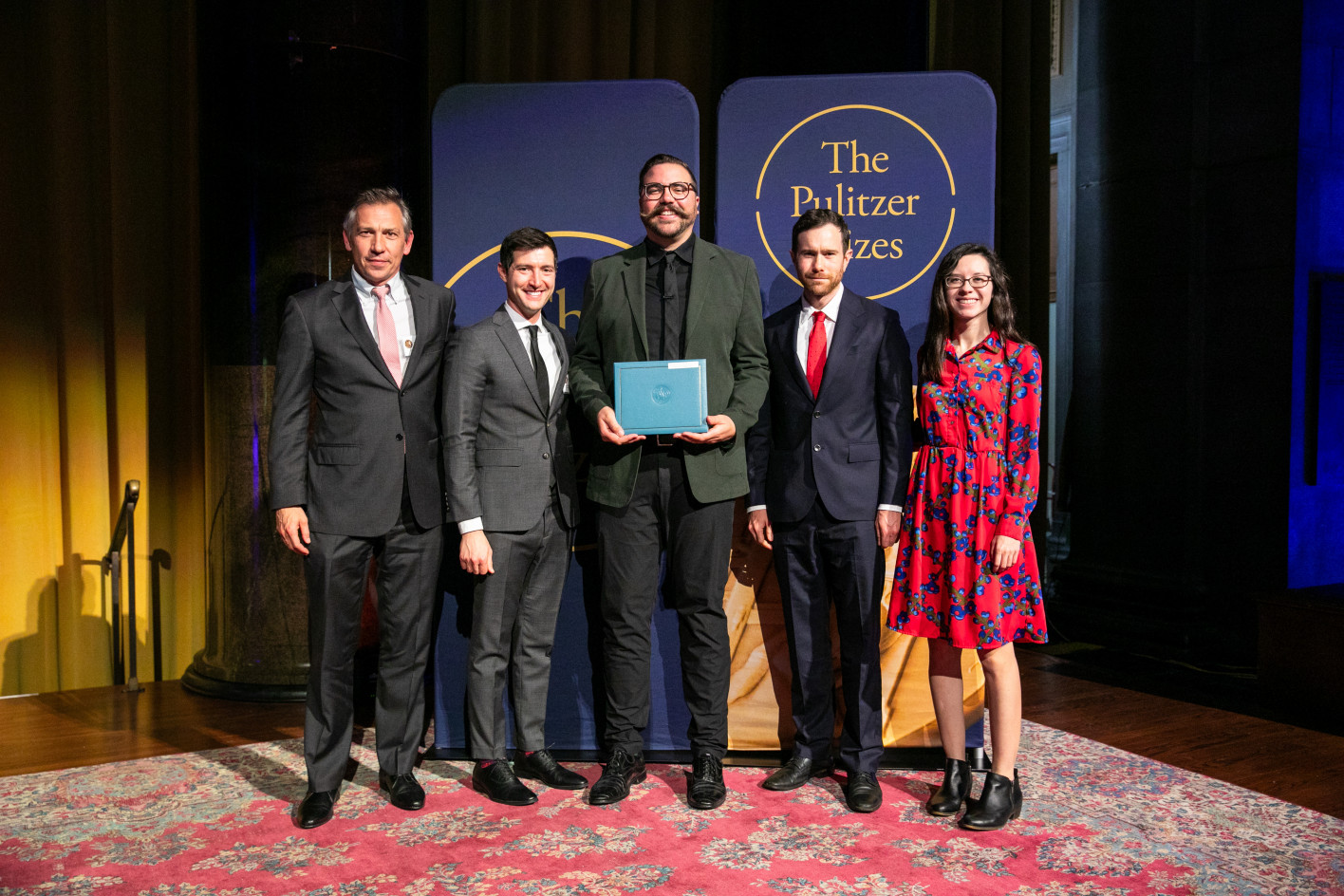
Shawn Boburg (left), Isaac Arnsdorf, Jabin Botsford, Samuel Oakford and Hannah Knowles of The Washington Post accept the 2025 Pulitzer Prize for Breaking News Reporting. (David Dini/The Pulitzer Prizes)
Winning Work
A view from the press riser of the chaos surrounding what authorities are investigating as an assassination attempt against Donald Trump.
By Isaac Arnsdorf and Jabin Botsford
BUTLER, Pa. — The gunshots were high-pitched pops, slight and hollow in the open air.
Donald Trump, the former president set to accept the Republican nomination in five days, was less than 10 minutes into his speech here to a crowd of tens of thousands. A miles-long line of cars crawled for hours to pass through metal detectors and bag inspections, just like any Trump event, until these green fairgrounds became a sea of red hats.
Trump was almost an hour late, and his supporters waited impatiently under the blazing sun and thumping music. In the middle of the crowd, opposite the stage, a platform of TV cameras pointed at the stage, with reporters huddled underneath for shade.
Finally Trump walked out, as usual, to chants of “USA” and marveled: “This is a big crowd. This is a big, big, beautiful crowd.” A bright red MAGA cap shaded his eyes, and his white shirt was open-collared in the heat as he leaned his arms on the lectern.
He launched into his stump speech but quickly got bored with the prepared script. He offered to invite the Republican Senate candidate, Dave McCormick, to speak, but McCormick wasn’t ready.
“You don’t mind if I go off teleprompter, do you?” Trump teased. “Because these teleprompters are so damn boring.” He asked to show “that chart that I love so much,” showing border crossings across his and Joe Biden’s presidencies, and acted amazed that his producers obliged, projecting it onto the giant screens to either side. “Wow, you guys are getting better with time.”
He was pointing to one of the screens, narrating the increase in immigration since he left office in 2021. “Look what happened to our country!”
The pops came in pairs, a burst of five or six total. Trump swatted his ear, as if he heard a mosquito. Then he hunched his shoulders and ducked.
“Get down, get down, get down!” Secret Service agents shouted as they rushed up onto the stage and surrounded him. The crowd screamed. Another burst of popping noises. More screaming. The people in the bleachers behind Trump shuffled, unsure about where to go. The people in chairs or standing crouched or fell to the ground. A dense cloud of smoke hung to the right of the stage, then dispersed quickly.
One more solitary shot.
More suited Secret Service agents rushed the stage, then black-clad men wearing body armor and helmets, and carrying assault rifles. The crowd shouted in confusion.
“Are we good?” one of the officers said, audible from the podium microphone.
“Shooter’s down,” another answered.
“We’re good to move.”
“Are we clear?”
“We’re clear!”
“Let me get my shoes on,” Trump said, as the agents lifted him.
“I got you, sir.”
“Hold on, your head is bloody.”
“Let me get my shoes on,” he said again, as the agents formed a ring around him.
The crowd, seeing him standing, started to cheer.
“Wait,” Trump said, and thrust up a fist. “Fight!” he said. “Fight!”
Then the people roared and chanted again: “USA!”
“We gotta move,” an agent said. Leaning on the agents for assistance, Trump kept his fist raised as he hobbled off the stage, down the stairs and into his black SUV. One black dress shoe remained on the red-carpeted stage.
Officers — Secret Service, county sheriff’s deputies, state troopers, U.S. Department of Homeland Security — started telling the crowd to evacuate, calling the site an active crime scene. The rallygoers walked out, calling and texting family and friends and recording videos. People were shocked but calm.
As people passed the press risers elevating the cameras, some took out their anger on the media.
“You’re not safe. It’s your fault.”
“You wanted political violence, now you got it. Hope you’re all f---ing happy.”
“The shot heard ’round the world.”
“The liberal media is responsible!”
“Every f---ing one of y’all!”
Others sought out the cameras to offer eyewitness accounts, but they were jumbled and sometimes contradictory amid the panic.
The crowd trudged glumly to the parking lot, a few stopping for a last-minute hot dog or snow cone.
A man with a cane cowered behind the bathrooms, vomiting.
They walked to their cars past Trump flags streaming in the wind over a long row of vendors selling MAGA hats and mug shot T-shirts and Trump keychains and vulgar bumper stickers and Trump visors topped with bright orange fake hair.
A man with a bullhorn wearing a homemade “JAN 6 SURVIVOR” shirt called on people to march on Main Street, “peacefully and patriotically,” echoing Trump’s speech on the Ellipse on Jan. 6, 2021. Most everyone ignored him. One young man accused him of being an undercover federal agent and told him to shut up.
They left behind a field strewn with empty plastic water bottles. A giant American flag hoisted from two cranes flapped high above the empty white bleachers bordered with red, white and blue bunting.
In a Pennsylvania field, confusion and then terror gripped thousands as gunfire rang out over a rally crowd.
By Peter Jamison, Michael Kranish, Beth Reinhard, Emmanuel Felton, Meryl Kornfield, Colby Itkowitz and Jon Swaine
Among the sunbaked thousands gathered in a Pennsylvania field, many strained to place the sound that interrupted former president Donald Trump’s speech.
Rico Elmore, a former state candidate, and Erin Autenreith, a real estate agent, both suspected fireworks — a late Fourth of July celebration. So did Paul Kosko, a 63-year-old retiree in the eighth row.
Cindy Hildebrand, who leads a local GOP group, heard popping.
Onstage, Trump was startled by a loud whiz — and then, belatedly, a blast.
Jondavid Longo, the 33-year-old mayor of nearby Slippery Rock, Pa., and a Marine Corps veteran, said he recognized the noise immediately: a gunshot. But even he didn’t trust his ears.
“There’s no way,” he thought.
Then more shots rang out, undeniable, in rapid succession. Trump dropped to the ground, clutching his ear as blood streamed down his face. Secret Service agents cocooned the former president.
Longo shouted for everyone nearby to drop and leaped on top of his wife.
“We’re in trouble,” Kosko thought, kneeling in the dirt.
Joseph Meyn, a 51-year-old doctor, watched a round hit a man 10 yards away. “I saw his head explode and his body slip down into the bleachers with a thud,” he said.
Elmore leaped over a barrier to help a grievously wounded man, trying to hold his head together until medics could come.
For those who had been waiting hours in the heat on Saturday in Butler, Pa., to hear Trump speak, elation turned instantly into disbelief, horror, terror and anger. They struggled in real time to comprehend what millions would soon grapple with from afar — a brazen attack on a former president and presumed GOP nominee.
Trump was injured, though a matter of inches could have inked a different story. He said a bullet nicked the top of his ear. One rally attendee died, and two others were critically wounded, authorities said Saturday night.
The suspected gunman, named by federal authorities as Thomas Matthew Crooks, 20, of Bethel Park, Pa., was shot and killed by law enforcement agents. He carried out the attack while crouched on a nearby roof with an AR-15-style rifle, a U.S. official and another person familiar with the investigation said, speaking on the condition of anonymity to discuss a probe that is in its early stages. His motive is not yet clear, the FBI said. Authorities say the attack was an assassination attempt on Trump.
The day started, for many of those gathered in Butler, with joy.
Kosko, a retired computer operations manager and an ardent Trump supporter, said he drove 80 minutes from his home in Greensburg, Pa. As he joined the crowds filtering into fairgrounds in this western Pennsylvania town about 35 miles north of Pittsburgh, the heat was crushing, so Kosko, an Eagle Scout, helped hand out bottles of water. Once inside, he grabbed a seat in the eighth row and chatted with an elderly woman attending her first Trump rally.
“People were just ecstatic and proud,” Kosko said in a phone interview Saturday night. “Butler County, it’s the typical heartland of America.”
Security seemed predictably tight to the attendees, who waited up to two hours to get through scanners and bag searches, recalled Melissa Shaffert, a 51-year-old English teacher from Grove City, Pa.
James Sweetland, a retired emergency department physician from DuBois, Pa., said that after he spent hours in the security line getting inside, he noticed significant protection around the ground.
“It seemed secure. I think I saw military and there were SWAT teams,” Sweetland said. “On the buildings behind the stage were two sets of sharpshooters wearing all black, with obvious high-velocity weapons. They were scoping the surrounding buildings.”
As the rally began, Longo led the crowd in the Pledge of Allegiance, met with Trump backstage and then sat in the first row.
Elmore, an Air National Guard member and former Republican candidate for the Pennsylvania House, addressed the crowd ahead of Trump’s speech.
Trump took the stage nearly an hour late to chants of “USA!” as he marveled at the “big, big, beautiful crowd.” A few minutes into his usual stump speech, he ditched the script and asked his team to project a chart showing illegal border crossing numbers under his term and President Biden’s.
“That chart’s a couple of months old,” Trump told the crowd a little after 6 p.m., turning his head to look at the screen. “If you want to really see something that’s sad, take a look at what happened — ”
He never finished the thought.
As Trump winced, grabbed at his ear and sank down, the first screams came from the crowd, and the gunshots echoed. Still, in the moment, many in the fairgrounds were confused.
“It was just totally quiet,” according to Autenreith, who said she was in the front row in front of Trump. “No one ran; it was very strange.”
Hildebrand was frozen as she watched Trump drop to the ground. “You just didn’t know what was going on; you were in a state of shock, wondering how to react to it,” she recalled.
In the eighth row, someone screamed, “Get down!” as Kosko hit the ground. He and the others around him in the front rows did their best to duck and cover between rows of folding chairs.
By the time the second shot rang out, Longo said he immediately realized what was happening. But he did not know whether the shooter was near him or beyond.
“We told everybody to hit the ground,” Longo said. “My wife got on the ground. I got on top of her. My first concern was, was the shooter inside and near us?”
Once he was convinced he and his wife were safe, Longo said, he turned his attention to Trump, whose hand he had shaken just 15 minutes earlier. Blood dripping from his right ear, the former president was surrounded by Secret Service agents.
Few had the perspective to determine how serious the injury was. “My heart stopped when he went down,” Autenreith said. “I really didn’t know if he was ever going to stand up again.”
Then, as the phalanx of Secret Service agents rose, Trump enmeshed between them and beginning to pump his fist, Kosko, an amateur photographer, rose with his camera and started to snap photos.
The close-up images in his lens finally brought home what had happened: On the former president’s face, he could see blood.
Elsewhere in the crowd, though, the severity of the situation was clear from the beginning. Meyn, a gun owner, said he could tell from the crowd’s reaction that some people thought the noise came from fireworks or some kind of prank — but he had no doubt it was gunfire.
“I heard seven rapid-fire shots,” he said. “It wasn’t fully automatic fire, but it was fast. I am a huge gun aficionado, so I know what it sounds like. … I knew we were under attack.”
A second later, after the gunshots, Meyn said, he heard the counterfire from Secret Service snipers.
“Rounds were going one way and then immediately rounds were going the other way,” he said. “They were on it.”
Meyn jumped over a barrier to see whether he could help the man who had been shot in the head, but he was already dead, he said. He also saw a woman who had been wounded. He helped carry the male victim into a tent behind the bleachers.
“A woman was hysterically crying and asking if he was going to be okay,” he said. “It was absolutely surreal.”
When Sweetland heard that someone had been shot, he said, “I just went into muscle memory.” He leaped toward the victim and said he was an ER doctor.
“Unfortunately, the gentleman, he looked like he was in his 30s, had a head wound that looked fatal,” Sweetland said. “He was without pulse and respiration and was ashen in color. I saw an entrance wound, which I believe was above his right ear. I did not see an exit wound.”
Sweetland started CPR for a few minutes, but the man had no pulse. “Two police officers came and lifted him up, and he was just like a rag doll,” he said. “He’s completely limp. And his family is right there. And I turn to them, and the look on their faces was unbelievable.”
Elmore, who had medical training through the National Guard, also tried to help. Blood was smeared across his white shirt.
“I held his head to keep it intact, but it was just, it was a serious injury,” Elmore said.
He didn’t believe the man survived. He also saw a woman passed out, but she didn’t appear to be bloodied.
As the Secret Service whisked Trump off the platform to safety, Kosko and others nearby struggled to make sense of the scene.
“When I saw the blood on the side of the face, everybody in the crowd was like, ‘Oh my God, they got Trump,’” Kosko recalled. “They were starting to cry. They fell down, and they were absolutely going hysterical.”
Hildebrand said that after the shooting, “there was a lot of anger, a lot of fear, a lot of crying. There were a couple people praying.”
Reflecting on all that had happened hours later, Kosko said he was disturbed, almost in despair. What had the country come to?
“Even though I didn’t vote for Biden, I still want him to be safe, healthy and successful,” Kosko said. “I’m a Republican, but I’m an American first.”
He paused.
“This is so, so bad,” he said.
Michelle Boorstein, Isaac Arnsdorf, Jabin Botsford and Monika Mathur contributed to this report.
3D analysis shows countersnipers likely had difficulty seeing the gunman before he fired.
By Samuel Oakford, Aaron Steckelberg, Evan Hill, Jarrett Ley, Jonathan Baran, Alex Horton
and Samuel Granados
Within seconds of 20-year-old Pennsylvania resident Thomas Matthew Crooks opening fire at former president Donald Trump’s rally in Butler on Saturday evening, he was fatally shot by the Secret Service. But how did a specialized team of countersnipers fail to prevent its worst security lapse in decades?
A Washington Post analysis, based on more than 40 videos and photos, as well as satellite imagery and terrain analysis used to build a 3D model examining the rally site and shooter’s position, found that the two Secret Service countersniper teams may have initially been hindered in their ability to see the shooter as he crawled up the roof due to its slanted sides. Trees near the rally probably played a part in obscuring the shooter from at least one team assigned to detect and neutralize would-be snipers.
The Secret Service is responsible for the overall coordination of security measures during an event. The agency’s director said it tasked local law enforcement with securing the building from which Crooks opened fire and that officers failed to prevent him from accessing the roof.
The Secret Service declined to comment when asked whether the slant of the roof or the trees would have impacted the teams’ ability to respond.
The Post’s assessments were reviewed and corroborated by three former law enforcement officials, including two retired snipers and a former Secret Service agent, as well as a former Marine sniper.
The Post’s 3D model established that both units may have been hampered by the pitch of the building’s roof where Crooks was found, which rises roughly 3.5 feet from its exterior walls to its peak. According to the analysis, which placed a camera at the eye view of the teams, Crooks would probably not have been visible as he crawled up the roof to take his final shooting position. The Post’s reconstruction shows that the northernmost Secret Service countersniper team closest to the shooter — slightly more than 400 feet away and atop an approximately 23-foot-tall barn — may have further struggled to see him because of two trees located between them.
The second countersniper team, located roughly 550 feet from the shooter, while farther away, could have had a less obstructed view, according to The Post’s reconstruction, because they were positioned slightly to the west and the trees may not have been in their line of sight.
Countersniper teams commonly scan for threats with binoculars, which offer a wider field of vision than a rifle optic, said Jason Lawless, a retired officer who worked as a sniper with the Tulsa Police Department’s Special Operations Team. But about two minutes before gunshots were fired, the northernmost team had already moved to their rifle positions, suggesting they were attuned to a potential threat at that point. It’s unclear exactly when Crooks first became visible to Secret Service countersnipers.
“If they’re on scope, they’ve been notified about something,” Lawless said. As Crooks fired his first shots, one of the countersnipers on the northernmost team flinched, he said, took his eye away from the scope, and reset his position.
The southernmost countersniper team, which can be seen in earlier images facing south, appeared to reorient northward before Crooks allegedly fired, suggesting that they were also aware of a threat.
The two teams’ positions on the barn roofs sat between approximately five and eight feet higher than the rooftop from which Crooks allegedly fired from. This meant that both teams were probably not high enough to see Crooks as he crawled up the other side of the roof, The Post’s model showed.
A law enforcement official with knowledge of the shooting said the sloped roof could have created a visual block to the countersnipers. The countersniper who killed Crooks had him in his sights for some moments trying to assess whether he had a gun and was a threat and then shot him seconds after Crooks fired, said the official, who spoke on the condition of anonymity amid an ongoing investigation.
Authorities have not said which member of Trump’s protection team shot and killed the gunman.
How Crooks scaled the roof of a nearby building, over 400 feet away from where Trump was speaking without being stopped by law enforcement, is under active investigation.
Aerial footage verified by The Post showed his body was located about 40 feet from the eastern edge of the building, which looks out on a parking lot. A few feet from him was a rifle, and farther down the roof an object that resembled a bag.
The Post’s 3D reconstruction shows that while there are trees in between the shooter and one of the Secret Service teams — which would have offered him concealment, according to Lawless and the other experts — the view between the shooter and the podium where Trump was standing was largely unimpeded.
Aerial footage showed a ladder leaning against a structure connected to the building Crooks allegedly fired from, where there are also air conditioning units. It’s unclear how the shooter reached the roof of the building, which at its lowest point is just over 13 feet high.
While the countersniper teams would have had difficulty seeing Crooks while he was on the far side of the roof, onlookers outside of the rally were able to easily spot him before the first gunfire, raising questions about the effectiveness of nearby local law enforcement patrols.
Multiple videos filmed by attendees outside the rally’s perimeter and verified by The Post reveal their attempts to alert law enforcement to a person on the roof who they thought might be armed. Police officers in the videos walk near the building from which Crooks fired. One video verified by The Post shows people calling out to officers that there was a man on the roof at least 86 seconds before the first shots were fired at 6:11 p.m. The camera zooms in to show him lying on his stomach.
“There should have been police officers in the vicinity who could have either denied him access to start with, or instantly respond to the call,” said Derrick Bartlett, a retired Fort Lauderdale Police Department SWAT sniper and president of the American Sniper Association. “So there was a hole in the security.”
At 6:11 p.m., gunfire crackled the air.
Two audio experts — Rob Maher of Montana State University and Steven Beck of Beck Audio Forensics — counted a total of 10 gunshots after analyzing verified footage of the assassination attempt and law enforcement response that followed. The first eight had similar audio characteristics and were fired in six seconds. They were followed immediately by a shot from a different location, they said, and, 16 seconds after the shooting began, by a final shot. These last two gunshots had different acoustic signatures from the previous ones, suggesting a security response. Both Maher and Beck cautioned that audio analysis alone could not determine the exact source of these gunshots.
On Tuesday, Secret Service Director Kimberly Cheatle said that local police were responsible for securing the building’s perimeter and that officers were inside when Crooks was on the roof. Part of the reason the agency didn’t request an officer on top, she said, was over safety concerns for someone standing on an angled roof.
The Post’s analysis shows the countersniper teams were positioned on steeper roofs.
On July 14, the day after the shooting, President Biden ordered an independent review of the incident. In a statement, Cheatle said her agency is “working with all involved federal, state and local agencies to understand what happened, how it happened, and how we can prevent an incident like this from ever taking place again.”
Carol Leonnig, Joyce Sohyun Lee and Kevin Uhrmacher contributed to this report.
Methodology
To build a 3D model of the rally site in Butler, Pa., The Post examined videos, photographs, satellite imagery, and lidar data of the location. Thomas Bordeaux, a graduate student at Georgia Tech’s School of Architecture, provided The Post with the lidar data, which The Post verified as being from the United States Geological Survey. The dimensions of permanent buildings on the site, including the structures on which the shooter and the USSS were positioned, were calculated using satellite measurements and lidar data. This data was processed in QGIS to calculate the height of building walls and the pitch of their roofs. The resulting figures were cross referenced with photographs of the buildings to arrive at their final representation. Temporary structures at the scene like the bleachers and stage were modeled by analyzing their features from multiple perspectives in videos and photographs to understand their scale in relationship to measurable objects in the scene.
The two trees south of the shooter were measured using lidar data referenced with analysis of images and videos; using these dimensions, The Post scaled a commercially built 3D model of the trees within the scene. The trees were selected to best represent the general density of the leaves and branches, but they are not a precise reconstruction of the foliage.
About this story
Editing by Nadine Ajaka and Sarah Frostenson. 3D analysis by Jarret Ley. 3D modeling by Aaron Steckelberg. Graphics by Samuel Granados and William Neff. Graphics editing by Manuel Canales. Videos by Jonathan Baran and Imogen Piper. Development by Garland Potts. Copy editing by Jeremy Hester.
Thomas Matthew Crooks temporarily recoiled from his rooftop perch and did not shoot again before he was killed by a Secret Service countersniper.
By Samuel Oakford, Shawn Boburg, Jonathan Baran, Jarrett Ley, Evan Hill and Devlin Barrett
Thomas Matthew Crooks paused shooting at former president Donald Trump after a local law enforcement officer assigned to a SWAT team returned fire, and Crooks did not shoot again before he was killed by a Secret Service countersniper, according to two officials familiar with the investigation into the assassination attempt.
The shot from the local officer caused the would-be assassin to temporarily recoil from his perch on a rooftop, according to the two officials and a Washington Post analysis of video evidence. Crooks’s retreat coincided with a 10-second pause in shooting, according to audio experts who examined the gunshots, a critical period that ended when the Secret Service countersniper shot and killed him.
It has been reported that a local officer fired at Crooks, but the analysis suggests that the officer may have played a more important role than previously known in responding to the attack at a July 13 rally in Pennsylvania.
One of the people who spoke to The Post, a local law enforcement officer close to the investigation, did so on the condition of anonymity because he was not authorized to speak publicly. The other, Richard Goldinger, the district attorney for Butler County, confirmed that a member of the county’s Emergency Services Unit (ESU), similar to a SWAT team, fired a shot at Crooks that prompted a reaction from the gunman.
“I don’t know if the officer actually hit Crooks and don’t believe he fired the neutralizing shot,” Goldinger, who oversees the Emergency Services Unit, said in a text message. But Goldinger said he believed the officer’s shot caused Crooks to stop firing his weapon, buying the Secret Service snipers time to kill the gunman.
A third person familiar with the investigation, speaking on the condition of anonymity to discuss details that have not been made public, confirmed that the Butler officer shot at Crooks before the Secret Service countersniper fired. The person said investigators have not found evidence that the local officer’s round struck the gunman, but witnesses said Crooks appeared to move after that shot was fired.
Ten shots were fired in the span of roughly 16 seconds, according to video recordings taken at the rally. Four audio experts consulted by The Post said the first eight shots, fired in bursts of three and five, have similar acoustic signatures and probably were fired by Crooks, who was armed with an AR-15-style rifle.
Eight spent cartridges were recovered on the roof Crooks fired from, FBI Director Christopher A. Wray told lawmakers last week. Trump’s ear was grazed by a bullet or bullet fragment, according to the FBI, and three spectators were wounded, one fatally.
Less than a second after the last of those eight shots, a ninth gunshot is heard. Then comes the 10-second pause.
The local law enforcement official close to the investigation did not know whether the local officer’s shot hit Crooks. But shortly after that shot, Crooks altered his positioning, the official said. Crooks stopped shooting at the rally site and slumped down behind the crest of the sloped roof where he was perched, the official said.
After the local police officer’s shot, “there was definitely some sort of reaction,” the official said. “Crooks slumped over, and he didn’t fire another round.”
The official credited the local officer with interrupting Crooks’s attack. “Anything that disrupts an active shooter can keep the situation from being significantly more catastrophic.”
The official’s account is supported by video taken about 100 feet west of the building from which Crooks fired. The footage was recorded by Jon Malis, a 52-year-old Pennsylvania resident who was watching the rally from that location, just outside the Secret Service security perimeter.
Crooks had roused the suspicion of local police as he milled around outside the rally with a golf range finder. They were looking for him when he crawled onto the roof of a warehouse complex and began shooting at 6:11 p.m. Malis’s video, first published by Fox News, records the sound of the eight shots from Crooks and then the sound of a ninth shot. After that ninth shot, the video captures Crooks as he turns, making his face visible to the crowd on the west side of the building, away from the rally, The Post analysis shows. He then appears to reposition himself.
The local officer who shot at Crooks was assigned to a barn behind and to the north of the rally stage, along with a counterassault and quick-reaction force team from Butler County, the local law enforcement official said.
The officer, who was not a sniper, had left the barn and was outside on the ground nearby when Crooks began firing from the rooftop about 110 yards away, the official said. The local officer saw the muzzle flashes from Crooks’s rifle, the official said, and fired his rifle at Crooks.
A rally worker told The Post they witnessed the local officer shoot at Crooks from the same location.
The worker, who spoke on the condition of anonymity because their employer had not authorized them to speak publicly, said they were standing behind the bleachers to the north of the stage when Crooks took his first shots. The worker said attendees scrambled while the local officer took aim.
“Everyone else was moving, and he wasn’t,” the worker said. “I remember thinking, ‘He’s not freaking out; he’s not yelling.’ He shot his gun, and I remember thinking, ‘We need to take cover.’”
A spokesman for the Secret Service said the FBI was best suited to answer The Post’s questions about the local police officer’s shot toward Crooks.
FBI officials confirmed that a Butler County officer fired at the gunman and that the officer’s weapon has been taken to the FBI’s laboratory in Quantico, Va., for further analysis. Firearms experts at Quantico are also examining the gunman’s weapon, an AR-15-style rifle with a collapsible stock, and the weapon used by the Secret Service countersniper, FBI officials said.
FBI officials have said that a Secret Service countersniper fired the round that killed Crooks.
Malis’s video captures the 10th shot and Crooks’s subsequent collapse. “He’s down,” an onlooker shouts, according to Malis’s recording, which then zooms in to show Crooks’s body splayed on the roof.
The local law enforcement official told The Post that the Butler County officer was preparing to take a second shot at Crooks when the Secret Service agent shot him. The official confirmed there were a total of 10 shots: eight by Crooks, one by the Butler County officer and the last by the Secret Service.
Imogen Piper and Jon Swaine contributed to this report.
A disjointed communications system on the day of the rally hampered the Secret Service’s ability to grasp the threat in real time, a Post examination found.
By Shawn Boburg, Samuel Oakford and Devlin Barrett
An urgent message crackled over the radio inside the white trailer, a mobile communications hub for local police helping to secure former president Donald Trump’s July 13 rally in Butler, Pa.
“Just an FYI, we had a younger white male, long hair, lurking around the AGR building,” a local countersniper said at 5:42 p.m., according to a time-stamped transcript of encrypted radio communications obtained by The Washington Post. “He was viewed with a range finder sighting the stage. … We lost sight of him.”
No one from the Secret Service, the agency primarily responsible for protecting Trump, was inside that white trailer to hear the message, according to two law enforcement officials. Instead, the federal agency had its own mobile command post with Pennsylvania State Police almost 300 yards away — and had no direct, open communication line to the local police hub. The local commander inside the trailer had to pick up his cellphone and dial a state trooper to relay the message, the two officials said.
The lack of a direct communication link would later hamper the ability of the Secret Service to quickly grasp the threat posed by would-be assassin Thomas Matthew Crooks as local police searched for him over the next 29 minutes, resulting in the federal agency’s gravest security lapse in decades, a Post examination found. At 6:11 p.m., Crooks opened fire from a rooftop, unleashing eight bullets that left the former president wounded, one rallygoer dead and two others critically injured.
The Post obtained a previously unreported transcript of more than seven hours of encrypted radio communications by local police at the rally that day and interviewed multiple law enforcement officials, some of whom spoke on the condition of anonymity because of the ongoing investigation.
The transcript and accounts provide the clearest picture yet of the minute-by-minute hunt for Crooks, and show how he evaded police and climbed onto the roof of a nearby building undetected. Police lost track of Crooks for 20 minutes after he was seen with the range finder, the transcript shows. When he was spotted again, walking toward the area where he would gain access to the rooftop of what local police called the “AGR building,” an officer mischaracterized where he was headed, directing his colleagues to the wrong side of the building.
The Post examination also shows that communication between the Secret Service and the local police was disjointed and time-consuming, helping to explain why Secret Service agents closest to Trump were taken by surprise when gunfire erupted. On three occasions, a local officer inside the Butler County command post had to relay information about Crooks to the Secret Service hub by cellphone — on a day when cell service was balky and unreliable.
That method was too slow when seconds counted. A local police officer spotted Crooks on a rooftop with a gun and radioed in to the local command center that he was “armed” approximately 30 seconds before the shooting, according to the transcript of the radio communications and Secret Service officials, but that message was not passed on to the Secret Service command post before Crooks started shooting, the agency has acknowledged.
The two law enforcement officers who said the command posts had no direct line of communication — and that information about Crooks had to be relayed by cellphone — were Butler County District Attorney Richard Goldinger and a law enforcement official familiar with the police response, who spoke on the condition of anonymity to discuss matters of ongoing investigation.
Patrick Young, commander of the Beaver County Emergency Services Unit, which supplied local officers to secure the rally, said that it’s important that law enforcement agencies share one command post where information can be received and transmitted quickly.
“All the key stakeholders should be in the same room,” Young said in an interview. “That alleviates any communications problems.”
A Pennsylvania State Police spokesman stressed that state troopers were acting in a supporting role and referred questions to the Secret Service.
At a news conference Friday, acting Secret Service director Ronald Rowe Jr. acknowledged that there were separate communications hubs that did not effectively share information in vital moments. “There might have been radio traffic that we missed. We have to be better on that,” he said.
Rowe repeatedly emphasized that the rally shooting was a failure by the Secret Service, not local law enforcement. “If the large majority of our partners are in a unified command post or in a different location, we need to probably be there, too,” he said.
“We’re certainly going to examine the communication aspect very closely,” Anthony Guglielmi, a spokesman for the Secret Service, said in response to questions from The Post.
‘I don’t have any service’
The radio transmission about the suspicious male with a range finder set off a flurry of messages between local officers on the ground and supervisors stationed in the Butler County command center trailer.
“Do you know what color shirt?” one sheriff’s deputy asked.
“White shirt with a hat,” another answered.
In a separate channel for local tactical officers — not audible on the channel used by sheriff’s deputies — the countersniper who first reported the range finder was giving a different description: “Gray T-shirt, light-colored khaki shorts.”
The local officers lost track of Crooks, and would not see him again for 20 minutes, the transcript shows.
Monitoring the three encrypted communication channels inside the trailer, located next to a lakeside warehouse to the south of the rally site, was Sgt. Ed Lenz, the tactical commander for the Butler County mobile unit, according to the law enforcement official familiar with the police response.
He was joined by a deputy commander in the Butler County Emergency Services Unit, a Butler County sheriff’s sergeant and a county employee, the official said.
Lenz did not respond to an email with detailed questions.
When Lenz heard the message about the range finder, he used his cellphone to call a state police officer stationed in the Secret Service trailer at 5:44 p.m., according to the official and call logs. State police Sgt. Joseph Olayer, the call recipient, relayed the information to his Secret Service counterparts in the trailer, the official said.
Olayer declined to comment, citing the ongoing investigation.
Pennsylvania State Police Commissioner Col. Christopher Paris acknowledged in congressional testimony last month that someone from Butler County’s tactical unit had called a state trooper inside the Secret Service command post and then sent a text message with a photograph of Crooks. The state police officer was told to forward the image to a separate Secret Service number, Paris said.
Minutes after Lenz passed on the suspicious-person report to the state police sergeant, Lenz radioed to local officers that help was on the way, the transcript shows.
“PSP (Pennsylvania State Police) and sheriffs should be in route,” Lenz told officers on the ground at 5:45 p.m.
As reinforcements made their way to help, officers tried to circulate photos of Crooks, but cellphone reception problems got in the way, the transcript shows.
“I’m trying to forward photographs of the individual,” said a local tactical team member at 5:47 p.m.
“Units be advised internet and cell service is down,” another officer on that channel said a minute later.
“Your picture is probably not going to go through because I don’t have any service,” a sheriff’s deputy radioed at 5:49 p.m.
Around this time, a Butler County tactical officer said he had “notified Hercules,” a code name for Secret Service countersniper units, according to the transcript. It’s not clear how that communication was sent. But at this point, the Secret Service has said, Crooks was considered a suspicious person, not a threat. The search for the suspicious male remained an endeavor mostly left for local police.
Lenz enlisted more officers, including police handling traffic on roads outside the rally site.
“Our sierra units lost visual of him,” Lenz told the traffic-control officers at 5:54 p.m., using the code name for local tactical officers. “I believe you guys are outside of that fence, if you come upon him.”
Crooks would resurface eight minutes later, setting off an intensifying manhunt.
‘Someone’s on the roof’
At 6:02 p.m., the same local sniper who first radioed in the message about the range finder was on the second floor of the building owned by Agr International. From a northwest window, facing away from the rally site, he glimpsed the suspect again just as Trump was preparing to take the podium.
“All right, subject is in between the AGR building. He has a backpack,” said Sgt. Greg Nicol, a Beaver County sniper. Nicol had been assigned to look out over the rally site from a window on the opposite side of the building, but he had moved to look for the suspect, according to Young, Nicol’s commander.
Nicol did not respond to requests for comment. But in an interview, Beaver County District Attorney Nathan Bible, whose office oversees the county’s tactical team, praised Nicol for moving within the building to look for Crooks, calling it “good old-fashioned police work.”
“He realized somebody needs to find this guy,” Bible told The Post.
From his vantage point on the second floor, Nicol was unable to discern where Crooks was headed, though, the transcript shows.
Crooks was walking to the northeast, toward an area between two wings of the complex of warehouses at Agr International. The space was enclosed on three sides, a dead end. But Nicol suggested Crooks was headed in the direction of a gas station on the other side of the building.
“He just went towards the Sheetz,” Nicol said, referring to the gas station about a quarter of a mile away.
That information quickly circulated, the transcript shows.
Inside the Butler County command center, Lenz again called Olayer in the Secret Service command post to pass on a message during a 40-second call at 6:03 p.m., according to the law enforcement official familiar with the police response and call logs.
The message was also passed on to local police units.
“All units be advised also that individual is headed towards Sheetz,” a sheriff’s deputy radioed to his colleagues at 6:04 p.m.
Instead, two law enforcement officials familiar with the investigation said, Crooks made his way to an HVAC unit next to the Agr building. He scaled that equipment to gain access to the roof of the building, the officials said. Video obtained by the FBI shows Crooks climbing onto the roof at 6:06 p.m., FBI Deputy Director Paul Abbate said in congressional testimony this week.
By the time Crooks was on the roof, officers were still focused on finding him on the ground.
“He’s reportedly between the building up here at AGR somewhere,” a local officer on the channel for traffic control said at 6:06 p.m. “I’m guessing the west side, east side looks clear.”
In the command post, Lenz radioed to the tactical units that local police had the building surrounded. “They should have a fairly good perimeter. If you get another visual let me know,” he said at 6:07 p.m.
Less than a minute later, Crooks was spotted again, this time up above.
“Someone’s on the roof,” a local officer radioed at 6:08 p.m. “I have someone on the roof with white shorts.”
Video published by Fox News shows Crooks running along the roof of the Agr building around this time.
Inside the local command, Lenz radioed to clarify that the person on the roof was not a police officer.
“We do not have assets on the roof,” he said. “That is not us.”
At 6:09, Lenz again dialed the state trooper to inform him about the suspect on the roof, according to the law enforcement official and call logs.
At the same time, a local officer said over the radio that he had a good view of the male on the roof.
“We got him,” the officer said. “We don’t have him in custody yet, but he’s right straight in front of me by the pine tree standing upwards. He had a backpack.”
The officer’s description appears to match a location on the east side of the complex, near the building where Crooks opened fire. But within 25 seconds, Crooks had slipped out of the officer’s range of vision.
“Lost sight of him, trooper was chasing him, trying to follow him around the building,” the officer said.
On the other side of the complex, bystanders gathered under a tree about 160 feet from the building had a clearer view of Crooks, who was prone on the rooftop, video shows.
“Someone is on top of the roof, look, there he is right there,” a spectator says in a video of that scene. Closer to the building, a police officer craned his neck to see on top, but apparently couldn’t locate Crooks due to the angle.
A video taken around the same time by Dave Stewart, a 35-year-old Pennsylvania resident, showed several law enforcement officers struggling to spot Crooks from south of the building, the side closest to the rally site.
“Last time I seen him was by the pine tree between the two buildings, the small walkway joining the buildings,” the officer who earlier spotted Crooks on the roof reported at 6:10 p.m.
At 6:11 p.m., a local officer hoisted up to the roofline by a colleague reported the first sign that the man on the roof was, in fact, a deadly threat.
“He’s armed,” the officer said, according to the transcript. “I saw him, he’s laying down.”
Local officials have previously said the officer lowered himself because his hands were on the roofline, preventing him from pulling his weapon as Crooks pointed his rifle in the officer’s direction.
“He’s got a long gun,” the officer said again into the radio.
Seconds later, Lenz radioed the Butler County quick response force, a team responsible for responding to any potential coordinated attack on Trump. The team was based in the barns behind the rally stage, documents show, but had moved out into a field and were facing the Agr building, according to video footage recorded two minutes earlier.
“QRF from command. You need to deploy to the AGR building,” Lenz said. He added, using shorthand for Butler Township police, “BT has a male on the roof with a long gun. They have made contact with him.”
As he was passing on the directive, Lenz interrupted himself: “Shots fired,” he said at 6:11 p.m.
The law enforcement official familiar with the police response said officials in the local command center were not able to pass on the message about an armed man to the Secret Service command post. There was not enough time to make the cellphone call.
Jonathan Baran, Szu Yu Chen, William Neff and Imogen Piper contributed to this report.
CORRECTION
A previous version of this article incorrectly said that after a local officer saw Crooks on the roof, Sgt. Ed Lenz did not call a state trooper in the Secret Service command post. Lenz did call the trooper at that time. The previous version also incorrectly said that Lenz made a total of two calls to the trooper; he made three. The article has been corrected.