For a distinguished volume of original verse by an American author, Fifteen thousand dollars ($15,000).

Ars Poeticas, by Juliana Spahr (Wesleyan University Press)

A collection in which the poet takes stock of her personal disillusionment, which she uses to interrogate her relationship to her art form, community and politics.

Winning Work

Ars Poeticas


Lyric meditations on writing poetry in a time of ecological crisis and right wing populism

During the time of an increasingly powerful alt-right which was also the time when species extinction was ever increasing, Juliana Spahr sat down to read Brecht. She was looking for an answer to Brecht's question about the dark times, about whether there will also be singing during the dark times. The answer that Brecht provides is that yes, that poets will sing of the dark times. In the six ars poeticas that Spahr writes, she sings of the dark times but also of coral, the pop song's possible liberation, and the love of comrades. She writes not only of the rich history of what politics and poetry have done with each other, but what they might yet do together.

[Sample Poem]

from ARS POETICA 1: CORAL

To write poetry after Castle Bravo.
Then to write poetry after 1500 feet.
After high-quality steel frame buildings
not completely collapsed, except
all panels and roofs blown in.
After 2,000 feet.
After reinforced concrete buildings collapsed
or standing but badly damaged.
After 3,500 feet.
After church buildings completely destroyed.
After brick walls severely cracked.
After 4,400 feet.
After 5,300 feet.
After roof tiles bubbled and melted.
After 6,500 feet.
After mass distortion of large steel buildings.
To write the Cold War and doves.
The Cold War and tapeworms.
The Cold War and sails of ships.
The Cold War and the steel of bridges.
To write poetry after that.
To write in a world with few nutrients,
one that rocks back and forth.
The same beginning in both the sea and the land.
To write poetry that knows a hard, cup-shaped skeleton.
And then poetry that knows
the long, stinging tentacles capturing.
Knows the water.
The Atlantic and the Pacific.
The connections between.
The one moving into the other.
To develop poetry in the stomach
that then exits through the mouth
which is the anus.
To write poetry in the blue
that is the absence of green.
Light penetration.
Whorls of tentacles.
The slime earth too.
Hunters and farmers.
Shallow water.
Few nutrients.
High fecundity.
Rapid growth.
Multiarmed morphology and tube feet.
To write tube feet.
To write the exact place.
Seaward slope place.
Sea terrace place.
Algal ridge place.
Coral algal zone place.
Seaward reef flat place.
Islet or interisland reef crest place.
Lagoon reef flat place.
Lagoon terrace place.
Lagoon floor or basin place.
Coral knolls, pinnacle and patch reefs place.
To write poetry after.
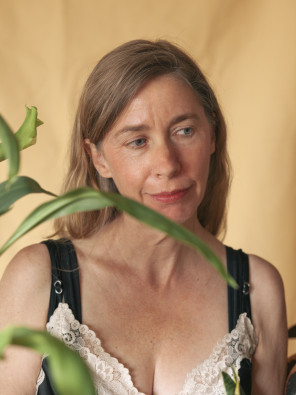
Biography

Juliana Spahr is a writer and scholar of literature. Her 2015 poetry collection, That Winter the Wolf Came, takes as its concern the global spread of political struggles located at the intersection of ecological and economic catastrophe. She also publishes literary prose. Highly fictionalized but still probably memoir, Army of Lovers was cowritten with David Buuck and tells the story of two mediocre poets who are attempting to write poetry in a time when poetry’s importance is on the decline. Her most recent book of scholarship, Du Bois’s Telegram: Literary Resistance and State Containment, explores the ambiguous and disconcerting role that literature plays in upholding the modern nation-state. She was also the editor, with Claudia Rankine, of American Women Poets in the 21st Century.
 

Finalists

Nominated as finalists in Poetry in 2026:

Douglas Kearney

A multiverse of poems that burst off the page in vivid innovative structures, deploying collage, comix, music, typography, wordplay and fiction to push literary boundaries.

Patricia Smith

A bold re-imagining of the “new and selected” form where the poet enters into dialogue with her earlier poems, transforming a career retrospective into an engagement with earlier selves.

The Jury

Tracy K. Smith(Chair)*

Boylston Professor of Rhetoric and Oratory; Professor of African and African American Studies; and Susan S. and Kenneth L. Wallach Professor at the Harvard Radcliffe Institute, Harvard University

Camille Dungy

University Distinguished Professor and Director, Creative Writing Program, Colorado State University

J. Michael Martinez

Assistant Professor of English and Creative Writing and Director, Center for Literary Arts, San Jose State University

D.A. Powell

Professor, Program in Writing, University of San Francisco

Elizabeth Willis

Professor of Poetry, Iowa Writers' Workshop

Winners in Poetry

Marie Howe

A collection drawn from decades of work that mines the day-to-day modern experience for evidence of our shared loneliness, mortality and holiness.

Brandon Som

A collection that deeply engages with the complexities of the poet’s dual Mexican and Chinese heritage, highlighting the dignity of his family’s working lives, creating community rather than conflict.

Carl Phillips

A masterful collection that chronicles American culture as the country struggles to make sense of its politics, of life in the wake of a pandemic, and of our place in a changing global community.  

Diane Seuss

A virtuosic collection that inventively expands the sonnet form to confront the messy contradictions of contemporary America, including the beauty and the difficulty of working-class life in the Rust Belt.

2026 Prize Winners

M. Gessen of The New York Times

For an illuminating collection of reported essays on rising authoritarian regimes that draw on history and personal experience to probe timely themes of oppression, belonging and exile.