Staff of The Minnesota Star Tribune
Winning Work
“The thing that’s going to stick with me,” said Shea McAdaragh, a parent who witnessed the shooting, “was when I said you guys can get up, and I knew some kids weren’t going to get up.”
By Reid Forgrave
The excitement of new beginnings seemed all around Wednesday morning at Annunciation Catholic School in south Minneapolis: the first week of the school year. A new principal, and a new priest at the adjoining parish.
Signs posted outside the church captured the mood: “A future filled with HOPE!”
Shea McAdaragh, whose oldest child is a second-grader at Annunciation, hadn’t planned on attending the annual back-to-school Mass. At the last minute, he crept into the back pew behind the teachers, parents and students, some as young as 6.
Outside, near the parish’s tiny wiffle-ball diamond, a 23-year-old shooter lurked.
The opening hymn began and the priest walked solemnly down the aisle.
Then a dissonant noise: Pop-pop-pop-pop.
McAdaragh’s a hunter. He knows the sound of gunshots. But he saw no shooter. Instead, when he looked to the stained glass on the east side of the big church, he saw light coming through the stained glass windows. The shots, he realized, were coming from outside.
It was weird, he recalled later, how quiet it felt in the church as the shooter reloaded and shot dozens more bullets.
McAdaragh’s screams pierced the quiet: “STAY DOWN! STAY DOWN!”
Just don’t let the kids outside, he thought.
Later, the casualty count would be horrific: 19 people shot, 16 of them kids. Two would be declared dead at the scene. Others would be rushed into surgery. But in the moment, all McAdaragh could think of was protecting a church full of children.
The first 911 calls came in at 8:27 a.m. Inside the church, McAdaragh watched the principal rush toward the gunfire and lock a door. Some groups ran to the basement and hid in a classroom.
The first Minneapolis police officer on the scene burst in just a few minutes after it all began.
“Where’s the shooter?” he shouted, then, without hesitation, ran to where parents pointed.
By then, the gunfire had stopped. The shooter had died of a self-inflicted gunshot wound just outside the church. The shooter’s weapons — a semiautomatic rifle, a shotgun and handgun — had all been purchased legally, and recently, police would later say.
McAdaragh told the kids they could get up from their hiding places under the pews. He saw terror in their faces.
“The thing that’s going to stick with me,” he said, “was when I said ‘you guys can get up,’ and I knew some kids weren’t going to get up.”
Parents and teachers began to triage students as more police and emergency responders rushed in. They assessed which students were injured and which most severely. They wrapped students’ wounds to stanch the bleeding. They carried the injured out of the church. One second-grader thought it must have been a robber trying to steal the prizes from the century-old church’s upcoming SeptemberFest, one parent said.
Cellphones buzzed around the tight-knit neighborhood surrounding the church. Parents abandoned cars on side streets and sprinted to the school, where they were escorted by police into the basement.
Dozens of kids in green Annunciation uniforms began pouring out of the church, several bloodied, some not wearing shoes. One neighbor said he held the hands of three children with gunshot wounds, one of them shot in the neck.
Police officers brought the injured to the front of the church, where paramedics loaded them sometimes two or three at a time into ambulances.
Two kids, ages 8 and 10, died at the scene from gunshot wounds to the head, according to police and eyewitness accounts. Fourteen more, ages 6 to 15, were injured, plus three parishioners in their 80s. Of the 11 people brought to HCMC, seven were in critical condition, and four required operations.
One of them was Endre Gunter Jr.
He was sitting in Mass when he looked out the window and saw the shooter coming, said his grandmother, Denise Roberts. A girl next to him was shot in the head. Endre was shot in the stomach. At HCMC, surgeons removed bullet fragments from his body.
“He’s groggy but he’s resting,” Roberts said after speaking with him.
At a family reunification center nearby came heavy emotions. There was the relief of parents picking up kids with hugs they never wanted to let go. There were kids whose parents hadn’t arrived yet. “I just want my mom!” they cried. Other parents lent them cellphones to make calls.
Parents gathered in the school parking lot before they were brought into the basement gymnasium to see their children. When another second-grader calmly told his father, “The shooter shot himself,” the father burst into tears.
Renee Lego, who has a fifth-grader and an eighth-grader at Annunciation, was trying to digest the events at her home Wednesday, surrounded by family and friends. Her boys were unharmed, out back shooting hoops.
“Both my kids have blood on them,” she said. “I got as close as I could [to the school] and kept trying to get ahold of my kids — I didn’t know if my kids were alive or not. We have a friend whose son is unaccounted for [late Wednesday morning]. We don’t know what that means. Several of my kids’ buddies are at HCMC. Just cannot make sense of any of this.”
At his house just a few blocks from Annunciation, McAdaragh said he was still in a daze. He hadn’t even begun to digest what had happened. In the immediate aftermath, he had run through the pews, yelling his son’s name, checking the two dead children to make sure neither were his, before he realized his son’s second-grade classroom had fled downstairs.
He worried what it would feel like going to bed that night.
His biggest yearning, though, was to go back to the church. And so, less than six hours after he’d witnessed the mass shooting of children, he retraced his steps, past the police cars blocking roads, past the yellow police tape encircling the church that’s a foundation of the community, toward where local leaders — the governor, the mayor, the police chief, Annunciation’s new principal — were holding a somber news conference.
“I don’t know what’s next,” McAdaragh said as he walked back to the church. “I don’t know what’s next for Annunciation. I don’t know what’s next for the school. But today I just want to put the pieces back together.”
Rohan Preston, Jeff Day, Louis Krauss, Liz Sawyer, Sofia Barnett, Mara Klecker, Jeremy Olson and Liz Navratil of the Minnesota Star Tribune contributed to this story.
It has been heartbreak after heartbreak for Minnesota.
By Jennifer Brooks
It was a mass shooting at a children’s Mass.
Wednesday was the first all-school Mass for the first week of classes at Annunciation Catholic School. Maybe the little ones prayed for the school year and the adventure ahead. Third grade. Fifth grade. The best year yet.
Maybe they prayed for us. The grown-ups who could have built them a world that protects its children from people with too many guns and a manifesto. We could have tried after Rocori, after Red Lake, after Sandy Hook, after Parkland, after Uvalde.
Instead, we let a shooter walk up to the church and fire round after round through stained glass windows into the crowded pews. Two children were shot dead and 18 others, ranging in age from a 6-year-old to parishioners in their 80s, were wounded.
Don’t offer us thoughts and prayers, a furious Minneapolis Mayor Jacob Frey told the news crews outside the crime scene tape Wednesday. These kids were literally praying.
As the sun set on a terrible day, a shattered community gathered to grieve. Again. It was the third lethal shooting in Minneapolis in 24 hours. It was a summer that began in the Twin Cities with a political assassination and ended like this — in a city still scarred by the murder of George Floyd and everything that came after.
Hundreds of mourners crowded into and overflowed the gymnasium of Holy Angels Academy in Richfield, the largest space the archdiocese could find on short notice. Standing before them, Archbishop Bernard Hebda searched for “the words to express inexpressible grief.”
Crowded into the auditorium was a governor, a senator, Annunciation’s pastor and principal. There were people wearing yarmulkes and hijabs and clutching rosaries as they bowed their heads and prayed: Our children were suddenly and violently taken from us. Come swiftly to our aid.
“We have a God who embraces us in our pain,” Hebda told the mourners. “He loves us. He loves all of those children who were in that church this morning. He loves their families. He loves the shooter.”
On the third day of the first week of school, bullets tore through a church and its children. Love may be the only thing that can get us through this day and that deed.
We’ll remember the teachers and older students who put their own bodies between the children and the bullets. The mother who tore off her shoes and sprinted barefoot down the street to the school. The first responders who rushed more than a dozen wounded children and adults to hospitals in time.
“You are so brave,” Annunciation Principal Matt DeBoer told children who shouldn’t have had to be this brave. “And I am so sorry that this happened to us today.”
The community’s response to so much cruelty was kindness. Neighbors wrapped the trees around Annunciation in fluttering ribbons. Strangers stood vigil in Lynnhurst Park with candles in their hands and tears on their cheeks.
Restaurants donated mountains of food to feed thousands of mourners. Friends will be organizing meal trains for traumatized families for weeks to come.
You were all so brave. You were all so kind. I am so sorry this happened to us. Again.
In handmade memorials from classmates and tearful tributes by parents and friends, the two children killed this week in a shooting in Annunciation Church are being remembered as deeply loved and full of promise
By Sharyn Jackson
One was an 8-year-old boy who loved “his family, friends, fishing, cooking and any sport that he was allowed to play.” The other, a 10-year-old girl “whose laughter, kindness and spirit touched everyone who knew her.”
The identities of the two children slain in a shooting at Annunciation Church in Minneapolis were released Thursday by their families.
Fletcher Merkel, 8, and Harper Moyski, 10, died while practicing their faith, attending the first all-school Mass of the year.
Jesse Merkel, Fletcher’s father, read a statement outside the church Thursday afternoon. Harper’s parents, Michael Moyski and Jackie Flavin, released a statement shortly afterward.
“Yesterday, a coward decided to take our 8-year-old son, Fletcher, away from us. Because of their actions, we will never be allowed to hold him, talk to him, play with him and watch him grow into the wonderful young man he was on the path to becoming,” Jesse Merkel said tearfully, with Annunciation Principal Matt DeBoer’s hand resting on his shoulder.
“While the hole in our hearts and lives will never be filled, I hope that in time, our family can find healing,” Merkel said.
“I pray that the other victim’s family can find some semblance of the same.”
Eighteen others were wounded in the attack, most of them children, some critically. All are expected to survive, Minneapolis police chief Brian O’Hara said Wednesday.
“I’m hopeful that all wounded are able to make a full recovery and return home to their families, and finally, all the people, and especially the children impacted by this horrific event, are able to recover mentally and find strength to live loving, happy lives,” Merkel said.
He added that he has heard many stories about heroic actions by both children and staff at Annunciation School during the attack.
“Without these people and their selfless actions, this could have been a tragedy of many magnitudes more. For these people, I am thankful.”
Merkel asked for empathy and privacy during this time of grief.
“Please remember Fletcher for the person he was, and not the act that ended his life,” Merkel said. “Give your kids an extra hug and kiss today. We love you, Fletcher. You’ll always be with us.”
Full of Light
Harper’s parents described their fifth-grader as “bright, joyful and deeply loved.”
“Our hearts are broken not only as parents, but also for Harper’s sister, who adored her big sister and is grieving an unimaginable loss. As a family, we are shattered, and words cannot capture the depth of our pain,” their statement read.
The family extended its thanks to the staff and first responders. And they added a call to action.
“While our immediate focus is on Harper and our family’s healing, we also believe it is important that her memory fuels action. No family should ever have to endure this kind of pain. We urge our leaders and communities to take meaningful steps to address gun violence and the mental health crisis in this country. Change is possible, and it is necessary — so that Harper’s story does not become yet another in a long line of tragedies,” they wrote.
Harper and her sister were known in their south Minneapolis neighborhood for their magical front-yard fairy garden, which has delighted passersby with its painted-rock rainbows and treasures.
“You just would smile when you saw them,” said Jennifer Eue, a neighbor.
At Christmastime, Eue said, Harper and her sister would deliver homemade ornaments to neighbors. On May Day, they dropped off baskets. During COVID they sent notes to check in. She frequently saw the girls jumping on their trampoline and running through the sprinkler together, with big sister doting on the little one.
“She was incredible, so full of light,” Eue said of Harper. “She and her little sister were best friends.”
Eue cried while recounting the message Harper’s father sent to neighbors when he shared the devastating news: Hold your babies close.
In their statement, Harper’s family expressed gratitude “for the outpouring of love, prayers, and support. Harper’s light will always shine through us, and we hope her memory inspires others to work toward a safer, more compassionate world.”
They also asked for privacy as they mourn.
“We need space to grieve, to support Harper’s sister, and to hold tightly to one another,” they wrote.
Flowers and notes
Merkel gave his statement in front of a massive display of flowers that had been delivered throughout the day to the church by the truckload. After his statement, friends embraced the Merkels as they walked past the flowers and other trinkets on display.
Earlier Thursday, a trio of fifth graders arranged flowers in buckets and left notes on memorial crosses for the slain children.
One girl, Astoria Safe, had a ruby red wound in the middle of her forehead. She was “feeling OK,” she said, after placing a stuffed animal on display for Harper.
The three girls had been classmates of Harper’s. “She was like, really funny, really nice. She would always like, cheer people up,” said Libby Passa, who said her friendship with Harper went back to first grade.
Others who were close with the families came throughout the day to pay respects, including one father of Annunciation students who declined to give his name.
“They’re incredibly sweet kids,” he said, misty-eyed, of the students who were killed.
At one point, Jesse Merkel, Fletcher’s father, was seen walking near the front of the church and talking with a clergy member. Adults who approached him and hugged him were sobbing. He stopped in front of the flowers for a moment and left.
Included in an afternoon flower delivery was an enormous brown teddy bear. Placed at the church’s front door, it was surrounded by dozens of smaller stuffed toys, and a hand-drawn sign saying: “Fletcher, I love you always and forever, Mom.”
Notes from classmates and others were scrawled on the memorial crosses for both children. They read:
“Thank you for being a good friend to MJ.”
“You are so loved and so amazing.”
“Your creative soul changed the world.”
And, “We will miss you.”
How to help the families
A friend and neighbor of Harper Moyski’s family has established a GoFundMe on behalf of the family. Money raised will be used “in honor of Harper’s memory with a portion donated in Harper’s honor to a nonprofit to be identified at a later date.”
Fletcher Merkel’s family said, through a spokesperson, that they will not be launching any fundraisers, but “the family will establish a scholarship at a later date.”
Rachel Hutton contributed to this story.
She expressed love for her family, but knew they’d wonder how they could have missed obvious signs.
By Walker Orenstein, Jeffrey Meitrodt and Dana Chiueh
The journals kept by the shooter in the Annunciation Catholic Church attack are filled with racist vitriol and a morbid fixation with mass murderers.
They also reveal a young adult in the throes of a crisis.
She had quit her job. She had moved in with a friend after breaking up with a longtime partner. She believed she was dying from a terminal illness.
It was time to put in motion the attack that she had spent months planning.
“There is no going back,” Robin Westman wrote in a notebook entry dated Aug. 16. “I blew all my money, quit my job, left [my partner], am slowly dying of cancer and am so hopelessly ruthlessly lost in despair and disdain for this world.”
Eleven days later, she fired more than 100 bullets through stained glass windows at the south Minneapolis church, killing two and wounding 19 others before taking her own life outside the church.
The dead and 16 of the wounded were students at Annunciation School, a K-8 school that Westman herself had attended.
It may be months, if ever, before law enforcement, grieving parents and their terror-stricken children gain a better understanding of why the 23-year-old embarked on her rampage, and whether anyone could have prevented it.
The Minnesota Star Tribune reviewed court and police documents, hundreds of pages of Westman’s writings and reached out to more than 50 former neighbors, classmates, co-workers and family members in an effort to understand her murderous intent.
The evidence suggests someone struggling to find her place in the world. Her home life became less stable after her parents divorced when she was still in elementary school. She bounced between several high schools as a teenager and struggled to navigate relationships and questions of identity as an adult.
But some former neighbors, co-workers and classmates said they saw no hints that Westman could be capable of such rage and senseless violence.
Her father and siblings did not respond to interview requests, and many others in the shooter’s orbit declined to speak to reporters. The morning of the shooting, the Star Tribune reached her mother, Mary. She was crying, and when asked if her child had carried out the shooting, she said: “No, I can’t right now. I can’t.”
The Star Tribune is referring to Westman with she/her pronouns because available legal documents list her gender as female.
Religious family, unstable home life
Robin Westman was the youngest of four children raised by parents Mary and Jim. The family’s early years were spent in a modest house in Maplewood; later they moved to an upscale neighborhood in Hastings.
Neighbors had mixed views about the family, and few wanted to speak publicly, even if they liked them.
The one thing everyone agreed on was that the Westmans fully embraced their Catholic faith. One recalled Mary Westman once walking down the street, carrying a cross, to demonstrate her beliefs.
A 2005 photo published by the Associated Press showed Mary and her daughter, Theresa, at an anti-abortion rally outside of a Planned Parenthood clinic in St. Paul. Mary was holding a crucifix.
At least while their children were young, neighbors said, the Westmans home schooled them, with many Saturday mornings spent on religious education.
Jim Westman was described as a loving father who could also be a strict disciplinarian. Neighbors in Maplewood recalled Westman replacing the muffler on a neighbor’s lawn mower after repeatedly – and unsuccessfully – complaining about the noise.
“They were just kind of odd,” said Sandra Edward, who lived across the street from the Westmans’ house. “They kept to themselves. They used to have prayer meetings at their house and stuff like that.”
In 2003, the family moved to a Hastings neighborhood where most homes sold for twice as much as the family’s old Maplewood-area home.
A former neighbor remembered that Robin wasn’t allowed to go trick-or-treating at Halloween because of her parents’ religious beliefs.
The shooter’s life became more turbulent when her mom and dad separated in July 2011. Later that year, when she was 9, her mom filed for divorce after 25 years of marriage. During the proceedings, Mary moved her children to Kentucky, according to court records. They moved back to Mendota Heights by the time the divorce was finalized in 2013.
At the time, court records show, Mary Westman hadn’t been able to work outside the home for years because of health problems, including colon and breast cancer.
Mary Westman “does not have the ability to meet her monthly living expenses and is in need of permanent spousal maintenance” from her ex-husband, a Dakota County judge noted in his order granting the divorce.
The order also required her former husband to take the children to “Sunday mass and Holy Day mass.”
Robin Westman later attended Annunciation Catholic School, where she graduated from eighth grade in 2017. Her mother worked at the church as a parish secretary, according to the search warrant and church records.
There were few signs of family stress. Before the divorce, police responded to a “juvenile problem” at the Hastings home in 2010. One of Westman’s sisters hit an unidentified sibling on the head with a phone, but police noted that Mary Westman was able to calm her down before officers arrived, records show.
In 2018, police responded to a “mental health” call at the mother’s home in Eagan. The incident report has been mostly redacted but shows police assisted in checking the welfare of an unidentified juvenile in the home.
In her journals, the shooter wrote that she first began obsessing about school killings in seventh grade. However, officials at two schools she attended as a teenager said they found no record of behavior problems.
In writings displayed on videos Westman published online, she apologized to her parents and expressed love and gratitude.
“Please do not think you have failed as parents,” she wrote. “I was corrupted by this world.”
‘Kid who needed help’
Westman jumped from school to school after Annunciation. She attended at least one Minneapolis charter school in 2017, then transferred to St. Thomas Academy, a Catholic all-boys school in Mendota Heights.
One of Westman’s former teachers at St. Thomas remembered her, at the time known as Robert, as a “kid who needed help,” and said she saw evidence of self-inflicted wounds on Westman’s arms. “[Westman] was definitely odd, was really into furries and odd artwork and said some odd things, but wasn’t violent towards others to my knowledge,” Sarah Reely wrote on Facebook.
Reely said she lost track of her student after Westman transferred to another school. She posted a photo of a sculpture — a clay head with arms and legs but no torso — Westman had given to her.
“I am posting this to remind people that it’s a snowball effect of multiple system failures at a national level, that every murderer was once a kid in someones classroom who needed help, and that this issue is so much deeper and more complicated than we want to admit,” she wrote.
Reached for comment, Reely confirmed she’d written the post but declined to comment further.
Westman left St. Thomas in 2018 after finishing freshman year, later graduating from Southwest High School in Minneapolis in 2021.
Lashana White had a few classes with her at Southwest. She said her first impression was that she was closed off and “very quiet,” but was more talkative with people she knew.
White said Westman became more outgoing after she began using female pronouns.
Westman’s name was legally changed to Robin M. Westman in 2020, a change her mother sought because her child “identifies as a female and wants her name to reflect that identification,” court records show.
White said she never saw her classmate be angry or aggressive. After the switch she was “bubbly,” and “started speaking out to everybody.”
A cannabis job, bass guitar and a violent journal
Pat Kielty lived next door to the shooter for nearly two years at an apartment complex in Richfield. They shared a wall, and Kielty said he could often hear Westman practicing her bass guitar.
They shared another thing in common: Annunciation Catholic Church and School. Kielty and his former wife were married there, and he worked as a custodian there from 1979 to 1985.
Kielty said it took a while to get Westman to do more than mumble a few words in the hallway. A breakthrough came this year before Kielty moved to South Dakota in June.
“I was always trying to get a ... little small talk. When I came out the door one evening to have a cigarette, he was smoking some pot back there.”
Kielty said his neighbor appeared to be identifying as a male, and that he never objected to his use of male pronouns.
They talked for an hour. Kielty, a guitarist and singer, bonded with Westman over music. “We talked and we talked and we talked at different times,” he said.
Kielty said Westman had a conversion van and was running a business with a girl that hung around a lot.
Kielty said he “never would have believed” his neighbor was capable of carrying out a massacre.
In March, Westman was hired to work at the Rise medical cannabis dispensary in Eagan, according to a current Rise employee who asked not to be named because they are not authorized to speak to the media.
Her job was to discuss products with customers. She worked there until Aug. 16, quitting shortly after being disciplined for missing work, the colleague said.
Despite that, she was well-liked by co-workers, and they never heard her express bigoted views, the Rise employee said. However, on multiple occasions she expressed admiration for Luigi Mangione, the man charged with the murder of UnitedHealthcare CEO Brian Thompson in New York City last December.
This summer, Westman appears to have started keeping a lengthy journal detailing her violent plans. The writings and videos are disturbing and, at times, incoherent. They suggest an unraveling that was largely invisible to family and others.
In videos she posted to YouTube, a person whose face isn’t shown flips through hundreds of pages of handwriting dated from May until August.
Giulia Dossi, a visiting assistant professor of Russian language and area studies at St. Olaf College, and Anna Pearce, a teacher of Russian as a foreign language who worked in the past at St. Olaf, verified the transliteration of the writings scribbled in the Cyrillic alphabet.
The writings display some anti-establishment beliefs, a nihilistic worldview and fascination and reverence for a wide array of school shooters and mass killers. The journals explain how Westman studied videos of those massacres, outline a racist ideology and show a preference for targeting children and killing as many as possible.
Acting U.S. Attorney Joe Thompson said “the shooter expressed hate towards almost every group imaginable.”
“I think I must be evil,” Westman wrote. “That’s the only explanation I can think of.”
In her writings, Westman considered many locations to attack before choosing the church, in part because she believed its layout and lack of security measures would lead to more casualties.
At one point, she pondered dressing up as a police officer to confuse the people she would attack, as Vance Boelter is accused of doing this year in the attack on two Minnesota lawmakers and their spouses.
At times, she wrote about wanting to be stopped. She detailed a sour relationship with a person she lived with. At the time of the shooting, Westman had been staying at a St. Louis Park home. Her father told police that she had recently moved out of her Richfield apartment after she “broke up with a significant and/or romantic partner,” according to a search warrant.
Some of the notebook entries suggest that she was also questioning her gender identity. At one point, she expressed regret about identifying as female, but she also acknowledges how good it made her feel.
As with Kielty, the Rise employee said Westman was using he/him pronouns this year and didn’t appear to identify as a woman.
Westman was surprised how easily guns could be bought. And she wrote at length about the particulars of choosing and buying them, working to raise money for the weapons, her visits to gun ranges and her fear of detection by family and authorities.
She also noted that she enjoyed talking about guns with her dad and brothers.
“They are going to be so broken and crushed when they find out,” she wrote. “It will make so much sense to them when they think about it. ‘How did we miss the signs?!’”
Jeff Day, Matt DeLong, Mara Klecker, Louis Krauss, Andy Mannix, Emmy Martin, Paul Walsh and MaryJo Webster of the Minnesota Star Tribune contributed to this story.
Winning Work
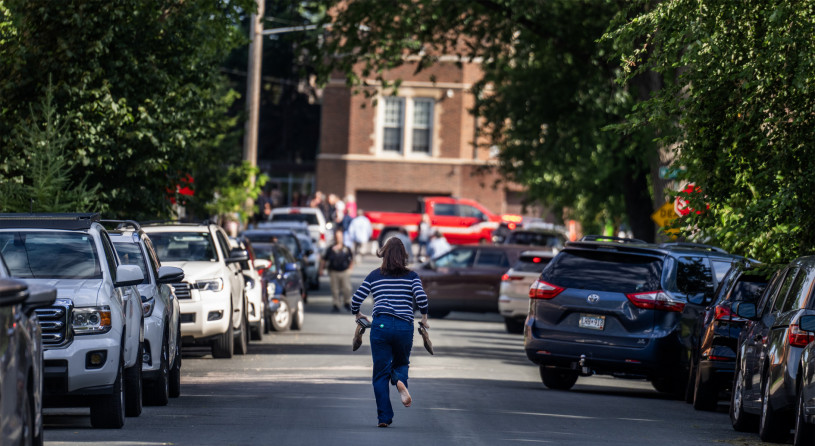
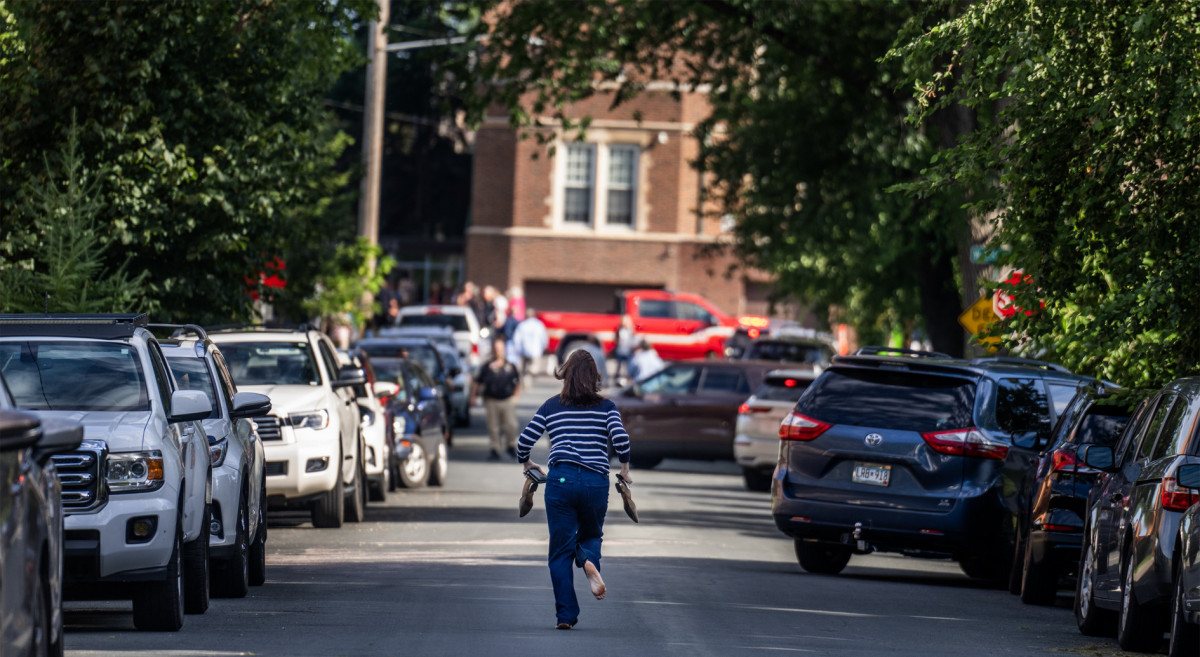
A parent runs toward the school after reports of an active shooter at Annunciation Church in Minneapolis, Minn., on Aug. 27, 2025. Two children, Harper Moyski, 10, and Fletcher Merkel, 8, were fatally shot and 28 others were wounded. The shooter also died of a self-inflicted gunshot wound. (Richard Tsong-Taatarii)