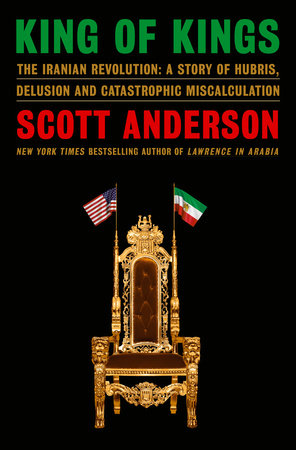
Finalist: King of Kings: The Iranian Revolution: A Story of Hubris, Delusion and Catastrophic Miscalculation, by Scott Anderson (Doubleday)

A superbly written and dramatic account of the downfall of the Shah of Iran, American miscalculation and the revolution that ushered in an Islamic state, history that is timely today.

Nominated Work

King of Kings: The Iranian Revolution: A Story of Hubris, Delusion and Catastrophic Miscalculation


A NEW YORK TIMES NOTABLE BOOK • NEW YORK TIMES BESTSELLER • FINALIST FOR THE NATIONAL BOOK CRITICS CIRCLE AWARD FOR NONFICTION • KIRKUS PRIZE WINNER • From the author of the landmark bestseller Lawrence in Arabia comes a stunningly revelatory narrative history of the Iranian Revolution, one of the most momentous events in modern times. This groundbreaking work exposes the jaw-dropping stupidity of the American government and traces the rise of religious nationalism, offering essential insights into today’s global unrest.

“A masterful and propulsive account that chronicles a devastatingly transformative series of events whose aftereffects reverberate to this day.” —The Kirkus Prize 2025 Jury

“An exceptional and important book. Scrupulous and enterprising reporting rarely combine with such superb storytelling.” —The New York Times Book Review

“A masterful and gripping account. Anderson gives us a page-turning history lesson that is more relevant than ever.” —Rajiv Chandrasekaran, author Imperial Life in the Emerald City, a finalist for the National Book Award

On New Year’s Eve, 1977, on a state visit to Iran, President Jimmy Carter toasted Shah Mohammad Reza Pahlavi, King of Kings, Light of the Aryans, Shadow of God on Earth, praising Iran as “an island of stability “ due to “your leadership and the respect and admiration and love which your people give to you.” Iran had the world’s fifth largest army and was awash in billions of dollars in oil revenues.  Construction cranes dotted the skyline of its booming capital, Tehran.  The regime’s feared secret police force SAVAK had crushed communist opposition, and the Shah had bought off the conservative Muslim clergy inside the country.  He seemed invulnerable, and invaluable to the United States as an ally in the Cold War.  Fourteen months later the Shah fled Iran into exile, forced from the throne by a volcanic religious revolution led by a fiery cleric named Ayatollah Khomeini. The ensuing hostage crisis forever damaged America’s standing in the world.  How could the United States, which had one of the largest CIA stations in the world and thousands of military personnel in Iran, have been so blind?

The spellbinding story Scott Anderson weaves is one of a dictator blind to the disdain of his subjects and a superpower blundering into disaster. Scott Anderson tells this astonishing tale with the narrative brio, mordant wit, and keen analysis that made his bestselling Lawrence of Arabia one of the key texts in understanding the modern Middle East.  The Iranian Revolution, Anderson convincingly argues, was as world-shattering an event as the French and Russian revolutions.  In the Middle East, in India, in Southeast Asia, in Europe, and now in the United States, the hatred of economically-marginalized, religiously-fervent masses for a wealthy secular elite has led to violence and upheaval – and Iran was the template.  King of Kings is a bravura work of history, and a warning.

Biography

Scott Anderson is the author of two novels and five works of nonfiction, including Lawrence of Arabia, an international bestseller which was a finalist for the National Book Critics Circle Award and a New York Times Notable Book. He is a contributing writer for The Times Magazine. The New York Times Magazine devoted an entire issue to his reportage across the Middle East in August 2016, which was published in book form as Fractured Lands: How the Arab World Came Apart.

Winners

Prize Winner in History in 2026:

Jill Lepore

A lively and engaging narrative that investigates why the Constitution is so difficult to amend, including a review of noteworthy failed amendments proposed by marginalized groups. History

Finalists

Nominated as finalists in History in 2026:

Bench Ansfield

An elegantly written and scholarly account of large-scale arson instigated by landlords that wiped out wide swaths of apartment buildings and tenements in New York City from 1968 to the early 1980s, especially in working-class and poor neighborhoods.

The Jury

Jacqueline Jones(Chair)*

Professor Emerita; Ellen C. Temple Chair in Women’s History and Mastin Gentry White Professor of Southern History, University of Texas at Austin

Ada Ferrer*

Dayton-Stockton Professor of History, Princeton University

Caroline Elkins*

Professor of History and of African and African American Studies; Thomas Henry Carroll/Ford Foundation Professor of Business Administration; Affiliated Professor of Law; and Founding Oppenheimer Director, Center for African Studies, Harvard University

Adrian R. Lewis

David Pittaway Professor in Military History, University of Kansas

John Wood Sweet

Professor of History, University of North Carolina at Chapel Hill

Winners in History

Edda L. Fields-Black

A richly-textured and revelatory account of a slave rebellion that brought 756 enslaved people to freedom in a single day, weaving military strategy and family history with the transition from bondage to freedom.

Jacqueline Jones

A breathtakingly original reconstruction of free Black life in Boston that profoundly reshapes our understanding of the city’s abolitionist legacy and the challenging reality for its Black residents.

Jefferson Cowie

A resonant account of an Alabama county in the 19th and 20th centuries shaped by settler colonialism and slavery, a portrait that illustrates the evolution of white supremacy by drawing powerful connections between anti-government and racist ideologies.

Ada Ferrer

An original and compelling history, spanning five centuries, of the island that became an obsession for many presidents and policy makers, transforming how we think about the U.S. in Latin America, and Cuba in American society.

2026 Prize Winners

M. Gessen of The New York Times

For an illuminating collection of reported essays on rising authoritarian regimes that draw on history and personal experience to probe timely themes of oppression, belonging and exile.