For a distinguished and appropriately documented book on the history of the United States, Fifteen thousand dollars ($15,000).

We the People: A History of the U.S. Constitution, by Jill Lepore (Liveright)

A lively and engaging narrative that investigates why the Constitution is so difficult to amend, including a review of noteworthy failed amendments proposed by marginalized groups.

Winning Work

We the People: A History of the U.S. Constitution


NEW YORK TIMES BESTSELLER
A NEW YORK TIMES NOTABLE BOOK OF THE YEAR
Named one of the Best Books of the Year by the Washington Post, New Yorker, Smithsonian, Bookpage, and the Chicago Public Library
Longlisted for the 2025 Andrew Carnegie Medal for Excellence in Nonfiction

"[Lepore's] 15th book, We the People, a history of the U.S. Constitution, may be her best yet, a capacious work that lands at the right moment, like a life buoy, as our ship of state takes on water." —Hamilton Cain, Los Angeles Times

From the best-selling author of These Truths comes We the People, a stunning new history of the U.S. Constitution, for a troubling new era.

The U.S. Constitution is among the oldest constitutions in the world but also one of the most difficult to amend. Jill Lepore, Harvard professor of history and law, explains why in We the People, the most original history of the Constitution in decades—and an essential companion to her landmark history of the United States, These Truths.

Published on the occasion of the 250th anniversary of the nation’s founding—the anniversary, too, of the first state constitutions—We the People offers a wholly new history of the Constitution. “One of the Constitution’s founding purposes was to prevent change,” Lepore writes. “Another was to allow for change without violence.” Relying on the extraordinary database she has assembled at the Amendments Project, Lepore recounts centuries of attempts, mostly by ordinary Americans, to realize the promise of the Constitution. Yet nearly all those efforts have failed. Although nearly twelve thousand amendments have been introduced in Congress since 1789, and thousands more have been proposed outside its doors, only twenty-seven have ever been ratified. More troubling, the Constitution has not been meaningfully amended since 1971. Without recourse to amendment, she argues, the risk of political violence rises. So does the risk of constitutional change by presidential or judicial fiat.

Challenging both the Supreme Court’s monopoly on constitutional interpretation and the flawed theory of “originalism,” Lepore contends in this “gripping and unfamiliar story of our own past” that the philosophy of amendment is foundational to American constitutionalism. The framers never intended for the Constitution to be preserved, like a butterfly, under glass, Lepore argues, but expected that future generations would be forever tinkering with it, hoping to mend America by amending its Constitution through an orderly deliberative and democratic process.

Lepore’s remarkable history seeks, too, to rekindle a sense of constitutional possibility. Congressman Jamie Raskin writes that Lepore “has thrown us a lifeline, a way of seeing the Constitution neither as an authoritarian straitjacket nor a foolproof magic amulet but as the arena of fierce, logical, passionate, and often deadly struggle for a more perfect union.” At a time when the Constitution’s vulnerability is all too evident, and the risk of political violence all too real, We the People, with its shimmering prose and pioneering research, hints at the prospects for a better constitutional future, an amended America.
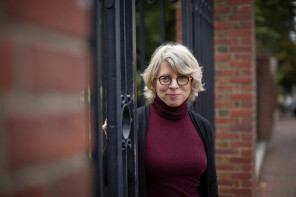
Biography

Jill Lepore is the David Woods Kemper ’41 Professor of American History at Harvard University and professor of law at Harvard Law School. She is also a staff writer at The New Yorker. Her many books include the international bestseller These Truths: A History of the United States. She lives in Cambridge, Massachusetts.

Finalists

Nominated as finalists in History in 2026:

Bench Ansfield

An elegantly written and scholarly account of large-scale arson instigated by landlords that wiped out wide swaths of apartment buildings and tenements in New York City from 1968 to the early 1980s, especially in working-class and poor neighborhoods.

Scott Anderson

A superbly written and dramatic account of the downfall of the Shah of Iran, American miscalculation and the revolution that ushered in an Islamic state, history that is timely today.

The Jury

Jacqueline Jones(Chair)*

Professor Emerita; Ellen C. Temple Chair in Women’s History and Mastin Gentry White Professor of Southern History, University of Texas at Austin

Ada Ferrer*

Dayton-Stockton Professor of History, Princeton University

Caroline Elkins*

Professor of History and of African and African American Studies; Thomas Henry Carroll/Ford Foundation Professor of Business Administration; Affiliated Professor of Law; and Founding Oppenheimer Director, Center for African Studies, Harvard University

Adrian R. Lewis

David Pittaway Professor in Military History, University of Kansas

John Wood Sweet

Professor of History, University of North Carolina at Chapel Hill

Winners in History

Edda L. Fields-Black

A richly-textured and revelatory account of a slave rebellion that brought 756 enslaved people to freedom in a single day, weaving military strategy and family history with the transition from bondage to freedom.

Jacqueline Jones

A breathtakingly original reconstruction of free Black life in Boston that profoundly reshapes our understanding of the city’s abolitionist legacy and the challenging reality for its Black residents.

Jefferson Cowie

A resonant account of an Alabama county in the 19th and 20th centuries shaped by settler colonialism and slavery, a portrait that illustrates the evolution of white supremacy by drawing powerful connections between anti-government and racist ideologies.

Ada Ferrer

An original and compelling history, spanning five centuries, of the island that became an obsession for many presidents and policy makers, transforming how we think about the U.S. in Latin America, and Cuba in American society.

2026 Prize Winners

M. Gessen of The New York Times

For an illuminating collection of reported essays on rising authoritarian regimes that draw on history and personal experience to probe timely themes of oppression, belonging and exile.